Stairs Detection Algorithm for Tri-Star Wheeled Robot
and Experimental Validation
Aye Mya Mya Thu
Department of Mechatronic Engineering, Yangon Technological University, East Gyogone, Insein, Yangon, Myanmar. E-Mail: [email protected], Tel: +95 9970353549.
This paper presents two contributions in the development of stair detection algorithm for climbing robot. First, a new tri-star wheeled mechanism was developed to smoothly overcome the stairs. Second, the sensor-based algorithm was proposed for detection of stairs and switching states autonomously. Two motor driven ultrasonic sensors feed the posture information of the robot back to the controller to recognize the climbing environment. The validity of the proposed algorithm was demonstrated through experiments in realizing climbing environment. The experiments prove that the proposed algorithm can do rolling, ascending and descending on the staircase.
Keywords: Climbing robot, Detection algorithm, Mechanism design, Range sensing, Sensor-based control.
INTRODUCTION
To cope with the climbing environment in the real world, various research efforts have been directed toward the development of a robot capable of autonomous stair climbing. Staircase is a common obstacle that a mobile search and rescue robot may encounter during every mission. Climbing up and down stairs for a mobile robot is not an easy task. Zhang et al. (2011) developed a laser based algorithm where a vertical laser and sonar sensor are used to identify stairs and a fuzzy control system is developed to ensure that the robot does not stray from the centerline of the stairs during approaching the staircases. The autonomous stair climbing algorithm was implemented on tracked robot by Vu et al. (2008), Pinhas et al. (2007), Shi et al. (2017) and Morozovsky et al. (2015) which is based on multi-sensor fusion and camera detection. Cong
et al. (2007) implemented a stair detection method implemented on UGV with the innovation of a control algorithm using Kinect v2 depth sensor to recognize and
measure stairs for stair climbing tasks of tracked robot. Michael et al. (2014) proved that the wheelchair is the solution for the demographic change in society as it promises the maximum of mobility for people who suffer physical impairment due to a stair climbing function and a car integration. Kinematics based approach has been proposed for rescue robot in the performance of Kalantari
et al. (2009), in order to improve their motion control and pose estimation. Lai et al. (2010) conducted the development of an image based cross-floor navigation method combined with wireless modules. Lai et al. (2009) investigated methods to detect and locate curbs and stairways using stereo vision. The previous researches are very motivated for the climbing environment but the recognitions of climbing environment are not so simple for those who unfamiliar with image processing. To simply cope with the above complex techniques, safe and autonomous stair climbing algorithm is proposed and implemented for a new tri-star wheeled robot in this paper.
Aiming at the functional requirement of climbing the stairs, Aye et al. (2016) has been reported on dynamics and kinematics analysis during a tri-star wheeled mobile robot’s climbing of stairs. Simulation results are also provided that the calculations are valid. This study aims to develop simple sensor-based stair detection algorithm combined with the reliable control strategy to switch rolling, ascending and descending states. To climb the stair autonomously, two motor driven ultrasonic sensors feed the posture information of the robot back to the controller. The proposed algorithm is based on the sensors’ information during approaching and landing. As a smooth
Research Article
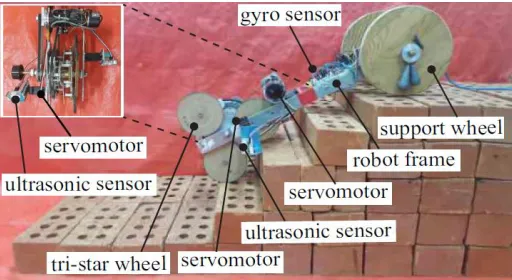
Figure 1: Sensors and actuators demonstration of the proposed tri-star wheeled robot. (Source: Author)
outcome, it completes the switching state to the robot. To ascend and descend the stairs with the simplest way is the motivation of this paper but not to reduce the number of sensors and actuators. The main contribution of mechanism design is the use of only one actuator to drive both of wheel rotation and tri-star frame rotation. The limitation is that the proposed system is appropriate for the proposed stair. This means that if other stairs design is approached, the successive probability of proposed algorithm may be less effective although not absolutely useless.
APPROACH TO PROPOSED SYSTEM
This section presents a brief introduction to the proposed system. The mechanism design used in the experiment is very simple and the focus is to use only one actuator rotating forward for rolling and backward for climbing. By redirecting the function of reversing the actuator to climbing, it loses the capability of rolling the vehicle backward with a single actuator. Actually, it is the strong point of the proposed contribution although it seems drawback because falling backward condition can be prevented during the climbing motion.
If there is any request for desired application areas, the other movements like backward and turning can be achieved by the additional derivative set of mechanism and the development of control algorithm. Structure components of the proposed design is demonstrated in Figure 1. Due to the complexity of autonomous stair climbing, the procedure is then decomposed into a sequence of three individual tasks with the additional stages as illustrated in Figure 2. The proposed design incorporates a number of sensors and actuators, which leads the robot to simply switch among rolling, ascending and descending. The proposed system is not only to operate on the flat surface like the conventional wheels but also to drive on the inclined surface in order to overcome the stairs. Therefore, two ultrasonic sensors are needed to be controlled by the two individual servomotors because
they must be always in the predefined positions providing for the proposed algorithm. Besides, two motor driven ultrasonic sensors will give the stable output just with the use of interrupt pin for two sensors and the power for two servomotors are individually given by the motor driver. The other considerations will give the unstable outcomes as shown in Figure 3. Due to the requirement of predicting the deviation of ultrasonic sensors, one gyro sensor is used to detect the inclination angle of the robot’s body. In this way, two ultrasonic sensors will be reached back to the original position every time when they are conflicted. Unlike the conventional robots, the tri-star wheeled robot can perform two rotations: wheel rotation leading the robot to rolling and tri-star frame rotation leading the robot to ascending and descending. Thus, two encoders are used to individually measure two rotations. Here, it is needed to note that both of rolling angle and tri-star angle are driven by the same actuator. So, it is reliable that rolling angle is not rotating altogether with the rotation of tri-star frame angle although the vice versa is operated.
An additional check of tri-star frame rotation has provided to confirm that the robot can safely land on the stair surface and can assist to the detection of two sensors before changing to the next state. Although the two sensors are always updating the information, the changes are valid just after landing the tri-star frame. The relevant velocity is also applied to the robot for each state heading to have the smarter and safer sequence for the system.
AUTONOMOUS STAIR DETECTION ALGORITHM
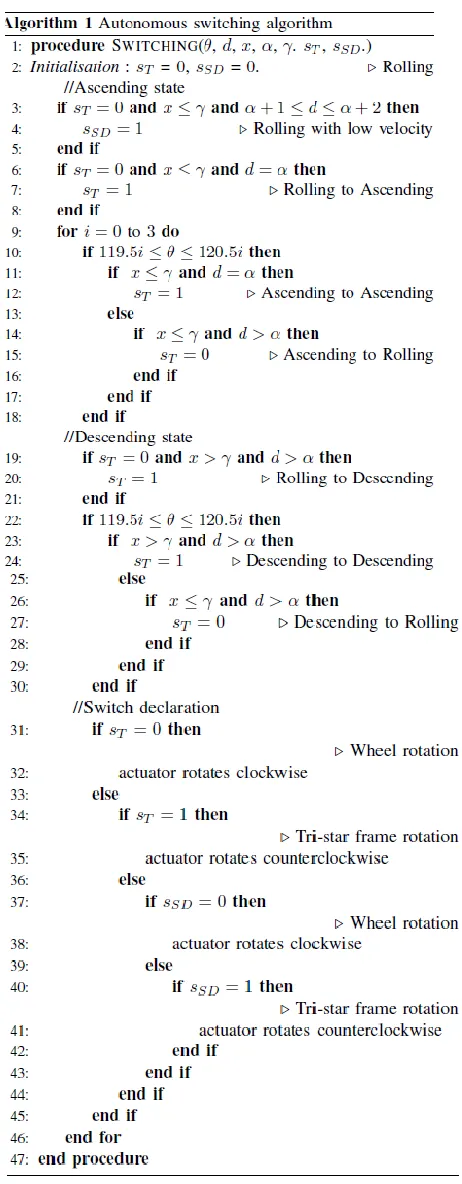
This section describes the design and implementation of the stair detection algorithm for the proposed robot. The objectives and approaches for the individual stages will be introduced respectively with the emphasis on range detection of the two motor driven ultrasonic sensors. The effectiveness of sensor ranges on different stair sizes leading to optimize the appropriate setting of sensors’ positions and height of staircases. The contribution of algorithm is detailed in Algorithm 1, where the notations are adopted as follows: d is the distance between the horizontal ultrasonic sensor and the step, αis the threshold value for d, x is the inclined distance between the inclined ultrasonic sensor and the step, and γ is the threshold value for x. Then, θ is the rotation angle of tri-star frame. These variables are input to the controller and as the output the robot will do rolling, ascending and descending. Initially, the robot will start with rolling meaning that tri-star frame switch denoted as sT and speed down switch denoted as
sSD are off. The condition of inclined sensor will be always
in the state of x <=γ while facing with the upstairs.
Figure 3: Experimental results of two motor driven ultrasonic sensors: (a) with interrupt pin and with power from motor driver, (b) with interrupt pin and without power from motor driver, (c) without interrupt pin and with power from motor driver, (d) without interrupt pin and without power from motor driver. (Source: Author)
For the horizontal sensor, if α+1 <= d <= α +2 is detected, the robot has to change a low forward velocity before accelerating to the desired ascending velocity during closing to the stairs to prevent the mechanism from bumping about the first step. So, sSDwill be on. If the value
of dis absolutely equal to the threshold value of α, switch sTwill on and the rolling state will switch to ascending state.
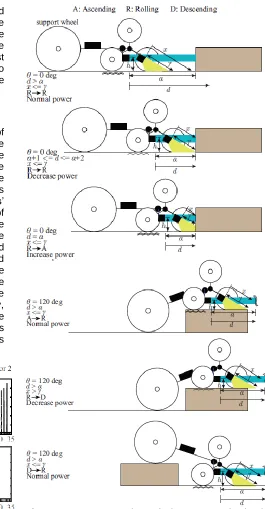
Figure 4: Demonstration of the proposed algorithm. (Source: Author)
As soon as the tri-star frame rotation is started, it will be always recorded and when reach to the multiples of 120 degrees, the information of two sensors will be checked again to give the switch decision to the robot. In switching to descending state, switch sTdo the same function with an
ascending/descending state outcomes from activation of tri-star frame rotation. Demonstration of the proposed algorithm is shown in Figure 4.
SENSORS AND ACTUATORS
The challenge of proposed algorithm is to identify and conquer the individual steps with clearly defined switching states. To overcome the complete computation of staircase’s parameters, only the information from two ultrasonic sensors are used to predict the existence of stair on ahead of. The demonstration of two ultrasonic sensors is illustrated in Figure 5. The strategy to control the sensors and actuators is very important to give the complete information to the controller and to provide for the switching decision of the proposed algorithm. Ascending and descending the stairs can be divided into three main tasks. (1) Approaching, (2) Climbing and (3) Landing. To be always kept the two sensors in leading ahead is tuned by two servomotors during approaching and after landing. Tri-star frame angle rotation is undertaking after approaching to complete climbing.
Figure 5: Demonstration of sensors and actuators. (Source: Author)
1) Prediction about Upstairs: The first ultrasonic sensor is implemented in the horizontal direction to be parallel with the ground level. This one is intended to detect the condition that there is the stair or not in front of the robot leading to know before the upstairs. If not the mechanism can be damaged by bumping with the staircase. To prevent from this condition, the horizontal ultrasonic sensor is needed to let the robot know before the mechanism touches with the stair.
2) Prediction about Downstairs: The second ultrasonic sensor is mounted in the inclined position to be parallel with the tri-star frame instead of horizontally. This is because it is intended for the prediction of downstairs. Unlike with the upstairs, downstairs are located in the inclined position and they cannot be detected with horizontal sensor. This can lead to the falling down of the robot. Implementing the second sensor in incline position can solve these problems. Therefore, the robot will know before the downstairs.
the correct information to the controller if there are no significant effects on the robot heading. Significant heading errors occur when the climbing environment is rough or disturbed by other obstacles except the steps. These errors are normal for the sensors as their feedback is based on the sound signal. Experimental results in Figure 6 and Figure 7 show that the robot is able to overcome and continue the stair climbing with desired switching state using the proposed algorithm.
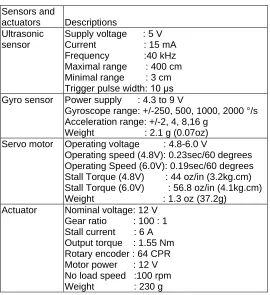
4) Specifications of Sensors and Actuators: The configurations related to the devices used in the proposed system are described in the following table.
Sensors and
actuators Descriptions Ultrasonic
sensor
Supply voltage : 5 V Current : 15 mA Frequency :40 kHz Maximal range : 400 cm Minimal range : 3 cm Trigger pulse width: 10 μs Gyro sensor Power supply : 4.3 to 9 V
Gyroscope range: +/-250, 500, 1000, 2000 °/s Acceleration range: +/-2, 4, 8,16 g
Weight : 2.1 g (0.07oz) Servo motor Operating voltage : 4.8-6.0 V
Operating speed (4.8V): 0.23sec/60 degrees Operating Speed (6.0V): 0.19sec/60 degrees Stall Torque (4.8V) : 44 oz/in (3.2kg.cm) Stall Torque (6.0V) : 56.8 oz/in (4.1kg.cm) Weight : 1.3 oz (37.2g)
Actuator Nominal voltage: 12 V Gear ratio : 100 : 1 Stall current : 6 A Output torque : 1.55 Nm Rotary encoder : 64 CPR Motor power : 12 V No load speed :100 rpm Weight : 230 g
DETECTION AND APPROACH
The main motivation of using ultrasonic sensors is to complete the stairs detection process without calculating the complete parameters of staircases (i.e, height, width, length, inclination). Two sensors will be simultaneously detected the stair and proposed algorithm will assist for the robot to decide the stair on ahead of is upstairs or downstairs. Then, the tri-star frame rotation will also be always checked. Every time when it reaches to the multiples of 120 (0, 120, 240, 360) degree, the information of two ultrasonic sensors will be checked again for the switching states.
1) Detection of Ascending State: As the actuator is started to activate, the two servomotors are rotated to control the orientation of two sensors, as demonstrated
in Figure 6(b) and Figure 6(c), according to the changes of inclination angle of robot’s body as shown in Figure 6(a). If the state of tri-star frame angle is satisfied with the multiples of 120 degrees, the first consideration is to check the information from horizontal sensor. If d > γ, it means the robot is not close up to the step. But only this information is not possible for the robot to have the accurate decision. Therefore, the second consideration is added to ensure that the inclined sensor is less than or equal to the threshold value (x <= γ). If so, the robot will be on flat surface with the normal velocity defined for rolling state. Here, the tri-star frame angle, θ will be zero and only the rolling angle, β will be activated since it is the rolling state. In this situation, the gyro feedback is not considered as the two sensors are in initial states. Since the robot is in rolling state, the information from two sensors are always changes and when the range of d is within the deviation of increment or decrement of 2 compared to the threshold value, the previous velocity will be decreased in order to prevent the mechanism from bumping into the steps. After 4 sec, the data in Figure 6(d) and Figure 6(e) show that the actual distance of ultrasonic sensor 1, d becomes equal to the threshold value of α and the actual distance of ultrasonic sensor 2, x becomes greater than γ then the velocity will be increased enough to climb the step because ascending state require the higher torque than rolling state and as a result the rolling mode is switched to the ascending mode as shown in Figure 6(g) and the descending mode is off during the ascending mode is on as can be seen in Figure 6(h). Once the ascending mode is on, the tri-star frame is rotated tri-starting from zero as shown in Figure 6(f), and at the same time the rolling angle, β is simultaneously rotated altogether with the rotation of θ because of the mechanism design as can be seen in Figure 6(i). After landing on the first step, the gyro feedback is considered to recover the deviation of two sensors. Similar actions will be activated when the next step is approached. To satisfy the detection of upstairs and to ascend each step, just 120 degrees’ rotation of tri-star frame is needed. Therefore, as confirmed in Figure 6(f), one revolution and 120 degrees of tri-star frame angle is required to overcome four steps. So, counter-clockwise rotation of the actuator gives the tri-star motion.
Figure 6: Experimental results of switching state between Figure 7: Experimental results of switching state rolling mode and ascending mode based on such data between rolling mode and descending mode based on of λ, μ, σ, d, x, θand β. (Source: Author) such data of λ, μ, σ, d, x, θand β. (Source: Author)
desired position of two sensors and the gyro feedback is not affected. The more the robot is close up to the down steps, the greater the range of inclined sensor. If
x > γ is satisfied, the rolling velocity is needed to be
decreased to safely overcome the steps because descending state does not require the higher torque as in ascending state. Then, the descending state will be switched smoothly. This means that wheel rotation is changed to tri-star frame rotation. Thus, as in the ascending state, tri-star frame angle is initiated to rotate starting from zero simultaneously with the activation of rolling angle. Throughout the changes of desired position, the two sensors will orientate themselves to the desired heading, based on the information obtained from the gyro sensor. To overcome a down step and to complete landing, the triangle position of tri-star frame which means 240 degrees is needed to rotate. Since the proposed stair has four steps, the tri-star frame is needed to rotate two revolutions and 240 degrees for the whole scenario. This was confirmed in Figure 7(f) with the instantaneous rotation of rolling angle as can be seen in Figure 7(i).
3) Declaration of Nomenclatures: The nomenclatures used in the paper can be denoted as follows:
λ= inclination angle of the robot’s body,
μ = rotation angle of servo motor 1 with respect to λ,
σ = rotation angle of servo motor 2 with respect to λ,
d = actual distance of ultrasonic sensor 1,
x= actual distance of ultrasonic sensor 2,
θ = tri-star frame angle,
β= rolling angle.
4) Range Limitations for Different Stairs Size: The robot first needed to find the scope of untouchable area, see in Figure 8, where the area must not meet
the staircase surface and its scope can be adjusted according to the height of staircase. The adjustable ones are the postures of two ultrasonic sensors and two servomotors which are denoted ash1and h2.
Figure 8: Setting of untouchable area for different stairs size. (Source: Author)
position of tri-star frame. If the fluctuated signal is got while the tri-star frame is out of the multiples of 120 degrees, the input signal to the controller is not effective to the switching state. Otherwise, the wrong information can conflict to the state decision. For the higher step, the robot is sure not to overcome the step. If the tri-star frame is fortunately flip over the step, the inclined sensor will be bumping to the step surface. So, the most satisfaction step for the proposed robot is the height between the upper level of horizontal ultrasonic sensor and the center of tri-star frame. Figure 9 shows the demonstration of range limitations for two controlled ultrasonic sensors.
Figure 9: Range limitations of two controlled ultrasonic sensors on different stairs size. (Source: Author)
5) Optimization of stair climbing ability: Depending on the radius of tri-star frame and the scope of untouchable area, the climbing probability can be optimized for different heights. The conditions of q = 0 and q = b are physically impractical. The scope of untouchable area, q must be between these two parameters. For 0 < q < b, the best position can be selected for different a and different q. Everyone can define all of parameters with different ways form the proposed deign. But, after testing for a lot of times, the most probability is adopted in Figure 10.
Figure 10: Optimization of robot’s climbing ability based on H, q and r0. (Source: Author)
CONCLUSION
In this paper, a complete stair climbing up and down scheme has been proposed where the tasks involve detection of stairs, preparation stage, actual ascending, actual descending and subsequent landing. It is especially verified that the use of two directional control ultrasonic sensors can provide the better stair detection and the safe descending state instead of the use of one sensor. Moreover, sensing the stairs with two sensors can easily recognize the climbing environment. The proposed algorithm is clearly detailed in pseudo code and also with the demonstration layout. Experimental results have been presented to validate the subsequent performance of the proposed algorithm. The algorithm developed in this paper was tested in a number of scenarios and has been proven to perform successfully on the proposed staircase. The proposed system provides the operation of one set of tri-star on ascending and descending staircase. The additional sets are needed to constructed with the development of switching algorithm for backward and turning movements.
REFERENCES
Aye, M.M.T., Soe, T.Z. and Okada, T. (2016). Dynamic analysis for both rolling and climbing of tri-star wheeled robot. International Organization of Scientific Research Journal, 13(5), 52-62.
Symposium on Safety, Security and Rescue Robotics. 1806-1811. DOI: 10.1109/ROSE.2007.4373976. Kalantari, A., Mihankhah, E. and Moosavian, S.A.A.
(2009). Safe autonomous stair climbing for a tracked mobile robot using a kinematics based controller. IEEE/ASME International Conference on Advanced Intelligent Mechatronics, Singapore. 1891-1896. DOI: 10.1109/AIM.2009.5229765.
Lai, W.M. and Lin, C.Y. (2009). Autonomous staircase detection and stair climbing for a tracked mobile robot using fuzzy controller. Proceedings of the IEEE International Conference on Robotics and Biomimetic, Thailand. 1980-1985. DOI: 10.1109/ROBIO.2009. 4913304.
Lai, W.M. and Lin, C.Y. (2010). Autonomous cross-floor navigation of a stair climbing mobile robot using wireless and vision sensor. IEEE/ASME International Conference on Advanced Intelligent Mechatronics, Singapore. 1971-1977. DOI: 10.1109/ISR.2013. 6695649.
Michael, H., Petra, F., Eichinger, A. and Wolf, B. (2014). Stair sensing system based on optical 3D data for an autonomous stair-climbing wheelchair. IEEE Fourth International Conference on Consumer Electronics Berlin. 400-403. DOI: 10.1109/ICCE-Berlin.2014. 7034274.
Morozovsky, N. and Bewley, T. (2015). Stair climbing via successive perching. IEEE/ASME Transactions on Mechatronics. 20(6), 1-10. DOI: 10.1109/TMECH.2015. 2426722.
Pinhas, B.T., Shingo, I. and Andrew, A.G. (2007). Autonomous stair climbing with reconfigurable tracked mobile robot. IEEE International Workshop on Robotic
and Sensors Environments, Canada. DOI:
10.1109/ICNSC.2008.4525517.
Shi, J.G., Zhu, W. and Wang, J. (2017). Approach to autonomous stair climbing for tracked robot. Proceedings of the IEEE International Symposium on Safety, Security and Rescue Robotics. 182-186. DOI: 10.1109/ICUS.2017.8278337.
Vu, Q.H., Kim, B.S. and Song, J.B. (2008). Autonomous stair climbing algorithm for a small four-tracked robot.
International Conference on Control, Automation and Systems, Korea. 2356-2360. DOI: 10.1109/ICCAS. 2008.4694199.
Zhang, Q., Ge, S.S. and Tao, P.Y. (2011). Autonomous stair climbing for mobile tracked robot. Proceedings of the IEEE International Symposium on Safety, Security and Rescue Robotics. 92-98. DOI: 10.1109/SSRR. 2011.6106757.
Accepted 5 August 2019
Citation: Aye MMT. (2019). Stairs Detection Algorithm for Tri-Star Wheeled Robot and Experimental Validation. World Journal of Mechanical Engineering 4(2): 041-048.