ISSN 0975-928X
Research Note
Genetic variability and association analysis for yield and its components in
single cross hybrids of maize (
Zea mays
L.)
Kanagarasu, S*., Nallathambi, G., Kannan, S and Ganesan, K.N
Centre for Plant Breeding and Genetics, Tamil Nadu Agricultural University, Coimbatore - 641 003 Tamil Nadu, India * Email: [email protected]
(Received: 17 Oct 2013; Accepted: 30 Nov 2013)
Abstract
A study was carried out to estimate the various genetic parameters and nature of association among the traits influencing maize grain yield. A total of 72 F1 hybrids were synthesised in a Line x Tester mating fashion using 24 inbred lines and
three testers. Analysis of variance revealed the presence of substantial variability for all traits studied. Grain yield/plant, grains/row, plant height, ear height, cob length, 100 grain weight and leaf breadth had high GCV estimates with high heritability. Genetic advance was higher for grain yield/plant, ear height, grains/row, plant height, cob length and 100 grain weight. High GCV, heritability as well as genetic advance indirectly indicate that selection may be effective for these traits. Genotypic correlation coefficients and path analysis revealed that grains/row, grain rows/cob, 100 grain weight and plant height had positively significant correlation and highest direct effect on grain yield. While formulating the breeding programme, the above traits may be considered as important traits aiming to maximize the grain yield of maize.
Keywords: Maize, variability, correlation, path analysis Maize (Zea mays L.) is third leading cereal crop of the world after wheat and rice. It is extensively grown in temperate, subtropical and tropical regions. It is a major food and calorie source for the people in the developing countries by contributing 15 % of the protein and 19% of the calories delivered from food crops (Tabassum, 2004). Genetic variability, which is a heritable difference among cultivars, is required in an appreciable level within a population to facilitate and sustain an effective long term plant breeding programme. Progress from selection has been reported to be directly related to the magnitude of genetic variance in the population (Helm et al., 1989; Tabanao and Bernardo, 2005). Grain yield is a complex trait conditioned by the interaction of various growth and physiological processes. The appropriate knowledge of such interrelationships between grain yield and its contributing components can significantly improve the efficiency of breeding programme by determining the appropriate traits to be used in indirect selection for yield improvement. As the number of independent variables influencing a particular dependent variables increases, the amount of interdependence of variables also increase such that indirect association becomes more complex and important. Under such a situation, correlation is not sufficient to explain the true association for effective manipulation of characters because the correlation studies simply measure the associations between yield and other traits. It does not indicate the cause and effect relationship and consequently, one may not be able to know which of the independent characters has the most direct effect
on grain yield. Path coefficient analysis permits the separation of correlation coefficient into direct and indirect effects. Hence, the present study was conducted to determine various genetic parameters and nature of interrelationships among different traits in maize affecting grain yield.
ISSN 0975-928X
http://sites.google.com/site/ejplantbreeding 1320
Analysis of variance showed highly significant differences among the genotypes and also among parents for all the characters studied (Table 1). This revealed the presence of significant variability in the experimental material for all the characters under study. Estimates of genetic parameters i.e., genotypic and phenotypic coefficients of variation, broad sense heritability (h2) and genetic advance as percentage of mean were presented in Table 2. A perusal of the data revealed that genotypic coefficient of variation (GCV) was lesser than phenotypic coefficient of variation (PCV) for all traits studied, which indicated significant role of environment in the expression of these traits.
The estimates of heritability were also more than 80% for all the traits showing heritable variation among genotypes. Heritability (h2 B.S) and genetic advance (GA) as percentage of mean for grain yield/plant, plant height, ear height, leaf breadth, grains/row and 100 grain weight was comparatively higher than other traits studied indicating that selection may be effective for these traits. This is in accordance with the findings of Annapurna et al. (1998), Mani et al. (1999), Alvi
et al. (2003) and Turi et al. (2007). Grain
yield/plant followed by plant height, ear height, cob length, grains/row and 100 grain weight had greater genotypic coefficient variation and broad sense heritability along with high genetic advance which is considered as good estimates for effective selection of these traits.
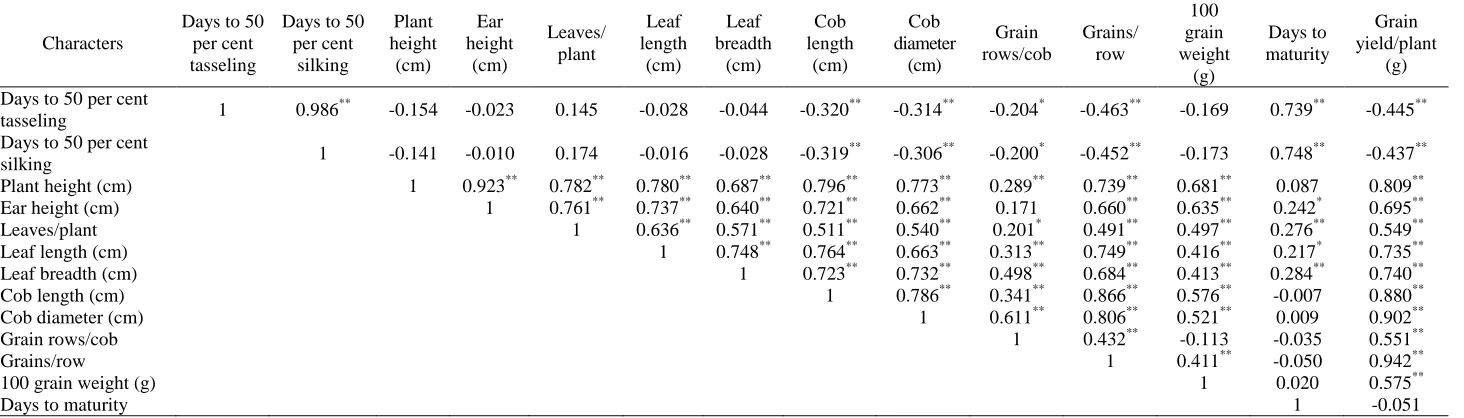
Knowledge on correlation coefficients between different yield attributes helps the maize breeder to find out the nature and magnitude of the association between the traits which are mostly used to attain better yield (Wannows et al., 2010). Association studied revealed significant and positive correlation coefficients between grain yield and grains/row (0.942), cob diameter (0.902), cob length (0.880), plant height (0.809), leaf breadth (0.740), leaf length (0.735), ear height (0.695), 100 grain weight (0.575) and grain rows/cob (0.551) (Table 3). This could help the breeder to enhance high grain yield through selection for these traits. The findings are in agreement with those of Wannows et al. (2010) and Kashiani et al. (2010). Grain yield was significantly and negatively correlated with days to 50 per cent tasseling and silking. Similar findings have also been reported by Rehman et al. (1995), Umakanth et al. (2000) and Appunu et al. (2006). Plant and ear height, leaves/plant, leaf length and breadth, cob length and diameter, grains/row and 100 grain weight had strong and significant genotypic association with each other and grain yield as concluded by Shakoor et al. (2007) and Wannows et al. (2010). These results indicates that selection for taller plants with higher ear height in addition to grains/row, cob length and diameter
contribute enhanced grain yield of maize. Selection on the basis of higher values of these traits would be fruitful for grain yield improvement.
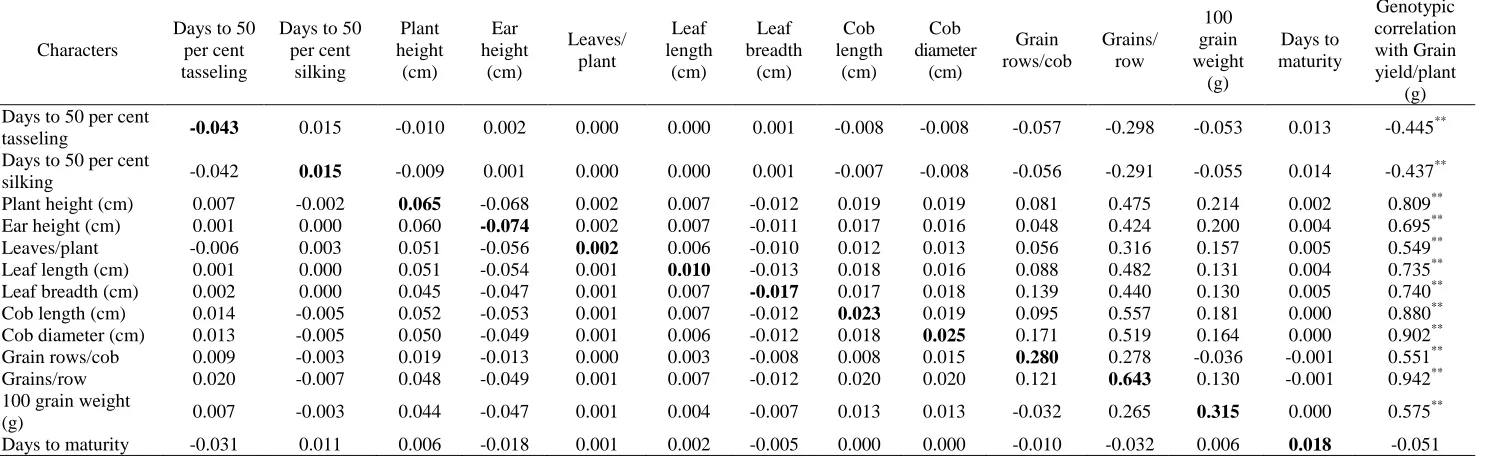
The analysis of path coefficient has been made to identify the important yield attributes by partitioning the correlation coefficient in to direct and indirect effects. This process helps in finding out the relative importance of different traits as selection index. The path analysis results showed that high positive direct effect on grain yield was exhibited by grains/ row (0.643) and 100 grain weight (0.315) and moderate and positive direct effect by grain rows/cob (0.280) (Table 4). Other traits recorded negligible direct effect on grain yield. In case of indirect effects, most of the traits recorded high and moderate indirect effect via grains/ row and 1000 grain weight respectively on grain yield. Similar results were reported earlier by Rehman et al. (2007), Shakoor et al. (2007) and Bello et al. (2010). In the light of results obtained in present study, it can be suggested that traits such as grains/row and 100 grain weight should be used as main selection criteria for grain yield improvement.
References
Alvi, M.B.M., Rafique, M., Tariq, S., Hussain, A., Mahmood, T. and Sarwar, M. 2003. Character association and path coefficient analysis of grain yield and yield components maize (Zea mays L.). Pakistan J. Biol. Sci., 6:136-138. Annapurna, D., Khan, H.A. and Mohammad, S. 1998.
Genotypic and phenotypic correlations and path coefficient analysis between seed yield and other associated characters in tall genotypes of maize. Crop Res.,16: 205-209. Appunu, C., Satyanarayana, E. and Nageswara rao, T.
2006. Correlation and path analysis in maize.
Andhra Agric. J., 3:29-32.
Bello, O.B., Abdulmaliq, S.Y., Afolabi, M.S. and Ige, S.A. 2010. Correlation and path coefficient analysis of yield and agronomic characters among open pollinated maize varieties and their F1 hybrids in a diallel cross. African J.
Biotechnol., 9: 2633-2639.
Dewey, D.R. and Lu, K.H. 1959. A correlation and path-coefficient analysis of components of crested wheat grass seed production. Agron. J., 51: 515-518.
Falconer, D.S. and Mackay, T.F.C. 1996. Introduction to Quantitative Genetics. 4th ed. Longman inc., New York. p. 315.
Helm, T.C., Hallauer, A.R. and Smith, O.S. 1989. Genetic variability estimate in improved and unimproved Iowa stiff stalk synthetics maize population. Crop Sci., 29: 259-962.
Kashiani, P., Saleh, G., Abdullah, N.A.P. and Abdullah, S.N. 2010. Variation and genetic studies on selected sweet corn inbred lines. Asian J.Crop Sci., 2: 78-84.
Kempthorne, O. 1957. An Introduction to Genetic Statistics. 1st Ed. John Wiley and Sons, New York.
ISSN 0975-928X
indigenous maize (Zea mays L.) germplasm.
Environ. Ecol., 17: 650-653.
Rehman, M.M., Ali, M.R., Sultan, M.S. and Mitra, M.K. 1995. Correlation and path coefficient studies in maize (Zea mays L.) composites.
Bangladesh J. Sci. Industrial Res., 30:87-92.
Rehman, S.A., Saleem, U. and Subhani, G.M. 2007. Correlation and path coefficient analysis in maize (Zea mays L.). J. Agric. Res., 45: 77-183.
Shakoor, M.S., Akbar, M. and Hussain, A. 2007. Correlation and path coefficients studies of some morphophysiological traits in maize double crosses. Pakistan J. Agric. Sci., 44: 213-216.
Singh, R.K. and Chaudhry, B.D. 1979. Biometrical methods in quantitative genetic analysis. Kalyani Publishers, Ludhiana, New Dehli, India. Pp. 303.
Tabanao, D.A. and Bernardo, R. 2005. Genetic variation in maize breeding population with different numbers of parents. Crop Sci., 45: 2301-2306. Tabassum, M.I. 2004. Genetics of physio-morphological
traits in Zea mays (L.) under normal and water stress conditions. Ph.D Thesis, Univ. Agric., Faisalabad, Pakistan.
Turi, N.A., Shah, S.S., Ali, S., Rahman, H., Ali, T. and Sajjad, M. 2007. Genetic variability for yield parameters in maize (Zea mays L.) genotypes. J. Agric. Biol. Sci., 2: 1-3.
Umakanth, A.V., Satyanarayana, E. and Kumar, M.V. 2000. Correlation and heritability studies in Ashwini maize composite. Ann. Agric. Res., 21: 228-230.
Wannows, A.A., Azzam, H.K. and AL-Ahmad, S.A. 2010. Genetic variances, heritability, correlation and path coefficient analysis in yellow maize crosses (Zea mays L.). Agric.
ISSN 0975-928X
http://sites.google.com/site/ejplantbreeding 1322
Table 1. Analysis of variance for yield and yield attributing traits in Maize
Sources df
Days to 50 per cent tasseling
Days to 50 per
cent silking
Plant height
Ear height
Leaves/ plant
Leaf length
Leaf breadth
Cob length
Cob diameter
Grain rows/cob
Grains/ row
100 grain weight
Days to maturity
Grain yield/plant
Genotypes 98 19.56** 21.17** 1527.32** 633.83** 1.95** 181.49** 2.11** 10.06** 4.86** 4.66** 91.92** 28.14** 36.55** 2868.79** Hybrids 71 11.45** 11.83** 558.56** 288.64** 1.38** 86.03** 0.75** 2.60** 1.15** 3.55** 17.36** 16.17** 29.31** 435.23**
Parents 26 26.42** 27.19** 852.56** 477.50** 1.89** 90.88** 1.82** 3.62** 2.79** 4.30** 13.22** 31.94** 56.03** 399.26**
Error 98 0.63 0.80 38.44 23.59 0.21 9.33 0.02 0.47 0.25 0.18 2.70 1.02 3.49 102.12
**-Significant at P=0.01
Table 2. Estimates of GCV, PCV, heritability, Genetic advance as % of mean in maize hybrids
Characters Range GCV (%) PCV (%) h2B.S% GA (percentage of mean)
Days to 50 per cent tasseling 49.00-65.00 5.430 5.606 93.796 10.833
Days to 50 per cent silking 51.00-68.00 5.441 5.649 92.750 10.794
Plant height (cm) 103.45-216.20 16.452 16.871 95.090 33.049
Ear height (cm) 46.80-121.00 20.696 21.481 92.822 41.076
Leaves/plant 9.10-13.40 8.120 9.029 80.886 15.045
Leaf length (cm) 55.60-101.00 11.313 11.911 90.216 22.136
Leaf breadth (cm) 6.75-11.52 10.526 10.601 98.577 21.528
Cob length (cm) 9.10-18.93 14.471 15.160 91.119 28.455
Cob diameter (cm) 9.33-16.35 11.110 11.706 90.081 21.723
Grain rows/cob 9.65-17.30 10.998 11.432 92.557 21.797
Grains/row 17.95-46.20 20.302 20.907 94.297 40.613
100 grain weight (g) 19.63-35.75 13.237 13.727 92.985 26.294
Days to maturity 80.50-110.00 4.992 5.335 87.551 9.623
Grain yield/plant (g) 43.75-182.63 29.314 30.377 93.125 58.275
ISSN 0975-928X
Table 3. Genotypic correlation coefficients of grain yield and yield component traits in maize
Characters
Days to 50 per cent tasseling
Days to 50 per cent
silking
Plant height (cm)
Ear height
(cm)
Leaves/ plant
Leaf length
(cm)
Leaf breadth
(cm)
Cob length
(cm)
Cob diameter
(cm)
Grain rows/cob
Grains/ row
100 grain weight
(g)
Days to maturity
Grain yield/plant
(g)
Days to 50 per cent
tasseling 1 0.986
**
-0.154 -0.023 0.145 -0.028 -0.044 -0.320** -0.314** -0.204* -0.463** -0.169 0.739** -0.445** Days to 50 per cent
silking 1 -0.141 -0.010 0.174 -0.016 -0.028 -0.319
**
-0.306** -0.200* -0.452** -0.173 0.748** -0.437** Plant height (cm) 1 0.923** 0.782** 0.780** 0.687** 0.796** 0.773** 0.289** 0.739** 0.681** 0.087 0.809** Ear height (cm) 1 0.761** 0.737** 0.640** 0.721** 0.662** 0.171 0.660** 0.635** 0.242* 0.695**
Leaves/plant 1 0.636** 0.571** 0.511** 0.540** 0.201* 0.491** 0.497** 0.276** 0.549**
Leaf length (cm) 1 0.748** 0.764** 0.663** 0.313** 0.749** 0.416** 0.217* 0.735**
Leaf breadth (cm) 1 0.723** 0.732** 0.498** 0.684** 0.413** 0.284** 0.740**
Cob length (cm) 1 0.786** 0.341** 0.866** 0.576** -0.007 0.880**
Cob diameter (cm) 1 0.611** 0.806** 0.521** 0.009 0.902**
Grain rows/cob 1 0.432** -0.113 -0.035 0.551**
Grains/row 1 0.411** -0.050 0.942**
100 grain weight (g) 1 0.020 0.575**
Days to maturity 1 -0.051
ISSN 0975-928X
http://sites.google.com/site/ejplantbreeding 1324
Table 4. Direct (bold) and indirect effects of various grain yield component characters with grain yield in maize
Characters
Days to 50 per cent tasseling
Days to 50 per cent
silking
Plant height
(cm)
Ear height
(cm)
Leaves/ plant
Leaf length
(cm)
Leaf breadth
(cm)
Cob length
(cm)
Cob diameter
(cm)
Grain rows/cob
Grains/ row
100 grain weight
(g)
Days to maturity
Genotypic correlation with Grain yield/plant
(g) Days to 50 per cent
tasseling -0.043 0.015 -0.010 0.002 0.000 0.000 0.001 -0.008 -0.008 -0.057 -0.298 -0.053 0.013 -0.445
**
Days to 50 per cent
silking -0.042 0.015 -0.009 0.001 0.000 0.000 0.001 -0.007 -0.008 -0.056 -0.291 -0.055 0.014 -0.437
**
Plant height (cm) 0.007 -0.002 0.065 -0.068 0.002 0.007 -0.012 0.019 0.019 0.081 0.475 0.214 0.002 0.809** Ear height (cm) 0.001 0.000 0.060 -0.074 0.002 0.007 -0.011 0.017 0.016 0.048 0.424 0.200 0.004 0.695** Leaves/plant -0.006 0.003 0.051 -0.056 0.002 0.006 -0.010 0.012 0.013 0.056 0.316 0.157 0.005 0.549** Leaf length (cm) 0.001 0.000 0.051 -0.054 0.001 0.010 -0.013 0.018 0.016 0.088 0.482 0.131 0.004 0.735** Leaf breadth (cm) 0.002 0.000 0.045 -0.047 0.001 0.007 -0.017 0.017 0.018 0.139 0.440 0.130 0.005 0.740** Cob length (cm) 0.014 -0.005 0.052 -0.053 0.001 0.007 -0.012 0.023 0.019 0.095 0.557 0.181 0.000 0.880** Cob diameter (cm) 0.013 -0.005 0.050 -0.049 0.001 0.006 -0.012 0.018 0.025 0.171 0.519 0.164 0.000 0.902** Grain rows/cob 0.009 -0.003 0.019 -0.013 0.000 0.003 -0.008 0.008 0.015 0.280 0.278 -0.036 -0.001 0.551** Grains/row 0.020 -0.007 0.048 -0.049 0.001 0.007 -0.012 0.020 0.020 0.121 0.643 0.130 -0.001 0.942** 100 grain weight
(g) 0.007 -0.003 0.044 -0.047 0.001 0.004 -0.007 0.013 0.013 -0.032 0.265 0.315 0.000 0.575
**