ISSN 0975-928X
Research Article
Generation mean analysis for quantitative traits in basil
(Ocimum basilicum
L
.)
Y.P. Singh and S.S. Gaurav
Department of Genetics and Plant Breeding
Ch. Charan Singh University campus, Meerut, (UP) India 250005 Email: [email protected]
(Received: 26 Aug 2014; Accepted:28 Nov 2014)
Abstract
To study the nature and magnitude of gene effects for yield and its components in basil (Ocimumbasilicum L.), generation mean analysis with following seven crosses of different accession was carried out: EC-388788/IC-333322, EC-387893/IC-326711, EC-388896/IC-369247, EC-388887/IC-386833, EC-387837/EC-338785, IC-369247/IC-370846 and IC-344681/IC-326735.Generation mean analysis with three parameter model with χ2 test indicated that additive-dominance model was inadequate for all the traits in all the crosses used to estimate the gene effects.The analysis showed the presence of additive, dominance and epistasis gene interactions.In addition to digenic and higher order of interaction, additive and dominance effects were also important for improvement in contributing traits to yield. Duplicate type epistasis played greater role than complimentary epistasis. This suggested that duplicated type of gene action was present confirming the importance of dominance effects. The study revealed the importance of both additive and non-dominance types of gene action for all the traits studied. Thus, considerable non-additive genetic effects observed in this study suggest that selection in advanced generation may be more appropriate.
Key words:
Ocimum basilicum L., quantitative trait, joint scaling test, gene effects, generation mean analysis
Introduction
The genusOcimum belonging to the Lamiaceae
family is characterized by great variability for both morpho and chemo types (Lawrence,1988). Cross-pollination leads to a large number of subspecies, varieties, and forms (Guenther,1949). Among all the species, Ocimumbasilicum (basil or sweet basil) is economically important and is cultivated and utilized throughout the world. The aromatic leaves are used fresh or dried as a flavouring agent for foods, confectionery products and beverages. Traditionally, the plant has been employed in folk medicine for its carminative, stimulant and antispasmodic properties. In ayurvedics, the traditional Indian medicine, basil is used as a remedy for many diseases. In India it is pretty common to plant basil in order to check the celebrity of a soil: the good growing of the plant makes a place or soil good. The leaves are used during religious ceremonies dedicated to God Vishnu, in particular the ones in favour of family wellness. The essential oil, mainly used in food industries and perfumery possesses antimicrobial activity (Prasad et al., 1985) and some of its components, such as 1, 8-cineole, linalool, and camphor, are known to be biologically active (Morris
et al., 1979). Camphor and 1, 8-cineole also seems to be involved as agents in allelopathic reactions (Rice, 1979). Based on chemical composition, several chemo types of basil, like methyl cinematic, methyl
ISSN 0975-928X
For genetics of the crop, the breeding method to be adopted depends mainly on the nature of gene action involved in the expression of quantitative traits. The presence or absence of epistasis can be detected by the analysis of generation mean using the joint scaling test, which measures epistasis accurately whether it is complementary (additive x Additive ) or duplicate (Additive x Dominance ) and (Dominance x Dominance ) at the digenic level. The objective of this research was to obtain information on the nature of gene action in basil to provide a basis for evaluation of selection methods for the improvement of the basil population.
Material and Methods
Thirty accessions of (Ocimumbasilicum L), namely: EC-388788, EC- 387893, EC-388896, EC-388887, 338785, 387837, IC-369247, IC-344881, EC-333322, 326711, 386833, 370846 and IC-326735 obtained from National Bureau of Plant Genetic Recourses, New Delhi were used in the present study. The experiments involved the six basic generations (the P1 and P2 parent the F1 and F2
generations, and BC1 and BC2) of seven
crosscombinations. The combinations used were EC-388788/IC-333322, EC-387893/IC-326711, EC-388896/IC-369247, EC-388887/IC-386833, EC-387837/EC-338785, 369247/370846 and IC-344681/IC-326735. The experiment was conducted at the research farm of Department of Genetics and Plant Breeding, Ch.Charan Singh University campus Meerut, India during 2009. All the six basic generations, i.e. P1, P2, F1, F2, B1 and B2 were planted
in a randomized block design with three replications and a plot size of 32.20 x 22 m. The data on quantitative traits like,plant height, leaf area, number of inflorescence, length of inflorescences, days to maturity, fresh herb yield,dry herb yield and oil content were recorded on 5 randomly selected plants in each of P1, P2 and F1 generations, 15 plants each of
B1 and B2 and 30 plants of F2 generations. The
estimates of generation mean analysis with three parameter model as suggested by Jinks and Jones (1958) and Joint Scaling test (Cavalli, 1952) were carried out to estimate the presence or absence of non-allelic interaction. Six parameter model suggested by Hayman (1958) was used to estimate variance components to fit the models.The essential oil was extracted from the air dried herb by hydro-distillation using Clevenger’s apparatus for 2.30hrs.
Results and discussion
The analysis of variance for all the eight traits recorded for 13 parents F1’s, F2’s, B1’s and B2’s in the
study are presented in (Table 1). The mean squares
due to treatment of all the eight traits were highly significant thereby suggesting the presence of sufficient genetic variability in the materials under study. The mean of six generations (P1, P2, F1, F2,
BC1 and BC2) for each trait and their corresponding
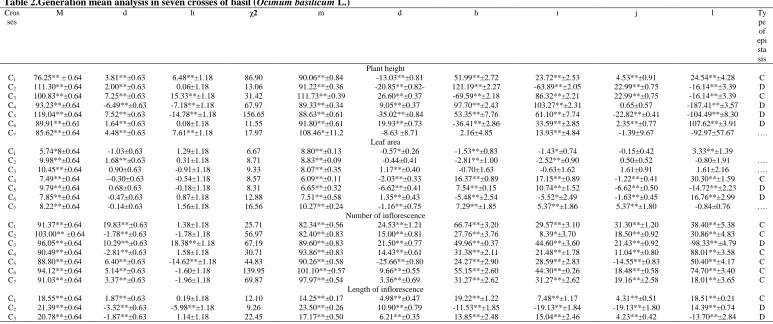
weights were used to estimates various gene effects for oil content and its contributing traits. Joint scaling test was applied to test the adequacy of additive-dominance model and estimates three parameters m (mean) d (additive effect) and h (dominance effect). In case the additive-dominance model was not found adequate, the data were analysed for estimation of six parameters m (mean), d (additive effect), h (dominance effect) and digenic interaction effects i.e. i (additive x additive). j (additive x dominance) and l (dominance x dominance). Significant joint scaling test indicated the presence of allelic interaction and non-significance indicated the absence of non-allelic interaction. In such cases 6- parameter model was used to estimates the additive, dominance and epistasis effects. The estimates of gene effects obtained using 6-parameter model for the 13 traits in seven crosses are presented in (Table 2).
The additive, dominance and epistatic types of gene interaction in each cross for different trait were found to be different from each other. The dominance x dominance [l] interaction was larger than the additive x additive [i] and additive x dominance [j] effects put together, while for the main effects the dominance component (h) was greater than the additive [d] components. The dominance [h] and dominance x dominance [l] effects were in the opposite direction, suggesting that duplicate-type epistasis occurred in most cases and indicating predominantly dispersed alleles at the interacting loci (Jinks, and Jones, 1958). Dominance gene effects were found to be relatively more important, as indicated by the fact that in all cases the dominance [h] values were higher than additive [d] values.
ISSN 0975-928X
in crosses, EC-388788/IC-333322 and IC-369247/IC-370846. It is clear that [i] indicate additive x additive, [j] indicate the additive x dominance and [l] indicate that dominance x dominance non- allelic interactions. For this trait, all the significant values were found positive h, j and i whereas ‘l’ was negative in all crosses except EC-388788/IC-333322 and IC-369247/IC-370846. The dominance gene effects were negative and non-significant for plant height. However non-significant and non-significant positive and negative estimates were recorded for plant height. A comparison of the generation mean analysis data in (Table 2) indicates that estimates of the additive gene effect [d] were greater in magnitude than their corresponding dominance effects [h] for plant height in crosses EC-388896/IC-369247 and IC-369247/IC-370846. Therefore additive genes are the most important factor contributing to the genetic control of this trait. Further, in situations where additive gene effects moderate indicated fixable gene effect and therefore early selection among the segregating population could be rewarding.
Since, significant estimates of ‘h’ and l had opposite signs, duplicate type of epistasis was indicate in four crosses; EC-387893/IC-326711, EC-388887/IC-386833, EC-387837/EC-338785, and IC-369247/IC-370846. The breeding implication is that difficulties might be encountered in the process of evolving varieties with improved plant height. Significant estimates of ‘h’ and l had same signs complimentary or recessive epistasis was indicated in only two crosses EC-388788/IC-333322 and EC-388896/IC-369247. Over dominance showed in all crosses for plant height. The magnitudes of dominance and non-dominance and non-allelic interactions were higher than the additive gene effects in all crosses except EC-387893/IC-326711 and EC-388896/IC-369247. For these traits dominant effects together with non allelic gene interaction type of epistasis are predominant.
Non-fixable gene effects were higher than the fixable gene effects to environment indicating a greater role of non-additive gene effects in the inheritance of these traits, which suggested that this trait can be improved through recurrent selection. These finding are agreement with those earlier reported by(Singh, and Paroda,1987;Singh, and Nanda,1989). Moreover epistasis in this trait was of duplicate type which further confirms the complex nature of this trait thereby suggested that difficulty would be encountered in selecting for this trait as also reported by (Ketataet al., 1976, Srivastavaet al., 1980, Ramesh et al., 2012 and Ganesh, and Sakila, 1999)
The leaf area trait for the three crosses EC-388887/386833, EC-387837/EC-338785 and IC-369247/IC-370846, showed a significant and pronounced additive, dominance and non allelic interactions. And all crosses showed additive and dominance type of gene effect except to EC-387893/IC-326711 for additive and EC-388896/IC-369247 for dominance type of gene effect. non opposite signs of [h] and [l] parameters in two crosses EC-387837/EC-338785 and IC-369247/IC-370846 indicated the duplicate type of interaction and cross EC-388887/IC-386833 same sings (i.e. positive or negative) of [h] and [l] parameters showed complimentary or recessive type of epistasis. Both additive and dominance gene effects as well as non-allelic interaction were found significant in three crosses, EC-388887/IC-386833, EC-387837/EC-338785 and IC-369247/IC-370846. However, additive gene effect was non- significant in cross EC-387893/IC-326711 and dominance gene effect was non-significant in cross EC-388896/IC-369247. In general, the magnitudes of non-additive effect were higher than additive gene effect in most of the crosses. Similar results were obtained Walton,(1969 and 1972).
In case of the number of inflorescence, all the gene effects were significant in all crosses. The magnitudes of non-additive effect were higher than that of additive gene effect. All the crosses exhibited complimentary type of epistasis for this trait except cross EC-388896/IC-369247 which showed duplicate type of epistasis. The non fixable gene effect were higher than fixable gene effects indicating a greater role of non-additive gene effects for this trait, which suggested that this trait can be improved through recurrent selection. These results confirm the findings of(Pathak et al., 2000, Kumaret al., 1994 and Noshinet al., 2003) who also reported the involvement of additive type of gene action for this trait.
For length of inflorescence in all the seven crosses, additive and non-additive gene effects were found significant in all crosses except EC-387837/EC-338785. The additive (dominance and non-allelic interaction) type gene effect was found significant in all crosses. The crosses EC-387893/IC-326711, EC-388896/IC-369247 and EC-387837/EC-338785 showed duplicate type of interaction and cross EC-388788/IC-333322 showed complimentary type of epistasis for this trait. The non-additive gene effects were predominant for this trait.
ISSN 0975-928X
388887/IC-386833 showed negative and IC-369247/IC-370846 showed positive significance. Dominance gene effects significant in all the seven crosses except to 388896/IC-369247 and EC-388887/IC-386833. All the types of gene effects were found in cross IC-369247/IC-370846. Among non-allelic interaction additive x additive with positive signs in cross EC-387837/EC-338785 and IC-369247/IC-370846, additive x dominance with positive significant in 388788/IC-333322, EC-388896/IC-369247and IC-369247/IC-370846, negative significant showed in EC-388887/IC-386833. In all significant cases the magnitudes [h], [i] and [l] were higher than that of additive gene effects. For this trait, both additive and non-additive gene effects were predominant. Duplicate type of epistasis was observed in two crosses except toEC-388788/IC-333322 and IC-369247/IC-370846, while EC-387893/IC-326711 showed in complimentary type of epistasis.
In case of the fresh herb yield all types of gene effects were found significant in only three crosses, EC-387893/IC-326711, EC-388887/IC-386833 and EC-387837/EC-338785. Additive type gene effect were found significant in crosses, EC-387893/IC-326711 , EC-388887/IC-386833 , EC-387837/EC-338785 , IC-369247/IC-370846 and IC-344681/IC-326735, dominance gene effect were observed in significant in crosses namely,EC-388788/IC-333322 , EC-387893/IC-326711 , EC-388896/IC-369247, EC-388887/IC-386833 and EC-387837/EC-338785 . All types of non-allelic gene interactions were significant in all the crosses except toEC-388788/IC-333322. Duplicate type of interaction showed in cross EC-388887/IC-386833, EC-387893/IC-326711 and EC-388896/IC-369247 and EC-388887/IC-386833 showed complimentary types of epistasis.
For the trait dry herb yield, all types of gene effects were found in only one cross EC-388788/IC-333322. Additive and dominance were found significant in crosses, EC-388788/IC-333322 and EC-387837/EC-338785. For this trait [i] type interaction was significant in crosses, 388788/IC-333322 , 387893/IC-326711 , 388896/IC-369247, EC-388887/IC-386833 and EC-387837/EC-338785 , [j] type of interaction were observed significant in EC-388788/IC-333322, EC-388896/IC-369247, EC-388887/IC-386833 and IC-344681/IC-326735 and (l) type of gene interaction were found in 388788/IC-333322 , 387893/IC-326711 , EC-388896/369247, 369247/370846 and IC-344681/IC-326735. In all the significant cases the magnitudes of [h], [i], [j] and [l] were higher than that of additive gene effects. In crosses
EC-388788/333322, EC-387893/326711 and IC-344681/IC-326735 showed complimentary type of epistasis and duplicate type of epistasis showed in EC-388896/IC-369247, EC-387837/EC-338785 and IC-369247/IC-370846.
For oil content six parameter models was used in three crosses, EC-387893/IC-326711 , EC-388896/IC-369247 and EC-387837/EC-338785 and rest of crosses used in 3-parameter models. EC-388788/IC-333322, EC-388887/IC-386833, IC-369247/IC-370846 and IC-344681/IC-326735 showed non-allelic interaction was absent. Although the best approximation of additive and dominance effects can be obtained from the three parameter additive-dominance model because these effects are unbiased due to absence of epistasis. The three parameter models was found not to be sufficient to explain the genetic control of oil content in three crosses, therefore the six parameter model was fitted to determine the type and magnitude of gene effects involved in the inheritance of oil content. The results of the six parameter model analysis indicated that dominance, additive x additive and dominance x dominance effects contributed significantly to the inheritance of trait. The cross EC-388896/IC-369247 showed complimentary and cross EC-387837/EC-338785 showed duplicate type of epistasis. This suggested that duplicate type of gene interaction were present confirming the importance of dominance effects as reported by Grewal,(1988).In conclusion, considerable non additive genetic effects were observed in this study suggesting that selection in advanced generation may be more appropriate because effective selection in early generation of segregating material can be achieved only when additive gene effects are substantial and environment effects are small. In all the three crosses dominance gene effect were observed positive significant except to EC-387837/EC-338785 which showed negative significant. A negative estimate of dominance might be due to epistatic gene action in the cross combination. Additive gene effects were found significant in all three crosses. Cross EC-387837/EC-338785 showed positive significant and EC-387893/IC-326711 and EC-388896/IC-369247were showed negative significant. The additive effects and gene interaction dominance x dominance [l] or other type digenic complementary gene interaction can be exploited effectively by selection for the improvement the traits.
ISSN 0975-928X
who determined that dominance, additive x additive and dominance gene effects play a significant role in the inheritance of oil content. The negative additive, additive x additive and dominance x dominance estimate shows the gene pairs responsible for oil content are in dispersive form (Mather, and Jinks, 1977). The different types of gene effects estimated provided a test for gene action and are useful for analyzing the genetic architecture of a crop so as to further improve desirable traits. The estimates obtained from each cross may be unique to that cross and may not be applicable to the parental population. Additive genetic variance formed the major part of the genetic variance for the important yield components and oil content. Therefore genetic improvement in the fresh herb and dry herb yield per plant trait would be easier through indirect selection for a component trait such as the oil content trait than through direct selection for fresh and dry herb yield itself.
References
Cavalli, L.L. 1952. An analysis of linkage in quantitative inheritance.(ed. E.C.R.Rieve and Waddington, C.H.), pp. 135-44. HMSO, London
Dani, R.G. and Kohel. R.J. 1989. Maternal effects and generation mean analysis of seed oil content in Cotton (Gossypiumhirsutum L.). Theor. Appl. Genet.,77: 569-575.
Duglas, J.S. 1969. Introducing essential oil crops. World Crops, 21: 122-124.
Ganesh, S.K. and Sakila, M. 1999. Generation mean analysis in sesame (Sesamumindicum L.) crosses. Sesame and Safflower Newslr., 14: 8-14.
Grewal, R.P.S.1988.Genetic basis of resistance to zonate leaf spot disease in forge sorghum.Theor. Appl. Genet.,76:505-554.
Guenther, E. 1949. The essential oils. viii. Robert e. krieger publ. Co. Malabar, Florida. P. 399-433
Hayman, B.I. 1958. Maximum likelihood estimation of genetic components of variation. Biometrics, 16: 369-81.
Jinks, J.L. and Jones, R.M. 1958. Estimation of components of heterosis. Genetics, 43: 223:234. Ketata, H., Smith, E.L., Edwards, L.H. and Mcnew, R.W.
1976. Detection of epistatic, additive and dominance variation in winter wheat (Triticumaestivum L. Thell.). Crop Sci.,16: 1 – 4. Kumar, V.D. Singh, S.R. Punder, M.C. Kamboj and Chandra, N. 1994. Genetics of yeid and its components in Indian mustard (Brassica Juncea L. Coss and Czern). Crop Res.Hisar.,7: 243-246. Lal, R.K., Gupta, P., Gupta, V., Sarkar, S., Singh, S. 2013.
Genetic variability and char-acter associations in vetiver (Vetiveriazizanioides L. Nash). Industrial Crop Production.,49:273–277.
Lal, R.K., Khanuja, S.P.S., Rizavi, H., Shasany, A.K., Ahmad, R., Chandra, R., Naqvi, A.A.,Misra, H.O., Singh, A., Singh, N., Lohia, R.S., Bansal, K., Darokar, M.P., Gupta, A.K.,Kalara, A.,
Dhawan, O.P., Bahl, J.R., Singh, A.K., Shankar, H., Kumar, D., Alam,M. 2008. Registration of a high yielding dark purple pigmented, variety ‘CIM-Angana’ of Shyamtulsi (Ocimum sanctum L.). J. Medicinal and Aromatic Plant Sci.,30: 92– 94.
Lal, R.K. 2014. Breeding for new chemotypes with stable high essential oil yield inOcimum. Industrial Crops and Products,59 :41–49
Lawrence, B. M. 1988. A further examination of the variation of (Ocimumbasilicum L.) In Flavors and Fragrances: A World Perspective; Lawrence, B. M., Mookherjee, B. D., Willis, B. J., Eds.; Elsevier Science: Amsterdam.
Mather, K. and Jinks, J.L. 1977. Introduction to biometrical genetics. London. Chapman and Hall.
Morris, J. A., Khettry, A., Seitz, E. W. M. 1979. Antimicrobial activity of aroma chemicals and essential oils. J.AmericanOil Chem.Soc.,56: 595-603
Noshin, M.M., Rahim, I. D. and Khan, S. J. 2003. Genetical analysis of yield and its components in F1s generation of brown mustard (Brassica
Juncea L. Coss and Czern). Asian J. Plant Sci,2: 1017-1033.
Pareek, S.K., Gupta, R. and Maheshwari, M.L. 1982. A eugenol rich sacred basil (Ocimum Sanctum L.), its domestication and industrial utilization. Pafai J., 13-17.
Pathak, A.D., Tripathi., R.M. Sharma., M.K. and Tripathi,R.2000. Evaluation of genetic components in Indian mustard (Brassica junceaL. Coss and Czern) through partial diallele crosses in incomplete block design. Annuls Agric. Res.,21: 282-287.
Prasad, G., Kuman, A., Singh, A.K., Bhattacharya, A.K., Singh, K. and Sharma, V.D. 1985. Antimicrobial activity of essential oils of some Ocimum species and clove oil. Fitoterapia,57:429-432.
Ramesh, K.R., Reddy, P. L. A. and Patel, R. P. 2012. Genetic association for oil yield and its component traits in different Ocimumspecies.Electron. J. Plant Breed., 3(2): 794-799.
Rice, E. L. 1979. Allelopaty-An Update. Botany Revirv,415: 15-109
Singh, G. and Nanda, G.S.1989. Estimation of gene action through triple test crosses in bread wheat. Indian J. Genet., 59: 700 – 702.
Singh, I. and Paroda, R.S. 1987. Partial diallel analysis for combining ability in wheat. Indian J. Genet.,47:
1 – 5.
Srivastava, R.B., Paroda, R.S. and Luthra, O.P. 1980. Estimation of gene effects for components of yield in wheat. Cereals Res.Common.,9: 31 – 37. Walton, P.D. 1969. Inheritance of morphological characters
associated with yield in spring wheat. Canadian J.Plant Sci., 49: 587-596.
Walton, P.D.1972. Quantitative inheritance of yield and associated factors in spring wheat. Euphytica,21:
ISSN 0975-928X
Table.1. Analysis of variance for eight quantitative characters of 13 parents, 7 F1s, 7F2s, 7 B1s, and 7 B2s of seven crosses in basil (Ocimumbasilicum).
Source of variation
d.f PH LA NI LI DM FHY DHY OC
Replication 2 44.31 1.71 0.75 0.50 1.06 18848.00 3966.00 .020
Treatment 40 633.5** 9.24** 391.30** 48.82* 100.04* 390958.40** 103503.00** 2.63**
Error 80 20.43 0.27 0.94 0.36 2.17 9650.60 9887.36 0.04
Acronyms:PH = Plant height (cm),LA = leaf area (cm2), NI =Number of inflorescence, LI = Length of inflorescences (cm), DM =Days to maturity, FHY = Fresh herb yield, DHY = Dry herb yield (g), OC =Oil content (%)
Table 2.Generation mean analysis in seven crosses of basil (Ocimum basilicum L.)
Cros ses
M d h χ2 m d h i j l Ty
pe of epi sta sis Plant height
C1 76.25** ± 0.64 3.81**±0.63 6.48**±1.18 86.90 90.06**±0.84 -13.03**±0.81 51.99**±2.72 23.72**±2.53 4.53**±0.91 24.54**±4.28 C
C2 111.30**±0.64 2.00**±0.63 0.06±1.18 13.06 91.22**±0.36 -20.85**±0.82- 121.19**±2.27 -63.89**±2.05 22.99**±0.75 -16.14**±3.39 D
C3 100.83**±0.64 7.25**±0.63 15.33**±1.18 31.42 111.73**±0.39 26.60**±0.37 -69.59**±2.18 86.32**±2.21 22.99**±0.75 -16.14**±3.39 C
C4 93.23**±0.64 -6.49**±0.63 -7.18**±1.18 67.97 89.33**±0.34 9.05**±0.37 97.70**±2.43 103.27**±2.31 0.65±0.57 -187.41**±3.57 D
C5 119.04**±0.64 7.52**±0.63 -14.78**±1.18 156.65 88.63**±0.61 -35.02**±0.84 53.35**±7.76 61.10**±7.74 -22.82**±0.41 -104.49**±8.30 D
C6 89.91**±0.61 1.64**±0.63 0.08±1.18 11.55 91.80**±0.61 19.93**±0.73 -36.41**±2.86 33.59**±2.85 2.35**±0.77 107.62**±3.91 D
C7 85.62**±0.64 4.48**±0.63 7.61**±1.18 17.97 108.46*±11.2 -8.63 ±8.71 2.16±4.85 13.93**±4.84 -1.39±9.67 -92.97±57.67 ….
Leaf area
C1 5.74*8±0.64 -1.03±0.63 1.29±1.18 6.67 8.80**±0.13 -0.57*±0.26 -1.53**±0.83 -1.43*±0.74 -0.15±0.42 3.33**±1.39
C2 9.98**±0.64 1.68**±0.63 0.31±1.18 8.71 8.83**±0.09 -0.44±0.41 -2.81**±1.00 -2.52**±0.90 0.50±0.52 -0.80±1.91 ….
C3 10.45**±0.64 0.90±0.63 -0.91±1.18 9.33 8.07**±0.35 1.17**±0.40 -0.70±1.63 -0.63±1.62 1.61±0.91 1.61±2.16 ….
C4 7.49**±0.64 --0.30±0.63 -0.54±1.18 8.57 6.09**±0.11 -2.03**±0.33 16.37**±0.89 17.15**±0.89 -1.22**±0.41 30.30**±1.59 C
C5 9.79**±0.64 0.68±0.63 -0.18±1.18 8.31 6.65**±0.32 -6.62**±0.41 7.54**±0.15 10.74**±1.52 -6.62**±0.50 -14.72**±2.23 D
C6 7.85**±0.64 -0.47±0.63 0.87±1.18 12.88 7.51**±0.58 1.35**±0.43 -5.48**±2.54 -5.52*±2.49 -1.63**±0.45 16.76**±2.99 D
C7 8.22**±0.64 -0.14±0.63 1.56±1.18 16.56 10.27**±0.24 -1.16**±0.75 7.29**±1.85 5.37**±1.86 5.37**±1.80 -0.84±0.76 ….
Number of inflorescence
C1 91.37**±0.64 19.83**±0.63 1.38±1.18 25.71 82.34**±0.56 24.53**±1.21 66.74**±3.20 29.57**±3.10 31.30**±1.20 38.40**±5.38 C
C2 103.00** ±0.64 -1.78**±0.63 -1.78±1.18 56.97 82.40**±0.83 15.00**±0.81 27.76**±3.76 8.39*±3.70 18.50**±0.92 30.86**±4.83 C
C3 96.05**±0.64 10.29**±0.63 18.38**±1.18 67.19 89.60**±0.83 21.50**±0.77 49.96**±0.37 44.60**±3.60 21.43**±0.92 -98.33**±4.79 D
C4 90.49**±0.64 -2.81**±0.63 1.58±1.18 30.71 93.86**±0.83 14.43**±0.61 31.38**±2.11 21.48**±1.78 11.04**±0.80 88.01**±3.58 C
C5 88.80**±0.64 6.40**±0.63 -14.62**±1.18 44.83 90.26**±0.58 -25.66**±0.80 24.27**±2.90 28.59**±2.83 -14.55**±0.83 50.40**±4.17 C
C6 94.12**±0.64 5.14**±0.63 -1.60±1.18 139.95 101.10**±0.57 9.66**±0.55 55.15**±2.60 44.30**±0.26 18.48**±0.58 74.70**±3.40 C
C7 91.03**±0.64 3.37**±0.63 -1.96±1.18 69.87 97.97**±0.54 3.36**±0.69 31.27**±2.62 31.27**±2.62 19.16**±2.58 18.01**±3.65 C
Length of inflorescence
C1 18.55**±0.64 1.87**±0.63 0.19±1.18 12.10 14.25**±0.17 4.98**±0.47 19.22**±1.22 7.48**±1.17 4.31**±0.51 18.51**±0.21 C
C2 21.39**±0.64 -3.32**±0.63 -5.98**±1.18 9.26 23.50**±0.26 10.90**±0.79 -11.53**±1.85 -19.13**±1.84 -19.13**±1.80 14.39**±0.74 D
ISSN 0975-928X
C4 19.85*8±0.64 -3.43**±0.63 -3.01**±1.18 28.64 18.14**±0.50 -7.81**±0.46 9.35*±2.43 10.30**±2.39 -1.48**±0.50 -24.43±30.02 ….
C5 18.18**±0.64 1.58**±0.63 -1.18±1.18 114.99 16.82**±0.19 0.51±0.62 -3.53*±1.48 -1.48±1.43 -4.01**±0.68 14..31**±2.69 D
C6 23.20**±0.64 -3.05**±0.63 -1.60±1.18 577.90 14.30**±0.14 -2.69**±0.43 7.34**±1.29 6.87**±1.11 -5.58**±0.45 -2.62±2.18 D
C7 18.67**±0.64 -1.73**±0.63 -1.96±1.18 56.61 21.16**±0.38 -3.40**±0.80 -2.59±2.18 -6.98**±2.18 -2.80**±0.80 -6.50±3.54 D
Days to maturity
C1 121.70**±0.64 -2.18**±0.63 -8.47**±1.18 8.48 119.36**±5.23 1.80±0.86 -9.27**±2.78 -4.78±2.71 1.92*±0.89 18.14**±4.22 D
C2 119.10**±0.64 3.32**±0.63 -5.98**±1.18 28.94 122.22**±0.86 -0.93±1.22 10.50*±4.29 -3.93±4.52 0.86±2.06 11.81±8.36 C
C3 119.98*8±0.64 -2.66**±0.63 -4.11**±1.18 8.97 112.33**±0.33 2.20±2.05 -3.93**±4.33 5.33±4.52 9.52**±1.26 11.45±6.18 -
C4 120.52**±0.64 -0.82±0.63 -6.14**±1.18 13.36 115.16**±0.56 -7.18**±2.05 -3.93±4.33 5.33±3.06 -7.07**±1.21 5.22±5.20 --
C5 118.20**±0.64 0.34±0.63 -5.18**±1.18 14.18 116.37**±0.20 0.66±0.49 5.48±1.76 4.50**±1.33 -5.77±3.25 1.40±1.33 ---
C6 122.20**±0.60 -3.05**±0.63 3.31**±1.18 54.68 116.20**±1.10 2.13**±0.83 12.33**±5.38 11.99*±4.71 1.86*±0.90 -17.79*±7.50 D
C7 121.20.** ±0.60 3.50**±0.63 3.31**±1.18 53.64 120.83**±0.84 0.12±0.75 -7.15**±3.76 -9.05**±0.37 0.69±0.83 14.74*±4.02 ….
Fresh herb yield
C1 2269.39**±0.64 68.09**±0.63 286.89**±1.18 38522.79 1580.00**±18.55 21.66±119.28 2435.83**±902.51 2070.00**±901.62 1591.00**±443.94 -2831±1800.00
C2 1960.04**±0.64 154.66**±0.63 -398.28**±1.18 54617.95 2603.00**±26.03 127.33**±27.77 -968.33**±118.02 985.33**±118.02 280.00**±32.39 3600.00**±161.30 C
C3 24.82.06**±0.64 111.00**±0.63 -254.60**±1.18 1648.70 1655.00**±47.69 320.00±658.33 1900.00**±655.54 675.00*±314.06 2650.00*±1269.00 3288.0**±658.33 C
C4 2373.20**±0.64 -38.93**±0.63 -357.40**±1.18 73666.62 2327.27**±14.05 632.00**±26.55 -1285.00**±79.09 1445.00**±77.35 -976.31**±29.09 1581.10**±124.67 D
C5 2333.66**±0.64 8.33**±0.63 -83.00**±1.18 20714.86 1816.31**±230.02 934.00**±81.25 545.00**±115.57 857.41**±111.29 1098.00**±32.62 1368.00**±167.30 C
C6 1140.41**±0.64 296.95**±0.63 705.64**±1.18 554533.80 2308.00**±22.04 247.50**±55.43 36.33±152.40 2583.00**±141.00 444.16**±60.99 593.33*±263.94
C7 1833.93**±0.64 179.53**±0.63 160.27*8±1.18 56991.24 2197.00**±53.50 -163.33*±67.46 259.00±257.01 -880.00**±53.50 -577.00**±71.86 -394.00**±356.41 ….
Dry herb yield
C1 1158.73**±0.64 -84.50**±0.63 -100.43**±1.18 26556.91 790.00**±5.77 277.00**±28.14 1531.45**±66.60 1059.33**±62.00 -265.71**±31.40 1062.90**±127.06 C
C2 744.03**±0.64 27.66**±0.63 52.03**±1.18 4994.75 1066.66**±44.09 40.00±26.14 1361.00**±351.73 1046.00**±183.96 271.66±296.27 1243.33*±633.66 C
C3 1156.60**±0.64 46.73**±0.63 4.07**±1.18 9733.26 802.00**±27.15 -63.33±76.73 1896.50**±189.10 1412.20**±188.02 13.16±77.71 2532.34**±328.23 D
C4 997.24**±0.64 144.40**±0.63 220.24**±1.18 24476.6 1052.89**±37.78 418.80**±32.77 -197.12±183.36 -309.00±164.00 -472.64**±44.01 -37.30±25.60 ….
C5 1004.53**±0.64 113.33**±0.63 -19.09**±1.18 61350.9 860.88**±12.07 196.00**±11.16 -217.10**±60.30 -109.54*±53.19 248.64**±27.29 471.40±60.90 D
C6 665.03**±0.64 121.66**±0.63 231.03**±1.18 10189.15 900.00**±28.86 45.33±69.19 1118.00**±186.68 1117.33**±180.24 -60.66±75.63 -1596**±315.00 D
C7 815.57**±0.64 93.00**±0.63 159.23**±1.18 6964.56 1050.00**±28.86 180.99**±48.69 75.83±156.02 268.33±151.06 -1433.00**±52.53 -338.33**±239.53 ….
Oil content
C1 3.45**±0.64 0.10±0.63 0.07±1.18 1.20 3.45**±0.64 0.10±0.63 0.07±1.18 --- --- ---
C2 2.72**±0.64 0.66±0.63 1.64±1.18 8.22 1.69**±0.33 -3.60**±01 14.05**±0.02 -3.50**±0.01 1.37**±0.10 0.44±0.46 ….
C3 2.75**±0.64 0.43±0.63 1.64±1.18 8.23 4.59**±0.33 -1.02**±0.34 6.07**±1.33 7.12**±1.33 -0.52±0.35 9.31**±1.38 C
C4 3.48**±0.64 -0.23±0.63 0.51±1.18 1.33 3.48**±0.64 -0.23±0.63 0.51±1.18 --- --- ---
C5 4.90**±0.64 -1.39±0.63 -1.73±1.18 9.66 3.27**±0.13 0.48*±0.20 -1.07**±0.10 -5.80**±0.07 -0.20±0.75 3.50**±0.17 D
C6 3.56**±0.64 0.55±0.63 0.12±1.18 0.49 4.90**±0.64 -1.39±0.63 -1.73±1.18 --- --- ---
C7 3.86**±0.64 -0.44±0.93 -0.75±1.18 0.26 3.56**±0.64 0.55±0.63 0.12±1.18 --- --- ---
Where, *, ** Significant at 5% and 1% level of significant, respectively. C1= EC- 388788 x IC- 333322, C2 = EC- 387896 x IC- 326711, C3= EC- 388896 x IC- 369247, C4=