Application of Quality Function Deployment
Framework in an Engineering Education
Institution
Chethan Emmanuel Peter
1, Emmanuel George
2, Harinarayan T
3, Roshan Sunil Kurian
4and Dr. Pradeepmon TG
51, 2, 3, 4
Student, Muthoot Institute of Technology and Science, APJ Abdul Kalam Technological University, Thiruvananthapuram, Kerala, India
5
Associate Professor, Mechanical Engineering Department, Muthoot Institute of Technology and Science,Arikoli, Kerala, India
Abstract
An engineer applies his technical knowledge in order to design and analyse different stages of product development and to the well-being of the society. The education provided to an engineer plays a key role in his knowledge level and attitude. The main aim of an educational institution should be to develop human resource which can drive the technology based infrastructure, green economy and an eco-friendly environment in the society. Due to rapid change in the technology, there exists a high demand for highly skilled workforce. Even though India has the largest youth population than any other country in the world, it lacks the number of highly skilled workforce when compared with other countries. The adaptation of liberalization, privatization, and globalization led to increase in the number of ill-equipped engineering education institutions in India [1]. Therefore, there is a greater need to improve the quality in engineering educational institutions in order to produce highly skilled workforce who can respond to any challenges in the global scenario. The educational institutions must provide quality education and create greater satisfaction among their stakeholders. It is important to recognise the stakeholders and their requirements. Quality Function Deployment (QFD), a customer driven tool for implementing Total Quality Management (TQM) helps to accomplish this task. QFD starts with capturing the voice of the customers (VOC) and ends with providing a path for delivering customer satisfaction. This paper provides an overview of the application of QFD to enhance quality in engineering educational institutions.
Keywords:Quality function deployment, engineering institutions, competitive assessment
Preface
1. Introduction
International Journal of All Research Education and Scientific Methods (IJARESM) ISSN: 2455-6211, Volume 7, Issue 9, September- 2019
education systems are failing to adequately prepare all students with the essential twenty-first century knowledge and skills necessary to succeed in life, career, and citizenship [4]. Identifying and developing educational programmes that can deliver skills required for twenty-first century workforce is complex because these skills continue to change in line with changes in technology and the new innovations [4]. The use of technology-enabled informal learning that takes place outside a formal classroom environment is recommended to enable the self-directed learner to develop critical twenty-first century skills that the workforce of tomorrow requires [5]. The QFD tool can be used to systematically and objectively identify, asses and measure the learning needs of students and thereby design and develop instructional strategies which can be used to fulfil the customer requirements. The QFD tool also assist in determining the most effective teaching strategies to meet the educational needs of the customer. It helps in determining the needs of students and also about the changes happening in the market and to meet those needs by changing the curriculum design. A methodology to improve higher education quality using QFD and analytic hierarchy process, in order to formulate an effective strategic plan in a customer driven education context was developed [7]. QFD framework for enhancing quality in engineering educational institutions describes the application of four phase’s methodology of QFD to ensure total quality in engineering education[1]. PatricaBrackin[8] used QFD to develop a step by step assessment process to develop an educational assessment plans providing engineering faculty with a foundation for understanding quality assessment. QFD was also used to analyse and design an engineering course, Statistical Quality Control (SQC) to improve the quality of SQC graduate.
3. Quality Function Deployment
Quality Function Deployment (QFD) is one of the important techniques of TQM and is used to convert the customer requirements to product specifications. QFD was first developed in Japan in 1966 by Prof.YojiAkao and Prof. Shigeru Mizuno as a quality system for Bridgestone tires. The HOQ or QFD is an effective tool to translate the customer needs into design characteristics of products or services, utilizing a relationship matrix. The main sections associated with the QFD matrix are WHAT’s (customer needs), HOW’s (design requirements), relationships (between WHATs and HOWs), HOW MUCHes (targeted values). There are four main phases involved in the QFD processes and they are:
Phase I - Product Planning Phase II - Parts Planning Phase III - Process Planning Phase IV - Production Planning
In QFD process, each phase is directly linked to another phase. The HOWs of one phase become WHATs of the next phase. The first crucial step that makes the efforts effective is by identifying who the customers are and what their demands are. The four phases of QFD methodology is represented in the figure 2.1. Which is adapted from Hauser and Clausing[2].
Fig 3.2: QFD Approach[9]
4. House of Quality
The primary planning tool used in Quality Function Deployment is house of quality. The house of quality interprets the voice of the customer into design requirements that meet specific target values and matches against how an organization will meet those requirements.
International Journal of All Research Education and Scientific Methods (IJARESM) ISSN: 2455-6211, Volume 7, Issue 9, September- 2019
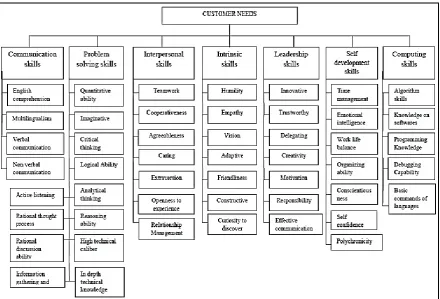
placement officers of various engineering education institutions, employability skill mapping reports etc... After collection of customer needs, it is to be sorted into hierarchical level to reduce the complexity due to the increased number of inputs to House of Quality (HOQ). An affinity diagram is used to sort the skill sets and construct a hierarchy based on grouping. After verification of affinity diagram by experienced faculties and placement officers of engineering education institutions, the skill sets are finalized.
Fig 5.1: Affinity Diagram
Fig 5.2: Methodology
6. Phases of QFD
6.1Phase I-product planning
Primarily, identification of the customer needs is done. In the current topic of discussion, the customer requirements are the skill sets or abilities engineering graduate students were expected to meet. QFD was applied by modelling the engineering education as the manufacturing process. Enrolling students were modelled to be the raw materials and graduates as finished products. Customer requirements are those raised by the industries hiring the graduates. Data taken from the National Employability Report by Aspiringminds 2016 gave precise data on the industrial requirements. The report was based on data from three million annual AMCAT assessments. Customer requirements were then sorted under seven main skill sets using an affinity diagram. In this topic of study, these seven skill sets are taken as the customer requirements.
Table 6.1.1: Customer Attributes[1]
Sl.No. Customer Attributes
1 Communication Skills
2 Computing Skills
3 Interpersonal Skills
4 Intrinsic Skills
5 Leadership Skills
6 Problem Solving Skills
7 Self-Development Skills
A survey was conducted in a few self-financing engineering education institution which were then considered as the competitors for the study. The survey responses were sorted and corresponding ratings for the seven skill sets were calculated using weighted average method.
The design requirements were generated by brainstorming sessions within the group, discussion with college faculties, principal, academic officers and from other reference papers.
Table 6.1.2: Engineering Characteristics[1]
Sl.No Engineering Characteristics
1 Well Equipped Lab Facilities
International Journal of All Research Education and Scientific Methods (IJARESM) ISSN: 2455-6211, Volume 7, Issue 9, September- 2019
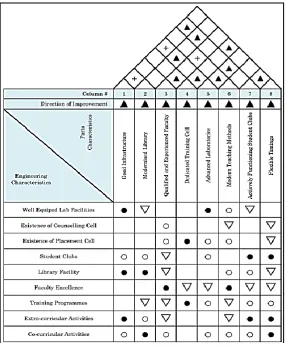
The tool House of Quality was adopted to complete the first phase of QFD. The relations between various customer requirements and engineering characteristics were investigated and incorporated in the relationship matrix by assigning corresponding magnitude. The inter relationship between engineering characteristics were also assigned in the correlation matrix.
Fig 6.1.1: Product Planning Phase
Relationship matrix shows the level of association between each customer attributes and engineering characteristics. These correlations are represented in the form of symbols which are further quantified by numbers to show the strength of association
= 3 (Strong Association) = 2 (Medium Association) = 1 (Weak Association)
Absolute weight for each engineering characteristics could be found out using the equation Tj = 𝑛𝑖=1𝑅𝑖𝑗. 𝐶𝑖
Tj = Absolute weight for engineering characteristics
Rij = Strength of association assigned to the relationship matrix (i= 1 to n & j= 1 to m)
Ci = Importance of customer towards customer attributes (i = 1 to n)
m = Number of engineering characteristics n = Number of customer attributes
6.2Phase II-parts planning
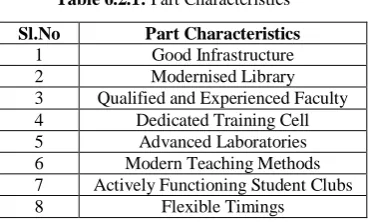
The design requirements or engineering characteristics from the first phase determine the components or part characteristics. The part deployment house is constructed in this phase. Based on engineering characteristics the critical sub components of those characteristics wereidentified and were introduced as the parts characteristics of phase 2. The critical sub components were generated by brainstorming sessions within the group, discussion with college faculties and from other reference papers. Finally the following are the parts characteristics in this phase:
Table 6.2.1: Part Characteristics [1]
Sl.No Part Characteristics
1 Good Infrastructure
2 Modernised Library
3 Qualified and Experienced Faculty
4 Dedicated Training Cell
5 Advanced Laboratories
6 Modern Teaching Methods
7 Actively Functioning Student Clubs
8 Flexible Timings
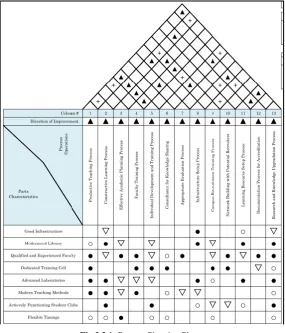
Fig 6.2.1: Part Planning Phase
6.3Phase III-Process Planning
In this phase investigations are done to find out various key process operations within an institution. The part characteristics becomes the WHTATs in this phase and the key process operations becomes the HOWs various processes involved in the production were identified and documented in this phase.
Sl.No Key Process operations
1 Productive Teaching Process
2 Constructive Learning Process
3 Effective Academic Planning Process
4 Faculty Training Process
5 Individual Development and Training Process
6 Consultancy for Knowledge Sharing
7 Appropriate Evaluation Process
8 Infrastructure Setup Process
9 Campus Recruitment Training Process
10 Network Building with Potential Recruiters
11 Learning Resource Setup Process
12 Documentation Process for Accreditation
13 Research and Knowledge Upgradation Process
International Journal of All Research Education and Scientific Methods (IJARESM) ISSN: 2455-6211, Volume 7, Issue 9, September- 2019
Fig 3.3.1: Process Planning Phase
6.4Phase IV-Production Planning
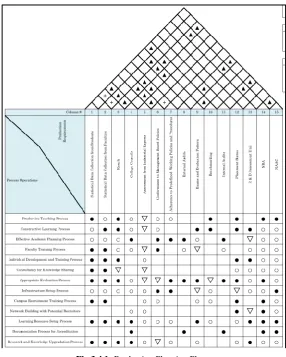
The customer requirements in phase I finally translated into production requirements through the previous two phases. The phase four is also called quality assurance phase. In this phase the quality assurance parameters were formulated through brainstorming and from experienced faculties of the institution. The various production requirements are:
Table 3.4.1: Quality Control Criteria
Sl.No Quality Control Criteria
1 Statistical Data Collection from Students 2 Statistical Data Collection from Faculties
3 Result
4 College Councils
5 Assessment from Industrial Experts 6 Conformance Management Board Policies 7 Adherence to Predefined Working Policies and Procedures 8 External Audits
Fig 3.4.1: Production Planning Phase 7. Result
In the current study, the institution under consideration was compared with two other self-financing institution which were recognized as competitors based on the previous results and placement history. From this it can be concluded that, the institution under consideration has maintained a certain level in all the customer attributes needed by the industry when compared with the first competitor, but the institution under consideration needs further improvement in all aspects of customer attributes when compared with second competitor. From the study, the following observations are made:
International Journal of All Research Education and Scientific Methods (IJARESM) ISSN: 2455-6211, Volume 7, Issue 9, September- 2019
skills due to the fall in customer competitive assessment rating when compared with the second competitor. It can be done by identifying the engineering characteristics having strong relationship with the corresponding attributes and translating those engineering characteristics to parts characteristics and further translating them to process planning phase and the process operations that must be focused by the institution could be identified. A quality based approach from the institution towards these processes will result in the improvement of thecorresponding customer attribute. Further, the quality assessment methodologies and requirements required can be identified from the relationships between key process operations and production requirements in the production planning phase. The customer attributes such as intrinsic skills and self-development skills are not given much importance when compared with other customer attributes. In customer competitive assessment, these skills lead ahead of the competitor 1, but slightly behind the competitor 2. Since these skills are given much lesser importance by the customer, the level of involvement of the institution under consideration for improving these skills can be trade off with the other skills which are given more importance by the customer. Also, the design requirements for these skills will also be improved to an extent since the quality of most of the engineering characteristics having strong relationship with these skills are also related with the skills having higher customer importance. The relative weightage of the engineering characteristics shows the level of involvement of characteristics towards customer attributes. Higher the weightage, higher must be the importance that the institution must give to the corresponding engineering characteristics.
8. Conclusion and Future Scope
Quality function deployment is a structured approach for defining customer needs or requirements and translating them into specific plans to produce products to meet those needs. In the current study, main focus were made on industries who hire the engineering graduates who satisfies the need of the industries. The QFD framework was solved and applied in a self-financing institution and comparing this institution with two other self-financing institutionsbased on their result and placement history. In order to produce quality graduates who satisfy the needs of the industry, it is required to identify the key process involved in the education system and then a quality approach is needed to improve the capability of processes so as to obtain total customer satisfaction[1]. The four phases of QFD provides a scientific and statistical basis for quality assessment for all process through measurement of quality level. From all the observations it can be concluded that, currently the institution under consideration requires improvement in various key processes in order to improve the quality of the engineering graduates of the institution.
Even though the customer competitive assessment rating is acceptable to a certain extent, overall rating is not satisfactory and it must be subjected to improvement. In future, further studies can be done with comparing the institution with other government institutions having good reputation and also by improving the QFD matrix by incorporating much more specific customer attributes, engineering characteristics and other factors which cannot be completed in this study due to time constrains.
References
1. DurgaPrasadKG,VenkataSubbaiahK, GauravGV, HimaGireeshCH. QFD Frame Work for Enhancing Quality in Engineering Educational Institutions, Researchgate, 2018.
2. HauserJR, ClausingD. The house of quality, Harvard Business Review,1988,63-73.
3. KusiakA. Quality Function Deployment and Process Models, Engineering Design: Products, Processes, and Systems, Academic Press, 1999.
4. Maria GraziaViolante, Enrico Vezzetti. Guidelines to design engineering education in the twenty-first century for supporting innovative product development, European Journal of Engineering Education, 2017, 1344-1364.
5. Herring Donna, Jimmy Barnes. STEM Studies: Enhancing 21st Century Skills through Robotics, Paper presented at the World Conference on Educational Multimedia, Hypermedia and Telecommunications, 2012.
6. Natarajan R. The Role of Accreditation in Promoting Quality Assurance of Technical Education, International Journal of Engineering Education. 2000; 16(2):85-96.
7. Hendry Raharjo, Min Xie, Thong NgeeGoh, Aarnout CBrombacher. A Methodology to Improve Higher Education Quality using the Quality Function Deployment and Analytic Hierarchy Process, 2014.
8. Patricia Brackin. Assessing Engineering Education: an Industrial Analogy,Department of Mechanical Engineering, Rose-Hulman Institute of Technology, Int. Journal on Engineering Education. 2002; 18(2):51-156.
![Fig 2.1: Phases of QFD [2]](https://thumb-us.123doks.com/thumbv2/123dok_us/8801742.1772316/2.595.84.510.497.673/fig-phases-of-qfd.webp)
![Fig 3.2: QFD Approach[9]](https://thumb-us.123doks.com/thumbv2/123dok_us/8801742.1772316/3.595.118.479.424.698/fig-qfd-approach.webp)
![Table 6.1.1: Customer Attributes[1]](https://thumb-us.123doks.com/thumbv2/123dok_us/8801742.1772316/5.595.223.372.481.575/table-customer-attributes.webp)