Please cite this article as:S.M. Mousavi, H. Gitinavard, B. Vahdani,Evaluating Construction Projects by a New Group Decision-Making Model Based on Intuitionistic Fuzzy Logic Concepts, International Journal of Engineering (IJE), TRANSACTIONS C: Aspects Vol. 28, No. 9, (September2015) 1312-1319
International Journal of Engineering
J o u r n a l H o m e p a g e : w w w . i j e . i rEvaluating Construction Projects by a New Group Decision-Making Model Based on
Intuitionistic Fuzzy Logic Concepts
S. M. Mousavia *, H. Gitinavard b, B. Vahdani c
a Department of Industrial Engineering, Faculty of Engineering, Shahed University, Tehran, Iran b Young Researchers and Elite Club, South Tehran Branch, Islamic Azad University, Tehran, Iran c Faculty of Industrial and Mechanical Engineering, Qazvin Branch, Islamic Azad University, Qazvin, Iran
P A P E R I N F O
Paper history: Received 26 July 2015
Received in revised form 28 August 2015 Accepted 03 September 2015
Keywords:
Group Decision-Making Intuitionistic Fuzzy Logic Construction Project Evaluation, Intuitionistic Fuzzy Index
A B S T R A C T
Selecting an appropriate project is a main key for contractors to increase their profits. In practice, in this area the uncertainty and imprecise of the involved parameters is so high. Therefore, considering fuzzy sets theory to deal with uncertainty is more appreciate. The aim of this paper is to present a multi-criteria group decision-making model under an intuitionistic fuzzy environment. The weight of each decision maker and each criterion are considered different. Indeed, decision makers' weights are determined based on a new intuitionistic fuzzy index, and criteria’ weights are specified by proposed decision method according to the concept of closer to ideal solution and farther from negative ideal solution. Then, the potential projects are ranked based on new intuitionistic fuzzy relative closeness coefficient. Thus, the proposed intuitionistic fuzzy group decision-making model is applied in an illustrative example about construction project selection from the recent literature. Finally, the ranking results are compared with a fuzzy TOPSIS method to indicate the applicability and efficiency of the proposed model.
doi: 10.5829/idosi.ije.2015.28.09c.08
1. INTRODUCTION1
Since Zadeh [1] introduced fuzzy sets theory, this theory and their extensions have been widely applied in solving the problems which have uncertain parameters. These problems are regarded in some fields such as artificial intelligence [2, 3], management [4, 5], pattern recognition [6, 7] and decision making [8-10]. Decision making is a procedure which is defined as final result of problems and assist decision makers for choosing the best potential candidates or set of potential candidates.
The multi-criteria decision making (MCDM) has established an efficient framework for evaluation of the problems which have been judged by multiple decision makers. In traditional MCDM methods, the evaluations of problems are provided based on crisp values, but in an uncertain situation the problems should be judged based on the fuzzy sets theory, and on the other hand it
*Corresponding Author’s Email: [email protected] (S.M. Mousavi)
could be considered as fuzzy multi-criteria decision making (FMCDM) approach [e.g., 11-13]. In addition, employing some decision makers under a group to assess the problem under imprecise condition is leading to fuzzy multi-criteria group decision-making (FMCGDM) approach.
In real world, the parameters have been considered uncertain/vague because decision makers cannot express their preferences and judgments by a crisp value. Thus, the decision makers’ judgments for constructing the decision matrix and criteria’ weights should be better to be defined by fuzzy values [8, 14, 15], such as interval values [16-19], hesitant fuzzy sets [20-23], linguistic terms [24, 25], and intuitionistic fuzzy sets [26-28]. A few studies have considered the group decision-making methods in fuzzy conditions. Hence, they considered fuzzy approaches which are based on Zadeh’s fuzzy set. Thus, in this fuzzy set theory, the membership degree for an object x is ( )
and the non-membership degree is
conditions, information about objects is fitting to a fuzzy concept which may be insufficient and incomplete. Therefore, the sum of the membership and non-membership degrees may be less than one [29, 30]. In Zadeh’s fuzzy set, no tools are existed to incorporate the membership degree when we have faced with lack of knowledge [30, 31]. In this respect, Atanassov [26, 32] introduced an appropriate solution called intuitionistic fuzzy set as a generalization of the Zadeh’s fuzzy set which the membership grades are ill-known. The intuitionistic fuzzy sets theory appears to be well suited for defining the preferences values of decision makers in decision-making problems and its applications [30, 31]. In this respect, numerous authors focused on fuzzy sets theory and its extension to overcome the existed uncertain parameters in their decision-making problems [18, 33, 34].
The fuzzy sets theory can be utilized in construction problems by considering their main advantages because the uncertainty of involved parameters in these problems can be high. In this respect, some authors have utilized the fuzzy sets theory for the assessment and have solved their construction problems [35-37]. In this respect, Gu et al. [38] proposed a modified TOPSIS method based on interval-valued intuitionistic fuzzy set to select the best bridge construction project, in which the criteria’ weights were completely known. Ning and Wang [39] presented an intuitionistic fuzzy TOPSIS method to assess the best site layout problem to select the most suitable site layout from the site layout candidates. Zhou et al. [40] developed the combined TOPSIS method with grey system theory based on intuitionistic triangular fuzzy numbers to rank the green risks in construction projects.
In this study, a new intuitionistic fuzzy group decision procedure is presented to select the most appropriate project in construction industry. In proposed model, the weights of criteria and decision makers are determined by proposed compromise solution and new intuitionistic fuzzy index, respectively. In addition, decision makers evaluate the project’s candidates versus the conflicted criteria based on linguistic terms, which converted to intuitionistic fuzzy numbers. The main contributions of this study are outlined as follows: (1) a novel group decision making method is proposed based on the intuitionistic fuzzy logic; (2) the relative importance of each decision maker is computed by a new intuitionistic fuzzy index; (3) the criteria’ weights are determined by developed compromise solution in an intuitionistic fuzzy setting; and (4) an intuitionistic fuzzy relative closeness coefficient is proposed for each candidate to rank the potential projects.
The reminder of this paper is structured as follows: In section 2, the proposed model is presented to solve the group decision-making problems. Hence, in section 3, an illustrative example about the construction project is provided to show the suitability of the proposed
model. Finally, some concluding remarks and future direction are presented in section 4.
2. PROPOSED INTUITIONISTIC FUZZY DECISION MODEL
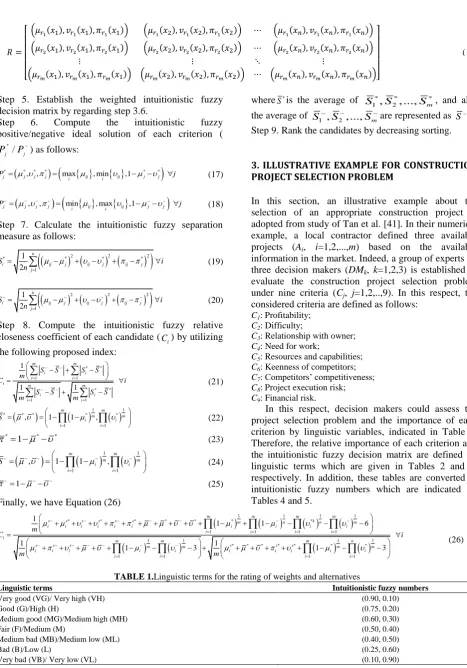
A decision-making problem can be demonstrated in a decision matrix, in which as an element can be
indicated the assessment of the ith alternative ( ) regarding to jth criterion ( ). This study will develop the classical group decision matrix to intuitionistic fuzzy group decision matrix (R) based on the opinions of a group of experts. Let be a set of candidates and let be a set of attributes, where
and . The properties of the candidate are expressed by the IFS, indicated as below:
( ) ( ) ( )
(1)
where the satisfaction degree of candidates versus the attributes are denoted by , and represented the non-satisfaction degree of candidates versus the attributes ( ) However, the proposed model is explained to determine the weight of each attribute and experts, and also rank the potential candidates which are provided as follows: Step 1. Establish a group of experts to determine the attributes and specify the prospective candidates for the group decision-making problem. The chosen attributes are defined qualitatively and assessed in linguistic terms which converted to intuitionistic fuzzy numbers. Step 2. Calculate the weight of each expert
k
based on new intuitionistic fuzzy index. In this respect, an intuitionistic fuzzy number for evaluating the kth experts is denoted byDk
k, k, k
.1 1 1 1 1 1 1 1
1 1 1 1
1 1 1 1 1 1 1 1
1 1 1 1
1 1 1
1
m n
k ij
m n m n m n
i j
k k k
ij ij ij m n m n
k k
i j i j i j
ij ij
i j i j
k m n
k ij
m n m n m n
i j
k k k
ij ij ij m n
k
i j i j i j
ij
i j
1
1 1
K
m n
k k
ij
i j
k
(2)
and ∑
.
Step 3. Compute the criteria’ weights by proposed compromise solution based on the concept of closer to ideal solution and farther from negative ideal solution by considering the following sub-steps.
Step 3.1. Establish the intuitionistic fuzzy decision matrix
j
1 2
1 1 1 2 2 2
1 1 1 1 1 1 1 1 1 1
1 1 1 2 2 2
, , , , , ,
, , , , , ,
k
k k k
j j j j j j j j j
j
k k k
m mj mj mj mj mj mj mj mj mj
m k
DM DM DM
A G j A (3) where, k mj
is the intuitionistic fuzzy membership degree for mth candidate which judged by kth expert to establish the jth intuitionistic fuzzy decision matrix. Step 3. 2. Determine the intuitionistic fuzzy positive/negative ideal solutions (IFPIS/IFNIS) matrixes( *
/
j j
w w
A A ) based on the intuitionistic fuzzy decision
matrix, respectively.
* * * * 1 2*1 *1 *1 *2 *2 *2 * * * 1 1 1 1 1 1 1 1 1 1
*1 *1 *1 *2 *2 *2 * * *
, ,
, , , , , ,
, , , , , ,
j
k k k
w i i i
m k
k
k k k
j j j j j j j j j
k k k
m mj mj mj mj mj mj mj mj mj
m k
A
DM DM DM
A j A (4)
1 21 1 1 2 2 2
1 1 1 1 1 1 1 1 1 1
1 1 1 2 2 2
, ,
, , , , , ,
, , , , , ,
j
k k k
w i i i
m k
k
k k k
j j j j j j j j j
k k k
m mj mj mj mj mj mj mj mj mj
m k
A
DM DM DM
A j A (5)
where the average of the intuitionistic fuzzy group decision matrix is calculated by the following relations:
1
1* * * *
1 1
, 1 1 , ,
n n
k k k n k n
ij ij ij ij
j j i k
(6)* * *
1
k k k
ij ij ij
(7)
k, k
min
k , max
k
,ij ij ij ij
j j i k
(8)
1
k k k
ij ij ij
(9)
Step 3.3. Compute the separation measure for each intuitionistic fuzzy decision matrix from the intuitionistic fuzzy positive/negative ideal solution matrixes by using the intuitionistic fuzzy Euclidean
distance measure which denoted by *
j
S and
j
S,
respectively.
2 2 2
* * * * 1 1 1 2 j m K
k k k k k k
w i i i i i i
i k
S j
mk
(10)
2 2 2
1 1
1
2 j
m K
k k k k k k
w i i i i i i
i k
S j
mk
(11)Step 3.4. Specify the intuitionistic fuzzy relative closeness of criteria
Cwj for determining the most important criterion.
2 1 1 2 2 1 1 * * 1 1 1 11 1 1 1
j j j j n k n j w j w n n
k n k n
j w j w
j j S C S S
(12) where * j wS the average of *
1, 2,..,
j
w
S j n , and also
the average of
1, 2,..,
j
w
S j n represented as
j
w S .
Step 3. 5. Aggregate the preferences experts’ judgments about the criteria’ weights ( ) as follows:
( ) ( ( ) ( ) ( )) ( ) ( ) ( ) (13) [ ∏ ( ( )) ∏ ( ( )) ∏ ( ( )) ∏ ( ( )) ]
Step 3.6. Estimate the weight of each criterion
jregarding to the relative closeness.
1 1 1 11 1 1
1 1 1 1
1 1 1
1 1
j f
j j j
j
f f f
j j j j j
f f
j j
j f
j j j
j
f f f
j j j j j
f f j j f j j j n f j j j C
C C C w
w w w C C
w w
C
n C C C w
w w w C C
j w w w C w C j (14)
Step 4. Construct the integrated intuitionistic fuzzy decision matrix based on the preferences experts’ judgments. In this case, ( ) ( ( ))
is defined as an intuitionistic fuzzy decision matrix for each expert. Then, integrated intuitionistic fuzzy decision matrix ( ( ) ) can be obtained based on the IFWA operator which is proposed by Xu [28].
( ( ) ( ) ( )) ( ) ( ) ( )
(15) [ ∏ ( ( )) ∏ ( ( )) ∏ ( ( )) ∏ ( ( ))]
Here
,
( ( ) ( ) ( ))
[
( ( ) ( ) ( )) ( ( ) ( ) ( )) ( ( ) ( ) ( )) ( ( ) ( ) ( )) ( ( ) ( ) ( )) ( ( ) ( ) ( ))
( ( ) ( ) ( )) ( ( ) ( ) ( )) ( ( ) ( ) ( ))]
(16)
Step 5. Establish the weighted intuitionistic fuzzy decision matrix by regarding step 3.6.
Step 6. Compute the intuitionistic fuzzy
positive/negative ideal solution of each criterion (
*
/
j j
P P) as follows:
* * * * * *
, , max , min ,1
j j j j ij ij j j
i i
P j (17)
, ,
min
, max
,1
j j j j ij ij j j
i i
P j (18)
Step 7. Calculate the intuitionistic fuzzy separation measure as follows:
2 2 2
* * * *
1
1 2
n
i ij j ij j ij j
j
S i
n
(19)
2 2 2
1
1 2
n
i ij j ij j ij j
j
S i
n
(20)Step 8. Compute the intuitionistic fuzzy relative closeness coefficient of each candidate (
i
C) by utilizing the following proposed index:
* *
1 1
* *
1 1
1
1 1
m m
i i
i i
i m m
i i
i i
S S S S
m
C i
S S S S
m m
(21)
1
1* * * * *
1 1
, 1 1 ,
m m
m m
i i
i i
S
(22)* * *
1
(23)
1
11 1
, 1 1 ,
m m
m m
i i
i i
S
(24)1
(25)
Finally, we have Equation (26)
where *
S is the average of * * *
1, 2,..., m
S S S , and also
the average of
1 , 2,..., m
S S Sare represented as S. Step 9. Rank the candidates by decreasing sorting.
3. ILLUSTRATIVE EXAMPLE FOR CONSTRUCTION PROJECT SELECTION PROBLEM
In this section, an illustrative example about the selection of an appropriate construction project is adopted from study of Tan et al. [41]. In their numerical example, a local contractor defined three available projects (Ai, i=1,2,...,m) based on the available information in the market. Indeed, a group of experts by three decision makers (DMk, k=1,2,3) is established to evaluate the construction project selection problem under nine criteria (Cj, j=1,2,..,9). In this respect, the considered criteria are defined as follows:
C1: Profitability;
C2: Difficulty;
C3: Relationship with owner;
C4: Need for work;
C5: Resources and capabilities;
C6: Keenness of competitors;
C7: Competitors’ competitiveness;
C8: Project execution risk;
C9: Financial risk.
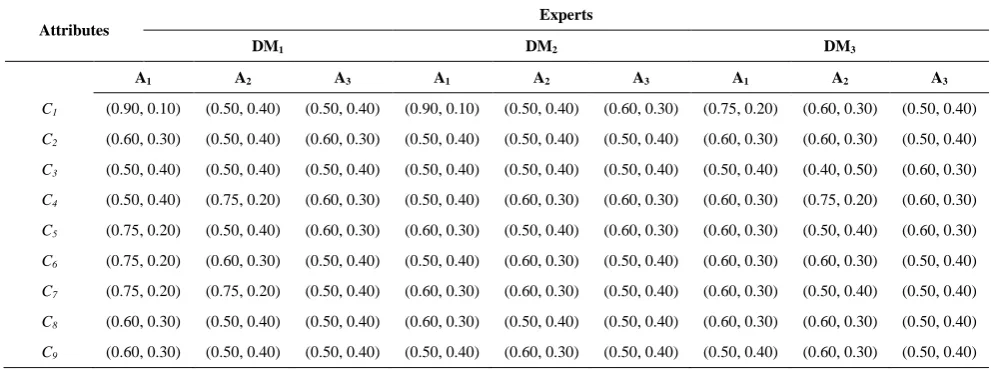
In this respect, decision makers could assess the project selection problem and the importance of each criterion by linguistic variables, indicated in Table 1. Therefore, the relative importance of each criterion and the intuitionistic fuzzy decision matrix are defined by linguistic terms which are given in Tables 2 and 3, respectively. In addition, these tables are converted to intuitionistic fuzzy numbers which are indicated by Tables 4 and 5.
1 1 1 1
* * * * * * *
1 1 1 1
1 1 1 1
* * * * * * *
1 1 1
1
1 1 6
1 1
1 3 1
m m m m
s s s s s s m n k n m
i i i i i i i i i i
i i i i
i
m m m
s s s m m s s s m m
i i i i i i i i i i
i i i i
m C
m m
1
3
n
i
(26)
TABLE 1.Linguistic terms for the rating of weights and alternatives
Linguistic terms Intuitionistic fuzzy numbers
Very good (VG)/ Very high (VH) (0.90, 0.10)
Good (G)/High (H) (0.75, 0.20)
Medium good (MG)/Medium high (MH) (0.60, 0.30)
Fair (F)/Medium (M) (0.50, 0.40)
Medium bad (MB)/Medium low (ML) (0.40, 0.50)
Bad (B)/Low (L) (0.25, 0.60)
TABLE 2. Preferences experts’ judgments about the criteria’ weights based on linguistic terms
Attributes Experts
DM1 DM2 DM3
C1 H H VH
C2 M MH M
C3 H H MH
C4 H MH M
C5 VH H H
C6 M MH MH
C7 H H H
C8 H MH MH
C9 MH H H
TABLE 3. Preferences experts’ judgments for rating the alternatives based on linguistic terms
Criteria
Experts
DM1 DM2 DM3
A1 A2 A3 A1 A2 A3 A1 A2 A3
C1 VG F F VG F MG G MG F
C2 MG F MG F F F MG MG F
C3 F F F F F F F MP MG
C4 F G MG F MG MG MG G MG
C5 G F MG MG F MG MG F MG
C6 G MG F F MG F MG MG F
C7 G G F MG MG F MG F F
C8 MG F F MG F F MG MG F
C9 MG F F F MG F F MG F
TABLE 4. Preferences experts’ judgments about the criteria weights based on IFS
Attributes
Experts
DM1 DM2 DM3
C1 (0.75, 0.20) (0.75, 0.20) (0.90, 0.10)
C2 (0.50, 0.40) (0.60, 0.30) (0.50, 0.40)
C3 (0.75, 0.20) (0.75, 0.20) (0.60, 0.30)
C4 (0.75, 0.20) (0.60, 0.30) (0.50, 0.40)
C5 (0.90, 0.10) (0.75, 0.20) (0.75, 0.20)
C6 (0.50, 0.40) (0.60, 0.30) (0.60, 0.30)
C7 (0.75, 0.20) (0.75, 0.20) (0.75, 0.20)
C8 (0.75, 0.20) (0.60, 0.30) (0.60, 0.30)
C9 (0.60, 0.30) (0.75, 0.20) (0.75, 0.20)
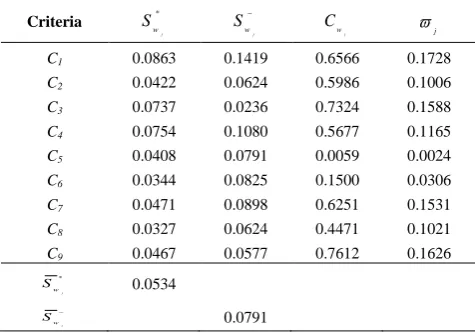
The relative significance of each decision maker is determined based on the new intuitionistic fuzzy index and represented in Table 6. Then, a compromise method is developed based on the concept of closer to ideal solution and farther from negative ideal solution to compute the weight of each criterion. In this respect, the IFPIS and IFNIS matrixes are established based on the Step 3.2. The results are given in Table 7. Thus, the separation measure, the intuitionistic fuzzy relative closeness of criteria and also the final weight of each criteria are determined by Steps 3.3-3.6 and are shown in Table 8.
TABLE 5. Preferences experts’ judgments for rating the alternatives based on intuitionistic fuzzy set
Attributes
Experts
DM1 DM2 DM3
A1 A2 A3 A1 A2 A3 A1 A2 A3
C1 (0.90, 0.10) (0.50, 0.40) (0.50, 0.40) (0.90, 0.10) (0.50, 0.40) (0.60, 0.30) (0.75, 0.20) (0.60, 0.30) (0.50, 0.40)
C2 (0.60, 0.30) (0.50, 0.40) (0.60, 0.30) (0.50, 0.40) (0.50, 0.40) (0.50, 0.40) (0.60, 0.30) (0.60, 0.30) (0.50, 0.40)
C3 (0.50, 0.40) (0.50, 0.40) (0.50, 0.40) (0.50, 0.40) (0.50, 0.40) (0.50, 0.40) (0.50, 0.40) (0.40, 0.50) (0.60, 0.30)
C4 (0.50, 0.40) (0.75, 0.20) (0.60, 0.30) (0.50, 0.40) (0.60, 0.30) (0.60, 0.30) (0.60, 0.30) (0.75, 0.20) (0.60, 0.30)
C5 (0.75, 0.20) (0.50, 0.40) (0.60, 0.30) (0.60, 0.30) (0.50, 0.40) (0.60, 0.30) (0.60, 0.30) (0.50, 0.40) (0.60, 0.30)
C6 (0.75, 0.20) (0.60, 0.30) (0.50, 0.40) (0.50, 0.40) (0.60, 0.30) (0.50, 0.40) (0.60, 0.30) (0.60, 0.30) (0.50, 0.40)
C7 (0.75, 0.20) (0.75, 0.20) (0.50, 0.40) (0.60, 0.30) (0.60, 0.30) (0.50, 0.40) (0.60, 0.30) (0.50, 0.40) (0.50, 0.40)
C8 (0.60, 0.30) (0.50, 0.40) (0.50, 0.40) (0.60, 0.30) (0.50, 0.40) (0.50, 0.40) (0.60, 0.30) (0.60, 0.30) (0.50, 0.40)
TABLE 7. FPIS/IFNIS matrixes
Alternatives IFPIS (
*
j
w
A )
DM1 DM2 DM3
A1 (0.6919, 0.2473, 0.0608) (0.6118, 0.3115, 0.0766) (0.6011, 0.3057, 0.0932)
A2 (0.5819, 0.3321, 0.0860) (0.5472, 0.3520, 0.1008) (0.5827, 0.3236, 0.0938)
A3 (0.5358, 0.3634, 0.1007) (0.5358, 0.3634, 0.1007) (0.5358, 0.3634, 0.1007)
IFNIS (
j w
A )
DM1 DM2 DM3
A1 (0.5, 0.4, 0.1) (0.5, 0.4, 0.1) (0.5, 0.4, 0.1)
A2 (0.5, 0.4, 0.1) (0.5, 0.4, 0.1) (0.5, 0.4, 0.1)
A3 (0.5, 0.4, 0.1) (0.5, 0.4, 0.1) (0.5, 0.4, 0.1)
TABLE 10. Intuitionistic fuzzy relative closeness coefficient of each candidate and ranking the potential candidates by comparative analysis
Alternatives Si* Si
i
C Ranked by proposed model Ranked by Tan et al. [41] method
A1 0.0249 0.0789 0.0948 2 2
A2 0.0545 0.0613 0.0422 3 3
A3 0.0810 0.0203 0.1007 1 1
*
S 0.0535
S 0.0534
TABLE 6. Experts’ weights based on new index
DM's weight DM1 DM2 DM3
k
0.331 0.335 0.334
TABLE 8. Separation measure, intuitionistic fuzzy relative closeness and the criteria’ weights
Criteria *
j
w
S
j
w
S
j
w
C
j
C1 0.0863 0.1419 0.6566 0.1728
C2 0.0422 0.0624 0.5986 0.1006
C3 0.0737 0.0236 0.7324 0.1588
C4 0.0754 0.1080 0.5677 0.1165
C5 0.0408 0.0791 0.0059 0.0024
C6 0.0344 0.0825 0.1500 0.0306
C7 0.0471 0.0898 0.6251 0.1531
C8 0.0327 0.0624 0.4471 0.1021
C9 0.0467 0.0577 0.7612 0.1626
* j
w
S 0.0534
j
w
S 0.0791
The intuitionistic fuzzy decision matrix is aggregated and the weighted intuitionistic fuzzy decision matrix is constructed. Then, the intuitionistic fuzzy positive / negative ideal solutions of each criterion are calculated based on step 5, and the results are demonstrated in Table 9. Finally, the rank of each
TABLE 9. Intuitionistic fuzzy positive / negative ideal solution of each criterion
Criteria Pj* Pj
C1 (0.2919, 0.6991, 0.0090) (0.1242, 0.8395, 0.0363)
C2 (0.0744, 0.9031, 0.0225) (0.0813, 0.8944, 0.0243)
C3 (0.1148, 0.8515, 0.0337) (0.0956, 0.8748, 0.0296)
C4 (0.1335, 0.8421, 0.0244) (0.0856, 0.8887, 0.0257)
C5 (0.0027, 0.9967, 0.0007) (0.0017, 0.9977, 0.0006)
C6 (0.0210, 0.9723, 0.0067) (0.0302, 0.9626, 0.0073)
C7 (0.1007, 0.8691, 0.0302) (0.1515, 0.8146, 0.0339)
C8 (0.0754, 0.9017, 0.0228) (0.0894, 0.7903, 0.1203)
4. CONCLUDING REMARKS
Multi-criteria group decision-making method is one of significant technique which has helped contractors to select the most suitable project for increasing their income. For this purpose, this study proposed a new group decision-making model based on the closer to ideal solution and farther from negative ideal solution and the intuitionistic fuzzy set was considered to cope with uncertain parameters. Hence, decision makers and criteria’ weights were calculated by proposed new intuitionistic fuzzy index and compromise solution, respectively. In addition, the preferences decision makers' judgments about the criteria’ weights and the weight of each decision makers were considered in proposed compromise solution for determining the criteria’ weights to obtain a precise solution. Then, an illustrative example was provided to show the applicability and efficiency of the proposed intuitionistic fuzzy group decision by comparing with the fuzzy TOPSIS method in the literature, in which same ranking results were obtained. For future direction, the proposed method can be developed under the interval-valued intuitionistic fuzzy and also a hierarchical structure can be developed to define the criteria and to consider all aspects of the project problem. In this respect, the proposed compromise solution method for determining the criteria’ weights can be extended.
5. REFERENCES
1. Zadeh, L.A., “Fuzzy sets”,Information and control, Vol. 8, No. 3, (1965), 338-353.
2. Greco, S., B. Matarazzo, and S. Giove, “The Choquet integral with respect to a level dependent capacity”,Fuzzy sets and Systems, Vol. 175, No. 1, (2011), 1-35.
3. Keramitsoglou, I., C.T. Kiranoudis, B. Maiheu, K. De Ridder, I.A. Daglis, P. Manunta, and M. Paganini, “Heat wave hazard classification and risk assessment using artificial intelligence fuzzy logic”,Environmental Monitoring and Assessment, Vol. 185, No. 10, (2013), 8239-8258.
4. Doria, S., “Characterization of a coherent upper conditional prevision as the Choquet integral with respect to its associated Hausdorff outer measure”,Annals of Operations Research, Vol. 195, No. 1, (2012), 33-48.
5. Paksoy, T., N.Y. Pehlivan, and C. Kahraman, “Organizational strategy development in distribution channel management using fuzzy AHP and hierarchical fuzzy TOPSIS”,Expert Systems with Applications, Vol. 39, No. 2, (2012), 2822-2841.
6. Melin, P. and O. Castillo, “A review on the applications of type-2 fuzzy logic in classification and pattern recognition”,Expert Systems with Applications,Vol. 40, No. 13, (2013), 5413-5423. 7. Melin, P. and O. Castillo, “A review on type-2 fuzzy logic
applications in clustering, classification and pattern recognition”,Applied Soft Computing, Vol. 21, (2014), 568-577.
8. Mousavi, S.M., S.A. Torabi, and R. Tavakkoli-Moghaddam, “A hierarchical group decision-making approach for new product selection in a fuzzy environment”,Arabian Journal for Science and Engineering,Vol. 38, No. 11, (2013), 3233-3248.
9. Qin, J. and X. Liu, “Study on Interval Intuitionistic Fuzzy Multi-Attribute Group Decision Making Method based on Choquet Integral”,Procedia Computer Science, Vol. 17, (2013), 465-472. 10. Gitinavard, H., S.M. Mousavi, and B. Vahdani, “A new multi-criteria weighting and ranking model for group decision-making analysis based on interval-valued hesitant fuzzy sets to selection problems”,Neural Computing and Applications, (2015), 1-13. 11. Tavakkoli-Moghaddam, R., M. Heydar, and S.M. Mousavi, “An
integrated AHP-VIKOR methodology for plant location selection”,International Journal of Engineering-Transactions B: Applications,Vol. 24, No. 2, (2011), 127.
12. Zegordi, S., E. Nik, and A. Nazari, “Power plant project risk assessment using a fuzzy-anp and fuzzy-topsis method”,International Journal of Engineering-Transactions B: Applications, Vol. 25, No. 2, (2012), 107.
13. Mousavi, S.M., A. Makui, S. Raissi, and S. Mojtahedi, “A multi-criteria decision-making approach with interval numbers for evaluating project risk responses”,International Journal of Engineering-Transactions B: Applications,Vol. 25, No. 2, (2012), 121-132.
14. Mousavi, S.M., F. Jolai, and R. Tavakkoli-Moghaddam, “A fuzzy stochastic multi-attribute group decision-making approach for selection problems”,Group Decision and Negotiation, Vol. 22, No. 2, (2013), 207-233.
15. Vahdani, B., M. Salimi, and S.M. Mousavi, “A new compromise decision-making model based on topsis and vikor for solving multi-objective large-scale programming problems with a block angular structure under uncertainty”,International Journal of Engineering-Transactions B: Applications, Vol. 27, No. 11, (2014), 1673-1681.
16. Vahdani, B., R. Tavakkoli-Moghaddam, S.M. Mousavi, and A. Ghodratnama, “Soft computing based on new interval-valued fuzzy modified multi-criteria decision-making method”,Applied Soft Computing, Vol. 13, No. 1, (2012), 165-172.
17. Cao, Q.-w. and J. Wu, “The extended COWG operators and their application to multiple attributive group decision making problems with interval numbers”,Applied Mathematical Modelling,Vol. 35, No. 5, (2011), 2075-2086.
18. Vahdani, B., S.M. Mousavi, R. Tavakkoli-Moghaddam, and H. Hashemi, “A new design of the elimination and choice translating reality method for multi-criteria group decision-making in an intuitionistic fuzzy environment”,Applied Mathematical Modelling,Vol. 37, No. 4, (2013), 1781-1799. 19. Yue, Z., “An extended TOPSIS for determining weights of
decision makers with interval numbers”,Knowledge-Based Systems,Vol. 24, No. 1, (2011), 146-153.
20. Yu, D., Y. Wu, and W. Zhou, “Multi-Criteria Decision Making Based on Choquet Integral Under Hesitant Fuzzy Environment”,Journal of Computational Information Systems, Vol. 7, No. 12, (2011), 4506-4513.
21. Zhang, N. and G. Wei, “Extension of VIKOR method for decision making problem based on hesitant fuzzy set”,Applied Mathematical Modelling, Vol. 37, No. 7, (2012), 4938-4947. 22. Liao, H. and Z. Xu, “A VIKOR-based method for hesitant fuzzy
multi-criteria decision making”,Fuzzy Optimization and Decision Making,Vol. 12, No. 4, (2013), 1-20.
23. Xu, Z. and X. Zhang, “Hesitant fuzzy multi-attribute decision making based on TOPSIS with incomplete weight information”,Knowledge-Based Systems, Vol. 52, (2013), 53-64.
24. Parreiras, R., P.Y. Ekel, J. Martini, and R.M. Palhares, “A flexible consensus scheme for multicriteria group decision making under linguistic assessments”,Information Sciences,Vol. 180, No. 7, (2010), 1075-1089.
ranking method”,International Journal of Production Research, Vol. 48, No. 18, (2010), 5307-5326.
26. Atanassov, K.T., “Intuitionistic fuzzy sets”,Fuzzy Sets and Systems,Vol. 20, No. 1, (1986), 87-96.
27. Hashemi, H., J. Bazargan, and S.M. Mousavi, “A Compromise Ratio Method with an Application to Water Resources Management: An Intuitionistic Fuzzy Set”,Water Resources Management,Vol. 27, No. 7, (2013), 1-23.
28. Xu, Z., “Intuitionistic preference relations and their application in group decision making”,Information Sciences,Vol. 177, No. 11, (2007), 2363-2379.
29. Li, D.-F., “Multiattribute decision making models and methods using intuitionistic fuzzy sets”,Journal of Computer and System Sciences,Vol. 70, No. 1, (2005), 73-85.
30. Li, D.-F., G.-H. Chen, and Z.-G. Huang, “Linear programming method for multiattribute group decision making using IF sets”,Information Sciences,Vol. 180, No. 9, (2010), 1591-1609. 31. Atanassov, K., G. Pasi, and R. Yager, “Intuitionistic fuzzy
interpretations of criteria person and multi-measurement tool decision making”,International Journal of Systems Science,Vol. 36, No. 14, (2005), 859-868.
32. Atanassov, K. and C. Georgiev, “Intuitionistic fuzzy prolog”,Fuzzy Sets and Systems, Vol. 53, No. 2, (1993), 121-128.
33. Boran, F.E., S. Genç, M. Kurt, and D. Akay, “A multi-criteria intuitionistic fuzzy group decision making for supplier selection with TOPSIS method”,Expert Systems with Applications, Vol. 36, No. 8, (2009), 11363-11368.
34. Zhang, X. and Z. Xu, “Soft computing based on maximizing consensus and fuzzy TOPSIS approach to interval-valued
intuitionistic fuzzy group decision making”,Applied Soft Computing, Vol. 26, (2015), 42-56.
35. Ardeshir, A., M. Mohajeri, and M. Amiri, “Safety Assessment in Construction Projects Based on Analytic Hierarchy Process and Grey Fuzzy Methods”,Iran Occupational Health, Vol. 11, No. 2, (2014), 87-98.
36. Nirmala, G. and N. Vanitha, “Decision-Making Model by Applying Fuzzy Numbers in Construction Project”,International Journal of Scientific Research Publication, (2014).
37. Taylan, O., A.O. Bafail, R.M. Abdulaal, and M.R. Kabli, “Construction projects selection and risk assessment by fuzzy AHP and fuzzy TOPSIS methodologies”,Applied Soft Computing, Vol. 17, (2014), 105-116.
38. Gu, X., Y. Wang, and B. Yang, “Method for selecting the suitable bridge construction projects with interval-valued intuitionistic fuzzy information”,International Journal of Digital Content Technology and its Applications, Vol. 5, No. 7, (2011), 1- 22.
39. Ning, X. and L.G. Wang, “Construction site layout evaluation by intuitionistic fuzzy TOPSIS model”,Applied Mechanics and Materials. (2011), Trans Tech Publ.
40. Zhou, W.-z., Y.-b. Yuan, and K. Lang, “A Ranking Model of Green Risk in Construction Based on Intuitionistic Triangular Fuzzy Numbers”,Journal of Engineering Management, Vol. 4, (2012), 4-15
41. Tan, Y.-t., L.-y. Shen, C. Langston, and Y. Liu, “Construction project selection using fuzzy TOPSIS approach”,Journal of Modelling in Management, Vol. 5, No. 3, (2010), 302-315.
Evaluating Construction Projects by a New Group Decision-Making Model Based on
Intuitionistic Fuzzy Logic Concepts
S. M. Mousavia, H. Gitinavardb, B. Vahdanic
a Department of Industrial Engineering, Faculty of Engineering, Shahed University, Tehran, Iran b Young Researchers and Elite Club, South Tehran Branch, Islamic Azad University, Tehran, Iran c Faculty of Industrial and Mechanical Engineering, Qazvin Branch, Islamic Azad University, Qazvin, Iran
P A P E R I N F O
Paper history: Received 26 July 2015
Received in revised form 28 August 2015 Accepted 03 September 2015
Keywords:
Group Decision-Making Intuitionistic Fuzzy Logic Construction Project Evaluation, Intuitionistic Fuzzy Index
هديكچ
هژورپ باختنا یاهرتماراپ تیعطق مدع ،لمع رد .تسا ناراکنامیپ یارب دوس شیازفا روظنم هب یلصا دیلک کی ،بسانم ی
هیرظن نتفرگ رظن رد ،نیاربانب .تسلااب رایسب هزوح نیا رد لیخد هعومجم ی
،تیعطق مدع اب هلباقم روظنم هب یزاف یاه
رایسب هئارا ،هلاقم نیا زا فده .تسا هجوت لباق میمصت لدم کی ی
هعومجم طیحم تحت هرایعم دنچ یهورگ یریگ یزاف ی
یم یدوهش میمصت زا مادک ره نزو .دشاب هدش هتفرگ رظن رد توافتم اهرایعم و ناریگ
میمصت نزو ،عقاو رد .دنا ناریگ
یم نییعت دیدج یدوهش یزاف صخاش کی ساسارب نزو و ددرگ
هلیسوب زین اهرایعم موهفم یانبم رب یداهنشیپ شور کی ی
هدیا لح هار هب کیدزن هدیا دض لح هار زا رود و لآ
یم هبساحم لآ هژورپ ،سپس .دنوش
یکیدزن بیرض ساسارب هوقلاب یاه
هبتر دیدج یدوهش یزاف یبسن یم یدنب
میمصت لدم ،ورنیا زا .دنوش کی رد یداهنشیپ یدوهش یزاف یهورگ یریگ
لاثم
هژورپ باختنا دروم رد یددع هبتر جیاتن ،نایاپ رد .تسا هدش ارجا نآ رد و باختنا ریخا تایبدا زا تخاس یاه
هب یدنب
.تسا هتفرگ رارق سایق دروم یزاف سیسپات شور کی اب یداهنشیپ لدم ندوب یدربراک و ییاراک نداد ناشن روظنم