CONTROL OF CHAOS IN A DRIVEN NON-LINEAR DYNAMICAL SYSTEM
M. R. Sarkardei
*Department of Physics, Az-Zahra University, Tehran 19834, Islamic Republic of Iran
Abstract
We present a numerical study of a one-dimensional version of the
Burridge-Knopoff model [16] of N-site chain of spring-blocks with stick-slip dynamics.
Our numerical analysis and computer simulations lead to a set of different results
corresponding to different boundary conditions. It is shown that we can convert a
chaotic behaviour system to a highly ordered and periodic behaviour by making
only small time-dependent perturbations. If part of the system (i.e., both ends) is
wiggled by imposing the periodic force, then it is possible to approach the nearly
stable solution even in a system which would otherwise be chaotic. The solutions
are periodic in both time and space and display effects that are strikingly similar
to those seen experimentally and numerically by Starrett and Tagg [6], Johnson
et
al.
[7] and others. This case is very important in controlling chaos, reducing the
noise in a noisy system and dynamical lubrication. We observe that for an
arbitrary disordered set of initial conditions, the system can spontaneously
organize itself so that the stable nearly periodic solutions emerge in a proper time.
The average of power input is reduced in a sensitive way and a regular, stable,
noise-free behaviour appears. The nature of the boundary conditions on the ends
of the chain has a strong effect on the nature of the solutions and requires the
parameters to be tuned in a proper way. We also study the possibility of taming
spatiotemporal chaos with disorder and investigate the effect of broken symmetry
in the system.
*
E-mail: [email protected] Introduction
The general problem of controlling a chaotic system and approaching the ordered behaviour, while clearly very important from a theoretical and practical point of
Keywords: Dynamical system; Chaos; Self organization; Spectral analysis
view, has, up to 1990, received almost no attention. First attempt on controlling chaos reported in 1990 by
Ott, Grebogi, and York (OGY) [1]. In their method, using time delay coordinates [2], they first determined some of the unstable periodic orbits (UPOs) that are embedded in the chaotic system. Then they examined these orbits and chose one which yields improved system performance. Finally they applied small time-dependent perturbations so as to stabilize this already existing orbit.
reported the control of chaos in a physical system, a parametrically driven magnetoelastic ribbon. We can address the new investigation of the (OGY) method in [4] and [5]. Recently, Starrett and Tagg have reported [6] the control of an otherwise chaotic pendulum into regular, periodic motion by adoptions of the OGY method. They have controlled a chaotic pendulum using small changes in damping according to feedback rules. Johnson et al. [7] have demonstrated with various methods the establishment of stable, spatially extended wave forms underlying a spatiotemporally chaotic state in open flow systems consisting of coupled oscillators. They have stablished different spatial wave patterns in an unstable system, both in experiment (through coupled diode resonator circuits) and numerical simulations of a model made up of coupled logistic maps. Also, Solé et al. [8] have used a similar method for chaos control to apply to small discrete neural networks. It was shown that control of unstable periodic orbits is reached for a wide set of parameters. In another methodology, a feedback control strategy using small perturbations is proposed to stabilize the trajectory around a desired chaotic phase [9,10]. Petrove et al. [11] applied a map based on feedback algorithms to stabilize periodic behaviour in the chaotic regime of an oscillatory chemical system: the Bleousov-Zhabotinsky chemical reaction. More recently, Lu et al. [12] proposed an algorithm for control of spatiotemporal chaos in an optical system based on the idea of stabilization of unstable patterns embedded in spatiotemporal chaotic states. They used small time- and space-dependent feedback to perturb a variable of the system. They demonstrated through numerical simulations the controlling chaos in an extended three-level laser.
We should mention here that no general methodology exists which is suitable for all chaotic systems. Nevertheless, the control of chaotic systems has generated interest in the scientific community. Since the pioneering work of OGY demonstrated that chaotic systems could be readily controlled, an enormous amount of work has demonstrated that the control of chaos provides a powerful tool to manipulate chaotic systems. Recent experiments have dramatically demonstrated successful tackling in circuit [13], lasers [14], and in an experiment by Petrov et al. in chemical reaction [11], and in another study they described how to control transition between the stable and unstable states using a non-linear control surface constructed from time series [15].
In this paper we follow the numerical study of a one-dimensional version of the Burridge-Knopoff model [16] of N-site chain of spring-blocks with stick-slip dynamics. It is shown that we can convert a chaotic behaviour system to an ordered and periodic behaviour
by making only small time-dependent perturbations. We derive the system by shaking two ends of the system and more to move it with constant velocity. In this case the boundary conditions is neither periodic nor free. So, by imposing the periodic force, it is possible to approach the stable solution. We find that there is a narrow window in parameter space in which the system settles down to a form of behaviour which is almost periodic in time and spatially ordered, independent of conditions defining the initial positions and velocities of the sliders. The nature of the boundary conditions on the ends of the chain has a strong effect on the nature of the solutions. We use the system initially with both free boundary conditions and periodic boundary conditions; note that in each case the parameters should be tuned to obtain the suitable pattern.
Results and Discussion
In our work we use a one-dimensional version of the spring-block model. The model studied here is the same as the previous ones [17] which is similar in some respects to previous earthquake models [18], except that we include the viscous force to the velocity-weakening frictional force. So, the equations of motion for this system, with free boundary conditions, are
) ( ) ( ( ) ( ) 2
( 1 1
2 2 j v j j P j j j c j X F X F X vt k X X X k dt X d m & & + + − + + − = + − (1)
j=1,2,…,N; Xo=X1; XN+1=XN
or, in another version with periodic boundary conditions, ) ( ) ( ( ) ( ) 2
( 1 1
2 2 j v j j P j j j c j X F X F X vt k X X X k dt X d m & & + + − + + − = + − (2)
j=1,2,…,N; Xo=XN; XN+1=X1 where, 0 ), sgn( 1 ) ( ≠ + −
= j j
f j o
j X X
V X F X
F & &
&
& (3)
and
dt dX X
Fv(&j)=−γ j (4)
velocity-dependent term -γXj with frictional force allows dissipation of the kinetic energy that would otherwise accumulate as work is done by the pulling springs. The main reason for doing this was that we wished to study the system for constant pulling force as well as constant velocity and the viscous term prevents the velocity from increasing without limit. It had very little effect when the system was studied at constant pulling velocity. In another attempt, we entered an extra term into the Equations (1) and (2) for damping force proportional to the relative velocity of blocks. We found no crucial change in the behaviour of our system.
We have solved Equations (1) and (2) for different values of parameters v, Fo, kc, kp, N. As the parameter space is multi-dimensional, we expect to have a rich phenomenology. The method of solution, using the Runge-Kutta method, is again numerical. We show that it is possible to transfer from a chaotic behaviour system to an ordered and periodic behaviour by making only small time-dependent perturbations. If part of the system (i.e., both ends) is wiggled by imposing the periodic force, then the system approaches to the stable solution by selecting the appropriate parameters. Control of Chaos
Deterministic chaos is characterized by long-term unpredictability arising from an extreme sensitivity to initial conditions. Such behaviour may be undesirable, particularly for processes depending on temporal and spatial regulation (for example, see [6] and [7]). In our work, we address the numerical study of controlling chaos by using a different algorithm on the basis of
step-by-step trial of different parameters. We see that
our system can be organized in such a way that shows ultimately an ordered behaviour which comes from a chaotic regime. We drive the system by shaking both ends while simultaneously moving the upper plate with constant velocity. To do this, we solve the Equations (1) and (2) with different boundary conditions by adding the extra term for driving force:
) cos( )
(t A t K
Fd = ω + . (5)
We have found that applying this small time-dependent perturbation at any end (or both ends) of the system makes it easier to control the behaviour of the system. We tune the parameters, specially the frequency and amplitude of the periodic force, then we observe that the system displays periodic behaviour and disordering die out. In this case the boundary conditions are neither periodic nor free. When we are outside the parameter window as our previous work with free boundary conditions [17], we are able to obtain the nearly highly ordered regime and stable behaviour in force trace which has lowered the average value of
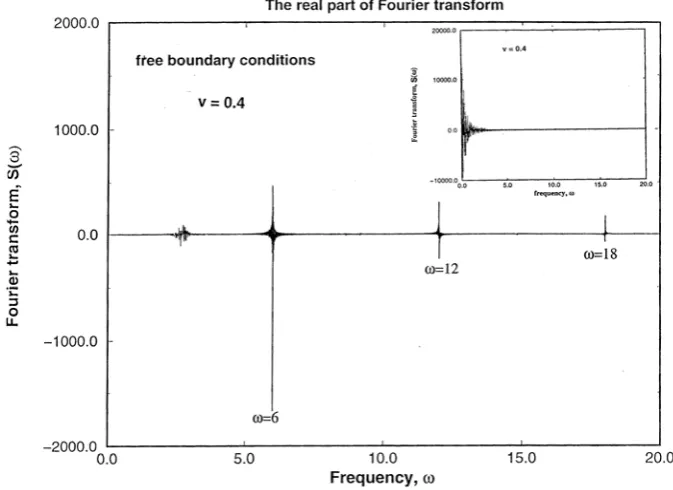
power input to the system. This is a very crucial result in dynamical lubrication. Figure 1 represents the force trace before and after applying the perturbation for the value v=0.4 which is originally outside the parameter window, for free boundary conditions, in which regular and periodic patterns emerge. In Figures 2 and 3 the configuration of the chain and real part of Fourier transform, respectively, are shown for v=0.4. Also Figures 4 and 5 represent the force trace and the configuration of the chain for the value v=0.6 which is initially outside the parameter window, for periodic boundary conditions, where the periodic behaviour emerges. We observe the role of coupled frequency in breaking the noise and reducing the amplitude and average of elastic force effectively. Even inside the parameter window of the previous work [17], the role of coupled frequency is very crucial. Here, by introducing appropriate frequency we can reduce the noise and lower the average value of power input with highly ordered behaviour. In our simulation the average of the driven power has been reduced up to some 15 percent (see Fig. 6). The response of the system to small variations in parameter is very quick, and orderliness emerges in a very short time. Figure 6 shows effectively this role of external frequency, where the total elastic force plotted versus time for the system with free boundary conditions for two different values of ω=0 and
ω=7.85 when v=0.6. We believe that changing from chaotic to ordered behaviour is very important from a theoretical and practical point of view; e.g., in dynamical lubrication and controlling chaos.
Taming Spatiotemporal Chaos with Disorder
Figure 2. The configuration of the chain after a long time when v=0.4, A=0.1, and ω=12. The other parameters are unchanged. The line is a guide to the eye and longitudinal displacements are plotted laterally for clarity of presentation.
Figure 4. Force trace P(t) plotted against time t before and after applying the perturbation for the parameters N=100, kc=40, kp=50, Fo=20 and v=0.6 which is outside the parameter window for the system with periodic boundary conditions. The role of imposed frequency in reducing the noise and controlling chaos is clearly observed.
Figure 6. Force trace P(t) Plotted against time t before and after applying the perturbation for the parameters N=100, kc=40, kp=50, Fo=20, A=0.4, ω=7.85, and v=0.6 which is inside the parameter window for the system with free boundary conditions. The role of imposed frequency in reducing the average of elastic force is clearly observed.
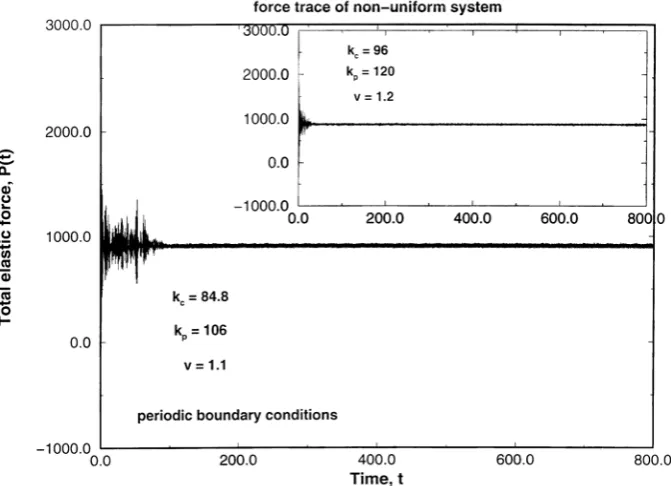
Figure 8. The force trace for a chain with a disordered array of threshold parameters Fo(j) for different set of parameter values. For the first graph the pulling velocity v is 1.1 and the chain stiffness kc is 84.8 and leaf spring constant is 106, which makes the
8 . 0
= =
p c
k k
α . The inset graph shows the force trace for the parameters v=1.2, kc=96 and
kp=120, again with the same vlue for α=0.8. The trace is quiet for long time intervals. boundary conditions refer to Figure 12, in Ref. [17]. We
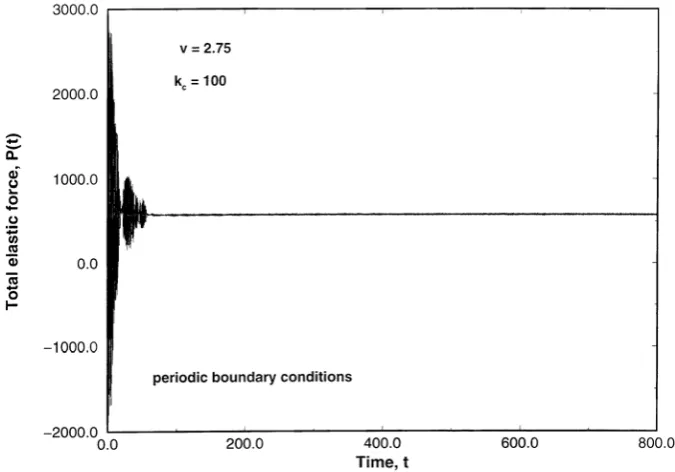
use a random distribution of Fo(j) so that the men value is 27.5 and the standard deviation is 8.8. Under normal conditions where v is equal to 0.6 and all other parameters are unchanged, P(t) is extremely broad and noisy at all times. But if we increase the value of v to 2.75 and increase kc to 100, then we find another window where the force trace settles down to rather stable, quiet behaviour after a long time (Fig. 7). Also, in another attempt we find that as long as we fix the quotient = =0.8
p c k k
α then there is a window for driving velocity in which the smooth shape of force trace and almost spatial ordered behaviour emerges. For example, Figure 8 shows this fact for the set of values of kc=84.8, kp=106 and v=1.1 and the set of kc=96, kp=120 and v=1.2.
Conclusion
In this report, we have shown the possibility of controlling chaos in a rather simple driven non-linear dynamical system: i.e., the spring-block model. It is shown that we can convert a chaotic behaviour system to a highly ordered and periodic behaviour applying only small time-dependent perturbations. The strategy for observing the quiet periodic behaviour is to force the ends of the system to oscillate with a suitable frequency as the system is driven from outside with constant
velocity. Our method is based on the step-by-step trial of parameters. There are some other methods for controlling the behaviour of a system, some of which are based on time delay coordinates [1] and some of them on feedback mechanism [20,21], or other methods [22]. We believe that this process is very crucial from a theoretical and practical point of view; e.g., in dynamical lubrication and reducing the noise and controlling chaos. It seems that using this strategy we can apply small spatially localized or distributed perturbations to control chaotic behaviour of the system outside the nearly periodic regime. If this is explored and understood more, there are potentially great practical advantages, some of them, as mentioned, would be noise reduction and wear reduction. Some type of intervention in a chaotic system, as mentioned in [6], could have great utility in controlling industrial processes where changing the built-in parameters of the system would be expensive or impossible.
system.
References
1. Ott, E., Grebogi, C. and York, J. A. Controlling Chaos, Phys. Rev. Lett., 64, 1196, (1990).
2. Takens, F. Dynamical system and turbulence, edited by D. Rand and L. S. Young, Springer-Verlag, Berlin, (1981).
3. Ditto, W. L., Rauseo, S. N. and Spano, M. L. Experimental control of chaos, Phys. Rev. Lett., 65, 3211-3214, (1990)
4. So, P. and Ott, E. Controlling chaos using time delay coordinates via stabilization of periodic orbits, Phys. Rev., E 51, 2955-2962, (1995).
5. In, V., Ditto, W. L. and Spano, L. Adaptive control and tracking of chaos in a magnetoelastic ribbon, Ibid., E 51, R2689-R2692, (1995).
6. Starrett, J. and Tagg, R. Control of a chaotic parametrically driven pendulum, Phys. Rev. Lett., 74, 1974, (1995).
7. Johnson, G. A., Locher, M. and Hunt, E. R. Stabilized spatiotemporal waves in a convectively unstable open flow: coupled diode resonators, Phys. Rev., E 51, R1625-R1628, (1995).
8. Sole, R. V. and Prida, L. M. Controlling chaos in discrete neural networks, Phys. Lett., A 199, 65, (1995).
9. Nagai, Y. and Lai, Y. C. Selection of a desirable chaotic phase using small feedback control, Phys. Rev., E 51, 3842-3848, (1995).
10. Ding, M., Ott, E. and Grebogi, C. Controlling chaos in a temporally irregular environment, Physica, D 74, 384-394, (1994).
11. Petrov, V., Gaspar, V., Master, J. and Showalter, K. Controlling chaos in the Belousov-Zhabotinsky reaction, Nature, 361, (Jan., 1993).
12. Lu, W., Yu, D. and Harrison, R. G. Control of patterns in spatiotemporal chaos in Optics, Phys. Rev. Lett., 76, 3316-3319, (1996).
13. Murphy, R. R., Maier, T. W., Gilles, T. D. and Hunt, E. R. Ibid., 68, 1259-1262, (1992).
14. Hunt, E. R. Stabilizing high period orbits in a chaotic system: the diode resonator, Ibid., 67, 1953-1955, (1991). 15. Petrov, V. and Showalter, K. Non-linear control of dyna-mical system from time series, Ibid., 76, 3312-15, (1996). 16. Burridge, R. and Knopoff, L. Model and theoretical
seismicity, Bull. Seismol. Soc. Am., 57, 341-347, (1967). 17. Sarkardei, M. R. and Tacobs, R. L. Dynamical origin of
spatial order, Phys. Rev., E 51, 1929-1935, (1995). 18. Carlson, J. M. and Langer, J. S. Properties of earthquakes
generated by fault dynamics, Phys. Rev. Lett., 62, 2632-2635, (1989) and Carlson, J. M. and Langer, J. S. Mechanical model of an earthquake fault, Phys. Rev., A 40, 6470-6484, (1989).
19. Braiman, Y., Lindner, F. and Ditto, W. L. Taming spatiotemporal chaos with disorder, Nature, 378, 465-467, (Nov., 1995).
20. Carlson, J. M., Langer, J. S. and Shaw, B. E. Dynamics of earthquake faults, Rev. Mod. Phys., 66, 657-670, (1994). 21. Cooper, D. P. and Scholl, E. Tunable real space transfer
oscillator by delayed feedback control of chaos, Z. Naturforsch., 50 a, 117-124, (1995).
22. Yao, W. Controlling chaos by standard signals, Phys.