Multipath Routing Protocols in WMN: A Study
1Ashutosh Dimri, 2Prof. Ranjit Biswas
1M.Tech (CSE), Department of Computer Science, Jamia Hamdard, New Delhi, India 2Professor & Dean, Department of Computer Science,Jamia Hamdard, New Delhi, India
Email - 1[email protected], 2[email protected]
1. INTRODUCTION:
Due to its dynamically well organized and well- configured network, the WMN brings new challenges and opportunities. Typically, a WMN can be treated a collection of nodes that communicate with one another and forward each other's packets [1]. The nodes of a WMN are classified as mesh router or mesh client. Every node within the network isn't only a host however additionally work as a router. The packets can be forwarded to other nodes beyond the direct range of wireless communication for their destinations.
A WMN is dynamic in nature by auto- organizing and self- configuring the nodes, thereby automatically establishing and maintaining mesh connectivity between the nodes. These features offer many advantages through the use of WMNs such as lower setup costs, simple network management, tolerance and decent service coverage. Figure 1 shows the architectural point of view of a typical wireless network.
The routing algorithm used is a key aspect of the network performance. For WMN, several single and multi- path routing algorithms were proposed. The important objective of multi- path routing is to integrate load balance and achieve a higher degree of fault tolerance. Several paths among two nodes are selected. The flow of the packet is allowed through each path. If a link fails on a path due to poor channel conditions or mobile conditions, the next path is chosen from the remaining path group. This paper compares the performance of multi- path routing protocols MHRP, MOLSR and AOMDV based on different parameters. The next section presents WMN's multi- path routing. Section 3 presents the features of various routing protocols for multipath. Section 4 describes the results and section 5 contains concluding comments.
Fig. 1. :Wireless mesh network consisting several clients to the internet [8].
2. MULTIPATH ROUTING IN WMN:
WMN has 2 types of nodes called mesh clients and mesh routers. The locations of mesh routers are fixed, but mesh clients can change their locations and connect via other mesh clients and mesh routers to the network. Additionally, to perform a traditional wireless router's routing capability for gateway/repeater functions, a node has extra routing functions to allow mesh connectivity.
Abstract: WMNs have recently developed as a new networking technology for deploying wireless networking infrastructure in metropolitan areas. WMNs are attractive for network operators because they offer possibility for easy installation, fast deployment, and reduction of capital investment and operating expense. Routing in WMNs is difficult due to the unstable variations in the wireless environments. This paper gives the review of selected multipath routing protocols and their performance comparison.
The multipath routing uses the core network resources by establishing many paths between the source- destination pair. The reasons behind its use include the use of bandwidth, optimizing latency, making the network tolerant, building reliability and equal load distribution, and so on. The aim of multipath routing is to use the different valid routes to reach the destination and not only the most appropriate route. However, the overhead control involved in setting up these multi- paths should be optimal.
The different aspects of multipath routing are: traffic distribution, path exploration and path maintenance. The path exploration phase decides the existing routes for the pair of nodes. The number of routes for the distribution of traffic is selected during the distribution phase. The maintenance of the path is responsible for generating paths once the initial path has been explored. It can either be started after the failure of one path or after the failure of all paths.
A. Path Exploration
Path exploration is the mechanism of finding out the Exploration of the path is the mechanism to determine the existing path set for a sender and receiver. There are many problems a protocol should consider when deciding on the subset of available paths that it is likely to generate during the exploration process.
B. Traffic Distribution
A number of methods are available to allocate traffic to existing paths. A multi- path protocol can only transmit traffic using the best path although maintaining other paths explored as backups or parallel paths. An algorithm for finding a path selects a subset of available paths based on a specific path attribute. For example, numbers of hops are widely used as a metric for a long time. Some other possible measurements are: disconnectedness, path reliability, degree of interdependence between routes, free bandwidth etc.
C. Path Maintenance
The maintenance of the path can be indicated as a mechanism to recreate the paths after the initial discovery. Due to the resource constraints of the node, paths are very prone to error. Therefore, the reconstruction of the path should be a mechanism to reduce the degradation of performance.
3. MULTIPATH ROUTING PROTOCOLS:
The main objective of the routing protocol is to select the route between the sender and the receiver node. The protocol must be reliable, fast and with fewer overheads. Some multipath protocols regularly monitor and track the quality or overall quality of existing tracks using a dynamic maintenance algorithm. The multipath Routing protocols can be categorized as re-active, pro-active and hybrid.
A. Reactive Protocols
Routes are established only when on the demand by the source node. Few reactive protocols are:
AOMDV
AODV-BR
AODV-DM
SMR
The AOMDV protocol works step- by- step on the basis of the distance vector and routes [10]. In addition, AOMDV discovers several paths with a single path finding technique on request.
The route request (RREQ) propagates from the sending node to the receiving node and establishes many return paths at both the intermediary and the receiving nodes. AOMDV also assigns alternative paths to intermediate nodes because they are considered useful in reducing the frequency of route exploration. [8].
The AOMDV protocol's main concept is to ensure that multiple paths are disjointed and loop- free and that these paths are efficiently found using a flood- based routing method. The AOMDV protocol depends to a large amount on the routing information already present in the AODV protocol under consideration, thereby reducing the delay in finding multiple paths.
B. Proactive Protocols
Each node contains one or more routing information tables for all other network nodes. Multipath Optimized Link State Routing Protocol is a proactive protocol aimed at reducing delays and drops in packets by using multipath routing [8].The OLSR limits the use of multipoint relays and multipoint relay selectors. MOLSR discovers more than one route and selects two best routes according to the link metrics announced in TC messages. The paths with more than 2 nodes are not considered.
MOLSR introduces the cross- layer concept and the node discovery algorithm, which is used to determine each node on the route to avoid disconnecting paths. The objective of this protocol is to reduce packet delay and drop ratio.
C. Hybrid Protocol
Since infrastructure network routes are relatively static, RIRP is a proactive protocol. IRRP is a member of a reactive routing group providing maintenance services and enhanced route discovery through local connectivity within the regional scope. The Region Gateway Protocol (RGP) simplifies the paths between two adhoc regions. When a node sends the data to a destination node, it asks if there is a route to the destination; if the route is not present, the node initiates the route discovery phase. The discovery of the route is carried out in three phases: route request, route setting and route response. MHRP is hybrid in nature as it takes both a proactive and a reactive approach to route discovery.
3. SIMULATION ENVIRONMENT:
EXPERIMENTAL SETUP
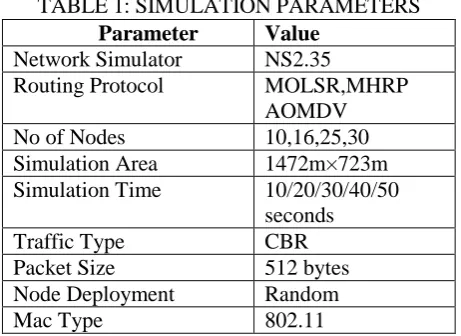
The simulation is performed to evaluate the performance of the WMN routing protocols for defined parameters using NS2. NS2 V 2.35 was used in the simulation study. For each experiment, the simulation was done with 10, 20, 30, 40, 50 nodes. All the nodes were distributed in the area of 1472 m x 723 m. The first node has been set to source while the last node has been set to target. The payload data was 512 bytes. Traffic type was the constant type of traffic.Figure 2 shows a simulated WMN with a random deployment of 30 mesh nodes over 1472 m x 723 m region.
Fig. 2. WMN with 30 random placement nodes using NS2.
With this simulation setup, three protocols MOLSR, MHRP and AOMDV are simulated. The simulation parameter details are shown in Table 1.
TABLE 1: SIMULATION PARAMETERS Parameter Value
Network Simulator NS2.35
Routing Protocol MOLSR,MHRP AOMDV
No of Nodes 10,16,25,30
Simulation Area 1472m×723m Simulation Time 10/20/30/40/50
seconds
Traffic Type CBR
Packet Size 512 bytes
Node Deployment Random
Mac Type 802.11
In this simulation study, following 4 parameters are used for simulation of selected routing protocols:
Packet delivery ratio: The ratio of the number of packets received successfully at the destination node to the total number of packets sent by the source node.
End to End Delay: The network delay lists the latency required for some data to pass through the network from one node or endpoint to another.
Packet loss ratio: If one or more transmitted packets are not able to reach their destination, it is known as packet loss. The loss ratio of packets indicates the percentage of packets transmitted that could not reach the destination.
4. RESULT:
The measured parameters are used to compare the reactive, proactive and hybrid protocols.
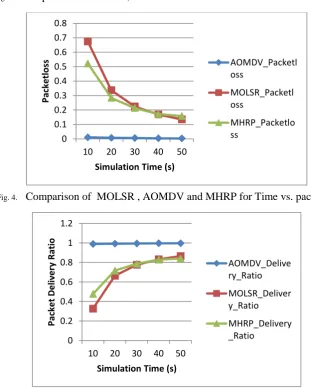
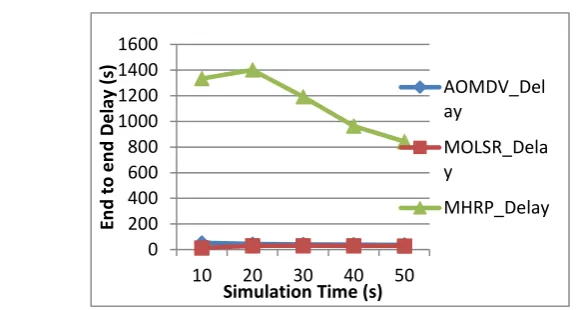
This simulation of MOLSR, MHRP and AOMDV protocols was carried out for four different parameters: packet delivery ratio, end to end delay, packet loss ratio and throughput.
For each protocol, performance was analyzed for different simulation time and values of end to end delay, throughput, packet delivery ratio and packet loss ratio and were measured for each protocol.
The results for throughput, packet loss, packet delivery ratio and end to end delay versus time are shown in Fig.
3, Fig. 4 Fig 5 and Fig. 6, respectively.
Fig. 3. Comparison of MOLSR, AOMDV and MHRP for Time vs. Throughput.
Fig. 4. Comparison of MOLSR , AOMDV and MHRP for Time vs. packet loss
Fig. 5. Comparison of MOLSR , AOMDV and MHRP for Time vs. packet Delivery Ratio
0 100 200 300 400 500 600 700 800
10 20 30 40 50
Th ro u gh p u t (K B PS )
Simulation Time (s)
AOMDV_Throug hput MOLSR_Through put MHRP_Through put 0 0.1 0.2 0.3 0.4 0.5 0.6 0.7 0.8
10 20 30 40 50
Pack
e
tloss
Simulation Time (s)
AOMDV_Packetl oss MOLSR_Packetl oss MHRP_Packetlo ss 0 0.2 0.4 0.6 0.8 1 1.2
10 20 30 40 50
Pack e t D e liv e ry R atio
Simulation Time (s)
Fig. 6. Comparison of MOLSR , AOMDVand MHRP for Time vs. Delay
5. CONCLUSION:
This paper presented performance comparison among three WMN multipath routing protocols: MHRP, AOMDV and MOLSR. Simulations in different random topologies have been performed using Network Simulator 2. The results show that the AOMDV protocol performs better for the given simulation environment than MOLSR and MHRP in terms of packet delivery ratio, throughput and packet loss. But MOLSR’s end- to- end delay is slightly better than AOMDV and far better than MHRP. It can be concluded that AOMDV performs better than MHRP and MOLSR for a WMN consisting of 10 to 30 nodes in the given region. Our future work includes the enhancement of AOMDV by improving the security features of it.
REFERENCES:
1. F. Akyildiz, X. Wang, and W. Wang, "Wireless mesh networks: a survey," Computer Networks, vol. 47, pp. 445-487, 2005.
2. Lee, Myung & Zheng, Jianliang& Ko, Young-Bae & Man Shrestha, Deepesh, “Emerging Standards for Wireless Mesh Technology”. Wireless Communications, IEEE, pp. 56-63, 2006.
3. S. Xuekang, G. Wanyi, X. Xingquan, X. Baocheng, G. Zhigang, “Node discovery algorithm based multipath
olsr routing protocol,” International Conference on Information Engineering, pp. 139-142, 2009.
4. C. Perkins, E. Belding-Royer and S. Das, “Ad hoc On demand Distance Vector (AODV) Routing,” IETF, RFC 3561,2003.
5. B.S. Manoj, R. R. Rao, “Wireless mesh networks: issues and solutions,” Wireless Mesh Networking:
Architecture, Protocols and Standards. Auerbach Publications, 2007.
6. J. Jun, M L. Sichitiu, “MRP: Wireless Mesh Networks Routing Protocol” Computer Communication, 2008.
7. W. Zhang, Z. Wang, S. K. Das, M. Hassan, “Security Issues in Wireless Mesh Networks,” Wireless Mesh Networks: Architectures and Protocols, Springer, 2008.
8. M. S. Siddiqui, S. O. Amin, J. H. Kim, C.S. Hong, “MHRP: A Secure Multi-Path Hybrid Routing Protocol
For Wireless Mesh Network,” In Military Communications Conference, pp. 1-7, 2007.
9. K. Valarmathi, N. Malmurugan, “Multi Path Routing Protocol for Improving Reliability in IEEE 802.16
Wireless Mesh Networks,” International Conference on Trendz in Information Sciences and Computing, pp. 116-121, 2011
10. Marina, M. Das, “On-Demand Multipath Distance Vector Routing in Ad Hoc Networks,” 9th International
Conference on Network Protocols, 2001.
11. Eiman Alotaibi, Biswanath Mukherjee, “A survey on routing algorithms for wireless Ad-Hoc and mesh
networks”, Computer Networks, pp. 940-965, 2012 0
200 400 600 800 1000 1200 1400 1600
10 20 30 40 50
En
d
t
o
e
n
d
Delay
(s)
Simulation Time (s)
AOMDV_Del ay
MOLSR_Dela y
![Fig. 1. :Wireless mesh network consisting several clients to the internet [8].](https://thumb-us.123doks.com/thumbv2/123dok_us/8720439.1743678/1.595.158.438.515.687/fig-wireless-mesh-network-consisting-clients-internet.webp)