Available Online at www.ijpret.com 57
INTERNATIONAL JOURNAL OF PURE AND
APPLIED RESEARCH IN ENGINEERING AND
TECHNOLOGY
A PATH FOR HORIZING YOUR INNOVATIVE WORK
CASTING METHODS DESIGN, SIMULATION AND OPTIMIZATION OF CIRCULAR
PLATE
MANMIT SALUNKE1, RUSHIKESH KATE2, VISHWAS LOMATE3 1. Assistant Professor, Department of Mechanical Engineering, J.S.P.M.’S B.I.T, Barshi, Solapur, Maharashtra, India 2. Assistant Professor, Department of Mechanical Engineering, J.S.P.M.’S B.I.T, Barshi, Solapur, Maharashtra, India
Accepted Date: 05/03/2015; Published Date: 01/05/2015
\
Abstract: Casting simulation helps designers to see how their designs will be resulted after casting process without needing to do the casting process. The use of simulation programs saves time and reduces the costs of the casting system design .Casting design simulation holds an important role in analyzing the outcome of the design. Casting solidification is actually the transformation of liquid phase to solid phase with the liberation of latent heat of fusion. During this metallurgical process, it induces casting defects like shrinkage, porosity and hot tears. To eradicate and eliminate these problems, accurate casting design and proper design of gating system is necessary. This can be predicted and designed by means of computer simulation of casting solidification. In this paper casting of circular disc is analyzed and studied to solve the problem frequent rejections due to shrinkage observed at machining stage. Initially feeder system is designed using past experience and judgment of patternmaker. .A well-designed feeding system is very important to secure good quality and optimal yield. The feed system is analyzed using theoretical knowledge and casting simulation. There after the feeder system for disc is redesigned based on feeding rules, conventional method and casting simulation. All the designs were simulated with Auto-Cast-X [Viewer Mode] to ensure the completion of filling process and to see the manner of solidification of Cast Iron castings. The various models are made, then 3D CAD model of casting with these modified feeder system are simulated to analyze effectiveness of modified feeder system. Results from simulation are used to evaluate the possibility of defects and minimize them .Analyzing the various modified feeder system and the most suitable design is selected so as it will give the improved quality of casting to achieve defect free casting.
Keywords: 3d Cad Modeling, Metal casting, Casting simulation, Solidification simulation, Quality, Defects, Mold filling
Corresponding Author: MR. MANMIT SALUNKE
Access Online On:
www.ijpret.com
How to Cite This Article:
Manmit Salunke, IJPRET, 2015; Volume 3 (9): 57-64
Available Online at www.ijpret.com 58
INTRODUCTION
Traditionally, casting process development is an inherent trial and error workflow. Design and engineering departments develop the guidelines for building a component mainly based on previous experiences. Although the foundry aims to manufacture the components in the desired quality, the initial casting trials of new prototypes often fail due to design mistakes. Therefore, modern casting engineering demands a stronger interlocking of the design and casting process.
This is because the later changes are made in this process chain, the more expensive they become. With the emergence of computer technology, Computer Aided Design (CAD) has also entered the area of casting engineering. Since the computer aided simulation of casting and solidification processes has become a necessity in founding industry.
Computer Aided Casting Simulation
Nowadays, Computer Aided Design is not limited to sketching and drafting, but also helps to create analyzable models as needed for computer based process simulation. Since industrial process simulation supports the identification of process issues and thus aids in the formulation of new design rules, it has become an inevitable part of the development chain. Therefore, also the simulation of casting and solidification processes has become a necessity in founding industry. A prior simulation of the entire manufacturing process makes potential castability problems already become apparent in the earlier design stages. Thus, modelling and simulating the casting process by a capable software tool helps to reduce manufacturing costs and to increase yield and casting quality.
Casting process modeling
Available Online at www.ijpret.com 59
applications to visualize and predict the casting results so as to provide guidelines for improving product as well as mold design in order to achieve the desired casting qualities .Prior to applying the Autocast extensively to create sand casting models for the simulation of molten metal flow (mold filling) and solidification).. Sand casting is the casting process that has the longest history (Ravi et al, 2005). Sand casting still accounts for the largest tonnage of production of shaped castings. This is due to the fact that sand casting is economical and possesses the flexibility to produce castings of any material and the weight of castings can be range from tens of grams to hundreds of tons. Conventional sand casting is not a precision process and requires after-cast machining processes and surface finishing producing the required dimensions and surface quality.
A. Problem definition:
A Circular plate as a weight component is manufactured by sand casting Its overall size is 150*150*20 mm and its weighs 2.5kg. The casting is exhibited a large shrinkage defects next to feeder .It suffered frequent rejections due to shrinkage, observed at machining stage .
Cast Metal Cast Iron - CI
4.0 CE
Casting Process Sand Casting
Density 7200 kg/m³ Liquidus 1176 ºC
Part Dimensions 150 mm X 150
mm X 20 mm
Part Surface Area 450.88 cm²
Min. Thickness 8.87 mm Max. Thickness 8.87 mm
Part Weight 2.49 kg Part Volume 332.57 cm³
Mold Material Green Sand Density 1550 kg/m³
Mold Dimensions 345mm X 345
mm X 130 mm
Parting Orientation Horizontal
Number of Cavities 2 x 2
Min. Cavity-Wall Gap 80.03 mm Metal / Sand (weight) 49.94%
Min. Cavity-Cavity Gap 14.44 mm Metal / Sand (Volume) 10.36%
ΙΙ. METHODOLOGY
Available Online at www.ijpret.com 60
iteration which is associated with machining cost, tooling cost, modification cost, melting cost, fettling and transportation cost as well as energy, materials, time are wasted in each trial until and unless the required results are obtained. hence optimization using conventional process is costly , complex and time consuming.In computer aided casting optimization , designs are made using feeding rules and theoreticalknowledge and according to the design the 3D CAD model of casting with each riser is made and further simulated to check for defects, if desired results are not obtained then riser design is modified based on feeding rules and previous simulation results . The required modifications are made in 3D CAD model of casting with riser and again simulated to check defects; the procedure is carried out until the required results are obtained. After analyzing the simulation results of the various modified feeder designs the best design is selected so as to obtain the defect free casting with the optimal casting yield.
A. Analysis of casting: For the analysis purpose of the casting of circular disc, the 3D model of the casting is made with modeling software and further it is simulated using e-foundry simulation
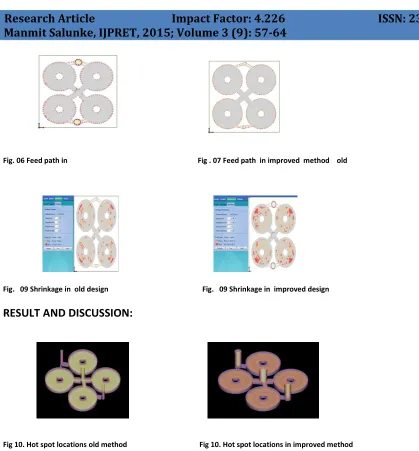
lab. Previos methoding included a cylindrical feeder of height 70 mm and 16 mm bottom diameter. From the result of simulation the size and location of hot spot is known, which match the casting defects in location and shape . The revised method design included a large feeder 75mm height and 35 mm bottom diameter. Simulation now shows better directional solidification with hot spot shifting entirely to feeder ,and leding to defect free casting.The results will appear as 3D colour image of temperatures inside casting at the end ofsolidification. From the image idea regarding temperatures inside casting can be achieved. The various colours for the analysis of state of metal and temperatures used are as follows: Blue indicates Early freezing region, red – In phase of solidification, white – Hot region, yellow – Hot spot. From the simulation result it is clear that hot spot is occurring in the part of circular disc hence defects such as porosity, cavity, surface sinks occurs.
STEPS
1. Solid model a cast part and save it as a .STL file.
2. Browse and upload the casting model
3. Wait till the simulation results are displayed.
4. Identify hot spots. Decide feeder size and location.
Available Online at www.ijpret.com 61
6. Simulate again and check the location of hot spots.
7. If hot spots are not shifted inside feeders, repeat 4-6.
Fig 1 .3D CAD model of circular disc
Fig2.defect in circular disc casting Fig 3 . 3D CAD and simulation result of disc without feeder system
Fig4 .3D CAD model of circular disc with feeder system
Available Online at www.ijpret.com 62 Fig. 06 Feed path in Fig . 07 Feed path in improved method old
Fig. 09 Shrinkage in old design Fig. 09 Shrinkage in improved design
RESULT AND DISCUSSION:
Fig 10. Hot spot locations old method Fig 10. Hot spot locations in improved method
The comparison of the initial and modified castingdesigns on the various parameters are given below,
1.) Considering initial design for a disc, simulation results showing hot region in casting hence the its is not working properly and efficiently. Temperature observed at part side is 1106 max and Temperature in feeder side is 709 max.
Available Online at www.ijpret.com 63
Simulation Result
Feed F old Design Improved design
Feeder
Feeding Yield 96.36% 90.37%
Orientation Side Side
Shape Cylindrical Cylindrical
Weight 173.14 g 522.76 g
Volume 23.17 cm³ 69.94 cm³
Diameter Top 13 mm 25 mm
Diameter Bottom 16 mm 35mm
Height 70 mm 75mm
Number ofNecks 2 2
Gating
Pouring Temperature 1326 ºC 1326 ºC
Total Metal Head 75 mm 75 mm
Gating System Weight 398.8 g 509.57 g
Total Poured Weight 10.72 kg 11.51 kg
Gating Yield 96.14% 95.12%
Number of Gates 4 4
Total Gating Weight 115.83 g 60.44 g
Total Gate Area 10 cm² 15 cm²
Total Gating Volume 15.5 cm³ 8.09 cm³
solidification time 2.57 min old 5.26 min
Temp in part side 1106 max 709 max
Temp in feeder side 865 max 1063 max
cavity filling time 3.49 sec 2.52 sec
Yield 92.77% 86.37%
Hot Spot In part side Shifted in Feeder side
Casting simulation clearly showed a hot spot region in part side, matching the casting defect in location & shape. The revised methoding was stimulated and analyzed for casting quality. From figure., we can see “Hot Spots” and the largest of them is being present at the feeder side. Therefore we could come to a conclusion that the above design of gating system for the circular plate is correct
Available Online at www.ijpret.com 64
critical section analysis shows improved temperature and gradient contours ,assuring the metal flow from the feeder to the casting.
The cause of the defect was correctly identified as an undersized feeder, used in simulation and this was corrected and verified by simulation again to achieve defect free casting . The revised methoding with modified feeding & getting system produce defect free casting with optimal yield. The rejection will eliminated by revised methoding.
REFERENCES
1. Auto CAST-X User Guide, Advanced Reasoning Technologies, Mumbai, India (2010).
2. Ravi, B. and Srinivasan, M.N. “Casting Solidification Analysis by Modulus Vector Method,” International Cast Metals Journal, Vol 9, Issue 1, pp. 1-7 (1996).
3. Ravi and Durgesh Joshi, “Feedability Analysis and Optimization Driven by Casting Simulation,” Indian Foundry Journal 53(6), pp 71-87, 2007.
4. B. Ravi, “Computer-aided Casting Design and Simulation”, STTP, V.N.I.T. Nagpur, July 21, 2009.
5. B. Ravi, “METAL CASTING : Computer Aided Design and Analysis”, 2005 PHI Learning Private Limited, New Delhi ISBN-978-81-203-2726-9. 2005.
6. B. Ravi, “Casting Design and Simulation”, Indian Institute of Technology Bombay, Mumbai. 2008 Efoundry.iitb.ac.in.
7. B. Ravi, “Casting Simulation and Optimization: Benefits, Bottlenecks, and Best Practices,” Technical Paper for Indian Foundry Journal Special Issue, January 2008.
8. B. Ravi, Casting Simulation Case Studies, Centre for Education and Training, Institute of Indian Foundrymen, Kolkata, 2012.