Available Online At www.ijpret.com
INTERNATIONAL JOURNAL OF PURE AND
APPLIED RESEARCH IN ENGINEERING AND
TECHNOLOGY
A PATH FOR HORIZING YOUR INNOVATIVE WORKDIGITAL WATERMARKING OF AN IMAGE USING WAVELET TRANSFORM
VANDANA STHUL, PROF. N. N. KHALSADepartment of Electronics & Telecommunication Engg, RMITR-Badnera-Amravati.
Accepted Date:
27/02/2013
Publish Date:
01/04/2013
Keywords
Digital Image
Watermarking,
3-level DWT,
Wavelet transform,
MSE,
PSNR.
Corresponding Author
Ms. Vandana Sthul
Abstract
Available Online At www.ijpret.com INTRODUCTION
With the widespread distribution of
digital information over the World Wide
Web (www), the protection of intellectual
property rights has become increasingly
important. These information, which
include still images, video, audio, or text
are stored and transmitted in a digital
format. Information stored in digital
format can be easily copied without loss
of quality and efficiently distributed. The
digital watermark is then introduced to
solve this problem. Digital watermarking
is a technique which makes use of the
redundant information and random
characteristics commonly consisting in
digital products (images, audio, video,
etc.) to embed copyright information in
the digital works so as to protect the
copyright or integrity of digital products.
Digital watermark technology is an
important research on information hiding.
Which is used to hide proprietary
information in digital media like
photographs, digital music or digital
video. The ease with which digital content
can be exchanged over the Internet has
created copyrightinfringement issues.
Copyrighted material can be easily
exchanged over peer-to-peer networks,
and this hascaused major concerns to
those content providers who produce
these digital contents.
In order for a digital watermarking
method to be effective it should be
imperceptible, and robust to common
image manipulations like compression,
filtering, rotation, scaling cropping, and
collusion attacks among many other
digital signal processing operations.
Many disciplines, such as signal
processing, cryptography, digital
communications, are now researching
and applying digital watermarking
technology. Researchers in various
disciplines who are different in their
research perspectives and research
priorities have put forward a lot of
algorithms. These algorithms are different
and all have their own features, but they
can be divided into two categories,
namely, spatial domain algorithm and
transform domainalgorithms. Current
digital image watermarking techniques
can be grouped into two major classes:
Spatial Domain Watermarking and
Frequency Domain Watermarking.
Compared to spatial domain techniques,
frequency-domain watermarking
Available Online At www.ijpret.com
with respect to achieving the
imperceptibility and robustness
requirements of digital watermarking
algorithms. Commonly used
frequency-domain transforms include the Discrete
Wavelet Transform (DWT), the Discrete
Cosine Transform (DCT) and Discrete
Fourier Transform (DFT). However, DWT
has been used in digital image
watermarking more frequently due to its
excellent spatial localization and
multi-resolution characteristics, which are
similar to the theoretical models of the
human visual system. Further
performance improvements in
DWT-based digital image watermarking
algorithms could be obtained by
increasing the level of DWT.
2. RELATED WORK
In this section we will look into the
review of digital watermarking used for
images. It describes the previous work
which had been done on digital
watermarking by using DWT technique
and other techniques, including the
analysis of various watermarking schemes
and their results. PgahFakhari a. [1]
introduced a novel digital watermarking
approach for copyright protection and
authentication of medical images based
on the wavelet transform. They employ
the particle swarm algorithm and genetic
algorithm optimization principles to
obtain performance improvement in this
method the strength of embedded
watermark and noise are controlled to
prevent the image from being used
directly regarding to visual properties of
the host image. Also embedded
watermark are varied to find the most
suitable ones for images with different
characteristics.
Mistry [2] introduced digital
watermarking methods- Spatial domain
(like LSB) and transform domain (like DCT,
DWT) methods. The spatial domain is the
normal image space, in which a change in
position in image directly projects to a
change in position in space. Ex. Least
Significant bit (LSB) method. Transform
Domain Method produce high quality
watermarked image by first transforming
the original image into the frequency
domain by the use of Fourier Transform,
Discrete Cosine Transform (DCT) or
Discrete Wavelet transforms (DWT).
Authors found that transform
watermarking is compa -ratively much
better than the spatial domain encoding.
Available Online At www.ijpret.com
watermarking scheme which provides
higher resistance to image processing
attacks such as JPEG compression, noise,
rotation, translation etc. In this approach,
the watermark is embedded in the mid
frequency band of the DCT blocks carrying
low frequency components and the high
frequency sub band components remain
unused. Watermark is inserted by
adjusting the DCT coefficients of the
image and by using the private key.
Watermark can then be extracted using
the same private key without resorting to
the original image. Performance analysis
shows that the watermark is robust.
Xia et.al [10] proposed a watermarking
scheme based on the Discrete Wavelet
Transform (DWT). The watermark,
modeled as Gaussian noise, was added to
the middle and high frequency bands of
the image. The decoding process involved
taking the DWT of a potentially marked
image. Sections of the watermark were
extracted and correlated with sections of
the original watermark. If the
cross-correlation was above a threshold, then
the watermark was detected. Otherwise,
the image was decomposed into finer and
finer bands until the entire, extracted
watermark was correlated with the entire,
original watermark. Performance analysis
shows that DWT is more robust to attack
than DCT [8]. The problem with the
proposed method is that this technique is
susceptible to geometric attacks.
Akhil et al. [4] proposed a robust image
watermarking technique based on 1-level
DWT (Discrete Wavelet Transform). This
method embeds invisible watermark into
salient features of the original image
using alpha blending technique.
Experiment result shows that the
embedding and extraction of watermark
is depend only on the value of alpha. All
the results obtained for the recovered
images and watermark is identical to the
original images.
G. Bhatnagar et al [5] presented a
semi-blind reference watermarking
scheme based on discrete wavelet
transform (DWT) and singular value
decomposition (SVD) for copyright
protection and authenticity. Their
watermark was a gray scale logo image.
For watermark embedding, their
algorithm transformed the original image
into wavelet domain and a reference
sub-image is formed using directive contrast
and wavelet coefficients. Then, their
Available Online At www.ijpret.com
reference image by modifying the singular
values of reference image using the
singular values of the watermark.
M. Barni et al. [6] have developed an
improved wavelet-based watermarking
through pixel-wise masking. It is based on
masking watermark according to
characteristics of HVS. The watermark is
adaptively added to the largest detail
bands. The watermark weighing function
is calculated as a simple product of data
extracted from HVS model. The
watermark is detected by correlation. The
proposed method is robust to various
attacks but this method is complex than
other transform technique.
Kundur et al. [7] decomposed binary logo
through DWT. The watermark is scaled by
a salience factor, computed on a block by
block basis, depending on local image
noise sensitivity. It is then repeatedly
added to the sub bands of DWT
decomposition of host image. Visual
masking is thus exploited up to only block
resolution. A binary code is embedded by
suitably quantizing the coefficients of
detail bands. For watermark recovery, the
embedded binary code is estimated by
analyzing coefficients quantization. Once
the code is estimated, it is correlated and
result is compared to a threshold.
LI Hui-fang [8] this proposed the image
digital watermarking based on DWT they
prove that this watermark has better
ability of hiding and anti interference.
Mohammad-RezaKeyvanpour[9] presents
a new watermark embedding technique
based on Discrete Wavelet Transform
(DWT) for hiding little but important
information in images. In order to
conform to human perception
characteristics, this approach uses three
sub-bands of DWT. The main goal of the
proposed scheme is to apply a dynamic
blocking instead of a static one for
selecting the positions of the embedding
watermark bits. Dynamic blocking is
applied to those pixels which are related
to strong edges where these pixels are
obtained from HL and LH sub-bands of
DWT. Because watermark bits are
embedding several times and their
embedding position depend to the
selected cover image, our proposed
scheme is naturally secure to block based
local attacks, and therefore, it is suitable
for maps and natural images. Robustness
of this technique is because of the fact
Available Online At www.ijpret.com
these two sub-bands, i.e. HL or LH, has a
role of backup for the other one.
Experimental results show the high
validity and good transparency of this
new approach.
Most methods found in literature are
highly complex and involve multiple
execution stages. In this paper, we tried
to propose a new simple methodology to
hide a gray scale image within another
gray scale image using 3- level DWT and
the the alpha-blending technique for the
process of security.
3. DIGITAL WATERMARKING
Digital watermarking is a new technology
that allows the imperceptible insertion of
information into multimedia data. The
supplementary information called
watermark is embedded into the cover
work through its slight modification. This
work is hidden form view during normal
use and only becomes visible as a result of
a special visualization process. An
important point of watermarking
techniques is that the embedded mark
must carry information about the host in
which it is hidden.
The most obvious example is banknotes
where watermarks are used as an extra
layer of protection from counter feting.
Recent technology has allowed the
principle of watermarking to be extended
to digital images, audio, video files. As
with the paper version, digital
watermarking adds information which is
normally invisible or barely visible to the
naked eye, but which can be detected in
order to identify the authenticity or
copyright owner of the image, video or
sound. For some purposes, however a
visible mark may actually be a better
determent than an invisible mark and
these are often used. For example by
cable and satellite television channels,
where the station logo is often
permanently placed in one corner of the
screen.
4.DISCRETE WAVELET TRANSFORM (DWT)
Discrete wavelet transform is a
transform domain transformation.
Wavelet transform is a new theory of
signal analysis. Compared with Fourier
transform and Gabor transform, it can
conduct multi-scale and refined analysis
for functions and signals effectively by
expansion operation, translational
operation etc. Therefore it has a variable
resolution rate on time and frequency. It
also overcomes a weakness of Fourier
Available Online At www.ijpret.com
Discrete Wavelet transform (DWT) is a
mathematical tool for hierarchically
decomposing an image. It is useful for
processing of non-stationary signals. The
transform is based on small waves, called
wavelets, of varying frequency and limited
duration. Wavelet transform provides
both frequency and spatial description of
an image. Unlike conventional Fourier
transform, temporal information is
retained in this transformation process.
Wavelets are created by translations and
dilations of a fixed function called mother
wavelet. This research applies wavelet
transform by using Haar wavelet
transform.
DWT is the multiresolution
description of an image the decoding can
be processed sequentially from a low
resolution to the higher resolution, The
DWT splits the signal into high and low
frequency parts. The high frequency part
contains information about the edge
components, while the low frequency
part is split again into high and low
frequency parts. The high frequency
components are usually used for
watermarking since the human eye is less
sensitive to changes in edges .
In two dimensional applications,
for each level of decomposition, we first
perform the DWT in the vertical direction,
followed by the DWT in the horizontal
direction. After the first level of
decomposition, there are 4 sub-bands:
LL1, LH1, HL1, and HH1. For each
successive level of decomposition, the LL
sub band of the previous level is used as
the input. To perform second level
decomposition, the DWT is applied to
LL1band which decomposes the LL1 band
into the four sub- bands LL2, LH2, HL2,
and HH2.
Figure1.3Leveldiscretewaveletdecomposit
Available Online At www.ijpret.com
To perform third level decomposition,
the DWT is applied to LL2 band which
decompose this band into the four
sub-bands – LL3, LH3, HL3, HH3. This results in
10 sub-bands per component. LH1, HL1,
and HH1contain the highest frequency
bands present in the image tile, while LL3
contains the lowest frequency band. The
three-level DWT decomposition is shown
in Fig.1.
5. PROPOSED WATERMARKING
TECHNIQUE
The proposed algorithm is divided into
two parts, watermark embedding and
watermark extraction.
A. Watermark Embedding
In the watermark embedding process
firstly the gray scale host image is taken
and 2-D, 3-level DWT (Discrete Wavelet
Transform) is applied to the image which
decomposes image into low frequency
and high frequency components. In the
same manner 2-D, 3-level DWT is also
applied to the watermark image which is
to be embedded in the host image.
The wavelet used here is the
wavelets of daubecheis. The technique
used here for inserting the watermark is
alpha blending. In this technique the
decomposed components of the host
image and the watermark are multiplied
by a scaling factor and are added. Since
the watermark embedded in this paper is
perceptible in nature or visible, it is
embedded in the low frequency
approximation component of the host
image.
According to the formula of the alpha
blending the watermarked image is given
by WMI =k * (LL3) +q * (WM3) (1)
Where, WMI = low frequency component
of watermarked image, LL3 = low
frequency component of the original
image obtained by 3-level DWT, WM3 =
low frequency component of Watermark
image, and k, q = Scaling factors for the
original image and watermark
respectively.
Figure 2. Watermark embedding
Available Online At www.ijpret.com
After embedding the cover image with
watermark image, 3-level Inverse discrete
wavelet transform is applied to the
watermarked image coefficient to
generate the final secure watermarked
image. Fig. 2 shows watermark
embedding process
B. Watermark Extraction
In this process firstly 3-level DWT is
applied to watermarked image and cover
image which decomposed the image in
sub-bands. After that the watermark is
recovered from the watermarked image
by using the formula of the alpha
blending.
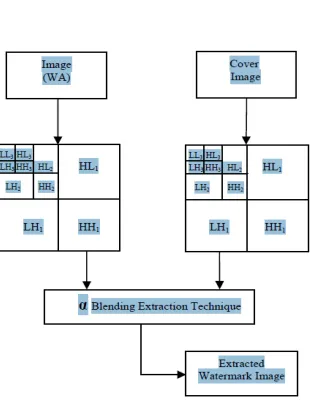
Figure 3. Watermark extraction technique
According to the formula of the alpha
blending the recovered image is given by
RW =(WMI - k * LL3) (2)
Where RW= Low frequency
approximation of Recovered watermark,
LL3= Low frequency approximation of the
original image, and WMI= Low frequency
approximation of watermarked image.
After extraction process, 3-level
Inverse discrete wavelet transform is
applied to the watermark image
coefficient to generate the final
watermark extracted image. Fig. 3 shows
the watermark extraction process.
6. RESULTS AND DISCUSSION
We compared proposed 3-level 2-D
DWT to the 2- level 2-D DWT technique.
For both the technique we have used gray
scale images Lena as original image and
the cameramen’s image as the
watermark. Both the images are of equal
size of 256X256. Fig. 4(a) shows the
original image and Fig. 4(b) shows the
watermark image.
For embedding of watermark in
the original image the value of scaling
factor k is varied from 1.5 to 0.6 by
Available Online At www.ijpret.com
obtained for k=0.98 for both 3 level and 2
level DWT. As the value of k is decreased
further to 0.2 the watermarked image
becomes darker and finally becomes
invisible. Fig. 5 shows the watermarked
image using 3-level discrete wavelet
transform for different value of k.
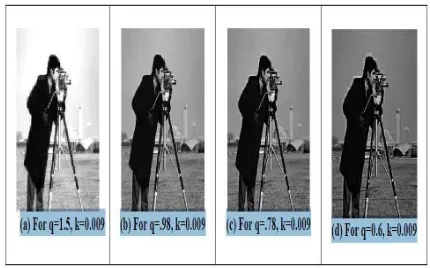
For the process of recovering the
watermark from the watermarked image
the value of k is kept constant at 0.009
and q is varied from 1.5 to 0.6. For the
higher values of q the watermark
becomes almost invisible and as the value
of q is reduced best result is obtained,
and if q is further reduced the recovered
watermark becomes darker and PSNR
decreases. Fig.6 shows the recovered
image using 3-level discrete wavelet
transform for different value of q.
Figure 4. Original and Watermarked
image
Figure 5. Watermarked images using
3-level DWT for various values of scaling
factors k
Figure 6. Recovered images using 3-level
DWT for various values of scaling factors q
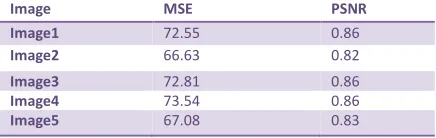
The peak signal to noise ratio
(PSNR) is employed to evaluate the
quality of information hidden image, the
MSE is employed to evaluate the quality
of recovered information. Table 1 shows
the experimental results that emphasis
the validity of the proposed algorithm on
some different images like (desert,
chrysanthemum, hydrangeas, koala,
Available Online At www.ijpret.com
distortion in the original and watermark
image. The values of MSE and PSNR are
calculated for varies input images by
keeping scaling factors constant at k=1.5
and q=0.009
TABLE I
COMPARISION OF MSE & PSNR FOR
WATERMARKED IMAGE IN TERMS OF
INPUT IMAGE
Image MSE PSNR
Image1 72.55 0.86
Image2 66.63 0.82
Image3 72.81 0.86
Image4 73.54 0.86
Image5 67.08 0.83
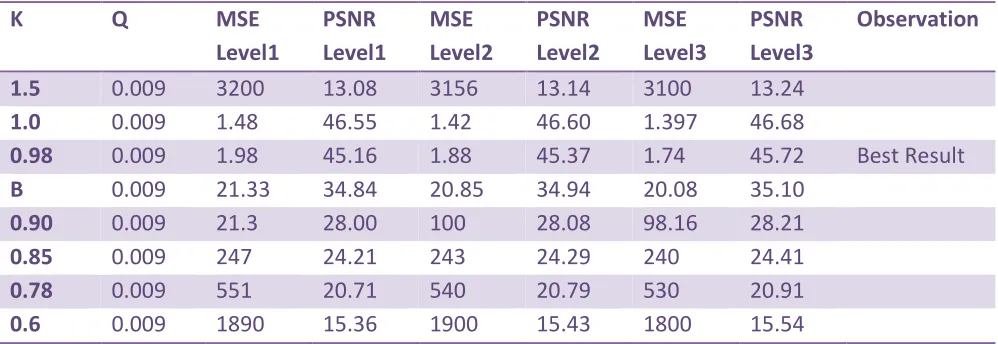
The values of the MSE (Mean square
error) and PSNR (Peak signal to noise
ratio) are calculated for various values of
the scaling factors k and q for 1-level,
2-level and 3 - 2-level DWT as shown in
Table II and Table III. Best result for
watermarked image is obtained at k= 0.98
& q=0.009 and best result for recovered
image is obtained at k= 0.009 & q= 0.98.
From Table 2 and Table 3, it can be
observed that the value of PSNR (peak
signal to noise ratio) is higher in case of
3-level Discrete wavelet transform for both
the watermarked and recovered image
which means that the proposed 3-level
DWT algorithm provide the better
performance than 1-level & 2-level DWT
Available Online At www.ijpret.com
TABLE II
COMPARISION OF 1-LEVEL,2-LEVEL AND 3-LEVEL DWT FOR WATERMARK IMAGE IN TERMS OF
MSE&PSNR
K Q MSE
Level1
PSNR Level1
MSE Level2
PSNR Level2
MSE Level3
PSNR Level3
Observation
1.5 0.009 3200 13.08 3156 13.14 3100 13.24
1.0 0.009 1.48 46.55 1.42 46.60 1.397 46.68
0.98 0.009 1.98 45.16 1.88 45.37 1.74 45.72 Best Result
B 0.009 21.33 34.84 20.85 34.94 20.08 35.10
0.90 0.009 21.3 28.00 100 28.08 98.16 28.21
0.85 0.009 247 24.21 243 24.29 240 24.41
0.78 0.009 551 20.71 540 20.79 530 20.91
0.6 0.009 1890 15.36 1900 15.43 1800 15.54
TABLE III
COMPARISION OF 1-LEVEL,2-LEVEL AND 3-LEVEL DWT FOR RECOVERD IMAGE IN TERMS OF
MSE&PSNR
Q K MSE
Level1
PSNR
Level1
MSE
Level2
PSNR
Level2
MSE
Level3
PSNR
Level3
observation
1.5 0.009 4450 11.65 4385 11.7 4300 11.79
1.0 0.009 6.4 310 2.5 304 5.3 301
0.98 0.009 7.11 39.6 7.016 39.67 6.90 39.74 Best Result
0.95 0.009 44.46 31.65 43.85 31.71 43.11 31.79
0.90 0.009 178 25.6 175 25.690 170 25.76
0.85 0.009 400 22.1 395 22.169 390 22.24
0.78 0.009 861 18.78 849 18.84 840 18.92
Available Online At www.ijpret.com 7. CONCLUSION AND FUTURE WORK
In this paper, an image watermarking
technique based on a 3-level discrete
wavelet transform has been implemented.
This technique can embed the invisible
watermark into salient features of the
image using alpha blending technique.
Experiment results shows that the quality of
the watermarked image and the recovered
watermark are dependent only on the
scaling factors k and q and also indicate that
the three level DWT provide better
performance than 1-level and 2- level DWT.
All the results obtained for the recovered
images and he watermark are identical to
the original images. The embedded
watermark can be extracted completely,
which indicates that this algorithm is
effective. This algorithm provide a new
approach for image digital watermarking
research and practice, therefore it is of
great practical significance.
8. REFERENCES
1. Pgean Fakhari, Eshan Vahedi, Caro
Lucas, “Protecting patient privacy from
unauthorized releas of medical image using
a bio-
2. inspired wavelet based watermarking
approach,”, Digital Signal Processing 21,2011
3. Darshana Mistry, Comparison of Digital
Watermarking methods, 21st Computer
Science Seminar SA1-T1-7, IJCSE, 2010.
4. Blossom Kaur, Amandeep Kaur, Jasdeep
Singh, Steganographic Approach for hiding
Image in DCT Domain, International Journal
of Advances in Engineering & Technology,
July 2011.
5. Akhil Pratap Shing, Agya Mishra,
Wavelet Based Watermarking on Digital
Image, Indian Journal of computer Science
and Engineering, 2011.
6. Bhatnagar, G. and Raman, B., A new
robust reference watermarking scheme
based on DWTSVD, Elsevier B.V. All rights
reserved 2008.
7. Barni M, Bartolini F, Piva, An Improved
Wavelet Based Watermarking Through
Pixelwise Masking, IEEE transactions on
image process]ing, 2001.
8. D. Kundur and D. Hatzinakos, Digital
Available Online At www.ijpret.com
Wavelet Decomposition, Proceedings, IEEE
International Conference Acoustic, Speech,
Signal Processing, 1998.
9. Li Hui-Frang,CHANGNing,CHEN
Xiao-ming“A Study on image Digital
Watermarking
BasedonWaveletTransform”,www.sciencedi rect.com/science/journal/10058885,http://
www,jcaupt.com,July 2011
10.Mohammad-Reza Keyvanpour,
Farnoosh Merrikh-Bayat,” Robust Dynamic
Block-Based Image Watermarking in DWT
Domain,”procedia Computer Science
3(2011)238-242
11.X. Xia, C. Boncelet.and G. Arce, ,”A
Multiresolution Watermark for Digital
Images,”Proc.IEEE Int. Conf.on Image