Available Online At www.ijpret.com
INTERNATIONAL JOURNAL OF PURE AND
APPLIED RESEARCH IN ENGINEERING AND
TECHNOLOGY
A PATH FOR HORIZING YOUR INNOVATIVE WORK
A REVIEW: RECENT TRENDS IN CLOUD COMPUTING
SHEETAL RAM PADMAWAR, PRASHANT BHALGE
1. Department of Computer Science and Engg. Babasaheb Naik college of Engineering and Technology, Pusad, Yavatmal , Maharashtra 445204
2. Asst. Professor, Department of Computer Science and Engg. Babasaheb Naik college of Engineering and Technology, Pusad.
Accepted Date:
27/02/2013
Publish Date:
01/04/2013
Keywords
Cloud Computing
PaaS
SaaS
IaaS
Piracy
Big Data
Hadoop
MapReduce
Dataset storage
Corresponding Author Mr. Prashant Bhalge
Abstract
Available Online At www.ijpret.com
1. INTRODUCTION
Cloud computing involves delivering hosted
services over the Internet on demand.
Cloud computing is scalable and managed
infrastructure. End-users simply consume
these services and pay on usage basis or
subscription basis. There are three famous
service models of cloud computing as
described below:
• Software as a Service (SaaS).
• Platform as a Service (PaaS):
• nfrastructure as a Service (IaaS)
Cloud computing has been driven
fundamentally by the need to process an
exploding quantity of data. One critical
trend shines through the cloud is Big Data.
When a company needed to store and
access more data they had one of two
choices. One option would be to buy a
bigger machine with more CPU, RAM, disk
space, etc. This is known as scaling
vertically. Of course, there is a limit to how
big of a machine you can actually buy and
this does not work, when you start talking
about internet scale. The other option
would be to scale horizontally. This usually
meant contacting some database vendor to
buy a bigger solution. These solutions do
not come cheap and therefore required a
significant investment. Dealing with big
datasets in the order of terabytes or even
petabytes is a challenging. In Cloud
computing environment a popular data
processing engine for big data is
Hadoop-MapReduce due to ease-of-use, scalability,
and failover properties.
Hadoop-MapReduce programming model consists of
data processing functions: Map and Reduce
. HDFS supports reliability and fault
tolerance of MapReduce computation by
storing and replicating the inputs and
outputs of a Hadoop job.
Cloud Computing is a service model where
services are providing to the end users with
flexible and scalable services available
through the internet [1]. The service can be
a software, hardware, infrastructure or
platform. This is a device independent
model because it resources can be accessed
not just from any computer on the internet,
but also any type of machines, provided
that it has an internet connection and web
Available Online At www.ijpret.com Several technologies are related to cloud
computing, and the cloud has emerged as a
convergence of several computing trends.
Cloud computing is a paradigm shift to
computing [2] that sees and delivers
computing as a service rather than as a
resource. Cloud computing encapsulates
several layers of computing provisioning
that include the hardware resources
located at the data centres of cloud
providers, the operating system and
virtualization software on top of that
hardware, and the applications that are
delivered as services over the internet.
These services are provided as utility to
customers who are billed based on usage,
similar to the billing scheme of traditional
public services such as electricity, telephone
and water.
1.1. Theoretical baselines
Cloud computing today is the beginning of
“network based computing” over Internet
in force. It is the technology of the decade
and the beginning to the end of the
dominance of desktop computing such as
that with the Windows. It is also the
beginning of a new Internet based service
economy: the Internet centric, Web based,
on demand, Cloud applications and
computing economy [3].
1.2. Distributed Computing
Distributed computing refers to the very
idea of using distributed systems that are
generally multiple computers connected to
each other via computer networks to
collaboratively process a common goal.
Those computers communicating can be
homogeneous or heterogeneous,
distributed globally or locally. According to
the characteristics of localization or
equality, distributed systems have different
subsets, such as supercomputers, grids,
clusters, web 2.0 and clouds [4].
Before going further into the subsets of
distributed computing, an illustration is
provided to visualize the interconnection
between the concepts that will be explained
in the following Figure 1: Distributed
Computing and its subsets.
Figure 1: Distributed Computing and its
Available Online At www.ijpret.com Every participating machine in a distributed
system is able to download the piece of
software and then interconnect to a
centralized server. The servers provide the
input from their sensors with a huge
amount of data, making the calculation of
this data normally very complicated. While
a single computer would not be able to do
that in an appropriate amount of time,
millions of computers that are
interconnected anywhere in the world
would be able to achieve that.
1.2.1 Clusters
Characteristics of clusters are that the
computers being linked to each other are
normally distributed locally, and have the
same kind of hardware and operating
system. Therefore cluster work stations are
connected together and can possibly be
used as a super computer [6].
1.2.2 Supercomputers
Supercomputers can be easily compared to
clusters, because it follows the same
concept, except the fact that it is merged
into one box already and is not locally
interconnected with other machines [6].
IBM is constructing those machines
consisting with a lot of processors that are
merged into one machine with high
performance capabilities [7]. The only
disadvantage is that they are usually
expensive and have the necessity of a huge
amount of energy.
1.2.3 Grids
When defining grid computing it is
necessary to differ it from clusters. Grids
involve heterogeneous computers that are
connected to each other and distributed
globally. The OS and hardware that run on
those machines can also be different from
each other [6].
The computers that are interconnected
over the internet can come from anywhere
while there is usually no obligation to pay.
For this reason already it is obvious that
Available Online At www.ijpret.com expensive as the supercomputers that are
offered from IBM and other technology
companies.
1.2.4 Clouds
Together with virtualization, clouds can be
defined as computers that are networked
anywhere in the world with the availability
of paying for the used clouds in a
pay-per-use way, meaning that just the resources
that are being used will be paid for [8].
1.3 Service models
Software as a Service (SaaS). In this
model, software application is hosted as
service and end-users use the application
on the web browser.
Platform as a Service (PaaS): In this
model, end-user creates, test and upload
applications using tools and libraries hosted
by the service provider.
Infrastructure as a Service (IaaS): This
model involves hosting of hardware
computing services like storage, hard-drive,
servers and network components. Service
provider is responsible for maintenance and
managing all these resources.
2. CLOUD COMPUTING RELATED
TECHNOLOGIES
Several technologies are related to cloud
computing, and the cloud has emerged as a
convergence of several computing trends.
Clouds extend the capabilities of other
domains with the specific goal to achieve
scalability/ elasticity, availability with
optimal resource utilisation, which is as
such only partially addressed in other
domains. Specifically, clouds belong to the
wider areas of Internet of Services
(including Web Services, Web3.0, Service
Oriented Architecture (SOA) etc.) and Utility
Computing (including Grid, Virtual
Organisations etc.) and implicitly inherit
multiple aspects from these domains, such
as virtualisation and outsourcing.
Depending on usage, they may extend
these characteristics, in particular by adding
Available Online At www.ijpret.com Figure 2: Inheritance and Extension of
Characteristics across the Related Domains
[9]
We refer Figure 2 here in particular to three
related domains, though the list can be
easily extended and refined:
Internet of Service: covering areas such as
Web Services, Web 3.0, and SOA etc. In
other words, individual service provisioning
without specific means for dealing with
availability, that is, just network load
balancing.
Utility Computing: including Grids, Virtual
Organisations, and also High Performance
Computing (HPC) to some degree, as they
were originally conceived and realised.
General IT or more correctly “non-web”
IT, including all computer science aspects
concerning isolated machines, i.e. without
making explicit use of the web. This
includes theory of computation, hardware
architectures, operating systems etc.
Figure 3: Overview of the Cloud
Characteristics and their Relationship to
other Domains. Inheritance is from Right to
Left. The Further Left is Characteristics
Advances, the more it needs to be adapted
for the respective domain(s), [9].
More specifically, the characteristics
identified above can be classified with
respect to the domains they were originally
conceived in and to the ones which take
up/extend them (see Figure 3). The
Columns denote the domain to which the
concepts apply, so that any entry within an
according column implies that the
respective characteristic is specifically
adjusted and or extended to meet the
domain‟s requirements. In other words,
single column entries imply that all domains
to the left inherit the characteristics
without significant adaptations,domains to
Available Online At www.ijpret.com If an entry spans multiple columns, it means
that the base concept is [10] conceived in
the right-most domain and that all domains
to the left adapt the concept to their
respective needs.
Cloud defines a four-layed architecture
Cloud infrastructure typically rely on Web
forms (over SSL) to create and manage
account information for end-users, and
allows users to reset their passwords and
receive new passwords via Emails in an
unsafe and unencrypted communication.
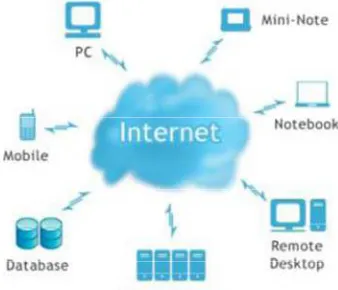
Figure 4: Cloud Computing [3]
3. BIG DATA
Big data is a collection of data sets so large
and complex which is also exceeds the
processing capacity of conventional
database systems. The data is too big,
moves too fast, or doesn‟t fit the structures
of our current database architectures. Big
Data is typically large volume of
un-structured (or semi structured) and
structured data that gets created from
various organized and unorganized
applications, activities and channels such as
emails, tweeter, web logs, Facebook, etc.
Figure 5 provides an example of big data.
The main difficulties with Big Data include
capture, storage, search, sharing, analysis,
and visualization.
Figure 5. Example of Different Sources of
Big Data
3.1Big Data Processing Methods
3.1.1 Hadoop
Hadoop is a batch processing system for a
cluster of nodes that provides the
underpinnings of most BigData analytic
Available Online At www.ijpret.com functionality most needed to deal with
large unstructured datasets nsmely,
Distributed file system and MapReduce
processing. it is a project from the Apache
Software Foundation written in Java to
support data intensive distributed
applications. Hadoop enables applications
to work with thousands of nodes and
petabytes of data. Hadoop‟s biggest
contributor has been the search giant
Yahoo, where Hadoop is extensively used
across the business platform. Hadoop is an
umbrella of sub-projects around distributed
computing and although is best known for
being a runtime environment
forMapReduce programs and its distributed
filesystem HDFS, the other sub-projects
provide complementary services and higher
level abstractions, as shown in Figure 6
below. Some of the current sub-projects are
as Core, MapReduce, HBase, Pig,
ZooKeeper, Hive, Chukwa,HCatalog.
Figure 6. High Level Architechture of
Hadoop
3.1.2 Hadoop distributed file system
(HDFS)
An HDFS cluster has two types of node
operating in a master-worker pattern: a
NameNode (the master) and a number of
DataNodes (workers). The namenode
manages the filesystem namespace. It
maintains the filesystem tree and the
metadata for all the files and directories in
the tree. The namenode also knows the
datanodes on which all the blocks for a
given file are located. Datanodes are the
workhorses of the filesystem. They store
and retrieve blocks when they are told to
(by clients or the namenode), and they
report back to the namenode periodically
with lists of blocks that they are storing.
Name Node decides about replication of
data blocks. In a typical HDFS, block size is
64MB and replication factor is 3 (second
copy on the local rack and third on the
Available Online At www.ijpret.com architecture distributed file system HDFS.
Figure 7. Hadoop Distributed Cluster File
System Architechture
Hadoop MapReduce applications use
storage in a manner that is different from
general-purpose computing. To read an
HDFS file, client applications simply use a
standard Java file input stream, as if the file
was in the native filesystem.
3.1.3 Map-Reduce
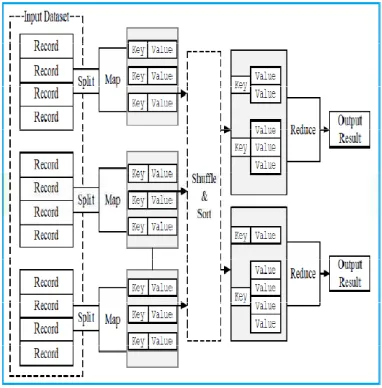
MapReduce is a data processing or parallel
programming model introduced by Google.
In this model, a user specifies the
computation by two functions, Map and
Reduce. In the mapping phase, MapReduce
takes the input data and feeds each data
element to the mapper. In the reducing
phase, the reducer processes all the
outputs from the mapper and arrives at a
final result. Map Reduce has gained a great
popularity as it gracefully and automatically
achieves fault tolerance. It automatically
handles the gathering of results across the
multiple nodes and returns a single result or
set. MapReduce model advantage is the
easy scaling of data processing over
multiple computing nodes.
Figure 8. Execution process of MapReduce
Programming Model
3.1.3.1 Execution Process in MapReduce
Programming Model
In MapReduce programming model and a
MapReduce job consists of a map function,
a reduce function, and When a function
Available Online At www.ijpret.com MapReduce will first divide the data into
N partitions with size varies from 16MB to
64MB
Then it will start many programs on a
cluster of different machines. One of
program is the master program; the others
are workers, which can execute their work
assigned by master. Master can distribute a
map task or a reduce task to an idle worker.
If a worker is assigned a Map task, it will
parse the input data partition and output
the key/value pairs, then pass the pair to a
user defined Map function. The map
function will buffer the temporary
key/value pairs in memory. The pairs will
periodically be written to local disk and
partitioned into P pieces. After that, the
local machine will inform the master of the
location of these pairs.
If a worker is assigned a Reduce task and
is informed about the location of these
pairs, the Reducer will read the entire
buffer by using remote procedure calls.
After that, it will sort the temporary data
based on the key.
Then, the reducer will deal with all of the
records. For each key and according set of
values, the reducer passes key/value pairs
to a user defined Reduce function. The
output is the final output of this partition.
After all of the mappers and reducers
have finished their work, the master will
return the result to users' programs. The
output is stored in F individual files.
4. A DISTIBUTED SERVICE AND BUSINESS
MODEL FOR PROVIDING CLOUD
COMPUTING SERVICE
4.1 Objective
It is the intention to develop an approach to
build a versatile and effective service model
for providing cloud computing service for
compiling source code remotely from any
hand held device (having limited resources)
using the distributed service model.
According to this model, for providing a
service, the service provider may
subsequently use the services of other
service providers in the cloud without the
awareness of the client. The cost model
effectively evaluates the cost which each
Available Online At www.ijpret.com for receiving the services. The approach will
provide services to the end user having
limited configuration in their hand held
devices. The Cloud service provider will
provide its services through web and the
consumer will pay for using the services. In
it, one service provider may subsequently
use the services of other service providers
without the awareness of consumers. The
model is expected to be mutually beneficial
to the client and its service provider.
4.2 Proposed Approach
The approach is to develop a suitable Cloud
Computing service and cost model for
providing cloud computing service (like
Compilation service, file service etc.)
SERVICE MODEL
The steps of this model are summarized as
follows:-
Step 1: In accordance with the service
model the client (CL) requests for a service
from a suitable service provider (SP).
Step 2: The service provider on receiving
the request ensures whether it is possessing
sufficient resource to provide the service
requested by its client.
Step 3: If the service provider finds that it
possesses sufficient resource to provide the
service then it provides the service to its
client directly else
{ if the service provider finds that it does
not possess all the necessary resource then
it finds suitable service providers and
requests those service providers to provide
it with the required resource. Again the
steps from Step 2 onwards are repeated for
each service provider requested (for
providing service).
5. CONCLUSION
Cloud computing is the on-demand
utilization of shared computing resources
available from the Internet. When these
services are used properly, they can reduce
cost and management responsibilities in
addition to increasing efficiency and
performance of an enterprise.
BigData is still in its early infancy. The size of
these datasets suggests that exploitation
may well require a new category of data
storage and analysis systems with different
architectures. Hadoop-MapReduce
Available Online At www.ijpret.com base in the Big Data community due to the
cost-effectiveness on commodity Linux
clusters, and in the cloud via data upload to
cloud vendors who have implemented
Hadoop/HBase. HDFS, the Distributed File
System, is a distributed file system designed
to hold very large amounts of data
(terabytes or even petabytes), and provide
high-throughput access to these
information.
The proposed approach comprising of
service and cost model for providing Cloud
computing service for writing and compiling
source code remotely from any hand held
device using the distributed service model is
expected to be mutually beneficial to the
client and its service provider. This model is
also expected to reduce software piracy to
a considerable extent thereby helping the
vendors in boosting up their business,In this
paper, I have conducted a review of recent
trends in cloud computing.
REFERENCES
1. Yashpalsing Jadeja, Kirit Modi “Cloud
computing concepts, architecture and
challenges”, International Conference on
Computing, Electronics and Electrical
Technologies [ICCEET] 2012, Kumaracoil,
pp.877-880, 2012.
2. Voas, J., & Zhang, J. (2009). Cloud
Computing: New Wine or Just a New
Bottle? IT Professional, 15-17.
3. Srinivasa et al. ().Cloud Computing: An
Overview. Journal of Theoretical and
Applied Information Technology, vol. pp.
71-79. www.jatit.org.
4. Foster I. et al. (2008). Cloud Computing
and Grid Computing 360-Degree Compared.
IEEE Grid Computing Environment
Workshop (GCE „08), pp 1-10.
5. Foster I. et al. (2008). Cloud Computing
and Grid Computing 360-Degree Compared.
IEEE Grid Computing Environment
Workshop (GCE „08), pp 1-10.
6. Buyya, R., Yeo, C., Venugopal, S.,
Broberg, J. & Brandic, I. (2009). Cloud
Computing and emerging IT platforms:
Vision, hype, and reality for delivering
computing as the 5th utility. Future
Generation Computer Systems, 25, 599-616.
7. IBM (2009). IBM continues TOP500 lead.
Available Online At www.ijpret.com 03.ibm.com/systems/deepcomputing/top5
00.html#a1. Accessed on: 17 September,
2012.
8. Armbrust, M., Fox, A. & Griffith, R.
(2009). Above the Clouds: A Berkeley View
of Cloud Computing. Electrical Engineering
and Computer Sciences University of
California at Berkeley, pp.1-8.
9. Lutz S & Keithe J. (2012): Advances in
Clouds: Research in Future Cloud
Computing, Expert Group Report.
Information Society and Media, European
Union, Belgium.
10.Azeem Sarwar*, Muhammad Naeem
Ahmed Khan* (2013)
11.A Review of Trust Aspects in Cloud
Computing Security. International Journal of
Cloud Computing and Services Science
(IJ-CLOSER) Vol.2, No.2, April 2013, pp.
116~122 ISSN: 2089-3337.
12.Rabi Prasad Padhy (2013). Big Data
Processing with Hadoop-MapReduce in
Cloud Systems. International Journal of
Cloud Computing and Services Science
(IJ-CLOSER) Vol.2, No.1, February 2013, pp.
16~27 ISSN: 2089-3337.
13.Shreya Bhadra*, Tirthankar Gayen**
(2013). A Distributed Service and Business
Model for Providing Cloud Computing
Service. International Journal of Cloud
Computing and Services Science
(CLOSER) Vol.2, No.2, April 2013, pp.
148~158 ISSN: 2089-3337.
14.Abah Joshua*, Francisca N.
Ogwueleka** (2013). Cloud Computing with
Related Enabling Technologies.
International Journal of Cloud Computing
and Services Science (IJ-CLOSER) Vol.2, No.1,