IMPACT OF GRAZING ON WHEAT YIELD AND ASSOCIATED WEEDS
Muhammad Adnan1, Nouman Saleem1, Abdul Basir1, Muhammad Arif*2,
Syed Rizwan Ali Shah3, Murad Ali4, Inayat-ur-Rahman1 and Yousaf
Jamal1
ABSTRACT
A field study was conducted at New Developmental Farm (NDF) at the University of Agriculture Peshawar-Pakistan during winter 2013. The aim of this study was to evaluate the influence of grazing on wheat yield, yield components, lodging and related weeds. The experiment was laid out in Randomized Complete Block design (RCBD) with 10 replications. Results of this experiment indicated that 70 days post sowing grazing declined tillers m-2 by 13.32%, spikes m-2 by 23.85%, plant height by 24.16%, grains spike-1 by 14.97%, 1000 grains weight by 12.22%, grain yield by 22.16%, biological yield by 26.03% and lodging by 94% whereas weeds fresh and dry weight (g m-2) were increased by 54.7 and 60.25% respectively. Keeping in view the negative aspects of grazing on crop growth, it is therefore, recommended that wheat crop may not be used for grazing.
Key words: grazing, fresh and dry weight, weeds, wheat, yield.
Citation: Adnan, M., A. Basir, M. Arif, S.R.A. Shah, M. Khan and Y. Jamal. 2015. Impact of grazing on wheat yield and associated weeds. Pak. J. Weed Sci. Res. 21(3): 351-358.
INTRODUCTION
Wheat is the chief staple foodstuff of Pakistan and is grown almost in every part of the country. It is also referred as the ‘king of cereals’. It ranks third among the cereals in the globe after maize and rice. Besides food, it is also utalized for livestock feeding and poultry. (Heyne, 1987).
In 2011-12 in Pakistan, wheat was grown on an area of 8.9 million hectares with a production of 25 million tones, the yield was 2833 (kg ha-1) which is relatively less as compared to the other
1Dept. of Agriculture, University of Swabi, Swabi, Pakistan
2Dept. of Agronomy, 3Dept. of Plant Protection, 4Department of Soil
and Environmental Sciences, The University of Agriculture, Peshawar, Pakistan
countries of the world. In 2011-12 Khyber Pakhtunkhwa, wheat was grown over an area of 7.24 million hectares with a production of 1.155 million tones giving a mean yield of 1595 kg ha-1 (MINFA, 2014).
Due to less production of livestock fodder in winter, oat (Avena sativa L.), rye (Secalecereale L.) and barley (Hordeumvulgare L.) are sown from December to February to be used as a good quality forage for livestock.
Weeds are one of the prime threat to agriculture. Weeds diminish crop revenue and adversely alter the excellence of the product. Weeds deplete soil fertility, compete for available moisture, space and sunlight which cause reduction in crop yield (Khan et al., 2004). The growth of weeds is inhibited when the wheat crop pass through the seedling stage but when the field is grazed or cut, fresh weeds emerge or the present weeds get a chance to flourish.
Double purpose (DP) wheat can encounter the over rising demands of people and animals, and can overcome the fodder deficit without any consequence on grains production. It will also reduce wheat replacement by fodder, as DP crop can be used for food as well as feed. Keeping in view the significance of wheat as a DP crop, the current study was designed to inspect the impact of grazing on wheat lodging, yield and connected weeds under prevalent agro-climatic conditions.
MATERIALS AND METHODS
The study (34°00'43.2"N 71°28'00.4"E) was conducted at New Developmental Farm (NDF) of the University of Agriculture Peshawar, Pakistan. Peshawar is located at 34oN latitude about 7539 km to north of
Indian Ocean, 71oE longitude and an altitude of 315 meters and thus
have a continental climate., Non uniform and uncertain rainfall is received both in rabbi and khrieef seasons . In Peshawar the mean monthly maximum temperatures in summer is about 40 oC and
minimum in winter is 18.3 oC with a relative humidity of 46% in June to
76% in October.
The physic chemical analysis of the soil of experimental field showed that it was alkaline in reaction had a pH of 8.02 and calcareous in nature having a lime content of 12.3%. The organic matter content of the soil was 0.82%. Soil was non-saline (EC (1:1) 0.87 dS m-1) and deficient in available nitrogen (0.04 g kg-1) and
phosphorous (4 mg kg-1) and almost adequate in potassium (80 mg
kg-1). Soil texture of the experimental site was silty clay loam (sand
Procedure for the experiment
A field experiment was carried out in 2013-14 to check the effect of grazing on yield and yield components of wheat and its associated weeds. Randomized Complete Block Design (RCBD) having 5 replications each from grazed and un-grazed fields was used for this study. Ten fields were thoroughly prepared by cultivator. Wheat verity ‘Siren’ at the seed rate of 120 kg ha-1 was sown in each field in rows
30 cm apart, on 15th Nov 2013. All the NPK was applied at the rate of
120:90:60 kg ha-1 uniformly to all fields at the time of sowing using
urea, SSP and SOP as a fertilizer source respectively. Normal cultural practices were assumed throughout the growing season expect weeding which was left as such.
After 70 days of sowing on 30th January, five fields were grazed
by cows from nearby dairy farm of the University of Agriculture Peshawar. Agronomic data were documented for various parameters in the grazed and un-grazed fields. Tillers and spikes m-2 were taken by
counting tillers and spikes 1m long three rows randomly at 10 locations and mean was calculated. For plant height 10 plants were randomly selected and their height was measured in centimeters from the ground level to the tip of the spike excluding awns using meter rod and then average was worked out. Number of grains were counted in ten randomly selected spikes from each field and then averaged. Thousand grains were taken from each plot ten times and its weight was measured by electronic weight balance and then averaged. To fined biological yield 3 m long three rows were harvested at 10 random points in each field, weighted and transformed into kg ha-1.
For grain yield rows considered for biological yield were threshed; grains were weighted and converted into kg ha-1. Lodging in each field
was dignified by measuring the zone of logged plant in whole field and renewed into per hectare. Weeds were uprooted from 3 meter long 3 rows and converted into per hectare for determination of weeds fresh weight. Weeds harvested for fresh weight were dried and weighed for finding weeds dry weight and converted to per hectare.
Statistical analysis
Data were compiled in MS Excel and analyzed as per procedure approved by Gomez and Gomez using Statistix 8 software.
RESULTS AND DISCUSSION
Results regarding yield, yield components and associated weeds are presented in Table-1. Analysis of the data showed that tillers m-2
(279.9) were higher in un-grazed plots as compared to grazed plots (246.8). Maximum spikes m-2 (232.1) were recorded in un-grazed
plots while minimum number of spikes m-2 (187.4) were recorded in
as compared to grazed plots where grazing depressed plant height. Grazing also negatively affected grains spike-1 and thus higher grains
spike-1 (43) were found in un-grazed plots whereas grazed plots
produced lower grains spike-1 (37.4). Similarly, grains of un-grazed
plots were heavier (45.1 g per 1000 grains) as compared to grazed plots (40.1 g per 1000 grains).
Grazing also adversely affected grain and biological yields of wheat. Un-grazed plots produced 3064 and 11408 kg ha-1 grain and
biological yields, respectively, which were significantly higher than grain yield (2509 kg ha-1) and biological yield (9052 kg ha-1) of grazed
plots. In contrast to all of the above parameters, grazing significantly reduced lodging and was significantly higher (1325 m2 ha-1) in
un-grazed plots as compared to un-grazed plots (683 m2 ha-1). Unlikely,
grazing did not reduce weeds biomass. Grazed plots produced significantly higher weeds fresh (358.5 g m-2) and dry (277.6 g m-2)
biomass than un-grazed plots.
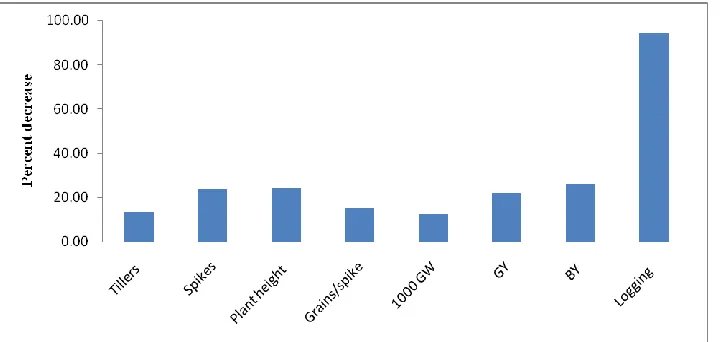
Grazing drastically reduced yield and yield components of wheat. It reduced tillers m-2 by 13.32%, spikes m-2 by 23.85%, grains
spike-1 by 14.97% and thousand grains weight by 12.22%. It also
resulted in short stature plants and declined plant height by 24.16%. Grazing also declined grain yield by 22.16% and biological yield by 26.03%.
Soil compaction and plants suppression due to animal intervention are the negative effects of grazing. Crop cannot produce any more tillers or hardly grow itself due to animal intervention or grazing shock damage the newly produced tillers (Arzadun et al., 2003). This damage or reduction of tillers grades in slighter crop densities in grazed plots. Arzadun et al. (2003) and Simmonds (1989) reported that increasing grazing pressure linearly decrease in spike density.
Grazing shock result shorter internode length thus suppresses plant height or little time is available for regrowth and completion of life cycle after grazing in grazed plot. Epplin et al. (2000) also found up to 44% reduction in heights of grazed plants over un-grazed.
Grazing significantly decreased (14.97%) grains spike-1 which
may be due to shortened growth period to the grazed plants. Similarly less grains spikes-1 are produced in fast growing weeds due to rapid
infestations. Our findings are in line with those of Khan et al. (2001) who also reported similar resultsin weedy check plots in wheat.
Arzadun et al. (2003) who stated that grazing pressure quadratically affected grain yield.
Biological yield reduced up to 26.03% due to grazing pressure. Similar results were reported by Benjamin et al. (1978) who noted that grazing had no significant effect on the total production of the pasture but reduced the dry matter yield of wheat by 32%. These outcomes are in mark with those of Royo et al. (1999) who described that clipping-induced decreases in pre anthesis dry weight and carbohydrate increase of triticale.
Grazing reduced the lodging by 94% in grazed plots over un-grazed plots. It may be due to positive correlation between plant height and lodging as grazing resulted dwarf heighted plants compared to un-grazed plots (Hossain et al., 2003). These outcomes are in agreement with Rajput and Verma 1994 who reported that grazing efficiently reduced wheat lodging in irrigated condition. Weeds fresh and dry weight were increased by 54.7 and 60.25% respectively due to grazing. In un-grazed plots wheat suppressed the weeds due to greater canopy and plant height. These results are in agreement with those of Ralston et al. (1994).
Table-1. Yield, yield component and weeds density as influenced by grazing of wheat.
Parameter Grazed
Un-grazed (0.05)LSD
CV
(%) Probability
Tillers m-2 246.80 279.70 23.7 8.88 0.0118
Spikes m-2 187.40 232.10 24.0 11.30 0.0023
Plant height (cm) 77.400 96.100 5.63 6.42 0.0000
Grains spike-1 37.400 43.000 2.64 6.49 0.0010
1000 grains weight (g) 40.180 45.090 2.26 5.24 0.0008
Grain yield ( kg ha-1) 2509 3064 203.1 7.21 0.0002
Biological yield (kg ha-1) 9052 11408 1280 12.37 0.0024
Lodging (m2 ha-1) 683.5 1325.9 475.7 46.80 0.0137
Weeds fresh weight (g m-2) 358.50 231.80 26.96 9.03 0.0000
Figure 1. Percent decrease in yield, yield components and lodging by grazing in wheat
CONCLUSION
It can be concluded from our study that grazing decreases tillers m-2, spikes m-2, plant height, grains spike-1, 1000-grain weight,
grain yield, biological yield and lodging. On the other hand the fresh and dry weight m-2 of weeds increases due to grazing. Keeping in view
the negative aspects of grazing on crop growth, it is therefore, recommended that wheat crop may not be used for grazing.
REFERENCES CITED
Arzadun, M.J., J.I. Arroquy, H. E. Laborde and R. E. Brevedan. 2003. Grazing pressure on beef and grain production of dual-purpose wheat in Argentina. Agron. J. 95:1157-1162.
Benjamin, R.W., M. Chen, N.G. Seligman, D. Wallach and M.J. Al Hadad. 1978. Primary production of grazed annual natural pasture and of grazed wheat in a semi-arid region of Israel. Agric. Syst. 3(3): 205-220.
Diaz, M.J., Z.E. Roberto, and E.F. Viglizzo. 1996. Diversification productiva y estabilida deconomica de sistemas con distint asrelacionesa groganaderas. Revista Argentina. Production animal. 6: 603-608.
Epplin, F.M., I. Hossain and E.J. Krenzer. 2000. Winter wheat autumn– winter forage yield and grain yield response to planting date in dual-purpose system. Agric. Sys. 63: 161-173.
Gupta, N.K., D.S. Shukl and P.C. Pande. 2002. Interaction of yield determining parameters in late sown wheat genotypes. Indian J. Plant Physiol. 7(3): 264-269.
Hernandez, O. 2003. Effecto de la epoca e intensidaddelpastoreosobre el rendimientoengrano de trigodobleproposito. Rev. Invest. Agropecu. Ser. 2(6): 155-165.
Heyne, E.G. 1987. Wheat and wheat improvement. 2nd edition.
Madison, Wisconisn, USA.
Hossain, I., F.M. Epplin and E.J. Krenzer. 2003. Planting date influence on dual-purpose winter wheat forage yield, grain yield, and test weight. Agron. J. pp. 1179-1188.
Khan, I., G. Hassan, M.I. Khan and I.A. Khan. 2004. Efficacy of some new herbicidal molecules on grassy and broadleaf weeds in wheat-II. Pak. J. Weed Sci. Res. 10(1-2):33-38.
Khan, I., G. Hassan, M.I. Khan and I.A. Khan. 2004. Assestment of lyield losses due to weeds in wheat. Pak. J. Weed Sci. Res. 7(2):40-44.
Khan, I., G. Hassan, M.I. Khan and F. Ullah . 2001. Efficacy of some new herbicidal molecules on grassy and broadleaf weeds in wheat-II. Pak. J. Weed Sci. Res. 10(1-2):33-38.
Rajput, R. and L. Verma. 1994. Effect of sowing dates on the yield of different varieties of wheat in Chambal Command Area of Madhya Pradesh Bharyiya Krishi Anusandhan Patrika. Ind. J. Agron. 9: 165-169.
Ralston, R.E., Knight, T.O., Coble, K.H. and Lippke, L.A. (1990). The wheat and stocker cattle analyzer: a microcomputer decision aid for evaluating wheat production and stocker cattle grazing decisions. Southern J. Agric. Eco. 22:185–93.
Redmon, L.A., Horn, G.W., Krenzer, E.G. and Bernardo, D.J. (1995). A review of livestock grazing and wheat grain yield. Agron. J. 87:137–147
Royo, C. J. Voltas, and I. Romagosa. 1999. Remobilization of preanthesis assimilates to the grain for grain only and dual purpose (forage and grain) triticale. Agron. J. 91:312-316.