Iranian Rehabilitation Journal, Vol. 13, Issue 3, Autumn 2015
Original Article
The Performance of Bilingual and Monolingual Children on Working
Memory Tasks
Faezeh Asadollahpour
Health Promotion Research CenterZahedan University of Medical Sciences, Zahedan, Iran
Kowsar Baghban
*University of Social Welfare and Rehabilitation Science, Tehran, Iran
Parisa Mirbalochzehi
Zahedan University of Medical Sciences, Zahedan, Iran
Ehsan Naderifar
Health Promotion Research Center
Zahedan University of Medical Sciences, Zahedan, Iran
Bahram Tahmasebi
Hamadan University of Medical Science, Hamadan, Iran
Objectives: The purpose of this research was to explore the possible differences in the working memory of monolingual (Persian) and bilingual (Persian-Baluchi) children. We wanted to examine if there is a statistically significant relationship between working memory and bilingualism.
Methods: Four working memory (WM) tests, assessing three WM components, were administered to 140 second grade school students, of whom 70 were monolinguals (35 girls and 35 boys) and 70 were bilinguals (35 girls and 35 boys). The tests used are the following: Forward Digit Span Test, Backward Digit Span Test, Non Word Repetition Test, Maze Memory Test. The results of the two groups were analyzed with multi-group confirmatory factor analysis, aiming to find out any differences in the working memory function of bilingual and monolingual children, and to determine which group has an advantage. Results: The multi-group confirmatory factor analysis was used to measure various WM factors across the two language groups. The findings showed that there were significant language effects on Forward and Backward Digit Span and Non Word Repetition Task (p‹0.001), and no significant language effects on Maze Memory (p›0.001).
Discussion: This study revealed that bilingual children had a better WM, which holds processes and updates information over short periods of time, than monolingual children.
Key words: Working memory, bilingual, monolingual
Submitted: 1 June 2015 Accepted: 6 August 2015
Introduction
Bilinguals are those individuals who need and use two (or more) languages in their everyday lives (1). The bilingual effect has been referred to as the task performance discrepancy among bilinguals and monolinguals on a range of working memory measures (2). Working memory is of particular importance, because it relates to the execution of numerous activities, including mental calculation and reading comprehension (3). WM includes the structures and processes related to the storage and
but interrelated parts, with one master and two subsystems (6). One part is the phonological loop that is dedicated to holding information in a speech-based form (7). Phonological loop memory was assessed with tasks that require serial recall of digits (Forward Digit Span and Non Word Repetition) (7, 8). Another part is the visual-spatial sketch pad, for the coding of visual and spatial information. This part is assessed by the Maze Memory Test (9). The two parts work integrally under the supervision and control of a third part, the central executive, which acts as supervisory system and controls the flow of information from and to its salve systems: the phonological loop and the visual-spatial sketch pad (10). The central executive is measured by the Backward Digit Span task (11). In spite of the fact that there has been an enormous amount of research on working memory, comparatively little research has investigated WM in bilinguals (12). The few studies that do exist provide mixed results, with some studies demonstrating a bilingual benefit and others finding no such effect (13). Therefore, further research is needed to establish whether or not bilingualism has an effect on working memory abilities (14). In the current study, we investigated
WM performance in bilingual Persian-Baluchi children and monolingual peers. The purpose of our study was to explore whether there was a significant difference between the bilinguals and monolinguals on their WM abilities.
Methods
Participants - In total, data from 140 (7-8 year-old) second-grade children recruited from 10 public schools in Zahedan city was analyzed; 70 children were monolingual (35 girls and 35 boys) and 70 children were bilingual (35 girls and 35 boys). Children of this age were chosen based on findings which suggest that this age is a critical period in the development of working memory. Participants were tested individually in a single session. For each child, a background questionnaire was obtained from the caregiver and children, which provided detailed information on the demographic characteristics of the family, and on language use in the home. All of the children were from Zahedan and lived permanently in Zahedan. The monolingual group was recruited from the same classrooms as the bilinguals. The demographic information is presented in Table (1).
Table 1. Demographic information of participants
monolingual bilingual
Age (mean) 7 years 8 month 7 years 5 month
Sample size 70 70
Male 35 35
gender Female 35 35
Measures and Procedures-Each participant answered the questions on the demographic questionnaire, and completed the following measures: Non-word repetition task, Forward Digit Span, Backward Digit Span, Maze Memory. Four working memory tests were administered to all of the participants to assess the three working memory components (central executive phonological loop, visual-spatial sketch pad). Three of four tests used to measure the three basic components were taken from the Wechsler test (1997) (WISC ver. Ш) and the non-word repetition tests were taken from the NAMA Scale (Kormi Nouri and Moradi, 2008). These tests are standardized for children. Two tests (non-word repetition and Forward Digit Span) were used as measures of the phonological loop. Backward Digit Span was used as a measure of the central executive.
in which the tasks were administered was randomized for each participant.
finger. The children were then instructed to recall the identical path shown by the experimenter. The tasks were all performed in Persian for all children. The mean duration for administering all of the tasks was 60 minutes. All tests were conducted in the morning in quiet rooms at the children’s schools, and were carried out in one session. All tests were done by a trained researcher who was fluent in both Persian and Baluchi. Children were rewarded with a small sticker after each task to keep them motivated. SPSS ver.11.0 was used for statistical analysis. Descriptive statistics were used for all measures according to the group. However, a multi-group
confirmatory factor analysis was used to examine the factorial structure of WM in monolingual and bilingual children.
Results
The hypothesis of the current study targeted WM function of monolingual and bilingual children. To investigate this hypothesis, we compared children in monolingual and bilingual groups for each working memory subsystem separately. Table (2) presents the means and standard deviations for all WM measures of the two groups.
Table 2. Means and standard deviations for all WM measures of the two groups
Monolingual Bilingual children
Standard deviation Mean Standard deviation Mean Tasks
1.53 3.98 1.35 5.54 Backward digit span
1.16 4.8 1.08 6.5 Forward digit span
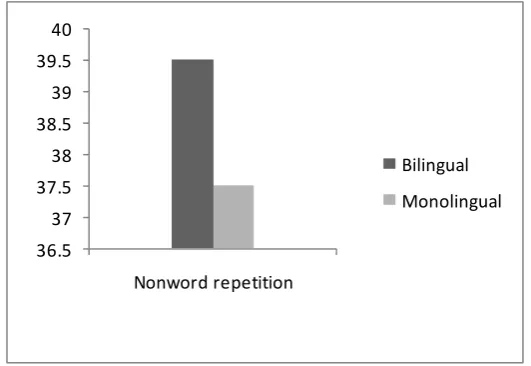
1.2 37.5 1.05 39.5 Non-word repetition task
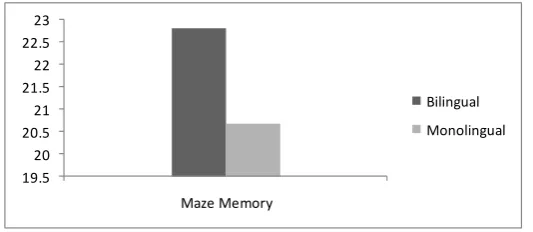
1.36 20.68 1.68 22.82 Maze memory
The scores of the two tasks assessing the phonological loop functioning were entered in to a multivariate analysis of variance (MANOVA). The multivariate main effect proved to be significant (P‹0.001). The tests also proved significant
differences between groups for all phonological loop tasks (Non-word repetition task (P‹0.001), Forward Digit Span (P‹0.001)).
(Figure 1).
36.5 37 37.5 38 38.5 39 39.5 40
Nonword repetition
Bilingual
Monolingual
Fig 1. Comparison of Non-word repetition scores in monolingual and bilingual children
The scores of the Maze Memory task assessing the visual-spatial sketch pad was entered into ANOVA and there was no significant main effect (P‹0.001). However, scores of the Backward Digit Span task,
0 1 2 3 4 5 6 7
Backward digit span Forward digit span
Bilingual children Monolingual
Fig 2. Comparison of Backward Digit Span and Forward Digit Span scores in monolingual and bilingual children
A MANOVA showed that there were significant language effects on three measures (i.e, Non-word repetition task, Forward Digit Span, Backward Digit
Span) of the WM components, and that there were no significant language effects on the Maze Memory measures (Figure 3).
19.5 20 20.5 21 21.5 22 22.5 23
Maze Memory
Bilingual
Monolingual
Fig 3. Comparison of Maze Memory scores in monolingual and bilingual children
Furthermore, the findings of the study showed that there were no significant effects of gender on working memory measures.
Discussion
The current study provided additional knowledge in understanding bilingualism and mono-lingualism with respect to WM. Furthermore, the present study investigated whether bilingual (Persian-Baluchi) children from Zahedan benefit from being bilingual and exhibit an advantage in WM performance when compared to their monolingual peers (Persian). As expected, the findings showed that the bilinguals performed significantly better than the monolingual group on WM tasks (Non-word repetition task, Forward Digit Span, Backward Digit Span). These findings are in line with other studies (10,15,16),
The implication of the current study supports the exploration of WM, the number of languages spoken and their interaction in order to better understand cognition and ourselves. With regard to limitations, this study was limited to a particular school grade (second grade), and the structure of WM might differ in different ages and grades. Future studies should also explore relationships between other WM tasks and bilingualism and different ages; they should also examine these tasks in other languages and socioeconomic statuses, and in a variety of clinical populations including children with hearing impairments and phonological disorders, etc.
Conclusion
In summary, the present study showed that bilingualism can be advantageous for performance
in several WM tasks. Moreover, the study showed that bilingual WM advantages develop regardless of gender and demographic features. Finally, the findings of the present study should be considered cautiously when comparing WM performance to bilingualism. Tests that will be used for comparisons should consider the cognitive load involved and the type of language used.
Acknowledgment
This work was supported by a grant from the Zahedan University of Medical Sciences. The authors are grateful to the Zahedan Education Center for help with data collection.
References
1. Kormi-Nouri R, Moniri S, Nilsson L. Episodic and semantic memory in bilingual and monolingual children. Scandinavian Journal of Psychology. 2003;44(1):47-54. 2. Bialystok E. Bilingualism in development: Language,
literacy, and cognition: Cambridge University Press; 2001. 3. Bialystok E. Bilingualism: The good, the bad, and the
indifferent. Bilingualism: Language and Cognition. 2009;12(01):3-11.
4. Jonides J, Lacey SC, Nee DE. Processes of working memory in mind and brain. Current Directions in Psychological Science. 2005;14(1):2-5.
5. Gathercole SE, Pickering SJ, Ambridge B, Wearing H. The structure of working memory from 4 to 15 years of age. Developmental psychology. 2004;40(2):177-90.
6. Baddeley A. Working memory. Science. 1992; 255(5044): 556-9.
7. Burgess N, Hitch GJ. Memory for serial order: A network model of the phonological loop and its timing. Psychological Review. 1999;106(3):551.
8. Archibald LM. The promise of nonword repetition as a clinical tool. Canadian Journal of Speech-Language Pathology and Audiology. 2008;32(1):21-8.
9. Logie RH, Marchetti C. Visuo-spatial working memory: Visual, spatial or central executive? Advances in Psychology. 1991;80:105-15.
10.Soliman AM. Bilingual advantages of working memory revisited: A latent variable examination. Learning and Individual Differences. 2014;32:168-77.
11.Gathercole SE, Alloway TP, Willis C, Adams A-M. Working memory in children with reading disabilities. Journal of experimental child psychology. 2006;93(3):265-81.
12.Engel de Abreu PM. Working memory in multilingual children: Is there a bilingual effect? Memory. 2011;19(5):529-37.
13.Morales J, Calvo A, Bialystok E. Working memory development in monolingual and bilingual children. Journal of experimental child psychology. 2013;114(2):187-202. 14.Blom E, Kuntay AC, Messer M, Verhagen J, Leseman P.
The benefits of being bilingual: Working memory in bilingual Turkish–Dutch children. Journal of experimental child psychology. 2014;128:105-19.
15.Adi-Japha E, Berberich-Artzi J, Libnawi A. Cognitive flexibility in drawings of bilingual children. Child development. 2010;81(5):1356-66.
16.Ganschow L, Sparks RL, Javorsky J, Pohlman J, Bishop-Marbury A. Identifying native language difficulties among foreign language learners in college: A" foreign" language learning disability? Journal of Learning Disabilities. 1991;24(9):530-41.
17.Danahy K, Windsor J, Kohnert K. Counting span and the identification of primary language impairment. International Journal of Language & Communication Disorders. 2007;42(3):349-65.