33 Available online at www.ijiere.com
International Journal of Innovative and Emerging
Research in Engineering
e-ISSN: 2394 – 3343 p-ISSN: 2394 – 5494
Web Usage Mining Techniques to Identify Students Learning
Behavioral Patterns for an Educational Web Portal
Sunil
aand Prof. M. N. Doja
baSection of Computer Engg., Faculty of Engg. & Tech., Jamia Millia Islamia, New Delhi, India bDepartment of Computer Engg., Faculty of Engg. & Tech., Jamia Millia Islamia, New Delhi, India
ABSTRACT:
With the unstable expansion of the internet in past few years the web usage mining techniques have grown hastily in online learning platforms. Online learning platforms provide various types of online learning resources like tutorials, e-books, scientific articles, etc. Nowadays educational web portals play an important role in E-learning and collecting useful information by the students. An educational web portal is a particular access point to all significant information, resources and applications in the education process. Web portal integrates diverse functionalities and services for adaptation of E-learning courses. This paper presents an educational web portal that is based on the students learning behavior and learns their patterns of accessing information through web portal. In the learning process the students’ learning behavior can be intangibly obtained by using web usage mining techniques, to get the students attribute information such as learning target, their style and inclination. Then students’ interest model can be predicted and E-learning system personalization can be achieved better. Keywords: Web usage mining, Web portal, E-learning, Pattern discovery
I. INTRODUCTION
A web portal is generally often a specifically intended website that brings information together from various sources in a uniform way. Frequently, every information source gets its committed area on the page for displaying information called a portlet; the user can organize which ones to display. An educational web portal for students is a web-based interface to access personalized information, resources, applications, and academic options with which students can accomplish a range of internal and external sources through a network connection in a password protected setting [1]. The use of portals by university students has been growing progressively and even though many limitations such information technology budgets, investments in portal solutions are still raising. An educational web portal with a good learning experience could make immense amounts of information be screened and filtered, and then show the information to the students which they are interested in [2]. This significantly increases the competence of the system effort, and also saves time for the student to filter information. Educational web portal organizes the information in an easy user-friendly mode. In World Wide Web numerous students use web portals to obtain information for their learning and to help with decision making [3]. The students and other data patrons need to certify that the data obtained are right for their needs. Thus the organizations that provide web portals need to recommend data that meet students’ requests. A rapid development in the communication and information technologies has fuelled the ample use of internet, which has changed the learning behaviors of the students [4]. The internet has become an information core that is accessible in an insidious manner. Now days it is a valuable platform for delivering and acquiring information for students. E-learning educational web portals engage students in a process of learning by providing then required useful information on-time and in valuable way. The paper introduces the use of web usage mining techniques that makes the educational web portal and E-learning environment more skilled and valuable. With the use of web usage mining techniques the educational web portal must be designed such a way that it satisfies the needs of the students and provide more effective learning environment.
II. BACKGROUND
34 to have all the contents in the online platform,
to have some scoring system with the opportunity of getting immediate feedback for student, allows knowledge to be updated and maintained in a more timely and competent manner.
to get a user account for every student. to keep track of students’ progress.
Another case study was conducted at the Ulsan National Institute of Science and Technology in Korea. There were blended courses that allowed activities such as project, video conferencing, posting a daily activity report on personal blog, sharing a video file etc. The obtained results showed that the students could learn the subjects enhanced. According to the above mentioned studies, approaches for improving the effectiveness of traditional way of learning is online learning that allows students to learn independently at any time, any place and at their own pace. It acts as a supporting tool for the traditional classroom settings.
III.WEB USAGE MINING
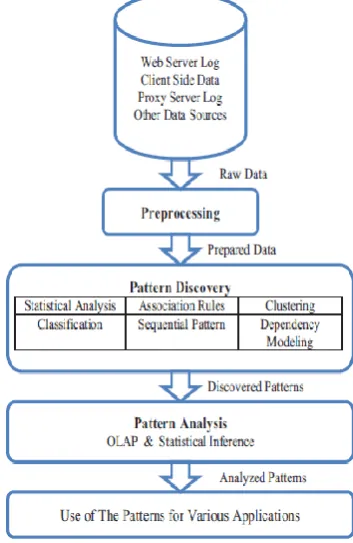
Web Usage Mining is the process of obtaining expensive information or knowledge from web data access information. The process of web usage mining can be divided into the following four stages as shown in the figure1: Data Collection, Data Preprocessing, Pattern Discovery and Pattern Analysis [6].
Figure 1. Web Usage Mining Process
A. Data collection
Web usage mining consists of lots of data sources major sources are web server logs, client side data, proxy server log and other data sources. Among these data sources the most important source of data are web server logs. These are the log records of the students who are visiting the educational web portal. Every time when the student visiting the educational web portal the server accounts their visiting pattern and saves these records in the log files. These log records primarily contains the students systems IP address, date of their visit, the type of browser they are using, operating system they are using and so on. Along with server site log records there are other sources of data that are the educational web portal backend database which contains the registered information and academic information of the students.
B. Data Preprocessing
In the data preparation process the data preprocessing is the initial step that aims to reformat the original web server logs to recognize students session [7]. As the log files which are received from the web server are not suitable for the direct mining of data. There are many pre-treatment methods to make then in proper format so that we can deal with them consequently. There are four steps of pre-treatment process they are data cleaning, user identification, session identification and path added.
C. Pattern Discovery
35 recognition [8]. The main mining techniques such as statistical analysis, association rules, clustering, classification, sequential pattern and dependency modelling are used to determine rules and patterns. The knowledge that can be revealed is represented in the form of rules, tables, charts, graphs, and other visual presentation forms for characterizing, comparing, predicting, or classifying data from the web access logs.
D. Pattern Analysis
Pattern Analysis is the concluding stage of web usage mining. The purpose of pattern analysis is to convey the rules, models and statistics found in the pattern to knowledge and then a precious model will be achieved after the analysis of patterns. There are two most general approaches for the patter analysis. The first one is to use the knowledge query mechanism such as SQL, while another is to construct multi-dimensional data cube before perform OLAP operations [9].
IV. RELATED WORK
A well designed educational web portal is always considered as a successful web portal. The educational web portal must be designed such a way that it can convince the requirements of the students.
Gerd Wagner [10] discusses on two issues that are sharing educational simulation models on the web, and running educational simulations as web resources. A portal named Simurena is proposed there that is an ongoing project for facilitating the expansion and publication of simulation models and simulations for open education. As there are already a number of hard work is done to provide simulations as educational resources on a web portal, Simurena is the first portal that supports the enlargement of simulations both as Open Educational Resources and as true web resources. The Simurena portal is also pioneering simulation engineering for Open Education by providing a simulation development portal with free developer accounts.
Adeyinka Tella et al. [1] proposed research that emphasized most general dimensions or factors which are a source for user contentment in E-portal system. According to selected dimensions they conduct a research, whose major intend was to examine undergraduate students’ satisfaction with the E-portal at the University of Ilorin, Nigeria. Most dimensions identified significantly persuade undergraduate contentment with the E-portal system.
Božidar Lj. Radenković et al. [11] proposed an approach for execution of a web portal for adaptive E-learning. There it was implemented a portal through combination of services and applications that enables association and communication among users in E-education system, apprehension of all teaching activities, as well as adaptive functionalities. There presented an adaptive mechanism that provides adaptivity of E-learning courses with respect to students’ pre-knowledge and learning styles.
Jingsha He et al. [2] proposed a recommender system for a web portal that helps students to find the most valuable information. The recommendation system is planned in which they used Euclidean formula to calculate the distance and Cosine formula to calculate the angle to distinguish between diverse needs of students. Thus, similar need students will receive associated items. The development of intelligent recommendation system is a methodical project, which relies on the blend of data structures, algorithms and other aspects of human computer relations to construct synergy. Recommendation engines just wordlessly record and watch every move of users and collect enormous amounts of data generated by all users to analyze and generate patterns of behavior and to understand step by step students’ habits. At last, recommendation systems can silently help users solve problems quickly and find what students want.
V. DEVELOPING EDUCATIONAL WEB PORTAL
The concept of an educational web portal is a comparatively modern phenomenon. It is seen as compilation of information and services of an activity or as a society reachable to members through a single secure and website [1]. An educational web portal is a student centric educational wide web based structure that incorporates a refined combination of all types of information content and services. As a core educational institute information system, it is often and within developed and designed to suit the particular needs of students.
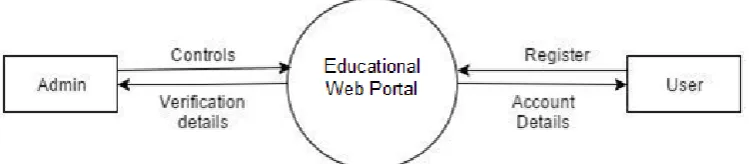
Figure 2. Data flow diagram of educational web portal
A. Web portal
One of the approaches for combination of diverse E-learning system mechanism is through an educational web portal [6]. Web portals are intricate sites that unite different information from various sources, and provide access to several applications. Educational web portal is a distinct access point to all relevant information, resources and applications in the education process. The main requirements of an educational web portal are [12]:
36 to open lines of communication among the neighbourhood users.
to allow both students and teachers to contribute information for common class performance.
to provide a tool for faculties and universities to innovate teaching and a tool for students to knowledge alternative forms of learning.
to use a single reliable web-based front end or interface to present information from a variety of resources.
The primary role of educational web portal in this research is incorporation of E-learning system components and services that offer adaptation. Web portal should have modular architecture, i.e. enable easy execution of additional components. The ways in which people teach and learn are changing. So the educational portal provides students with notes so that students can refer portals when they skipped some lecture or when they are not able to understand what was taught in the class. This will help them keep in pace with other students in class. At the time of exams, students need previous years papers to get some idea of what was asked before, what can be the possible and important questions, what was the pattern of the paper etc. The answer to all the needs of the students could be addressed through the educational portal which acts as a platform where anyone can get all what they want.
The proposed educational portal allows the students to upload their study material for which they get credit points in return. Using those credits points, one can download documents of their need. In addition to just providing students with study material, some advantages of proposed educational portal are listed below:
creation of an authentic portal where students can interfere with its activities.
allowing students to have unlimited access to the course material, which is furthermore related to reduced stress and increasing satisfaction for slow learners.
creation of an environment where each student has the privilege to discuss their issues with diversified minds. assuring only useful documents to be uploaded which results in time saving.
assurance of long-term ability to access the material.
Figure 3. Entity Relationship Diagram of proposed educational portal
The proposed system is to make an online web portal for students, so that every student can get information about their needed information, students can easily upload and download previous year question papers, documents, projects, synopsis, assignments, notes and other study related stuff. Students can communicate with each other on topics, issues and can publish their articles. The proposed system could be accessed from anywhere.
B. What actually the proposed portal is?
37 The portal also consist of a discussion area page where students can give suggestions and can communicate with other students to discuss on some topics or issues that can prove to be beneficial for them. In addition to this, their suggestion will also help us to improve our portal. Also, for topics that they couldn’t understand or in case they missed some lecture, we are providing them with tutorials and videos that will help them understand the topic in a enhanced way. The system will display notices and will give updates about all the current activities. Post registration students can manage their profile according to their own needs. Based on the students’ preferences, educational background and experience, this information helps the system to make personalization of the learning content and the information is stored in the students’ profile.
VI.CONCLUSION
Educational web portal can be benefit to develop intelligent and personalized environment for the students. Educational web portals are becoming a vital tool to sustain the learning system and offers new potential in E-learning. Web usage mining techniques within web portal is a rapidly growing trend. Web mining is the series of task used for mining or extracting useful information from the web pages or websites. The proposed an approach for implementation of an educational web portal is intended for students’ ease in getting relevant documents. It will surely help the students to search for all the required notes and assignments. Students will able to get all documents at one central place from where they can download and refer. Portal is implemented through combination of services and applications that enables association and communication among students in E-learning system, apprehension of all teaching activities, as well as adaptive functionalities.
REFERENCE
[1] Adeyinka Tella and M.T. Bashorun, “ Impact of web portals on E-learning”, Fourth International Conference on the Applications of Digital Information and Web Technologies (ICADIWT), IEEE-2011, pp. 161-166, doi:10.1109/ICADIWT.2011.6041424.
[2] Jingsha He, Jianghao Du, Yixuan Zhang and Shiyi Zhou, “A recommendation system for a web portal”, International Conference on Progress in Informatics and Computing, IEEE-2014, pp.70-74, doi:10.1109/PIC.2014.6972298.
[3] S. Christy, S. Brintha Rajakumari and M. Suryakala, “Quality data representation in web portal — A case study”, Trendz in Information Sciences & Computing(TISC), IEEE-2010, pp.230-232, doi:10.1109/TISC.2010.5714636. [4] Sunil and Prof. M. N. Doja, “Web Usage Mining Techniques to Improve the Capabilities of E-learning Websites and
Blogs”, International Journal of Advanced Research in Computer Science (IJARCS), Volume 8, No. 5, May-June 2017, ISSN No. 0976-5697, pp. 1847-1851.
[5] Sunil, Prof. M.N. Doja, “A Review Paper on Identifying Students Interest in E-learning using Web Usage Mining”, International Journal of Latest Trends in Engineering and Technology (IJLTET) Volume 8, Issue 1, pp.520-525, e-ISSN:2278-621X , doi:http://dx.doi.org/10.21172/1.81.067.
[6] Xinjin Li, Sujing Zhang, “Application of web usage mining in learning platform”, International Conference on E-business and E-government, IEEE 2010, doi:10.1109/ICEE.2010.353., pp. 1391-1394.
[7] K. Sudheer Reddy, M. Kantha Reddy and V. Sitaramulu, “An effective Data Preprocessing method for Web Usage Mining”, International Conference on Information Communication and Embedded Systems (ICICES), IEEE-2013. doi: 10.1109/ICICES.2013.6508197, pp. 7-10.
[8] Sunil, Prof. M.N. Doja, “Recommender System Based On Web Usage Mining For Restructuring Of E-Learning Websites And Blogs”, International Journal of Research in Engineering & Advanced Technology (IJREAT), Volume 5, Issue 1, Feb - Mar, 2017, ISSN: 2320 – 8791.
[9] O. Zaiane, M. Xin, J. Han.,”Discovering Web Access Patterns and Trends by applying OLAP and Data Mining Technology on Web Logs”, In Advances in Digital Libraries, pages 19-29, Santa Barbara, CA, 1998.
[10]Gerd Wagner, “Simurena — A web portal for open educational simulation”, Proceedings of the 2012 Winter Simulation Conference (WSC), IEEE-2012, pp.1-12, doi:10.1109/WSC.2012.6465217.
[11]Božidar Lj. Radenković, Marijana S. Despotović-Zrakić, Dušan M. Barać, Zorica M. Bogdanović and Aleksandar R. Milić, “Web portal for adaptive e-learning”, 10th International Conference on Telecommunication in Modern Satellite Cable and Broadcasting Services (TELSIKS), IEEE-2011, Vol.:1, pp.365-368, doi:10.1109/TELSKS.2011.6112072. [12]C. Mercado and G. Genove, “MySLU: A WEB Portal Project Promoting ICT and WEB Based Collaboration in Higher