Elasticity Solution for Static Analysis of Sandwich
Struc-tures with Sinusoidal Corrugated Cores
M. Shaban
∗Mechanical Engineering Department, Bu-Ali Sina University, Hamadan, Iran.
Article info
Article history: Received 2016.05.06 Received in revised form 2016.06.29
Accepted 2016.07.11
Keywords:
Corrugated sandwich panel Elasticity solution
State-space Analytical Static
Abstract
Metal sandwich panels are three-dimensional structures widely used in indus-tries mainly due to two distinct properties: low density and high strength. Although significant efforts have been made at research into corrugated sand-wich panels, analytical solutions are still very few. This work wishes to present accurate analytical results of static analysis of corrugated sandwich panels. In order to determine equivalent properties of corrugated core in the thickness di-rection, energy method is used in conjunction with homogenization approach. Based on three-dimensional theory of elasticity, partial differential equations are reduced to ordinary differential equations by using the Fourier series. Ana-lytical solutions for the stress and displacement fields are derived by using the state-space method in the thickness direction.
A detailed parametric study was conducted involving the dependency of out-of-plane properties on the corrugation geometrical parameters. Moreover, effects of these variables on the stress and displacement fields are discussed.
Nomenclature
A cross-section A Length
B Width Cij equivalent constants
Cij stiffness elastic constants E elastic modulus
G shear modulus hc height of core
hf facing thickness ht total height of panel
I moment of inertia L Length
M0 external moment M bending moment
N internal normal force P half period of core
Q external distributed force T internal tangential force
tc thickness of core sheet V external vertical force
u, v, w displacement components in the x, y,
andz
¯
U ,V ,¯ W¯ non-dimensional displacement compo-nents
x, y, z Cartesian reference coordinates, where
xis along the corrugation direction Greek symbols
γij shear strain δH horizontal displacement
δV vertical displacement E normal strain
H non-dimensional thickness coordinate νzx Poisson’s ration
σi normal stress τij shear stress
φ angle of tangent line
∗Corresponding author: M. Shaban, (Assistant professor) E-mail address: [email protected]
Subscripts
0 z= 0 n, m half-wave numbers in thexandy
direc-tions
xyz reference coordinates
1. Introduction
It is well-known that metallic sandwich panels are widely used in many engineering fields due to their low density, high strength, and easy fabrication. Cor-rugated sandwich panel is a special type of sandwich panel which has corrugated metallic core with alternate ridges and grooves shaped. Due to their extremely anisotropic behavior, corrugated sandwich panels are increasingly used in many industrial applications, par-ticularly in aerospace engineering.
There are several articles discussing equivalent properties of corrugated sandwich panels to predict their mechanical behavior. On the basis of periodic nature of corrugated cores, many authors have used homogenization methods to predict the behavior of cor-rugated cores. One of the early investigations was con-ducted by Libove and Hubka [1] showing that shear effects are not negligible and should be considered in equivalent orthotropic plates. Briassoulis [2] used FEM to calculate the extensional and flexural rigidity of si-nusoidal corrugated plates. By considering Mindlin-Reissner plate theory, Chang et al. [3] presented an equivalent two-dimensional orthotropic thick plate for corrugated-core sandwich plates; The bending analysis of corrugated sandwich panels was performed and indi-cated that obtained results are in good agreement with previous experimental investigations. Not all of the works are dedicated to homogenization techniques for corrugated cores; in [4], the authors have used homog-enization theory to present the effective properties of sandwich panels with corrugated cores. Kirchhoff-Love theory was used to solve basic cell problems. However, they acknowledged that it is necessary to use compli-cated theories like MindlinReissner models to provide better results for stiffer panels.
Xia et al. [5] assumed that corrugated panel can be approximated by an orthotropic classical Kirchhoff plate. They used equivalent force method to derive equivalent stiffness terms for any corrugation shapes. Bartolozzi et al. studied the acoustic behavior of corru-gated cores with sinusoidal shape [6]. They used energy approach to obtain the main parameters of corrugated cores and showed that the results are in good agree-ment with detailed finite eleagree-ment simulations. Moham-madi et al. [7] proposed an equivalent model for trape-zoidal corrugated cores. Zheng et al. [8] proposed an equivalent plate model for corrugated cores by using classical shell theory. They presented a complete set of effective in-plate stiffness. Park et al. [9] extended the homogenization model for corrugated composite cores
and presented explicit expressions to calculate effec-tive extensional and bending stiffness for them; It was shown that effective stiffness and the anisotropy are considerably affected by ply angles. An excellent sur-vey of the research work on the composite corrugated structures can be found in the work done by Dayyani et al. [10]
To the knowledge of the author, more literature is dedicated to calculate the equivalent in-plane prop-erties of corrugated sandwich panels despite the fact that corrugated sandwich panels are three-dimensional structures and as a result of those extreme orthotropic natures, equivalent out-of-plane properties cannot be ignored.
In the present work, an attempt was made to de-termine the equivalent out-of-plane properties of corru-gated sandwich panels which have not been considered yet.
Moreover, analytical solution for bending problem of corrugated sandwich panels was developed by in-corporating both equivalent in-plane and out-of-plane properties into the three-dimensional theory of elastic-ity. First, partial differential equations were reduced to the ordinary differential equations by expanding the field variables to double Fourier series along in-plane directions. Then, coupled state-space equations were derived and solved by imposing the boundary condi-tions in the thickness direction.
2. Equivalent Orthotropic Properties in
the
z
-Direction
A corrugated sandwich panel with length a, width b
and total thickness ht, as shown in Fig. 1, is con-sidered. The corrugated sandwich panel is consid-ered as a multi-layer composite plate consisted of two isotropic facing sheets with thicknesshf and one thick orthotropic plate having equivalent elastic constants instead of a corrugated core.
b = 1. The position of a point on the middle surface can be considered as follows:
f(x) = (
hc−hccos
πx p
)
(1)
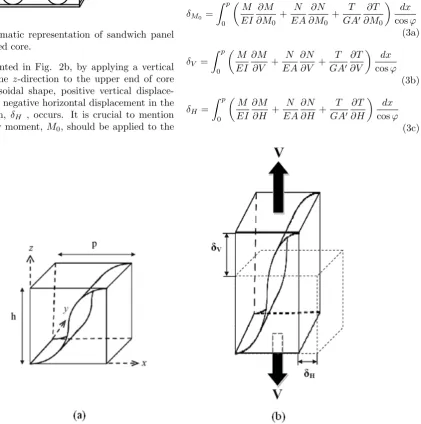
Fig. 1. Schematic representation of sandwich panel with corrugated core.
As represented in Fig. 2b, by applying a vertical force, V, in the z-direction to the upper end of core with the sinusoidal shape, positive vertical displace-ment,δV, and negative horizontal displacement in the other direction, δH , occurs. It is crucial to mention that a dummy moment,M0, should be applied to the
upper end of unit-cell to avoid rotation in thexz-plane. The produced bending moment, normal and tan-gential forces at a distancexare as follows:
M(x) =xV −M0 (2a)
N(x) =−sinφV (2b)
T(x) = cosφV (2c)
whereφindicates angle of tangent in the pointx. Ap-plying the Castiglianos second theorem, the rotation of the upper end and its vertical and horizontal displace-ments can be derived as follows:
δM0=
∫ p
0
(
M EI
∂M ∂M0
+ N
EA ∂N ∂M0
+ T
GA′ ∂T ∂M0
)
dx
cosφ
(3a)
δV = ∫ p
0
(
M EI
∂M ∂V +
N EA
∂N ∂V +
T GA′
∂T ∂V
)
dx
cosφ
(3b)
δH = ∫ p
0
(
M EI
∂M ∂H +
N EA
∂N ∂H +
T GA′
∂T ∂H
)
dx
cosφ
(3c)
Solving Eqs. (3a) and (3b) by considering two con-ditions V = 1 andδM0 = 0 and then substituting the
results in Eq. (3c), one can obtain:
δV =C22−
C232
C33
(4a)
δH =C12−
C13C23
C33
(4b)
The equivalent elastic modulus in thez-direction is then as follows:
Ez=
σz εz = ( Fz Axy ) / ( δV Iz )
= 2hc
pδV
(5)
To obtain the Poisson’s ratio,νzx, the ratio of lat-eral strain should be calculated along x-direction and the axial strain along z-direction. Thus:
νzx=−
εx εz = ( δH p ) / ( δV 2hc
)
= 2hc
p
[
C12−
C13C23
C33
] / [
C22−
C2 23
C33
] (6)
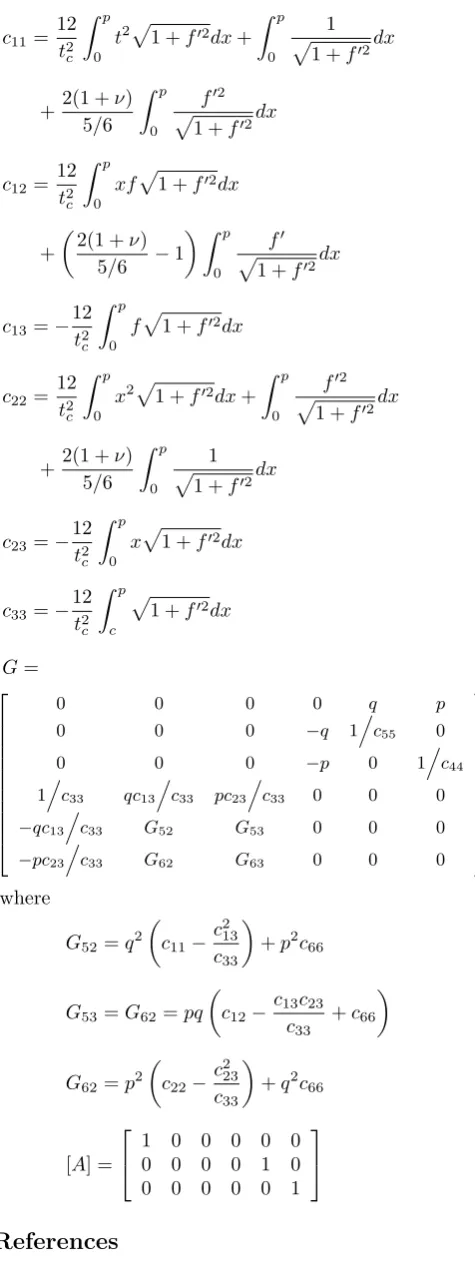
where Cij is a symmetric matrix introduced in Ap-pendix.
3. Governing Equations
In the present section, the corrugated sandwich panel is considered as a laminated composite panel consisted of two facing plates and equivalent thick orthotropic layer instead of a corrugated core. In the absence of body forces, the three-dimensional equations of equi-librium for each layer of three-layer orthotropic plates are:
∂σx
∂x
+∂τxy
∂y + ∂τxz
∂z = 0, ∂τxy
∂x + ∂σy
∂y + ∂τyz
∂z = 0, (7) ∂τxz
∂x + ∂σyz
∂y + ∂τz
∂z = 0
The constitutive equations for an orthotropic layer are as follows:
{σ}= [c]{ε} (8) where {σ} = {σx σy σz τzy τzx τxy}T, {ε} = {εx εy εz γzy γzx γxy}T and material proper-ties matrix [c] is:
[c] =
c11 c12 c13 0 0 0
c12 c22 c23 0 0 0
c13 c23 c33 0 0 0
0 0 0 c44 0 0
0 0 0 0 c55 0
0 0 0 0 0 c66
(9)
Note that, for corrugated core, the equivalent three-dimensional properties should be used in the above ma-trix; while for top and bottom faces only two indepen-dent isotropic engineering constants, i.e.,E andν are used.
The linear relations between the strain components and the displacements are as follows:
εx=
∂u
∂x γzy= ∂w ∂y +
∂v ∂z εy =
∂u
∂y γzx= ∂w ∂x +
∂u
∂z (10) εz =
∂u
∂z γxy= ∂v ∂x +
∂u ∂y
The mechanical boundary conditions for outer sur-faces of the sandwich panel are considered as follows:
σz=τzx=τzy = 0 at z= 0
σz=q=q∗= sin (πx a ) ·sin (πy b ) , (11)
τzx=τzy= 0 at z=h
4. Exact Solution for Stress Field
For a corrugated sandwich panel with four simply sup-ported edges, the following boundary conditions should be satisfied:
u=w= 0, σy= 0 at y= 0, b
v=w= 0, σx= 0 at x= 0, a
(12)
The exact solution can be obtained from using the following solutions:
u(x, y, z) =u∗cos(qn·x)·sin(pm·y)
v(x, y, z) =v∗sin(qn·x)·cos(pm·y)
w(x, y, z) =w∗sin(qn·x)·sin(pm·y)
σx(x, y, z) =σx∗sin(qn·x)·sin(pm·y)
σy(x, y, z) =σ∗ysin(qn·x)·sin(pm·y) (13)
σz(x, y, z) =σz∗sin(qn·x)·sin(pm·y)
τzy(x, y, z) =τzy∗ sin(qn·x)·cos(pm·y)
τzx(x, y, z) =τzx∗ cos(qn·x)·sin(pm·y)
where pm = mπb , qa = nπa and u∗, v∗, w∗, σ∗x, σ∗y,
σz∗, τzy, τzx∗ , τxy∗ are functions ofz. By substituting re-lations Eq. (13) into Eqs. (7) and (8), the state-space equations can be obtained as follows:
d
dz{δ}=G{δ} (14)
where {δ} = {σz∗ u∗ v∗ w∗ τzx∗ τzy∗ }T. G is the co-efficients matrix presented in Appendix. The general solution to Eq. (14) explicitly expressed as:
{δ}=e
∫z
0 G·dz{δ0}=eG·z{δ0} (15)
where{δ0}is the state vector at the lowest surface.
Im-posing surface boundary conditions at the upper and lower surface, Eq. (11), the following equations can be obtained:
[ [A] [S]H
]
{δ0}={0 0 0 −q0 0}T (16)
where matrix [S]H is and [A] is given in Appendix. By solving Eq. (16), the{δ0} was obtained. Then,
appli-cation of Eq. (15) yields the state variables in other layers.
5. Results and Discussion
In an effort to illustrate the foregoing analysis, a simply supported sandwich panel with corrugated core made of aluminum was considered. It is worth noting that for the in-plane equivalent elastic constants all values were compared with Ref. [6] and all of them were exactly the same as the mentioned reference.
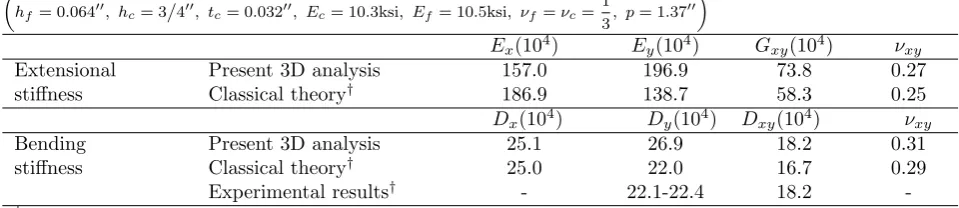
To verify the accuracy and reliability of the present approach, an aluminum sandwich panel with following geometrical parameters was considered: hf = 2tc = 0.064′′, p = 1.37′′, hc = 0.75′′. The extensional and bending stiffness of corrugated sandwich panel were calculated and compared with both analytical and ex-perimental results in Table 1. Experimental results are obtained due to 4-point bending test. Good agree-ment with the corresponding predictions from pre-sented model can be observed. Since in-plane equiv-alent elastic constants of corrugated core have been presented analytically in the same previous researches, only equivalent out-of-plane constants, i.e. Ez, Gxz,
Gyz andxz were plotted.
Table 1
Comparison of extensional and bending stiffness for sandwich panel. (
hf = 0.064′′, hc= 3/4′′, tc= 0.032′′, Ec= 10.3ksi, Ef= 10.5ksi, νf =νc= 1
3, p= 1.37 ′′)
Ex(104) Ey(104) Gxy(104) νxy
Extensional Present 3D analysis 157.0 196.9 73.8 0.27
stiffness Classical theory† 186.9 138.7 58.3 0.25
Dx(104) Dy(104) Dxy(104) νxy
Bending Present 3D analysis 25.1 26.9 18.2 0.31
stiffness Classical theory† 25.0 22.0 16.7 0.29
Experimental results† - 22.1-22.4 18.2
-† Libove and Hubka [1]
The Young’s modulus and Poisson’s ratio are
E = 71 GPa and = 0.33, respectively. Based on industrial applications, for parametric studies, the ini-tial values are considered as follows: tc=hf= 0.001′′,
p= 1′′andhc= 1/4′′.
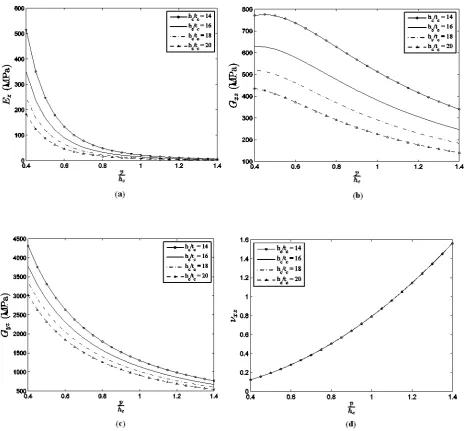
Fig. 3 shows the out-of-plane equivalent elastic constants of corrugated sandwich panel versus non-dimensional ratiop
/
hc for four values ofhc /
tcratios. It is obvious that, in constanthc
/
tc ratio, Increasing thep
/
hcwill cause a significant decrease in theEzand
Gyz and notable decrease in the Gxz. On the other hand, under constant p
/
hc ratio, the decline of core
sheet thickness, tc to height of core hc (i.e. hc /
tc) de-creases the all equivalent out-of-plane modulus in the z-direction. On contrast, xz is not influenced by chang-ing bothp
/
hc andhc /
tc ratios.
In the figures to follow,zcoordinate, displacement and stress components are non-dimensionalized as:
η= z
ht
−0.5, U = u
∗
h, V =v
∗
h, W =
w∗ h , σi=
σ∗i q0
, τy =
Fig. 3. Out-of-plane equivalent elastic constants of core against non-dimensional ratio,p
/
hc, for varioushc /
tc ratios.
(
tc
tf
= 1 hc = 1/4′′ )
Fig. 4a-4f depicts through-thickness distributions of the dimensionless transverse displacements,U , V , W
and normal and shear stressesσz, τxz, τyz with various
hctotcratios. As would be anticipated, continuity was satisfied for all displacements and stresses; but sudden change in the slope of curves at the interface between the core and facing sheets can be observed. This is due to the fact that equivalent elastic constants of corru-gated core and facing sheets are dissimilar which con-stitute discontinuity in the curve slopes.
From these figures, it can be observed that for larger
hc /
tc ratio, maximum in-plane displacements U and
V will be increased. It was also indicated that the in-plane displacements across the thickness were very
small and negligible in comparison to transverse dis-placement,W. Furthermore, it was found that increas-ing of dimensionless hc
/
tc ratio causes a significant decrease in the transverse displacement.
The distribution of σz, τzx and τzy through the thickness is depicted in Fig. 4d-4f. As shown in fig-ures, change ofhc
/
tcratio has slight effect onσz. It is obvious that theτzxandτzy first increases to a maxi-mum value occur in the core and then decreases along the thickness. Increasing ratio ofhc
/
tcwill cause more nonlinearity in transverse stress distributions,τxz and
Fig. 4. Influence of non-dimensional ratio, hc /
Fig. 5 shows the effect of two parameters p
/
hc andhc
/
tc, on the non-dimensional transverse displace-ment,W. As expected, the curve shows clearly that the smaller the pitch-to-depth of core ratio is, the higher the transverse displacement will be. Also, transverse displacement tends to decrease with the increase of the
hc /
tc.
Fig. 5. Transverse displacement of sandwich panel against non-dimensional ratio p
/
hc for varioushc /
tc ratios.
(
x= a
2 = 1, y=
b
2, z=
h
2,
tc
tf
= 1 hc = 1/4′′ )
6. Conclusions
In this study, analytical formulations were proposed for sinusoidal corrugated sandwich panels. The en-ergy method was used to obtain the main equivalent out-of-plane parameters. The governing equations of non-homogeneous, orthotropic laminated plates with equivalent properties for corrugated core were derived and put in a state-space matrix. Parametric studies were conducted for corrugated plates with different pitches, thicknesses and corrugation heights. It was found that out-of-plane properties of corrugated sand-wich panel weaken with increasing pitch and height of corrugations, and strengthen when sheet of core be-comes thicker. Also, the influences of these parame-ters on the stress and displacement fields were studied by using three-dimensional elasticity relations. It was found that out-of-plane properties can play an impor-tant role in characterizing the mechanical responses of corrugated sandwich panels which were omitted in the previous studies.
Appendix
[c] =
c11 cc1222 cc1323
sym. c33
c11=
12
t2
c ∫ p
0
t2√1 +f′2dx+
∫ p
0
1 √
1 +f′2dx
+2(1 +ν) 5/6
∫ p
0
f′2
√
1 +f′2dx
c12=
12
t2
c ∫ p
0
xf√1 +f′2dx
+ (
2(1 +ν) 5/6 −1
) ∫ p
0
f′
√
1 +f′2dx
c13=−
12
t2
c ∫ p
0
f√1 +f′2dx
c22=
12
t2
c ∫ p
0
x2√1 +f′2dx+
∫ p
0
f′2
√
1 +f′2dx
+2(1 +ν) 5/6
∫ p
0
1 √
1 +f′2dx
c23=−
12
t2
c ∫ p
0
x√1 +f′2dx
c33=−
12 t2 c ∫ p c √
1 +f′2dx
G=
0 0 0 0 q p
0 0 0 −q 1/c55 0
0 0 0 −p 0 1/c44
1
/
c33 qc13
/
c33 pc23
/
c33 0 0 0
−qc13
/
c33 G52 G53 0 0 0
−pc23
/
c33 G62 G63 0 0 0
where
G52=q2
(
c11−
c213
c33
)
+p2c66
G53=G62=pq
(
c12−
c13c23
c33
+c66
)
G62=p2
(
c22−
c2 23
c33
) +q2c66
[A] =
10 00 00 00 01 00
0 0 0 0 0 1
References
[2] D. Briassoulis, Equivalent orthotropic properties of corrugated sheets, Comput. Struct., Comput. Struct., 23 (1986) 129-138.
[3] W.S. Chang, E. Ventsel, T. Krauthammer, J. John, Bending behavior of corrugated-core sand-wich plates, Compos. Struct. 70 (2005) 81-89.
[4] N. Buannic, P. Cartraud, T. Quesnel, Homogeniza-tion of corrugated core sandwich panels, Compos. Struct. 59 (2003) 299-312.
[5] Y. Xia, M.I. Friswell, E.I.S. Flores, Equivalent models of corrugated panels, Int. J. Solids. Struct. 49 (2012) 1453-1462.
[6] G. Bartolozzi, M. Pierini, U. Orrenius, N. Bal-danzini, An equivalent material formulation for si-nusoidal corrugated cores of structural sandwich panels, Compos. Struct. 100 (2013) 173-185.
[7] H. Mohammadi, S. Ziaei-Rad, I. Dayyani, An equivalent model for trapezoidal corrugated cores based on homogenization method, Compos. Struct. 131 (2015) 160-170.
[8] Z. Ye, V.L. Berdichevsky, W. Yu, An equivalent classical plate model of corrugated structures, Int. J. Solids. Struct. 51 (2014) 2073-2083.
[9] K.J. Park, K. Jung, Y.W. Kim, Evaluation of ho-mogenized effective properties for corrugated com-posite panels, Compos. Struct. 140 (2016) 644-654.