Original Article / Articolo Originale
Effect of radiological extent and severity
of bronchiectasis on pulmonary function
Effetti dell’estensione radiologica e della gravità
delle bronchiectasie sulla funzionalità respiratoria
Mehmet A. Habesoglu1, Fahri Tercan2, Ugur Ozkan2, Fusun O. Eyuboglu3
1Department of Chest Disease, Baskent University Adana Teaching and Medical Research Center, Adana, Turkey
2Department of Radiology, Baskent University Adana Teaching and Medical Research Center, Adana, Turkey
3Department of Chest Disease, Baskent University Faculty of Medicine, Ankara, Turkey
ABSTRACT
Background:The aim of this study was to ascertain the effect
of the extent and severity of bronchiectasis as determined with high-resolution computed tomography (HRCT) on lung function in patients with pure bronchiectasis, bronchiectasis and asthma, and bronchiectasis and chronic obstructive pul-monary disease (COPD).
Methods: One hundred nineteen patients (71 with pure
bronchiectasis, 25 asthmatic patients with bronchiectasis, and 23 COPD patients with bronchiectasis) underwent HRCT and pulmonary function tests. Computed tomography fea-tures were scored by the consensus of 2 radiologists.
Results: There were no statistically significant differences
among the 3 patient groups regarding the extent of bronchiectasis, bronchial dilatation degree, bronchial wall thickening, decreased attenuation in the lung parenchyma, or presence of mucus in the large and small airways. In the pure bronchiectasis group, a negative correlation was found between forced vital capacity (FVC) % of predicted, forced
expiratory volume in 1 sec (FEV1) % of predicted, the
FEV1/FVC ratio and the extent of bronchiectasis, bronchial
wall thickening, bronchial wall dilatation, and decreased attenuation. At multivariate analysis the main morphologic
changes associated with impairment of FVC and FEV1were
the extent of bronchiectasis and a decreased attenuation in
the lung parenchyma. The decrease in the FEV1/FVC ratio was
associated with bronchial wall dilatation. No correlation was found between morphologic changes and indices of pul-monary function in the asthma and COPD patients.
Conclusions:Morphologic changes associated with
bronchi-ectasis do not influence lung function in patients with asth-ma and COPD directly, although they do play a role in impair-ing pulmonary function in patients with bronchiectasis alone.
Keywords: Asthma, bronchiectasis, computed tomography,
COPD, lung function tests, X-ray.
RIASSUNTO
Premessa:Scopo di questo studio era verificare l'effetto della
estensione e della gravità delle bronchiectasie, determinate mediante tomografia computerizzata ad alta risoluzione (HRCT), sulla funzionalità respiratoria nei pazienti con bron-chiectasie semplici, bronbron-chiectasie e asma, e con broncopneu-mopatia cronica ostruttiva (BPCO) e bronchiectasie.
Metodi:119 pazienti (71 pazienti con bronchiectasie semplici,
25 pazienti asmatici con bronchiectasie, e 23 pazienti con BP-CO e bronchiectasie) sono stati sottoposti ad HRCT e prove di funzionalità respiratoria. I punteggi delle HRCT sono stati at-tribuiti sulla base di un consenso tra 2 radiologi.
Risultati:Non ci sono state differenze statisticamente
signifi-cative tra i 3 gruppi di pazienti riguardo all’estensione delle bronchiectasie, al grado di dilatazione bronchiale, all’ispessi-mento della parete bronchiale, alla riduzione di attenuazione del parenchima polmonare, o alla presenza di muco nelle grandi e piccole vie aeree. Nel gruppo con bronchiectasie semplici, una correlazione negativa è stata trovata fra FVC (%
del teorico), FEV1 (% del teorico), rapporto FEV1/FVC ed
estensione delle bronchiectasie, ispessimento della parete bronchiale, dilatazione della parete bronchiale e riduzione di attenuazione. L'analisi multivariata ha mostrato che i cambia-menti morfologici principali associati al deterioramento di
FVC e FEV1sono l’estensione delle bronchiectasie e la
riduzio-ne di attenuazioriduzio-ne riduzio-nel parenchima polmonare. La
diminuzio-ne del rapporto FEV1/FVC è associata a dilatazione della
pare-te bronchiale. Nessuna correlazione è stata riscontrata tra le variazioni morfologiche e gli indici respiratori nei pazienti con asma e BPCO.
Conclusioni:Le modificazioni morfologiche associate a
bron-chiectasie non influenzano direttamente la funzionalità respi-ratoria nei pazienti con asma e BPCO, ma hanno un ruolo nel
+Mehmet A. Habesoglu
Department of Chest Disease, Baskent University Adana Teaching and Medical Research Center Dadaloglu M, 39 S, No 6, Yüregir, 01250 Adana, Turkey
email: [email protected]
Data di arrivo del testo: 25/08/2010 – Accettato dopo revisione: 10/02/2011
MA Habeso
glu,
F
Te
rcan,
U Ozkan,
FO Eyubo
glu
Pulmonary function in br
onc
hiectasis –
Funzionalità r
espir
ator
ia nei br
onchiettasici
deterioramento della funzionalità respiratoria nei pazienti con bronchiectasie semplici.
Parole chiave:Asma, BPCO, bronchiectasie, raggi x, test di
fun-zionalità respiratoria, tomografia computerizzata.
INTRODUCTION
Bronchiectasis is defined as a permanent abnormal dilatation of an airway [1]. Characteristically, most patients with bronchiectasis have an obstructive pulmonary function defect; however, those with limited disease can maintain their pulmonary func-tion, while those with diffuse and severe disease can have restrictive or mixed impairment. The mechanism of airway obstruction is not known with certainty. Previous studies have found that it might be associated with the collapse of large airways at expiration [2], the retention of endobronchial secre-tion [3], bronchial wall thickening [4], obliterative bronchitis [5,6], or accompanying asthma [7]. Bronchiectasis can be diagnosed accurately with high-resolution computed tomography (HRCT), and morphologic changes caused by bronchiectasis can be evaluated quantitatively. Previous studies have shown that the degree of the morphologic changes caused by bronchiectasis is associated with im-paired pulmonary function [4,8-11].
Bronchiectasis, chronic obstructive pulmonary dis-ease (COPD) and asthma are the disdis-eases that cause obstructive pulmonary functional impairment. In patients with COPD it is seen radiologically in 2 to 29% of patients with asthma [12-14], and in 29 to 50% of patients with COPD [15-16]. Bronchiectasis has been found to be associated with the clinical severity of the disease in asthma patients [13-14]. In patients with COPD it has been shown to be as-sociated with increased inflammatory airway mark-ers, bacterial colonization, and severe exacerba-tions [16]. However, the relaexacerba-tionship between the morphologic changes associated with bronchiectasis and the impairment in pulmonary function in patients with asthma and COPD has not yet been clearly elu-cidated.
In this retrospective study, we investigated the effect of the extent and severity of bronchiectasis on lung function of patients with asthma, COPD, and bronchiectasis alone.
MATERIALS AND METHODS
The study included 119 consecutive clinically sta-ble patients (54 males, 65 females) with bronchiec-tasis confirmed by HRCT at our institution between January 2004 and December 2007. Patients who did not have PFTs within two months of the HRCT were excluded. Patients younger than 18 years of age and those with a history of lung resection, as well as those with bronchial carcinoma, interstitial lung disease, active tuberculosis, or lobar consoli-dation on HRCT were also excluded. No patients had allergic bronchopulmonary aspergillosis or cys-tic fibrosis.
Patients were classified into 3 groups: those who had only bronchiectasis (bronchiectasis group); those with asthma and bronchiectasis (asthma group); and those with COPD and bronchiectasis (COPD group). The diagnosis of asthma was made in accordance with the Global Strategy for Asthma Management and Prevention (GINA) criteria [17] and the diagnosis of COPD was made based on the American Thoracic Society criteria [18]. The HRCT results and pulmonary function parameters of the 3 groups were compared.
Lung function tests
Pulmonary function tests were performed using a spirometer (Vmax 22, SensorMedics Corp., Yorba Linda, CA, USA) in compliance with European Respiratory Society standards. Forced vital capacity (FVC) % of predicted, forced expiratory volume in 1 sec (FEV1) % of predicted, and the FEV1/FVC ratio
were measured and indicated as percentage values in accordance with the age, sex and height of the patients [19]. Airway obstruction was defined as an FEV1/FVC value < 70%.
High resolution computed tomography
Computed tomography images of the lungs were obtained using a multidetector computed tomogra-phy scanner (Sensation 4, Siemens, Erlangen, Germany). Scanning parameters included a colli-mation of 1.3 mm, section interval of 10 mm, 120 kVp, and 200 mAs. All images were obtained with the patient in supine position at full inspiration and without injection of a contrast medium. Scanned images were reconstructed into a bone algorithm through a 512 × 512 matrix with a small field of view to image only pulmonary areas. Images were obtained at a window width of 800 to 1500 H and a window level of -500 to -700 H.
Radiologic evaluation
Computed tomography images were evaluated si-multaneously by 2 radiologists (FT and UO) who were blinded to patients’ data. The final decision was made by consensus.
Multidisciplinary R
espir
atory Medicine 2011;
6(5):
284-290
of the adjacent pulmonary artery); 4) presence of mucous plugging in large airways (0 = none, 1 = present); 5) presence of mucous plugging in small airways (0 = none, 1 = present); and 6) extent of de-creased attenuation (0 = normal, 1 = ≤ 50% of lobar volume, 2 = > 50% of lobar volume).
Statistical analyses
Data analyses were carried out using SPSS software (Statistical Product and Services Solutions, version 11.5, SPSS Inc, Chicago, IL, USA). Depending on the distribution, patient features, PFT parameters and HRCT results, scores were expressed as means plus standard deviation (SD) or medians with ranges. Comparisons of pulmonary function test re-sults among the groups and the differences in HRCT scores were performed using independent sample t test or the Mann-Whitney U test. Univariate analy-ses of the associations between PFT results and HRCT scores were determined using the Spearman rank correlation. Stepwise forward regression analy-sis was performed to identify which HRCT score in the bronchiectasis group had an independent deter-minant effect on pulmonary function. Values for p < 0.05 were accepted as statistically significant.
RESULTS
Patient characteristics
The characteristics of the patients in each of the 3 groups are summarized in Table I. While the mean age of patients in the bronchiectasis and asthma groups was not significantly different, it was higher in the COPD group than in the other 2 groups (p < 0.05).
Computed tomography scores and lung function test results
As shown in Table II, there were no statistically sig-nificant differences in HRCT scores among the 3 groups. When PFT was evaluated, FVC% in the bronchiectasis group was found to be higher than in the asthma group. The predicted FEV1/FVC ratio was
higher in the bronchiectasis group than in the other 2 groups.
Correlation between lung function test results and HRCT scores
In Table III, the relationships between the PFT re-sults and HRCT scores are summarized for each of
the 3 groups. For the patients in the bronchiectasis group, a strong negative correlation was found be-tween the extent of bronchiectasis, the severity of bronchial wall dilatation, BWT, the extent of DA, and all functional parameter values (FVC%, FEV1%
and FEV1/FVC). There were no statistically
signifi-cant correlations between the HRCT scores and PFT parameters in the asthma and COPD groups.
Multiple regression analyses
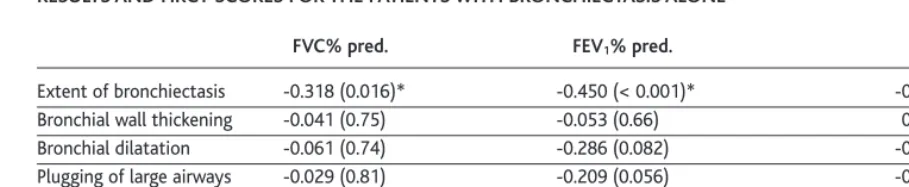
According to stepwise regression analysis (Table IV), the extent of bronchiectasis and the DA score were found to be positively related to impairment in FVC% (both p < 0.05) and FEV1% (p < 0.001 and p
< 0.05, respectively). In addition, the bronchial di-latation score was consistently associated with the FEV1/FVC ratio (p < 0.001).
DISCUSSION
To the best of our knowledge, this is the first study to concomitantly determine a correlation between the structural changes associated with bronchi -ectasis and lung function impairment in patients with pure bronchiectasis, as well as in patients with asthma and COPD who have bronchiectasis. There was no statistical difference between groups with regard to structural change (the extent of bronchiec-tasis, bronchial dilatation, BWT, DA in lung parenchyma, and the presence of mucus plugging in large and small airways) on HRCT. Notwithstanding, while the HRCT scores of bronchiectasis were found to be correlated with pulmonary functional impairment only in patients with pure bronchiectasis, morphologic changes as-sociated with bronchiectasis were observed to be not influential on pulmonary function in asthma and COPD patients.
We found a strong inverse correlation between the extent of bronchiectasis, the degree of bronchial di-latation, BWT, DA in lung parenchyma, and PFT pa-rameters (FVC%, FEV1% and FEV1/FVC) in patients
with pure bronchiectasis. Conversely, the presence of mucus plugging in airways (large and small) was found to have less effect on PFT results; for instance, mucus plugging in small airways correlated only with the decrease in the FEV1/FVC ratio. Shah et al.
suggested that the presence of mucus plugging in large and small airways in patients with cystic
fibro-TABLE I: CHARACTERISTICS OF PATIENTS
Bronchiectasis Asthma COPD Total
N. (%) 71 (59.7) 25 (21) 23 (19.3) 119 (100)
Male/Female 31/40 2/23 21/2 54/65
Age, years
Mean ± SD 55.9 ± 13.8 55.4 ± 14.5 62.5 ± 6.8 57.0 ± 13.1
Max-Min 18-78 18-76 51-78 18-78
MA Habeso
glu,
F
Te
rcan,
U Ozkan,
FO Eyubo
glu
Pulmonary function in br
onc
hiectasis –
Funzionalità r
espir
ator
ia nei br
onchiettasici
sis did not affect pulmonary function [21]. In our study, multivariate analyses revealed that the pres-ence of mucus plugging in airways of patients with bronchiectasis was not the primary cause of lung function impairment. However, as stated by Sheehan et al., when the mucus load of airways varies over time this could be a reason for some fluctuation in pulmonary function [9].
Multivariate analysis showed that the extent of bronchiectasis and DA in the lung parenchyma were the main determinants of the reduction of both FVC% and FEV1%. These findings suggest that
the morphologic changes in patients with pure bronchiectasis could lead both to restrictive and ob-structive functional impairment.
The increase in the extent of bronchiectasis reflects the extension of inflammation and destruction in airways, and thus a proportional impairment of pul-monary function could be expected. The restrictive component of impairment in lung function can be explained by atelectasis, pleural disease, parenchy-mal scarring, and peribronchial fibrosis that
accom-pany bronchiectasis.
The decrease of attenuation in the pulmonary parenchyma that surrounds the bronchiectatic bronchi implies an association of bronchiectasis and obliterative bronchitis, and it can be seen as a mosaic pattern radiologically. Reports have shown that obliterative bronchitis that is accompanied by bronchiectasis is one of the primary causes of the obstructive type of pulmonary function impairment [4,8,9]. It has been known since the 1960s that when the small airways are obliterated due to chronic infections and inflammation in bronchiectatic large airways, the result is a contin-ued collateral air flow through Khon pores instead of a collapse in distal obstruction, with air trapping emerging as a check-valve effect which is thought to cause the decreased attenuation in the pul-monary parenchyma [5]. Moreover, obliterative bronchitis is considered by some authors to be a part of bronchiectasis, and it is an early finding in the pathogenesis of the disease. Hansell et al. con-tend that monitoring the attenuation decrease in the TABLE II: HRCT SCORES AND PULMONARY FUNCTION TEST (PFT) RESULTS FOR THE 3 GROUPS
Bronchiectasis Asthma COPD Total
Extent of bronchiectasis* 5 (1-15) 4 (2-14) 5 (1-14) 5 (1-15)
Bronchial wall thickening* 2 (0-10) 2.5 (0-6) 2 (0-7) 2 (0-10)
Bronchial wall dilatation* 4 (1-16) 5 (1-15) 5 (1-15) 5 (1-16)
Plugging of large airways* 0 (0-5) 0 (0-5) 0 (0-2) 0 (0-5)
Plugging of small airways* 0 (0-5) 0 (0-3) 0 (0-2) 0 (0-5)
Decreased attenuation* 2 (0-9) 3 (0-9) 2 (0-9) 2 (0-9)
FVC%† 88.81 ± 22.02 76.32 ± 19.93 85.00 ± 17.58 85.45 ± 21.22
FEV1%,‡ 72.87 ± 25.74 51.96 ± 15.04 55.21 ± 13.38 65.06 ± 23.80
FEV1/FVC‡ 66.15 ± 13.04 56.64 ± 9.49 53.34 ± 11.76 61.68 ± 13.26
HRCT scores are medians with ranges. PFT results are means with SD. *No significant difference was found among the 3 groups (p > 0.05).
†p < 0.05 bronchiectasis group compared with asthma group; p = NS COPD group compared with asthma and bronchiectasis groups.
‡p < 0.05 bronchiectasis group compared with asthma and COPD groups; p = NS asthma group compared with COPD group.
Definition of abbreviations:COPD, chronic obstructive pulmonary disease; FEV1, forced expiratory volume in 1 second; FVC, forced vital capa-city; HRCT, high resolution computerized tomography.
TABLE III: UNIVARIATE CORRELATION BETWEEN PULMONARY FUNCTION TEST RESULTS AND HRCT SCORES
FVC% pred. FEV1% pred. FEV1/FVC %
BRC Asthma COPD BRC Asthma COPD BRC Asthma COPD
Extent of bronchiectasis -0.472* -0.122 0.042 -0.570† -0.174 -0.388 0.524† -0.135 -0.137
Bronchial wall thickening -0.288† -0.064 0.062 -0.332† -0.040 -0.285 -0.296* -0.029 -0.147
Bronchial wall dilatation -0.449* -0.001 0.004 -0.562† -0.010 -0.075 0.532† -0.027 -0.163
Plugging of large airways -0.228 -0.195 0.113 -0.429† -0.285 0.298 0.432† -0.288 -0.311
Plugging of small airways -0.102 -0.081 0.264 -0.181 -0.054 0.092 -0.235* -0.020 -0.124 Decreased attenuation -0.392* -0.198 0.087 -0.517† -0.318 0.048 -0.353* -0.203 -0.069
Definition of abbreviations:BRC, bronchiectasis; COPD, chronic obstructive pulmonary disease; FEV1, forced expiratory volume in 1 second; FVC, forced vital capacity; HRCT, high-resolution computed tomography.
Data are r values (Spearman correlation coefficient). *p < 0.05.
Multidisciplinary R
espir
atory Medicine 2011;
6(5):
284-290
pulmonary lobes, which have no sign of bronchiec-tasis in patients with bronchiecbronchiec-tasis, supports this view [7]. On the assumption that the DA in the parenchyma indirectly shows inflammation in the lungs and the extent of destruction, as in our study, the development of a mixed-type of pulmonary functional defect can be expected when obliterative bronchitis becomes widespread.
According to the multivariate analysis, in our pure bronchiectatic patients the degree of bronchial di-latation (p < 0.001) was the main independent vari-able associated with a decrease of the FEV1/FVC
ra-tio. In the literature, contradictory results have been obtained regarding the impact of the degree of bronchial dilatation on pulmonary function in pa-tients with bronchiectasis. Lee et al. [11] reported that the degree of bronchial dilatation correlated with airway obstruction, whereas Roberts et al. sug-gested that the increase in the degree of bronchial dilatation correlated with the amount of airway ob-struction at lower levels [4]. Bronchial dilatation is one of the main signs of bronchiectasis morpholog-ically. It has been previously shown that small air-way disease correlates with bronchial dilatation in patients with bronchiectasis [22]. In parallel with the increase of bronchial dilatation in the patients with bronchiectasis, the increase in airway obstruc-tion can be associated with morphologic changes in small airways, which cannot be demonstrated radi-ologically with HRCT.
In the case of the coexistence of asthma and bronchiectasis, it has been shown that bronchiectasis can contribute to severe and difficult-to-control asthma with pulmonary complications [13-14]. Lynch et al. noted that bronchial dilatation in asth-matic patients did not influence pulmonary func-tion; however, airway obstruction was seen to be more severe in patients when emphysema was de-tected [23]. Paganini et al. stated that the preva-lence of irreversible structural changes such as bronchiectasis, bronchial wall thickening, and em-physema increased in patients with asthma, and that these changes could be seen more frequently in severely asthmatic patients [24]. Our study suggests that the aggravating effect of bronchiectasis on
asth-ma is independent of the effect on pulmonary func-tion. Impairment in the clearance of the bronchial tree and the increase in epithelial permeability after inflammation caused by bronchiectasis may result in bacterial colonization and be the cause of more severe and complicated asthma.
Similarly, there was no significant correlation be-tween the morphologic changes caused by bronchiectasis and pulmonary function in the COPD group. The presence of bronchiectasis in pa-tients with COPD caused bacterial colonization in the lower respiratory tract, increased bronchial in-flammation and, as a result, there were more severe exacerbations [16]. While impairment in pul-monary function was found to be correlated with radiological extension of emphysema, the extent of associated bronchiectasis and the degree of bronchial dilatation did not affect airway obstruc-tion [25]. Radiologically, it is difficult to differenti-ate the hyperaeration of the lung caused by emphy-sema from the decrease in attenuation in pul-monary parenchyma associated with bronchiectasis accompanied by obliterative bronchitis. Therefore, a correlation between the decreased attenuation in pulmonary parenchyma and pulmonary functions may not be found in patients with COPD.
It is known that the morphologic changes detected at HRCT in COPD, asthma and bronchiectasis arise secondary to the airway remodelling process. These morphologic changes have been defined mostly in patients with only either asthma or COPD; for ex-ample, the increase in BWT is characteristic of asth-ma [26]. In our study, no difference was detected in the morphologic changes of all 3 groups. The pres-ence of bronchiectasis in our patients with asthma or COPD might have formed a mixed-type inflam-matory response resulting in the remodelling process, leading to similar morphologic changes. Further histopathologic studies are required to ex-plain the pathogenesis of inflammatory and remod-elling-related morphologic changes in patients with more than one type of airway disease. On the other hand, in our study, BWT was determined by a semi-quantitative technique based on the diameter of the pulmonary artery accompanying the bronchus.
TABLE IV: βCOEFFICIENTS OF STEPWISE REGRESSION ANALYSIS FOR CORRELATION BETWEEN PULMONARY FUNCTION
RESULTS AND HRCT SCORES FOR THE PATIENTS WITH BRONCHIECTASIS ALONE
FVC% pred. FEV1% pred. FEV1/FVC%
Extent of bronchiectasis -0.318 (0.016)* -0.450 (< 0.001)* -0.314 (0.055)
Bronchial wall thickening -0.041 (0.75) -0.053 (0.66) 0.043 (0.743)
Bronchial dilatation -0.061 (0.74) -0.286 (0.082) -0.620 (< 0.001)*
Plugging of large airways -0.029 (0.81) -0.209 (0.056) -0.102 (0.478)
Plugging of small airways -0.032 (0.76) -0.080 (0.409) -0.186 (0.052)
Decreased attenuation -0.264 (0.045)* -0.248 (0.038)* -0.127 (0.236)
Data in parentheses are p values. *Statistically significant.
MA Habeso
glu,
F
Te
rcan,
U Ozkan,
FO Eyubo
glu
Pulmonary function in br
onc
hiectasis –
Funzionalità r
espir
ator
ia nei br
onchiettasici
Probably, if BWT were evaluated quantitatively, the difference between groups could be interpreted more clearly. Taking into consideration that hyper-plasia of the pulmonary vasculature can develop in patients with bronchiectasis, the relative thickening of BWT occurring in each of the 3 diseases could be expected.
The functional changes that emerge as a conse-quence of the interaction between COPD and asth-ma with bronchiectasis asth-may be related to causes other than the morphologic changes arising from bronchiectasis. In recent years, as a result of factor analysis studies on asthma, COPD and bronchiectasis patients, inflammatory, microbiologic, and function-al parameters, as well as morphologic changes, have been observed to affect the course and severity of these diseases independently [27-28]. Therefore, it has been emphasized that considering the different parameters together is required while evaluating the course of these diseases. In a study by Garcia et al., the extension of the disease, airway obstruction, dys-pnea, and pulmonary hyperinflation in patients with bronchiectasis were observed to be independent en-tities affecting the clinical course of bronchiectasis [28]. In the same study, the degree of dyspnea was correlated more with pulmonary hyperinflation than with airway obstruction. Therefore, the lack of a cor-relation between functional parameters and mor-phologic changes associated with bronchiectasis, particularly in asthmatic and COPD patients, can be considered not to be a contradictory result. The radi-ologic findings and airway obstruction should be considered as independent factors affecting the severity of both diseases.
Our study has several limitations due to its retro-spective nature. Firstly, the number of patients in the asthma and COPD groups was relatively low.
However, we tried to select well defined patients with asthma and COPD according to international guidelines to allocate patients to three different groups without overlapping. Increasing the number of patients in the asthma and COPD groups would have enhanced the power of our results. Secondly, the HRCT evaluation was carried out by the con-sensus of two radiologists rather than by independ-ent observers. However, we believe that our radio-logic findings were not affected significantly be-cause the radiologists were blinded to the lung function test results of the patients. Thirdly, the lack of expiratory CT scans may have led to low sensitiv-ity in detecting DA of the lung parenchyma. Finally, total lung capacity (TLC) values were lacking in our patients. Currently, the gold-standard diagnosis of restrictive pulmonary impairment requires the measurement of the TLC through helium dilution or plethysmograph techniques. However, a low FVC together with a normal or high FEV1/FVC ratio has
traditionally been accepted as a restrictive abnor-mality and a low FVC with a low FEV1/FVC ratio as
a mixed-type abnormality [29].
In conclusion, our findings show that although the morphologic changes associated with bronchiectasis might be a determinant in impairing the pulmonary function of patients with bronchiectasis alone, the pulmonary function of patients with asthma and COPD were not affected directly. Even though bronchiectasis does not affect pulmonary function in these patients, it might be considered as an inde-pendent factor which plays a role in the clinical course of asthma and COPD patients.
CONFLICT OF INTEREST STATEMENT:None of the authors has
any conflict of interest to declare in relation to the subject matter of this manuscript.
1. Tsang KW, Tipoe GL. Bronchiectasis: not an orphan disease in the East. Int J Tuberc Lung Dis 2004;8:691-702. 2. Fraser RG, Macklem PT, Brown WG. Airway dynamics in
bronchiectasis; a combined cinefluorographic-manometric study. Am J Roentgenol Radium Ther Nucl Med 1965;93:821-835.
3. Cochrane GM, Webber BA, Clarke SW. Effects of sputum on pulmonary function. Br Med J 1977;2:1181-1183. 4. Roberts HR, Wells AU, Milne DG, Rubens MB, Kolbe J,
Cole PJ, Hansell DM. Airflow obstruction in bronchiectasis: correlation between computed tomography features and pulmonary function tests. Thorax 2000;55:198-204. 5. Culiner MM. Obliterative bronchitis and bronchiolitis with
bronchiectasis. Dis Chest 1963;44:351-360.
6. Hansell DM, Wells AU, Rubens MB, Cole PJ. Bronchiectasis: functional significance of areas of decreased attenuation at expiratory CT. Radiology 1994;193:369-374.
7. Ip MS, So SY, Lam WK, Yam L, Liong E. High prevalence of
asthma in patients with bronchiectasis in Hong Kong. Eur Respir J 1992;5:418-423.
8. Ooi GC, Khong PL, Chan-Yeung M, Ho JC, Chan PK, Lee JC, Lam WK, Tsang KW. High-resolution CT quantification of bronchiectasis: clinical and functional correlation. Radiology 2002;225:663-672.
9. Sheehan RE, Wells AU, Copley SJ, Desai SR, Howling SJ, Cole PJ, Wilson R, Hansell DM. A comparison of serial computed tomography and functional change in bronchiec-tasis. Eur Respir J 2002;20:581-587.
10. Lynch DA, Newell J, Hale V, Dyer D, Corkery K, Fox NL, Gerend P, Fick R. Correlation of CT findings with clinical evaluations in 261 patients with symptomatic bronchiecta-sis. AJR Am J Roentgenol 1999;173:53-58.
11. Lee JH, Kim YK, Kwag HJ, Chang JH. Relationships between high-resolution computed tomography, lung function and bacteriology in stable bronchiectasis. J Korean Med Sci 2004;19:62-68.
Multidisciplinary R
espir
atory Medicine 2011;
6(5):
284-290
between hospital diagnoses of bronchiectasis and asthma. Allergy 1997;52:1120-1122.
13. Harmanci E, Kebapci M, Metintas M, Ozkan R. High-reso-lution computed tomography findings are correlated with disease severity in asthma. Respiration 2002;69:420-426. 14. Oguzulgen IK, Kervan F, Ozis T, Turktas H. The impact of
bronchiectasis in clinical presentation of asthma. South Med J 2007;100:468-471.
15. O'Brien C, Guest PJ, Hill SL, Stockley RA. Physiological and radiological characterisation of patients diagnosed with chronic obstructive pulmonary disease in primary care. Thorax 2000;55:635-642.
16. Patel IS, Vlahos I, Wilkinson TM, Lloyd-Owen SJ, Donaldson GC, Wilks M, Reznek RH, Wedzicha JA. Bronchiectasis, exacerbation indices, and inflammation in chronic obstructive pulmonary disease. Am J Respir Crit Care Med 2004;170:400-407.
17. Global Strategy for Asthma Management and Prevention. Revised 2006: Global Initiative for Asthma (GINA) NHLB. www.ginasthma.org
18. Celli BR, MacNee W; ATS/ERS Task Force. Standards for the diagnosis and treatment of patients with COPD: a summary of the ATS/ERS position paper. Eur Respir J 2004;23:932-946. 19. Standardized lung function testing. Official statement of the European Respiratory Society. Eur Respir J Suppl 1993;16:1-100.
20. Bhalla M, Turcios N, Aponte V, Jenkins M, Leitman BS, McCauley DI, Naidich DP. Cystic fibrosis: scoring system with thin-section CT. Radiology 1991;179:783-788. 21. Shah RM, Sexauer W, Ostrum BJ, Fiel SB, Friedman AC.
High-resolution CT in the acute exacerbation of cystic fibro-sis: evaluation of acute findings, reversibility of those
find-ings, and clinical correlation. AJR Am J Roentgenol 1997;169:375-380.
22. Becroft DM. Histopathology of fatal adenovirus infection of the respiratory tract in young children. J Clin Pathol 1967;20:561-569.
23. Lynch DA, Newell JD, Tschomper BA, Cink TM, Newman LS, Bethel R. Uncomplicated asthma in adults: comparison of CT appearance of the lungs in asthmatic and healthy sub-jects. Radiology 1993;188:829-833.
24. Paganin F, Trussard V, Seneterre E, Chanez P, Giron J, Godard P, Sénac JP, Michel FB, Bousquet J. Chest radiogra-phy and high resolution computed tomograradiogra-phy of the lungs in asthma. Am Rev Respir Dis 1992;146:1084-1087. 25. Aziz ZA, Wells AU, Desai SR, Ellis SM, Walker AE,
MacDonald S, Hansell DM. Functional impairment in emphysema: contribution of airway abnormalities and dis-tribution of parenchymal disease. AJR Am J Roentgenol 2005;185:1509-1515.
26. Jeffery PK. Remodeling and inflammation of bronchi in asthma and chronic obstructive pulmonary disease. Proc Am Thorac Soc 2004;1:176-183.
27. Rosi E, Ronchi MC, Grazzini M, Duranti R, Scano G. Sputum analysis, bronchial hyperresponsiveness, and air-way function in asthma: results of a factor analysis. J Allergy Clin Immunol 1999;103:232-237.
28. Martínez-García MA, Perpiñá-Tordera M, Soler-Cataluña JJ, Román-Sánchez P, Lloris-Bayo A, González-Molina A. Dissociation of lung function, dyspnea ratings and pul-monary extension in bronchiectasis. Respir Med 2007;101:2248-2253.