Procedia - Social and Behavioral Sciences 40 ( 2012 ) 264 – 268
1877-0428 © 2012 Published by Elsevier Ltd. Selection and/or peer-review under responsibility of the Asia Pacific Business Innovation and Technology Management Society
doi: 10.1016/j.sbspro.2012.03.189
The 2012 International Conference on Asia Pacific Business Innovation and
Technology Management
Determining the Effects of Mobile Broadband Counter
Service as Moderator Variable to the Relationship between
Service Quality and Customer Satisfaction
Ahmad Jusoh
a*, Norhayati Zakuan
a, Ahamad Zaidi Bahari
a, Mohd Shoki Md.
Ariff
aand Muiz Hayat
aaFacultyof Management and Human Resource Development, UniversitiTeknologi Malaysia, 81310 UTM Skudai,Malaysia
Abstract
The aim of this paper is to examine the relationship between service quality and customer satisfaction of mobile broadband services. Specifically, this research investigated the effects of broadband counter service on the relationship between mobile broadband service quality and customer satisfaction by treating the counter service as a moderator variable among university students. Data were obtained from 200 Malaysia’s public universitystudents with a 98.5% response rate using paper-based survey forms. The findings showed that mobile broadband counter service did not function as a moderator variable in the relationship between mobile broadband quality and customer satisfaction while mobile broadband quality has a significant relationship with customer satisfaction. Both service quality and satisfaction levels were also found to be at moderate level.
Keywords: Product Quality; Counter Service; Customer Satisfaction; Broadband and Malaysia Public University
1.Introduction
Telecommunication industry has grown rapidly, especially in the past 20 years. Various new high-tech products and services in the forms of devices, equipment and gadgets have been introduced for public consumptions, and wireless broadband service is among them. This technology has significantly affected almost every aspects of human life: the way we interact and communicate, receive and process information, respond to environment stimuli, and even the way we live our daily life. In the early 1990s, when the technology was first introduced to the market, only 11 million subscribers were recorded to use the service, mainly concentrating around the western countries. However, the latest data shows that the number has grown to 555 million subscribers across the globe[1]. From merely a simple mode of communication, now it has become a tool for various purposes, including academic learning, especially in the higher learning institutions. Realising the potential benefits to be gained from the technology, Malaysia has taken a big leap towards implementing broadband technology. Malaysia has appropriately
identified the technology as the new tool to compete in the knowledge-based economy, as stated in the Ninth and Tenth Malaysia Plan. By realising ICT as the main indicator of development process, efforts are made to widen the access to ICT services and facilities, strategies as well resources have been channelled towards fulfilling this new dream. Development of infrastructure and human capital has been put into places in order to ensure widespread acceptance and practices in all aspect of life.
This study therefore provided additional insights into the relationship between mobile broadband product quality and customer satisfaction by examining the effects of counter service as a moderating variable. To investigate the effects of the proposed moderator, the authors used Statistical Package for the Social Sciences (SPSS) and Hierarchical Multiple Regression analysis of a data collected from Malaysia Public University’s students.
2.Literature Review
Moderators have been described as the third variable in research studies since they change the associations of the independent variables and dependent variables [13]. In this study, the authors investigated the relationship between mobile broadband product (service) quality and customer satisfaction with mobile broadband counter service as a moderating variable.
After comprehensively reviewing the literature on service quality in software, internet service provider, website and information technology, it can be concluded that (a) prior researches directly focusing on mobile broadband were too limited [2], (b) there is lack of research on the relationship between mobile broadband service quality and customer satisfaction in university context, and (c) the traditional counter service quality may interact as a moderator for product quality-satisfaction relationship [3]. Based on this perspective, it is reasonable that this research was put into practice.
Researches on service quality conducted in areas such as banking, transportation, retails and e-commerce have come up with various instruments including SERVQUAL [4], SiteQual[5],SoftQual[6] and E-Qual[7]. Majority of these industries focuses on single product or service, hence, the models developed were as such. The mobile internet service industry is quite unique in a way that it has both product as well as service components [8]. Therefore, this research is needed to provide further insight on the applicability of the existing models as well as the nature of the relationship between three variables. Customer satisfaction in mobile internet service is assumed to be influenced by both product quality and counter service quality. In this research, product quality is postulated to be more dominant than counter service quality, hence treated the latter as a moderating variable.
3. Validity and Reliability
Factor analyses were conducted on the principal component with varimax rotation in order to validate the underlying structure of mobile broadband service quality as the independent variable, customer satisfaction as the dependent variable and mobile broadband counter service quality as the moderating variable. Kaiser-Meyer-Olkin (KMO) value, Bartlett’s sphericity test and loading factor were used to interpret the findings from the factor analyses.
The overall constructs of mobile broadband service quality, counter service quality and customer satisfaction converted pretty well. The KMO measurement of sampling adequacy value was 0.804, indicating that the current data were appropriate for running the factor analyses. Essentially, KMO value must be more than 0.50 to be acknowledged [9]. The Bartlett’s test of sphericity was also initiated to be significant (0.000), proving that the entire variables were appropriate for factor analyses. The constructs was extracted using loading factor of 0.4, resulting omission of five items,namely, Tan3, Tan4, Res4, Ful2 and Sec1, with values lower than 0.4 of standard loading.
As in previous studies, Cronbach’s alphawas used as reliability analysis to measure the degree of consistency and correlation with each other. The higher the alpha value, the better the measured items.
The alpha value for each construct was higher than 0.6, indicating that data used in this research was reliable and valid for further analysis.
4. Result and Analysis
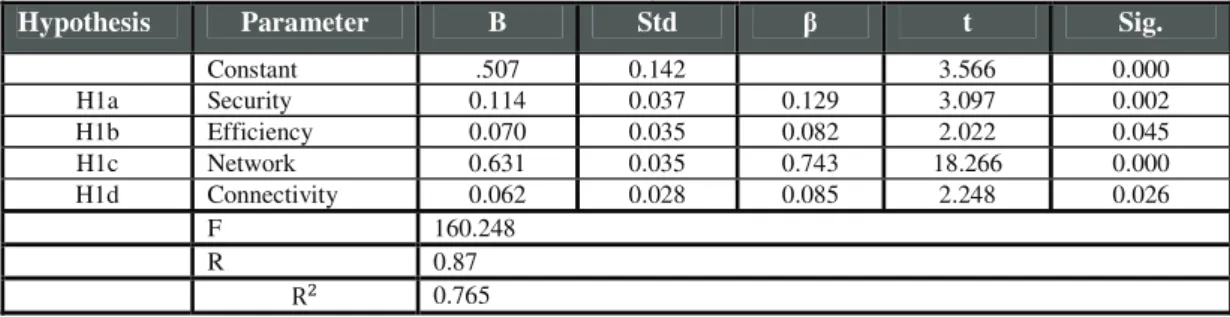
As illustrated in Table 1, the multiple regression analysis on four dimensions of mobile broadband service quality verified that there was a significant relationship between customer satisfaction and service quality. Since the correlation coefficient value was R=0.87, the impact of mobile broadband quality towards customer satisfaction can be considered as high. In contrast, the results of hierarchical multiple regression relating the role of counter service as a moderating variable demonstrated no significant effect on the relationship between mobile broadband service quality and customer satisfaction as shown in Table 2, 3 and 4. The results of hypothesis testing in this research were therefore supported based on prior research.
Table 1:The Effect of Mobile Broadband Service Quality on Customer Satisfaction
Hypothesis Parameter B Std ȕ t Sig.
Constant .507 0.142 3.566 0.000 H1a Security 0.114 0.037 0.129 3.097 0.002 H1b Efficiency 0.070 0.035 0.082 2.022 0.045 H1c Network 0.631 0.035 0.743 18.266 0.000 H1d Connectivity 0.062 0.028 0.085 2.248 0.026 F 160.248 R 0.87 ଶ 0.765
Table 2:Testing Moderator Effects of Tangibles using Hierarchical Multiple Regression
Step and VariablesSE BȕFF ChangeR2R2 Change Step 1: Broadband Quality 0.055 0.745* 242.980* 242.980 0.555 0.555 Step 2: Broadband Quality, 0.056 0.738 Tangibles 0.042 0.040 121.618 0.669 0.556 0.002 Note: * p<0.05
Table 3:Testing Moderator Effects of Responsiveness using Hierarchical Multiple Regression
Step and VariablesSE BȕFF ChangeR2R2 Change Step 1: Broadband Quality 0.055 0.745* 242.980* 242.980 0.555 0.555 Step 2: Broadband Quality, 0.056 0.718 Responsiveness 0.047 0.115* 127.124* 5.571 0.567 0.012 Step 3: Broadband Quality0.322 1.134 Responsiveness 0.304 0.588 (Broadband 0.098 -0.704 86.065 2.275 0.572 0.005 Quality x Responsiveness)
Note: * p<0.05
Table 4:Testing Moderator Effects of Fulfilment using Hierarchical Multiple Regression
Step and VariablesSE BȕFF ChangeR2R2Change Step 1: Broadband Quality 0.055 0.745* 242.980* 242.980 0.555 0.555 Step 2: Broadband Quality, 0.062 0.715 Fulfillment 0.059 0.064 122.430 1.392 0.558 0.003 Note: * p<0.05 5. Discussions
The multiple regression analysis indicated that all the dimensions significantly explained 0.77% of customer satisfaction. Accordingly, this finding supported the hypothesis of the research that mobile broadband quality has a significant relationship with customer satisfaction. Thus, the result is consistent with prior research [2; 8; 10].
The hierarchical multiple regression analysis, on the other hand, exhibited that the moderator is not significantly affecting the relationship between mobile broadband service quality and customer satisfaction (p<0.05). Hence, the result is parallel with previous research by Yap et al. [3]. Although the mean score for counter service was moderate, it is not adequate to conclude that it has the potential to serve as moderator, providing evidence to the role of culture and technological modernization [11].
Customers lining up to makebusiness transactions over service counters is no longer a common phenomenon nowadays, a direct contribution of the emergence of internet technology which enables consumers to conduct business deals anytime and just about anywhere, reflecting changes in culture. Technological modernization also provides better alternativeswhereby the use of online transactions saves time, reduces expenditure and provides more systematic ways to keep records, which would later have positive impacts on individual performance [12].
6. Conclusions
This research had revealed that the service quality and customer satisfaction of mobile broadband service levels were moderate, indicating that mobile broadband service quality is an important construct to internet service provider because it affects the overall customer satisfaction. However, the study also suggested that mobile broadband counter service did not perform as a moderator to the relationship between service quality and customer satisfaction. Since mobile broadband service businesses are increasingly contributing to the economy and university students are targeted as being one of the main subscriber groups, it is important to examine how this unique market segment perceived the service quality of competing mobile broadband internet providers. Such study should limit the scope to merely the experience of using one specific gadget, rather, should include the overall experience of using the broadband service.
ACKNOWLEDGEMENT
The authors would like to thank the Faculty of Management and Human Resource Development, UniversitiTeknologiMalaysia, Johor Bahru, Malaysia.
REFERENCES
[1] ITU Telecommunications Indicators Update: The World in 2010. (2010), From: http://www.itu.int/ITU-D/ict/statistics/.
[2]Suradi, N.R.M., Z, Mustafa.,Shahabuddin, W.R., Ali, F.A.A., and Norkisme, Z.A. (2008). Measuring Broadband Service Quality: Engineering Students Perspective: UniversitiKebangsaan Malaysia. Bangi.
[3]Yap, K.B., Wong, D.H., Loh, C. and Bak, R. (2009). Building Trust in E-Banking: Where is the Line between Online and Offline Banking?.International Journal of Bank Marketing. 28(1), 27 - 46. [4]Mansor, N. and Razali, C.H.C.M. (2010). Customers’ Satisfaction Towards Counter Service of Local
Authority in Terengganu, Malaysia. The Journal of Asian Social Science. 6(8), 197-208. [5]Mummalaneni, V. and Juan, M. (2010). Measurement Equivalency of Web Service Quality
Instruments: A Test on Chinese and African American Consumers. Journal of International
Consumer Marketing.22(3), 259 - 269.
[6]Myerscough, M.A. (2002). Information Systems Quality Assessment: Replicating Kettinger and Lee’s USIF/SERVQUAL Combination – Eighth Americas Conference on Information Systems, pp. 1104-15.
[7]Hongxiu, L., Yong, L. and Reima, S. (2009). Measurement of E-Service Quality: An Empirical Study on Online Travel Service. 17th European Conference on Information Systems. Pp. 6-13.
[8]Jeon, S. (2008). Mobile Internet Service: Assessment of Quality and Satisfaction from the Customer’s Perspective. PhD Thesis, University of Nebraska.United State.
[9]Hair, J. F., Anderson, R. E., Tatham, R. L., and Black, W. C. (1998). Multivariate DataAnalysis
(5thed.). New Jersey: Prentice-Hall International Inc.
[10]Vlachos, P.A. and Vrechopoulos, A.P. (2008). Determinants of Behavioral Intentions in the Mobile Internet Services Market.The Journal of Service Marketing. 22(4), 280 - 291.
[11]Lee, I., Choi, B., Kim, J., and Hong, S. (2007). Culture Technology Fit: Effects of Cultural Characteristics on the Post-Adoption Beliefs of Mobile Internet Users. International Journal of
Electronic Commerce. 11(4), 11-51.
[12]Xia, P. and Feng, J.X. (2009). A Research on Development of Chinese B2C E-commerce Trust. 6th International Conference on Service Systems and Service Management,on 23-24 May,2009. Wuhan, China. pp.762-765.
[13] Chen, Y.H., Tseng, M.L.*, Lin, R.J., (2010). Evaluating the customer perceptions on in-flight service quality. African Journal of Business Management 5(7), 2865-2873