Cost Effective Power Factor
Controller
The NCP1606 is an active power factor controller specifically designed for use as a pre−converter in electronic ballasts, ac−dc adapters and other medium power off line converters (typically up to 300 W). It embeds a Critical Conduction Mode (CRM) scheme that substantially exhibits unity power factor across a wide range of input voltages and power levels. Housed in a DIP8 or SOIC−8 package, the NCP1606 minimizes the number of external components. Its integration of comprehensive safety protection features makes it an excellent driver for rugged PFC stages.
General Features
•
“Unity” Power Factor•
No Need for Input Voltage Sensing•
Latching PWM for Cycle by Cycle On Time Control (Voltage Mode)•
High Precision Voltage Reference (±1.6% over temperature ranges)•
Very Low Startup Current Consumption (≤ 40 mA)•
Low Typical Operating Current (2.1 mA)•
−500 mA / +800 mA Totem Pole Gate Driver•
Undervoltage Lockout with Hysteresis•
Pin to Pin Compatible with Industry StandardsSafety Features
•
Programmable Overvoltage Protection•
Protection against Open Loop (Undervoltage Protection)•
Accurate and Programmable On Time Limitation•
Overcurrent LimitationTypical Applications
•
Electronic Light Ballast•
AC Adapters, TVs, Monitors•
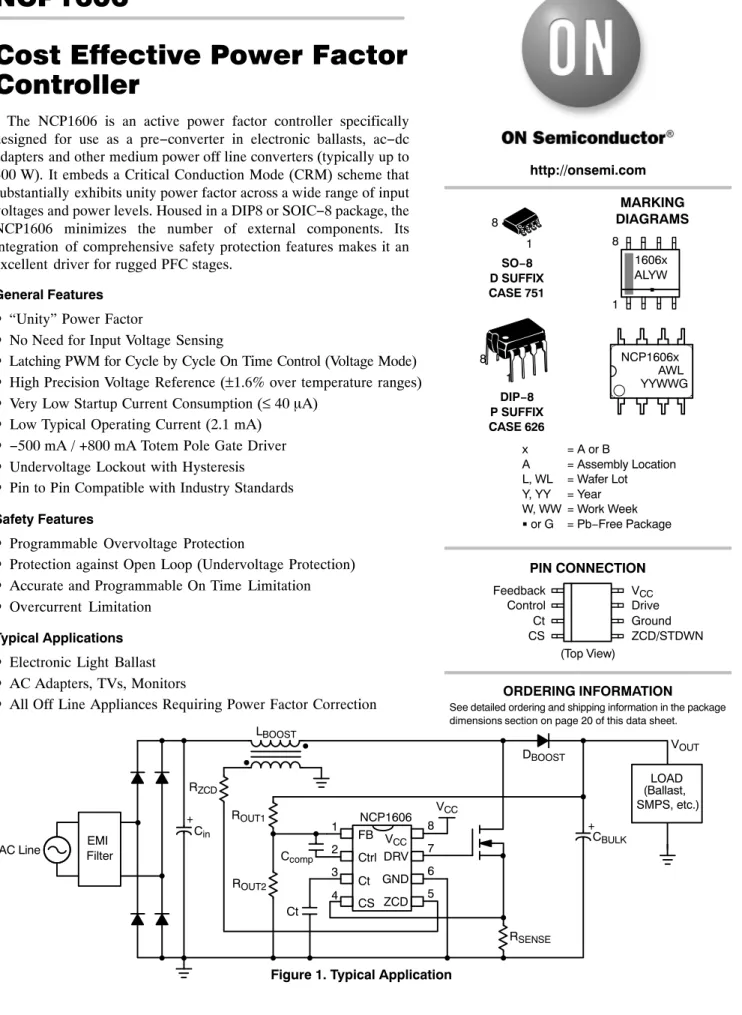
All Off Line Appliances Requiring Power Factor CorrectionFigure 1. Typical Application +
AC Line EMI Filter
1 4 3 2 8 5 6 7 FB Ctrl Ct CS GND ZCD DRV + CBULK LOAD (Ballast, SMPS, etc.) NCP1606 VOUT RSENSE Cin RZCD ROUT1 ROUT2 Ccomp VCC Ct VCC DBOOST LBOOST http://onsemi.com SO−8 D SUFFIX CASE 751 MARKING DIAGRAMS PIN CONNECTION NCP1606x AWL YYWWG DIP−8 P SUFFIX CASE 626 1 8 x = A or B A = Assembly Location L, WL = Wafer Lot Y, YY = Year W, WW = Work Week G or G = Pb−Free Package 1606x ALYW G 1 8
See detailed ordering and shipping information in the package dimensions section on page 20 of this data sheet.
ORDERING INFORMATION Feedback Control Ct CS VCC Drive Ground ZCD/STDWN (Top View) 1 8
Figure 2. Block Diagram ESD UVLO DRV GND FB ESD Control Ct ESD CS ESD ZCD E/A +− Measure + 300 + 2.5 V + + 200 mV + 2.1 V VCL(POS) Clamp Shutdown Demag UVP Fault OCP + − + Dynamic OVP ESD Shutdown VEAH Clamp Active Clamp LEB Add VEAL Offset
Static OVP is triggered when clamp is activated. VEAL Clamp Static OVP Off Timer Reset PWM R Q S (Enable EA) + 1.6 V R Q S R Q S R Q S R Q S POK nPOK nPOK nPOK AC IN DRV VCONTROL ROUT2 ROUT1 CCOMP RSENSE RZCD CBULK Q Q Q VCC VOUT VCC Q Q VDD VDD 270 mA VDD VCC VDD VDDGD VDD Reg IEAsink mV
Isink>Iovp
VCL(NEG)
*All SR Latches are Reset Dominant +− + − + − + − + − Enable +− VCS(limit) Ct DBOOST
*All values shown are typical only. Refer to the “Electrical Characteristics” for complete specifications.
LBOOST uVDD uVDD uVDD VddGD UVLO
PIN FUNCTION DESCRIPTION
Pin Number Name Function
1 Feedback (FB) The FB pin makes available the inverting input of the internal error amplifier. A simple resistor divider scales and delivers the output voltage to the FB pin to maintain regulation. The feedback information is also used for the programmable overvoltage and undervoltage protections.
2 Control The regulation block output is available on this pin. A compensation network is placed between FB and Control to set the loop bandwidth low enough to yield a high power factor ratio and a low THD. 3 Ct The Ctpin sources a 270 mA current to charge an external timing capacitor. The circuit controls the power
switch on time by comparing the Ct voltage to an internal voltage derived from the regulation block. 4 Current Sense
(CS) This pin limits the pulse by pulse current through the switch MOSFET when connected as show inFigure 1. When the voltage exceeds 1.7 V (A version) or 0.5 V (B version), the drive turns off. The maximum switch current can be adjusted by changing the sense resistor.
5 Zero Current
Detection (ZCD) The voltage of an auxiliary winding should be applied to this pin to detect the moment when the coil isdemagnetized for critical conduction mode operation. Ground ZCD to shutdown the part. 6 Ground (GND) Connect this pin to the pre−converter ground.
7 Drive (DRV) The powerful integrated driver is suitable to effectively switch a high gate charge power MOSFET. 8 VCC This pin is the positive supply of the IC. The circuit starts to operate when VCC exceeds 12 V (typ)
and turns off when VCC goes below 9.5 V (typ). After startup, the operating range is 10.3 V to 20 V.
MAXIMUM RATINGS
Rating Symbol Value Unit
Supply Voltage VCC −0.3 to 20 V Supply Current ICC ±20 mA DRV Voltage VDRV −0.3 to 20 V DRV Current IDRV −800 to 500 mA FB Voltage VFB −0.3 to 10 V FB Current IFB ±10 mA
Control Voltage VControl −0.3 to 10 V
Control Current IControl −2 to 10 mA
Ct Voltage VCt −0.3 to 6 V Ct Current ICt ±10 mA CS Voltage VCS −0.3 to 6 V CS Current ICS ±10 mA ZCD Voltage VZCD −0.3 to 10 V ZCD Current IZCD ±10 mA
Power Dissipation and Thermal Characteristics P suffix, Plastic Package, Case 626
Maximum Power Dissipation @ TA = 70°C Thermal Resistance Junction−to−Air D suffix, Plastic Package, Case 751 Maximum Power Dissipation @ TA = 70°C Thermal Resistance Junction−to−Air
PD(DIP) RqJA(DIP) PD(SO) RqJA(SO) 800 100 450 178 mW °C/W mW °C/W
Operating Junction Temperature Range TJ −40 to +125 °C
Maximum Junction Temperature TJ(MAX) 150 °C
Storage Temperature Range TSTG −65 to 150 °C
Lead Temperature (Soldering, 10 s) TL 300 °C
Stresses exceeding Maximum Ratings may damage the device. Maximum Ratings are stress ratings only. Functional operation above the Recommended Operating Conditions is not implied. Extended exposure to stresses above the Recommended Operating Conditions may affect device reliability.
1. This device series contains ESD protection and exceeds the following tests: Pins 1−6, 8: Human Body Model 2000 V per JEDEC Standard JESD22−A114E,
Machine Model Method 200 V per JEDEC Standard JESD22−A115−A Pin 7: Human Body Model 2000 V per JEDEC Standard JESD22−A114E,
Machine Model Method 180 V per JEDEC Standard JESD22−A115−A
ELECTRICAL CHARACTERISTICS
(Unless otherwise specified: For typical values, TJ = 25°C. For min/max values, TJ = −40°C to +125°C, VCC = 12 V, FB = 2.4 V, CDRV = 1 nF, Ct = 1 nF, CS = 0 V, Control = open, ZCD = open)
Symbol Rating Min Typ Max Unit
VCC UNDERVOLTAGE LOCKOUT SECTION
VCC(on) VCC Startup Threshold (Undervoltage Lockout Threshold, Vcc rising)
−25°C < TJ < +125°C
−40°C < TJ < +125°C 11.0
10.9 12.012.0 13.013.1 V
VCC(off) VCC Disable Voltage after Turn On (Undervoltage Lockout Threshold, VCC falling)
−25°C < TJ < +125°C
−40°C < TJ < +125°C 8.7
8.5 9.59.5 10.310.5 V
HUVLO Undervoltage Lockout Hysteresis 2.2 2.5 2.8 V
DEVICE CONSUMPTION
ICC(startup) Icc consumption during startup: 0 V < VCC < VCC(on)− 200 mV − 20 40 mA ICC1 Icc consumption after turn on at VCC = 12 V, No Load, 70 kHz switching − 1.4 2.0 mA ICC2 Icc consumption after turn on at VCC = 12 V, 1 nF Load, 70 kHz switching − 2.1 3 mA ICC(fault) Icc consumption after turn on at VCC = 12 V, 1 nF Load, no switching
(such as during OVP fault, UVP fault, or grounding ZCD) − 1.2 1.6 mA
REGULATION BLOCK (ERROR AMPLIFIER)
VREF Voltage Reference @ TJ = 25 °C
−25°C < TJ < +125°C −40°C < TJ < +125°C 2.475 2.465 2.460 2.50 2.50 2.50 2.525 2.535 2.540 V
VREF(line) Vref Line Regulation from VCC(on) + 200 mV < VCC < 20 V, @ TJ = 25°C −2 − 2 mV IEA Error Amplifier Current Capability:: (Note 3)
Sink (Control= 4 V, VFB = 2.6 V): Source (Control= 4 V, VFB = 2.4 V): 8.0 −20 17 −6.0 30 −2 mA
GOL Open Loop, Error Amplifier Gain (Note 4) − 80 − dB
BW Unity Gain Bandwidth (Note 4) − 1 − MHz
IFB FB Bias Current @ VFB = 3 V −500 − 500 nA
IControl ControlPin Bias Current @ FB = 0 V and Control = 4.0 V. −1 − 1 mA
VEAH VCONTROL @ IEASOURCE = 0.5 mA, VFB = 2.4 V 4.9 5.3 5.7 V
VEAL VCONTROL @ IEASINK = 0.5 mA, VFB = 2.6 V 1.85 2.1 2.4 V
VEA(diff) VEA(diff) = VEAH− VEAL. Difference between max and min Control voltages 3.0 3.2 3.4 V
CURRENT SENSE BLOCK
VCS(limit) Overcurrent Protection Threshold: NCP1606A NCP1606B 1.6 0.45 1.7 0.5 1.8 0.55 V
tLEB Leading Edge Blanking duration 150 250 350 ns
tCS Overcurrent protection propagation delay. 40 100 170 ns
ICS CS bias current @ VCS = 2 V −1 − 1 mA
ZERO CURRENT DETECTION
VZCDH Zero Current Detection Threshold (VZCD rising) 1.9 2.1 2.3 V
VZCDL Zero Current Detection Threshold (VZCD falling) 1.45 1.6 1.75 V
VZCD(HYS) VZCDH − VZCDL 300 500 800 mV
IZCD Maximum ZCD bias Current @ VZCD = 5 V −2 − +2 mA
VCL(POS) Upper Clamp Voltage @ IZCD = 2.5 mA 5 5.7 6.5 V
ICL(POS) Current Capability of the Positive Clamp at VZCD = VCL(POS) + 200 mV: 5.0 8.5 − mA 3. Parameter values are valid for transient conditions only.
ELECTRICAL CHARACTERISTICS
(Unless otherwise specified: For typical values, TJ = 25°C. For min/max values, TJ = −40°C to +125°C, VCC = 12 V, FB = 2.4 V, CDRV = 1 nF, Ct = 1 nF, CS = 0 V, Control = open, ZCD = open)
Symbol Rating Min Typ Max Unit
VCL(NEG) Negative Active Clamp Voltage @ IZCD = −2.5 mA 0.45 0.6 0.75 V
ICL(NEG) Current Capability of the Negative Active Clamp: in normal mode (VZCD = 300 mV) in shutdown mode (VZCD = 100 mV) 2.5 35 3.7 70 5.0 100 mA mA
VSDL Shutdown Threshold (VZCD falling) 150 200 250 mV
VSDH Enable Threshold (VZCD rising) − 290 350 mV
VSDHYS Shutdown Comparator Hysteresis − 90 − mV
tZCD Zero current detection propagation delay − 100 170 ns
tSYNC Minimum detectable ZCD pulse width − 70 − ns
tSTART Drive off restart timer 75 180 300 ms
RAMP CONTROL
ICHARGE Charge Current (VCT = 0 V) −25°C < TJ < +125°C
−40°C < TJ < +125°C 243
235 270270 297297 mA tCT(discharge) Time to discharge a 1 nF Ct capacitor from VCT = 3.4 V to 100 mV. − − 100 ns
VCTMAX Maximum Ct level before DRV switches off −25°C < TJ < +125°C
−40°C < TJ < +125°C 2.9
2.9 3.23.2 3.33.4 V
tPWM Propagation delay of the PWM comparator − 150 220 ns
OVER AND UNDERVOLTAGE PROTECTION
IOVP Dynamic overvoltage protection (OVP) triggering current: NCP1606A NCP1606B @ TJ = 25°C NCP1606B @ TJ = −40°C to +125°C 34 9.0 8.7 40 10.4 − 45 11.8 12.1 mA
IOVP(HYS) Hysteresis of the dynamic OVP current before the OVP latch is released: NCP1606A NCP1606B − − 30 8.5 − − mA
VOVP Static OVP Threshold Voltage VEAL +
100 mV V
VUVP Undervoltage protection (UVP) threshold voltage 0.25 0.3 0.4 V
GATE DRIVE SECTION ROH
ROL
Gate Drive Resistance:
ROH @ ISOURCE = 100 mA ROH @ ISOURCE = 20 mA ROL @ ISINK = 100 mA ROL @ ISINK = 20 mA − − − − 12 12 6 6 18 18 10 10 W
trise Drive voltage rise time from 10% VCC to 90% VCC with CDRV = 1 nF and VCC = 12 V. − 30 80 ns tfall Drive voltage fall time from 90% VCC to 10% VCC with CDRV = 1 nF and VCC = 12 V. − 25 70 ns VOUT(start) Driver output voltage at VCC = VCC(on)− 200 mV and Isink = 10 mA − − 0.2 V 3. Parameter values are valid for transient conditions only.
TYPICAL CHARACTERISTICS
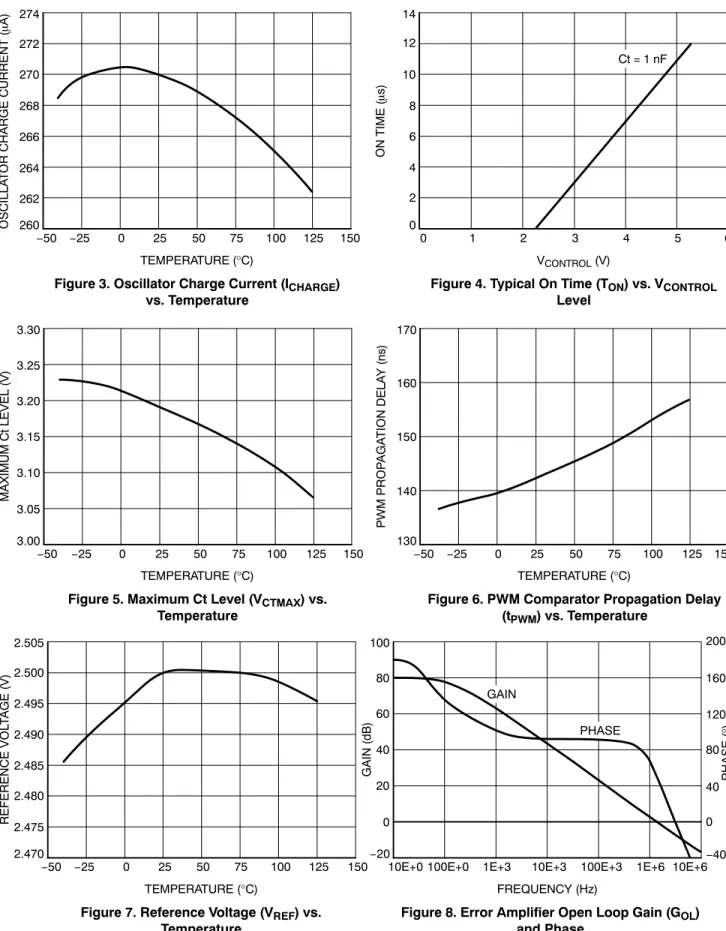
Figure 3. Oscillator Charge Current (ICHARGE) vs. Temperature
Figure 4. Typical On Time (TON) vs. VCONTROL Level TEMPERATURE (°C) VCONTROL (V) 150 100 75 50 25 0 −25 −50 260 262 264 266 268 270 272 274 6 5 4 3 2 1 0 0 2 4 6 8 10 12 14 OSCILLA
TOR CHARGE CURRENT (
m A) ON TIME ( m s) 125 Ct = 1 nF
Figure 5. Maximum Ct Level (VCTMAX) vs.
Temperature
Figure 6. PWM Comparator Propagation Delay (tPWM) vs. Temperature TEMPERATURE (°C) TEMPERATURE (°C) 125 100 75 50 25 0 −25 −50 3.00 3.05 3.15 3.20 3.25 3.30 125 100 75 50 25 0 −25 −50 130 140 150 160 170 MAXIMUM Ct LEVEL (V) PWM PROP A G ATION DELA Y (ns) 3.10 150 150
Figure 7. Reference Voltage (VREF) vs.
Temperature Figure 8. Error Amplifier Open Loop Gain (Gand Phase OL)
TEMPERATURE (°C) FREQUENCY (Hz) 125 100 75 50 25 0 −25 −50 2.470 2.475 2.480 2.485 2.490 2.495 2.500 2.505 10E+6 1E+6 100E+3 10E+3 1E+3 100E+0 10E+0 −20 0 20 40 60 80 100 REFERENCE VOL TAGE (V) GAIN (dB) 150 PHASE ( ° ) 200 160 120 80 40 0 −40 GAIN PHASE
TYPICAL CHARACTERISTICS
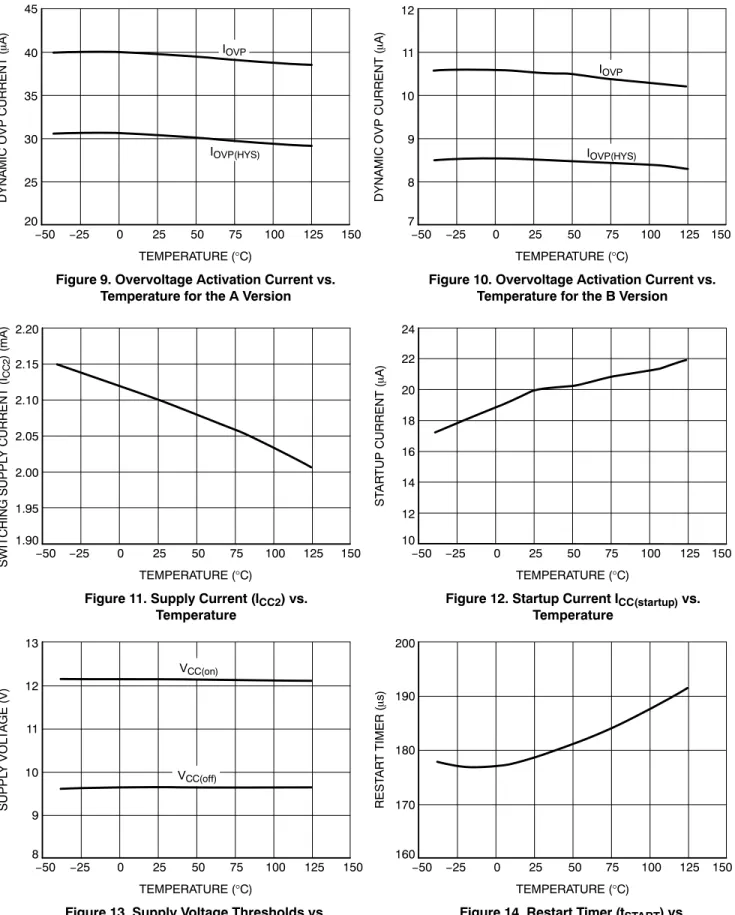
Figure 9. Overvoltage Activation Current vs.
Temperature for the A Version Figure 10. Overvoltage Activation Current vs.Temperature for the B Version
TEMPERATURE (°C) TEMPERATURE (°C) 125 100 75 50 25 0 −25 −50 20 25 30 35 40 45 125 100 75 50 25 0 −25 −50 7 8 9 10 11 12
DYNAMIC OVP CURRENT (
m
A)
DYNAMIC OVP CURRENT (
m A) 150 IOVP(HYS) IOVP 150 IOVP(HYS) IOVP
Figure 11. Supply Current (ICC2) vs.
Temperature Figure 12. Startup Current ITemperatureCC(startup) vs.
TEMPERATURE (°C) TEMPERATURE (°C) 125 100 75 50 25 0 −25 −50 1.90 1.95 2.00 2.05 2.10 2.15 2.20 125 100 75 50 25 0 −25 −50 10 12 14 16 18 20 22 24
Figure 13. Supply Voltage Thresholds vs. Temperature
Figure 14. Restart Timer (tSTART) vs. Temperature TEMPERATURE (°C) TEMPERATURE (°C) 150 125 100 75 25 0 −25 −50 8 9 10 11 12 13 125 100 75 50 25 0 −25 −50 160 170 180 190 200 SWITCHING SUPPL Y CURRENT (I CC2 ) (mA) S TA R TUP CURRENT ( m A) SUPPL Y VOL TAGE (V) REST AR T TIMER ( m s) 150 150 50 VCC(on) VCC(off) 150
TYPICAL CHARACTERISTICS
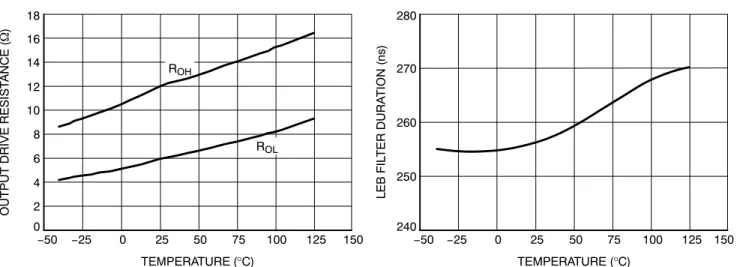
Figure 15. Output Gate Drive Resistance (ROH
and ROL) at 100 mA vs. Temperature Figure 16. LEB Duration (tLEB) vs. Temperature
TEMPERATURE (°C) TEMPERATURE (°C) 125 100 75 50 25 0 −25 −50 0 2 4 8 10 12 16 18 125 100 75 50 25 0 −25 −50 240 250 260 270 280
OUTPUT DRIVE RESIST
ANCE ( W ) LEB FIL TER DURA TION (ns) 6 14 150 ROH ROL 150
Figure 17. Overcurrent Threshold VCS(limit) vs.
Temperature TEMPERATURE (°C) 125 100 75 50 25 0 −25 −50 1.670 1.675 1.685 1.690 1.695 1.705 1.710
Figure 18. Undervoltage Protection Threshold (VUVP) vs. Temperature
Figure 19. Shutdown Thresholds vs. Temperature TEMPERATURE (°C) TEMPERATURE (°C) 150 125 100 75 25 0 −25 −50 0.280 0.285 0.305 0.310 0.315 0.320 125 100 75 50 25 0 −25 −50 0.15 0.20 0.25 0.30 0.35
A VERSION OVERCURRENT THRESHOLD (V)
UVP THRESHOLD (V) SHUTDOWN THRESHOLD (V) 150 50 150 1.680 1.700 0.520 0.515 0.510 0.505 0.500 0.495 0.490 0.485 0.480
B VERSION OVERCURRENT THRESHOLD (V)
A B 0.290 0.295 0.300 VSDH VSDL
Introduction
The NCP1606 is a voltage mode power factor correction (PFC) controller designed to drive cost effective pre−converters to meet input line harmonic regulations. This controller operates in critical conduction mode (CRM) for optimal performance in applications up to about 300 W. Its voltage mode scheme enables it to obtain unity power factor without the need for a line sensing network. The output voltage is accurately controlled by a high precision error amplifier. The controller also implements a comprehensive array of safety features for robust designs. The key features of the NCP1606 are as follows:
•
Constant on time (Voltage Mode) CRM operation. High power factor ratios are easily obtained without the need for input voltage sensing. This allows for optimal standby power consumption.•
Accurate and Programmable On Time Limitation. The NCP1606 using an accurate current source and an external capacitor to generate the on time.•
High Precision Voltage Reference. The error amplifier reference voltage is guaranteed at 2.5 V ±1.6% over process and temperature. This results in very accurate output voltages.•
Very Low Startup Consumption. The circuit consumption is reduced to a minimum (< 40 mA) during the startup phase which allows fast, low loss, charging of VCC. The architecture of the NCP1606 gives a controlled undervoltage lockout level and provides ample VCC hysteresis during startup.•
Powerful Output Driver. A −500 mA / +800 mA totem pole gate driver is used to provide rapid turn on and turn off times. This translates into improved efficiencies and the ability to drive higher power MOSFETs. Additionally, a combination of active and passive circuitry is used to ensure that the driver output voltage does not float high while VCC is below its turn on level.•
Programmable Overvoltage Protection (OVP). The adjustable OVP feature protects the PFC stage against excessive output overshoots that could damage the application. These events can typically occur during the startup phase or when the load is abruptly removed. The NCP1606B gives a lower OVP threshold, which can further reduce the application’s standby power loss.•
Protection against Open Loop (Undervoltage Protection). Undervoltage protection (UVP) disables the PFC stage when the output voltage is excessively low. This also protects the circuit in case of a failure in the feedback network: if no voltage is applied to FB because of a bad connection, UVP is activated and shuts down the pre−converter.•
Overcurrent Limitation. The peak current is accurately limited on a pulse by pulse basis. The level isNCP1606B uses a lower overcurrent threshold, which can further reduce the application’s power dissipation. An integrated LEB filter reduces the chance of noise prematurely triggering the overcurrent limit.
•
Shutdown Features. The PFC pre−converter can be easily placed in a shutdown mode by grounding either the FB pin or the ZCD pin. During this mode, the ICC current consumption is reduced and the error amplifier is disabled.Application information
Most electronic ballasts and switching power supplies use a diode bridge rectifier and a bulk storage capacitor to produce a dc voltage from the utility ac line (Figure 20). This DC voltage is then processed by additional circuitry to drive the desired output.
Figure 20. Typical Circuit without PFC Load Converter Rectifiers Bulk Storage Capacitor + AC Line
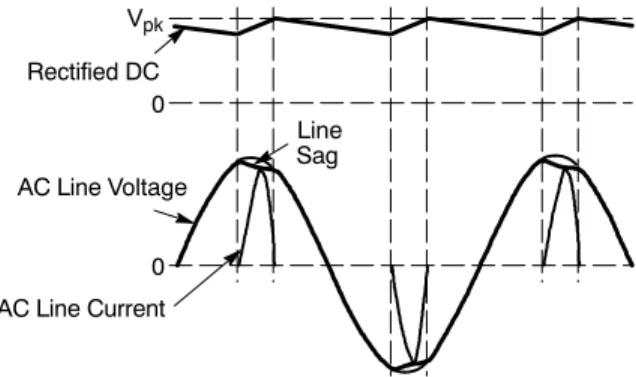
This simple rectifying circuit draws power from the line when the instantaneous ac voltage exceeds the capacitor voltage. Since this occurs near the line voltage peak, the resulting current draw is non sinusoidal and contains a very high harmonic content. This results in a poor power factor (typically < 0.6) and consequently, the apparent input power is much higher than the real power delivered to the load. Additionally, if multiple devices are tied to the same input line, the effect is magnified and a “line sag” effect can be produced (see Figure 21).
Figure 21. Typical Line Waveforms without PFC Line Sag Rectified DC AC Line Voltage AC Line Current 0 0 Vpk
Increasingly, government regulations and utility requirements necessitate control over the line current harmonic content. To meet this need, power factor correction is implemented with either a passive or active circuit. Passive circuits usually contain a combination of large capacitors, inductors, and rectifiers that operate at the
a high frequency switching converter which regulates the input current to stay in phase with the input voltage. These circuits operate at a higher frequency and so they are smaller, lighter in weight, and more efficient than a passive circuit. With proper control of an active PFC stage, almost any complex load can be made to appear in phase with the
ac line, thus significantly reducing the harmonic current content. Because of these advantages, active PFC circuits have become the most popular way to meet harmonic content requirements. Generally, they consist of inserting a PFC pre−regulator between the rectifier bridge and the bulk capacitor (Figure 22).
Figure 22. Active PFC Pre−Converter with the NCP1606
Rectifiers + AC Line High Frequency Bypass Capacitor NCP1606 PFC Preconverter Converter Load + Bulk Storage Capacitor
The boost (or step up) converter is the most popular topology for active power factor correction. With the proper control, it produces a constant voltage while drawing a sinusoidal current from the line. For medium power (<300 W) applications, critical conduction mode (also called borderline conduction mode) is the preferred control method. Critical conduction mode (CRM) occurs at the boundary between discontinuous conduction mode
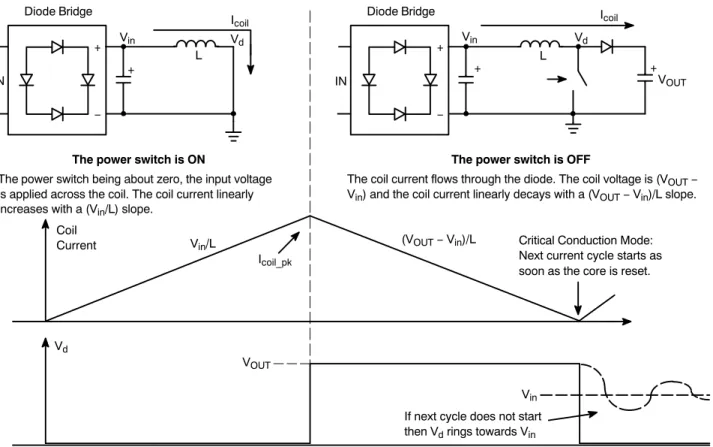
(DCM) and continuous conduction mode (CCM). In CRM, the next driver on time is initiated when the boost inductor current reaches zero. CRM operation is an ideal choice for medium power PFC boost stages because it combines the lower peak currents of CCM operation with the zero current switching of DCM operation. The operation and waveforms in a PFC boost converter are illustrated in Figure 23.
Figure 23. Schematic and Waveforms of an Ideal CRM Boost Converter Diode Bridge IN + − L Diode Bridge IN + − L +
The power switch is ON The power switch is OFF
Critical Conduction Mode: Next current cycle starts as soon as the core is reset. Coil
Current
+
The power switch being about zero, the input voltage is applied across the coil. The coil current linearly increases with a (Vin/L) slope.
The coil current flows through the diode. The coil voltage is (VOUT− Vin) and the coil current linearly decays with a (VOUT− Vin)/L slope.
Icoil VOUT Vin Vd (VOUT− Vin)/L Icoil_pk Icoil Vin Vd Vd Vin/L VOUT Vin If next cycle does not start then Vd rings towards Vin +
When the switch is closed, the inductor current increases linearly to its peak value. When the switch opens, the inductor current linearly decreases to zero. At this point, the drain voltage of the switch (Vd) is essentially floating and begins to drop. If the next switching cycle does not start, then the voltage will ring with a dampened frequency around Vin. A simple derivation of equations (such as found in AND8123), leads to the result that good power factor correction in CRM operation is achieved when the on time is constant across an ac cycle and is equal to:
ton+h2@@VacPOUT@L
RMS2 (eq. 1)
A simple plot of this switching over an ac line cycle is illustrated in Figure 24. The off time varies based on the instantaneous line voltage, but the on time is kept constant. This naturally causes the peak inductor current (ILpk) to follow the ac line voltage.
The NCP1606 represents an ideal method to implement this constant on time CRM control in a cost effective and robust solution. The device incorporates an accurate regulation circuit, a low power startup circuit, and advanced protection features.
Figure 24. Inductor Waveform During CRM Operation ON OFF MOSFET Iin(t) IL(t) Vin(t) Vinpk ILpk Iinpk
ERROR AMPLIFIER REGULATION
The NCP1606 is configured to regulate the boost output voltage based on its built in error amplifier (EA). The error amplifier ’s negative terminal is pinned out to FB, the positive terminal is tied to a 2.5 V ± 1.6% reference, and the output is pinned out to Control (Figure 25).
Figure 25. Error Amplifier and On Time Regulation Circuits FB Control +− EA + 2.5 V PWM BLOCK VCONTROL ROUT2 ROUT1 CCOMP tPWM tON(max) VOUT tON VEAL VEAH Slope+I Ct CHARGE VCONTROL
A resistor divider from the boost output to the input of the EA sets the FB level. If the output voltage is too low, then the FB level will drop and the EA will cause the control voltage to increase. This increases the on time of the driver, which increases the power delivered and brings the output back into regulation. Alternatively, if the output voltage (and hence FB voltage) is too high, then the control level decreases and the driver on times are shortened. In this way, the circuit regulates the output voltage (VOUT) so that the VOUT portion that is applied to FB through the resistor divider R and R is equal to the internal reference
(2.5 V). The output voltage can then be easily set according to the following equation:
VOUT+2.5 V@ROUT1)ROUT2
ROUT2 (eq. 2)
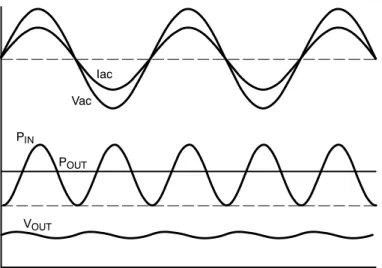
A compensation network is placed between the FB and Control pins to reduce the speed at which the EA responds to changes in the boost output. This is necessary due to the nature of an active PFC circuit. The PFC stage absorbs a sinusoidal current from a sinusoidal line voltage. Hence, the converter provides the load with a power that matches
the average demand only. Therefore, the output capacitor must “absorb” the difference between the delivered power and the power consumed by the load. This means that when the power fed to the load is lower than the demand, the output capacitor discharges to compensate for the lack of
power. Alternatively, when the supplied power is higher than that absorbed by the load, the output capacitor charges to store the excess energy. The situation is depicted in Figure 26.
Figure 26. Output Voltage Ripple for a Constant Output Power VOUT
POUT PIN
Iac Vac
As a consequence, the output voltage exhibits a ripple at a frequency of either 100 Hz (for 50 Hz mains such as in Europe) or 120 Hz (for 60 Hz mains in the USA). This ripple must not be taken into account by the regulation loop because the error amplifier’s output voltage must be kept constant over a given ac line cycle for a proper shaping of the line current. Due to this constraint, the regulation bandwidth is typically set below 20 Hz. For a simple type 1 compensation network, only a capacitor is placed between FB and Control (see Figure 1). In this configuration, the capacitor necessary to attenuate the bulk voltage ripple is given by:
CCOMP+ 10
G 20
4@pfline@ROUT1 (eq. 3)
where G is the attenuation level in dB (commonly 60 dB)
ON TIME SEQUENCE
Since the NCP1606 is designed to control a CRM boost converter, its switching pattern must accommodate constant on times and variable off times. The Controller generates the on time via an external capacitor connected to pin 3 (Ct). A current source charges this capacitor to a level determined by the Control pin voltage. Specifically, Ct is charged to VCONTROL minus the VEAL offset (typically 2.1 V). Once this level is exceeded, the drive is turned off (Figure 27).
Figure 27. On Time Generation Control Ct +− PWM + DRV ICHARGE tON VEAL VCONTROL− VEAL tON VCt VCt(off) VDD DRV VCONTROL
Since VCONTROL varies with the RMS line level and output load, this naturally satisfies equation 1. And if the values of compensation components are sufficient to filter
out the bulk voltage ripple, then this on time is truly constant over the ac line cycle.
Note that the maximum on time of the controller occurs when VCONTROL is at its maximum. Therefore, the Ct capacitor must be sized to ensure that the required on time can be delivered at full power and the lowest input voltage condition. The maximum on time is given by:
tON(max)+CtI@VCTMAX
CHARGE (eq. 4) Combining this equation with equation 1, gives:
Ctw2h@@PVacOUT@L@ICHARGE
RMS2@VCTMAX (eq. 5) where VCTMAX = 2.9 V (min)
ICHARGE = 297 mA (max)
OFF TIME SEQUENCE
While the on time is constant across the ac cycle, the off time in CRM operation varies with the instantaneous input voltage. The NCP1606 determines the correct off time by sensing the inductor voltage. When the inductor current drops to zero, the drain voltage (“Vd” in Figure 23) is essentially floating and naturally begins to drop. If the switch is turned on at this moment, then CRM operation will be achieved. To measure this high voltage directly on the inductor is generally not economical or practical. Rather, a smaller winding is taken off of the boost inductor. This winding, called the zero current detector (ZCD) winding, gives a scaled version of the inductor output and is more useful to the controller.
Figure 28. Voltage Waveforms for Zero Current Detection DRIVE Winding Pin Drain 0.6 V VOUT 5.7 V 2.1 V 1.6 V ZCD
Figure 28 gives typical operating waveforms with the ZCD winding. When the drive is on, a negative voltage appears on the ZCD winding. And when the drive is off, a positive voltage appears. When the inductor current drops to zero, then the ZCD voltage falls and starts to ring around zero volts. The NCP1606 detects this falling edge and starts the next driver on time. To ensure that a ZCD event has truly occurred, the NCP1606’s logic (Figure 29) waits for the ZCD pin voltage to rise above VZCDH (2.1 V typical) and then fall below VZCDL (1.6 V typical). In this way, CRM operation is easily achieved.
Figure 29. Implementation of the ZCD Winding ZCD +− + 200 mV + − + 2.1 v VCL(POS) Clamp Shutdown Demag VCL(NEG) Active Clamp + − + 1.6 V Reset Dominant Latch R Q S DRIVE RSENSE RZCD VDD Vin NZCD Q NB
To prevent negative voltages on the ZCD pin, the pin is internally clamped to VCL(NEG) (600 mV typ) when the ZCD winding is negative. Similarly, the ZCD pin is clamped to VCL(POS) (5.7 V typical), when the voltage rises too high. Because of these clamps, a resistor (RZCD in Figure 29) is necessary to limit the current from the ZCD winding to the ZCD pin.
At startup, there is no energy in the ZCD winding and therefore no voltage signal to activate the ZCD comparators. This means that the driver could never turn on. Therefore, to enable the PFC stage to startup under these conditions, an internal watchdog timer is integrated into the controller. This timer turns the drive on if the driver has been off for more than 180 ms (typical). Obviously, this feature is deactivated during a fault mode (OVP, UVP, or Shutdown), and reactivated when the fault is removed.
STARTUP
Generally, a resistor connected between the ac input and VCC (pin 8) charges the VCC capacitor to the VCC(on) level (12 V typical). Because of the very low consumption of the NCP1606 during this stage (< 40 mA), most of the current goes directly to charging up the VCC capacitor. This provides faster startup times and reduced standby power dissipation. When the VCC voltage exceeds the VCC(on)
level, the internal references and logic of the NCP1606 turn on. The controller has an undervoltage lockout (UVLO) feature which keeps the part active until VCC drops below VCC(off) (9.5 V typical). This hysteresis allows ample time for the auxiliary winding to take over and supply the necessary power to VCC (Figure 30).
Figure 30. Typical VCC Startup Waveform
VCC VCC(on)
VCC(off)
When the PFC pre−converter is loaded by a switch mode power supply (SMPS), then it is often preferable to have the SMPS controller startup first. The SMPS can then supply the NCP1606 VCC directly. Advanced controllers, such as the NCP1230 or NCP1381, can control when to turn on the PFC stage (see Figure 31) leading to optimal system performance. This setup also eliminates the startup resistors and therefore improves the no load power dissipation of the system.
Figure 31. NCP1606 Supplied by a Downstream SMPS Controller (NCP1230) 1 7 6 5 2 3 4 NCP1606 + + + + 1 7 6 5 2 3 4 NCP1230 PFC_Vcc 8 8 VCC + Cbulk Dboost
QUICK START and SOFT START
At startup, the error amplifier is enabled and Controlis pulled up to VEAL (typically 2.1 V). This is the lowest level of control voltage which produces output drives. This feature, called “quick start,” eliminates the delay at startup
associated with charging the compensation network to its minimum level. This also produces a natural “soft start” mode where the controller’s power ramps up from zero to the required power (see Figure 32).
Figure 32. Startup Timing Diagram Showing the Natural Soft Start of the ControlPin FB
Control 2.5 V
Natural Soft Start VCC Iswitch VEAL VOUT VCC(off) VCC(on) OUTPUT DRIVER
The NCP1606 includes a powerful output driver capable of peak currents of +500 mA and −800 mA. This enables the controller to efficiently drive power MOSFETs for medium power (up to 300 W) applications. Additionally, the driver stage is equipped with both passive and active pull down clamps (Figure 33). The clamps are active when VCC is off and force the driver output to well below the threshold voltage of a power MOSFET.
Figure 33. Output Driver Stage and Pull Down Clamps UVLO DRV GND + − + DRV IN uVDD VCC VDD VddGD VDD REG UVLO Overvoltage Protection
The low bandwidth of the feedback network makes active PFC stages very slow systems. One consequence of this is the risk of huge overshoots in abrupt transient phases (startup, load steps, etc.). For reliable operation, it is critical that some form of overvoltage protection (OVP) effectively prevents the output voltage from rising too high. The NCP1606 detects these excessive VOUT levels
and disables the driver until the output voltage returns to nominal levels. This keeps the output voltage within an acceptable range. The limit is adjustable so that the overvoltage level can be optimally set. The level must not be so low that it is triggered by the 100 or 120 Hz ripple of the output voltage. But it must be low enough so as not to require a larger voltage rating of the output capacitor. Figure 34 depicts the operation of the OVP circuitry.
Figure 34. OVP and UVP Circuit Blocks FB Control +− E/A +− Measure + 300 mV + 2.5 V UVP Fault Dynamic OVP VEAH Clamp
Static OVP is triggered when clamp is activated. VEAL
Clamp Static OVP Enable (Enable EA) ROUT2 ROUT1 CCOMP VDD ICONTROL > Iovp VOUT ICONTROL VCONTROL ICONTROL
When the output voltage is in steady state, ROUT1 and ROUT2 regulate the FB voltage to 2.5 V. Also, during this equilibrium state, no current flows through the compensation capacitor (“CCOMP” of Figure 1). Therefore:
•
The ROUT1 current is:IR
OUT1+
(VOUT)nom*2.5 V
ROUT1 (eq. 6)
where (VOUT)nom is the nominal output voltage.
•
The ROUT2 current is:IR
OUT2+
2.5 V
ROUT2 (eq. 7)
•
And since no current flows through CCOMP,IR OUT1+IROUT2å (VOUT)nom*2.5 V ROUT1 + 2.5 V ROUT2 (eq. 8)
Under stable conditions, these equations are true. Conversely when VOUT is not at its nominal level, the output of the error amplifier sinks or sources the current necessary to maintain 2.5 V on pin 1. In particular, in the case of an overvoltage condition:
•
The error amplifier maintains 2.5 V on pin 1, and the ROUT2 current remains:IR
OUT2+
2.5 V
ROUT2 (eq. 9)
•
The ROUT1 current is:IR +VOUTR −2.5 V+(VOUT)nomR)DVOUT−2.5 V
(eq. 10)
•
Therefore, the error amplifier sinks:IR
OUT1−IROUT2+
(VOUT)nom)DVOUT−2.5 V
ROUT1 −
2.5 V ROUT2
(eq. 11)
The combination of Equations 2 and 11 leads to a very simple expression of the current sunk by the error amplifier:
ICONTROL+IR
OUT1*IROUT2+ DVOUT
ROUT1 (eq. 12)
Hence, the current absorbed by pin 2 (ICONTROL) is proportional to the output voltage excess. The circuit senses this current and disables the drive (pin 7) when ICONTROL exceeds IOVP (typically 40 mA in NCP1606A, 10.4mA in NCP1606B). This gives the OVP threshold as:
(VOUT)OVP+(VOUT)nom)(ROUT1@IOVP)
By simply adjusting ROUT1, the OVP limit can be easily set. Therefore, one can compute the ROUT1 and ROUT2 resistances using the following procedure:
1. Select ROUT1 to set the desired overvoltage level:
ROUT1+(VOUT)OVPI*(VOUT)nom
OVP
For instance if implementing the NCP1606B, and 420 V is the maximum output level and 400 V is the nominal output level, then
ROUT1+42010.4*m400A +1.9 MW 2. Select ROUT2 to adjust the regulation level:
For the above example, this leads to:
ROUT2+400 V2.5 V*2.5 V@1.9 MW+12.0 kW. STATIC OVERVOLTAGE PROTECTION
If the OVP condition lasts for a long time, it may happen that the error amplifier output reaches its minimum level (i.e. Control = VEAL). It would then not be able to sink any current and maintain the OVP fault. Therefore, to avoid any discontinuity in the OVP disabling effect, the circuit incorporates a comparator which detects when the lower level of the error amplifier is reached. This event, called “static OVP”, disables the output drives. Once the OVP event is over, and the output voltage has dropped to normal, then Controlrises above the lower limit and the driver is re−enabled (Figure 35).
Figure 35. OVP Timing Diagram Vout Vcontrol Icontrol Dynamic OVP Static OVP IovpH IovpL Vout(nom) Drive VEAH VEAL
NCP1606 Undervoltage Protection (UVP)
When the PFC stage is plugged in, the output voltage is forced to roughly equate the peak line voltage. The NCP1606 detects an undervoltage fault when this output voltage is unusually low, such that the feedback voltage is below VUVP (300 mV typ). In an UVP fault, the drive output and error amplifier (EA) are disabled. The latter is done so that the EA does not source a current which would increase the FB voltage and prevent the UVP event from being accurately detected. The UVP feature helps to protect the application if something is wrong with the power path to the bulk capacitor (i.e. the capacitor cannot charge up) or if the controller cannot sense the bulk voltage (i.e. the feedback loop is open).
Furthermore, the NCP1606 incorporates a novel startup sequence which ensures that undervoltage conditions are always detected at startup. It accomplishes this by waiting approximately 180 ms after VCC reaches VCC(on) before enabling the error amplifier (Figure 36). During this wait time, it looks to see if the feedback (FB) voltage is greater than the UVP threshold. If not, then the controller enters a UVP fault and leaves the error amplifier disabled. However, if the FB pin voltage increases and exceeds the UVP level, then the controller will start the application up normally.
Figure 36. The NCP1606’s Startup Sequence with and without a UVP Fault
FB
Control 2.5 V
UVP UVP Wait
UVP Wait VUVP VEAH VEAL VOUT(nom) VOUT VCC(off) VCC(on) VCC
UVP Fault is “Removed”
The voltage on the output which exits a UVP fault is given by:
VOUT
(UVP)+
ROUT1)ROUT2
ROUT2 @300 mV (eq. 13)
If ROUT1 = 1.9 MW and ROUT2 = 12.0 kW, then the VOUT UVP threshold is 48 V. This corresponds to an input voltage of approximately 34 Vac.
Overcurrent Protection (OCP)
A dedicated pin on the NCP1606 senses the peak current and limits the driver on time if this current exceeds VCS(limit). This level is 1.7 V (typ) on the NCP1606A and 0.5 V (typ) on the NCP1606B. Therefore, the maximum peak current can be adjusted by changing RSENSE according to:
Ipeak+VRCS(limit)
SENSE
(eq. 14)
An internal LEB filter (Figure 37) reduces the likelihood of switching noise falsely triggering the OCP limit. This filter blanks out the first 250 ns (typical) of the current sense signal. If additional filtering is necessary, a small RC filter can be added between RSENSE and the CS pin.
Figure 37. OCP Circuitry with Optional External RC Filter CS + − + OCP LEB DRIVE optional RSENSE VCS(limit) SHUTDOWN MODE
The NCP1606 allows for two methods to place the controller into a standby mode of operation. The FB pin can be pulled below the UVP level (0.3 V typical) or the ZCD pin can be pulled below the VSDL level (typically 200 mV). If the FB pin is used for shutdown (Figure 38(a)), care must be taken to ensure that no significant leakage current exists on the shutdown circuitry. This could impact the output voltage regulation. If the ZCD pin is used for shutdown (Figure 38(b)), then any parasitic capacitance created by the shutdown circuitry will add to the delay in detecting the zero inductor current event.
Figure 38. Shutting Down the PFC Stage by Pulling FB to GND (A) or Pulling ZCD to GND (B) 1 4 3 2 8 5 6 7 FB Ctrl Ct Cs GND ZCD DRV NCP1606 Shutdown Shutdown RZCD ROUT2 ROUT1 VOUT Ccomp VCC 1 4 3 2 8 5 6 7 FB Ctrl Ct Cs GND ZCD DRV NCP1606 VCC
Figure 38(a) Figure 38(b)
LBOOST
To activate the shutdown feature on ZCD, the internal clamp must first be overcome. This clamp will draw a maximum of ICL(NEG) (5.0 mA maximum) before releasing and allowing the ZCD pin voltage to drop low enough to shutdown the part (Figure 39). After shutdown, the
comparator includes approximately 90 mV of hysteresis to ensure noise free operation. A small current source (70 mA typ) is also activated to pull the unit out of the shutdown condition when the external pull down is released.
Shutdown 5 mA ~1 V VSDL VSDH IZCD VCL(NEG) ~70 mA
BOOST DESIGN EQUATIONS Components are identified in Figure 1 RMS Input Current
Iac(rms)+ POUT
h@Vac(rms)
h (the efficiency of only the Boost PFC stage) is generally in the range of 90 − 95%
Maximum Inductor Peak
Current I
pk(max)+
2@Ǹ @2 POUT
h@VacLL
Ipk(max) occurs at the lowest line voltage. Inductor Value Lv 2@Vac2@
ǒ
VOUT 2 Ǹ *VacǓ
VOUT@Vac@Ipk(max)@fSW(min)fSW(min) is the minimum desired switching frequency. The maximum L must be calculated at low line and high line.
Maximum On Time
tON(max)+2h@@LVac@POUT
LL2
The maximum on time occurs at the lowest line voltage and maximum output power.
Off Time
tOFF+ VOUTtON Vac(rms)@Ťsin(q)Ť@Ǹ *2 1
The off time is greatest at the peak of the AC line voltage and approaches zero at the AC line zero crossings. Theta (q) represents the angle of the AC line voltage. Frequency fSW+Vac(rms) 2@h 2@L@POUT@
ǒ
1* Vac(rms)@|sinq|@Ǹ2 VOUTǓ
Pin 3 Capacitor Ctw2@POUT@L@ICHARGE h@VacRMS2@V CTMAXICHARGE and VCTMAX are given in the NCP1606 specification table. Boost Turns to ZCD Turns
Ratio N
B: NZCDv
VOUT*VacHL@Ǹ2 VZCDH
The turns ratio must be low enough so as to trigger the ZCD comparators at high line.
Resistor from ZCD
wind-ing to the ZCD pin (pin 5) R
ZCDw
VacHL@Ǹ2 ICL(NEG)@(NB: NZCD)
RZCD must be large enough so that the shutdown comparator is not inad-vertently activated.
Boost Output Voltage
VOUT(nom)+2.5 V@ROUT1R)ROUT2
OUT2
Maximum VOUT voltage prior to OVP activation and the necessary ROUT1 and ROUT2.
VOUT(max)+VOUT(nom))ROUT1@IOVP ROUT1+VOUT(max)I*VOUT(nom)
OVP
ROUT2+V2.5 V@ROUT1
OUT(nom)*2.5 V
IOVP is given in the NCP1606 spe-cification table. IOVP is lower for the NCP1606B, then for the NCP1606A version.
Minimum output voltage necessary to exit
under-voltage protection (UVP) VOUT(UVP)+
ROUT1)ROUT2
ROUT2 @VUVP
VUVP is given in the NCP1606 spe-cification table.
Bulk Cap Ripple
Vripple(pk−pk)+ POUT
Cbulk@2@p@fline@VOUT
Use fline = 47 Hz for worst case at universal lines. The ripple must not exceed the OVP level for VOUT. Inductor RMS Current
IcoilRMS+ 2@POUT
3
Ǹ @VacLL@h
Boost Diode RMS Current
IdMAX(rms)+43@
Ǹ
2@pǸ2@ POUT h@Ǹ
VacLL@VOUT MOSFET RMS CurrentIM(rms)+ 2
3
BOOST DESIGN EQUATIONS Components are identified in Figure 1 MOSFET Sense Resistor
RSENSE+VCS(limit)I
pk
PRSENSE+IM(rms)2@R
SENSE
VCS(limit) is given in the NCP1606 specification table. The NCP1606B has a lower VCS(limit) level.
Bulk Capacitor RMS
Current I
C(rms)+
32@Ǹ @2 POUT2
9@p@VacLL@VOUT@h2*(ILOAD(rms))2
Ǹ
Type 1 CCOMP C
COMP+ 10
Gń20
4@p@fline@ROUT1
G is the desired attenuation in decibels (dB). Typically it is 60 dB.
ORDERING INFORMATION
Device Vcs(limit) (typ) (Note 5) IOVP (typ) (Note 5) Package Shipping†
NCP1606APG 1.7 V 40 mA PDIP−8 50 Units / Rail
NCP1606ADR2G 1.7 V 40 mA SOIC−8 2500 / Tape & Reel
NCP1606BPG 0.5 V 10 mA PDIP−8 50 Units / Rail
NCP1606BDR2G 0.5 V 10 mA SOIC−8 2500 / Tape & Reel
5. See the electrical specifications section for complete information on VCS and IOVP.
†For information on tape and reel specifications, including part orientation and tape sizes, please refer to our Tape and Reel Packaging Specification Brochure, BRD8011/D.
PACKAGE DIMENSIONS SOIC−8 NB CASE 751−07 ISSUE AJ SEATING PLANE 1 4 5 8 N J X 45_ K NOTES:
1. DIMENSIONING AND TOLERANCING PER ANSI Y14.5M, 1982.
2. CONTROLLING DIMENSION: MILLIMETER. 3. DIMENSION A AND B DO NOT INCLUDE
MOLD PROTRUSION.
4. MAXIMUM MOLD PROTRUSION 0.15 (0.006) PER SIDE.
5. DIMENSION D DOES NOT INCLUDE DAMBAR PROTRUSION. ALLOWABLE DAMBAR PROTRUSION SHALL BE 0.127 (0.005) TOTAL IN EXCESS OF THE D DIMENSION AT MAXIMUM MATERIAL CONDITION. 6. 751−01 THRU 751−06 ARE OBSOLETE. NEW
STANDARD IS 751−07. A B S D H C 0.10 (0.004) DIM
A MIN MAX MIN MAX INCHES 4.80 5.00 0.189 0.197 MILLIMETERS B 3.80 4.00 0.150 0.157 C 1.35 1.75 0.053 0.069 D 0.33 0.51 0.013 0.020 G 1.27 BSC 0.050 BSC H 0.10 0.25 0.004 0.010 J 0.19 0.25 0.007 0.010 K 0.40 1.27 0.016 0.050 M 0 8 0 8 N 0.25 0.50 0.010 0.020 S 5.80 6.20 0.228 0.244 −X− −Y− G M Y M 0.25 (0.010) −Z− Y M 0.25 (0.010) Z S X S M _ _ _ _ 1.52 0.060 7.0 0.275 0.6 0.024 1.2700.050 4.0 0.155
ǒ
mm inchesǓ
SCALE 6:1*For additional information on our Pb−Free strategy and soldering details, please download the ON Semiconductor Soldering and Mounting Techniques Reference Manual, SOLDERRM/D.
PACKAGE DIMENSIONS
8 LEAD PDIP CASE 626−05
ISSUE L NOTES:1. DIMENSION L TO CENTER OF LEAD WHEN FORMED PARALLEL.
2. PACKAGE CONTOUR OPTIONAL (ROUND OR SQUARE CORNERS).
3. DIMENSIONING AND TOLERANCING PER ANSI Y14.5M, 1982. 1 4 5 8 F NOTE 2 −A− −B− −T− SEATING PLANE H J G D K N C L M M A M 0.13 (0.005) T B M
DIM MIN MAX MIN MAX INCHES MILLIMETERS A 9.40 10.16 0.370 0.400 B 6.10 6.60 0.240 0.260 C 3.94 4.45 0.155 0.175 D 0.38 0.51 0.015 0.020 F 1.02 1.78 0.040 0.070 G 2.54 BSC 0.100 BSC H 0.76 1.27 0.030 0.050 J 0.20 0.30 0.008 0.012 K 2.92 3.43 0.115 0.135 L 7.62 BSC 0.300 BSC M --- 10 --- 10 N 0.76 1.01_ 0.030 0.040_
ON Semiconductor and are registered trademarks of Semiconductor Components Industries, LLC (SCILLC). SCILLC reserves the right to make changes without further notice to any products herein. SCILLC makes no warranty, representation or guarantee regarding the suitability of its products for any particular purpose, nor does SCILLC assume any liability arising out of the application or use of any product or circuit, and specifically disclaims any and all liability, including without limitation special, consequential or incidental damages. “Typical” parameters which may be provided in SCILLC data sheets and/or specifications can and do vary in different applications and actual performance may vary over time. All operating parameters, including “Typicals” must be validated for each customer application by customer’s technical experts. SCILLC does not convey any license under its patent rights nor the rights of others. SCILLC products are not designed, intended, or authorized for use as components in systems intended for surgical implant into the body, or other applications intended to support or sustain life, or for any other application in which the failure of the SCILLC product could create a situation where personal injury or death may occur. Should Buyer purchase or use SCILLC products for any such unintended or unauthorized application, Buyer shall indemnify and hold SCILLC and its officers, employees, subsidiaries, affiliates, and distributors harmless against all claims, costs, damages, and expenses, and reasonable attorney fees arising out of, directly or indirectly, any claim of personal injury or death associated with such unintended or unauthorized use, even if such claim alleges that SCILLC was negligent regarding the design or manufacture of the part. SCILLC is an Equal Opportunity/Affirmative Action Employer. This literature is subject to all applicable copyright laws and is not for resale in any manner.
PUBLICATION ORDERING INFORMATION
N. American Technical Support: 800−282−9855 Toll Free
The product described herein (NCP1606), may be covered by the following U.S. patents: 5,073,850 and 6,362,067. There may be other patents pending.