HISPANIC-SERVING INSTITUTIONS BEST PRACTICES: A HUMAN RESOURCE DEVELOPMENT PERSPECTIVE
A Dissertation by
CELESTINO VALENTIN JR.
Submitted to the Office of Graduate and Professional Studies of Texas A&M University
in partial fulfillment of the requirements for the degree of DOCTOR OF PHILOSOPHY
Chair of Committee, Larry Dooley Co-Chair of Committee, Khalil Dirani Committee Members, Manuel Piña Jr.
Ben D. Welch Head of Department, Mario Torres
May 2018
Major Subject: Educational Human Resource Development
ii
ABSTRACT
Hispanic-Serving Institutions (HSIs) are foundational to the education and degree attainment for Hispanics across the state of Texas. It is imperative for research,
knowledge and diversity purposes to understand the significant role community colleges play in this educational endeavor for Hispanics. Research conducted for this qualitative study focused on understanding Hispanic-Serving Institutions` best practices in a community college environment. Seven community colleges that are HSIs were
strategically selected from regions across Texas for this study. There are three research questions designed to gain a wealth of knowledge of the organization development process within a community college setting. Research interviews with HSIs
administrative participants were conducted at their prospective community college locations and dates convenient to their schedules.
The researcher identified eight overarching themes in the study based on HSIs administrative participants` responses. The themes were 1) Addressing gaps, 2)
Enrollment and Programs, 3) Culture, Capacity and Change, 4) State Initiatives, 5) HSIs progress part I & II, 6) Achievements, 7) Top HSIs challenges, and 8) Applied HRD. These themes are part of a cross case analysis of all seven community colleges and are discussed in detail in data collection and data analysis sections of the study.
iii
The researcher provided conclusions and recommendations for current and emerging HSIs regarding best practices, policy implications, HRD implications, and future research implications. Furthermore, the researcher created a, “Conceptual model for HSIs best practices” and an “HRD Developmental process model for HSIs: Applied Strategic HRD” because of the study.
iv
DEDICATION
I would like to dedicate my dissertation to my best friend and wife of 32 years, and future Dr. Marie A. Valentin. We have been through an immense educational journey that started in 2008, entering college as freshmen, and having to take introductory courses. However, look at what the Lord has done, taken us through multiple physical, emotional and spiritual experiences that have made us who we are today. We have paved an educational path for our children to follow, and as they say, “you have set the bar high” Dr. Dad and Dr. Mom.
I would also like to dedicate my dissertation to our children, Valerie, Stacy, Tiffany, Brittany, Kaleb and Ezekiel, you fill my life with joy and pride in being your father. My grandchildren given to us by GOD, to bring total happiness and love for being grandpa, or as they say, “Apa” Tristan, Zachary, Ava, Julian, Zoe, Grayson and Sofia.
I would also like to dedicate my dissertation to the seven HSIs administrators and HSI community colleges who participated in this study. I appreciate the time taken from your busy schedules to meet with me for the interview and willingness to share
organizational best practices to inform current and emerging HSIs. I enjoyed meeting you all and visiting your respective campus.
v
ACKNOWLEDGEMENTS
My educational endeavor has given me vision for a future generation of Hispanic educated family members who are destined to be great leaders in our community. I would like to acknowledge my daughters Valerie, Stacy, Tiffany and Britany for following in their mother’s footsteps and attaining a higher education degree. I would also like to acknowledge my sons Kaleb and Ezekiel for being scholars at a young age and karate practitioners, following my example.
I would like to express my gratitude and love to my father Celestino Valentin Sr. and mother Soila Cruz Valentin, whom have prayed for me to be a good family man and always respect life. My siblings, Mary Rico, San Juan Valentin, Magdalena Mireles, Nancy Hernandez and Guadalupe Purcell, whom have had my back through thick and thin. My in-laws, Francisco and Maria Sampayo, being there for us and gave me a beautiful wife. In addition, to the rest of my family members I will always love you for being a part of my life.
Dr. Larry Dooley, my committee chair and guide through the dissertation journey. Thank you for your support throughout the course of the research, and suggestions for research questions provided during the proposal phase.
vi
Dr. Khalil Dirani, my committee member and chair for HRD program. Thank you for your feedback and suggestions on structuring my dissertation. My chapters look very impressive because of your recommendations.
Dr. Ben Welch, my committee member and professor for my professional project course at Mays College of Business. Thank you for agreeing to be on my committee and
providing me with leadership inspiration.
Dr. Manuel Piña Jr., my committee member and professor at Texas A&M University. Thank you for stepping in and agreeing to be on my committee, you made it possible for me to continue my educational endeavor.
Dr. Fredrick M. Nafukho, Professor, educational mentor and friend. Thank you for working with me on book chapter publications and referred journals.
Dr. Mario Torres, EAHRD Dept. Head, Professor and friend I met through family. Reverend Ruben and Mrs. Janie Medel, my spiritual mentor and senior pastor, “La Obra Milagrosa”, known as “The Miracle Center”. Thank you for showing me how to be a Man of God, for his honor and glory.
Shihan Luis and Mrs. Leticia Gonzalez, my friend and karate mentor of over 20 years. Thank you for training me, and now my sons at Sanchin Karate.
vii
CONTRIBUTORS AND FUNDING SOURCES
Contributors
This dissertation was supervised by my committee consisting of, Dr. Larry Dooley – Chair of Committee, Dr. Khalil Dirani - co-chair of committee, and committee members, Dr. Manuel Piña Jr. and Dr. Ben D. Welch.
All work for the dissertation was completed by Celestino Valentin Jr., under the advisement of Dr. Larry Dooley of the Department of Educational Human Resource Development.
Funding Sources
viii
NOMENCLATURE
CD Career Development
HHRD Hispanic Human Resource Development
HRD Human Resource Development
HSI Hispanic-Serving Institution
IPO Input Process Output
OD Organization Development
TACE Texas Administrators of Continuing Education TAMU Texas A&M University
TD Training and Development
ix TABLE OF CONTENTS Page ABSTRACT ……… ii DEDICATION ……… iv ACKNOWLEDGEMENTS ……… v
CONTRIBUTORS AND FUNDING SOURCES……… vii
NOMENCLATURE ……… viii
TABLE OF CONTENTS ………. ix
LIST OF FIGURES ……….. xii
LIST OF TABLES ……… xiv
CHAPTER I INTRODUCTION ..……….………..……….……… 1
Problem ……….. 3
Problem Statement .……….……….. 4
Purpose of the Study ………..……….……….. 5
Research Questions ……… 6
Operational Definitions ………. 7
Theoretical framework for HSI best practice ……… 9
Assumptions ……….. 13
Applicability to HRD and Significance of Study ………..…… 13
Contents of Dissertation ………. 15
x
Problem Statement .…….……….……….. 17
Purpose ……….….………..……….……….. 17
Page Method …………...……… 18
Hispanic population and Education ……….………. 20
Hispanic-Serving Institutions ……… 24
HSI Community and Ethnic Identity ……….………..….….… 29
HRD lens of an HSI ………..………..….….… 40 Summary ………..….….… 42 III METHODOLOGY ……… 45 Research Questions ……….. 46 Participants ……….……….. 47 Instrumentation ………. 50 Validity ………. 53 Reliability ………. 57 Trustworthiness ……… 57 Bias ……….. 58 Ethical Considerations ………. 60 Data Collection ………. 61 Data Analysis ………. 62
IV DATA ANALYSIS AND FINDINGS………...……… 68
Interview Questions ….…………..……….. 70 Central Region 1 ……...…………..……….. 74 Southern Region 2a ……..…………..……….…. 80 Southern Region 2b …...…….………....……….…. 84 Eastern Region 3 ……..….………..…. 92 Southeast Region 4 ………...………..………. 97 North Region 5 ………..……….. 102 West Region 6 ……..….……….………. 106
V SUMMARY, CONCLUSION AND RECOMMENDATIONS ……...… 112
xi
Research Questions and Findings ……….. 118
Findings for research question #1 ….……..……….………. 118
Addressing Gaps ……….……….………. 120
Enrollment and Programs …….………. 123
Findings for research question #2 ….……..……….………. 128
Culture, Capacity and Change ……….…….… 129
State Initiatives ………….……….……... 131
Findings for research question #3 ….……..……….………. 136
Achievements ………..….……….……… 141
Top HSIs challenges ……….……….……… 145
Top HSIs challenges: A comparison of study findings……….………. 146
Applied Strategic HRD and Implications …………..……….……….. 149
Conclusion ……….….……….………. 150
Limitations and Delimitations ………..………..……….……….. 159
Recommendations ………...……….………. 160
HSIs progress part II ……….………. 161
REFERENCES ………..……… 167
APPENDIX A INFORMATION SHEET ………..……….. 183
APPENDIX B INTERVIEW PROTOCOL ……...………... 186
APPENDIX C CONSENT FORM ………... 189
xii
LIST OF FIGURES
FIGURE Page
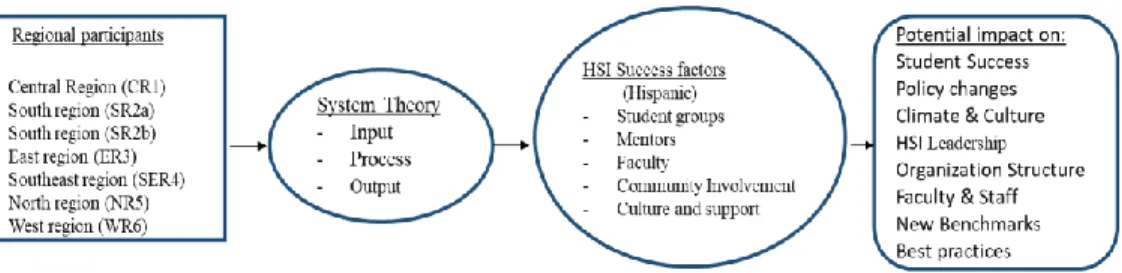
1 System theory applied to HSIs ………..……….. 10
2 Framework of Literature Review .……… 19
3 Projected Hispanic population in the United States ………….……… 20
4 Conceptual model for HSIs best practices …….……….……….. 43
5 HSI community college regions in the state of Texas …….……….. 49
6 HRD Developmental process model for HSIs ……….………… 64
7 HSI community college regions in the state of Texas …….……….. 70
8 Central Region 1 ……….……….………… 74 9 Southern Region 2a ……….………… 80 10 Southern Region 2b ……….………… 84 11 Eastern Region 3 ………..……….………… 92 12 Southeast Region 4 ………..……….………… 97 13 North Region 5 ……….……….………… 102 14 West Region 6 ……….………… 106
15 2010 to 2016 Hispanic enrollment % for regions ……….………… 124
16 2010 to 2016 Regional degree and certificate data ……….. 125
xiii
FIGURE Page
xiv
LIST OF TABLES
TABLE Page
1 Hispanic-Serving Institutions Resources ………. 32
2 Central Region 1 themes ………...…….……….. 76
3 Southern Region 2a themes ………….………. 81
4 Southern Region 2b themes ………...…….……….. 86
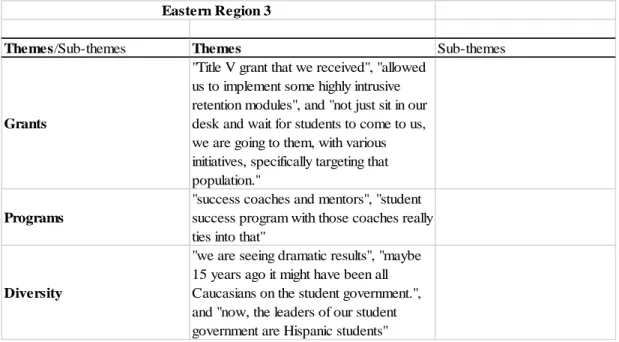
5 Eastern Region 3 themes……….……….. 93
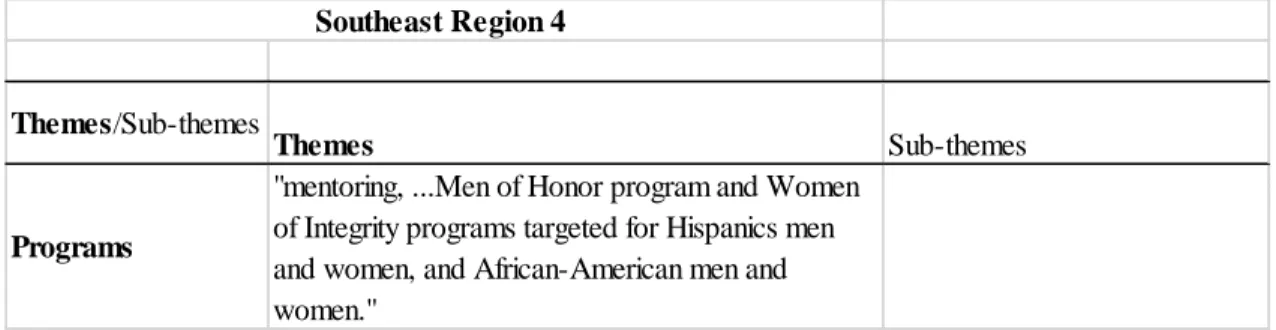
6 Southeast Region 4 themes ……….………. 98
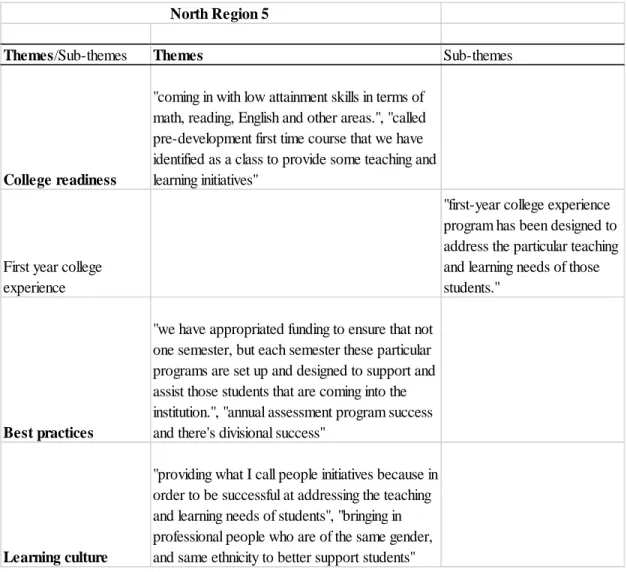
7 North Region 5 themes ………. 103
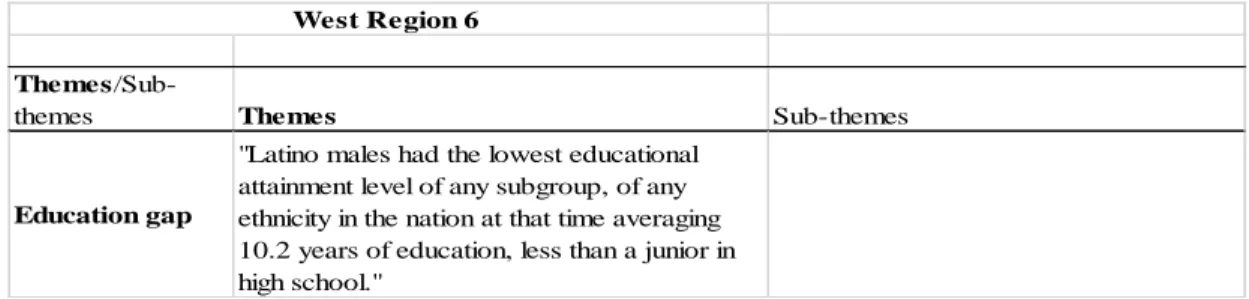
8 West Region 6 themes ……….. 107
9 Cross case analysis of all themes ……….. 116
10 Addressing Gaps ………..……… 120
11 Enrollment and Programs …………...………. 123
12 Culture, Capacity, and Change ………..………. 129
13 State Initiatives ………..……….. 133
14 HSIs Progress part I ………. 140
15 Achievements ……….………. 144
16 Top HSIs challenges ………..……….. 145
xv
TABLE Page
18 Applied Strategic HRD……… 149 19 HSIs progress part II ………..………. 161
1
CHAPTER I
INTRODUCTION
Hispanic-Serving Institutions Best Practices: A Human Resource Development Perspective. The Hispanic-Serving Institution (HSI) is a driving force for educational attainment and provides a pathway of opportunity academically and professionally for the Latino student. Furthermore, “Latinos, like all other population groups in the U.S., are facing the reality that a high school diploma, no longer offers secure, well-paid employment nor ensures career mobility” (Carnevale, 1999; Stearns, Watanabe, & Snyder, 2002; Laden B. V., 2004, p. 182). This study explores the HSIs best practices from a Human Resource Development (HRD) perspective and through an organization development lens. The qualitative methodology for this study provides an opportunity to enhance learning and understanding of the culture, meaning, structure and diversity within HSIs. Exploring current HSI organizations provides knowledge, resources, and opportunity for future HSIs, because the Latino student education enrollment is projected to increase 27% by 2022 (NCES, 2014).
Seven HSI community college persons of authority, (President, Vice-President, Dean and/or Vice-Chancellor), have been interviewed from select regions in the state of Texas to represent their organization as a participant in this study. The locations are Central region, South region (a, b), East region, North region, Southeast region and West region. HSIs as part of a multicultural organization need to “understand commonalities
2
and differences among underrepresented groups and to develop an appreciation of how an understanding of these characteristics might create alliances for change” (Bensimon & Tierney, 1993, p.68; Laden B. V., 2004, p. 183).
An area of concern by colleges and universities throughout the United States is how to address diversity within the organization. Moreover, an understanding of “the challenge faced by higher education that still remains before us is how to serve a culturally diverse student population and ensure that the different forms of knowledge and experiences brought by these students are acknowledged and incorporated using a critical multicultural approach” (Laden B. V., 2004, p. 185). The definition and essence of multiculturalism is “based on a democratic acceptance of both commonalities and differences of all groups within the organization” (Laden B. V., 2004). The importance of an educated Latino/a community is, “only when a sustainable and representative flow of Hispanic students enters college and subsequently graduates will the general standard for the Hispanic community improve. Educational achievement, the true equalizer, will then make it possible for Latinos to participate fully at all levels of the economy, society and government” (Galdeano, Flores, & Moder, 2012, p. 161).
3
Problem
The problems encountered by an HSI organization are a continual responsibility of adhering to and addressing the challenges of being an HSI in addition to the mission of being a community college. According to scholars, the mission of a community college is inclusive of, “(a) collegiate studies to prepare students to transfer to a 4-year institution; (b) vocational education to prepare students for jobs; (c) developmental education to help students develop basic skills; and (d) community and multicultural education to serve members of the local area” (Cohen & Brawer, 2008; Nunez, Sparks, & Hernandez, 2011, pg. 20). In a study conducted by De Los Santos & De Los Santos in 2003, they asked questions to presidents, chancellors and CEOs of HSIs in the United States. The questions were focused on challenges /issues /problems faced by their institution in the next 2 to 4 years. The top five reported results and findings were: (1) Funding – lack of resources (2) Technology – inability to keep pace with cost, upgrades (3) Faculty – difficulty recruiting minority faculty (4) Growth and Diversity – growth curve is very steep, and (5) Preparation of students, retention, and graduation – students underprepared (pg. 383-386).
The problems, therefore become an opportunity to examine how these HSIs work through these challenges/issues /problems and how can it be documented in the form of best practices and/or benchmarks. Description of the research problem as identified through literature and the framework for research questions: (1) Acknowledge there is a
4
gap in Hispanic education attainment and what is being accomplished to fill the gap. (2) Understand organizational frameworks at selected HSI colleges. (3) Identify
organizational preparations for the influx of Hispanic students at HSIs. (4) Collect data of resources utilized by HSIs to fulfill community college mission. (5) Analyze best practices and benchmarks implemented to address the state of Texas 60X30TX plan by select HSI community colleges. The Texas 60X30TX plan includes:
a) Goal – 60x30: by 2030, at least 60% of Texans ages 25-34 will have a certificate or degree. b) Completion - by 2030, at least 550,000 students in that year will complete a certificate, associate, bachelor’s or masters from an institution of higher education. c) Marketable skills – by 2030, all graduates from Texas public Institutions of higher education will have completed programs with identified marketable skills. d) Student debt – by 2030, undergraduate student loan debt will not exceed 60 percent of first-year wages for graduates of Texas Public Institutions (THECB, 2015, p. 5).
Problem Statement
In the United States, 60% of the population growth from 2005 to 2050 will be Latino (Education U. D., 2014).Latinos have the least education levels of any group in the United States of America (Education U. D., 2014, p. 1). Additionally, HSIs organization and structures are not the same as Non-HSIs regarding student enrollment population. Therefore, the units of measure should be different based on the environment and culture they serve (Garcia G. A., 2015). To compound the issue, there is a limited body of knowledge, resource, and research on HSIs.
5
An HSI organization must engage in an application process for
acknowledgement by the United States government as an official Hispanic-Serving Institution. However, “Few HSIs in fact express their status as an HSI in mission statements on their websites or in strategic planning materials, causing some concern about the extent to which HSIs authentically “serve” Latino students” (Contreras, Malcom, & Bensimon, 2008; Malcom-Piqueux & Bensimon, 2015; Nunez A.-M., 2015, p. 6). This raises areas of concern as to why the organization engages in the process of completing an application to become an HSI to be able to apply for HSI grant funding opportunities and not publicly acknowledge the fact that it is an HSI. On the other hand, a potential problem for Latino students and the college choices available to them is a “real concern is that HSIs themselves need to consider creating more partnerships, such as with selective and more elite public and private non-HSIs, to increase Latinos’ and other diverse students’ presence in these institutions”. (Laden B. V., 2004, p. 195). Furthermore, a real concern for Latino students, “It is not enough to let HSIs do the majority of educating of this population; other higher education institutions must assume their share and play significant roles, too, in this process or Hispanics will be stratified within higher education to only HSIs and the like” (Laden B. V., 2004, p. 195).
Purpose of the Study
The purpose of this study is to understand, document from a leadership and HRD perspective an organizational development process of best practices and develop
6
organizational level, the functional characteristics, culture, and framework of two-year community colleges that have been self-identified as an HSI. The purpose stems from literature research, which has stated “while year HSIs made up only 5% of all two-year institutions in the United States in 2003-2004, they awarded 42% of all degrees awarded to Latinos” (Santiago, 2006, March, pg. 12). Another purpose is to include documentation of HSI as an organization and gain an understanding of why, “Latino students tend to have more positive, empowering, and community-oriented experiences in HSIs” (Nunez A.-M., 2015, p. 6). Furthermore, explore why “Instructors in HSIs tend to use more “student centered” pedagogical approaches, including class discussions, group projects, and reflective writing and journaling and to include community service and student-selected content as part of their coursework” (Hurtado & Ruiz Alvarado, 2015; Nunez A.-M., 2015, p. 6). Summary of the purpose is to address the problems and questions identified through research of literature of HSIs, and to provide potential solutions, pathways and/or roadmaps for emerging HSI organizations.
Research Questions
There are three research questions to gain a rich understanding from an
organizational leadership perspective of what are the HSI best practices. The questions have been derived from a literature review to guide the study and accomplish the purpose of understanding education level gaps, and factors such as Hispanic mentors, Hispanic student groups, community involvement, Hispanic professors, culture and
7
support groups, as well as, best practices – projects, programs, OD (organization development), TD (training and development) and CD (career development).
1. How do Hispanic-Serving Institutions address the gap of Hispanics having the lowest education attainment levels of any group in the U.S.?
2. What factors allow for Hispanic-Serving Institutions to have a higher level of associate degrees earned by Hispanic students?
3. What institutional best practices contribute to HSIs success in Hispanic degree attainment?
Operational Definitions
Definitions are provided as a resource and clarification of terms used within the context of this study:
Emic – an insider’s point of view of the culture and language used by the people in the study as documented by the researcher/observer. Term first used by Kenneth Pike, in (Pike, 1954; Patton, 2015, p. 337).
Four-Year college/University – Provide students’ opportunities to gain an academic education (Bachelor’s degree, and graduate programs such as a Master degree, Professional degree and/or Doctoral degree).
8
Hispanic Human Resource Development – (HHRD) defined as the enhancement, enrichment, and the edification process of strengthening the Hispanic/Latino individual, and organization through education, mentoring, training, career development, and organization development for educational and economic advancement opportunities. Hispanic-Serving Institutions – (HSI) is defined as an institution of higher education that: (A) is an eligible institution; and (B) has an enrollment of undergraduate full-time equivalent students that is at least 25 percent Hispanic students at the end of the award year immediately preceding the date of application. The Title V Program does not pre-certify institutions as Hispanic-Serving Institutions. Institutions that meet these
eligibility requirements and want to apply to the Title V Program, simply must submit an assurance with their Title V application with the necessary student enrollment data. (Education U. D., 2011)
Human Resource Development – (HRD) “is a process of developing and/or unleashing human expertise through organization development (OD) and personal training and development (T&D) for the purpose of improving performance” (Swanson, 2001). Latino/Hispanic – according to the U.S. Census Bureau is that of, “A person of Cuban, Mexican, Puerto Rican, South or Central American, or other Spanish culture or origin regardless of race” (Standards, 2012).
9
Organization Development – (OD) “a process of planned system change that attempts to make organizations better able to attain short- and long-term objectives” (French, Bell, & Zawacki, 1989; Swanson & Holton, 2001, p. 265).
Two-Year community college – Provide students opportunities to gain an academic education (an associate degree) and/or technical training in various fields such as Heating and Air conditioning, Vet. Tech, Auto Mechanic, and Nursing ... etc. (Certification / Associate degree). They also provide the opportunity to transfer to a Four-year College/University.
Theoretical framework for HSI best practice
System Theory - Key variables to be measured in the study stem from the research questions to be addressed by the organizations and the conceptual model that will both guide the research and shape my analysis include:
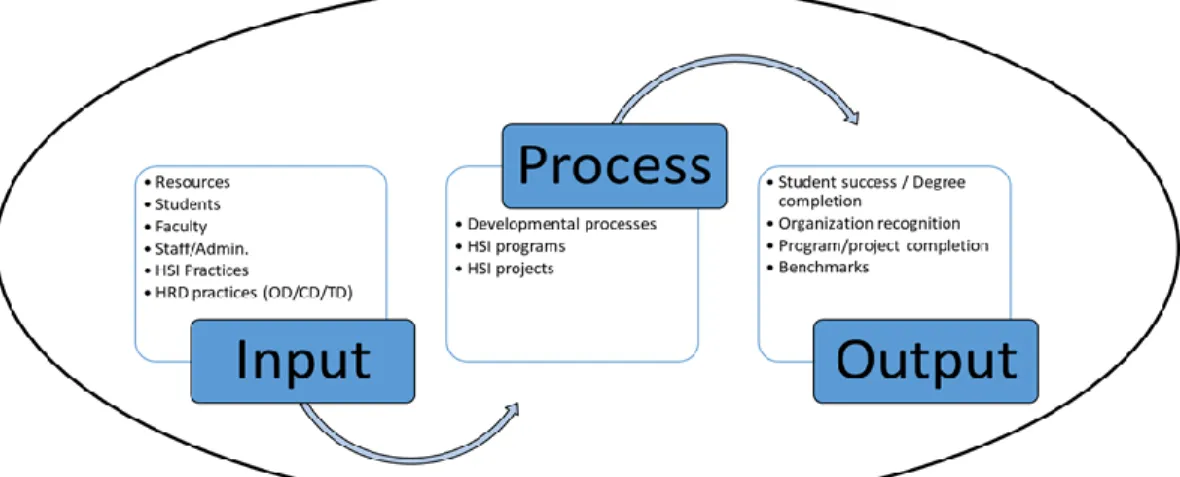
System Theory: Environment – Input – Process – Output
System theory origins have been accredited to, Ludwig von Bertalanffy (1950) and further explained as having, “the basic tenets of system theory is that systems consist of many interacting subsystems, which are distinguished by boundaries that, in turn, monitor and control the rate and flow of inputs from the environment to the system and the outputs from the system to the environment” (von Bertalanffy, 1950; Jacobs, 1989, p. 30).
10
The strategic method in which I have utilized system theory in my research was, to understand and document what organizational programs and projects are being used by HSI community college organizations (inputs), how are these programs and projects developed/implemented within the organization (process), and what results have been documented or need to be documented best practices and benchmarks (outputs). The resulting best practices and benchmarks will then be analyzed and a matrix of best practices will be created for future reference materials for emerging HSIs, as well as, answering the research questions. Listed below is an overview of the system theory outline that I have used to guide the research, descriptions of each step content and definitions.
11 Environment
In system theory the environment is defined as being, “everything that is outside the system that affects or is affected by the system’s behavior: at the low end of the systems hierarchy, the system’s normal functioning is independent of the
environment…..and at the high end of the systems hierarchy, the environment and the system engage in frequent and complex exchanges of information” (McLagan P. A., 1989, p. 68). Furthermore, “all systems, whatever their level, are collections of interdependent, organized parts that work together in an environment to achieve the purpose of the whole” (McLagan P. A., 1989, p. 68). The organizational environment within the HSI community college encompasses the organization, administration & staff, faculty and students.
Input
The input step in system theory is defined as, “materials, energy, and information that will be in the output or will be used to produce an output” (McLagan P. A., 1989, p. 71). The inputs for this study are inclusive of the research questions, as well as,
understanding or acknowledging how and if any of the following materials and/or people are being used for organization development purposes, (HSI practices, organization requirements, resources, students, administration & staff, faculty and HRD practices).
12 Process
The process step in system theory is defined as, “direct responses and actions that transform or reorganize inputs into outputs…… also include the responses and actions that support the system’s ability to produce outputs and achieve its purpose” (McLagan P. A., 1989, p. 71). The process step for this study included conducting interviews with participants that have been purposefully selected from a sample of HSI community colleges per region. The information and research data collected from these participants has been transcribed, analyzed and coded as part of the qualitative process.
Output
The output step in system theory is defined as being, “what the system or subsystem/part delivers, produces or provides as it works to accomplish its purpose” (McLagan P. A., 1989, p. 71). The HSI best practices – consist of program outcomes, what processes - procedures worked best, recommendations for systemic improvements. The output step also provide material for documenting results of the program,
enrollment, graduation rates, certifications completed, transfers to 4-year institutions for continued education and other findings that may be uncovered during the interviewing process. Best practice is defined as, “professional procedures that are accepted or prescribed as being correct or most effective” (Oxford, 2015). Best practices of organization development objectives of each program per college will be included as part of the study to develop a roadmap for emerging HSIs.
13
Assumptions
The researcher has been involved in the HSI community college educational process for the past 8 years, both as a student and then as an educator. The researcher has been an adjunct instructor for the past 5 years at a community college and has included the following, because “assumptions provide meaning to the conclusions and lend support to the recommendations” (Lunenburg & Irby, 2008, p. 135). There are three general assumptions made to help guide this study.
a) The participant of the organization should be able to provide insights into what the organization is doing in terms of best practices and benchmarks used.
b) The organizations identified are still HSI organizations in accordance with government standards and have full time enrollment of 25% or greater Latino students.
c) The organization has an organization development process for the faculty, staff, and students.
Applicability to HRD and Significance of the Study
Applicability to HRD and the significance of the HRD developmental Process Model designed for the utilization of organizational development, knowledge and understanding of how best practices are resources in promoting educational
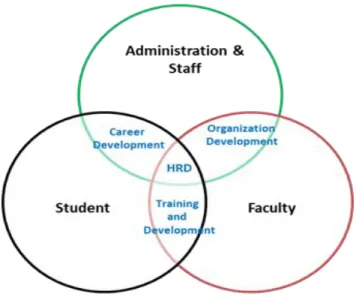
advancement opportunities for the Hispanic-Serving Institution organization. An “HRD Developmental process model for HSI” example has been created for visual reference
14
and what perhaps is a possible interaction of OD, TD and CD within the process context of HRD as described in the methodology section of this dissertation. Furthermore, the significance of the study being qualitative research utilizing interviews, literature and field research allows for, “these techniques of data gathering will yield thick and rich descriptions necessary for the ethnographic dissertation in the form of quotations (low inference descriptors), descriptions of the group and the contexts, and parts of
documents” (Lunenburg & Irby, 2008, p. 99).
The research, literature review and methodology follow the core guidance and definition of Human Resource Development as defined by the Texas A&M University, Department of Education and Human Resource Development (EHRD) website which is, “HRD is the process of improving learning and performance in individual, group, and organization context through domains of expertise such as lifelong learning, career development, training and development, and organization development” (TAMU, 2016, http://eahr.tamu.edu/degrees-and-programs/undergraduate-degree-programs/human-resource-development). The results of this ethnographic dissertation have been utilized to develop an understanding of how HRD and systems theory through an organizational development process can improve HSI strategies, cultural environment, training, inform policy and implementation of effective and efficient organization development best practices and new benchmarks created.
15
Contents of Dissertation
The dissertation is comprised of the traditional five chapters as described by the Office of Graduate Studies at Texas A&M University. Chapter I is the Introduction of the Dissertation, “Hispanic-Serving Institutions Best Practices: A Human Resource Development Perspective”, and consist of the problem statement, purpose of study, research questions, operational definitions, systems theory, assumptions, significance of study and applicability to HRD and contents of the dissertation. Chapter II, is the literature review and sets the foundation of the study through a contextual framework consisting of the Hispanic population and education, Hispanic-Serving Institutions and HSI Organization Development as well as, theoretical framework for HSI best practice. Chapter III, is the methodology section and provides an overview of the purpose of the study, detailed research questions, variables, theoretical frameworks, OD, TD and CD, sample participants' information, instrumentation, validity, reliability, trustworthiness, bias, data collection, and data analysis plan. Chapter IV consists of the findings of the interview protocol questions responses, data coding, data analysis, and artefactual data analysis. The final Chapter V, consists of a complete overview of the findings, matrix and table of best practices created based on interviews, cross case analysis of themes created based on coding analysis, research questions responses, discussion, delimitations and limitations, and summary of research. Additionally, implications for Human
Resource Development, and policy implications for HSIs based on findings and research in the study.
16
CHAPTER II
LITERATURE REVIEW
This review of literature examines Hispanic-Serving Institutions (HSI) best practices, a Human Resource Development (HRD) perspective, with emphasis on HSI community colleges in Texas. The importance of having an educated workforce in the United States is based on the premise that a, “projected decline in educational levels coincides with the growth of a knowledge-based economy that requires most workers to have higher levels of education. At the same time, the expansion of a global economy allows industry increased flexibility in hiring workers overseas. As other developed nations continue to improve the education of their workforces, the United States and its workers will increasingly find themselves at a competitive disadvantage” (Miller, 2015, pg. 1). Community colleges play an integral part of educating the workforce of the future, which includes all races and color of people, in particular the minority
population, which is a cause of concern and represent a gap in the education attainment level. The review of literature also includes understanding possible theoretical reasons why Hispanics tend to enroll in colleges or universities where they know people already, people who look like them and have recommended certain colleges they have attended over other potential locations. Furthermore, this review will explore the driving force behind this theory and how it relates to HSIs.
17
Problem Statement
There is an underlying problem with college enrollment and completion by Latino/a students. Even in the midst of a shift in college enrollment increase of Latino/a students, there still exist, the non-completion factor for these students (Flores & Park, 2013). In a recent publication by the White House Initiative on Educational Excellence for Hispanics, stated on its cover page, “The future of our nation is inextricably linked to the future of the Hispanic community – Hispanics are the largest and fastest-growing minority group, and will represent 60 percent of our nation’s population growth between 2005 and 2050. However, Hispanics have the lowest education attainment levels of any group in the United States” (Education, 2014, pg. 1).
Purpose
The purpose of this chapter is to present a review of literature of
Hispanic-Serving Institutions (HSI) and to develop a framework for understanding the process and procedures an organization undertakes in providing education, knowledge, skills and abilities to Latino/a students. The review is strategically divided into three major sections. The first section is an overview of the Hispanic population and Hispanic educational attainment within the United States, and specifically in Texas. Furthermore, the first section is inclusive of HSI community colleges in Texas, a general source of reference when referring to 2-year colleges and are the select participative educational organization(s) being studied. The second section is the Hispanic-Serving Institutions (HSIs), definition and importance, Latino HSI enrollment, challenges of HSIs, HSI
18
community / ethnic identity and resources. The third section is an HSI organization development (OD), HSI OD lens and world view, Best practices / Benchmarks – Texas Higher Education Coordinating Board (THECB), and applicability of Human Resource Development (HRD) lens to an HSI.
Note: The term Latino and Hispanic used interchangeably within the context of this document.
Method
There is currently a limited body of knowledge, resources and research on Hispanic-Serving Institutions Best practices from a Human Resource Development perspective. The concept of a college or university being designated as a Hispanic-Serving Institution is relatively new, about 30 years, being acknowledged by the U.S. Congress and the U.S. Department of Education. Therefore, scholarly research
documents, books, academic journals, HSI College/University websites and designated Latino/a organizations serving the Latino/a community are being utilized as a frame of reference in preparing this literature review. A review of theoretical literature is also included in which organizations, such as HSIs, can learn and develop their own theoretical frameworks for conducting business as an HSI serving Latino/a student’s instead of just having a large population of Latino/a students enrolled in college. A basic literature review is defined as, “A written document that develops a case to establish a thesis. This review synthesizes current knowledge pertaining to the research
19
question” (Machi & McEvoy, 2012, p. 1).Based on the literature selected in the topic of HSIs, an outline was created and utilized as a framework to guide this literature review. The framework used to guide this literature review is listed below.
Figure 2. Framework of Literature Review
1. Hispanic Population and Education a. Hispanics in the United States b. Hispanics in Texas
c. HSI Community Colleges in Texas 2. Hispanic-Serving Institutions
a. Definition and Importance of HSI b. Latino HSI enrollment
c. Challenges of HSIs
d. HSI community and ethnic Identity e. Resources for HSIs
3. HSI Organization Development (OD) a. HSI OD Lens and world view
b. Best practices / Benchmarks - THECB c. HRD lens of an HSI
20
Hispanic population and Education
Hispanics in the United States
The Hispanic population in the United States has exceeded 54 million or 17% of the U.S. population in 2013 and is projected to increase to 19% by 2020, 22% by 2030, 25% by 2040 and 28% by 2050 (Bureau, 2013). The significance of these figures is the projected Hispanic population by 2060 in the United States is 31% or 128.8 million, which means one in three U.S. citizens will be Hispanic. Whereas in 2012 the number was one in six U.S. citizens were Hispanic (Bureau, U.S. Census Bureau Projections show a slower growing, older, more diverse nation a half century from now., 2012). Percentage of Hispanic projection is derived from the total U.S. citizen population growth. Projected Hispanic Population from 2013 to 2060 derived from (Bureau, 2013). Figure 3. Projected Hispanic population in the United States
21
Furthermore, in 2012 the number of people of Hispanic origin in the United States who were of Mexican background in percentages was 64%, Puerto Rican 9.4%, Salvadoran 3.8%, Cuban 3.7 %, Dominican 3.1 % and Guatemalan 2.3%, the remainder were from Central America, South America or of other Hispanic/Latino origin (Bureau, 2012 American Community Survey: Table B03001, 2012). The definition of Hispanic or Latino, according to the U.S. Census Bureau is that of, “A person of Cuban, Mexican, Puerto Rican, South or Central American, or other Spanish culture or origin regardless of race” (Standards, 2012).
The Hispanic educational attainment in the United States, “the number of
Hispanics age 18 to 24 enrolled in a two- or four-year college has more than tripled since 1993. In 2013, 2.2 million Hispanics were enrolled in college, up from 728,000 in 1993 – a 201% increase” (Krogstad, 2015). However, the number of Hispanics obtaining a four-year degree is still lower than any other group, “Hispanics ages 25 to 29, just 15% have a bachelor degree or higher. By comparison, among the same group, about 40% of Whites have a bachelor’s degree or higher (as do 20% blacks and 60% of Asians)” (Krogstad, 2015).
Hispanics in Texas
The estimated Hispanic population in Texas was 10 million as of 2013, which has exceeded the number of the White population of 9.5 million, in Texas, according to the U.S. Census Bureau (Bureau, Annual Estimates of the resident population by sex,
22
race, and Hispanic origin for the United States, States, and Counties: April 1,2010 to July 1, 2013, 2014).
In 2012-13, Latinos represented 16% of undergraduate students enrolled in the United States. The majority (60%) of Latino undergraduates were enrolled in four states – California, Texas, Florida and New York. In three states and Puerto Rico, Latinos represented one-third or more of students enrolled – California, Texas, New Mexico, and Puerto Rico. In 11 states, Latinos were at least 10% of undergraduate students enrolled. Moreover, Latino college enrollment is projected to increase more than other groups. Between 2011 and 2022, Latinos’ college enrollment is projected to increase 27%,
compared to African Americans (26%), Whites (7%), and Asians (7%), (NCES, 2014).
HSI Community Colleges in Texas
The community colleges in Texas are divided into six geographical regions as per the, Texas Administrators of Continuing Education, (T.A.C.E.), which are the Central region, South region, East region, North region, Southeast region and West region. The purpose and mission of TACE are, “Texas’ premier professional association for individuals working in continuing education at Texas community and technical colleges” (TACE, 2015).
These college regions are represented and divided by geographical location only and are not equally distributed per region.
23 South region – 1 college district, 12 colleges East region – 9 colleges
North region – 2 college districts, 14 colleges
Southeast region – 1 college district, 2 college systems, 14 colleges West region – 14 colleges
Note: A college is a single institution and a District and/or a System comprises of one or more colleges, which may or may not be within the same region. Not all colleges listed by T.A.C.E. are HSI organizations, therefore, a cross reference check is in place to verify HSI status of select college participants.
According to, Excelencia in Education analysis of the National Center for
Education Statistics’ Institutional Postsecondary Education Data System (IPEDS)
housed at the Department of Education, 2012-13: Fall Enrollment Final Release Data File, Texas has the second largest enrollment of Latinos/Hispanics, at 466,378 or 34% undergraduate Latinos out of 1,362,852 total overall undergraduate enrollments in
Texas. There was a total of 409 Hispanic-Serving Institutions according to data from
Excelencia in Education, 2013-2014, and Texas had 75 HSIs in 2014. (Education E. I., 2015, pg. 1-12). Texas total undergraduate full-time enrollment at HSIs is at 500,202, students and of that total, 234,972 are Hispanic, which is 47% of the student population
24
(Education E. i., 2015). Moreover, a difference of one calendar year from 2014-2015, has seen an increase in Latino undergraduate students to 1.75 million, the amount of HSIs total increase to 435 institutions, and Texas increases to 78 HSIs. (Education E. i., 2016)
Hispanic-Serving Institutions
Definition and Importance of HSIs
In the conceptual formation of a college or university, historically, the thought of being an HSI was not considered as a major factor in the decision process. In fact,
“Latino students’ college choices create HSIs. However, most Latino students enrolled at HSIs did not know their institution was an HSI” (Santiago D., 2007, pg. 3). Other key factors of an HSI include, “about half (47%) of HSIs are community colleges” (Mercer & Stedman, 2008; Nunez, Sparks, & Hernandez, 2011, pg. 20) and “Two-year HSIs have a higher proportion of Hispanic faculty, who can offer enhanced understanding of students’ cultural backgrounds and serve as mentors” (Laden, 2001; Nunez, Sparks, & Hernandez, 2011, pg. 21).
A Hispanic-Serving Institution (HSI) is defined as an institution of higher education that—
(A) is an eligible institution; and (B) has an enrollment of undergraduate full-time equivalent students that is at least 25 percent Hispanic students at the end of the award year immediately preceding the date of application. The Title V Program does not
25
certify institutions as Hispanic-Serving Institutions. Institutions that meet these
eligibility requirements and want to apply to the Title V Program, simply must submit an assurance with their Title V application with the necessary student enrollment data. (Education U. D., 2011).
History of HSI
The history of a Hispanic-Serving Institution begins with its origins from an organization known as the Hispanic Association of Colleges and Universities (HACU), which was founded in 1986 with a membership of eighteen institutions, which is
currently at over 400 colleges, and universities committed to higher education success in the U.S.; Puerto Rico, Latin America, and Spain (HACU, 2015). HACU was the initiator in 1992 to have the U.S. Congress to “formally recognize campuses with high
enrollment as federally designated HSIs and to begin targeting federal appropriations to those campuses” (HACU, 2015).
Today, these federal funds provide financial resources to Hispanic-Serving Institutions through a competitive grant process in which HSIs submit projects that enhance the Hispanic Students’ in their education endeavor. These projects result in cumulative potential best practices and benchmarks for future HSIs to gain knowledge, educational resources, organizational development, and talent building techniques.
26 HSI and Chain Migration Theory
A fundamental connection with HSIs and Chain Migration theory is they both involve the same type of ethnic people, Hispanics, and are parallel in the phenomena of migration to a place known by others who are associated with them resulting in them congregating to the same locations to work and/or get an education. In Chain Migration (MacDonald and MacDonald 1964, p. 227) “that movement in which prospective migrants learn of opportunities, are provided with transportation, and have initial accommodation and employment arranged by means of social relationships with previous migrants” (Perez & McDonough, 2008, pg. 253)
Whereas, Chain migration used in community college, for a 2-year education initially by Person & Rosenbaum, (2006) provides an understanding and knowledge for scholars of how, “research on immigrant communities can inform the study of college enrollment, as it encourages the researcher to examine the enrollment persistence as part of a continuous process” (p. 52). Furthermore, “friends and family members served as primary social contacts who provided information about the institution and application process, as well as provided support upon arrival at the institution” (Person &
Rosenbaum, 2006; Perez & McDonough, 2008, pg. 251).
The application of model to college choice provides students with various options such as, (1) Apply or select colleges where someone they know has preceded them, (2) Apply or choose a college along with someone they know, and (3) Seek out
27
contacts once at the college (Person & Rosenbaum, 2006; Perez & McDonough, 2008, pg. 254).
An example of HSI and chain migration theory applied to higher education is; the majority of Latino students were concentrated in a small number of institutions. In 2012-13, almost 60% of Latino undergraduates were enrolled in the 11% of institutions of
higher education identified as Hispanic-Serving Institutions (HSIs). [Excelencia in
Education analysis of U.S. Department of Education, NCES, IPEDS, Fall Institutional Characteristics and Enrollment Surveys for 2012-13]
Importance of HSI
The importance of HSIs according to several scholars is, “HSIs are the institutions in which Hispanics have chosen to enroll. Benefiting the Hispanic community requires developing the research, education, support, and administrative capacity of these institutions. The strategy of focusing on the greatest concentrations of Hispanic college students still promises to be the most efficient approach to increasing Hispanic educational attainment and closing the gaps” (Laden, Hagendorn, & Perrakis, 2008; Nunez & Bowers, 2011; Galdeano, Flores, & Moder, 2012, p. 161). Furthermore, the research analyzed by scholars concludes, “findings corroborate previous research, which has documented that HSI is a primary staple of Latino/a higher education, enrolling close to a majority of the Hispanic students in postsecondary education” (Benitez & DeAro, 2004; Laden, 2004; Flores & Park, 2013, p. 120).
28 Latino HSI enrollment
The importance of HSIs and graduation rates for Hispanics being higher when enrolled in an HSI according to Excelencia in Education, (2006), “HSIs not only enroll a
large number of Latinos, they also graduate a large number. For example, while two-year HSIs made up only 5% of all two-two-year institutions in the United States in 2003-2004, they awarded 42 percent of all associate degrees to Latinos. Further, while four-year HSIs made up only 2 % of all four-four-year institutions in the country in 2003-04, they awarded almost 40 percent of all baccalaureate degrees earned by Latinos that year”
(Santiago, 2006, March, Pg.12).
To serve better the Latino students, “HSIs must actively change their curricula and programs to meet the needs of their diverse population, including Latina/o, low income, and first-generation students” (Garcia & Okhidoi, 2015, pg. 1). Change in how Latino students are perceived and how their voice is heard is part of the curriculum improvement process needed because, “the voice of Latina/o students and other
underrepresented groups have been largely excluded from the curricula at institutions of higher education, even at HSIs” (Cole, 2011; Garcia & Okhidoi, 2015, pg. 8).
Challenges of HSIs
The challenge an HSI is faced with, “despite a general increase in college enrollment and completion over time, enrollment and completion rates by race and ethnicity continue to show a gap” (Fry & Lopez, 2012; Flores & Park, 2013, p. 115).
29
There is a continual responsibility of adhering to and addressing the challenges of being an HSI in addition to the mission of a being a community college. According to scholars, the mission of a community college is inclusive of, “(a) collegiate studies to prepare students to transfer to 4-year institutions; (b) vocational education to prepare students for jobs; (c) developmental education to help students develop basic skills; and (d)
community and multicultural education to serve members of the local area” (Cohen & Brawer, 2008; Nunez, Sparks, & Hernandez, 2011, pg. 20).
In a study conducted by (De Los Santos & De Los Santos, 2003), questions were asked to presidents, chancellors and CEOs of HSIs in the United States. The questions were asked regarding challenges/issues/problems facing their institution in the next 2 to 4 years. The top five report results and findings were: (1) Funding – lack of resources (2) Technology – inability to keep up with cost, upgrades (3) Faculty – difficulty recruiting minority faculty (4) Growth and Diversity – growth curve is very steep, and (5)
Preparation of students, retention, and graduation – students underprepared (pg. 383-386).
HSI Community and Ethnic Identity
HSI Community
The importance of an educated Latino/a community is, “only when a sustainable and representative flow of Hispanic students enters college and subsequently graduates will the general standard for the Hispanic community improve. Educational
30
achievement, the true equalizer, will then make it possible for Latinos to participate fully at all levels of the economy, society and government” (Galdeano, Flores, & Moder, 2012, p. 161). Research of minority serving institutions, the population they serve and “demographics indicate that the nation’s colleges and universities must prepare
themselves, if they have not already done so, to serve a population that is more racially and ethnically diverse than at any other time in the nation’s history” (Flores & Park, 2013, p. 115).
The significance of an HSI community is that the Hispanic culture is inclusive of family and friends that communicate to each other about where they have had personal experiences and success during the college education process. However, the negative component is also true, they will communicate which experience has been difficult and barriers or obstacles they had to overcome during the time enrolled at a certain college. Therefore, it is a good idea to have an open-door policy in place to communicate with all students during their attendance at the college to create an atmosphere of wanting to learn and gain knowledge, as well as, attain a college education.
Ethnic identity at an HSI
The importance of understanding the ethnic identity of Latinos/a is because, research concerning Latino/a student identity and self-perception according to the scholars is dependent on the environment in which the student grew up. For example, if the Latino/a student grew up in a majority Latino/a populated area, they “did not see
31
themselves as a minority until they arrived at the predominately White campus” (Torres, 2003, p. 537). However, if the Latino/a student grew up in a majority White populated area, they defined, “their ethnicity based on geography, and identified more with Whites and simultaneously felt conflict between these associations and Latino/a background” (Torres, 2003; Gonzalez, 2010, p. 286). An HSI may still be considered a predominately White campus, because the required Latino/a full time enrollment should be a minimum of 25%, therefore the HSI should make effort in understanding the differences in ethnic identities within the organization.
Resources for HSIs
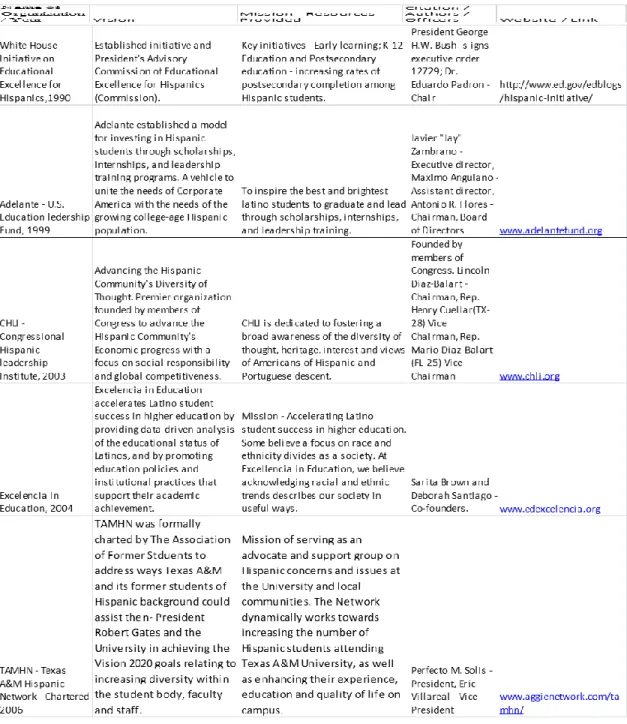
There are several resources available for institutions of higher education that serve the Latino/a community, and provide educational information and knowledge regarding, culture, policy, statistics, scholarships, ethics, research, college entry and graduation data for Latino/a’s. Listed on table 1 is a brief overview of some
organizations whose mission, vision and purpose are for the Latino/a advancement opportunities in career, education and/or politics.
32 Table 1. Hispanic-Serving Institutions Resources
33
34
The three main areas for the resources include, but are not limited to the student, faculty and the organization.
Student resources available through various organizations in the table above include assistance with applications for college, financial aid assistance, FAFSA
application assistance, career choice selections and options, degree selection, graduation, degree paths, college choice, internship opportunities, scholarship opportunities and resources for funding college.
Faculty resources include educational reimbursement for higher degree attainment, career development, provide financial resource for continued research opportunities, grant funding of projects, policy development, advocacy and networking opportunities.
Organization resources include creating grant-funding opportunities for building, supplies, technology, staff and faculty development, awareness of diversity, education, policy, communication with other organizations through networking and workforce development.
HSI Organization Development
The organization development of HSIs utilizing a strength-based approach, in which, (Garcia, 2015) suggest an organizational lens to view these specialized
organizations by, “pulling from interdisciplinary theories that stem from sociology, management, organizational behavior, and higher education, we can begin to examine
35
the ways in which HSIs are transforming as we analyze the challenges facing these institutions and focus on the strengths inherent within them” (p.83). Organization development has been defined by scholars as, “a process of planned system change that attempts to make organizations better able to attain short- and long-term objectives” (French, Bell, & Zawacki, 1999; Swanson & Holton, 2001, p. 265).
HSIs currently are predominately community college level organizations that serve Latino/a, first-generation, and underrepresented students, of which, may require additional financial and academic assistance (Contreras & Contreras, 2015, p. 154). Therefore, the focus of this literature review is primarily community college HSIs and the organizational development process they currently have in place. Community
colleges are generally 2-year post-secondary, higher education institutions that may have funding resources from the state, federal and local government, as well as, private
contributions.
The organization development culture within an HSI environment is that of an, “Institutional culture is both a process and a product. As a process, culture shapes, and is shaped by, the ongoing interactions of people on and off campus. As a product, the culture reflects interactions among history, traditions, organizational structures, and the behavior of current students, faculty, and staff” (Kuh & Whitt, 1988, p. 6). Additionally, the framework of organizational culture is inclusive of the following elements;
36
environment, mission, socialization, information, strategy and leadership (Tierney, 1998, p. 8).
An organization development environment that utilizes a broad perspective as stated in (Tierney, 1998), within the organizational culture provides five potential opportunities for practitioners:
1. “Consider real or potential conflicts not in isolation, but on the broad canvas of organizational life;
2. Recognize structural or operational contradictions that suggest tensions in the organization;
3. Implement and evaluate everyday decisions with keen awareness of their role in and influence upon organizational culture;
4. Understand the symbolic dimensions of ostensibly instrumental decisions and actions; and
5. Consider why different groups in the organization hold varying perceptions about institutional performance” (p. 6).
An HSI has the opportunity to enhance their organization and culture by understanding and implementing these basic concepts as outlined by Tierney.
HSI OD lens and worldview
HSIs are being measured and evaluated the same as non-HSIs, utilizing the same metrics for success. The problem is that HSIs organization and structures are not the same as Non-HSIs with regards to student enrollment population, therefore the units of measure should be different based on the environment and culture they serve (Garcia, 2015). The importance of understanding organization development structure is by “studying the cultural dynamics of educational institutions and systems equips us to
37
understand and, hopefully, reduce adversarial relationships. Equally important, it will enable us to recognize how actions and shared goals are most likely to succeed and how they can be best implemented” (Tierney, 1998, p. 5). HSI structure assists in that
communication between members of the organization can be established and learning can take place.
Organization development procedures for HSIs should be inclusive of utilizing an organizational lens because, “using an organizational lens will help to reframe the research in hopes of finding ways in which HSIs are in fact changing, albeit slowly, into organizations that embrace their newfound role to serve Latina/o students” (Garcia, 2015, p.84). An organizational lens of an HSI provides an insider’s view of what it really means to be an HSI and what it takes to educate the Latino/a student from a perspective of a select organization.
Best Practices
The state of Texas has developed a “60X30TX” educational organization
development plan for educating 60% of Texans ages 25-34 by 2030 with a certificate or degree, which places emphasis on closing the educational gap (THECB, 2015). The goals of the state education agency, “Texas Higher Education Coordinating Board” have outlined some best practices / benchmarks that have been achieved in Texas by colleges and universities.
38
The success of the previous THECB program, (Closing the Gaps by 2015) “Over a 15-year period, beginning in 2000, the Legislature established and funded new higher education institutions, appropriated $3.3 billion for TEXAS Grants to help low-income students attend college, and increased funding for programs in critical fields” (THECB, 2015, p. 4). The results of the program from 2014 were, “Institutions of higher education in the state responded by increasing access and improving completions, enrolled 1.6 million students – an increase of almost 600,000 since 2000. The institutions also awarded almost 250,000 bachelor’s degrees, associate's degrees and certificates – approximately 130,000 more than in 2000” (THECB, 2015, p. 4).
Current goals in the new THECB program 60X30TX include, (1) Overarching goal – 60X30: By 2030, at least 60% of Texans ages 25-34 will have a certificate or degree (2) Second goal – Completion: By 2030, at least 550,000 students in that year will complete a certificate, associate, bachelor’s, or master’s from an institution of higher education in Texas (3) Third goal – Marketable skills: By 2030, all graduates from Texas public institutions of higher education will have completed programs with identified marketable skills (4) Fourth goal – Student debt: By 2030, undergraduate student loan debt will not exceed 60 percent of first-year wages for graduates of Texas public institutions (THECB, 2015, p. 5).
Examples of best practices / benchmarks as indicated by the THECB: (THECB, 2015, p. 16)
39
Strategies to achieve goal – Texas Education Agency (TEA) data show that Hispanics and African Americans make up more than 60% of the K-12 pipeline for higher education in Texas. (1) Have the government, institutions, community organizations, business leaders to rally around the common cause. (2) Two-year institutions – strengthen connections and partnerships with local and regional
organizations. (3) Four-year institutions – build or strengthen connections to local or regional organizations and school districts.
Note: This is only a brief example of THECB strategies for the 60X30TX program and full program can be found in (THECB, 2015).
THECB - strategies to respond to the needs of the changing population of Texas so students are supported into and through higher education. Example: (1) aggressively promote college attainment to students and parents prior to high school (2) Develop and implement education and curriculum delivery systems (e.g., Competency-based
programs) to make higher education available to a broader and changing population (3) Provide high-quality education programs for educationally underserved adults (4) Develop practices to encourage stop-outs with more than 50 semester credit hours to return and complete a degree or certificate (5) Collaborate with TWC (Texas Workforce Commission) to identify critical fields and to update them periodically. (THECB, 2015, p. 16).
40
THECB - strategies to respond to support completion, pipeline by providing access to multiple postsecondary options. Example: (1) Scale up and share practices that guide students to higher education (2) Collaboration with K-12 in improving college and career readiness (3) Increase the participation of economically disadvantaged high school students in dual credit and other college level courses (4) Build credentials at each level with the aim of reducing coursework duplication and time to subsequent degrees (THECB, 2015, p. 20).
“Reaching the 60x30 goal is essential for Texas to remain globally competitive and its people and communities to prosper” (THECB, 2015, p. 16).
HRD lens of an HSI
To understand the review of literature of an HSI and how HRD can be utilized in the organization’s structure, a basic background and overview is provided to set a foundation in place for HSI and HRD knowledge. The background and definition(s) of Human Resource Development (HRD):
According to Richard A. Swanson, the definition of Human Resource
Development is, “HRD is a process of developing and/or unleashing human expertise through organization development (OD) and personal training and development (T&D) for the purpose of improving performance” (Swanson, 2001). HRD is used “to enhance learning, human potential and high performance in work-related systems” (Bates, Hatcher, Holton III, & Chalofsky, 2001, p. 205). Furthermore, HRD is, “a field of study
41
that is specific to the development of human performance and growth, through education, training, career and organization development” (Valentin, 2015).
The core human resource development belief and theoretical foundation as identified by Swanson (2001) is as follows.
1. Organizations are human-made entities that rely on human expertise in order to establish and achieve their goals.
2. Human expertise is developed and maximized through HRD processes and should be done for the mutual long-term and/or short-term benefits of sponsoring organization and the individuals involved.
3. HRD professionals are advocates of individual and group, work process and organizational integrity (Swanson, 2001).
Human resource development lens focuses on the organization as a whole and understands there is a need to grow, develop internally and externally to provide opportunities to have students, faculty, staff, and administrators work in conjunction to create an HSI that can be a benchmark for future HSIs. In an article that addresses HSI organization development that engages scholarship with community, written by (Nunez G. G., 2014) she states, “When theory and practice come together, then engagement becomes scholarly” (p. 93). A theory is, “an attempt to explain why some event or phenomenon occurs in real world. But a theory is greater than a collection of facts or a
42
summary of what is known about the event. It also represents an attempt to organize and integrate that knowledge into something useful.” (Jacobs, 1989, p. 31).
System theory can be applied to HSIs and potentially bring theory and practice together to create an engaged environment. Systems theory has been stated as, “simply a theory concerned with systems, wholes, and organizations” (Ruona, 2001, p. 114). Furthermore, systems theory as a, “common conception of organizations – an organizer or conceptual frame through which HRD can ensure holistic understanding of its subject. It also provides analysis methodologies capable of including multiple variables” (Ruona, 2001, p. 117).
Summary
This review of literature was designed to be a starting point for understanding how a Hispanic-Serving Institution was created and how it functions in the educational context of colleges and universities. Historically, there is a lesson to be learned, in order for an organization, institution and/or college to be diversified in learning, culture and practice, means that humanity as a whole prospers. A well-educated workforce within the United States provides for the competitive edge that we have enjoyed thus far, but if educational attainment levels do not improve, it may lead to alternative means of future workforce attainment, via external resources.
By providing opportunities to view Hispanic-Serving institutions through a Human Resource Development, perspective allows for new understanding and learning