Washington University in St. Louis
Washington University Open Scholarship
All Theses and Dissertations (ETDs)12-2-2013
The Relationship between Household Economic
Resources and Youth Academic Performance in
Ghana: A Multilevel Structural Equation Modeling
David Ansong
Washington University in St. Louis
Follow this and additional works at:https://openscholarship.wustl.edu/etd Part of theSocial Work Commons
This Dissertation is brought to you for free and open access by Washington University Open Scholarship. It has been accepted for inclusion in All Theses and Dissertations (ETDs) by an authorized administrator of Washington University Open Scholarship. For more information, please contact
[email protected]. Recommended Citation
Ansong, David, "The Relationship between Household Economic Resources and Youth Academic Performance in Ghana: A Multilevel Structural Equation Modeling" (2013).All Theses and Dissertations (ETDs). 1194.
WASHINGTON UNIVERSITY IN ST. LOUIS George Warren Brown School of Social Work
Dissertation Examination Committee: Michael Sherraden, Chair
Gina Chowa Carolyn Lesorogol Amanda Moore McBride
Mungai Mutonya Ramesh Raghavan
James Wertsch
The Relationship between Household Economic Resources and Youth Academic Performance in Ghana: A Multilevel Structural Equation Modeling
by
David Ansong
A dissertation presented to the Graduate School of Arts and Sciences
of Washington University in partial fulfillment of the requirements for the degree
of Doctor of Philosophy
December 2013 St. Louis, Missouri
Copyright by David Ansong
ii Table of Contents List of Figures……….………...iv List of Tables……….……….iv List of Abbreviations……….v Acknowledgements……….………...vi Abstract………vii 1. Chapter 1: Introduction………..1
1.1.Background of the Study………....1
1.2.Statement of Problem……….2
1.2.1. Low Academic Performance………...3
1.2.2. High Cost of Transition………...5
1.3.Significance of the Study………...7
1.4.Purpose of the Study………..9
1.5.History and Structure of the Ghanaian Educational System………..9
1.6.Definition of Concepts………..12
1.6.1. Youth………..12
1.6.2. Formal Education and Educational Outcomes………...12
1.6.3. Economic Resources………..13
1.7.Conclusion ………...15
2. Chapter 2: Theoretical Framework ………...17
2.1.Overview………...17
2.2.Human Capital Development ………...17
2.3.Effects of Income on Educational Outcomes………...21
2.4.Effects of Assets on Educational Outcomes………...23
2.4.1. Direct Effects of Economic Resources on Educational Outcomes………24
2.4.2. Indirect Effects of Economic Resources on Educational Outcomes………….25
2.4.2.1. Academic self-efficacy pathway………...24
2.4.2.2. Academic expectations pathway………...26
2.4.3. The Asset Experience …………..………...30
2.5.Summary ………...32
3. Chapter 3: Empirical Evidence………...34
3.1.Overview………...34
3.2.Evidence from Developed Countries………...34
3.2.1. Effects of Income on Educational Outcomes………...34
3.2.2. Effects of Assets on Educational Outcomes………...36
3.3.Evidence from Sub-Saharan Africa………...39
iii
3.3.2. Effects of Assets on Educational Outcomes………...41
3.4.Additional Correlates and Predictors of Educational Outcomes………45
3.4.1. Individual-Level Correlates………...46
3.4.2. Household- and Family-Level Correlates………...47
3.4.3. School- and Community-Level Correlates………...48
3.5.Conclusion ………...50
4. Chapter 4: Methodology………...51
4.1.Overview………...51
4.2.Conceptual Framework………...51
4.2.1. Direct Effects of Household Economic Resources………..51
4.2.2. Indirect Effects of Household Economic Resources through Self-Efficacy and Expectations………..52
4.3.Research Questions………...53
4.3.1. Direct Relationships………...53
4.3.2. Indirect Relationships………...54
4.3.3. Moderated Relationships………...55
4.4.Research Design and Setting.………...56
4.4.1. Sampling ………...57 4.4.2. Data Collection ………...58 4.5.Instruments………...59 4.6.Measures………...60 4.6.1. Dependent Variables………...60 4.6.2. Independent Variables………...61 4.6.2.1. Parents’ income………...61
4.6.2.2. Household asset ownership………...61
4.6.3. Hypothesized Mediators………...62 4.6.3.1. Academic self-efficacy………...62 4.6.3.2. Academic expectation ………...62 4.6.4. Covariates………...63 4.6.4.1. Individual-level characteristics………...63 4.6.4.2. Household-level characteristics………...64 4.6.4.3. School-level characteristic………...64
4.7.Data Analysis Plan………...65
4.7.1. Measurement Models……….………...67
4.7.2. Multilevel Structural Models……….…………...68
4.7.2.1. Multilevel Mediation Analyses….………...68
iv
5. Chapter 5: Results………...71
5.1.Overview………...71
5.2.Descriptive Results………...71
5.2.1. Individual- and Household-Level Characteristics.………...71
5.2.2. School-Level Characteristics………73
5.2.3. Dependent Variables ………...74
5.2.4. Independent Variables………...74
5.2.5. Mediators (Academic Self-Efficacy and Expectations)...75
5.3.Results of Multilevel Measurement Models……….………...75
5.4.Results of Direct Relationships between Economic Resource and Academic Performance ………...78
5.4.1. Direct Relationship between Economic Resources and English Scores.…….78
5.4.2. Direct Relationship between Economic Resources and Math Scores….…….82
5.5.Results of Indirect Relationships between Economic Resource and Academic Performance ………...………90
5.5.1. Results of Self-Efficacy Pathway………...90
5.5.1.1. Mediating role of academic self-efficacy in English score outcomes...90
5.5.1.2. Mediating role of academic self-efficacy in math score outcomes…...92
5.5.2. Results of Expectation Pathway………...94
5.5.2.1. Mediating role of youths’ expectations in English score outcomes…..94
5.5.2.2. Mediating role of youths’ expectations in math score outcomes …….95
5.6.Conclusion………....96
6. Chapter 6: Discussion ………...97
6.1.Summary of Findings………...97
6.2.Direct Relationship between Household Economic Resources and Academic Performance………...99
6.3.Mediated (Indirect) Relationships between Household Economic Resources and Academic Performance………...102
6.4.Gender as a Partial Moderator in the Relationship between Household Economic Resources and Academic Performance………...104
6.5.Relationship between School-Level Variables and Academic Performance………..106
6.6.Relationship between other Control Variables and Academic Performance...107
6.7.Challenges and Limitations………...109
7. Chapter 7: Implications and Conclusion………...112
7.1.Implications for Policy………...112
7.2.Implications for Future Research………...115
7.3.Conclusion………...118
References………120 Appendices.………..160-162
v
List of Figures
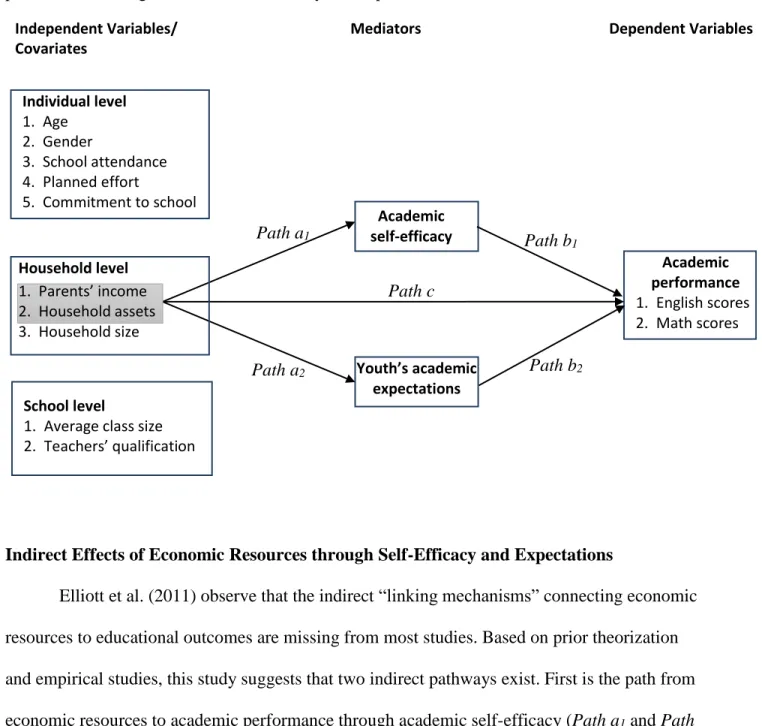
Figure 1. Illustration of a multiple mediation design with two mediators……….52 Figure 2. Two-level path diagram for the direct and indirect relationships between
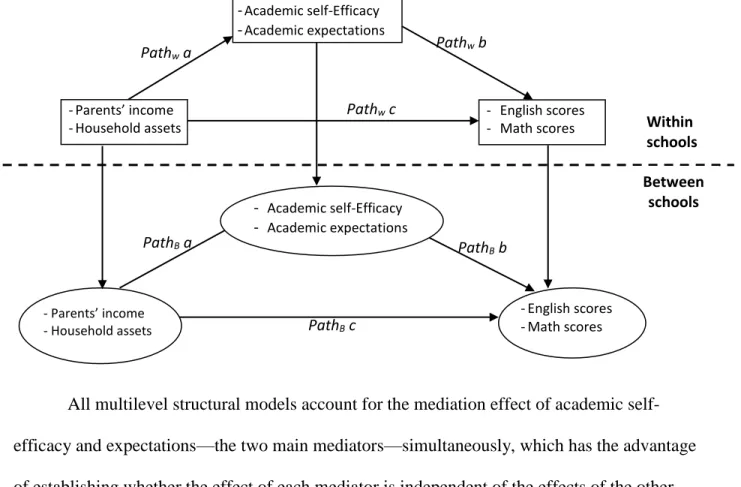
household economic resources and youth academic performance………69 Figure 3. Multilevel exploratory factor analysis for academic self-efficacy and
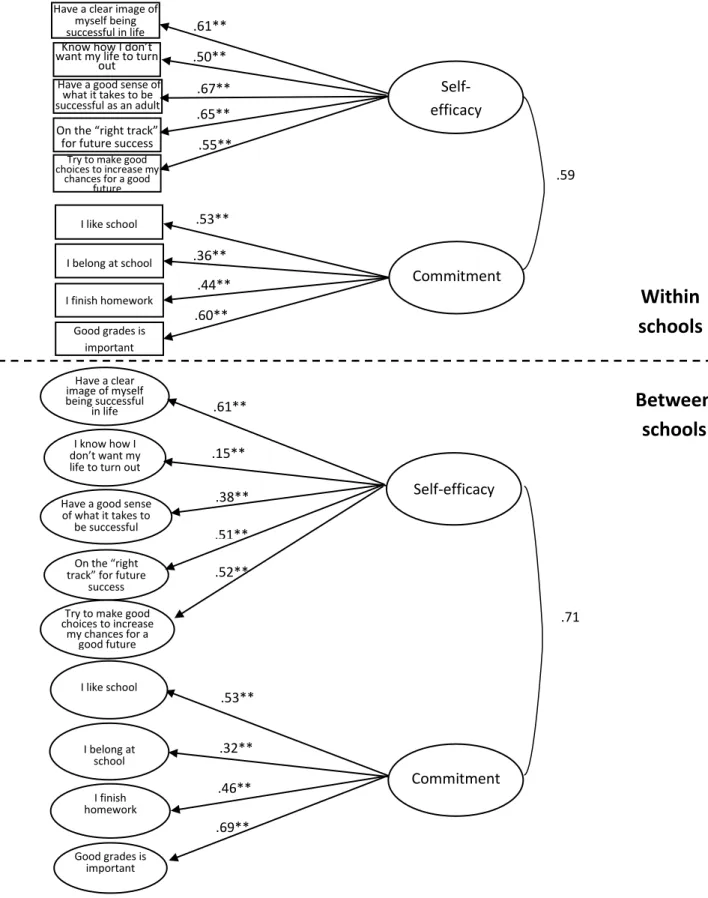
commitment to school scales at the within- and between-school levels..…………..77 Figure 4. Estimated unstandardized path coefficients for direct and indirect association
between parents’ income and English grade for the full sample at the within- and between-school levels……….………79 Figure 5. Estimated unstandardized path coefficients for direct and indirect association
between household assets and English grade for the full sample at the within- and between-school levels………..80 Figure 6. Estimated unstandardized path coefficients for direct and indirect association
between parents’ income and math grade for the full sample at the within- and between-school levels………...…...83 Figure 7. Estimated unstandardized path coefficients for direct and indirect association
between household assets and math grade for the full sample at the within- and between-school levels ………...84
List of Tables
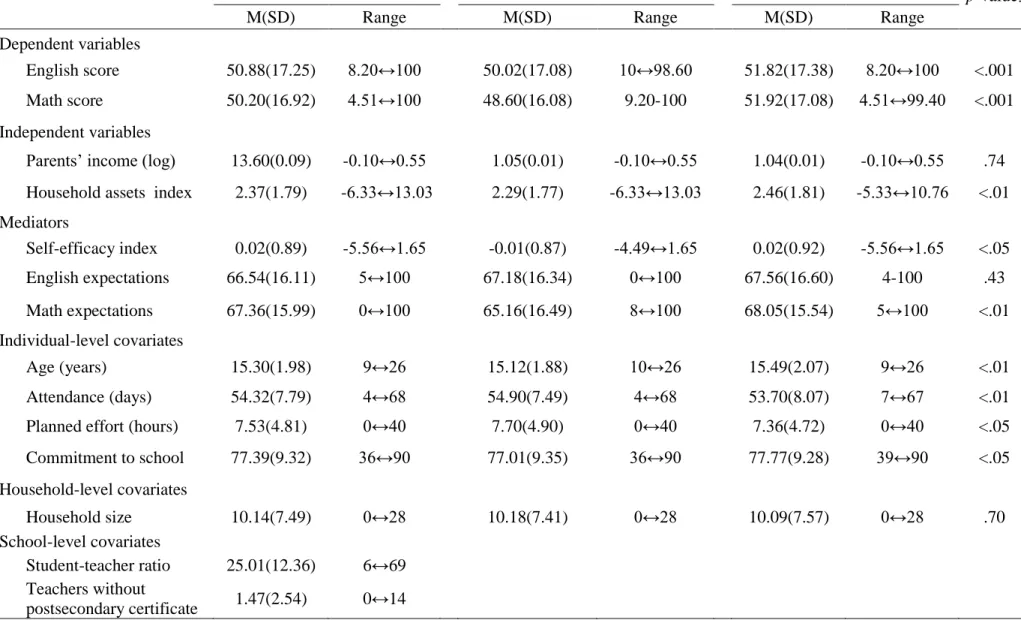
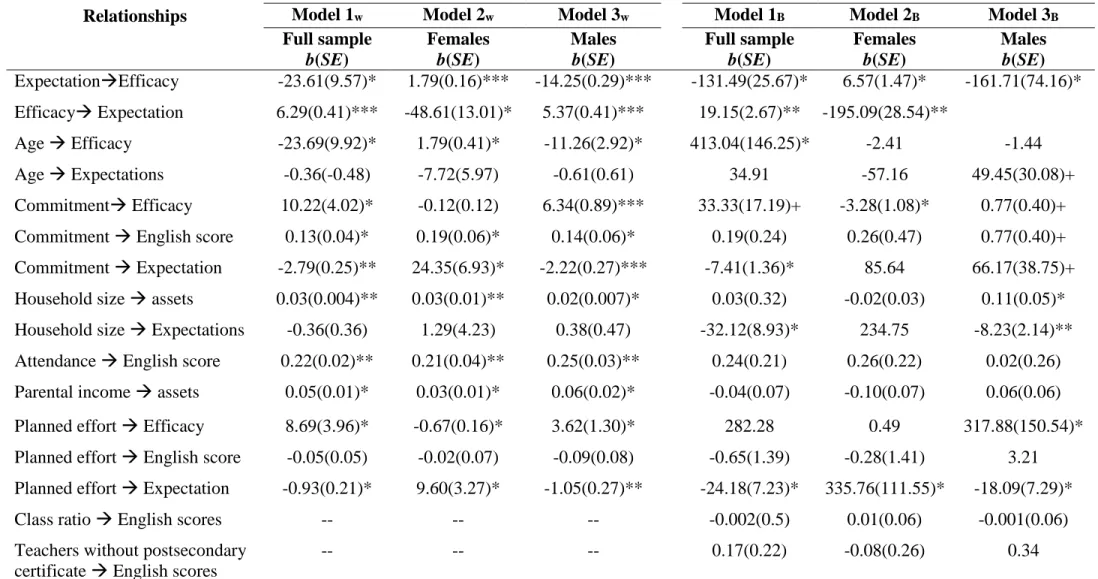
Table 1. Descriptive characteristics of the full, female-only, and male-only samples………..72 Table 2. Summary of model fit statistics for measurement and structural models………76 Table 3. Coefficient estimates of independent variables and mediators
in the English models………..86 Table 4. Coefficient estimates of covariates in the English models………...87 Table 5. Coefficient estimates of independent variables and mediators in the math model…..88 Table 6. Coefficient estimates of covariates in the English math model………...89 Table 7. Summary of hypotheses supported and not supported ………98
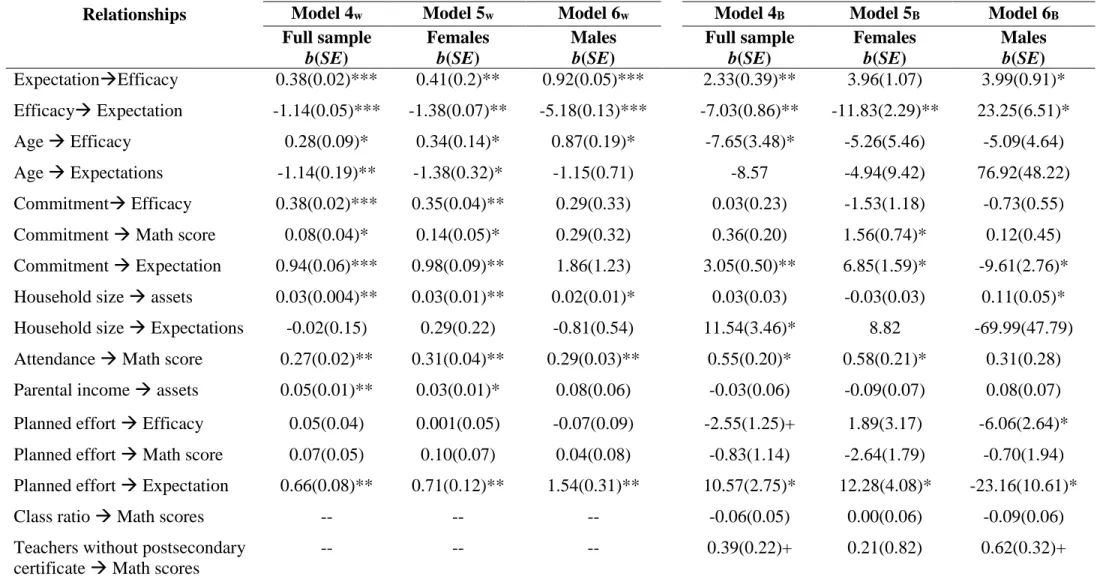
vi List of Abbreviations BCS BECE BHPS CCT CFA CFI CI CGAP CSD FCUBE GES GHC GNA GoG GPA GSS JHS LEAP MSEM NAF NLSY NYPG OECD PIH PSID PTA RMSEA ROSCA SACMEQ SCT SE SEM SHS SSA TRA UNESCO UNICEF
British Cohort Study
Basic Education Certificate Examination British Household Panel Study
Conditional Cash Transfer Confirmatory Factor Analysis Comparative Fit Index
Confidence Interval
Consultative Group to Assist the Poor Center for Social Development
Free Compulsory Universal Basic Education Ghana Education Service
Ghana Cedi
Ghana News Agency Government of Ghana Grade Point Average Ghana Statistical Service Junior High School
Livelihood Empowerment against Poverty Multi-group Structural Equation Modeling New America Foundation
National Longitudinal Survey of Youth National Youth Policy of Ghana
Organization for Economic Co-operation and Development Permanent Income Hypothesis
Panel Study of Income Dynamics Parent-Teacher Association
Root Mean Square Error of Approximation Rotating Savings and Credit Association
Southern and East African Consortium for Monitoring Education Quality Social Cognitive Theory
Standard Errors
Structural Equation Modeling Senior High School
Sub-Saharan Africa
Theory of Reasoned Action
United Nations Educational, Scientific and Cultural Organization United Nations Children's Fund
vii
Acknowledgements
This dissertation would not have been possible without the support of many people. I wish to express my enormous gratitude for the advice, leadership, encouragement, and assistance that my advisors Michael Sherraden PhD (dissertation chairperson) and Gina Chowa PhD
(dissertation committee member) so generously offered to me throughout my doctoral training and the dissertation process. Their counsel and dedication to my research training inspired me to pursue my research interest. I am thankful to have had the opportunity to work and study under them as a Research Associate at the Center for Social Development.
To the other dissertation committee members, Carolyn Lesorogol PhD, Ramesh
Raghavan MD, PhD, Mungai Mutonya PhD, Amanda Moore McBride PhD, and James Wertsch PhD, I am grateful for your support and steadfastness and for believing in me and in the
importance of this work. Your guidance and encouragement sustained me in this research. Thank you to my family who stood by me from the beginning through to the end. My wife Bernice, my son Kwesi, my brother Eric, and my friend Abena Ampomah have been my strongest source of love, support, and strength throughout the dissertation process.
Many special thanks to my colleagues and friends at the Center for Social Development, Li Zou, Lissa Johnson, Tiffany Trautwein, Tiffany Heineman, and Julia Steven for their research and administrative assistance.
viii
ABSTRACT OF THE DISSERTATION
The Relationship between Household Economic Resources and Youth Academic Performance in Ghana: A Multilevel Structural Equation Modeling
by David Ansong
Doctor of Philosophy in Social Work Washington University in St. Louis, 2013
Professor Michael Sherraden, Chair
The Government of Ghana recognizes the importance of education for improving the socioeconomic well-being of young Ghanaians and the development of the nation. Education currently accounts for the largest share (31%) of Ghana’s national budget (GNA, 2012). Educational reforms and investments have had remarkable success in improving access to education up to the Junior High School (JHS) level, but progression beyond JHS remains a challenge. More than half of JHS graduates do not gain admission into Senior High School (SHS) because of poor academic performance and the inability of those who qualify to afford the drastic increase in educational costs.
Stakeholders have focused on different ways to address these educational challenges. Researchers who study the developmental effects of owning assets (e.g., savings, home, land, livestock, etc.) in particular have begun paying attention to ways in which personal (e.g., savings) and household (e.g., assets) economic resources can improve young people’s educational outcomes. This emerging area of work is guided by the asset-effects framework, which posits that economic resources may influence educational outcomes directly throughbeing able to pay for tuition and school supplies and indirectly through their influence on cognitive
ix
processes (e.g., academic self-efficacy and expectations). Empirical evidence from around the world suggests potential connections, but there are significant research gaps on how specific types of economic resources affect educational outcomes. For instance, while most studies that link income and educational outcomes find strong relationships between income and children’s academic performance, others find mixed or contradictory results. The mixed results suggest the need for further conceptualization and empirical research to clarify the nature of the relationships between different types of economic resources and academic performance.
To help address the research gaps, this study uses nested cross-sectional data from an ongoing youth savings experiment to examine potential direct and indirect associations between two types of economic resources—parents’ income and household assets—and math and English scores of middle school-age youth in Ghana. In addition, the study assesses the possibility that gender moderates the relationships between the aforementioned types of economic resources and math and English scores.
Using multilevel structural equation modeling techniques, the study does not find strong evidence to support the hypothesized direct relationship between economic resources and educational outcomes. However, the study finds strong evidence that parents’ income and household assets indirectly affect math and English scores through young people’s academic self-efficacy and expectations. These findings suggest that psychological factors such as
academic self-efficacy and expectation are more predictive of youth academic performance than economic resources. Subgroup analyses also show that gender moderates the indirect
relationships between economic resources and English scores but not math scores. This finding concerning possible gender differences could inform policymakers about economic resources that may promote parallel outcomes for boys and girls.
1
Chapter 1: Introduction
Background of the Study
Formal education is the principal institutional route by which people are equipped with the knowledge and skills they need to become economically productive and competitive (Baffour-Awuah, 2011; Maliyamkono & Ogbu, 1999; Oduro, 2000). Like most young people around the world, school-age youth in Ghana need formal education to acquire knowledge, skills, and competencies to participate in an increasingly knowledge-driven society. Emerging
empirical evidence from sub-Saharan Africa (SSA) suggests that having economic resources is associated with educational success (Chowa, Ansong, & Rainier, 2010). However, such research does not explain how different types of economic resources—such as accumulated savings and income—might have varying associations with specific types of educational outcomes (e.g., academic performance) or how these relationships may vary by gender. Thus, this dissertation examines:
(1) how two types of economic resources—income and assets—are associated with academic performance1 of Junior High School (JHS) students in Ghana, (2) whether students’ psychological factors—academic self-efficacy and academic
expectations—mediate the relationships between economic resources and academic performance, and
(3) whether the nature of the relationships between economic resources and academic performance depends on the child’s gender.
Because formal education is critical to economic growth and human development through human capital, especially in developing countries (Barro, 2006; Oduro, 2000), the
1 For the purposes of this study, academic performance refers to how well students are doing with respect to grades
2
Government of Ghana (GoG), public and private organizations, and other education stakeholders have made and continue to make significant investments in the country’s educational system. For the individual, formal education has both monetary and nonmonetary benefits, as it boosts:
earning potential, economic well-being, and social mobility (Baum & Payea, 2005; Haveman & Wolfe, 1994; Keeley, 2007; Loke & Sacco, 2011);
social skills, including the ability to engage in peer relationships, self-control, compliance with laws and social codes, and assertiveness (Gesthuizen, Van der Meer, & Scheepers, 2008); and
cultural capital through their acquisition and/or reinforcement of norms and values (e.g., tolerance, hard work, civility, and respect) (National Research Council, 2005).
Statement of Problem
Given that there are more returns on attaining higher levels of education, the youth in Ghana must pursue educational advancement beyond the basic education level to benefit fully. In Ghana and many developing countries, the youth with higher education have comparative
advantage over those who have only basic education. This is because those without higher education often have to direct their job search toward the lower-tier and informal sector jobs that are mostly casual and temporary, but the youth with higher education can be competitive in both the formal and informal job market (El Badaoui & Rebiere, 2012). For instance, the 2007 job tracking survey by the Ghana Statistical Service (GSS) revealed that more than 80% of job openings in the formal employment sector were available only to individuals with no less than Senior High School (SHS) education (Amankrah, 2007). Thus, there are better job prospects in the formal sector for individuals who are able to enroll in formal education beyond the JHS level. However, there are enormous challenges to the smooth transition from JHS to SHS in Ghana,
3
two of which are low academic performance and high cost of higher education (Ministry of Education, Science, and Sports, 2007).
Low Academic Performance
Admission to SHS in Ghana is partly merit-based. That means successful transition from JHS to SHS partially hinges on good grades. Yet, many JHS students have poor academic performance and therefore they cannot gain admission to SHS (Ajayi, 2012). For example, between 1992 and 1997, less than one fifth of JHS students reached mastery level2 in English language and math subjects (Mereku, 2003). From 2006 to 2008, 38% of JHS students who sat for the Basic Education Certificate Examination (BECE)3 did not qualify for SHS because of poor performance (Daily Graphic, 2008). In 2008 and 2010, students from 34 schools had a 0% pass rate on the BECE and therefore did not qualify for SHS (Okyerefo, Fiaveh, & Lamptey, 2011). Several inter-country studies also have corroborated the observation that academic performance in Ghana is comparatively low. For instance, Ghana placed last among other African countries, including South Africa, Morocco, Botswana, and Egypt in the Trends in International Math and Science Study (TMISS) in 2003 (Abukari, 2010). A repetition of the TMISS study in 2007 and 2011 revealed that academic performance in Ghana continues to trail other countries with similar income levels (Etsey et. al., 2009; National Center for Education Statistics, n.d.).
Poor academic performance in Ghana has been attributed to inadequate infrastructure, lack of educational materials, and inadequate training and motivation of teachers (Ghana News Agency, 2010; Norviewu-Mortty, 2012). Nevertheless, individual- and family-owned economic
2 As of 2003, the Ghana Education Service’s (GES) cutoff for mastery in a subject was 60% (i.e., Average) for
English language and 55% for math (Mereku, 2003). The GES uses the following 9-scale grading system: Excellent (80%-100%), Very Good (75%-79%), Good (70%-74%), High Average (65%-69%), Average (60%-64%), Low Average (55%-59%), Low (50%-54%), Lower (45%-49%), and Lowest (below 40%).
4
resources might help improve academic performance through investment in educational
resources and needs. While empirical research has not shed adequate light on this possibility in Ghana, evidence from Elliott’s (2011, 2013) research on the effects of economic instability on children’s educational outcomes in the US suggests that economic resources provide families with an advantage. Families with accumulated assets are able to access educational resources— such as textbooks and writing materials—that are proven to affect academic performance (Chowa, Masa, Wretman, & Ansong, 2012; Etsey, 2005; World Bank & UNICEF, 2009).
The GoG has made efforts to address many of the challenges facing the educational system. However, most of these efforts have been geared toward achieving universal primary education by 2015—Millennium Development Goal 2 —and less about improving academic performance. The GoG’s efforts to increase enrollment at the JHS level have had little or no impact on academic performance (Atta-Quayson, 2007), one of the major barriers to successful transition from JHS to SHS. Enrollment rates at the JHS level have increased steadily since the 1980s, while academic performance has decreased over the same period (Akyeampong, 2009; DANIDA, EFW, & The World Bank, 2011; Okyerefo, Fiaveh, & Lamptey, 2011; The World Bank, 2010). See Appendix A for enrollment trends of public and private JHS from 2001 to 2010. Using econometric estimation models, Osei and others (2009) find that government tuition subsidies do not have a significant impacts on BECE pass rates. Thus, ensuring access through an increased focus on enrollment does not guarantee other important educational outcomes, such as regular attendance, active engagement in schoolwork, and good academic grades. Without efforts to improve academic performance, many JHS students will not obtain passing grades in the BECE to qualify for admission into SHS.
5
High Cost of Transition
Apart from low academic performance, the significant increase in educational expenses is another major barrier to successful transition to SHS. Basic education (primary and JHS) has been made mostly free through GoG programs that subsidize educational costs by providing School Capitation Grants (free tuition), a School Feeding Program (free school lunch), school uniforms, and textbooks (Osei, et. al., 2009). The GoG provides these subsidies at the basic education level partly because the Constitution of the Republic of Ghana4 stipulates that basic education is a fundamental human right for all Ghanaian children, and must be free to all regardless of social or economic background (Akyeampong, 2011). However, government subsidies drop substantially at the SHS level as the Constitution recommends but does not require the GoG to guarantee or fund second cycle institutions. For instance, in the 2011/2012 academic year, SHS students paid an equivalent of about USD 500 in annual tuition (Public Agenda, 2011) and almost USD 100 in direct costs of school charges and materials (Innovation for Poverty, n.d.). Clearly, as one transitions from JHS to SHS, the number of school-related supplies5 increases and the cost of education rises to more than 50% of many families’ annual incomes (Ghana Health and Education Initiative, n.d.). The drastic increase in educational expense may account for the high dropout rate (70%), which is higher during the transition from JHS to SHS than the dropout rate during JHS (22%). This may be an indication that many families cannot bear the cost of SHS education. See Appendix B for illustration of the rates of transition from primary school through SHS.
4 Chapter 5 of the 1992 Constitution of the Republic of Ghana stipulates that (a) basic education shall be free,
compulsory, and available to all; (b) secondary education in its different forms, including technical and vocational education, shall be made generally available and accessible to all by every appropriate means, and in particular, by the progressive introduction of free education.
5 Common school-related supplies at the SHS level include school uniforms, school bags, exercise books, textbooks,
6
School-related expenses create enormous challenges for individuals and households, especially those who fall within low-income brackets. Data from the Ghana 2003 Core Welfare Indicators Questionnaire (CWIQ) survey reveal that persons from households in the highest wealth quintile in Ghana are nearly three times likely to have completed middle school than persons in the lowest wealth quintile (Oduro, 2008). This gap could be due to poor households’ inability to afford school expenses. Like many developing countries, Ghana’s economy is
growing, and there are competing demands on meager public funds available for social programs like education. Conventional mitigating measures—such as scholarships and fellowship
opportunities—at the SHS level are scarce, thus individuals and families have to find ways to pay for educational expenses.
As Ghana moves toward a model of more cost sharing in education at the SHS and higher levels, individual- and family-owned economic resources—income and assets—may become an even more important factor in determining whether or not one can afford schooling. Knowing that they are able to pay for current and future educational expenses enables students to concentrate on their academic performance. It is becoming increasingly clear that provision of free access to school, particularly beyond the primary school level, is unlikely because of the continued rise in population, high levels of inflation, low economic growth rates, and competing demands on limited government funds (Maliyamkono & Ogbu, 1999). Lewin (2008) predicts that the already low SHS enrollment level will continue to plunge unless the GoG allocates at least 5% of Ghana’s gross domestic product (GDP) to education6. In terms of percentage of total education expenditure, public expenditure dropped from 19% to 18% for JHS and from 19% to 12% for SHS from 2004 to 2008 (DANIDA, EFW, & The World Bank, 2011). Taking the
6 In 2011, 8.1% of GDP was spent on education, which was 24.4% of the total government (UNESCO Institute for
7
current trends in education funding into account, cost sharing will continue to be a key part of government policies at higher levels of education.
In principle, the Free Compulsory Universal Basic Education (FCUBE) program initiated in 1996 to increase access and ensure that parents pay only limited non-tuition fees has not completely removed the financial burden on parents (UN Girl’s Education Initiative [UNGEI], n.d.). There are over 70 different types of fees ranging from UDS 0.33 to UDS 13.13 that parents must pay in addition to stationery, transportation, and 10% of the cost of required textbooks (The World Bank & UNICEF, 2009). These costs have resulted in 11% of children working while in school and 3% dropping out entirely (The World Bank & UNICEF, 2009). Despite the current share of education expenses already borne by students and parents, some government officials are calling for increment in the amount of fees and levies they are required to pay (Caillaud et al., 2009; Lewin, 2008). Thus, government subsidies for education are not likely to increase enough to absorb costs, a situation that raises the questions: Does the lack or limited availability of economic resources affect students’ educational expectations? How does this, in turn, affect effort and performance in school?
This dissertation will examine whether access to economic resources can lead to a strong sense of self-efficacy and positive educational expectations, which may motivate students to focus on their academic work in order to perform well in school.
Significance of the Study
Much of what we know about the impacts of economic resources on educational outcomes is derived from studies in developed countries and other African countries. Findings suggest that economic resources—owned mostly by parents—are positively associated with children’s school-related behaviors (e.g., regular school attendance) (Zhan & Sherraden, 2011;
8
Elliott & Beverly, 2010) and educational outcomes (e.g., graduation, better grades, and
progression) (Elliott & Beverly, 2010; Kim, 2010; Loke & Sacco, 2011). While these results may suggest that there is a relationship between economic resources and education in Ghana, there are knowledge gaps. For instance, the mediating mechanisms through which economic resources affect academic performance have not been fully understood (Elliott, Choi, Destin, & Kim, 2011). Knowing such mediation mechanisms will clarify the processes that underlie the nature of the relationship between economic resources and academic performance.
Also, the educational effects of economic resources—particularly of those owned by youth in SSA—are not well documented (Deshpande & Zimmerman, 2010), and the few empirical studies in developing countries have been limited to small sample sizes or specific countries (Deshpande & Zimmerman, 2010). There are nuances such as different measures and important covariates that empirical research does not yet account for (Chowa, Ansong, & Masa, 2010).
In addition, economic, social, and political differences exist between Ghana and developed or even fellow SSA countries (Green, 2013; Pasquali & Aridas, 2013). Therefore, results from different settings may not be generalizable to the Ghanaian context (Fentiman, Hall, & Bundy, 1999), and the mechanisms by which economic resources are associated with
academic performance are less clear.
By helping address these gaps, this study seeks to inform practitioners and policymakers on how economic empowerment opportunities may create educational advantage for Ghanaian youth and their households. Findings from this study and others can guide efforts to reverse the lagging academic performance at the JHS level, one of the major barriers to educational
9
Purpose of the Study
Further research is needed to shed light on the relationships between economic resources—income and assets—and academic performance in Ghana. Thus far, empirical
evidence from around the world suggests potential connections, but there are significant research gaps on how specific types of economic resources (e.g. household income versus assets) affect academic performance. In the SSA context, it is not clear whether other factors fully or partially mediate the relationships between different types of economic resources and academic
performance, and whether these possible direct and indirect relationships differ for girls and boys. This dissertation uses data from a random sample of Ghanaian youth and parents
participating in the YouthSave Ghana Experiment to provide clarity on the relationship between economic resources (income and assets) and academic performance (math and English language subject scores). Specifically, this dissertation aims to examine:
1. the kinds of household economic resources associated with youth’s academic performance,
2. the mediating role of academic self-efficacy and expectations in the relationship between economic resources and academic performance,
3. whether the unmediated (i.e., direct) and mediated (i.e., indirect) relationships between economic resources and academic performance vary by gender.
History and Structure of the Ghana Education System
A brief review of its history and current structure is necessary to put the Ghanaian educational system into perspective. I divide the educational history of Ghana into three
epochs—precolonial, colonial, and postcolonial. Prior to the introduction of Western literacy to Ghana in the 1530s by the Dutch and Danish (Education Encyclopedia, n.d.), young people
10
developed knowledge and skills through indigenous education in the form of social or
apprenticeship training. This training covered practical, social, spiritual, and intellectual needs appropriate for the environment and community (Egbo, 2000). Artisans and professionals taught crafts, trades, and other professions through apprenticeships (Obide, 1995). Males and females received instructions in different activities.
Indigenous education was overshadowed and dwarfed by western educational policies in the colonial era. Beginning in the 1830s, missionaries introduced Western literacy as a means of spreading Christianity (Education Encyclopedia, n.d.; Ghana Education Service [GES], 2004; Graham, 1971, 1976). Later, colonialists trained some older youth in Western literacy so they could assist in running the colonies. The colonial administration gradually introduced formal education and later built infrastructure for schools (Obide, 1995). By the end of the colonial era in the late 1950s, Ghana had moved toward mass formal education and a Western educational system. Later in 1961, the country passed the Education Act (Act 87), which pushed for the construction of more schools and adoption of the concept of universal primary education (GES, 2004; Oduro, 2000).
The postcolonial era has seen a gradual move from an agricultural-based economy—with 24.65% of the country’s GDP in this sector—to an industrial- and service-based economy
(Kolavalli, et. al., 2012), which has resulted in an increasing demand for workers who have mastered numeracy and literacy skills. These structural shifts refocused the approach to education and employment. The formal educational system has formalized the acquisition of knowledge and skills. Youth who wish to develop their capabilities for future employment and boost their earnings prospects may have to go through some form of formal education. This is recognized generally as the most suitable means of acquiring literacy and numeracy skills and
11
acquiring broader knowledge, reasoning, and problem-solving skills essential for being successful in the changing economy (National Research Council, 2005).
The educational structure in Ghana has undergone many reforms since the country gained independence. The most recent and significant changes were the result of the 1987 educational reforms, which shortened pre-university education from 17 years to 12 years (Tonah, 2009). Currently, Ghana has the 6-3-3-4 educational structure. Students begin formal education at age six and spend six years in primary school, three years in JHS, three years in SHS, and four years in the university. Basic education is universal and covers the first nine years of schooling
(primary school and JHS). The goal of universal education is to expose children to a wide variety of ideas and skills to (a) build their capabilities to fit into society, (b) stimulate their interests in specific areas for future training, and career development. Students are taught eight to nine subjects: mathematics, English language, integrated science, social studies, Ghanaian language and culture, basic design and technology, information and communication technology, religious and moral education, and the French language (optional). A school year at the primary and JHS level lasts 40 weeks. At the end of the third year in JHS, students are tested using scores from an internal continuous assessment and Basic Education Certificate Examination (BECE) which is a national standardized examination.
By law, basic education in Ghana is compulsory, universal, and tuition-free. According to the last population and housing census conducted in 2010, most Ghanaians (53.7%) have had at least basic education (Ghana Statistical Service, 2012). The current gross enrollment ratio at JHS is 79.5%, but the completion rate is only 66% (Global Partnership for Education & Ghana
Development Partner Group, 2012). Students are not obliged to continue their education beyond JHS, but doing so is a goal of many students because in SHS they begin to acquire advanced
12
knowledge, specialized skills, and competencies that increase their higher education
opportunities, enhance their employment prospects and access to most formal jobs. The SHS curriculum covers core subjects—English language, mathematics, integrated science, and social studies—and elective subjects in one of five program areas—agriculture, general arts/sciences, business, vocational, and technical studies.
The current gross enrollment ratio at SHS is 40% (UNESCO Institute for Statistics, 2013). Results of the 2010 census show that among the entire population of Ghana, 23.4% have no formal education, 33.4% have a primary level education, 26.7% have a JHS education or its equivalent, 10.9% have an SHS education or its equivalent, and 4.1% have a post-SHS education (Ghana Statistical Service, 2012). This means more than four in five Ghanaians have never progressed from JHS to SHS even though an SHS education equips young people with the knowledge and skills that broaden their chances of future educational prospects, economic well-being, and social mobility. Contrasted with previous generations, more Ghanaian youth are transitioning from JHS to SHS today (Fatusi & Hindin, 2010), but a large pool of youth still do not progress because of poor performance in JHS and the inability to pay for SHS education.
Definition of Concepts Youth
In this study, youth are defined as 12- to 18-year-olds enrolled in JHS or SHS. While there is no universally accepted definition of youth in Ghana, for practical and policy purposes, the National Youth Policy of Ghana (NYPG) defines it as persons from ages 15 to 35 years (Ministry of Youth and Sport, 2010). The United Nations’ definition of youth as those aged 15 to 24 years serves as the basis for the NYPG age range. This study limits the definition of youth to
13
12- to 18-year-olds because it is consistent with the age range of typical JHS and SHS students, the target population of this study.
Other youth characteristics considered in this study are based on socially defined activities (e.g., school and work) that youth typically are involved in (Jacobo, n.d.). Youth in Ghana can be categorized in four ways: (1) in school but not working, (2) in school and working, (3) working only, and (4) neither working nor in school. Given that one of the primary
phenomena of interest in this study is academic performance, the current study focuses on youth enrolled in the formal educational system, including those who also work. This study uses the terms youth, young people, and JHS students interchangeably.
Formal Education and Educational Outcomes
Education includes the knowledge, skills, and attitudes that people cultivate to prepare for future occupations, responsible citizenship, and leisure activities. Formal and informal education represents acquired human capital and the process of acquiring it, but the focus of this study is on formal education. Unlike informal education, formal education is more systematic, has a
predefined curriculum and minimum attendance requirements (Dib, 1988).
Typical measures of formal educational outcomes fall under two categories: academic performance and educational attainment (Kim, 2010). Some of the measures of academic performance are test scores and subject grades (Elliott, Kim, Jungj, & Zhan, 2010; Huang, Guo, Kim, & Sherraden, 2010; Jutte et al., 2010; Reynolds & Temple, 1998; Watkins, 1997).
Educational attainment, on the other hand, encompasses achievement of milestones such as school completion, graduation, and transition to higher levels of education (Elliott & Beverly, 2010; Reynolds, Temple, & Ou, 2010). Other studies have focused on school behaviors,
14
and establishing networks and bonding in school (Buhs, 2005; Iyer, Kochenderfer-Ladd,
Eisenberg, & Thompson, 2010) or psychological measures, including academic self-efficacy and expectations (Kim, 2010; Zhan & Sherraden, 2003).
Different studies model these education-related measures differently as outcomes,
predictors, mediators, and correlates. In this study, educational outcomes are limited to academic performance as demonstrated by math and English language subject scores. Given that the literature on educational outcomes has used academic performance and achievement
interchangeably, the current study will use both academic performance and achievement to refer to educational outcomes, especially when discussing extant literature.
Economic Resources
In this study, the term economic resources has a broad meaning, encompassing both income and assets. Although these two concepts are connected, they are distinct and therefore should be treated as separate concepts (Oliver & Shapiro, 1997; Sherraden, 1991; Wolff, 1995; Zhan, 2006). Income denotes the inflow of financial resources (Sherraden, 1991) and becomes an asset only if saved for future use (Oliver & Shapiro, 2006). Assets refer to accumulated
resources, including deferred income. Assets can be abstract (i.e., intangible) or concrete (i.e., tangible) (Sherraden, 1991; Sparr & Moser, 2007), but a broad definition of assets, though useful in some cases, “runs the risk of blurring a great many meanings of assets and may not serve very well in thinking about social issues related to government policies” (Nam, Huang, & Sherraden, 2008, p. 2).
This study focuses on tangible assets (e.g., wealth and physical property), which are the most relevant for educational outcomes in Ghana. Measuring tangible assets is a more focused way to gauge/measure economic resources, and studying their impact on educational outcomes
15
ensures that this study draws on the theoretical perspective that assets are a tool for
socioeconomic development of young people (see Nam, Huang, & Sherraden, 2008). Specific examples of tangible assets include but are not limited to (1) financial savings; (2) stocks, bonds, and other financial securities; (3) real property; (4) hard assets other than real estate (e.g.,
automobiles); (5) machines, equipment, tools, and other tangible components of production; (6) durable household goods; and (7) livestock (Nam, Huang, & Sherraden, 2008).
In this study, the term economic resources refers to income and assets, unless specified otherwise. As necessary, ownership of an economic resource—by student, parent, or
household—will be clarified.
Conclusion
For many in Ghana, progressing beyond JHS is critical to future socioeconomic well-being. There are several infrastructural and personnel inadequacies that may contribute to the problem, but two of the major barriers to progression are low academic performance and inability to afford fees and school-related expenses. However, individual and household economic resources might help fund students’ education, which could affect their academic performance at the JHS level. Emerging theoretical and empirical work on asset effects— especially in developed countries and some SSA countries (e.g., Uganda)—are the basis for this reasoning (Chowa, Ansong, & Masa, 2010). However, empirical research has not yet shown the effects of economic resources on academic performance in Ghana. It is not clear what type of economic resources or whose economic resources matter most in improving academic
performance. We know little about how the direction and magnitude of the relationship may change when individual, classroom, and school factors are considered. We do not know whether economic resources directly influence academic performance or whether behavioral and personal
16
psychological factors mediate these relationships. This study contributes to the knowledge base by examining these questions and shedding light on how findings may confirm or deviate from what we know empirically about the relationship between economic resources and academic performance in other contexts.
17
Chapter 2: Theoretical Framework
Overview
Using the human capital development framework, I address the sources of and motivations for individual and household investment in formal education. I also explore the direct and indirect effects of income and assets on educational outcomes.
Human Capital Development
Understanding the relationships between economic resources and educational outcomes requires a focus on the broader question of what motivates educational investment. Why and how do others, especially parents and relatives, get involved in education of youth? Why does it matter to invest in youth education beyond basic school? The human capital development perspective provides a framework for understanding important aspects of investment in youth education.
In their seminal work in the early 1960s, Theodore Schultz, Gary Becker, and Jacob Mincer set the stage for debate on what constitutes human capital and how human capital relates to future well-being, productive activities, and earnings (Beaulieu & Mulkey, 1995; Hayami, 2009; Nureev, 2010). Human capital is an individual’s stock of skills, specialized knowledge, experience, and acquired abilities that result from formal and informal education. In this study, I will focus on the benefits of formal education without discounting apprenticeships, on-the-job training, and other avenues for human capital accumulation.
A key argument in favor of human capital investment is that knowledge and skills bring returns to individuals and communities, organizations, and civil society (Hayami, 2009; Kwon, 2009). The human capital development framework is grounded in the assumption that people are rational and weigh the benefits and costs of their investment in human capital (Becker, 1996;
18
Schultz, 2003). Economists view education as capital good because individuals’ knowledge and skills affect productivity levels and lead to economic growth through spending of earnings (Beaulieu & Mulkey, 1995; Ng & Feldman, 2010; Olaniyan & Okemakinde, 2008). In addition to these economic returns of human capital investment, there are social benefits of self-respect and honor (Acemoglu & Angrist, 1999; Moretti, 2004). As people acquire more education, they acquire more competencies that boost their self-worth, and they may become more useful to others who may need their help.
One underlying assumption of the human capital development perspective is that capital acquisition is multileveled with individual, family, community, and national levels influencing knowledge and skills acquisition (Hayami, 2009; Kwon, 2009). At the individual-level,
personality traits that influence human capital accumulation include genetic makeup, physical and mental qualities, strength, and intelligence (Nureev, 2010). Family- and household-level characteristics that constrain or facilitate investment in children’s human capital include parents’ education, interests, decision-making power dynamics, and economic status (Akresh, Bagby, de Walque, & Kazianga, 2012a). Communities and countries contribute to the development of human capital through education by devoting resources to educational infrastructure.
Human capital development is not always a personal decision (Olaniyan & Okemakinde, 2008), especially for children and youth who depend on parents’, relatives’, and guardians’ investments in their knowledge and skills acquisition. Also, if parents’ resources are limited, their ability to spend money and time on children’s education will be affected. The type of investment also depends on “…financial capabilities in the families [and] the prospective utilization of the capital which is being accumulated” (Mincer & Polachek, 1974, p. S77). Parents’ financial resources and their knowledge of options, returns, and costs influence
19
investment in their children’s education. Many parents and families may make deliberate financial sacrifices hoping for future benefits (Hayami, 2009). For example, a Ghanaian parent might sell or use property as collateral to raise money to support a child’s education in the hope of better returns in the future.
Similarly, governments’ and other entities’ investments through policies—such as compulsory school attendance—hinge on the premise of financial capacity and prospects of future benefits to individuals and society. When the government makes an educational
investment, youth seldom have a say in how it happens. Even when children have resources and are aware of available human capital investment options, they may not have enough information about those options or may lack maturity to make informed and rational choices. As Fischhoff (1992) explains, youth who lack information often do not make the best decisions. Even when they have adequate information, “…they often do a poor job of understanding the probabilities of consequences… [and] they are more likely to rely on personal experiences” (Fischhoff, Crowell, & Kipke, 1999, p. 3). Some youth may not have had the personal experiences that are pivotal in making informed decisions about educational investments.
Human capital is developed through accumulation over time (Cisternas, 2011; Tamura, 2004). Within the context of formal education, the human capital accumulation process starts from preschool and builds progressively through higher education and beyond. This means it is important that individuals go beyond the basic school level if they want to acquire advanced knowledge and skills to be competitive in the future. More human capital investments (e.g., more years of education and training) often yield greater returns. In Ghana, for instance, individuals who acquire formal education up to the basic education level may not be as marketable as those who attend school beyond JHS (Sackey, 2008). The higher the levels of education attained, the
20
greater the returns. Two individuals with the same job titles but different levels of education might earn different salaries, even if they are similar in productivity (College Board, 2005; Day & Newburger, 2002). Research on youth earnings in Harare, Zimbabwe, finds that individuals with higher education earn about 21% more than those with a GCE O-level (SHS) certificate (Zhou, 2002). Individuals who have O-level certificates earn 25% more than those without it.
Although more years of education and higher credentials may not always translate into better performance, having them positively influences the chances of employment and earnings. These differential returns on human capital investment can motivate parents and youth to strive for more education or training beyond the basic level to reap more benefits.
Gender also affects the allocation of investments in human capital (Mincer & Polachek, 1974), partly because in many societies, returns on education differ by gender. In developed and developing countries, occupational differences still exist between men and women. Even when the labor force has a high representation of women, they frequently are employed in low-earning activities (Heintz, 2005). In the US for instance, the average salary of female researchers in the medical field is lower than that of men in the same field, regardless of specialty, rank, leadership positions, and number of publications (Jagsi et. al, 2012).
If the theoretical argument holds that human capital investment depends on expected returns, investment in girls’ education is lower than investment in boys’ in many societies (Jensen, 2010). For some families, the idea that most girls will join their husbands’ families after marriage means that the return on any human capital investment may not always have direct benefits to their parents (Foster & Rosenzweig, 2009), which could be a disincentive (Jensen, 2010). Thus, it is important that studies such as this one take into account gender dynamics that
21
influence how people make human capital investment decisions, which may lead to different outcomes.
The foregoing review of the human capital development perspective focused on motivations for, sources of, and gender dynamics in human capital investment. Next, I discuss the theoretical frameworks which explain how income and assets affect academic success.
Effects of Income on Educational Outcomes
Income is an important economic resource that enables people to afford educational resources and services. The relevance of income to education lies mostly in its ability to fund important educational expenses, such as daily school lunch, stationery, school supplies, and tuition. Because of the importance of income for education, governments often step in to provide income support to families (Mayer, 2010). Indeed, the increase in income-maintenance
strategies—including conditional cash transfer (CCT) programs in Ghana and other SSA countries—is due to the impact they are having on school enrollment and school attendance (Garcia & More, 2012).
While the presence of income boosts educational investment, which results in better educational outcomes, the absence of income has negative effects on educational investments. When the steady flow of income is interrupted by job loss or other events, investment in education also may diminish. Some families in developing countries such as Ghana respond to these income shocks by increasing children’s labor to supplement household income (Chowa, Ansong, & Masa, 2011; Beegle, Dehejia, & Gatti, 2003; World Bank & UNICEF, 2009).
There are also situations where changes in flow of income compels some parents and guardians to frequently change jobs and housing locations, which leads to school changes (Ross & Roberts, 1999). Continuous residential and school mobility is associated with lower math
22
scores, more grade failures, and school behavior problems (McDonnell, Crook, & Chellman, 2012; Ross & Roberts, 1999). Frequent changes of school make it difficult for students to feel connected to a school and build important alliances and friendships, which are important for staying on course in school.
Friedman’s permanent income hypothesis (PIH) is a cornerstone of the theorized
connection between income and educational expenditures. His hypothesis is that an individual’s ability to forecast future income determines how they spend or invest current income (Wang 2006). Someone convinced that human capital will result in more future income is more inclined to spend current income on its development. Proponents of the PIH expect in-school youths’ future incomes to be higher than their current incomes because they will obtain higher paying jobs that require superior knowledge and skills. In other words, those who expect education to result in higher future incomes may be motivated to spend on education now. Studies in Ghana suggest that the economic motivation to invest in education is boosted further when the
household size is small and the head has formal education (Alhassan, 2010; Donkoh & Amikuzuno, 2011).
Income is important for human capital development, but relying solely on it may not result in long-term educational well-being (Sherraden, 1991; Boshara, 2009). When it comes to education, long-term and short-term investments are both important. Uncertainties about continuous income may lead to doubts that resources will be available to pay for future educational costs, especially for students who plan to progress to higher education levels.
Another challenge with the income perspective is that young people in particular may not have income. As the neoclassical lifecycle theory asserts, income does not flow throughout all stages of the lifecycle. School-age youth are likely to have limited or no income, which means
23
most depend on employed parents and adult relatives to assist with their educational investments. However, parents’ and relatives’ incomes often are susceptible to inconsistent flow because of job loss, death, or illness (Ansong, Chowa, Grinstein-Weiss, 2013; Sherraden, 1991). When these unexpected events happen, a young person may have no choice but to drop out of school, unless there are other economic resources to draw on.
In essence, income is important for short-term educational expenditure but may not be the most reliable means of funding long-term human capital development. For income to have a significant effect on future educational well-being, it has to create a storehouse of future consumption through asset accumulation. Thus, in addition to needing income for short-term educational expenses, the youth and their families also need assets to serve as insurance against future reductions or losses of income. According to Shapiro and Wolff (2005, p. 12), “wealth (assets) signifies a command over financial resources that, when combined with income, can produce the opportunity to secure ‘good life’ in whatever form is needed or desired – education, training…” With this distinction between income and assets, how distinct are the impacts of income and assets on educational outcomes? One would expect variations in the magnitude and nature of the associations because of the inherent differences in these types of resources. A discussion of the relationship between assets and educational outcomes follows.
Effects of Assets on Educational Outcomes
If income is important but sometimes insufficient for supporting long-term educational outcomes, can assets fill the gap? The asset-effect perspective asserts that assets can have short-term, long-short-term, direct, and indirect impacts on educational outcomes. Michael Sherraden (1991) hypothesized that beyond consumption effects, assets have important effects on several domains of individuals’ and families’ economic, psychological, social, and educational outcomes. If
24
assets influence young people’s educational outcomes, by what mechanisms does this happen in the Ghanaian context? Next, I discuss how the asset-effect framework theorizes the direct and indirect mechanisms by which assets affect educational outcomes.
Direct Effects of Economic Resources on Educational Outcomes
One may hypothesize a direct link from assets to educational outcomes (Elliott, Kim, Jung, & Zhan, 2010), because people often rely on wealth and fungible resources to pay for school-related expenses. As in other SSA countries, Ghanaian children often are denied access to education because their families cannot afford fees (Agbewode, 2009). Even though basic school is supposed to be free because of government policies and programs, some schools charge additional fees and levies that lead some families to tap into their economic resources. Some pupils cannot go to school because they have not paid their fees (Siziya, Muula, & Rudatsikira, 2007).
Education is high-priority expenditure for many families in Ghana and many African countries, and some individuals and families accumulate savings from their jobs and other productive assets for the specific purpose of paying school tuition and expenses for their children (Bouman, 1995). Those with limited or no financial resources may sell off personal or family properties, and some use assets as collateral to secure loans (Lerman & McKernan, 2008) to finance educational investments. Student loan programs in Ghana have formidable problems (Woodhall, 1992), and obtaining educational loans is a challenge for most individuals, especially at the SHS level. Basic-level education is subsidized, and student loan programs are readily available for tertiary-level (i.e., college) students. That leaves SHS-level students with limited options for funding their education. For those who cannot easily access student loans or the
25
limited scholarships, one option is to use non-moveable personal or family assets (e.g., houses and land) as collateral for commercial loans.
The direct effects of assets on educational access are more evident in countries such as Ghana where most individuals cannot depend on the limited number of scholarships available, which often do not cover living expenses or school-related needs (OECD and The World Bank, 2007). Even students who receive scholarships must bear school-related expenses in the course of their education, which makes having personal and family assets critical. Kimuyu (1999) explains that some households in rural East Africa participate in savings schemes such as RoSCAs to accumulate enough savings to pay school fees. Students who do not have sufficient financial assets or other forms of economic resources may have to forego school until resources become available.
Indirect Effects of Economic Resources on Educational Outcomes
Some asset researchers have built on the original conceptualization of direct asset effects by suggesting that assets also have indirect effects on educational outcomes (Ansong, Chowa, & Grinstein, 2013; Shobe & Page-Adams, 2001). The indirect asset-effect framework suggests that assets may change people’s thinking and behavior, which in turn, may affect how students perform in school. Two pathways—academic self-efficacy and academic expectations—explain how this happens for JHS students.
Academic self-efficacy pathway: Defined as a belief in one’s ability to accomplish a particular task successfully, self-efficacy often depends on whether one has the opportunity to participate in knowledge and skills acquisition through formal education. The sense of control obtained by accumulating, managing, and spending economic resources also improves self-efficacy (Bynner & Paxton, 2001). This is consistent with the vicarious learning perspective,
26
which suggests that observational learning (i.e., modeling) is a key determinant of self-efficacy (Bandura, 1997; Gist & Mitchell, 1992; Law & Hall, 2009).
External social and economic factors, including the presence or absence of income and assets, influence the development of self-efficacy. When these economic resources are available, people react to them in varying ways that may affect their beliefs and how they feel about their capabilities (Pajares & Schunk, 2001; Shobe & Page-Adams, 2001). Bynner and Paxton (2001, p.5) suggest that “having an asset allows a household to be more confident looking to the future and will enable people to take more active control of their lives.”
As economic resources influence self-efficacy, self-efficacy may in turn affect
educational outcomes (Bean & Sidora-Arcoleo, 2012; Chowa, Masa, Wretman, & Ansong, 2013; Page-Adams & Sherraden, 1996; Sherraden, 1991). Since the 1980s, motivation researchers and educational psychologists have focused considerable attention on the relationship between efficacy and positive educational outcomes. So far, studies have shown that academic self-efficacy predicts college grades (Bong, 2001; Zajacova, Lynch, & Espenshade, 2005), hours spent on schoolwork (Torres & Solberg, 2001), and the propensity to stay in school (Zhang & RiCharde, 1998). Young people’s beliefs about their capabilities influence their task choices and the effort they put into their schoolwork (Bandura, 1997; Schunk, 1995; Schunk & Pajares, 2002). Students who feel capable tend to work harder and seldom give up when faced with obstacles (Schunk & Pajares, 2002). Bandura’ social cognitive theory posits that when students believe in their self-efficacy, they are motivated to use acquired knowledge and skills to tackle academic challenges, which eventually result in better academic outcomes (Zajacova, Lynch, & Espenshade, 2005). Confident young people tend to view difficult school assignments as
27
In Bandura’s view, students’ feelings of self-efficacy determine how they set personal academic goals and behave in school. Research on academic self-efficacy of students suggests that perceived self-efficacy influences the setting of academic goals and final academic
performance (Bandura, Barbaranelli, Gian, & Pastoreili, 1996; Grabowski, Call, & Mortimer, 2001; Zimmerman, Bandura, & Martinez-Pons, 1992). The more students believe in their abilities, the more they would exercise control over how they think, feel, and behave in school.
Concerns about limitations or a lack of economic resources to pay for educational
expenses can arouse academic stress or doubts, which may disrupt learning abilities (NIH News, 2012; Yousefi, et al., 2010). In the absence of such anxieties and self-doubts, students are
motivated to concentrate on schoolwork, increase their study hours, and seek help from teachers and/or colleagues, all of which are important for performing well in school (see Oyserman, Bybee, & Terry, 2006). Even students with superior academic skills may need motivation to use their academic prowess. In other words, competent and brilliant students need some level of belief in their own capabilities to excel in school. The availability of sufficient economic resources to pay for school expenses allows students to be confident and proactively use their skills. Bandura (1986) explains that, “judgments of efficacy …determine how much effort people will expend and how long they will persist in the face of obstacles or aversive experiences. The stronger their perceived self-efficacy, the more vigorous and persistent are their efforts” (p. 394). In short, the presence of economic resources may influence students’ beliefs about what they can accomplish. Confidence in one’s capabilities may in turn affect amount of effort and academic performance.
Academic expectations pathway: Economic resources also affect educational outcomes indirectly through academic expectations. Most people, including young students, have hopes,
28
goals, and plans for the future. Those who have positive expectations anticipate better
opportunities in the future, which form the basis for goal setting, planning, and behaving in ways to optimize goal attainment (Christy-McMullin, Shobe, & Wills, 2009; Hideg & Novaky, 2002; Seginer, 2009).
Motivation for positive expectations often is stimulated by individuals’ interactions with their physical and social environments (Seginer, 2009). When parents invest substantial
economic resources into their children’s education, they expect their children to perform well because they have provided for their school needs. Some parents may not only have high
academic expectations of their children but will also get involved in their children’s schooling to make sure their educational investments are not wasted. Children who are aware of their parents’ educational expectations may be motivated to work harder in school in order not to disappoint their parents. On the other hand, those who feel overly pressured to perform may be inclined to rebel against what they perceive as unrealistic expectations and incessant pressure; such rebellion could negatively affect their academic performance (Akhtar & Aziz, 2011; Peixoto, 2011).
Some theorists suggest that an active process of interconnection and coexistence occurs between people and their physical environments (i.e., the environment influences people’s thoughts and behaviors just as people manage and shape their environments) (Werner & Altman, 2000; Werner, Brown, & Altman, 2002). Stimulation to think and behave in certain ways also comes from children’s physical environments. The ongoing interconnections and interactions with the physical environment include the processes of accumulating resources and managing those already accumulated. Managing personal economic resources might prompt people to think about future possibilities. Young people who assist their parents manage a productive asset (e.g., rental properties such as a commercial vehicle or house) may think about what they can do to
29
accumulate similar assets or achieve even greater success in the future. Conversely, youth from families with fewer or no assets may not even consider attaining higher education level because they lack the financial resources to sustain the process. It is possible that some people with few resources may also be even further motivated because of their desire to experience better life situations that will be different from the difficult experiences of their parents. Notwithstanding, their perception of what might be feasible, in terms of being able to pay for higher education, may become an obstacle. In order for students from poor households to intensify and sustain their hard work toward higher education (i.e. future identity), they must first be convinced that resources are available to help pay for future tuition and other school related expenses (Elliott, Chowa, & Loke, 2011).
Stimuli that influence thoughts and behaviors vary in intensity, frequency, duration, number of sources, and type (Hutchison, 2008; Sundstrom, Bell, Busby, & Asmus, 1996). This means that different levels, sources, and types of economic resources or expectations could have varying effects on behavior. Hutchison (2008) explains that an overload or deprivation of
environmental stimuli (i.e., physical and social) can have negative influences on human behavior. That means overly high parental expectation or lack of any form of parental expectation could hinder academic achievement.
Young people have sophisticated cognitive abilities that allow them to respond to stimuli from available economic resources. They can reconstruct past and current events and imagine likely future outcomes of their actions (Taylor & Pham, 1996). This cognitive stimulation is reflected in their expectations for and worries about the future. Depending on how young people’s experiences and social contexts influence their thoughts, they may develop fears or hopes that affect how they behave and plan for the future. For instance, the fear of not