Improving Online Learning Experience through
Enhanced Interactivity:
Supporting Students from China to Participate Effectively in
MOOCs
Qi Chen
Submitted to OCAD University
in partial fulfillment of the requirements for the degree of Master of Design in Inclusive Design
Toronto, Ontario, Canada, May 2014 Qi Chen, 2014
This document is licensed under the Creative Commons Attribution 4.0 International License. To view a copy of this license, visit http://creativecommons.org/licenses/by/4.0/.
Copyright Notice
This document is licensed under the Creative Commons Attribution 4.0 International License: http://creativecommons.org/licenses/by/4.0/.
You are free to:
• copy and redistribute the material in any medium or format
• remix, transform, and build upon the material for any purpose, even commercially.
Under the following terms:
• Attribution — you must give appropriate credit, provide a link to the license, and
indicate if changes were made. You may do so in any reasonable manner, but not in any way that suggests the licensor endorses you or your use.
Notice:
• You do not have to comply with the license for elements of the material in the
public domain or where your use is permitted by an applicable exception or limitation.
• No warranties are given. The license may not give you all of the permissions
necessary for your intended use. For example, other rights such as publicity, privacy, or moral rights may limit how you use the material.
Author's Declaration
I hereby declare that I am the sole author of this MRP. This is a true copy of the MRP, including any required final revisions, as accepted by my examiners.
I authorize OCAD University to lend this MRP to other institutions or individuals for the purpose of scholarly research.
I understand that my MRP may be made electronically available to the public.
I further authorize OCAD University to reproduce this MRP by other means, in total or in part, at the request of other institutions or individuals for the purpose of scholarly
research.
Signature _________________________________ [Qi Chen]
Abstract
A Massive Open Online Course (MOOC) is a course of study made available over the Internet without charge to a very large number of people. MOOCs offer open access to course materials and provide an interactive learning environment. While they attract learners from around the globe, MOOCs are not always designed to accommodate their diverse backgrounds and needs. This project examined the limitations in current MOOCs from the perspective of problems faced by Chinese MOOC users. Based on an environmental scan of MOOCs, analysis of published reports about major MOOCs, and lessons drawn from personal experience as a Chinese student and language tutor in North America, design guidelines for MOOC structure and MOOC interaction interfaces were created. These guidelines will be useful to online education providers and system developers when
designing or developing online courses. An orientation guide for new Chinese MOOC users was also prepared in the form of a booklet.
Acknowledgments
This MRP would not have been possible without the love and support of a number of incredibly special people.
I would like to thank my Principle advisor Jutta Treviranus and my External advisor Sambhavi Chandrashekar for their time and invaluable guidance in the development of my Major Research Project. Their patience was remarkable, as was their ability to sharpen pencils.
Also, I would like to thank my mother: Min Song and my father: Xiangyang Chen for their support and encouragement to study in Canada. Without you, none of my graduate study at OCAD University or this work could have happened.
Table of Contents
Copyright Notice ... ii
Author's Declaration ... iii
Abstract ... iv
Acknowledgments ... v
List of Figures ... viii
List of Tables ... ix
1 Introduction ... 1
1.1 Design Context ... 1
1.2 Global Reach of MOOCs ... 2
1.3 MOOCs in China ... 3
1.4 Needs of Chinese MOOC Users ... 6
1.5 Rationale for the Design Exercise ... 7
1.6 Design Goals and Approach ... 9
2 An Overview of MOOCs ... 10
2.1 Structure, Community and Peer Review ... 10
2.2 Interaction Interface ... 13
2.3 Learner Experience ... 15
2.4 Design Requirements Identified from Reports ... 18
3 Analysis of Seven MOOCs ... 20
3.1 Operation Mechanism: University-based Diversified Collaboration ... 22
3.2 Platform Orientation: User-based Service ... 23
3.3 Curriculum Structure: Structured Course Design ... 24
3.4 Curriculum Resources: Video-based Delivering Method ... 24
3.5 Quality Certification: Early Stage Exploration ... 24
3.6 Inspiration for Chinese MOOCs ... 25
3.7 Summary of Design Criteria Derived ... 27
4 Lessons Learned from Personal Experience ... 28
5.1 Design Guidelines for MOOC Structure ... 32
5.2 Design Guidelines for MOOC Interface ... 37
5.3 Orientation Guide for New Chinese MOOC Users ... 42
6 Looking Back and Looking Forward ... 44
6.1 Contributions ... 44
6.2 Future Research ... 45
References ... 47
Appendix A – Application of Interaction Interface Guidelines ... 51
List of Figures
Figure 1 MOOC learner types and proportions ... 16
Figure 2 MOOC Structure ... 33
Figure 3 MOOC Community ... 35
Figure 4 Peer review strategy ... 36
Figure 5 Button ... 38
Figure 6 Lecture page wireframe ... 39
Figure 7 Accessibility widgets ... 41
Figure 8 Dictionary widget ... 41
Figure 9 Buttons on course webpage ... 51
Figure 10 Course Lecture page interface ... 51
Figure 11 Accessibility widgets: applying inverted colors ... 51
List of Tables
Table 1 Chinese Participation in Coursera and edX ... 4
Table 2 Types of MOOC ... 11
Table 3 Content Analysis Details ... 21
Table 4 Content Analysis List ... 22
Table 5 Operation Mechanism ... 23
Table 6 Syllabus of Grammar Course ... 28
1
Introduction
1.1 Design Context
Online education, with its variety of formats and content, provides a new avenue of learning to people who want to expand their knowledge. One popular form of online education is the Massive Open Online Course (MOOC), made available over the Internet without charge to a very large number of people. MOOCs offer open access to course materials and provide an interactive learning environment. This form of education breaks through the limitations of traditional educational systems. With its massive scale and open access, it provides an alternative, and more flexible, experience to learners. At the same time, online courses also reduce administrative costs for educational institutions such as admission and physical infrastructure expenses. Furthermore, the Internet resolves time and space restrictions, thus attracting global users to these online spaces and creating potential opportunities for unlimited educational networking.
In the above context, there is an increasing need to consider the diversity of learners in these global education systems and to include them all by suitably designing the online courses and associated systems. To illustrate, MOOCs organized and run by North American entities might not be familiar with certain unique systemic and cultural needs of students who participate from China, where the education system is different from that in the West. As a result, Chinese students might be unable to use these MOOCs to their full potential, although technically these MOOCs are available to them. This report
presents the results of a study aimed at identifying design requirements that would make MOOCs more usable to students from China.
1.2 The Global Reach of MOOCs
The concept of MOOCs evolved in the context of a course experiment conducted by Canadian educational researchers Stephen Downes and George Siemens (2008), who opened a for-credit course titled Connectivism and Connective Knowledge at the
University of Manitoba, Canada to open registration. The gist of the experiment consisted in encouraging learners to take the course content not as the end, but as the beginning of an autonomous and active journey defined by the connections the learner creates between resources and with co-learners (McAuley et al., 2010).
As early as in 2002, MIT’s Open Course Ware (OCW) movement had introduced the values of openness and sharing, from which the concept of open educational resources was developed. MIT has since been offering an increasing number of courses online for free access. Following this, universities and educational institutions have been sharing their high-grade resources online, creating Open Educational Resources (OER). With the emergence and establishment of online education companies on the Internet, OER expanded in quality and quantity. From Udacity and Coursera to edX and Udemy, these companies promote free and high quality course materials as their highlights. They also provide online support, including course material, assignments, evaluation and interaction between mentor and learners as well as among learners. They even award course
Course service received a wide welcome from learners and came to be known as MOOC in short. The year 2012 was marked as The Year of the MOOC (Pappano, 2012).
MOOCs build on the ‘open knowledge sharing’ philosophy of the OER, by not only sharing high-quality educational resources globally but also providing additional learning support. This is a radical breakthrough in learning methods and approach. MOOCs are aimed at interactive participation by a massive number of learners in open source online courses. Unlike other online courses, apart from providing educational resources, they also create online communities that engage in interactive participation.
While online courses are still an emerging phenomenon for learners, and even course designers and developers, it is important to examine the merits and drawbacks of current MOOCs in catering to the learning needs and user preferences of a diverse set of users in a global context. This task is rather large in scope. My project contributes to it in a small way by considering how MOOCs are created and used in China and what specific user needs and preferences exist for Chinese MOOC users in the international context.
1.3 MOOCs in China
As in other countries, several formats of online learning were developed in China before MOOCs were introduced. Many universities were influenced by the OER philosophy and uploaded their courses online for students to access for free. The Open University of China’s Aopeng Distance Education Xuexi Center is China’s largest online education platform with over 2 million learners (Maurer, 2013).
MOOC was first introduced in China in 2013, when two major MOOC platforms,
Cousera and edX, partnered with Chinese universities to offer their courses online. When their courses were formally released through partner Chinese universities, more Chinese universities began focusing on MOOCs. MOOCs became a popular topic in China’s education landscape. Many conferences and discussions were held and many local MOOC platforms were established, such as Coursera Zone, XuetangX, Kaikeba and TopU.com (Embassy of Switzerland in China, 2014).
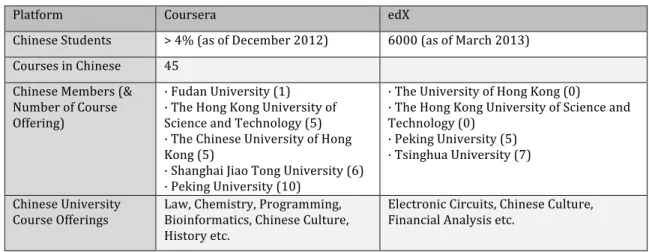
There were 6,000 Chinese students in edX in March 2013 (Ezekiel, E., 20 November, 2013). On Coursera, which is the biggest MOOC platform, more than 4% of users are Chinese and 45 courses are available in Chinese (Table 1). Over 100 courses of MIT’s OpenCourseWare (OCW) have been translated and adapted into Simplified Chinese by China Open Resources for Education (CORE), one of MIT OCW's translation affiliates (MIT OpenCourseWare, 2006).
Table 1 Chinese Participation in Coursera and edX
Platform Coursera
edX
Chinese Students > 4% (as of December 2012) 6000 (as of March 2013)
Courses in Chinese 45
Chinese Members (& Number of Course Offering)
· Fudan University (1) · The Hong Kong University of Science and Technology (5) · The Chinese University of Hong Kong (5)
· Shanghai Jiao Tong University (6) · Peking University (10)
· The University of Hong Kong (0) · The Hong Kong University of Science and Technology (0)
· Peking University (5) · Tsinghua University (7) Chinese University
Course Offerings Law, Chemistry, Programming, Bioinformatics, Chinese Culture, History etc.
Electronic Circuits, Chinese Culture, Financial Analysis etc.
Coursera also tried to develop new forms of local MOOC communities in China. In October 2013, Coursera collaborated with the Chinese Internet provider NetEase to launch an inland service called Coursera Zone, a learning and communication platform in Chinese to help more Chinese students come into Coursera’s learning mode and quality education resources. Coursera Zone offers course details and forums from Coursera. They also translate the courses through professional translators. The major advantage of
Coursera Zone in contrast to Coursera is that the language of the platform is in Chinese whereby users could understand the details of courses and instructors and decide their course selection in Chinese. They can also communicate with each other to share learning experience, questioning and answering in Chinese environment. Furthermore, with this official cooperation mode, Coursera Zone is increasing loading speed of videos and other course content in China through its Content Delivery Network (CDN). This is improving Chinese students’ learning experience even though Coursera, as a foreign site, loads more slowly. At the same time, Coursera Zone employs local teaching assistants to
communicate with students and translate/repost hot discussions from Coursera.
Although the MOOC wave is still in its early phase in China, its openness (everyone can access regardless of location, occupation or age) and scale (there is no limitation in terms of numbers) will influence more Chinese students to make use of this new learning format. Chinese MOOCs are able to offer services that better suit Chinese needs at a technical, cultural and linguistic level. But international MOOCs have the advantage of providing resources from top international universities that attract Chinese students who have an
international vision. These MOOCs, however, are unable to cater well to the needs of students from China.
1.4 Needs of Chinese MOOC Users
In the case of Chinese students, the technical difficulties in accessing foreign MOOCs and the language barriers lead to a comparatively low participation rate. A study shows that English MOOC courses recruited only 1.3% users from China. What is worse, a typical MOOC requires students to read hundreds of academic papers, which is an “unrealistic” task for those whose mother language is not English. This situation directly leads to lower completion rate by Chinese users. Whereas the global average MOOC completion rate is about 10%, it is only 5% in China.
From Coursera’s guide to course developers, they suggest that instructors and teaching assistants should not answer students’ question. They hold the opinion that looking for answers from instructor or course staff would encourage students’ dependency. They want to train students to have a sense of solving questions by collaboration amongst themselves. From Coursera’s practice, another student would answer questions within half an hour. However, it is difficult to apply this strategy to a Chinese-speaking user circle. In Coursera's Chinese courses, students are still accustomed to seeking help from their instructors and TAs. Course administrators are tired of assisting student discussions as they were spending more than 30 hours per week to support their MOOC (Yeh, 2013).
The traditional Chinese learning environment causes this situation. Pedagogical culture in China is teacher-dominated and centrally organized. To avoid uncertainty, Chinese students and instructors were motivated to form an online community, in which the collectivist-femininity attribute of Chinese culture is said to be reflected (Ku & Lohr, 2003). Another tendency in Chinese teacher-student interaction is that students are more inclined to emphasize relationships than work tasks. Moreover, students from China are conditioned to view their peers as competitors. They are less willing to help with other learners’ problems. Education is very competitive. The social structures and communities within MOOCs are very foreign to them.
Another barrier for Chinese students who adopt MOOCs is that there is a gap in the learning structure between MOOCs and the Chinese school system. For MOOCs to be successful, this requires a habitual and societal shift in how knowledge is pursued. Learning in the Chinese school system is often a passive pursuit with all energy spent in learning to pass exams and get into college. And even in college, whereas obtaining knowledge for the sake of knowledge is encouraged in Western universities, Chinese students have long lost the motivation for learning; they regard gaining education as a way to gain social status (Dembs, 2013).
1.5 Rationale for the Design Exercise
Literature reveals a substantial amount of research already done on the technical
global reach of MOOCs, however, it is surprising how little has been done on making the MOOC’s structure and interface design accessible to, and usable by, users with diverse requirements based on physical and sensory impairments, cultural and language
differences, etc.
My personal experience as a Chinese student in North America gives me a perspective of the mismatch between the needs of Chinese students and the offerings of MOOCs, especially those based in North America. In China, we are used to learning in the
traditional method and environment. The past learning experience for most Chinese users is face-to-face teaching and learning in a cohort. Yet, little research has been conducted on including students with cultural and language differences into international online learning communities, especially into hybrid online / offline community structures. The focus of recent research has been on the network-based learning platform (Connectivism MOOC), which is for specific learning sectors and content, and little research is available on improving the learning experience of the general learning community or for assisting the entire teaching process.
The education system and strategies are quite different in China compared to western perspectives. Chinese MOOC developers lack a basic understanding of this distinction. They are generally copying the mainstream international MOOC platforms. Chinese students’ learning culture and relationship with the teacher are unique. This aspect does not appear to be taken into account in the design of the structure or interaction design of
international MOOCs. It is also necessary to provide guidance to new MOOC users to help them get oriented and sustain their learning interest.
1.6 Design Goals and Approach
The questions that drove this design challenge are:
• What connectivism principles affect online curriculum design?
• What are the unique needs of online courses, especially for Chinese students,
associated with structure and user interaction?
• What are the unique needs of students’ learning process and offline activities
supervision?
• What experience and perspectives affect Chinese students when they participate in
MOOCs?
The design approach adopted included (i) a detailed environmental scan of MOOCs based on published reports (Chapter 2), (ii) content analysis of relevant information gathered from testing seven most popular MOOC websites to study their online course structure and the interaction experience offered (Chapter 3); and (iii) lessons learnt from personal experience of teaching English to Chinese students remotely (Chapter 4).
Based on criteria derived from the above exercise, a set of design guidelines for MOOC structure and interaction interfaces was developed, primarily from the perspective of Chinese learners (Chapter 5). An orientation guide for Chinese students who are new to learning through MOOCs was also prepared (Appendix B). It is hoped that the design guidelines emerging from this project will influence the future design and development of MOOCs.
2
An overview of MOOCs
This chapter presents a review of research done on remote education by scholars and organizations. As MOOC projects are mostly in their early stages, the references are limited to online resources and research reports. There is paucity of information directly relating to the MOOC user experience.
2.1 Structure, Community and Peer review
Many models of practice have emerged in the MOOC context. Different ideologies have resulted in MOOCs using a variety of curriculum design approaches. Scholars are also classifying MOOCs using different standards. Pedagogically, MOOCs have been
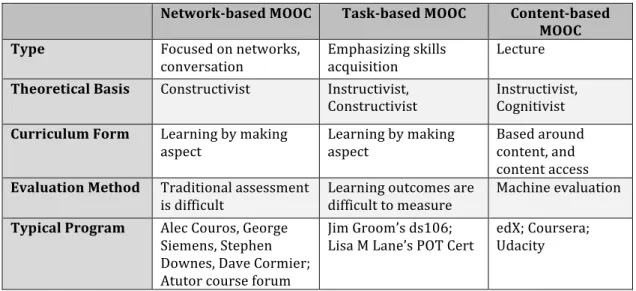
classified into Instructivist, Cognitivist, Social Constructivist and Connectivistic using a theoretical basis. Lisa M. Lane (2012) claims that every MOOC includes Networks, Tasks and Content. According to these different emphases, MOOCs are classified as Network-based-MOOC, Task-based-MOOC and Content-based-MOOC as described in Table 2 below.
Table 2 Types of MOOC
Network-‐based MOOC Task-‐based MOOC Content-‐based MOOC Type Focused on networks,
conversation Emphasizing skills acquisition Lecture Theoretical Basis Constructivist
Instructivist, Constructivist Instructivist, Cognitivist Curriculum Form Learning by making
aspect
Learning by making
aspect Based around content, and content access Evaluation Method Traditional assessment
is difficult
Learning outcomes are difficult to measure
Machine evaluation
Typical Program Alec Couros, George Siemens, Stephen Downes, Dave Cormier; Atutor course forum
Jim Groom’s ds106;
Lisa M Lane’s POT Cert edX; Coursera; Udacity
The most widely received theoretically based classifications are: cMOOC built around connectivity and xMOOC, or extended MOOC. In cMOOC’s theory, knowledge is networked and connected. Learners discuss the same topic in a community network but learning in different pathways; each learner has their own personal tendency of learning. For example, Atutor system is the online learning platform used by the students of the Master of Design program in Inclusive Design in OCAD University. Every week, the course instructor posts weekly readings, resources and forum questions.
Students establish their own personal, customized and preferred tools and platforms to achieve their leaning goals (Fan, 2012). Forum questions are led by responses from students. Progress and results cannot be predicted in the course outline. In this model of MOOC, the instructor’s resources are the starting point of research; student responses and
discussions are the core factor of study and interaction (Fan, 2012). cMOOC (Connectivism MOOC) has the following features:
• interactive learning ways based on social networking; • unstructured course contents;
• focus on building learning pathway; • self-regulating and self-motivated learners.
If cMOOC was the progress and innovation of traditional education, the xMOOC based on behaviorism was an extension breakthrough, like Coursera and edX. Compared with cMOOC, xMOOC is accepted more easily by learners in its structured curriculum and systematized support. Moreover, the contents were connected with mainstream college courses. The xMOOC considered more aspects on user and system interaction with its multiple features, and I chose to focus my major research project (MRP) on the structure of the system and user’s experience of page design.
Christoph Meinel is a German scientist and university professor of computer science. In Meinel’s paper (2013) “openHPI: Evolution of a MOOC platform from LMS to SOA”, Meinel presented a new platform for MOOC. He pointed out that MOOC learning content needs to be presented in its hyper textual structure and the learning environment must support learners to test innovative competence and by confronting them with graphical representations of their progress. He also emphasized that the platform should allow users to connect their learning experience to their social networks.
A conspicuous MOOC researcher and NYU Professor Clay Shirky, launched a MOOC dispute in his article “Your Massively Open Offline College is Broken.” Shirky
considered that MOOCs should be seen as a reasonable response to the failure of the US education system.
Ron Legon is Executive Director of the US Program “Quality Matters” which is a faculty-centered peer review process that is designed to certify the quality of online and blended courses. In his article “MOOCs and the quality question”, he divided MOOCs into two generations. His argument was that the first wave of MOOCs (MOOC 1.0) was designed by faculty from elite institutions. They chose to model their MOOCs on successful lecture courses rather than hard-won knowledge. MOOC 1.0 courses take no responsibility for learning results or for the monitoring, engagement and evaluation. According to Ron, the second generation MOOC (MOOC 2.0) focuses on the typical learner, and will enhance services and evaluation, and more tangible guarantees of credit or recognition for those learners who successfully complete.
2.2 Interaction Interface
In Google’s web accessibility course, Google software engineer Charles Chen
demonstrated how to use the screen reader project ChromeVox to make a webpage more accessible for people with visual impairment and increase the potential audience. They did a lot of work to ensure users aren’t excluded from being able to easily navigate the web.
Inge de Waard is the organizer of MobiMOOC. She initiated a MOOC guide that was opened up for all to add and edit, called MOOCGuide. The guide deals with some crucial factors that influence MOOC choices and resources, including a discussion on social media tools in the MOOC design process and how to make MOOC accessible via mobile devices. This Guide also includes many tools to tutor learners to set up their own MOOC. Rebaque-Rivas, Gil-Rodríguez and Sabaté-Jardí contributed a case study on W3C’s online symposium in their paper “A customizable and flexible e-learning environment for visually impaired students: a case study ” (2013). They gave design recommendations focused on the customization and flexibility of the environments. They pointed out that an e-learning environment featuring widgets allows students to have access to the relevant content and updated information and to situate the widgets according to their preference. Also, customizing widgets allows students to build their online environment to suit their access needs.
In their research on “Chat’s accessibility in mobile learning environments,” Arbiol, Calvo and Iglesias evaluated serious accessibility barriers in selected chats application
(Whatsapp, Line and Spotbros Chat) considering the established accessibility guidelines. The evaluation practice had the following components:
• All interface elements should have a name, meaningful and, if possible, unique in the
context (ISO 9241-171:200 8.1.1, 8.1.2 and 8.1.3, WCAG 1.1.1, 2.4.2 and 2.4.6, UDL 1.3)
• Interface Element size and color contrast (ISO 9241-171:200 10.4.1, 10.4.2 and
10.4.5; WCAG 1.4.3, 1.4.4, 1.4.8; UDL 1.1, 1.7 and 7.1)
• Texts’ Configuration (ISO 9241-171:200 10.3.2 and 10.3.3; WCAG 1.4.4; UDL 7.1),
Alerts (ISO 9241-171:200 8.4.9, 10.6.2 and 10.6.4; WCAG 3.3.1 and 1.4.2; UDL 1.3 and 1.2)
• Documentation and support (ISO 9241-171:200 11.1.1 to 11.1.5; WCAG 3.3.2;
MWABP 3.3.1; UDL 2.1)
W3C (The World Wide Web Consortium) is an international community striving to lead the Web to its full potential. Their working draft (30 January, 2014) “Website
Accessibility Conformance Evaluation Methodology (WCAG-EM) 1.0” provides guidance on evaluating websites’ conformance with the Web Content Accessibility Guidelines (WCAG) 2.0. This methodology describes an evaluation procedure in 5 steps. Using this methodology, I explored the accessibility conformance of current MOOC projects.
2.3 Learner Experience
Learners’ experience of MOOCs is reflected in the literature by way of analysis of reports and course metrics. The statistical approach presents firm insights about various types of learner preferences in MOOCs and captures trends of learner participation over course durations.
Stanford’s Lytics Lab’s report “Deconstructing Disengagement: Analyzing Learner Subpopulations in Massive Open Courses” (Kizilcec, Piech & Schneider, 2013)
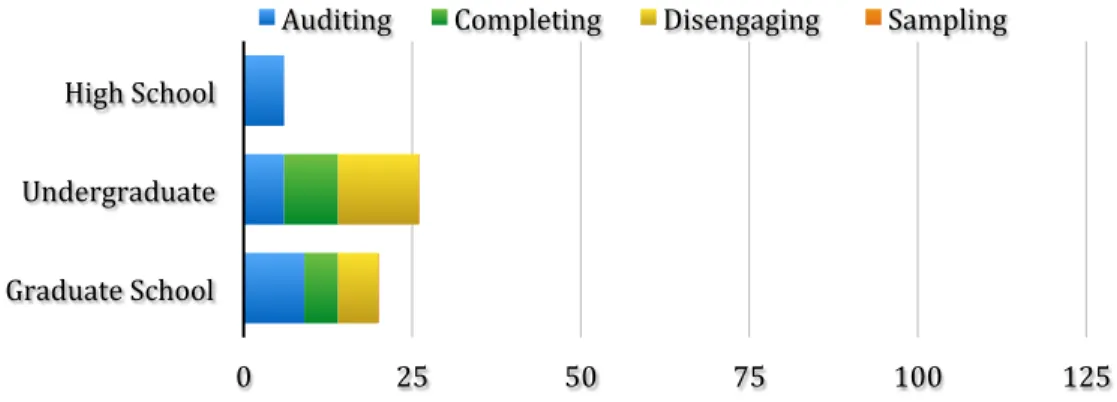
approaches the problem of large population of learners dropping out by investigating and categorizing learners through courseware analytics. The report categorizes learners into four prototypical learner trajectories–auditing, completing, disengaging and sampling– and notes across the three courses analyzed as shown in Figure 1.
Figure 1 MOOC learner types and proportions
This paper points that analysis of course metrics and looking into learner psychology can be used to improve course design and enhance completion rates. Some patterns can be chosen as a lens to more closely analyze learners’ behavior and background. These could be used to research and design the direction for future courses.
Phil Hill has developed four patterns of learners on the same lines as Lytics Lab in the
0 25 50 75 100 125 High School
Undergraduate
Graduate School
widely quoted. The charts show a characteristic distribution of patterns of learners’ durations in Coursera-style MOOCs (i.e. xMOOCs). Hill also provided a line chart to demonstrate the trend of numbers of video views from a Coursera course on
Bioelectricity and EDC.
Stephen Downes, the Canadian commentator and expert in online learning, who is also a MOOC practitioner and designer, argues that more subtle classifications of learners are required. In his notes from the presentation “Designing and Implementing MOOCs that Maximize Student Learning” (2013), he points out that half the people in a MOOC may not have a knowledge of English as a first language. He also states that because the majority of active users are taking the course for fun or a challenge, rather than for a credential, they were not motivated to complete the course and earn a certificate. Edinburgh University ran the first MOOCs in UK on Coursera in early 2012, with 300,000 attending its six MOOCs. The University published a report (2013) based on a pre-and-post course evaluation. Survey responses were received from 45,182 learners at the start of the course and from 15,351 for the end-of-course evaluation. The survey showed a very high percentage of window-shopping learners in all courses and a dramatic decline from enrolment to Week 1; the main aspirations of learners were curiosity about MOOCs and online learning, and a desire to learn new subject matter.
The Embassy of Switzerland in China published a situation analysis: “Massive Open Online Courses (MOOCs) in China” in February 2014. In this article, they presented a situation that MOOC students in China are still, to a large degree, coming from a
higher-educated and richer class. According to the study, 80% of MOOC students in China come from the richest 6% of the population. They also pointed out many challenges that
MOOC is facing in China, including student cheating, and copyright issues and the possibility of fake MOOC certificates. What was worse, many Chinese were concerned that “foreign ideas” might be imported via MOOCs and that it will affect the Chinese ideology and socialism (Forestier, K., 2013).
2.4 Design Requirements Identified from Reports
The following high-level requirements could be identified from the reports studied above:
• Networked community of learners
• Accessibility of the interaction interface to users with disabilities such as visual
impairments
• Customizability through widgets.
• Assistance to non-English speaking learners in understanding course material • Guiding material to initiate new learners into MOOCs
Thus, the above research studies that have already been done in the field of MOOC and online community design provide my major research project with a strong base from which to build up. Studying the work others have done helped me in finding my own strategy for building an e-learning system, drawing upon the existing useful features and structures to create my own framework. The design exercise is influenced by the specific
design would benefit not only online learners from China but also learners from other places around the globe in similar situations.
3
Analysis of Seven MOOCs
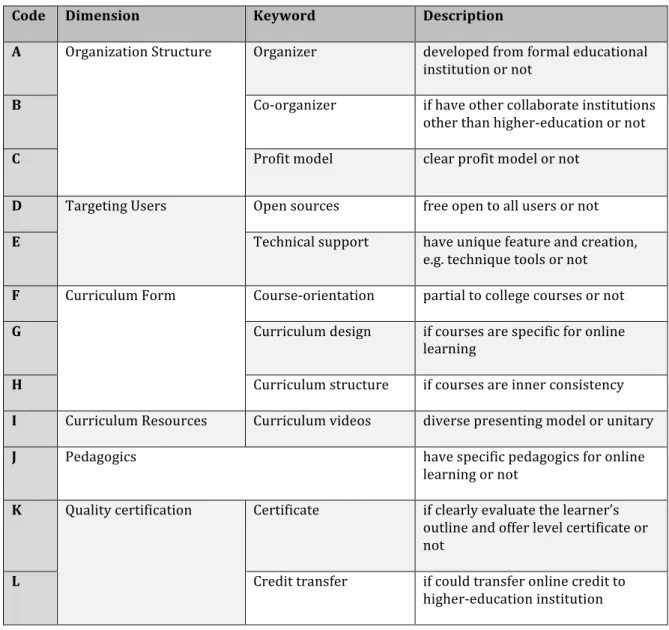
Seven typical MOOC projects (Udacity, Coursera, edX, Udemy, Funturelearn, Canvas Network and Open2Study) were selected and studied based on their size, popularity and relevance to China. Content analysis of the information gathered resulted in six
dimensions related to twelve keywords as shown in Table 5 on the next page. These keywords were then applied back to the seven MOOCs as shown in Table 6, to arrive at a set of guidelines for the structure of inclusive MOOCs, described in the next chapter. Content analysis also inspired identification of some features specifically for Chinese users in the areas of operation mechanism, curriculum design, student participation and learning assessment.
Table 3 Content Analysis Details
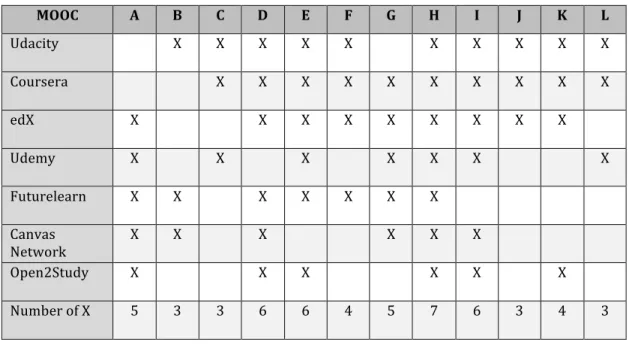
Table 3 shows the seven MOOCs arranged in chronological order of the year founded, as well as the presence or absence of features represented by the keywords. In general, every MOOC tried to emphasize the features that distinguished them from the MOOC’s
foundational model. They regarded curriculum, internal consistency, course video design, Code Dimension Keyword Description
A Organization Structure Organizer developed from formal educational institution or not
B Co-‐organizer if have other collaborate institutions other than higher-‐education or not
C Profit model clear profit model or not
D Targeting Users Open sources free open to all users or not
E Technical support have unique feature and creation, e.g. technique tools or not
F Curriculum Form Course-‐orientation partial to college courses or not
G Curriculum design
if courses are specific for online learning
H Curriculum structure
if courses are inner consistency I Curriculum Resources Curriculum videos
diverse presenting model or unitary
J Pedagogics have specific pedagogics for online learning or not
K Quality certification Certificate
if clearly evaluate the learner’s outline and offer level certificate or not
L Credit transfer
if could transfer online credit to higher-‐education institution
and offering communication tools between learners and teachers online as important. On the basis of high quality content, they tried to lead massive user participation. However, controlling of learning outcomes and certification still require improvement. Issues around these problems need to be solved to remedy the current malady of high dropout rates.
Table 4 Content Analysis List
MOOC A B C D E F G H I J K L Udacity X X X X X X X X X X Coursera X X X X X X X X X X edX X X X X X X X X X Udemy X X X X X X X Futurelearn X X X X X X X Canvas Network X X X X X X Open2Study X X X X X X Number of X 5 3 3 6 6 4 5 7 6 3 4 3
From the above content analysis, as summarized in Table 4, the current MOOC projects are seen to have the following development characteristics:
3.1 Operation Mechanism: University-based Diversified Collaboration
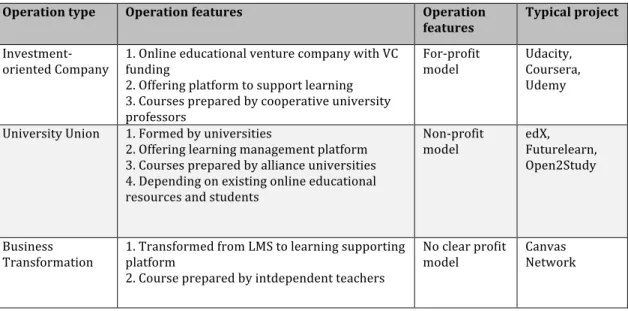
MOOCs offer a platform for universities and teachers to trade their online courses. There are three types of operating mechanisms: (i) Investment-oriented venture company, like
Udacity and Coursera (Coursera received $1,600 million investment from Kleiner Perkins Caufield Byers and New Enterprise Associates); (ii) Open source MOOC projects
conducted by universities using their open online courses, as a form of distance education; and (iii) Business transformation of companies in the education business, from learning management system (LMS) to MOOC company, like Canvas Network (Table 5).
Table 5 Operation Mechanism
Operation type Operation features Operation
features Typical project
Investment-‐
oriented Company 1. Online educational venture company with VC funding 2. Offering platform to support learning 3. Courses prepared by cooperative university professors
For-‐profit
model Udacity, Coursera, Udemy University Union 1. Formed by universities
2. Offering learning management platform 3. Courses prepared by alliance universities 4. Depending on existing online educational resources and students
Non-‐profit
model edX, Futurelearn, Open2Study
Business
Transformation 1. Transformed from LMS to learning supporting platform 2. Course prepared by intdependent teachers
No clear profit
model Canvas Network
3.2 Platform Orientation: User-based Service
In MOOC projects, all courses need to meet its platform criteria before being launched to users. This requires universities and teachers to design their course according to online learners’ needs and experience. Some courses surveyed learners before the course started, and analyzed course metrics throughout the course time, in order to satisfy learners’ demands. The emerging MOOCs are leading to democratization of learning experience, and learners’ experience is becoming the core standard to evaluate teachers.
3.3 Curriculum Structure: Structured Course Design
Open class (www.openclass.com) highlights sharing resources and building the resources together. Comparing with Open Class, MOOC has a structured course design and learning plans to meet users preferences. MOOC emphasizes learning interaction through its well-designed teaching and learning process. It is a network to connect knowledge providers and knowledge receivers. Coursera, EdX and Open2study have structured their courses by clear course calendar and syllabus. They also arrange lecture videos, exercises and programming assignments to enhance user experience.
3.4 Curriculum Resources: Video-based Delivering Method
All the MOOCs are using video as their core method to deliver knowledge. The videos are commonly no longer than 20 minutes. Developers have tried to connect video with quizzes. For example, in Coursera a quiz section is followed with a video as a segue into the next section.
3.5 Quality Certification: Early Stage Exploration
MOOCs have made a huge leap forward in outcome evaluation by employing machine assessment and peer review to provide learners with timely feedback. Some MOOC organizations also award digital certification to learners who qualify by passing the final exams. Moreover, they are also trying to collaborate with universities in order to transfer online credits to college credits. At the moment, five Coursera courses have been
evaluated and recommended by American Council on Education’s College Credit Recommendation Service (ACE CREDIT).
3.6 Inspiration for Chinese MOOCs
MOOCs are improving educational resource sharing and creating global networks of learners and teachers. By comparing current MOOC development and college education characteristics in China, I derived inspiration for Chinese MOOC development from content analysis in the field operating mechanism; curriculum design; student participation and learning assessment.
3.6.1 Creating University Alliance
MOOCs originally began as high quality courses from elite universities. Futurelearn was launched with 12 British university partners and Open2Study projects was founded by Open Universities in Australia. They all operated MOOCs in cross-school mechanisms. Although the Chinese educational administrative departments invested in and promoted open courses in China, the results were not remarkable. Moreover, the quality of
education in Chinese universities differs by regions. For these reasons, creating university alliances and sharing high quality educational resources would improve online course quality and cross-school collaboration in China.
3.6.2 Redesigning Curriculum Structure
The evolution from open educational resources (OER) to MOOC was through sharing resources to provide courses and education. In MOOC curriculum design, all courses were developed to assist users in their learning pathway. Course registration, lectures, tests, assignments and exams were all developed to specifically suit online learning. The Chinese college courses being quite different from these MOOC requirements, Chinese MOOC developers should learn to design their online courses by following online user needs and requirements in learning, teaching and structure aspects. Also, the relationship between teacher and students should be redefined and redesigned, abandoning certain old hierarchical practices still prevailing in China (see 5.1.1).
3.6.3 Reinforce User Support
The open education world has three trends: learning tools and infrastructure usability (Tunnel), free and open education materials and resources usability (Page) and worldwide collaborative open access and sharing movement (participatory learning culture) (Bonk, C., 2009). With years of OER movement, the “tunnel” and “page” has already tended toward perfection. However, the biggest difference between OER and MOOC is the degree of student participation.
In alignment with the Web 2.0 practices, the online learning culture has also turned participatory. Keeping this in mind, developers should consider the use of multiform tools such as email, social media and online forums to enable learners to discuss and build
community. Students should not only be content consumers, but also content creators and developers. They should collaborate with each other and organize self-learning in a friendly atmosphere.
3.6.4 Transform Evaluation Concepts
In Chinese traditional education evaluation systems, educators use examinations to evaluate student’s learning performance and a good grade becomes the goal for most Chinese students. MOOC developers need to change this system by not just assessing the level of subject matter knowledge, but also creating multiform criteria to evaluate
learning outcomes. They also need to consider offering timely feedback during the entire learning process, in order for students to adjust learning methods and improve study outcomes.
3.7 Summary of Design Criteria Derived
The following points emerged from the above analyses with a bearing on the design:
• Structure course design and learning plans to meet users preferences • Use video-based learning materials
• Prepare learning materials to specifically suit online learning
• Provide multiple tools such as email, social media and online forums to enable
learners to discuss and build community
• Use multiform evaluation criteria and offer frequent, prompt feedback to learners • Enable transfer of online credits to college credits
4
Lessons learned from Personal Experience
I taught English to two friends from September 2013 to December 2013 to help them prepare for their International English Language Testing System (IELTS) test, while I was in Canada and they were physically in China. I used this opportunity as a teacher to build a small online learning system myself. I take this teaching experience as a part of my research on online curriculum, system structure and community design. My two students were extremely limited English users, who could convey the general meaning of a familiar situation in English, although a breakdown in communication was highly likely, and would happen frequently. Both are students are college graduates, and began their study of English in the first year of junior high.The IELTS consists of four sections: listening, speaking, reading and writing. I started my course with English grammar, because they had learnt grammar earlier but didn't use English for more than two years. I structured this section as in Table 6:
Table 6 Syllabus of Grammar Course
Lecture 3 hours per day via Skype and screen sharing as whiteboard
Course Materials Grammar book, course notes sharing by Evernote
Assignment Multiple-‐choice questions exercise, Recitation
Evaluation Multiple-‐choice questions accuracy, Questioning
After Class Discussion Student self-‐organized
The lecture part taught concepts of grammar combined with sentences contained in each grammar part. I wrote the emphasis and highlights on screen and shared with them on Evernote. I shared my screen and talked with them via Skype, I also could see their faces from their camera. There is no textbook for my class, but I told them the title of grammar points prior to the class. So the grammar book is their reference before and after class. They themselves evaluated the accuracy of their answers to multiple-choice questions. Also, there was a questioning session at the beginning of each class for me to evaluate their recitation performance. And their offline discussion was self-organized through many channels: phone, messages and face-to-face.
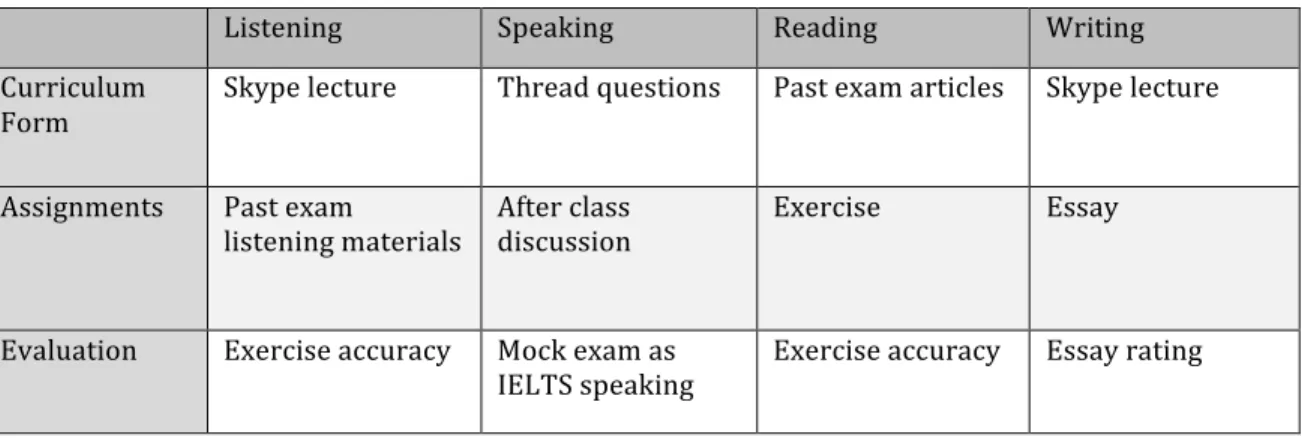
The following outlines the course design for four sections of the IELTS, and the courses were organized as in Table 7.
Table 7 Course Arrangement
Listening Speaking Reading Writing
Curriculum Form
Skype lecture Thread questions Past exam articles Skype lecture
Assignments Past exam
listening materials After class discussion Exercise Essay
Evaluation Exercise accuracy Mock exam as IELTS speaking
Exercise accuracy Essay rating
I designed the four sections through two modes of delivery: listening and writing were delivered via Skype; the grammar part was delivered as a lecture; and speaking and reading were designed around connectivity. The course material was from Cambridge
IELTS official examination papers. For the listening part, I taught them listening skills and let them practice listening to materials from Cambridge IELTS. Assignments were also in the form of practicing skills I taught in class. For the writing part, I deconstructed writing methods, and the daily assignment was an IELTS essay. I checked and edited their essays myself and it took me more than 30 minutes for each essay. For the speaking part, I uploaded thread questions in a shared document on Google drive. Students could respond to questions directly on Google drive and all three of us could read the updated file online. I designed this part like a cMOOC model, where students set up their learning plan on their own. Also, the after class discussion played an important role, with face-to-face talking to make a realistic communication circumstance in English. The evaluation mode was a mock exam like IELTS. I talked with my friends and I evaluated their outcomes and gave them advice for improvement. For the reading part, I organized self-learning exercises that involved reciting words, and asked students to self-evaluate learning outcomes.
I faced several challenges during the online teaching practice. Firstly, the unstable Internet connection was an issue that always affected the online lecture, and this could cause a time lag in screen sharing and voice transmission. At times, I had to waive the class and this negatively impacted students’ after-class schedule and teaching plan. Secondly, because of the distance and time lag, there were limitations in course time planning. In addition, I could not monitor students’ offline learning progress, offline discussion and peer learning progress.
The above research and first hand experience provided me with a greater understanding of distance education and structural design for an online course. I derived the following insights for my major research project that formed a solid base to begin my design:
• The users should have a stable Internet connection; be able to engage in
self-learning and self-evaluation; and provide peer evaluation and feedback.
• The system should provide for monitoring of students’ offline learning progress,
5
Design Contributions
Adopting the design approach outlined in the previous chapters led to the development of a representative set of guidelines for MOOC Structure and MOOC Interaction Interface Design, aimed at making future MOOC systems more inclusive. The purpose of the MOOC Structure guidelines is to improve user experience by creating a more inclusive and interactive learning community and the Interactive Interface Design guidelines are aimed at improving accessibility for students with visual impairments and those for whom English is a second language. An orientation guide for new Chinese MOOC users was also developed.
5.1 Design Guidelines for MOOC Structure
The guidelines encompass three areas: structure, community design and peer-review strategy.
5.1.1 MOOC Structure Design
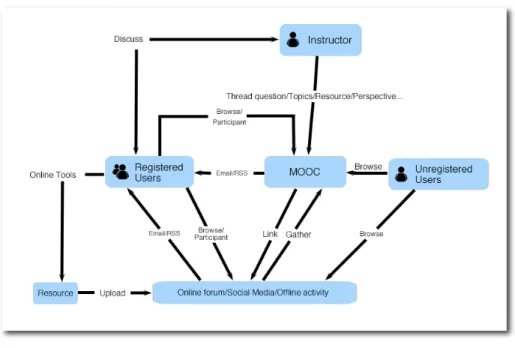
Figure 2 MOOC Structure
MOOC is the central platform in the suggested structure (see Figure 2). It is managed and maintained by the administrator. MOOC releases course materials such as lectures,
syllabus, course schedule, exercise, assignments, surveys, activity notice, thread questions, etc. The instructor is in charge of organizing the entire learning practice. In this structure, the instructor contributes course resources; thread questions and his/her perspectives on the course. The instructor also coordinates users’ discussion and learning progress. Learners use MOOC and other platforms and tools to participate in the course; browse resources; discuss course questions; and complete assignments.
The role of the instructor is more like a sponsor and a coordinator. They are in-charge of creating and updating the course; writing newsletters; reading, commenting and leading online forums, hosting online seminars and reviewing learning progress.
5.1.2 MOOC Community Design
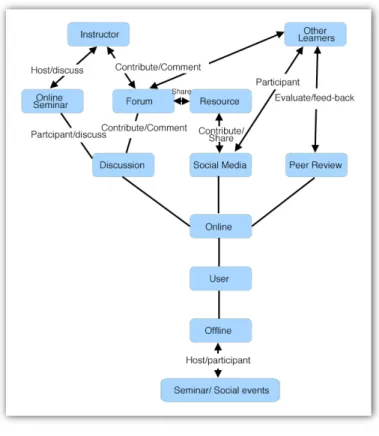
The MOOC community (as illustrated in Figure 3) is a part of the structure. The user will get to interact with the instructor and other learners both in online and offline
environments. The online environment includes discussion, social media and peer review. In the discussion section, users participate and communicate through forums and video chats with the instructor and other users. They could also add, as friends, other learners on MOOC and social media. This gives them a platform for contributing and sharing
Figure 3 MOOC Community
The offline part is self-organized by users, they can host and participate in diverse forms of activities as a part of a MOOC community.
5.1.3 Peer Review Strategy
Peer assessment refers to the practice of classmates evaluating each other’s work. In the context of a Coursera course, this form of assessment (1) allows instructors to give assignments that go beyond automated or machine grading; (2) provides class members with personalized feedback, even in classes with thousands of learners; and (3) offers
learners the opportunity to learn by playing the role of both "teacher" and "student" (which, education research suggests, is highly effective).
Figure 4 Peer review strategy
In my review strategy (as illustrated in Figure 4), if User A agrees to enroll in a peer-review program, after his/her assignment was submitted to the system, that paper will randomly send to another user (say, user B) who is also enrolled. User B assesses and evaluates User A’s paper and then writes an assessment report to User A. After User A receives the report, A could argue or comment on User B’s assessment report and grade User B’s evaluation results. User B will get experience points (popularly called expo points) and rating from User A. Likewise, User A receives another user’s assignment and plays the same role as User B.
The peer-review experience points could upgrade the user’s level, that means the user could get reviews from higher level users. Conversely, if the user does not evaluate
his/her peers’ work or delays submission, he/she will receive a penalty that will reduce the experience points or course grade.
In addition, there are some policies:
• Assignments will be seen by several other users, as well as by course staff. • All the assignments will remain anonymous among peers.
• Sarcasm, profanity, or personal attacks should not be included in a peer
evaluation.
• The instructor maintains the right to moderate student review results.
5.2 Design Guidelines for MOOC Interface
With a view to improving accessibility of MOOCS, some guidelines are suggested below for (i) redesigning webpage interaction elements such as buttons; (ii) creating a wireframe design for lecture videos; and (iii) adding accessibility widgets. Appendix A provides illustrations of application of the guidelines to a prototype MOOC webpage.
5.2.1 Interaction elements
Proposed Guideline: (i) Provide buttons made of different colors and containing text; (ii) Where applicable, use non-text figures for effective visual presentation.
Figure 5 Button
Interaction elements on the user interface are crucial to effective and enjoyable user experience. It is essential, therefore, to ensure they are accessible to all. One of the common user interaction elements is the button
(i) Provide buttons made of different colors and containing text:
All interface elements, such as buttons, should have a name, meaningful and, if possible, unique in the context. Such textual information will especially help users who are blind in using the elements. Moreover, it is also desirable to provide different color schemes to allow enough contrast (Arbiol et al., 2013). In fact, playing with all these elements and their corresponding contrast can improve the appearance of the design and also help in making the design more accessible to users with reduced vision (The Shock Family+, 2013).
Visual elements, if applicable, represent context, provide meaning and help users using different languages to navigate the interface features. Alternative text provided for such visual elements will help users who have trouble viewing the interface in getting the context.
5.2.2 Course Lecture
Proposed Guidelines: (i) Provide alternatives for time-based media; (ii) Develop useful tools on the lecture page.
Figure 6Lecture page wireframe
The guidelines proposed here are primarily suggested by WCAG in the context of users with disabilities. In addition, these will also be helpful to users from a different
(i) Provide alternatives for time-based media:
Alternatives for time-based media include captions for audio content and audio
description for video content. WCAG 2.0 guideline 1.1.2 requires that captions must be provided for all prerecorded audio content in synchronized media. An exception could be when the media is a media alternative for text and is clearly labeled. Captions not only help users who cannot hear in accessing audio content, but also enable users not proficient in the language of the audio content to understand it better. Guideline 1.1.3 requires an alternative for time-based media or audio description of the prerecorded video content to be provided for synchronized media, except when the media is a media
alternative for text and is clearly labeled. Audio description makes the visual and silent portions of videos intelligible to users who cannot see. Such descriptions also make culturally significant meanings explicit to users from a different cultural background.
(ii) Develop useful tools on the lecture page:
Dual and adjustable size videos (as shown in Figure 6) provide alternative scale for course lecture videos and real-time course slides. These would make learning easier for users not very familiar with the lecture content. Page tools such as notes and recorders improve the learning experience for all users by integrating busy desktop application windows. They could also improve learning outcome in reviewing course materials.
5.2.3 Accessibility Widgets
Proposed Guidelines: Provide diverse and customizable accessibility widgets to meet the diverse needs of users
Figure 7 Accessibility widgets
Figure 8 Dictionary widget
The possibility of repositioning the widgets in the environment allows learners to situate the widgets according to their preferences (e.g. placing the most relevant widgets at the top of the page), therefore avoiding the need to search for what they need (M. Ribera et al., 2008). An e-learning environment featuring widgets allows learners to have access to
the relevant content and updated information of their studies located on the same page, with no need to open new windows or tabs to access these contents. Customizing the colors of widgets allows learners with sufficient partial sight to identify them without having to read them (Rebaque-Rivas et al., 2013). Although still not large, some MOOC courses recruited more than 8% learners whose first language is not English (Edinburgh University, 2013). The majority of MOOCs are in English, but increasingly - we are seeing some of these being translated by the MOOCs' online student community themselves. It is also anticipated that multi-lingual MOOCs will be growing with the increased participation of leading international universities (MOOCs University). Language widgets like dictionaries, as illustrated in Figure 8, could provide more inclusive and convenient environments for international users.
5.3 Orientation Guide for New Chinese MOOC Users
The diverse and broad curricula offered by MOOCs provide an opportunity for Chinese students to boost their global competitiveness. However, most Chinese MOOC users face anxiety, unfamiliarity and other such issues when they first participate in international MOOCs. There are several reasons for this, Including the past educational experiences of Chinese students; the differences between eastern and western cultural perspectives; and Internet connectivity problems due to the blocking of most foreign websites by Chinese authorities. There is thus a need to provide learning material that will bridge this gap and help Chinese students begin and sustain their learning through international MOOCs.
An orientation guide in the form of a booklet has been designed (see Appendix B) to meet the above need. The purpose of the booklet is to provide knowledge about MOOCs and demonstrate general guidelines for course preparation prior to participation in online learning. It is intended to help all new Chinese MOOC users as a good starting point for gaining an insight into the MOOC family. Following an introduction, the second section of the booklet provides guidance for proxy setting to help users access the Internet more efficiently, and recommends certain hardware that would facilitate their learning process. It provides reminders regarding what to bring and what not to bring while enrolling into MOOCs, and also tries to promote past good customs and perspectives and helps students abandon bad views. Sections 3 and 4 of the booklet provides a general account of the operating mechanism and peer review strategy of MOOCs.
6
Looking Back and Looking Forward
6.1 Contributions
The goal of this project was to explore interactive MOOC structure design and to make design suggestions for improving accessibility for users with diverse needs. Specifically, the needs of MOOC users from China were considered. It involved developing structures for MOOC platforms and communities and designing interaction interface guidelines that designers and developers can use in conjunction with their own research. An orientation booklet for the general guidance of new MOOC users from China was also prepared. The suggested MOOC structure defined each MOOC participant interface as well as the overall platform, focusing on the roles and relationships between them. The MOOC community design used online tools and offline communication to create an interactive and inclusive environment for e-learning participants. By making users feel more included in the course, new users will be more likely to continue their learning progress. Additionally, this mechanism can be applied to other online communities. The peer review procedure included assignment evaluation strategies that could reduce the instructor’s work and create the opportunity for future massive certificate courses. Participants also have greater responsibility in reviewing others’ papers through the recommended dual response process and experience promotion.
widgets. It is hoped that the design guidelines emanating from this research will allow new approaches when designing MOOC accessibility tools.
6.2 Future Research
The MOOC of today is developing rapidly and is all set to eventually evolve into an acceptable alternative method of delivering knowledge (Dennis, 2014). There are several directions and strategies that could be explored in future work: (1) Curriculum design could be aligned with college credit recommendation requirements to enable transfer of online learning accomplishments to the real world; (2) Analytics could be developed for evaluating course design, which would then generate data for future research; and (3) Localization of MOOCs for Chinese users could be explored further.
Future work on curriculum design could include examination of effective approaches, pedagogies and practices that lead to student success, applicability of college credit recommendations for MOOCs to college degree completion programs (ACE, 2012), assessing the applicability and determining whether or not MOOC curriculum design could successfully meet real college requirements, etc. Future work on MOOC analytics research would progress from more MOOC practice and Big Data analysis. This work requires massive feedback, experience and recorded information with the time.
MOOCs will change the overall Chinese education landscape. Localizing MOOC could include designing new forms of courses for Chinese students, or creating new tools while
taking other language courses, because very few MOOCs have been translated into Chinese or have captions.
References
ACE. (2012). ACE to Assess Potential of MOOCs, Evaluate Courses for Credit-Worthiness. (n.d.). Prior Learning Assessments. Retrieved April 21, 2014, from
http://www.acenet.edu/news-room/Pages/ACE-to-Assess-Potential-of-MOOCs-Evaluate-Courses-for-Credit-Worthiness.aspx
Arbiol, A., Calvo, R., & Iglesias, A. (n.d.). Chat's accessibility in mobile learning environments. - Submission for the RDWG Symposium on Accessible E-Learning. Retrieved April 21, 2014, from http://www.w3.org/WAI/RD/2013/e-learning/paper5/
Caldwell, B., Cooper, M., Reid, L. G., & Vanderheiden, G. (2008, December 28). Web Content Accessibility Guidelines (WCAG) 2.0. Retrieved April 20, 2014, from
http://www.w3.org/TR/WCAG20/
Cooper, A. (1999). The inmates are running the asylum. Indianapolis, IN: Sams. Dembs, J. (2013, October 9). Do MOOCs Stand A Chance in China?. TechNode.
Retrieved May 6, 2014, from http://technode.com/2013/10/09/do-moocs-stand-a-chance-in-china/
Dennis, M. (n.d.). (2014, January 24). The future of MOOCs - University World News.
RSS. Retrieved April 21, 2014, from
Edinburgh University. (2013, May 10). MOOCs at Edinburgh 2013: Report 1. Edinburgh, Scotland. Retrieved May 28, 2013, from
http://www.era.lib.ed.ac.uk/bitstream/1842/6683/1/Edinburgh%20MOOCs%20Report%2 02013%20%231.pdf
Embassy of Switzerland in China. (2014, February). Situation Analysis: Massive Open Online Courses (MOOCs) in China. Beijing, China
Fan, W. (2012). Connectivism-based MOOC. Distance Education, 03, 31.
Hill, P. (2013, March 6). Emerging Student Patterns in MOOCs: A Graphical View.
eLiterate. Retrieved April 21, 2014, from
http://mfeldstein.com/emerging_student_patterns_in_moocs_graphical_view/
IELTS | Test Takers - My test score. (n.d.). Getting my results. Retrieved April 10, 2014, from
https://www.ielts.org/test_takers_information/getting_my_results/my_test_score.aspx Kizilcec, R. F., Piech, C., & Schneider, E. (2013, April). Deconstructing disengagement: analyzing learner subpopulations in massive open online courses. In Proceedings of the Third International Conference on Learning Analytics and Knowledge (pp. 170-179). ACM.
Ku, H., & Lohr, L. L. (2003). A case study of Chinese students - attitude toward their first online learning experience. Education Technology Research and Development, 51(3), 94-102.
Lane, L. (2012). Three kinds of MOOCs. Lisa’s (Online) Teaching Blog.
Legon, R. (n.d.). MOOCs do not represent the best of online learning (essay). Inside Higher Ed. Retrieved April 21, 2014, from
http://www.insidehighered.com/views/2013/04/25/moocs-do-not-represent-best-online-learning-essay#sthash.OzPRaHVv.dpbs
Ling, Y. (2013, October 10). How National Taiwan University Professor looking on MOOC?. 36 Kr's Interview. Retrieved May 6, 2014, from
http://www.36kr.com/p/207211.html
Meinel, C., Totschnig, M., & Willems, C. (2013). openHPI: Evolution of a MOOC platform from LMS to SOA. In Proceedings of the 5th International Conference on Computer Supported Education (CSEDU), INSTICC, Aachen, Germany (Vol. 5). MOOCs University. (n.d.). MOOCs Directory. Retrieved April 21, 2014, from http://www.moocs.co/
Pappano, L. (2012). The Year of the MOOC. The New York Times, 2(12), 2012.
Preece, J., Rogers, Y., & Sharp, H. (2002). Interaction design: beyond human-computer interaction. New York, NY: J. Wiley & Sons.