Concentration of the Economic Activity: Comparing Methodologies
and Geographic Units
Jenifer Ruiz-Valenzuela
12, Rosina Moreno-Serrano
34Esther Vayá-Valcarce
34AQR Research Group – IREA, Universitat de Barcelona
Preliminary Draft – February, 2006
Abstract:
The purpose of the present paper is twofold. First, we are interested in analyzing the sectoral concentration of economic activity in Catalonia; that is, the level of concentration and location pattern of both manufacturing and service sectors at the municipality level, using different indices proposed in the literature. As a second step, specialization measures and the techniques of the Exploratory Spatial Data Analysis let us study the degree of specialization of the municipalities in Catalonia in order to see if a random distribution exists or if, on the contrary, closer regions tend to show similar specialization patterns.
JEL CODES: L60, L80, R12
Keywords: Ge ographic concentration, Specialization of regions, Service Sector, Spatial Econometrics.
1. Introduction
One of the most relevant characteristics of the economic activity is that it normally appears to be concentrated in the space. Among the high variety of examples that we could underline, the concentration of high-tech industries in Silicon Valley (US) or the automobile industry in Detroit appear to be as two of the most cited. Although this field has been the focus of important attention during the last decades, both considering the theoretical development and the political actions trying to emulate Silicon Valley-style agglomerations, Alfred Marshall’s (1890) Principles pointed out the existence of external economies leading to the formation of industrial agglomerations. Thanks to the work of Krugman (1991a,b), the study of agglomerations of economic activity has emerged as a central issue among economists and
1
Corresponding author: Departament d’Econometria, Estadística i Economia Espanyola, Facultat de Ciències Econòmiques i Empresarials, Av. Diagonal, 690, 08034 Barcelona; email: [email protected], Tel: +34 934021011. Fax: +34 934021821
2 J. Ruiz-Valenzuela acknowledges financial support from the Ministerio de Educación y Ciencia, Secretaría de Universidades e Investigación, Programa Nacional de Formación de Profesorado Universitario.
3
Email: [email protected], [email protected]. Tel: +34 934021012. 4
We gratefully acknowledge the financial support of SEJ2005-04348 and SEJ2005-04348/ECON, Ministerio de Educación y Ciencia. Plan Nacional de Investigación Científica, Desarrollo e Innovación Tecnológica.
economic geographers. Moreover, the work of Krugman is followed by several publications (Krugman and Venables (1995, 1996), Venables (1996), among others) that will form the central axis of the New Economic Geography (NEG).
The vast majority of studies, both at international and national level, have focused their attention to the analysis of the location and the determinants of the geographic concentration of manufacturing sectors. Ellison and Glaeser (1997), Maurel and Sédillot (1999) and Duranton and Overman (2005), among others, have proposed different indices to measure the degree of concentration of the economic activity, obtaining results for the manufacturing industry of Unites States, France and United Kingdom, respectively. Another type of articles is oriented towards the analysis of the causes that could be behind the existence of industrial agglomerations (Amiti (1999), Haaland et al (1999) and Rosenthal and Strange (2001), among others, at the international level, and Tirado et al (2002) at the Spanish level). This greater attention to the industrial sector has been motivated by questions of data availability as well as by the fact that the study of manufacturing sectors is of particular interest due to a higher risk of relocalization, motivated in part by a major tradability of industrial products.
However, as noted by Midelfart-Knarvik et al (2000), “as service industries account for around 60% of EU employment, the geography of those services must be increasingly important”. For 2003, the value-added (as a percent of the Gross Domestic Product –GDP–) corresponding to the activities of the service sectors of the European Monetary Union (EMU) accounted for 69.98%, being the general tendency among the developed countries one of constant increase. Among the reasons that could be behind this growth of the service sector’s participation in the GDP, we could find the rise of the income levels across EU countries, the fact that most manufacturing sectors have become more intensive users of services as intermediates in production and, also, the fact that the manufacturing industries that have been amongst the fastest growing are also those industries considered as highly service intensive industries (Midelfart-Knarvik et al, 2000).
The lack of data for the service sectors let us with a very few number of works studying the concentration and the pattern of location of this part of the economic activity. At an international level, Midelfart-Knarvik et al (2000) and Hallet (2000) study the concentration of the service sector with a level of disaggregation of only 5 sectors for the EU-15 and 119 European regions, respectively (Financial services, Insurance, Real Estate and Business Services; Wholesale and Retailing; Restaurants and Hotels; Transport; and Communication). Krugman specialization index and the Gini Coefficient are used by the former author in order to assess the degree of specialization of the EU15 and the concentration of sectors, respectively.
Hallet (2000) proposes four indicators to measure the spatial dispersion of production regarding concentration, clustering, centrality and income. Braunerhjelm and Borgman (2004) use the Ellison and Glaser (EG) index to examine empirically the degree of concentration in the production of goods and services at a 2-digit and 4-digit level of disaggregation according to the International Standard Industrial Classification (ISIC) system, for the local labour systems of Sweden.
For the Spanish case, we have been unable to find an article studying both the concentration of manufacturing and service activities in Spain. Callejón (1997) uses the EG index to measure the geographic concentration of the Spanish industry with employment data for 30 industrial sectors and 50 provinces, but she herself is aware that an analysis with a higher level of sectoral disaggregation is needed in order to perform a discrimination of the different patterns of location amongst sectors. Alonso-Villar et al (2003 and 2004) use the index proposed by Maurel and Sédillot (MS) at a 3-digit level of sectoral disaggregation (108 industrial sectors) but using as the geographic unit of the analysis the NUTS-2 level (Comunidades Autónomas). The computation of indices of concentration for such a vast area is problematic for two main reasons. First, we have to bear in mind the fact that NUTS-2 are regions not determined by economic reasons but by administrative borders. Second, concentration usually takes place at an inferior geographic level. Santa María et al (2005) perform an analysis based in the methodology proposed by O’Donoghue and Gleave (2004) at the municipality level and at a very disaggregated sectoral level (103 industrial sectors), but they fail to take into account spatial proximity. Viladecans (2004) is aware of this fact and uses the Moran’s I statistic of spatial autocorrelation in order to incorporate the neighbouring areas of the municipalities in the computation of the geographic level of concentration of manufacturing activities. However, she performs the analysis with only 19 sectors for the municipalities of Spain with more than 15000 inhabitants.
Fratesi (2004) points out what a complicated issue could be the choice of the sectoral scale in which to measure and explain localisation: “if used at a sectoral scale different from those underlying economic processes, the measures have no real economic meaning”.
The problem concerning the use of geographic units based on administrative borders in the calculation of several indices of concentration has been recently discussed in this kind of literature. Duranton and Overman (2005) criticize that this type of measures “still ex-ante allocate establishments (i.e. points located on a map), to counties, regions or states (i.e. spatial units at a given level of aggregation). In other words, they transform dots on a map into units in boxes”; a fact that implies throwing away a large amount of information, restricting the analysis
to only one spatial scale and working with spatial units defined according to administrative needs, not economic relevance. Distance-based methods, as those proposed by Duranton and Overman (2005) or Marcon and Puech (2003), appear as an alternative way to measure the concentration of economic activity, but a high level of data requirement, (data for every establishment in the area under study is needed), makes the computation of distance-based indices and the comparison of results between different countries a difficult task. Thus, the use of local labour systems as a geographic unit based not on administrative borders but on economic relevance (commuting flows) appears to be as the best way to deal with the problem of spatial scale when the data requirements needed to compute distance-based indices are not available.
The purpose of the present paper is twofold. First, we are interested in analyzing the sectoral concentration of economic activity in Catalonia; that is, the level of concentration and location pattern of both manufacturing and service sectors at the municipality level, using different indices proposed in the literature. As a second step, the techniques of the Exploratory Spatial Data Analysis let us study the degree of specialization of the municipalities in Catalonia in order to see if a random distribution exists or if, on the contrary, closer municipalities tend to show similar specialization patterns. We have to point out that the testing of models of economic geography or the study of the determinants of agglomeration is not amongst the objectives of the present study, being our primary intention to provide a faithful description of the geographical concentration of economic activity in Catalonia as well as a comparison of the results using different indices of concentration and specialization.
In this sense, our article works with a considerable high level of sectoral disaggregation (60 sectors), a geographic unit of analysis based in the municipalities of Catalonia that will let us to work with local labour systems in future research, and a database containing information not only about manufacturing employment but employment on the service sectors as well, that will permit us to shed some light on the geographic distribution of overall economic activity.
In a future research, and given that we do not have the information needed to compute distance-based indices, we will use local labour systems to overcome the problem of working with geographic units based on administrative borders that, like municipalities, are not based in real economic areas. To our knowledge, the use of local labour systems to compute indices of sectoral concentration is new in Spain. At the international level, Braunerhjelm and Borgman (2004) are the first ones in analysing these issues at this level of aggregation.
To our knowledge, the analysis of the concentration of the service sectors as well as the computation of some of the indices that we are going to analyze in this article is a novelty in Spain. Moreover, the high level of disaggregation both at the regional and sectoral level will constitute an advantage in front of other related literature at the Spanish level. Finally, we will consider the spatial scope of the indices by using the techniques of the Exploratory Spatial Data Analysis.
The rest of the paper is organised as follows. The next section outlines the methodology and section 3 describes the data. Section 4 presents the results and section 5 concludes.
2. Methodology
Duranton and Overman (2002) presented five requirements that a satisfactory index of spatial concentration should rely on5:
1. Any index should be comparable across industries;
2. Control for the overall agglomeration of manufacturing (or the overall agglomeration of economic activity in our case);
3. Purging spatial concentration from industrial concentration; 4. Be unbiased with respect to scale and aggregation, and; 5. Give an indication of the significance of the results.
The measures of concentration and specialization that we will compute in this article try to capture complementary information in order to fulfil these five requirements.
Concentration measures
The first measure that we calculate is a simple one: the index of relative concentration of the industry j, which fulfils the first two requirements. The index is given by:
∑
= − = N i i j ij j Y Y Y Y L 1 2 1 , (1)where Yij is the employment in sector j and municipality i, Yi represents total employment of
municipality i, Yj contains the total employment of sector j, and Yis the total employment in
Catalonia. This index varies between 0 and 1, and measures the differences for all municipalities between their respective participation in total employment of industry j and the share of their employment in total employment. The index will be equal to 0 if the employment’s share of
5
For an extended revision of what implies each requirement and what indices fulfil the different properties, see Bertinelli and Decrop (2005).
industry j in municipality i is always equal to the employment’s share of industry j in total employment; that is, in this situation it does not exist regional concentration of industry j.
Locational Gini Indices developed by Krugman (1991a), fulfil the same properties as the index described above, but we compute the measure because its popularity will allow us to compare the results obtained for Catalonia with those obtained for other economies. The Locational Gini index is a summary measure of spatial dispersion derived from a spatial Lorenz curve. Formally, the locational Gini coefficient for an industry j, used by Guillain et al (2005) is calculated as (Kim et al, 2000):
x j µ G 4 ? = , (2) with:
( )
−∑∑
= = − = n i n m m i x x n n 1 1 1 1 ? ,( ) CommuneCommuneii''ss((mm''s)s)shareshareofof totalemployment employment in j
xim = , x µ is the mean of
∑
= = n i i x i N x µ x 1 : ,where N is the number of municipalities and i and m are indices for municipalities (i≠m). The locational Gini coefficient has a value of zero if employment in industry j is distributed identically to that of total employment (that is, if the total employment of sector j equals the total employment share), and a value of 0.5 if industry employment is totally concentrated in one municipality. Locational Gini coefficients have the advantage of its ease of computation and its limited data requirements, but fail to account for industrial concentration (third requirement).
The four measures proposed by Hallet (2000) complement these measures and have the advantages of its ease of computation and limited data requirements, capturing different aspects of location. We have to acknowledge that the respective branch value of the four measures is always set in relation to GDP value in order to standardise the results and to eliminate business cycle effects. Due to a lack of GDP data at the municipality level, we will standardise the results by comparing the results for one particular sector with the distribution of total employment.
In the same line as the measures exposed above, the concentration measure proposed by Hallet (2000) indicates if a branch is located in few municipalities and captures the spatial dispersion of production measured by the coefficient of variation:
(
)
N y y y N y y y V i i i i i j i j i j i j 2 2 1 1∑
∑
− − = , (3) where j iy is the employment of branch j in municipality i relative to the total employment of Catalonia in branch j; yi is the total employment in municipality i relative to total employment
in Catalonia; and N is the number of municipalities.
The measures exposed above are frequently criticized because they do not account for spatial proximity. The clustering measure proposed by Hallet (2000) tries to overcome this fact by introducing the use of distances between municipalities. This measure is based on the gravity model by summing up the distance-weighted production of all pairs of municipalities and analyzes if the employment of sector j is more concentrated in close municipalities in the geographical space than total employment. The computation of the index is done as follows:
∑∑
∑∑
= i m im m i i m im j m j i j d y y d y y C with i≠m, (4)where dijis the geographic distance between centroids of municipalities i and m, and the rest of
variables are defined as those of the concentration measure presented above. When interpreting the results, a high result for the clustering measure will indicate that the employment for a certain branch takes place in municipalities having geographically low distance to each other in comparison with the pattern of overall employment.
The centrality measure adds new information about the sector’s pattern of location by analyzing if the employment of industry j is more localized in central municipalities than total employment. Thus, this new measure expresses if the production is located in the centre or in the periphery of Catalonia, relative to the distribution of total employment in Catalonia. To compute this measure we need to calculate the peripherality index of each municipality for a particular year. Hallet (2000) computes this index following Copus (1999), where the peripherality indicators are calculated as to reflect the economic potential of a location, by summing the influences of all other centres in the system. Copus (1999) uses three different mass variables to compute the index: GDP, labour force and population. We also use labour force and population to compute the peripherality index, but we employ the average earnings
declared by the contributors in the income tax (IRPF) in 1998 for each municipality as a proxy for the GDP. The centrality measure is defined as follows:
∑
∑
= i i i i i j i j p y p y M , (5) where∑
= = n m im m i d M P 1is the peripherality indicator and Mm is the mass variable specified in each
case (GDP, labour force or population).
Finally, the income measure will allow us to assess if the employment is located in wealthier or in poorer municipalities. As we do not have GDP data by municipalities, we again use the same variable defined above as a proxy for the GDP. The measure analyzes if the employment of industry j is more localized in those municipalities with high levels of income than total employment in those same municipalities. The measure is computed as follows:
( )
( )
∑
∑
= i i i i i j i j w y w y W , (6)where wi is the average earning declared by the contributors in the income tax (IRPF) in 1998 for municipality i.
To our knowledge, this is the first time that these four measures proposed by Hallet (2000) are computed in Spain. When interpreting the results for these four measures, their common features have to be borne in mind; that is, for example, a result of 1 for a certain measure means that the branch followed the spatial pattern of employment in Catalonia.
Specialization measures
We have reviewed how to measure the degree of concentration of a particular sector. Now, we are going to concentrate our attention in how to analyze the degree of specialization of a particular municipality. The first measure presented in the concentration section is easily transformed into a measure that captures the pattern of specialization of the municipalities in Catalonia. Thus, the relative specialization of a municipality i is given by:
∑
= − = R j j i ij i Y Y E E L 1 2 1 , (7)where the variables are defined as the relative concentration measure presented above. Again, this index varies between 0 and 1. The more specialized a municipality in few sectors, the more closer this index will be to 1.
A well-known index of specialization is the one proposed by Krugman (1991a). In this paper, we compute the specialization index of Krugman calculated à la Hallet (2000). The index is computed as the absolute difference between the sectoral share j
i
y of branch j in municipality i and the respective Catalan average j
y , summed over all branches j:
∑
− = j j j i i y y S 2 1 (8)The last index of concentration calculated in this paper is the specialization version of the concentration measure proposed by Hallet, the only difference being that the indices i and j have been switched. Thus, i
j
y will be the employment of sector j in municipality i, respective to
the total employment of this municipality, yj will be the share of sector j in total employment
and R will be the number of sectors. This specialization measure is computed as follows:
(
)
R y y y R y y y V j j j j j i j i j i j i 2 2 1 1∑
∑
− − = (9)As the four measures of concentration presented above, this measure will be interpreted in terms of disparities with the specialization of Catalonia, being 1 the result for the situation when a municipality has the same pattern of specialization than Catalonia.
Coefficients of regional and sectoral concentration
Both the concentration and specialization measures presented until now have a main drawback. On the one hand, concentration measures do not give any information on the geographical distribution patterns of the different sectors. On the other hand, specialization measures are computed only for municipalities, giving an indication of the degree of specialization of each municipality, but they are unable to state in which sectors a particular municipality is specialized. With this purpose on mind, we compute the coefficients of regional and sectoral concentration (sometimes called location quotients), defined by:
R 1,..., j N; ..., 1, i= = = Y Y Y Y L j i ij ij
By computing this measure, we can state that if Lij>1, (Lij<1) municipality i is more (less)
specialized in industry j than Catalonia.
The vast majority of these indices and measures have one major shortcoming: they fail to take into account the space in which each municipality is located, considering it as an isolated unit and ignoring any possible links with its neighbouring regions. Therefore, once we have calculated this battery of indices, we use the techniques of the Exploratory Spatial Data Analysis in order to perform a more in-depth study of the geographic distribution of the overall economic activity. Specifically, we compute the Moran’s I test both for the specialization measures and the Lij.
3. Data
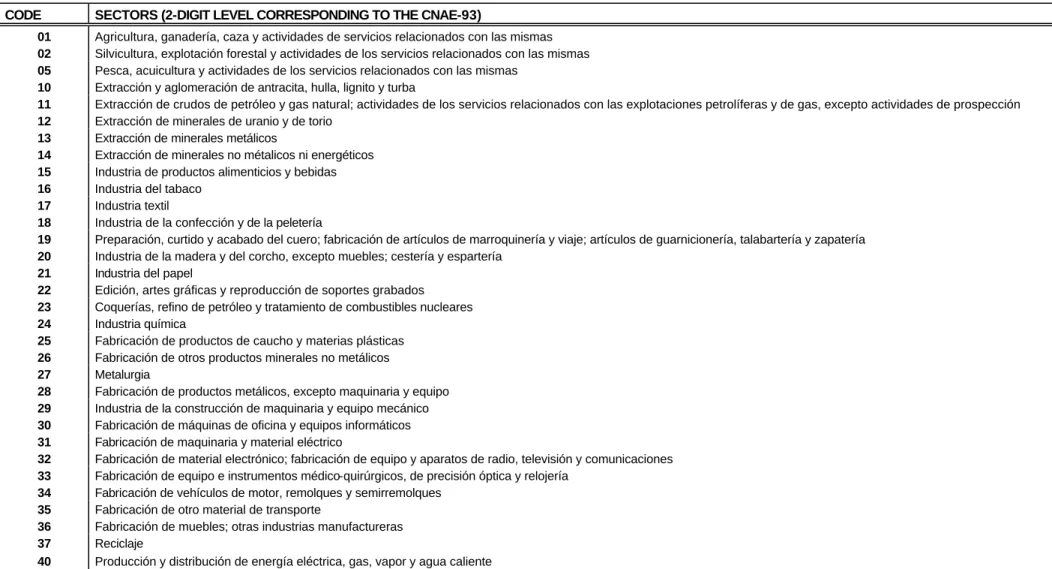
We use data of employment in each municipality of Catalonia with a 2-digit level of disaggregation corresponding to the CNAE-93 (National Classification of Economic Activities), that is, we have information for 60 sectors including manufactures and services for the 946 municipalities in Catalonia (table 1 displays each sector and its code). The data contains information about the location of activity, say, people working in each municipality for each sector. The data is provided by Idescat (Statistical Institute of Catalonia), and is based on the 2001 Census of Population. We have to highlight that the data contains people working in a particular municipality, not people living in a particular municipality. Data about population of each municipality in 2001 is provided by the Spanish Institute of Statistics (INE), and we approximate data about GDP per capita of each municipality with data on the average earnings declared by the contributors in the income tax (IRPF) in 1998, provided by Idescat.
Geographic distance between municipalities is calculated with a GIS program that, after assigning a centre to each municipality and establish its coordinates, calculates the distance between centroids
4. Results
In this section we will describe the results after computing each measure presented above. Results will be displayed with the same three subsections developed in the methodology.
Concentration results
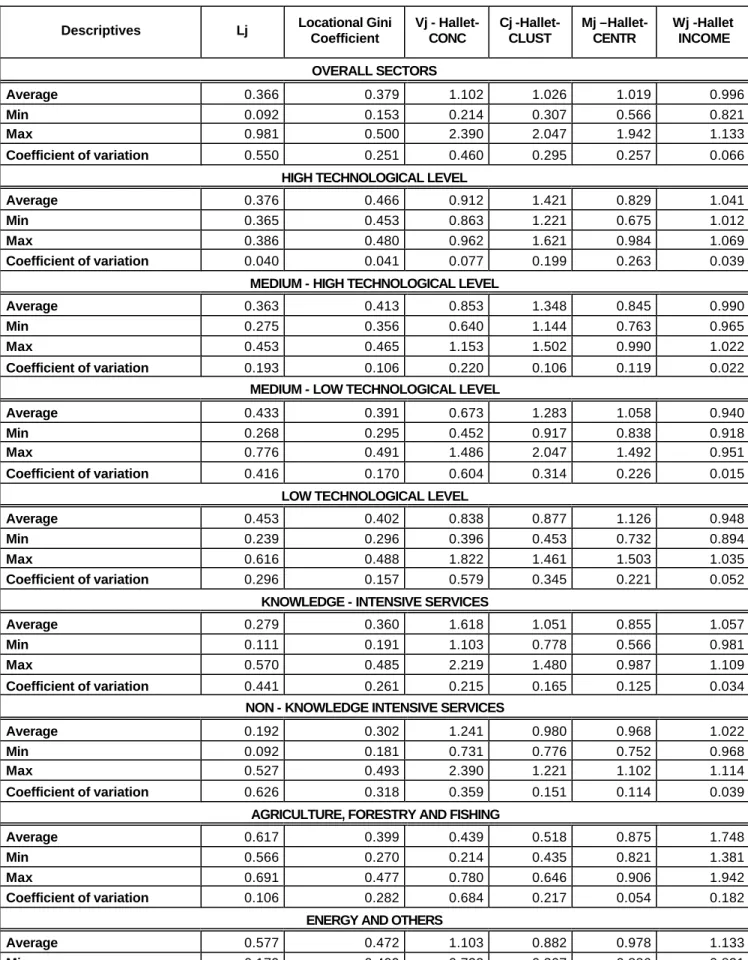
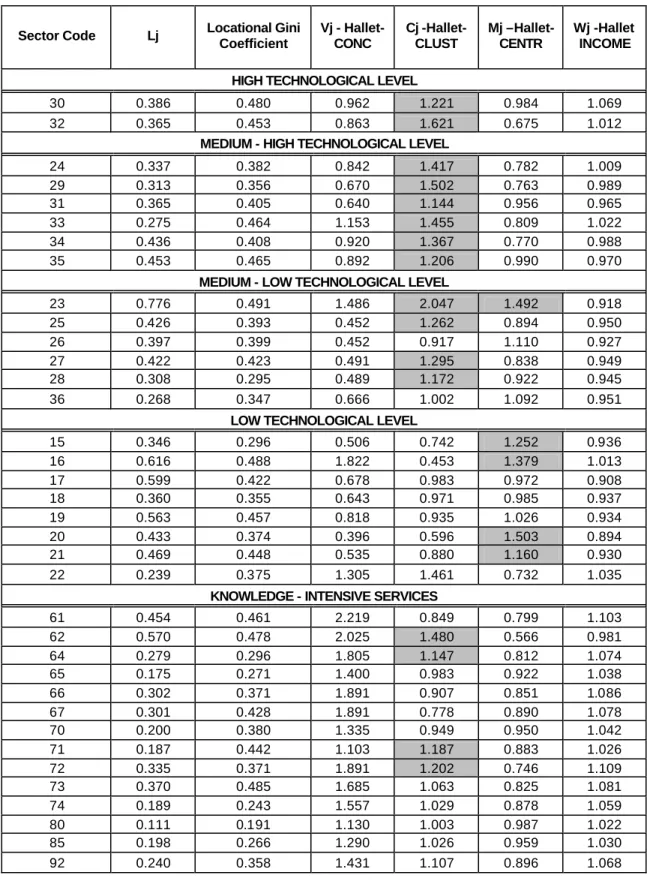
The results concerning sectoral information are displayed in two tables6. Table 3 presents some descriptive statistics (mean, minimum, maximum and the coefficient of variation) both by the overall population of sectors and by groups, attending to their technological level (for the manufacturing sectors) or their knowledge intensity (for the service sectors). In table 4 one finds the particular values for each index and sector, grouped again by their technological level or their knowledge intensity. For an easiest acknowledgement of which sectors are placed in each group, see table 2.
After a revision of the results displayed in table 3, one can draw a general picture about the concentration of overall economic activity in Catalonia. The first two measures presented in this table (relative concentration of the industry j and the Locational Gini Coefficients, columns one and two, respectively) show that, in general, the average concentration by groups is higher in manufacturing sectors than in service sectors. However, the groups with the highest average concentration level are the agriculture, forestry and fishing one and energy and others. These two last groups, together with the manufacturing groups, present an average concentration higher to the average concentration of the overall population of sectors. Attending to the manufacturing sectors in particular, one could see that medium-low and low manufacturing sectors show a higher level of concentration than those sectors with a higher technological intensity. On the contrary, knowledge intensive services appear to be more concentrated in space than non-intensive services. For a more exhaustive study of the concentration levels of one particular sector, see table 4.
If one pays attention to the concentration measure proposed by Hallet (2000), one can see that the picture described by this index is totally different from the general picture presented above. In this case, only the average spatial concentration of services and energy and others is higher than the relative to overall employment. We do not go further in analyzing these results until a more in-depth analysis of the causes that could be behind these differences will be done in a future version of the paper.
Now we turn to consider geographic distance between municipalities to compute the clustering measure. High results for this index indicate that the employment of a particular sector takes place in regions having geographically low distance to each other comparing to the
6
For the centrality measure, the results presented in both tables use the population as the mass variable to compute the peripherality indicator. No significant differences have appeared when computing the centrality measure using any of the three options mentioned in section 2 as the mass variable for the peripherality index.
pattern in the case of total employment. Clustering of similar activities seems to be more important in manufacturing (with the exception of low-tech industries) than in service activities, whose average values appear to be close to total employment clustering. Spillover effects could be behind the higher clustering of high-tech, medium-high tech and medium-low technological industries respective to the clustering of overall employment. If we take a closer look to the particular values for this measure displayed in table 4, we could see that practically the total of the manufacturing sectors (with the exception observed above) have values above 1.15. For the rest of groups, we can highlight the values of some particular service sectors (62, Transporte aéreo y espacial; 64, Correos y telecomunicaciones; 71, Alquiler de maquinaria y equipo sin operario, de efectos personales y enseres domésticos; 72, Actividades informáticas) and sector 37, Reciclaje. Compared to the clustering of total employment; agriculture, forestry and fishing and energy and others appear to be less clustered geographically. The same result was obtained by Hallet (2000) when studying the clustering measure for 119 European regions.
The centrality measure indicates whether employment in a particular branch takes place in the centre or in the periphery of Catalonia. As a rather surprising result, except for the medium-low tech industries, non knowledge-intensive services and energy and others that tend to follow the centre – periphery pattern of general employment, the rest of groups present a lower degree of centrality, being the exception low-tech industries, which displays the highest value of centrality (see 23, Coquerías, refino de petróleo y tratamiento de combustibles nucleares; 15, Industria de productos alimenticios y bebidas; 16, Industria del tabaco; 20, Industria de la madera y del corcho, excepto muebles; cestería y espartería; 21, Industria del papel). These results are clearly in contrast with those obtained by Hallet (2000), being the service sector of banking and insurance the most centralised in his case.
The income measure indicates whether employment is located in wealthier or in poorer municipalities. As in Hallet (2000), in general, both industry and service sectors follow the employment pattern within a rather narrow band of between 0.95 and 1.05. Medium-low and low tech industries seem to be located in poorer municipalities than overall employment. What is really surprising is that the group of agriculture, forestry and fishing presents the highest value for the income measure among all the groups (see table 4).
Finally, the construction sector displays low values for the first three measures, showing that this sector is far from being concentrated, as well as it is less clustered in space than overall employment. Moreover, it seems to follow the centre-periphery pattern of total employment, and it shows a tendency to be located in wealthier municipalities.
In a future revised version of the article, a more in-depth analysis of the results as well as a deeper comparison to previous literature will be done. Moreover, one could expect that an analysis to assess the significance of the results will shed some light on particular surprising conclusions.
Specialization results
The geographical distribution of the three specialization measures obtained in this paper is displayed in Maps 1 to 3. In all of them one can observe that the spatial distribution of specialization is far from being random, with values of the different indexes that tend to be clustered in the space. In other words, municipalities with similar specialization patterns tend to be geographically concentrated. In general terms, it seems that the municipalities in the coast tend to be less specialized that the ones in the inner region. This is a common feature for all the indexes, although it is more pronounced in the cases of the Hallet measure and the Li.
The process described above could be related to spatial dependence, that is, to the fact that the specialization pattern in one municipality may be associated to the one in neighbouring municipalities. This possibility can be evaluated by means of the Moran's I statistic (Moran, 1948), a well-known spatial dependence test. The advantage of the spatial dependence tests over the mapping is that the information given by the latter, although true, is somewhat subjective on the range of intervals selected for mapping the index; whereas spatial dependence tests provide a statistical framework. So, we have computed the Moran’s I based on a contiguity weight matrix. The most general specification for the matrix is one of physical contiguity, where unity represents the case of two municipalities sharing a boundary, and zero in the opposite case. The Moran index for the three indexes (as given in each map) shows the existence of a strong positive spatial autocorrelation process, although higher in the case of the Hallet measure and the Li, confirming the visual impression of spatial clustering given by the maps. In other words,
it seems that the specialization patterns are not randomly distributed in space but, on the contrary, there is a trend towards spatial clustering as signaled by the positive spatial dependence pointed by the Moran’s I index.
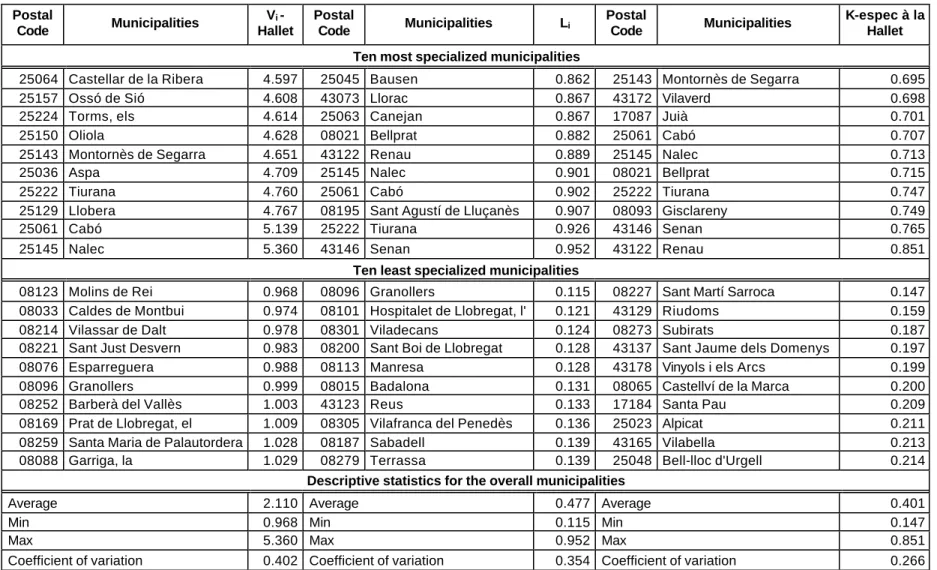
In order to identify what particular municipalities show the highest and lowest levels of specialization, table 5 shows the 10 most and least specialized municipalities, together with some descriptive statistics for the three measures. Again, if one pays attention to the coefficient of variation, one could see that both for the Hallet and Li measure the values are higher than for
the Krugman specialization index (K-espec), signalling a more pronounced difference in the distribution. Taking a closer look to the table, we could see that for the first two measures,
almost all the least specialized municipalities are located in the province of Barcelona7, near to the coast. On the contrary, the ten most specialized municipalities are located in inner regions. The Hallet measure identifies the ten most specialized regions all in the province of Lleida, while the Li locates these ten most specialized municipalities both in Lleida and in Tarragona
(with the exception of 2 municipalities located in Barcelona). In the same line as in the conclusions drawn from the map and the Moran’s I, the K-espec measure is less clear in its results for the ten most and least specialized municipalities, containing municipalities located in the four provinces in both cases. As for this last measure, a look at the map 1 will help to clarify the results.
Coefficients of regional and sectoral concentration
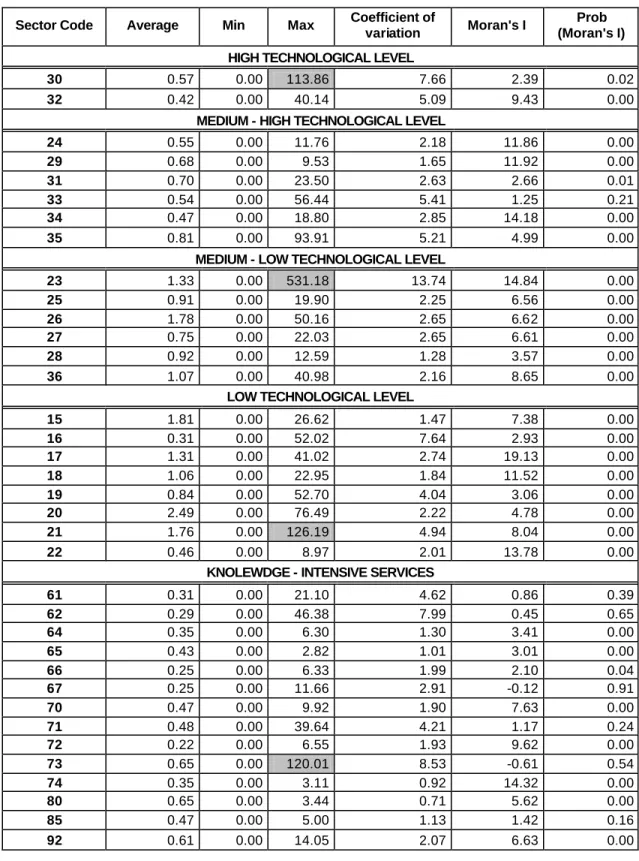
Table 6 displays the average results by sector for the regional and sectoral coefficients of concentration, together with the minimum8, maximum and the coefficient of variation, as well as the value for the Moran’s I and its probability.
From the results, we could get a general impression about both the concentration and specialization of activity in Catalonia. Except for sector 55, Hostelería; the two groups of services and high-tech and medium-tech industries display Lij values less than 1; that is, all the
sectors grouped in these categories show an average specialization of the municipalities lower than Catalonia. However, it is important to highlight that for some of these sectors there is at least one municipality with specialization levels remarkably higher than the overall specialization level in Catalonia (30, Fabricación de máquinas de oficina y equipos informáticos; 73, Investigación y desarrollo).
Low-tech and medium-low technological sectors show average values for their Lij that,
in general, are higher than those for the sectors mentioned above. Nonetheless, one could find several values above and below 1, and any of them is remarkably high or low. Thus, in general, for these two sectors we could state that the average specialization of the municipalities corresponds with that of total employment (with the exception of sector 16, Industria del tabaco, which displays a very low value). In this case, we could find again some sectors in which at least one municipality shows high levels of specialization, compared to the specialization level in Catalonia (23, Coquerías, refino de petróleo y tratamiento de combustibles nucleares; 21, Industria del papel).
7
The two first numbers of the postal codes in table 5 identify the province in which is located a particular municipality; being 08 the code for Barcelona, 17 for Girona, 25 for Lleida and 43 for Tarragona.
8
The fact that the minimum value for each sector is always zero, means that there is at least one municipality in each sector which has no employment for that particular sector.
The higher average values as well as the higher maximums are found in sectors 01, Agricultura, ganadería, caza y actividades de servicios relacionados con las mismas; 02, Silvicultura, explotación forestal y actividades de los servicios relacionados con las mismas; and 11, Extracción de crudos de petróleo y gas natural; actividades de los servicios relacionados con las explotaciones petrolíferas y de gas, excepto actividades de prospección; indicating that certain municipalities have a level of specialization in these sectors extraordinarily higher with respect to Catalonia.
Attending now to the results of Moran’s I statistic and its probability, three main conclusions could be drawn. First, only in fourteen sectors the distribution of the Lij index is
random, while a highly significant positive spatial association is detected in forty six cases. So, generally speaking, it seems that nearby municipalities tends to show similar patterns of sectoral concentration and that the space still matters.
Second, the agriculture and industrial sectors show, in average terms, higher values of the Moran’s I than the services and energy sectors (agriculture show the maximum values of this spatial autocorrelation test). Agriculture and almost all the industrial sectors show a positive and significant spatial dependence (with the exception of sector 33 Fabricación de equipos y instrumentos medicoquirúrgicos, de precisión, óptica y relojería) while most of knowledge intensive sectors are randomly distributed through the space, jointly with some energy sectors. So, it could be concluded that the advantages of being closer to municipalities with a similar specialisation pattern are bigger in the case of industria l sectors than services (maybe explained by the major relevance of agglomeration economies on the first type of sectors).
Finally, it seems that technological level of the industrial sectors does not influence to the value of Moran’s I. So, we detect highly significant positive spatial dependence patterns in high tech industries (sector 32 Fabricación de materiales electrónicos, equipos de radio, televisión y telecomunicaciones), industries with medium – high tech level (34, Fabricación de vehículos de motor, remolques y semiremolques) and more traditional sectors (23, Coquerias, refinamiento de petroleo y tratamiento de combustibles nucleares; 17, Industrias Textiles; 18, Industrias de la confección y la peleteria; 22, Edición y artes gráficas). In addition, municipalities with similars levels of specialisation in two services sectors (51, Comercio al por mayor; 55, Hosteleria) tend to be significantly clustered in the space.
5. Conclusions
The main purpose of this article consists in analyzing the sectoral concentration of economic activity in Catalonia as well as the degree of specialization of the municipalities in the same territory. In doing so several novelties are introduced if compared to previous research. First, in addition to the most common indexes, some new indexes in the international literature are used for the first time in the Spanish case. Second, a high level of sectoral and geographical disaggregation is considered, with information covering not only the manufacturing sector, as common in the literature, but also the service sector. Third, we analyze the geographical distribution of specialization in Catalonia, in other words, we check whether closer municipalities tend to show similar specialization patterns.
The level of concentration of manufacturing and service sectors have been analyzed by computing several indices of concentration proposed in the literature. To our knowledge, the analysis of the concentration of the service sectors as well as the computation of some of the indices (as those proposed by Hallet, 2000) is a novelty in Catalonia and also in Spain. Moreover, the high level of disaggregation both at the regional and sectoral level constitutes an advantage in front of other related literature at the Spanish level. Finally, the computation of specialization measures and the techniques of the Exploratory Spatial Data Analysis have allowed us to study the degree of specialization of the municipalities in Catalonia and its spatial distribution.
Our most important directions for future research include, in the first place, the computation of these indices for the local labour systems of Catalonia. In doing so, we will overcome the problem of working with geographic units based on administrative borders. As a second direction for future analysis, we will compute some new indexes that overcome some specific limitations of the ones used in this paper, and perform a more in-depth analysis of the results as well as a deeper comparison to previous literature. Finally, we will improve the Exploratory Spatial Data analysis with the computation of local statistics of spatial dependence.
References
Alonso-Villar, O., Chamorro Rivas, J. M. and González Cerdeira, X. (2003). Spillovers geográficos y sectoriales de la industria. Revista de Economía Aplicada, n.32 (vol.XI), pp.77-95.
Alonso-Villar, O., Chamorro Rivas, J. M. and González Cerdeira, X. (2004). Agglomeration economies in manufacturing industries: the case of Spain. Applied Economics, 36, pp.2013-2116.
Amiti, M. (1999). Specialization patterns in Europe. Weltwirtschaftliches Archiv, vol.135(4)
Braunerhjelm, P. and Borgman, B. (2004). Geographical Concentration, Entrepreneurship and Regional Growth: Evidence from regional Data in Sweden, 1975-1999. Regional Studies, vol.38.8, pp.929-947.
Callejón, M (1997). Concentración geográfica de la industria y economías de aglomeración. Economía Industrial, n.317-V, pp.61-68.
Combes, P. P. and Overman, H. G. (2004). The spatial distribution of economic activities in the European Union. Handbook of Regional and Urban Economics, vol.4, chapter 64
Copus, A. K. (1999). A New Peripherality Index for the NUTS-III Regions of the European Union. ERDF/FEDER Study 98/00/27/130. A Report for the European Commission, Directorate General XVI.A.4
Duranton, G. and Overman, H. G. (2002). Testing for Localization Using Micro-Geographic Data, Working Paper, LSE.
Duranton, G. and Overman, H. G. (2005). Testing for Localization Using Micro-Geographic Data. Review of Economic Studies, vol.72 (4), pp.1077-1106.
Ellison, E., and Glaeser, E. L (1997). Geographic Concentration in US. Manufacturing industries: A dartboard approach. Journal of Political Economy, vol.105, no.51, pp.879-927.
Fratesi, U. (2004). Measuring and Explaining Localisation: Evidence from two British Sectors. Working paper n.4, CERTeT (Centre for Regional Economics, Transports and Tourism), Università Commerciale Luigi Bocconi.
Guillain, R. and LeGallo, J. (2005). Mesuring agglomeration: An exploratory spatial analysis approach applied to the case of Paris and its surroundings. Working Paper provided by the authors.
Guimaraes, P., Figuereido, O. and Woodward, D. (2004). Location Modelling and the Localization of Portuguese Manufacturing. Communication presented at the 44th Congress of the European Regional Science Association.
Haaland, J. I., Kind, J. K. and Midelfart-Knarvik, K. H. (1999). What determines the economic geography of Europe? CEPR Discussion Paper No. 2072, February.
Hallet, M. (2000). Regional Specialization and Concentration in the EU. Economic Papers of the European Commission, Directorate-General for Economic and Financial Affairs, n.141.
Krugman, P. (1991a). Geography and Trade. The MIT Press, Cambridge, Massachusetts.
Krugman, P. (1991b). Increasing Returns and Economic Geography. Journal of Political Economy, Vol.99, No.3, pp.483-499.
Krugman, P. and Venables, A. J. (1995). Globalization and the Inequality of Nations. The Quarterly Journal of Economics, Vo.110, No.4, pp.857-880.
Krugman, P. and Venable s, A. J. (1996). Integration, Specialization and Adjustment. European Economic Review, 40, pp.959-967.
Kim, Y., Barkley, D. L. and Henry, M. S. (2000). Industry Characteristics Linked to Establishments Concentration in Nonmetropolitan Areas. Journal of Regional Science, Vol.40, No.2, pp.231-259.
Marshall, A. (1890). Principles of Economics. London: Macmillan
Maurel, F. and Sédillot, B. (1999). A measure of the geographic concentration in french manufacturing industries. Regional Science and Urban Economics, 29 (1999), pp.575-604
Midelfart-Knarvik, K. H., Overman, H. G., Redding, S. J. and Venables, A. J. (2000). The location of European Industry. Report preparated for the Directorate General for Economic and Financial Affairs, European Commission.
Marcon, E. and Puech, F. (2003). Evaluating the geographic concentration of industries using distance-based methods. Journal of Economic Geography 3, pp.409-428.
O’Donoghue, D. and Gleave, B. (2004). A Note on Methods for Measuring Industrial Agglomeration. Regional Studies, Vol.38.4, pp.419-427.
Rosenthal, S. S. and Strange, W. C. (2001). The determinants of Agglomeration. Journal of Urban Economics, 50, 191-229.
Santa María , M. J., Giner Pérez, J. M. and Fuster Olivares, A. (2005). The industry location in Spain: New Methods for Measuring Industrial Agglomeration. Communication presented at the 45th Congress of the European Regional Science Association.
Tirado, D. A., Paluzie, E. and Pons, J. (2002). Economic integration and industrial location: the case of Spain before World War I. Journal of Economic Geography 2, pp.343-363.
Venables, A. J. (1996). Equilibrium Locations of Vertically Linked Industries. International Economic Review, Vol.37, No.2, pp.341-359.
Viladecans, E. (2004). Agglomeration economies and industry location: city-level evidence. Journal of Economic Geography 4, pp.565-582.
Tables and figures
Table 1. Codes and sectors at the two digit level of the CNAE-93 CODE SECTORS (2-DIGIT LEVEL CORRESPONDING TO THE CNAE-93)
01 Agricultura, ganadería, caza y actividades de servicios relacionados con las mismas
02 Silvicultura, explotación forestal y actividades de los servicios relacionados con las mismas
05 Pesca, acuicultura y actividades de los servicios relacionados con las mismas
10 Extracción y aglomeración de antracita, hulla, lignito y turba
11 Extracción de crudos de petróleo y gas natural; actividades de los servicios relacionados con las explotaciones petrolíferas y de gas, excepto actividades de prospección
12 Extracción de minerales de uranio y de torio
13 Extracción de minerales metálicos
14 Extracción de minerales no métalicos ni energéticos
15 Industria de productos alimenticios y bebidas
16 Industria del tabaco
17 Industria textil
18 Industria de la confección y de la peletería
19 Preparación, curtido y acabado del cuero; fabricación de artículos de marroquinería y viaje; artículos de guarnicionería, talabartería y zapatería
20 Industria de la madera y del corcho, excepto muebles; cestería y espartería
21 Industria del papel
22 Edición, artes gráficas y reproducción de soportes grabados
23 Coquerías, refino de petróleo y tratamiento de combustibles nucleares
24 Industria química
25 Fabricación de productos de caucho y materias plásticas
26 Fabricación de otros productos minerales no metálicos
27 Metalurgia
28 Fabricación de productos metálicos, excepto maquinaria y equipo
29 Industria de la construcción de maquinaria y equipo mecánico
30 Fabricación de máquinas de oficina y equipos informáticos
31 Fabricación de maquinaria y material eléctrico
32 Fabricación de material electrónico; fabricación de equipo y aparatos de radio, televisión y comunicaciones
33 Fabricación de equipo e instrumentos médico-quirúrgicos, de precisión óptica y relojería
34 Fabricación de vehículos de motor, remolques y semirremolques
35 Fabricación de otro material de transporte
36 Fabricación de muebles; otras industrias manufactureras
37 Reciclaje
Table 1 (continuation)
CODE SECTORS (2-DIGIT LEVEL CORRESPONDING TO THE CNAE-93)
41 Captación, depuración y distribución de agua
45 Construcción
50 Venta, mantenimiento y reparación de vehículos de motor, motocicletas y ciclomotores; venta al por menor de combustible para los vehículos de motor
51 Comercio al por mayor e intermediarios del comercio, excepto de vehículos de motor y motocicletas
52 Comercio al por menor, excepto el comercio de vehículos de motor y motocicletas y ciclomotores; reparación de efectos personales y enseres domésticos
55 Hostelería
60 Transporte terrestre; transporte por tuberías
61 Transporte marítimo, de cabotaje y por vías de navegación interiores
62 Transporte aéreo y espacial
63 Actividades anexas a los transportes; actividades de agencias de viajes
64 Correos y telecomunicaciones
65 Intermediación financiera, excepto seguros y planes de pensiones
66 Seguros y planes de pensiones, excepto seguridad social obligatoria
67 Actividades auxiliares a la intermediación financiera
70 Actividades inmobiliarias
71 Alquiler de maquinaria y equipo sin operario, de efectos personales y enseres domésticos
72 Actividades informáticas
73 Investigación y desarrollo
74 Otras actividades empresariales
75 Administración Pública, defensa y seguridad social obligatoria
80 Educación
85 Actividades sanitarias y veterinarias; servicios sociales
90 Actividades de saneamiento público
91 Actividades asociativas
92 Actividades recreativas, culturales y deportivas
93 Actividades diversas de servicios personales
95 Hogares que emplean personal doméstico
Table 2. Sectors classified according to their technological level or knolewdge intensity HIGH TECHNOLOGICAL LEVEL
30 Fabricación de máquinas de oficina y equipos informáticos
32 Fabricación de material electrónico; fabricación de equipo y aparatos de radio, televisión y comunicaciones MEDIUM - HIGH TECHNOLOGICAL LEVEL
24 Industria química
29 Industria de la construcción de maquinaria y equipo mecánico
31 Fabricación de maquinaria y material eléctrico
33 Fabricación de equipo e instrumentos médico-quirúrgicos, de precisión óptica y relojería
34 Fabricación de vehículos de motor, remolques y semirremolques
35 Fabricación de otro material de transporte
LOW - MEDIUM TECHNOLOGICAL LEVEL
23 Coquerías, refino de petróleo y tratamiento de combustibles nucleares
25 Fabricación de productos de caucho y materias plásticas
26 Fabricación de otros productos minerales no metálicos
27 Metalurgia
28 Fabricación de productos metálicos, excepto maquinaria y equipo
36 Fabricación de muebles; otras industrias manufactureras
LOW TECHNOLOGICAL LEVEL
15 Industria de productos alimenticios y bebidas
16 Industria del tabaco
17 Industria textil
18 Industria de la confección y de la peletería
19 Preparación, curtido y acabado del cuero; fabricación de artículos de marroquinería y viaje; artículos de guarnicionería, talabartería y zapatería
20 Industria de la madera y del corcho, excepto muebles; cestería y espartería
21 Industria del papel
Table 2 (continuation)
KNOWLEDGE - INTENSIVE SERVICES
61 Transporte marítimo, de cabotaje y por vías de navegación interiores
62 Transporte aéreo y espacial
64 Correos y telecomunicaciones
65 Intermediación financiera, excepto seguros y planes de pensiones
66 Seguros y planes de pensiones, excepto seguridad social obligatoria
67 Actividades auxiliares a la intermediación financiera
70 Actividades inmobiliarias
71 Alquiler de maquinaria y equipo sin operario, de efectos personales y enseres domésticos
72 Actividades informáticas
73 Investigación y desarrollo
74 Otras actividades empresariales
80 Educación
85 Actividades sanitarias y veterinarias; servicios sociales
92 Actividades recreativas, culturales y deportivas
NON KNOLEWDGE - INTENSIVE SERVICES
50 Venta, mantenimiento y reparación de vehículos de motor, motocicletas y ciclomotores; venta al por menor de combustible para los vehículos de motor
51 Comercio al por mayor e intermediarios del comercio, excepto de vehículos de motor y motocicletas
52 Comercio al por menor, excepto el comercio de vehículos de motor y motocicletas y ciclomotores; reparación de efectos personales y enseres domésticos
55 Hostelería
60 Transporte terrestre; transporte por tuberías
63 Actividades anexas a los transportes; actividades de agencias de viajes
75 Administración Pública, defensa y seguridad social obligatoria
90 Actividades de saneamiento público
91 Actividades asociativas
93 Actividades diversas de servicios personales
95 Hogares que emplean personal doméstico
Table 2 (Continuation)
AGRICULTURE, FORESTRY AND FISHING
01 Agricultura, ganadería, caza y actividades de servicios relacionados con las mismas
02 Silvicultura, explotación forestal y actividades de los servicios relacionados con las mismas
05 Pesca, acuicultura y actividades de los servicios relacionados con las mismas
ENERGY AND OTHERS
10 Extracción y aglomeración de antracita, hulla, lignito y turba
11 Extracción de crudos de petróleo y gas natural; actividades de los servicios relacionados con las explotaciones petrolíferas y de gas, excepto actividades de prospección
12 Extracción de minerales de uranio y de torio
13 Extracción de minerales metálicos
14 Extracción de minerales no métalicos ni energéticos
37 Reciclaje
40 Producción y distribución de energía eléctrica, gas, vapor y agua caliente
41 Captación, depuración y distribución de agua
CONSTRUCTION
Table 3. Descriptive statistics for the concentration measures
Descriptives Lj Locational Gini
Coefficient Vj - Hallet- CONC Cj -Hallet-CLUST Mj –Hallet- CENTR Wj -Hallet INCOME OVERALL SECTORS Average 0.366 0.379 1.102 1.026 1.019 0.996 Min 0.092 0.153 0.214 0.307 0.566 0.821 Max 0.981 0.500 2.390 2.047 1.942 1.133 Coefficient of variation 0.550 0.251 0.460 0.295 0.257 0.066
HIGH TECHNOLOGICAL LEVEL
Average 0.376 0.466 0.912 1.421 0.829 1.041
Min 0.365 0.453 0.863 1.221 0.675 1.012
Max 0.386 0.480 0.962 1.621 0.984 1.069
Coefficient of variation 0.040 0.041 0.077 0.199 0.263 0.039
MEDIUM - HIGH TECHNOLOGICAL LEVEL
Average 0.363 0.413 0.853 1.348 0.845 0.990
Min 0.275 0.356 0.640 1.144 0.763 0.965
Max 0.453 0.465 1.153 1.502 0.990 1.022
Coefficient of variation 0.193 0.106 0.220 0.106 0.119 0.022
MEDIUM - LOW TECHNOLOGICAL LEVEL
Average 0.433 0.391 0.673 1.283 1.058 0.940
Min 0.268 0.295 0.452 0.917 0.838 0.918
Max 0.776 0.491 1.486 2.047 1.492 0.951
Coefficient of variation 0.416 0.170 0.604 0.314 0.226 0.015
LOW TECHNOLOGICAL LEVEL
Average 0.453 0.402 0.838 0.877 1.126 0.948
Min 0.239 0.296 0.396 0.453 0.732 0.894
Max 0.616 0.488 1.822 1.461 1.503 1.035
Coefficient of variation 0.296 0.157 0.579 0.345 0.221 0.052
KNOWLEDGE - INTENSIVE SERVICES
Average 0.279 0.360 1.618 1.051 0.855 1.057
Min 0.111 0.191 1.103 0.778 0.566 0.981
Max 0.570 0.485 2.219 1.480 0.987 1.109
Coefficient of variation 0.441 0.261 0.215 0.165 0.125 0.034
NON - KNOWLEDGE INTENSIVE SERVICES
Average 0.192 0.302 1.241 0.980 0.968 1.022
Min 0.092 0.181 0.731 0.776 0.752 0.968
Max 0.527 0.493 2.390 1.221 1.102 1.114
Coefficient of variation 0.626 0.318 0.359 0.151 0.114 0.039
AGRICULTURE, FORESTRY AND FISHING
Average 0.617 0.399 0.439 0.518 0.875 1.748
Min 0.566 0.270 0.214 0.435 0.821 1.381
Max 0.691 0.477 0.780 0.646 0.906 1.942
Coefficient of variation 0.106 0.282 0.684 0.217 0.054 0.182
ENERGY AND OTHERS
Average 0.577 0.472 1.103 0.882 0.978 1.133
Min 0.179 0.409 0.732 0.307 0.886 0.831
Max 0.981 0.500 1.913 1.269 1.133 1.462
Table 4. Values for the concentration measures
Sector Code Lj Locational Gini
Coefficient Vj - Hallet- CONC Cj -Hallet-CLUST Mj –Hallet- CENTR Wj -Hallet INCOME HIGH TECHNOLOGICAL LEVEL
30 0.386 0.480 0.962 1.221 0.984 1.069 32 0.365 0.453 0.863 1.621 0.675 1.012
MEDIUM - HIGH TECHNOLOGICAL LEVEL
24 0.337 0.382 0.842 1.417 0.782 1.009 29 0.313 0.356 0.670 1.502 0.763 0.989 31 0.365 0.405 0.640 1.144 0.956 0.965 33 0.275 0.464 1.153 1.455 0.809 1.022 34 0.436 0.408 0.920 1.367 0.770 0.988 35 0.453 0.465 0.892 1.206 0.990 0.970
MEDIUM - LOW TECHNOLOGICAL LEVEL
23 0.776 0.491 1.486 2.047 1.492 0.918 25 0.426 0.393 0.452 1.262 0.894 0.950 26 0.397 0.399 0.452 0.917 1.110 0.927 27 0.422 0.423 0.491 1.295 0.838 0.949 28 0.308 0.295 0.489 1.172 0.922 0.945 36 0.268 0.347 0.666 1.002 1.092 0.951
LOW TECHNOLOGICAL LEVEL
15 0.346 0.296 0.506 0.742 1.252 0.936 16 0.616 0.488 1.822 0.453 1.379 1.013 17 0.599 0.422 0.678 0.983 0.972 0.908 18 0.360 0.355 0.643 0.971 0.985 0.937 19 0.563 0.457 0.818 0.935 1.026 0.934 20 0.433 0.374 0.396 0.596 1.503 0.894 21 0.469 0.448 0.535 0.880 1.160 0.930 22 0.239 0.375 1.305 1.461 0.732 1.035
KNOWLEDGE - INTENSIVE SERVICES
61 0.454 0.461 2.219 0.849 0.799 1.103 62 0.570 0.478 2.025 1.480 0.566 0.981 64 0.279 0.296 1.805 1.147 0.812 1.074 65 0.175 0.271 1.400 0.983 0.922 1.038 66 0.302 0.371 1.891 0.907 0.851 1.086 67 0.301 0.428 1.891 0.778 0.890 1.078 70 0.200 0.380 1.335 0.949 0.950 1.042 71 0.187 0.442 1.103 1.187 0.883 1.026 72 0.335 0.371 1.891 1.202 0.746 1.109 73 0.370 0.485 1.685 1.063 0.825 1.081 74 0.189 0.243 1.557 1.029 0.878 1.059 80 0.111 0.191 1.130 1.003 0.987 1.022 85 0.198 0.266 1.290 1.026 0.959 1.030 92 0.240 0.358 1.431 1.107 0.896 1.068
Table 4 (continuation)
Sector Code Lj Locational Gini
Coefficient Vj - Hallet- CONC Cj -Hallet-CLUST Mj –Hallet- CENTR Wj -Hallet INCOME NON KNOWLEDGE - INTENSIVE SERVICES
50 0.152 0.259 0.731 0.917 1.102 0.968 51 0.101 0.253 1.036 1.141 0.933 1.009 52 0.092 0.181 1.005 1.003 1.019 0.997 55 0.157 0.230 1.065 0.841 1.097 1.006 60 0.128 0.284 1.074 1.117 0.932 1.002 63 0.207 0.352 1.276 1.221 0.824 1.028 75 0.162 0.206 1.206 0.873 1.079 1.020 90 0.161 0.404 0.924 1.123 0.945 0.997 91 0.290 0.425 1.649 0.776 1.015 1.052 93 0.100 0.251 0.973 0.962 1.035 0.995 95 0.226 0.283 1.560 1.000 0.881 1.075 99 0.527 0.493 2.390 0.784 0.752 1.114
AGRICULTURE, FORESTRY AND FISHING
01 0.596 0.270 0.214 0.473 0.821 1.922 02 0.566 0.449 0.324 0.646 0.899 1.381 05 0.691 0.477 0.780 0.435 0.906 1.942
ENERGY AND OTHERS
10 0.801 0.497 1.278 1.099 0.898 1.332 11 0.614 0.500 1.180 0.974 0.992 1.086 12 0.981 0.500 1.913 0.307 1.133 1.091 13 0.749 0.495 0.775 0.816 0.917 1.121 14 0.672 0.470 0.805 0.747 0.886 1.462 37 0.394 0.475 0.732 1.269 0.974 0.831 40 0.226 0.428 1.155 0.848 1.026 1.154 41 0.179 0.409 0.990 0.998 1.000 0.987 CONSTRUCTION 45 0.144 0.153 0.755 0.819 0.970 1.156
Map 1. Krugman Specialization Index
Moran’s I : z-value=9.917 (p:0.000) T a b l e 1 . s h p 0 . 1 4 7 - 0 . 3 2 5 0 . 3 2 5 - 0 . 3 8 2 0 . 3 8 2 - 0 . 4 6 3 0 . 4 6 3 - 0 . 8 5 1Map 2. Specialization measure (Hallet, 2000)
Moran’s I : z-value=21.411 (p:0.000) T a b l e 1 . s h p 0 . 9 6 8 - 1 1 - 2 . 0 3 1 2 . 0 3 1 - 2 . 6 6 5 2 . 6 6 5 - 3 . 5 3 7 3 . 5 3 7 - 5 . 3 6Map 3. L
i Moran’s I : z-value=22.411 (p:0.000) T a b l e 1 . s h p 0 . 1 1 5 - 0 . 3 4 4 0 . 3 4 4 - 0 . 4 7 8 0 . 4 7 8 - 0 . 5 9 9 0 . 5 9 9 - 0 . 9 5 2Table 5. Ten most and least specialized municipalities and descriptive statistics for the overall population Postal Code Municipalities Vi - Hallet Postal Code Municipalities Li Postal Code Municipalities K-espec à la Hallet Ten most specialized municipalities
25064 Castellar de la Ribera 4.597 25045 Bausen 0.862 25143 Montornès de Segarra 0.695 25157 Ossó de Sió 4.608 43073 Llorac 0.867 43172 Vilaverd 0.698 25224 Torms, els 4.614 25063 Canejan 0.867 17087 Juià 0.701 25150 Oliola 4.628 08021 Bellprat 0.882 25061 Cabó 0.707 25143 Montornès de Segarra 4.651 43122 Renau 0.889 25145 Nalec 0.713 25036 Aspa 4.709 25145 Nalec 0.901 08021 Bellprat 0.715 25222 Tiurana 4.760 25061 Cabó 0.902 25222 Tiurana 0.747 25129 Llobera 4.767 08195 Sant Agustí de Lluçanès 0.907 08093 Gisclareny 0.749 25061 Cabó 5.139 25222 Tiurana 0.926 43146 Senan 0.765 25145 Nalec 5.360 43146 Senan 0.952 43122 Renau 0.851
Ten least specialized municipalities
08123 Molins de Rei 0.968 08096 Granollers 0.115 08227 Sant Martí Sarroca 0.147 08033 Caldes de Montbui 0.974 08101 Hospitalet de Llobregat, l' 0.121 43129 Riudoms 0.159 08214 Vilassar de Dalt 0.978 08301 Viladecans 0.124 08273 Subirats 0.187 08221 Sant Just Desvern 0.983 08200 Sant Boi de Llobregat 0.128 43137 Sant Jaume dels Domenys 0.197 08076 Esparreguera 0.988 08113 Manresa 0.128 43178 Vinyols i els Arcs 0.199 08096 Granollers 0.999 08015 Badalona 0.131 08065 Castellví de la Marca 0.200 08252 Barberà del Vallès 1.003 43123 Reus 0.133 17184 Santa Pau 0.209 08169 Prat de Llobregat, el 1.009 08305 Vilafranca del Penedès 0.136 25023 Alpicat 0.211 08259 Santa Maria de Palautordera 1.028 08187 Sabadell 0.139 43165 Vilabella 0.213 08088 Garriga, la 1.029 08279 Terrassa 0.139 25048 Bell-lloc d'Urgell 0.214
Descriptive statistics for the overall municipalities
Average 2.110 Average 0.477 Average 0.401
Min 0.968 Min 0.115 Min 0.147
Max 5.360 Max 0.952 Max 0.851
Table 6. Descriptive statistics for the Lij measure by sectors and Moran’s I statistic
Sector Code Average Min Max Coefficient of
variation Moran's I
Prob (Moran's I) HIGH TECHNOLOGICAL LEVEL
30 0.57 0.00 113.86 7.66 2.39 0.02 32 0.42 0.00 40.14 5.09 9.43 0.00
MEDIUM - HIGH TECHNOLOGICAL LEVEL
24 0.55 0.00 11.76 2.18 11.86 0.00 29 0.68 0.00 9.53 1.65 11.92 0.00 31 0.70 0.00 23.50 2.63 2.66 0.01 33 0.54 0.00 56.44 5.41 1.25 0.21 34 0.47 0.00 18.80 2.85 14.18 0.00 35 0.81 0.00 93.91 5.21 4.99 0.00
MEDIUM - LOW TECHNOLOGICAL LEVEL
23 1.33 0.00 531.18 13.74 14.84 0.00 25 0.91 0.00 19.90 2.25 6.56 0.00 26 1.78 0.00 50.16 2.65 6.62 0.00 27 0.75 0.00 22.03 2.65 6.61 0.00 28 0.92 0.00 12.59 1.28 3.57 0.00 36 1.07 0.00 40.98 2.16 8.65 0.00
LOW TECHNOLOGICAL LEVEL
15 1.81 0.00 26.62 1.47 7.38 0.00 16 0.31 0.00 52.02 7.64 2.93 0.00 17 1.31 0.00 41.02 2.74 19.13 0.00 18 1.06 0.00 22.95 1.84 11.52 0.00 19 0.84 0.00 52.70 4.04 3.06 0.00 20 2.49 0.00 76.49 2.22 4.78 0.00 21 1.76 0.00 126.19 4.94 8.04 0.00 22 0.46 0.00 8.97 2.01 13.78 0.00
KNOLEWDGE - INTENSIVE SERVICES
61 0.31 0.00 21.10 4.62 0.86 0.39 62 0.29 0.00 46.38 7.99 0.45 0.65 64 0.35 0.00 6.30 1.30 3.41 0.00 65 0.43 0.00 2.82 1.01 3.01 0.00 66 0.25 0.00 6.33 1.99 2.10 0.04 67 0.25 0.00 11.66 2.91 -0.12 0.91 70 0.47 0.00 9.92 1.90 7.63 0.00 71 0.48 0.00 39.64 4.21 1.17 0.24 72 0.22 0.00 6.55 1.93 9.62 0.00 73 0.65 0.00 120.01 8.53 -0.61 0.54 74 0.35 0.00 3.11 0.92 14.32 0.00 80 0.65 0.00 3.44 0.71 5.62 0.00 85 0.47 0.00 5.00 1.13 1.42 0.16 92 0.61 0.00 14.05 2.07 6.63 0.00
Table 6 (continuation)
Sector Code Average Min Max Coefficient of
variation Moran's I
Prob (Moran's I) NON KNOWLEDGE - INTENSIVE SERVICES
50 0.91 0.00 16.73 1.24 2.06 0.04 51 0.72 0.00 13.15 1.14 10.70 0.00 52 0.65 0.00 3.92 0.67 8.87 0.00 55 1.40 0.00 12.91 0.95 12.85 0.00 60 0.68 0.00 15.49 1.42 4.00 0.00 63 0.49 0.00 19.12 2.22 4.95 0.00 75 0.81 0.00 11.27 0.98 5.97 0.00 90 0.71 0.00 54.72 3.42 1.57 0.12 91 0.71 0.00 27.03 2.84 -0.26 0.80 93 0.75 0.00 13.63 1.10 2.17 0.03 95 0.64 0.00 12.46 1.31 6.72 0.00 99 0.21 0.00 32.80 8.80 4.33 0.00
AGRICULTURE, FORESTRY AND FISHING
01 9.59 0.00 42.09 1.00 24.10 0.00 02 6.25 0.00 534.60 4.21 7.09 0.00 05 1.16 0.00 111.40 5.98 5.89 0.00
ENERGY AND OTHER
10 2.44 0.00 1024.21 15.12 0.49 0.62 11 9.80 0.00 8881.12 29.47 0.56 0.58 12 0.51 0.00 321.47 22.30 -0.03 0.98 13 0.75 0.00 122.11 9.70 0.48 0.63 14 3.03 0.00 229.23 4.66 2.50 0.01 37 0.82 0.00 113.68 6.18 0.99 0.32 40 0.89 0.00 115.58 5.31 2.23 0.03 41 0.63 0.00 20.78 2.47 3.20 0.00 CONSTRUCTION 45 1.33 0.00 5.29 0.56 8.77 0.00