An Integrated Modeling Framework
for Managing the Deployment and
Operation of Cloud Applications
byMohammad Hamdaqa
A thesis
presented to the University of Waterloo in fulfillment of the
thesis requirement for the degree of Doctor of Philosophy
in
Electrical and Computer Engineering
Waterloo, Ontario, Canada, 2016
c
I hereby declare that I am the sole author of this thesis. This is a true copy of the proposal, including any required final revisions, as accepted by my examiners.
Abstract
Cloud computing can help Software as a Service (SaaS) providers to take advantage of the sheer number of cloud benefits such as, agility, continuity, cost reduction, autonomy, and easy management of resources. To reap the benefits, SaaS providers should create their applications to utilize the cloud platform capabilities. However, this is a daunting task. First, it requires a full understanding of the service offerings from different providers, and the meta-data artifacts required by each provider to configure the platform to efficiently deploy, run and manage the application. Second, it involves complex decisions that are specified by different stakeholders. Examples include, financial decisions (e.g., selecting a platform to reduces costs), architectural decisions (e.g., partition the application to maxi-mize scalability), and operational decisions (e.g., distributing modules to insure availability and porting the application to other platforms). Finally, while each stakeholder may con-duct a certain type of change to address a specific concern, the impact of a change may span multiple models and influence the decisions of several stakeholders.
These factors motivate the need for: (i) a new architectural view model that focuses on service operation and reflects the cloud stakeholder perspectives, and (ii) a novel framework that facilitates providing holistic as well as partial architectural views, and generating the required platform artifacts by fragmenting the model into artifacts that can be easily modified separately.
This PhD research devises a novel architecture framework, “The 5+1 Architectural View Model”, for cloud applications, in which each view corresponds to a different per-spective on cloud application deployment. The architectural framework is realized as a cloud modeling framework, called “StratusML”, which consists of a modeling language that uses layers to specify the cloud configuration space, and a transformation engine to generate the configuration space artifacts. The usefulness and practical applicability of StratusML to model multi-cloud and multi-tenant applications have been demonstrated though a representative domain example. Moreover, to automate the framework evolution as new concerns and cloud platforms emerge, this research work introduces also a novel schema matching technique, called “Liberate”. Liberate supports the process of domain model creation, evolution, and transformations. Liberate helps solve the vendor lock-in problem by reducing the manual efforts required to map complex correspondences between cloud schemas whose domain concepts do not share linguistic similarities. The evalua-tion of Liberate shows its superiority in the cloud domain over existing schema matching approaches.
Acknowledgements
I would like to convey my heartfelt gratitude and sincere appreciation to all the people who made this work possible.
First and foremost, I would like to thank my supervisor Dr. Ladan Tahvildari for giving me the opportunity and freedom to explore my research interests. During my Ph.D., Ladan was a sister and a mentor. Her continuous support, encouragement, and confidence in my success were the reason I am presenting this today. Her advice did not only have an impact on my research, but it will remain invaluable throughout the rest of my career.
I would like to thank the members of my dissertation committee: Professor Eleni Strou-lia, my external examiner, for taking the time out of her busy schedule to read my thesis and provide me with her insightful suggestions, Professor Daniel M. Berry my internal-external examiner for his invaluable comments on my thesis, Professor Kostas Kontogiannis, my grand-advisor, for his inspiring remarks throughout my PhD, which broadened my perspec-tives in research, Professor Derek Rayside for his encouraging comments and indispensable support, and Professor Sue Horton for serving as the thesis examination chair.
I am grateful to have had the opportunity to meet Professor Hausi Muller at the beginning of my Ph.D. I cannot thank Hausi enough for all the valuable feedback, sweet gestures and kind support during the several CSER and CASCON meetings.
I would like to express my sincere appreciation to Dr. Marin Litoiu for exposing me to the SAVI network by inviting me to present my work in cloud computing and schema matching to the SAVI community. Also, I want to express my gratitude to Dr. Patrick Martin for his valuable feedback and remarks during the ORF-RE project on Ultra-Large-Scale Services meeting, and for giving me the opportunity to collaborate with the DSL lab.
I am very lucky to have been given the opportunity to be a part of Sceneverse Inc. family. Through my work with Sceneverse, I had the chance to meet so many wonderful people and professionals who had a significant impact on my professional career. Many thanks to Neil Lachapelle, David de Weerdt, Brian Campbell, Lindsay Stewart, Tanya McGinnity and James Swidersky for providing a pleasant and friendly working and research environment.
I am indebted to my colleagues in the STAR lab and the wider members of the Uni-versity of Waterloo. Needless to mention, Dr. Amir Keyvan Khandani, Dr. Krzysztof Czarnecki, Dr. Wojciech Golab, Dr. Vijay Ganesh, Dr. Gordon B. Agnew, Dr. Fakhri
Karray, Dr. Mahesh Tripunitara, Dr. Ashraf Aboulnaga and many others for their contri-bution to my academic life. During my Ph.D. research, I learned many new things from each one of you.
Finally to all my friends in Waterloo, the Williams Group, Habeeb Group, the Wa-terloo Cool Guys, the Gravitational Waves Group, Alkhateeb Family, and My Fishing Buddies thank you for the happy moments and making this Ph.D. journey an enjoyable and wonderful experience.
Last but not least, I would like to thank my wife Ayesha whom without her not only this thesis will be empty but my life will be obsolete. I would like to thank Ayesha for standing beside me throughout this journey. Thank you for all the love and support and sacrifice you have made through bad times and for being a part of my happiness in the good times. Thank you for being with me, for putting up with me, for taking care of me, for inspiring me, for helping me, for showing me how to be a better me and for understanding me without me having to say a word. Thank you because simply without you there is no I. I love you Ayesha!
This work was financially supported by Ontario Graduate Scholarship (OGS), Univer-sity of Waterloo Presidents Graduate Scholarship (PGS), The Queen Elizabeth II Graduate Scholarships in Science and Technology, and Mitacs Accelerate.
Dedication
To my best friend and unison the wind beneath my wings
my wife Ayesha
To the joy of my life the pure definition of happiness
without whom, I would have finished this thesis two years earlier :) my beautiful children Lujain, Adam and Dina
To those who witnessed my past Who believe in my future
accepts me the way I am and will never let me down My parents (Adnan and Nabela)
Table of Contents
List of Tables xii
List of Figures xiii
1 Introduction 1
1.1 Motivations . . . 2
1.1.1 Responsibility of the Cloud Consumers . . . 2
1.1.2 Challenges of Architecting Cloud Applications . . . 3
1.2 Problem Description and Research Focus . . . 6
1.3 Approach and Research Questions . . . 6
1.3.1 RQ1. How is architecting cloud applications different from architect-ing other applications? . . . 7
1.3.2 RQ2. How should an application be architected to be deployed into multiple clouds and how should cloud modeling and configuration spaces be bridged? . . . 8
1.3.3 RQ3. How should the framework be extended to support generating analytical performance models for cloud applications? . . . 9
1.3.4 RQ4. How should the framework be kept up-to-date? . . . 10
1.4 Research Contributions . . . 10
2 Supporting Concepts and Related Work 12
2.1 Cloud Computing Principles and Requirements . . . 14
2.1.1 Cloud Computing Characteristics . . . 14
2.1.2 Cloud Computing Deployment Models . . . 16
2.1.3 Cloud Computing Service Models . . . 19
2.1.4 The Relationship Between Cloud Computing and Other Computing Paradigms . . . 22
2.2 Related Research Projects . . . 24
2.2.1 Viewpoint Architectural Frameworks . . . 24
2.2.2 Modeling Frameworks for Cloud Applications . . . 25
2.2.3 Model-Driven Quality Prediction . . . 31
2.2.4 Schema Matching for the Cloud Vendors’ Schemas . . . 33
2.3 Summary . . . 36
3 An Architecture Framework for Cloud Native Applications 37 3.1 Characterizing Cloud Applications . . . 38
3.1.1 The Definition of Cloud Applications . . . 38
3.1.2 The Cloud Architecture Building Blocks . . . 39
3.1.3 Cloud Applications Requirements . . . 43
3.1.4 Term Disambiguation . . . 46
3.2 The Cloud Application Development and Operation Process . . . 48
3.2.1 The Cloud Application Life Cycle Management (CALM) . . . 48
3.2.2 Envisioned Users . . . 50
3.3 Architecting for the Cloud . . . 51
3.3.1 The Malleable Application Architectural Style . . . 52
3.3.2 The (5+1) Architectural View Model . . . 54
4 StratusML: A Domain Specific Modeling Language for Cloud
Applica-tions 58
4.1 An Example of the Cloud Configuration Space Artifacts . . . 59
4.2 The Stratus Modeling Language Framework . . . 61
4.2.1 The StratusML Features . . . 61
4.2.2 The StratusML Framework . . . 61
4.2.3 The StratusML Methodology and Implementation . . . 63
4.3 The Stratus Modeling Language Specifications . . . 65
4.3.1 The StratusML Abstract Syntax. . . 65
4.3.2 The StratusML Model Validation . . . 74
4.4 Mapping the Stratus Meta-Models to Cloud Specific Platforms . . . 77
4.4.1 Mapping the Core Model Components . . . 79
4.4.2 Mapping Dynamic Behavior (Adaptation Meta-Model) . . . 81
4.4.3 Mapping Providers’ Specifications (Provider Meta-Model) . . . 82
4.5 Case Study: Demonstrating the Stratus Framework Capabilities . . . 83
4.5.1 The CoupoNet Scenario . . . 84
4.5.2 Using the StratusML Framework Modeling Features . . . 84
4.5.3 Artifacts Generation . . . 90
4.6 Summary . . . 93
5 StratusPM: Generating Layered Cloud Performance Models 94 5.1 Evaluating the Requirements of Performance Modeling . . . 95
5.2 StratusPM: A Pivot Model for Cloud Performance . . . 97
5.2.1 The Performance Meta-Model . . . 98
5.2.2 The Workflow Meta-Model . . . 100
5.3 The Target Analytical Performance Model . . . 101
5.4 Generating LQN Performance Models from StratusPM Models . . . 103
5.4.2 Level 2: Mapping StratusPM Workflow and Performance Parameters
to LQN Parameters . . . 108
5.5 Case Study: CoupoNet . . . 111
5.5.1 Annotating CoupoNet with Performance and Workflow Parameters 112 5.5.2 Applying the Transformation Rules to the CoupoNet Example . . . 114
5.5.3 Results . . . 117
5.6 Summary . . . 121
6 Liberate: A Schema Matching Approach to Support Service Migration in the Cloud 122 6.1 Preliminaries . . . 123
6.1.1 Mismatches Between Platform Providers . . . 123
6.1.2 Schema Matching in the Cloud . . . 125
6.2 The Liberate Approach . . . 126
6.2.1 The SF++ Element-Based Similarity . . . 128
6.2.2 The SF++ Structural-Based Similarity . . . 133
6.2.3 Implementations . . . 137
6.3 Experimental Setup and Evaluation . . . 140
6.3.1 Experiment Setup . . . 141
6.3.2 Evaluation of Results . . . 142
6.3.3 Threats to Validity . . . 148
6.4 Summary . . . 150
7 Conclusions and Future Directions 152 7.1 Contributions . . . 152
7.2 A Summary of Research Questions . . . 154
7.3 Future Work . . . 156
APPENDICES 160
A LQN Transformation Template 161
B CoupoNet LQNS Results 164
C Cloud Concepts 174
List of Tables
1.1 A Sample of Cloud Service Outages 2011-2014 . . . 4
2.1 A Comparison Between the Different Cloud Deployment Models . . . 17
2.2 Comparison of Selected Match Tools . . . 35
4.1 Availability and Fault Recovery Levels . . . 72
4.2 Mapping Meta-Data Artifacts . . . 78
4.3 Mapping of Platform Specifications . . . 79
4.4 Mapping of Adaptation Rules . . . 82
4.5 Mapping of StratusML Privider Service Templates to Existing Cloud Providers’ Offerings . . . 82
4.6 Comparing The Service Templates’s Pricing and Resource Specifications . 83 4.7 Addressing CoupoNet Challenges . . . 85
5.1 Mapping Performance Modeling Requirements to Cloud Artifacts . . . 96
6.1 Path Length Pairwise Similarity . . . 125
6.2 WSM Pairwise Similarity . . . 129
6.3 Gloss-Based Pairwise Similarity . . . 131
List of Figures
1.1 Research Approach . . . 7
2.1 NIST Visual Model of Cloud Computing Definition. . . 14
2.2 Cloud Service Models (a) SPI vs. (b) IBM. . . 20
2.3 Cloud Computing Relationship with Other Computing Paradigms. . . 23
2.4 The Schema Matching Process [68] . . . 34
3.1 Creating an Architectural Framework for Cloud Applications . . . 37
3.2 The Relationships between Cloud Applications and the Different Cloud Computing Service Deployment Models. . . 38
3.3 Cloud Application Components Granularity. . . 41
3.4 The Tradeoffs between Applications’ Portability and the Level of Automation. 42 3.5 Cloud Application Composition . . . 47
3.6 The Cloud Application Life Cycle Management Process . . . 49
3.7 Architecting for Application Implementation v.s. Service Operation . . . . 52
3.8 The Malleable Application Architectural Style . . . 53
3.9 The Architectural Perspectives of Cloud Stakeholders . . . 55
3.10 The (5+1) Architectural View Model . . . 56
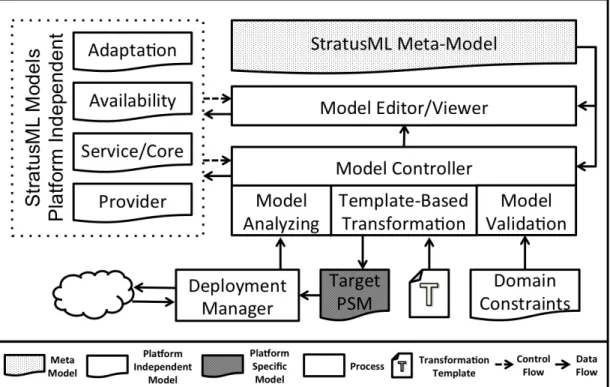
4.1 The StratusML Framework Architecture . . . 62
4.2 A Snapshot of the Design Window of the StratusML Modeling Framework 64 4.3 The Core View Meta-Model . . . 66
4.4 Storage Management in StratusML . . . 69
4.5 The Adaptation View Meta-Model . . . 71
4.6 The Availability View Meta-Model . . . 72
4.7 The Provider View Meta-Model . . . 73
4.8 Example of Validation Code for a Hard Rule . . . 76
4.9 Example of Hard Validation Rule . . . 77
4.10 Example of Soft Validation Rule . . . 77
4.11 StratusML Availability View Excerpt . . . 87
4.12 StratusML Adaptation Rule and Action Excerpt . . . 88
4.13 StratusML Provider Snapshot . . . 89
5.1 The Performance View Meta-Model . . . 99
5.2 The Workflow View Meta-Model. . . 100
5.3 LQN Meta Model [159] . . . 102
5.4 Transformation Process from StratusPM to LQN . . . 104
5.5 Different Scenarios of Varying Multiplicity (M) and Replication (R) in LQN 107 5.6 The Different Cases to Generating Entries and Phases . . . 110
5.7 Annotating CoupoNet with Performance Parameters . . . 113
5.8 Applying the Structural Transformation Rules . . . 115
5.9 Applying the Rules of Multiplicity and Replication . . . 117
5.10 Generating Analytical LQN Model for the Fetch Coupon Workflow Scenario 118 5.11 The CoupoNet LQN Model . . . 119
5.12 The Change in Fetch Coupon Response Time with User Population . . . . 120
6.1 A Sample of Public Providers’ Configuration Artifacts . . . 124
6.2 A Sample of Standard Languages’ Configuration Artifacts . . . 124
6.3 Liberate - A Schema Matching Approach for Model-Driven Migration . . . 126
6.5 A PCG Example . . . 135
6.6 Configuring a Composite Matcher . . . 138
6.7 Applying the GBM on AZURE Service Definition and StratusML Core Schemas . . . 139
6.8 Experiment 1 - Results . . . 144
6.9 Experiment 2 - Results . . . 146
Chapter 1
Introduction
“Works of imagination should be written in very plain language; the more purely imaginative they are the more necessary it is to be plain.”
– Samuel Taylor Coleridge, 1834
It is no wonder Gartner’s expects cloud adoption to hit $250 billion by 2017 [56]. Cloud computing has changed the traditional computing model, in which organizations should invest in building sophisticated infrastructures to support their need for applications that are always available and reachable, and can scale rapidly to meet changes in business demand. Cloud providers offer distributed infrastructures that support fault tolerance and capacity on-demand as a service in an affordable “pay-per-use” basis. Moreover, they offer software-defined platforms that abstract the complexity of application delivery to enable their rapid deployment and easy management through configuration.
This new delivery model changes the way development teams need to think about and deal with the underlying resources while building and managing their applications. Today, organizations do not question whether to adopt cloud computing. Instead, they question what type of cloud deployment they should consider to address their performance and security requirements, and how to leverage the cloud capabilities to satisfy their specific business goals. Moreover, the diversity of cloud providers’ offers and services creates an obstacle with respect to the application interoperability and portability. This diversity increases the complexity of developing and managing cloud applications to operate on multi-cloud platforms.
This thesis investigates the process of building, deploying and managing cloud applica-tions (a.k.a., Cloud DevOps process). The thesis describes a new methodology supported
by a modeling framework to enable organizations that build cloud applications, such as SaaS providers, to unbiasedly exploit the cloud platform building blocks to leverage the flexibility, reliability, and scalability that these platforms provide to the application layer in a cost effective manner.
1.1
Motivations
Cloud computing shifts the control to provider’s side. While this shift helps organizations to focus on their business functionalities, it is still the responsibility of the platform consumers and SaaS providers to plan for their service operation. For example, consumers should architect their applications to utilize the platform components to build services that are widely reachable, scalable and available. This section provides examples that emphasize this responsibility in order to guarantee the desired service operation and highlights the challenges of the cloud development and operation process.
1.1.1
Responsibility of the Cloud Consumers
The following is evidence that consumers should not rely solely on providers support. • On April 21st 2011, a failure in the Amazon Elastic Block Store (EBS) on the US
East Region availability zone took down a large number of businesses including many cloud platform providers such as Heroku, Reddit, Quora, and many others. Lydia Leongas; the research vice president at Gartner noted “Customers who rely upon Amazon to run their businesses will, and should, think hard about the resiliency of their architectures”1. Since that incident, several outages of cloud services have been reported that cover all cloud providers at all service levels (see Table1.1). The main lessons to learn from such failures are: first, it is the consumers’ responsibility to plan for failure and to read their (SLA) contracts, second it is not enough to handle availability and fault recovery at the infrastructure layer; planning for fault recovery should also be addressed and automated at the upper layers.
• Even though elasticity is an essential cloud computing capability, current cloud plat-forms do not fully support dynamic elasticity. This limited support is due to some technical challenges and to liability concerns. For example the limitation on rapid
1
scale-down capabilities of the cloud applications as well as the way these applications are structured, which does not allow full components controllability pose technical difficulties on providers to support efficient dynamic elasticity. On the other hand, the lack of transparency between the cloud providers and their consumers, which can be represented in the lack of a formal way to convey the consumer intention to scale up and down on-demand make it risky for the providers to support dynamic elasticity to avoid any service level agreement violation. Moreover, cloud consumers cannot fully trust the cloud providers to perform auto-scale on their behalf without their consent. This is because these decisions are reflected on the consumers’ bill (i.e., in the case of scale-up) and may disrupt their business stability (i.e., in the case of scale-down). As a result, even with current cloud development platforms, it is still the responsibility of the cloud developers to divide their application into scalable units, keep track of these components at run-time, and define the set rules that specify how each scalable unit will respond to the different environment changes and user demand requests.
Accordingly, while cloud platforms provide services to facilitate deploying and managing applications in the cloud, it is the platform consumer’s task to select the provider that offers the cheapest and best offer, then leverage the platform capabilities to ensure agility and continuity and assure the application portability.
1.1.2
Challenges of Architecting Cloud Applications
Architecting cloud applications to leverage the underlying platform and at the same time ensure portability is challenging. It requires a full understanding of the service offerings from different providers and the meta-data artifacts required by each provider to deploy, run and manage an application. Moreover, it involves complex decisions that are specified by various stakeholders; such as, financial decisions (e.g., selecting a platform to reduce costs), architectural decisions (e.g., partitioning the application to maximize availability), and operational decisions (e.g., distributing modules to ensure availability). The following is a list a list of the main challenges that motivates the research in this thesis:
(a) The Vendor Lock-in Problem: The cloud “pay per use” model promotes business agility and promises cost savings. However, for this model to make sense, customers should have the ability to port their applications between providers to maximize busi-ness opportunities. Without portability, migrating applications will require partially
Service Outage
Date Duration Reason of outage Results
Twitter Ser-vice 2/25/2011 3/27/2011 1 to 4 hours per outage
over-capacity significant delays in de-livering messages to SMS and Facebook
Gmail and Google Apps Services
2/27/2011 2 days a bug in one of Google’s updates
login errors and empty mailboxes
Netflix Streaming Service
3/22/2011 4 to 8 hours rare technical issue prevented customers from accessing their queues and streaming content
Amazon Web Ser-vices
4/21/2011 4 Days stuck volumes caused read and write problems so the AWS operators had to dis-able all control APIs for the degraded EBS cluster. There were two services involved in this outage, Amazon EC2 and Amazon RDS Service.
many customers including cloud platform providers were taken offline
Salesforce 7/10/2012 2 days a power outage caused by faulty equipment up-grades in the company’s West Coast data centers
many customers were un-able to access the compa-nys services
Microsoft Windows Azure
10/30/2013 >20 hours a subcomponent of the system failed worldwide.
every single Azure re-gion was affected (in-cluding West US, West Europe, Southeast Asia, South Central US, North Europe, North Central US, East Asia, and East US)
Dropbox 1/10/2014 2 days a scripting glitch caused OS upgrades to be ap-plied on actively running machines during routine maintenance.
5 percent of users were having trouble syncing files from the desktop client, and about 20 per-cent were having issues with Dropbox’s mobile applications
modifying or even rewriting the application, which is difficult and costly. Therefore, customers will be locked into a particular vendor. This problem is usually referred to as the “vendor lock-in” problem [125]. This problem is further escalated if an organization decided to adopt a hybrid cloud model for security reasons, as an example.
(b) Deployment Architecture Mismatch: Cloud computing promotes reuse at all levels (i.e., Infrastructure, Platform, and Software). This has been made applicable, within each provider, through providing standard service-based interfaces, interaction proto-cols, and architectural styles (e.g., RESTful). Unfortunately, as noted by Garlan, “as the level of reuse and the complexity of assumption increase, architectural mismatch become more of an issue” [55] that requires advanced software engineering solutions. A mismatch occurs due to hidden assumptions about (i) the application domain, (ii) com-ponents at the same level of abstraction, and (iii) the infrastructure. Cloud providers use customizable virtual machines that arguably can deal with a mismatch at the code level by allowing the software components to run on a variety of low-level infrastruc-tures. However, cloud dynamics represented by the multiple providers and continuous updates in the platform, infrastructure and applications create a mismatch at the architectural deployment level. Therefore, an architecture description language that makes these assumptions explicit is needed.
(c) Lack of Domain Concepts and Methodologies: Although they share many concepts with existing development paradigms (e.g., real time, service-oriented and distributed computing); cloud applications have their characteristics, domain requirements, and development process. There is a need for a modeling language that supports the cloud application development process and provides the concepts required to (i) address the cloud specific characteristics, such as malleability (i.e., ability to be used, re-configured, re-combined, and re-composed), availability and self-adaptivity, (ii) specify the deployment model for a multi-tenant and web-farm friendly application so that the application can be distributed, parallelized, and hosted in multiple locations [67], and (iii) support patterns that enable loosely coupled asynchronous interactions and late binding of services.
(d) Quality Assurance: Current software architectures lack the elements to address the cloud quality attributes. Moreover, consumers usually overlook these characteristics as they rely on the providers support. However, as explained earlier, providers poorly manage and partially support these characteristics. These factors urge for a language that integrates quality of service and performance models and techniques with the cloud models; to facilitate design time and runtime analysis to deal with the different cloud trade-offs.
(e) The Gap Between Cloud Stakeholders: Existing cloud modeling frameworks address the requirements of each stakeholder individually. An efficient modeling framework should provide a holistic view that facilitates collaboration between the different stake-holders at the various cloud service levels.
Several academic and industrial projects aim at addressing the aforementioned chal-lenges (see [6], [17], [57] to mention few). The results from these projects are necessary to promote interoperability and contribute to prevent vendor lock-in, but they are not suffi-cient to adequately manage the complexity of development and administration of multi-cloud systems [6].
1.2
Problem Description and Research Focus
The challenges explained in the last section uncovered two research gaps:
1. The first research gap is related to the need for anarchitectural frameworkto ad-dress the complexity of the cloudoperational requirements and facilitatecollaboration between the different cloud application stakeholders.
2. The second research gap is related to the need for aconfiguration generator that is able to (i) generate the configuration space artifacts based on the target vendor specifications in order to address the vendor lock-in problem, and (ii) bridge the gap between the architectural models and operational perspectives through model transformation.
This research is investigating the process of building, deploying and managing cloud applications. The goal is to build a multi-cloud framework that provides the cloud platforms users (SaaS providers) with the tools required to exploit cloud platforms capabilities in order to architect malleable cloud applications that can guarantee the desired service level and minimize operational costs.
1.3
Approach and Research Questions
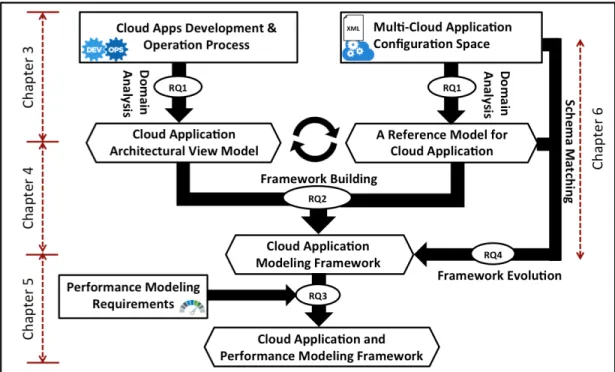
To tackle this problem, a Model Driven Engineering (MDE) approach has been adopted. An overview of the research approach is depicted in Figure 1.1. The approach aims to provide answers to four research questions. For each of these questions, we explain its objective and the methodology followed to address it.
Figure 1.1: Research Approach
1.3.1
RQ1. How is architecting cloud applications different from
architecting other applications?
Objective: The objective of the first question is to devise a software architecture frame-work for cloud applications. The frameframe-work will capture the common practices of the different stakeholders of the cloud application in order to enable them to create, interpret, analyze and use architecture descriptions to specify cloud applications deployment and management aspects.
Methodology: To understand the domain and the architectural requirements of cloud applications, we started by a study for two cloud computing reference architectures [67]; namely, the NIST Cloud Computing Reference Architecture [115] and the IBM Cloud Com-puting Reference Architecture [12]. Consequently, a list of cloud services and stakeholder’s
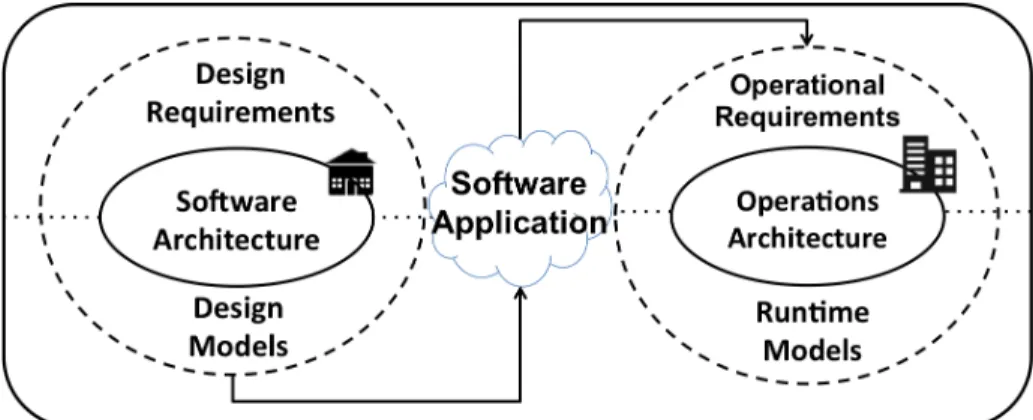
roles have been identified. We considered roles that are directly related to the cloud ap-plication development and operation process and studied the different financial, design and operational decisions required to build a cloud application, deploy it, and manage its operations while running in the cloud. The initial observations were that: (i) a cloud application needs to evolve dynamically at runtime to meet performance, availability, and scalability targets, and (ii) the quality of a cloud application depends on its configuration and the architecture of its service model. These are fundamental differences from what existing software architecture frameworks address, where the focus is on the application implementation. In cloud computing, architecture evolves during deployment; therefore, runtime operation needs as much architectural modeling as functional design does. This shift in emphasis from architecting for implementation to architecting for service operation motivated the need for a view model that is constructed around the application service and deployment model. Chapter3 provides the details of this model.
1.3.2
RQ2. How should an application be architected to be
de-ployed into multiple clouds and how should cloud modeling
and configuration spaces be bridged?
Objectives: Deploying an application on a cloud platform requires specifying how the application service model will use the platform resources of that particular provider. Our objectives are the following:
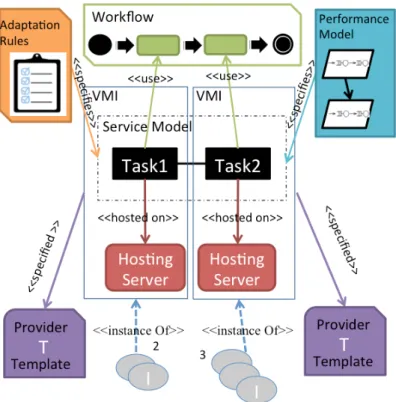
• facilitate the migration of cloud applications between different cloud providers, first, by providing an abstraction layer (reference model) for cloud applications to enable modeling the service structure and configuration independently from the target cloud platform specifications, second, by mapping the platform independent models into the target platform specifications as needed.
• maintain the architectural models in synchrony with the configuration space as appli-cations evolve, through developing a modeling framework that supports transforming the high-level architectural models into platform specific artifacts.
Methodology: To create a reference model for cloud applications, we started by domain analysis for the different artifacts required to successfully deploy and manage an application on three cloud platform providers (i.e., Amazon AWS, Windows Azure and Google App Engine). Particularly, we analyzed the schemas provided by these platforms. These schemas specify the syntax and structure of the information that is required by the
platform. Our methodology includes both a manual and semi-automated (cf. Chapter 6) schema matching process to identify the similar domain concepts and then creates meta-concepts that describe them independently from the target platform.
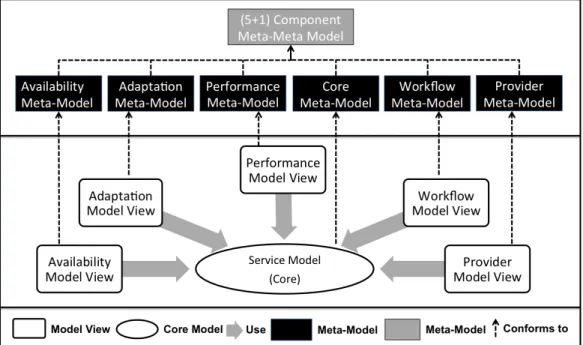
To build the modeling framework, we created a meta-model for each of the (5+1) view models. Then integrated the meta-models into one meta-model, by extending the top ele-ment of each meta-model from a common meta-meta component, and defining associations between the elements of the different meta-models. The outcome meta-model is then re-alized as a layered Domain Specific Modeling Language (DSML), where we utilized the hierarchical structure of the meta-model to divide the model into layers to facilitate incre-mental and collaborative modeling. To facilitate model transformation, a model generator has been implemented. We used template-based transformation as it provides the required flexibility and portability, since the only thing that needs to be changed to support a new platform is the template. The details of the meta-models and framework are provided in Chapter 4.
1.3.3
RQ3. How should the framework be extended to support
generating analytical performance models for cloud
appli-cations?
Objective: The objective here is to allow the developers, system architects and perfor-mance engineers to analyze the perforperfor-mance of a cloud system under several configuration and platforms by reusing the existing cloud configuration space artifacts. This should help them make better decisions regarding the system architecture, design, configuration and the target platform.
Methodology:
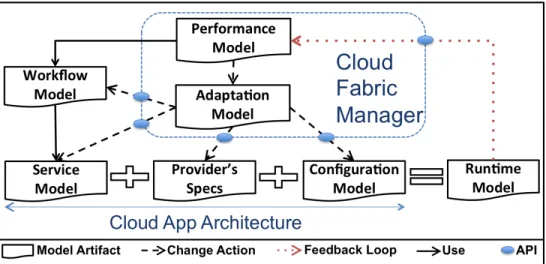
To extend the cloud application framework to support generating analytical mance models for cloud applications, we started by analyzing the requirements of perfor-mance modeling to assess how much information can be reused from the cloud service and deployment modeling artifacts. The initial observation is that there is a significant overlap between the information that is required to analytically analyze the system performance and the information that is required to deploy and run an application on a particular platform. Accordingly, we extend the framework to capture the application runtime pa-rameters. Then we defined a set of transformation rules to automatically transform the StratusML models into Layered Queuing Network (LQN) models. Chapter5provides the details of how to generate LQN models from the StrausML models.
1.3.4
RQ4. How should the framework be kept up-to-date?
Objective: The objective of this question is to support the framework evolution as new cloud platforms evolve. In MDE, the process of domain model creation, evolution, and transformation depends on the ability to find correspondences (mappings) between the concepts of the source and the target models. Consequently, this phase will focus on devising a semi-automated approach to facilitate matching domain concepts of different providers’ schemas to facilitate creating new concept abstractions and transformation rules.Methodology: To automate the generation of alignments between providers’ schemas, we used schema matching to identify the possible matches between different cloud providers’ schemas. We noticed that the shortcomings of traditional schema matching techniques are that they rely on linguistic and structural similarities to identify the possible matches. In the cloud, schema terms diverge so much that such matching is impossible. To address this challenge we incorporated domain knowledge in the schema matching process. The details of the proposed schema matching techniques and the results of applying them on cloud schemas are provided in Chapter 6.
1.4
Research Contributions
This research aims at providing a comprehensive framework that covers the entire Cloud Applications’ life-cycle. The contributions of this research:
• an architectural view model for cloud applications that focuses on service operation rather than implementation,
• a modeling framework for cloud applications that
– fragments models into artifacts that are easy to modify,
– allows weaving fragments into model views,
– uses layers and multiple views to facilitate collaboration,
– provides an intuitive way to specify the dynamic behavior of cloud applications, and
– uses template-based transformation to enable a model-once deploy-everywhere approach,
• a pivot performance model for cloud applications and an analytical performance model generator that
– addresses the dynamic nature of cloud applications, where both the platform and the application are fluid and continuously changing after deployment,
– captures the cloud application runtime performance parameters, and
– defines transformation rules to automatically transform the cloud models into Layered Queuing Network models, and
• a schema matching approach for the cloud domain that
– addresses the vendor lock-in problem, and
– reduces the manual efforts needed to create a meta-model and keep it up-to-date as schemas evolve, and generate transformation templates.
1.5
Document Organization
The rest of this thesis is organized as follows. Chapter 2 briefly reviews the background concepts and some related work. Chapter 3 characterizes cloud native applications and proposes an architectural framework for cloud applications. Chapter 4 shows how the ar-chitectural framework has been realized as a cloud modeling framework (StratusML) that consists of a modeling language that uses layers to specify the cloud configuration space, and a transformation engine to generate the configuration space artifacts. Chapter 5 ex-tends the framework to support capturing the cloud application performance. Chapter 6
shows how to automate the framework evolution as new concerns and cloud platforms emerge. In which, a new approach has been devised for schema matching and then evalu-ated using public schemas of two major cloud providers (i.e., Windows Azure and Google App Engine) and private schemas of two reference cloud models (StratusML and TOSCA). Chapter7summarizes the thesis, draws several conclusions, and suggests ideas for potential future work.
Chapter 2
Supporting Concepts and Related
Work
“Learn from yesterday, live for today, hope for tomorrow. The important thing is not to stop questioning.”
– Albert Einstein, 1955
Cloud computing is a big disruption to how information technology (IT) is consumed and managed. The concepts and technologies behind cloud computing are not new. It is believed that the concept of cloud computing is the same as what John McCarthy, in the 1960’s, referred to as the ability to provide and organize computation as a “utility”. The main characteristics of cloud computing were also discussed by Douglas Parkhill in “The Challenge of the Computer Utility” in 1966 [124]. On the other hand, the termcloud and its graphical symbol have been used for decades in computer network literature; first to refer to the large Asynchronous Transfer Mode (ATM) networks in the 1990s, and then to describe the internet (i.e., a large number of distributed computers).
Even though the concept is not new, the past few years have witnessed several at-tempts to define “Cloud Computing”. Vaquero et al. compared 22 different definitions in an attempt to provide a unified definition [156]. Some of these definitions are gen-eral: “applications delivered as services over the internet and the hardware and systems software in the datacenters that provide those services” [50]. Others are more specific de-scribing the cloud as “a type of parallel and distributed system consisting of a collection of inter-connected and virtualized computers that are dynamically provisioned and presented as one or more unified computing resources based on service-level agreements established
through negotiation between the service provider and consumers”. The fact that cloud computing is not a purely technical term, as well as the large number of interdisciplinary technologies that participate in characterizing cloud computing, are the reasons behind all the different definitions.
The information technology industry has sought to standardize the definition of cloud computing. One of the first standardized definitions is the one by Forrester Research. In which, they defined cloud computing as “a standardized IT capability (services, software, or infrastructure) delivered via internet technologies in a pay-per-use, self-service way” [148]. Forrester’s definition focuses on the service and business models of the cloud; however, it ignores the deployment models. The most recent and accepted standardized definition of cloud computing is the one by the National Institute of Standards and Technology (NIST) [102]:
“Cloud computing is a model for enabling ubiquitous, convenient, on-demand network access to a shared pool of configurable computing resources (e.g., networks, servers, stor-age, applications, and services) that can be rapidly provisioned and released with minimal management effort or service provider interaction. This cloud model promotes availability and is composed of five essential characteristics, three service models, and four deployment models.”
The NIST definition is relatively technical and covers all of the cloud service (IaaS, PaaS, SaaS) and deployment (Public, Private, Hybrid, Community) models. The NIST definition is concise and accurate. It distinguishes between the main and derived charac-teristics (rapid elasticity vs. massive scalability) of cloud computing. Also, it differentiates between the cloud characteristics and its enabling technologies (i.e. virtualization and au-tonomic computing). Nevertheless, the definition ignores the “pay-per-use” business model of cloud computing. However, the “pay-per-use” model was not omitted from the defini-tion out of ignorance, but because NIST tried to cover all of the cloud deployment models, including the “private cloud” deployment model, which does not necessarily involve the “pay-per-use” practice. Instead of explaining the business model, NIST identified the main technological characteristics that can result in cost reduction and add constraints (e.g., all services must be measurable) that provide all the requirements for cloud deployment mod-els to adopt any billing or utility model (i.e. “pay-per-use”).
The rest of this chapter will be organized as follows: Section 2.1 explains the cloud computing principles and requirements and clarifies the relationship between cloud com-puting and the service-oriented architecture, grid comcom-puting, parallel comcom-puting, utility computing, autonomic computing, and virtualization. In Section2.2 we present the most related research projects to the one presented in this thesis.
2.1
Cloud Computing Principles and Requirements
As shown in Figure 2.1, the NIST definition of cloud computing reveals the main charac-teristics, delivery models, and service models of cloud computing.
Essential Characteristics Service Models Deployment Models Broad Network
Access Rapid Elasticity
Measured Service
On-Demand Self-Service
Resource Pooling
SaaS PaaS IaaS
Public Cloud Private Cloud Hybrid Cloud Community Cloud
Figure 2.1: NIST Visual Model of Cloud Computing Definition.
This section describes the foundation of cloud computing by listing and explaining these characteristics and models in more detail.
2.1.1
Cloud Computing Characteristics
The following are the five main characteristics of cloud computing that most people agree upon:
(a) On-demand self-service. Cloud services are on-demand; that is, service consumers can automatically request the service based on their needs, without human interaction with the service provider.
(b) Easy to access standardized mechanisms. NIST refers to this characteristic as broad network access; however, the term “global reach capability” is also used. The idea is that it should be possible to access cloud services through the network using standardized interfaces and access mechanisms. Having global reach capability does
not mean that these services must always be accessible from the internet, because this depends on the deployment model used. However, it should be possible to reach the service globally, when policies allow this.
(c) Resource pooling and multi-tenancy. In cloud computing, resources (i.e. stor-ages, processors, memory, network bandwidth, and virtual machines) are shared be-tween multiple tenants, and assigned exclusively at run-time to one consumer at a time. Assigning resources is done dynamically based on the consumers’ needs. Sharing re-sources can help increase utilization, and hence significantly reduce the operation cost. Scheduling algorithms can be used to dynamically assign resources to different tenants based on the type of workload, fairness, locality, and many other factors. [155, 163].
(d) Rapid elasticity. Elasticity is the ability to scale in and out by provisioning resources and releasing them, respectively. Cloud computing should provide mechanisms to allow quick and automatic elasticity. The large pool of resources in cloud datacenters gives the illusion of infinite resources to the consumers, and elasticity provides the flexibility to provision these recourses on-demand.
(e) Measured service. Providing cloud metrology or mechanisms for measuring ser-vice usage as well as to monitor the health of serser-vices is crucial in cloud computing. Measuring services enables optimizing resources and provides transparency for both consumers and providers, allowing them to better utilize the service. Measured services can help in building closed-loop cloud systems that are fully automated.
(f) Auditability and certifiability. Regulatory compliance requires enforcing rules and regulations. Services should provide logs and trails that allow the traceability of policies, so as to ensure that regulations are correctly enforced.
The list above (except point (f)) is based on the NIST definition. These characteris-tics are the most adopted in the cloud industry. Some other definitions may have slight variations. For example, we added “auditability and certifiability” to the list above based on the regulatory compliance requirements. Some more specific lists of characteristics can be made for each layer and each type of service provided in the cloud environment. For example, at the application level, a possible cloud service characteristic is that a service must be portable, pre-configured, or adaptable. Chapter3provides an example of a list of more specific characteristics and requirements for cloud applications.
2.1.2
Cloud Computing Deployment Models
A cloud computing deployment model is a model that describes the environment where cloud applications and services can be installed, in order to be available to consumers. By the deployment environment, we mean the physical location, the infrastructure facilities, the platform constraints, as well as anything that can affect the access mechanisms of the deployed applications. There are four main cloud computing deployment models: public, private, hybrid, and community cloud.
(a) Public cloud: A public cloud or external cloud is an open model, in which the resources and services (e.g., applications, storages) are provided by a third party (the cloud providers). The infrastructure or platform services are provided to the public based on the service-level agreement between the service provider and the consumer. This type of resource sharing between multiple organizations or consumers is referred to as the multi-tenancy model. Public cloud is the least expensive choice for application hosting. However, the lack of a trust model between the cloud providers and consumers is the main obstacle for this model.
(b) Private cloud: A private cloud or internal cloud is a model, in which the infrastruc-ture and platform services are hosted and operated entirely by the application provider on premises. This eliminates the need for a trust model and provides more flexibility. Organizations can implement their own policies with regards to privacy, security, and access mechanisms. However, this option is expensive in terms of resources, and the manpower needed to manage the resources.
(c) Hybrid cloud: A hybrid cloud model is a combination of the public and private cloud models. It provides a similar trust model for in-house services as in private clouds, yet it is less expensive than a private cloud as it uses public cloud platforms and infrastructure for part of its services. However, having both public and private clouds working together requires interoperability and portability of both applications and data to allow communication between the models.
(d) Community (cooperative) cloud: A community cloud is similar to extranets, but with virtualization and on-demand capabilities. In a community cloud, a number of organizations, which usually share some common goals or belong to a specific commu-nity, build a shared cloud datacenter that can be used by all of the members. The goals are to alleviate deficiencies in the individual IT infrastructures, reduce the cost of administration, and lower the cost per unit [72]. The community can be created between a professional community (i.e. organizations with business relationship), a
Attribute Public Cloud Private Cloud Hybrid Cloud Community Cloud Cost of building the
datacenter on service consumer
No initial cost High initial cost
Medium initial cost Varies , depends on the number of cooperatives Operation and maintenance cost on the provider Lowest cost with respect to the datacenter size Highest cost with respect to the datacenter size Weighted average, depending on the percentage of public and private parts.
Similar to private clouds, but the cost divided on the participants Size of the datacenter ~50,000 Server
~5,000 Server Less than private Cloud
~15000 More than private cloud but much less than public cloud Infrastructure Controllability and Flexibility Limited configuration controllability Full controllability (HW + SW) Full controllability over the private part and limited for the public part
High controllability but limited by the community policies Level of trust Lowest trust, Highest Medium trust High trust
Infrastructure Location
Off-Premise On-Premise Both On- and Off-Premise Within the Cooperative Facility Owner of the infrastructure The IaaS Vendor The Customer
The IaaS vendor owns the public part, and the consumer owns the in-house part
Shared between the Cooperatives
As shown in Table~\ref{tb:DeploymentComparison} there is no initial cost associated with adopting public cloud by consumers \cite{Economics2008}. Consumers need not to worry about creating the cloud infrastructure. Instead, they can request the services and resources on-demand and pay just for what they use. Conversely, a private cloud requires a big initial capital investment in order to build the private datacenter\cite{Economics2008}. Different from the private model the hybrid model builds relatively a smaller private datacenter for sensitive and important tasks and information. It also uses the public cloud for other jobs. For this reason, the cost of adopting the hybrid cloud model is in the middle between public and private clouds. Finally, the community cloud model share the cost of building the required datacenter on the cooperatives. For this reason, the initial cost can vary; the larger the community the smaller the share and the lower the cost.
Table~\ref{tb:DeploymentComparison} also shows that the operating cost (i.e. power consumption, man power expenses, rent, maintenance, upgrades, etc.) of public cloud is the lowest in comparison to other models. This is due to the economies of scale as well as the high level of automation and
optimization in public cloud. Production costs drop significantly as the number of units produced increase\footnote{This phenomenon is referred to as the experience curve effect and was first noticed by
Table 2.1: A Comparison Between the Different Cloud Deployment Models
geographic community, or some other well-defined community group. A community cloud relies on the trust relation between all the members, which is driven by their mutual benefits [24,98]. As a result, this model is more trusted than the public cloud, and less expensive on participating members than having a private cloud. This model also provides more controllability over the shared infrastructure resources. However, a community cloud still needs to enforce strong security and privacy policies. Further-more, regulatory compliance is a main obstacle facing community cloud adoption. Table 2.1 shows a comparison between the different cloud deployment models, based on the initial cost of building the cloud datacenter or the capital expenses (CapEx) on the consumer, the operating expenses (OpEx) and maintenance cost of the datacenter, the
size of the datacenter, controllability and flexibility, the level of trust, the location of the infrastructure, and who owns the infrastructure.
As shown in Table 2.1 there is no initial cost associated with adopting public cloud by consumers [139]. Consumers need not worry about creating the cloud infrastructure. Instead, they can request the services and resources on-demand and pay just for what they use. Conversely, a private cloud requires a big initial capital investment in order to build the private datacenter[139]. Unlike the private model, the hybrid model builds a relatively small private datacenter for sensitive and important tasks and information, and uses the public cloud for other jobs. For this reason, the cost of adopting the hybrid cloud model is between that of public and private clouds. Finally, the community cloud model shares the cost of building the required datacenter with the cooperatives. For this reason, the initial cost can vary; the larger the community the smaller the share and the lower the cost.
Table 2.1 also shows that the operating cost (i.e. power consumption, manpower ex-penses, rent, maintenance, upgrades, etc.) of public cloud is lower than the other models. This is due to the economies of scale, as well as the high level of automation and optimiza-tion the public cloud. Producoptimiza-tion costs drop significantly as the number of units produced increase 1 [82]. This allows public cloud providers to enjoy favorable prices for IT equip-ment and needed resources, since they purchase them in bulk. According to Jon Moore’s blog, a private datacenter should have on average 10,000 servers to get an economically feasible marginal cost that is comparable to what current public cloud providers charge [111]. On the other hand, public providers tend to invest more in automation and opti-mization, which results in fewer administrative staff. For example, while the ratio between IT staff to servers is (1:100) [60] in traditional datacenters, this ratio goes to (1:1000) [60] and even (1:5000) in public cloud datacenters.
It is clear from Table2.1that consumers can have full control over a private cloud infras-tructure, whereas in a public cloud, controllability is limited to tuning some configuration parameters. On the other hand, while community cloud consumers can have access and control over the infrastructure, this controllability is bounded by the community policies and agreements.
The level of controllability and flexibility can also affect the level of trust. This explains why consumers trust the private cloud model more than the other models. However, it is important to note that the level of trust is not related to the actual security level. Public cloud providers tend to implement best practices and try to ensure security at every level of the security stack. However, the cloud computing paradigm introduces new security
1This phenomenon is referred to as the experience curve effect and was first noticed by Bruce Henderson
threats that did not exist in traditional datacenters, such as threats related to sharing resources through virtualization [32]. Most of these threats are equally applicable to both public and private models. Some of the cloud security myths assume that all clouds are created equally [44], while others assume that public and private cloud providers have the same experience and capabilities to implement security measures [107] for data protection, identity management, compliance, access control rules, and other security capabilities. If these assumptions are true, then a public cloud is the least secure, while a private cloud is the most secure.
Cloud deployment models differ based on the infrastructure’s owner, location, or oper-ators and their policies. One model does not fit all business types. The selection of a cloud deployment model depends on the consumers’ need and budget, and on whether they favor price reduction and control delegation over flexibility, control, and customization.
2.1.3
Cloud Computing Service Models
This subsection presents and compares the cloud computing service models. Cloud service models are sometimes referred to as the cloud service hierarchical view [154], cloud service offerings, cloud service delivery models [93], or the cloud service layered architecture, in analogy to the network layered architecture. Cloud service models try to classify “any-thing” providers offer as a service (XaaS), where X means is an arbitrary service (e.g., infrastructure, software, storage). A cloud service model represents a layered high-level abstraction of the main classes of services provided by the cloud computing model, and how these layers are connected to each other. This separation between layers allows each cloud provider to focus on the core services they provide, while at the same time being able to reuse the services from the lower layers by following the set of standard communi-cation mechanisms and protocols between the different layers. Layers differ based on the management scope covered by the provider [12], which means that a user in the upper layers cannot bypass the interfaces provided by the layer beneath, so as to directly access the resources. This separation does not only help in service integration but also allows having a fully distributed, scalable, and fault-tolerant architecture. By having different layers with different abstraction levels, cloud providers can have better manageability over the resources, as well as higher controllability and security.
As in the network layered architectures (i.e. OSI, TCP/IP), there are different cloud service models. These models vary based on the time they were proposed, relative to the maturity of the cloud computing paradigm at that time; and on the level of detail in these models, as represented in the number of model layers. However, the differences between service models do not contradict each other. Instead, these models are complementary [2].
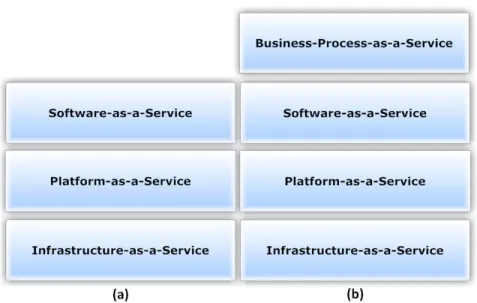
Figure 2.2: Cloud Service Models (a) SPI vs. (b) IBM.
This subsection will briefly discuss the main two service models: The NIST SPI model [102] (aka, the three service-layers model), and the IBM service model [12] (aka, the four service layers model). Figure.2.2 shows a comparison between these two models.
The NIST SPI model:
The SPI model classifies the services provided by the cloud providers into three main categories (layers): Software services, Platform services, and Infrastructure services. The SPI model is named after these categories, which are described below:
• Software as a Service (SaaS): A service is classified as a software service if it allows the consumer (end user) to access and use a provider software application that is owned (hosted), deployed, and managed by the provider. Consumers normally have limited control over the application, and are restricted in how they can use and in-teract with the application. The application is usually accessed via a thin client (i.e. web browser), through which consumers can input data and get output [102]. Because most SaaS services are specific applications rather than being generic soft-ware services, SaaS is sometimes referred to as Application-as-a-Service. Examples of SaaS are content services such as video-on-demand (i.e Netflix), email services (i.e. gmail), and business applications such as customer relationship management applications (i.e. Salesforce).
• Platform as a Service (PaaS): A service is classified as a platform service if it allows the service consumer (usually a SaaS provider, cloud developer, or administrator) to define, develop, configure, deploy, manage, and monitor cloud applications. While PaaS allows consumers to deploy and control applications and their hosting environ-ment configurations, consumers do not have direct control over the underlying cloud infrastructure [102]. PaaS services abstract the communications with the lower-level infrastructure by providing easy to access and easy to use interfaces. Operating systems and application frameworks are part of the PaaS layer.
• Infrastructure as a Service (IaaS): A service is classified as an infrastructure service if it allows the service consumer (usually PaaS providers) to lease infrastructure capabilities based on demand. The infrastructure capabilities include processing, storage, network or any other basic computing resources that can be used to deploy and run platforms (i.e. operating systems, management tools, development tools, and monitoring tools) and the applications developed on top of the platforms. Again, consumers are not given direct access to resources but have the ability to select and configure resources as required based on their needs [102]. IaaS is sometimes referred to as the virtualization layer, since it utilizes virtualization technologies to partition physical resources, so as to provide the consumers with a pool of storage and computing resources.
IBM service model:
According to the IBM Cloud Computing Reference Architecture [12], a cloud service model consists of four service layers; from top to bottom, these are the Business-Process-as-a-Service, Software-as-a-Business-Process-as-a-Service, Platform-as-a-Business-Process-as-a-Service, and Infrastructure-as-a-Service lay-ers.
The last three layers are exactly the same as in the SPI model. In fact, IBM used the same definition of SaaS, PaaS and IaaS as defined according to the NIST SPI model. The only difference between the IBM service model and the NIST SPI is in the Business-Process-as-a-Service (BPaaS) layer. Since this is the only difference, we will only explain BPaaS and why it was introduced.
• Business-Process-as-a-Service: A service is classified as a business process service if it allows the consumer (end user, business process manager, or designer) to design, manage and integrate a set of transactional and collaborative activities based on the SaaS provided in the layer beneath, so as to accomplish a specific business organi-zational goal. Accordingly, IBM classifies any business process service - whether it
focuses on technology and reuse (horizontal), or it is domain specific (vertical) - as BPaaS if and only if the service (i) represents a business process that is delivered through the cloud computing model based on its main characteristics, as defined in the NIST definition (i.e. multi-tenant service, self-service, elastic, metered, and priced); (ii) accessed through a web-centric interface; (iii) and utilizes a web-oriented cloud architecture. Similar to IaaS and PaaS services, the service provider of a BPaaS provides the tools to access and utilize the resources in the BPaaS layer. Consumers do not need to access services in the underlying layers. “a BPaaS provider is re-sponsible for the related business function(s)[12]”. Some examples of BPaaS include a process for employee benefits management; and IT-centric processes, such as a process for software testing where the whole process, including the testing staff, is provided as a cloud service.
As mentioned earlier in this subsection, currently there are many cloud service models in the market. This is because different cloud providers use different service models to reflect the types of services they provide. However, the differences between cloud service models are minute. In addition, these models complement each other. The most dominant service models currently in use are the ones discussed in this subsection. The next subsection discusses the relationship between cloud computing and other computing paradigms.
2.1.4
The Relationship Between Cloud Computing and Other
Computing Paradigms
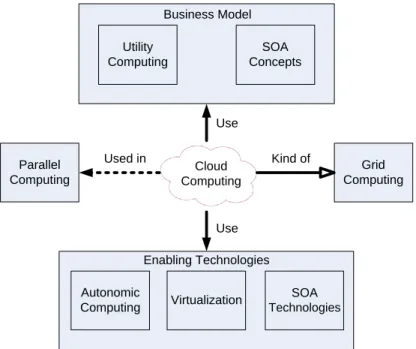
Cloud computing is the result of evolution and adoption of existing technologies and paradigms. The goal of cloud computing is to allow users to take benefit from all of these technologies, without the need for deep knowledge about or expertise with each one of them. The cloud aims to cut costs, and help the users focus on their core business instead of being impeded by IT obstacles. Figure.2.3 summarizes how cloud computing is related to the other technologies that it has emerged from.
The figure shows that the main enabling technologies for cloud computing are virtu-alization and autonomic computing. Virtuvirtu-alization abstracts the physical infrastructure, which is the most rigged component, and makes it available as a soft component that is easy to use and manage. By doing so, virtualization provides the agility required to speed up IT operations, and reduces cost by increasing infrastructure utilization. On the other hand, Autonomic Computing automates the process through which the user can provision resources on-demand. By minimizing user involvement, automation speeds up the process and reduces the possibility of human errors.
Grid Computing Cloud Computing Utility Computing SOA Concepts Autonomic Computing Virtualization Business Model Enabling Technologies Parallel Computing Kind of Use Use Used in SOA Technologies
Figure 2.3: Cloud Computing Relationship with Other Computing Paradigms. Users face difficult business problems every day. Cloud computing adopts concepts from SOA that can help the user break these problems into services that can be integrated to provide a solution. Cloud computing provides all of its resources as services, and makes use of the well established standards and best practices gained in the domain of SOA to allow global and easy access to cloud services in a standardized way. Cloud computing also utilizes concepts from utility computing in order to provide metrics for the used services, based on the benefits gained. These metrics are at the core of the pay-per-use model in public clouds. Having measured services is also an essential part of completing the feedback loop in autonomic computing, which is required for fully automating services so that they can scale on-demand and automatically recover from failures.
Cloud computing is a kind of Grid Computing; it has evolved from Grid by addressing the QoS and reliability problems. Cloud computing provides the tools and technologies to build data/compute intensive parallel applications with much affordable prices compared to traditional parallel computing techniques.
More details of the relationships between cloud computing and other computing paradigms can be found in our survey paper [67].
2.2
Related Research Projects
Our work has taken shape in the context of a rich literature focused on viewpoint architec-ture frameworks, model-driven engineering and quality prediction, cloud domain specific modeling languages, and lastly schema matching for cloud vendor schemas. Here we relate our work to the most related projects in each of these fields.
2.2.1
Viewpoint Architectural Frameworks
A viewpoint is a set of representations (views and models) of an architecture that covers a stakeholder’s issues. In Chapter 3, the (5+1) view model, which is an architectural view model for cloud applications is presented. The model uses different views to describe different perspectives of the cloud application deployment. Using multiple views to explore systems from different angles is a common practice in software engineering. For example, Krutchen [91] famously proposed four views: logical, development, process and physical; plus “use cases” as the fifth view, to completely describe the lifecycle of a software system. Zou and Pavlovski [165] extended the (4+1) view model by adding acontrol case view to address non-functional system requirements.
The (4+1) view model [91] is an example of many other frameworks used in software development. Some of these examples include: the Department of Defense Architecture Framework (DoDAF) [120], the Three-Schema Approach, [84], Zachman Framework [162], the Reference Model of Open Distributed Processing (RM-ODP) [94], and the Open Group Architecture Framework (TOGAF) [157]). These frameworks are not cloud specific; they do not target the cloud applications’ development process, or capture the domain specific constraints related to the cloud platforms and providers. The aforementioned frameworks are generic enough to describe large class of software systems. However, they only con-sider the dynamism and variability of the design model and assume a static deployment infrastructure. Even when deployment models are considered, they are considered as part of the lifecycle and not a driver of architectural evolution.
The (5+1) model was inspired by the (4+1) model process view [91]. In fact, if tasks are considered processes, the (5+1) model can be seen as an extension of theprocess view, distinguished by its focus on the cloud application ecosystem (represented by variable deployment models, dynamic infrastructure, and standardized service offerings). The (5+1) model augments its core with elements that enable quality prediction. Its views are limited but expressive enough to cover operational requirements and the application lifecycles in the cloud.