Effectiveness of Multicomponent Programs with
Community Mobilization for Reducing
Alcohol-Impaired Driving
Ruth A. Shults, PhD, MPH, Randy W. Elder, PhD, James L. Nichols, PhD, David A. Sleet, PhD, FAAHB, Richard Compton, PhD, Sajal K. Chattopadhyay, PhD, Task Force on Community Preventive Services
Abstract: A systematic review was conducted to determine the effectiveness and economic efficiency of multicomponent programs with community mobilization for reducing alcohol-impaired driving. The review was conducted for theGuide to Community Preventive Services(Community Guide). Six studies of programs qualified for the review. Programs addressed a wide range of alcohol-related concerns in addition to alcohol-impaired driving.
The programs used various crash-related outcomes to measure their effectiveness. Two studies examined fatal crashes and reported declines of 9% and 42%; one study examined injury crashes and reported a decline of 10%; another study examined crashes among young drivers aged 16 –20 years and reported a decline of 45%; and one study examined single-vehicle late-night and weekend crashes among young male drivers and reported no change. The sixth study examined injury crashes among underage drivers and reported small net reductions. Because the actual numbers of crashes were not reported, percentage change could not be calculated.
According toCommunity Guiderules of evidence, the studies reviewed here provided strong
evidence that carefully planned, well-executed multicomponent programs, when imple-mented in conjunction with community mobilization efforts, are effective in reducing alcohol-related crashes. Three studies reported economic evidence that suggests that such programs produce cost savings. The multicomponent programs generally included a combination of efforts to limit access to alcohol (particularly among youth), responsible beverage service training, sobriety checkpoints or other well-defined enforcement efforts, public education, and media advocacy designed to gain the support of both policymakers and the general public for reducing alcohol-impaired driving.
(Am J Prev Med 2009;37(4):360 –371) Published by Elsevier Inc. on behalf of American Journal of Preventive Medicine
Introduction
A
lcohol-impaired driving continues to be ama-jor public health problem in the U.S. In 2007, there were 12,998 people who died in crashes in which at least one driver had a blood alcohol concentration (BAC) of at least 0.08 grams per deciliter (g/dL), the level at which adult drivers in the U.S. are legally drunk.1The estimated economic cost of alcohol-related crashes in 2000 was $51 billion,2 or
approxi-mately $64 billion in 2008 dollars based on the annual average Consumer Price Index.a
Attempts to address alcohol-impaired driving through law enforcement date back to New York’s impaired driv-ing law of 1910.3More than 50 years later, the National Highway Safety Bureau’s 1968 Report to the Congress on Alcohol and Highway Safety stimulated official and public concern regarding alcohol-impaired driving.3,4Since then, individual states and communities have imple-mented a broad range of strategies to reduce alcohol-impaired driving. Other systematic reviews in this series have summarized the effectiveness of some of the common single-component interventions, including various laws,5,6 sobriety checkpoints,5–7 mass media campaigns,8designated driver programs,9and school-From the Division of Unintentional Injury Prevention (Shults, Sleet),
National Center for Injury Prevention and Control; Division of Health Communication and Marketing (Elder, Chattopadhyay), Na-tional Center for Health Marketing, CDC, Atlanta, Georgia; and Office of Research and Traffic Records (Nichols, Compton), Na-tional Highway Traffic Safety Administration, Washington, DC
Address correspondence and reprint requests to: Ruth A. Shults, PhD, MPH, Division of Unintentional Injury Prevention, Centers for Disease Control and Prevention, 4770 Buford Highway, Mailstop
F-62, Atlanta GA 30341. E-mail:[email protected].
aThis estimate is based on the Bureau of Labor Statistics (BLS)
Consumer Price Index (CPI). It was calculated using the BLS CPI
Inflation Calculator found athttp://data.bls.gov/cgi-bin/cpicalc.pl.
This estimate was obtained on July 7, 2009.
360 Am J Prev Med 2009;37(4) 0749-3797/09/$–see front matter
based programs.10In practice, individual interventions are combined to form multicomponent programs.
Among the earliest multicomponent community-based programs to address alcohol-impaired driving were the Alcohol Safety Action Projects (ASAPs), funded by the U.S. Department of Transportation (DOT) and conducted from 1969 through 1975. These programs were based on a “systems approach,” later called a “health–legal” approach that focused on health-related interventions, such as alcohol-problem screening and referral to treatment, on the one hand, and on legal interventions, such as legislation, enforce-ment, adjudication, and penalties, on the other. Each of these programs also had a public information and education component made up primarily of public service media campaigns, speakers bureaus, local edu-cation programs, and other informational activities. Approximately $84 million was expended over a period of 5– 6 years on 35 individual ASAPs. Evaluation results reported by the National Highway Traffic Safety Admin-istration (NHTSA) indicated that about one third of these projects (12 of 35) resulted in significant reduc-tions in nighttime fatal crashes, compared with zero in matched comparison sites.11
Although all of the ASAPs involved multiple commu-nity agencies and organizations, and several were im-plemented at the community (county) level, they did not specifically focus on community mobilization to implement and sustain the programs. A multicompo-nent program was defined for this review as one that implemented interventions, policies in multiple set-tings (e.g., responsible beverage service in bars and sobriety checkpoints), or both to alter the community environment to directly or indirectly reduce alcohol-impaired driving. Programs satisfied the community mobilization criterion if a community coalition or task force was actively involved in making decisions about the type of interventions implemented or methods for implementation and the group remained engaged in the program throughout the period of implementa-tion. The multicomponent programs included in this systematic review are summarized below.
In 1984, planning began for a multicomponent pro-gram to be implemented by the Rhode Island Depart-ment of Health, with funding from the CDC and the National Institute on Alcohol Abuse and Alcoholism (NIAAA). The Rhode Island Community Alcohol Abuse and Injury Prevention Project introduced an approach referred to as the “gatekeeper model,” which targeted key individuals who influence community drinking practices (e.g., alcohol servers and enforce-ment agencies) rather than targeting drinkers them-selves. This was also one of the first documented programs designed to mobilize broad community sup-port for actions by these gatekeepers to reduce alcohol-related injuries and deaths.12
Then, in the late 1980s, the Massachusetts Saving Lives Program was implemented as a multicomponent effort, addressing traffic safety issues including im-paired driving, speeding, and pedestrian injuries in six moderate-size communities. These programs were de-signed more specifically to organize city departments and private citizens to address the impaired driving issue.13
At the same time, the IOM recommended the imple-mentation of such multicomponent community efforts to address the more general problems posed by alcohol use and abuse.14 Following that recommendation, several large-scale, multicomponent community-based programs were implemented. From 1992 through 1996, for example, the Community Trials Project was funded by the Center for Substance Abuse and Prevention (CSAP) and NIAAA and implemented in three commu-nities in northern California, southern California, and South Carolina. In addition to community mobilization activities, the project sought to reduce rates of alcohol-related injuries by means of interventions involving enforcement of drinking and driving laws, publicity, responsible alcohol beverage service, and reducing access to alcohol. These interventions were imple-mented in stages, forming intervention “pulses.”15
Also in 1992, the Robert Wood Johnson Foundation (RWJF) funded a large-scale, multimillion-dollar com-munity intervention program to reduce substance abuse problems in 14 communities across the U.S. Five of these 14 communities implemented interventions that focused on reducing alcohol availability, particu-larly among youth, as well as on expanding treatment and referral activities. This program, called Fighting Back, began with 2-year community planning efforts through which local task forces developed multicom-ponent interventions involving combinations of public-ity, referral, treatment, and aftercare; efforts to reduce access to alcohol; responsible alcohol service; “sting” operations at alcohol retail stores to reduce underage purchases; and reduced marketing of alcohol. One community also included enhanced enforcement of drinking and driving laws.16
In 1993, another large, community-based program was funded by the CSAP and NIAAA. The Communities Mobilizing for Change on Alcohol (CMCA) program focused on community organizing to change policies and practices to reduce youth access in seven Minne-sota and Wisconsin communities. Interventions in-cluded enforcement to reduce underage purchasing of alcohol, publicity, and reduced access to alcohol via efforts to change alcohol service practices and commu-nity norms.17
In 1997, with funding from the NIAAA and RWJF, the Operation Safe Crossing program was implemented in San Diego (CA) County to reduce the number of young people crossing the U.S. border to drink in Tijuana, Mexico, then driving to destinations in and
around San Diego on their return. It focused exten-sively on community mobilization, strong media ad-vocacy, and publicized driving-under-the-influence
law enforcement efforts to meet its objectives.18
These six community-based programs provided the research base for examining the potential for multi-component programs with community mobilization to reduce alcohol-impaired driving and associated crashes and injuries.
This systematic review was conducted on behalf of the Task Force on Community Preventive Services (Task Force) for inclusion in the Guide to Community Preventive Services(Community Guide, www.thecommuni-tyguide.org). The general methods used to conduct systematic reviews and economic evaluations for the Community Guide have been described in detail elsewhere.19,20
An economic evaluation is conducted only if the systematic review indicates that a strategy is effective according to Community Guide rules of evidence, and economic data are available. Economic evaluations use the societal perspective, which considers all costs and benefits, regardless of who bears the costs or receives the benefits.19
To be included in this review, a study had to (1) be primary research published in a peer-reviewed jour-nal, technical report, or government report; (2) be published in English between January 1, 1980, and June 30, 2005; (3) meet minimum Community Guide quality criteria for study design and execution19; and (4) evaluate the effects of a multicomponent program with community mobilization to reduce alcohol-related crashes.
“Community mobilization” or “community organiza-tion” has been broadly defined as the organization and activation of a community to address local prob-lems.21 The concept has been defined as “a planned process to activate a community to use its own social structures and any available resources to accomplish community goals that are decided on primarily by
community representatives and that are generally con-sistent with local values.”22 The community mobiliza-tion model, which emphasizes community-level ac-tions over individual behavior change strategies,23,24is well suited to addressing alcohol misuse for at least two reasons. First, communities exert some local control over the sale and public consumption of alcohol through enacting and enforcing local ordinances, and second, many of the costs associated with alcohol misuse are borne not only by the individual drinker but also by other members of the community, for example, through motor vehicle crashes and alcohol-related violence.25
Evidence Acquisition
Conceptual Model
Thefigurebelow shows the conceptual model that guided the review. The model reflects that community mobilization efforts can facilitate changes in alcohol-impaired driving through both direct and indirect pathways. For example, policy and environmental changes implemented in these programs can either directly target alcohol-impaired driving, usually by increasing the perceived risk of arrest for alcohol-impaired driving, or they can focus on reducing high-risk alcohol consumption, thereby reducing alcohol-impaired driving.
Search Strategy
The articles to be reviewed were obtained from systematic searches of multiple databases, reviews of bibliographic refer-ence lists, and consultations with experts in the field. The following databases were searched: MEDLINE, PsycINFO, Social SciSearch, National Technical Information Services, Trans-portation Research Information Services, EI Compendex, and EMBASE. Details of the search strategy are available at
www.thecommunityguide.org/mvoi.
Evaluating and Summarizing the Studies
Each study that met the inclusion criteria was evaluated by two independent abstractors for the suitability of the study design and study execution. The suitability of each study design was rated, according toCommunity
Guidestandards, as “greatest,” “moderate,”
or “least” suitable, depending on the de-gree to which the design protects against potential threats to validity. For example, to be rated as having “greatest” study design, a study must have both a concur-rent comparison group and prospective measurement of exposure and outcome.19 The execution of each study was rated based on predetermined factors that could potentially limit a study’s utility for assessing effectiveness. These factors in-cluded the study population and interven-tion descripinterven-tions, sampling methodology, exposure and outcome measurement, data analysis, interpretation of results (in-cluding follow-up, bias, and
confound-Figure 1. Conceptual model showing the hypothesized pathways through which multicomponent programs with community mobilization are thought to affect intermediate and health outcomes
ing), and a category for “other” factors, as specified by the rater. A total of nine limitations was possible. Studies with zero to one limitation were rated as having “good” execution; those with two to four limitations were rated as having “fair” execution; and those with five or more limitations were rated as having “limited” execution.19Only those studies rated as having “good” or “fair” execution were included in the review. When multiple papers by the same authors used similar methods to evaluate the same program, only the paper with the longest or most complete postintervention follow-up was included in the review. For qualifying studies, the systematic review team (the team) calculated effect sizes for the outcome of interest, alcohol-related motor vehicle crashes, wherever sufficient information was available to do so.
Program Characteristics
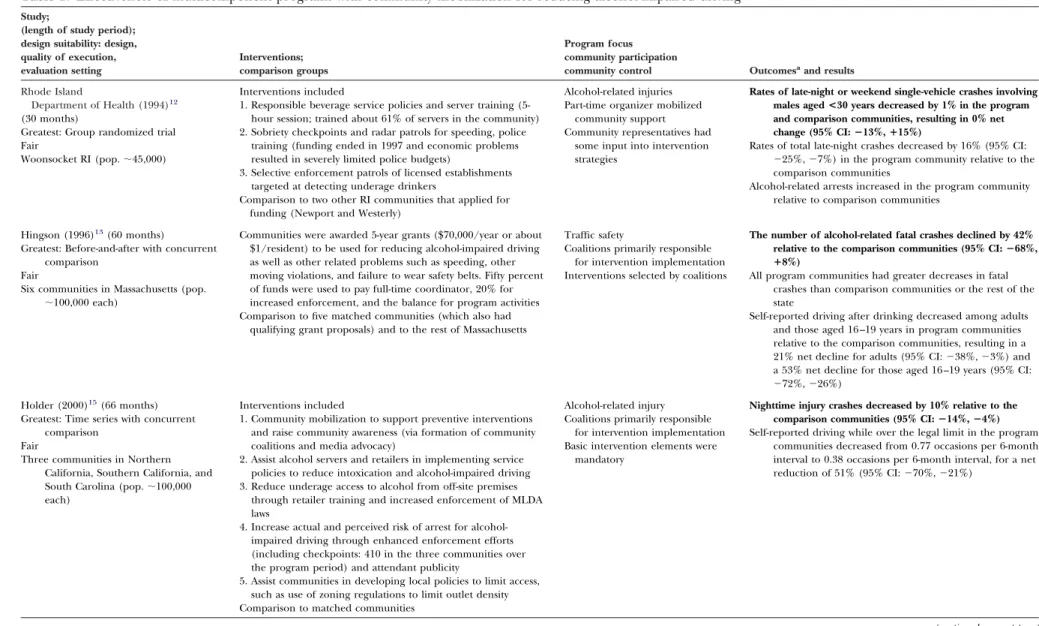
Programs were classified according to their focus, level of community mobilization, and interventions implemented (Table 1). With regard to program focus, the behaviors or outcomes targeted by the interventions (e.g., underage drink-ing, alcohol-related injury) were recorded. With regard to community mobilization, the team assessed the level of com-munity participation involved in designing and implementing the program, and the level of community control over which interventions were implemented. Information on other pro-gram characteristics, such as funding level, intervention reach, and the organizational structure of community groups (e.g., grass-roots versus Department of Motor Vehicles lead-ership; inclusion of industry groups) was reported, when available.
Calculating Effect Sizes
The primary outcome evaluated in this review was alcohol-related motor vehicle crashes. Some of the included studies used established proxy measures for alcohol-related crashes (e.g., single-vehicle nighttime injury crashes). Because of the imperfect association between these proxy variables and alcohol-related crashes, the resulting effect estimates are likely biased toward the null, with the degree of bias being most pronounced for proxies with the weakest association with alcohol involvement. For studies that provided more than one crash outcome, the crash outcome considered to be most closely associated with alcohol involvement was selected.5
Whenever they were available, effect measures were se-lected that compared alcohol-related crash outcomes to crash outcomes not related to alcohol (e.g., ratio of had-been-drinking crashes to had-not-been-had-been-drinking crashes) over the same time period. Such effect measures help control for both the long-term downward trend in total fatal crashes and factors that influence the total number of crashes, such as weather, economic conditions, vehicle miles traveled, and safety characteristics of vehicles and highways.27To further address potential confounding, whenever possible the team selected effect measures that incorporated a concurrent comparison group such as drivers in communities that were not exposed to the multicomponent program.
For studies incorporating comparison groups, effect sizes are reported in the form of the net change, reflecting the difference in the percentage change between the interven-tion and comparison groups. For studies using interrupted
time–series or other regression-based designs, results are reported in terms of the percentage change estimated from the model. Because the specific effect measure reported by each study was unique (i.e., relative odds of fatal crash, ratio of nighttime had-been-drinking crashes to had-not-been-drinking crashes), no summary effect measure was calculated for this systematic review.
Evidence Synthesis
Six studies were identified that evaluated changes in alcohol-related crashes following implementation of a multicomponent program with community mobiliza-tion.12,13,15–18All six of these programs were conducted in the U.S. between 1988 and 2001. They addressed a variety of outcomes in addition to alcohol-impaired driving, including underage drinking, other risky driving behaviors such as speeding, disorderly con-duct, alcohol-related injuries and violence, access to alcohol treatment, or substance misuse in general. Table 1provides summary information for each program evaluated.
All six studies were rated as having greatest suitability of study design and fair quality of execution. Study designs included time series with concurrent comparison (n⫽2); before-and-after with concurrent comparison (n⫽2); and group randomized trials (n⫽2). Follow-up periods ranged from 30 to 120 months, with a median follow-up period of 48 months.
Four of the six programs were implemented in multiple communities; the number of intervention communities ranged from three to seven. All six pro-grams implemented interventions in multiple settings within each intervention community. Communities were located in California, Massachusetts, Minnesota, Missouri, Rhode Island, South Carolina, Texas, and Wisconsin.
As previously described, the multicomponent programs implemented multiple interventions, policies, or both to address a range of alcohol-related concerns including alcohol-impaired driving. All six programs imple-mented responsible beverage service activities and other efforts to limit access to alcohol, such as enforce-ment of minimum legal drinking age laws or control-ling alcohol outlet density. Five programs involved sobriety checkpoints, along with awareness or public education campaigns; two addressed other driving risks, such as speeding; and one increased access to treatment for alcohol-related problems (Table 2).
Alcohol-Related Motor Vehicle Crash Outcomes Five of the six studies provided effect measures that could be expressed as the percentage change in alcohol-related crashes, and four of these five studies re-ported declines in the effect measures (i.e., in the desired direction) selected for the systematic review.
Table 1. Effectiveness of multicomponent programs with community mobilization for reducing alcohol-impaired driving
Study;
(length of study period); design suitability: design, quality of execution, evaluation setting Interventions; comparison groups Program focus community participation
community control Outcomesaand results Rhode Island
Department of Health (1994)12
(30 months)
Greatest: Group randomized trial Fair
Woonsocket RI (pop.⬃45,000)
Interventions included
1. Responsible beverage service policies and server training (5-hour session; trained about 61% of servers in the community) 2. Sobriety checkpoints and radar patrols for speeding, police
training (funding ended in 1997 and economic problems resulted in severely limited police budgets)
3. Selective enforcement patrols of licensed establishments targeted at detecting underage drinkers
Comparison to two other RI communities that applied for funding (Newport and Westerly)
Alcohol-related injuries Part-time organizer mobilized
community support Community representatives had
some input into intervention strategies
Rates of late-night or weekend single-vehicle crashes involving males aged<30 years decreased by 1% in the program and comparison communities, resulting in 0% net change (95% CI:ⴚ13%,ⴙ15%)
Rates of total late-night crashes decreased by 16% (95% CI:
⫺25%,⫺7%) in the program community relative to the comparison communities
Alcohol-related arrests increased in the program community relative to comparison communities
Hingson (1996)13(60 months)
Greatest: Before-and-after with concurrent comparison
Fair
Six communities in Massachusetts (pop.
⬃100,000 each)
Communities were awarded 5-year grants ($70,000/year or about $1/resident) to be used for reducing alcohol-impaired driving as well as other related problems such as speeding, other moving violations, and failure to wear safety belts. Fifty percent of funds were used to pay full-time coordinator, 20% for increased enforcement, and the balance for program activities Comparison to five matched communities (which also had
qualifying grant proposals) and to the rest of Massachusetts
Traffic safety
Coalitions primarily responsible for intervention implementation Interventions selected by coalitions
The number of alcohol-related fatal crashes declined by 42% relative to the comparison communities (95% CI:ⴚ68%,
ⴙ8%)
All program communities had greater decreases in fatal crashes than comparison communities or the rest of the state
Self-reported driving after drinking decreased among adults and those aged 16 –19 years in program communities relative to the comparison communities, resulting in a 21% net decline for adults (95% CI:⫺38%,⫺3%) and a 53% net decline for those aged 16 –19 years (95% CI:
⫺72%,⫺26%) Holder (2000)15
(66 months) Greatest: Time series with concurrent
comparison Fair
Three communities in Northern California, Southern California, and South Carolina (pop.⬃100,000 each)
Interventions included
1. Community mobilization to support preventive interventions and raise community awareness (via formation of community coalitions and media advocacy)
2. Assist alcohol servers and retailers in implementing service policies to reduce intoxication and alcohol-impaired driving 3. Reduce underage access to alcohol from off-site premises
through retailer training and increased enforcement of MLDA laws
4. Increase actual and perceived risk of arrest for alcohol-impaired driving through enhanced enforcement efforts (including checkpoints: 410 in the three communities over the program period) and attendant publicity
5. Assist communities in developing local policies to limit access, such as use of zoning regulations to limit outlet density Comparison to matched communities
Alcohol-related injury Coalitions primarily responsible
for intervention implementation Basic intervention elements were
mandatory
Nighttime injury crashes decreased by 10% relative to the comparison communities (95% CI:ⴚ14%,ⴚ4%)
Self-reported driving while over the legal limit in the program communities decreased from 0.77 occasions per 6-month interval to 0.38 occasions per 6-month interval, for a net reduction of 51% (95% CI:⫺70%,⫺21%)
(continued on next page)
364 American Journal of Preventive Medicine, Volume 37, Number 4 www.ajpm-online.net
Table 1. (continued) Study;
(length of study period); design suitability: design, quality of execution, evaluation setting Interventions; comparison groups Program focus community participation
community control Outcomesa
and results
Hingson (2005)16(120 months)
Greatest: Before-and-after with concurrent comparison Fair Milwaukee WIb Santa Barbara CAb Vallejo CAb Kansas City MO San Antonio TX
Evaluated a subset of five Fighting Back communities that implemented at least eight interventions to reduce alcohol availability or increase alcohol treatment
Commonly implemented interventions included increased access to treatment, ED-based screening and referral, sting operations enforcing MLDA laws, responsible beverage service training, revised ordinances on public consumption or beverage sales, and actions to address problematic outlets or outlet density. One site implemented enhanced enforcement for alcohol-impaired driving
Funding levels were $3– 4 million per program for first 5 years; $0.2– 0.3 million for next 5
Compared ratio of alcohol-related to non–alcohol-related fatal crashes in targeted cities with such ratios in matched cities in same states (at three BAC levels)
Limit alcohol availability and expand treatment services Coalitions were primarily
responsible for intervention implementation
Interventions were selected by coalitions
Relative odds of drivers in fatal crashes having BACs of
>0.08%:
Decreased by 9% (95% CI:⫺19%,⫹4%) across all five program communities
Decreased by 25% (95% CI:⫺45%,⫹3%) across three communities where the program targeted the entire community
Estimated effects were larger for fatal crashes with driver BACsⱖ0.01%:⫺11% (95% CI:⫺21%, 0%) for five program communities and⫺30% (95% CI:⫺47%,
⫺7%) for three communities where the program targeted the entire community
Estimated effects were also larger for fatal crashes with driver BACsⱖ0.15%:⫺12% (95% CI:⫺45%, 3%) for five program communities and⫺34% (95% CI:⫺46%,
⫺2%) for three communities where the program targeted the entire community
Wagenaar (2000)17
Wagenaar (1999)29
Wagenaar (2000)26(30 months)
Greatest: Group randomized trial Fair
Seven communities in Minnesota and western Wisconsin (range:⬃8000 – 65,000 pop.)
Communities were mobilized to change formal and informal policies and practices related to underage drinking, and to raise awareness of underage drinking as a serious problem Interventions included revised policies on public consumption
or beverage sales at community events, responsible beverage service training, monitoring of underage purchase attempts at liquor stores, and public education
Comparison to 8 communities randomly selected from a pool of 15 matched communities
Underage drinking
Coalitions primarily responsible for intervention implementation Interventions selected by coalitions
(with technical assistance)
Reduction in the numbers of crashes cannot be determined from data presented
Linear regression modeling estimated the rate of change in single-vehicle nighttime injury crashes:
Among those aged 18 –20 years went from⫺0.18/quarter to⫺0.11/quarter in the program communities, versus a change from⫺0.14/quarter to⫺0.02/quarter in the control communities (net change in
slope⫽⫺0.06/quarter; 95% CI:⫺0.69,⫹0.58)
Among those aged 15–17 years went from⫺0.11/quarter to
⫺0.08/quarter in the program communities, versus a change from⫺0.08/quarter to⫹0.18/quarter in the control communities (net change in
slope⫽⫺0.23/quarter; 95% CI:⫺0.80,⫹0.34) On-sale alcohol establishments (e.g., bars) in program
communities experienced a net increase of 17% (p⫽0.06) in the proportion checking age identification; off-sale establishments (e.g., liquor stores) experienced a net increase of 15% (p⫽0.17)
Alcohol sales to buyers who appeared underage experienced a net decline of 24% (p⫽0.06) in on-sale establishments and 8% (p⫽0.29) in
off-sale establishments
Small, nonsignificant net decreases in prevalence and frequency of self-reported alcohol consumption were reported for both age groups
(continued on next page)
October 2009 Am J Prev Med 2009;37(4) 365
The selected effect measure for each study is described below.
The Rhode Island Community Alcohol Abuse and Injury Prevention Project was implemented in
Woon-socket RI from 1987 to 1988.12Based on the
standard-ized crash rates reported in the appendix of the evalu-ation report, the intervention community and control communities each experienced a 1% decline (95% CI⫽⫺13%,⫹15%) in the rate of late-night (10:00PM to 3:00 AM) or weekend single-vehicle crashes among male drivers aged ⬍30 years. The team selected this effect measure instead of the rate of police-reported alcohol-related crashes because of concerns about the completeness of police recording of whether a crash was related to alcohol.28
One study evaluated the Massachusetts Saving Lives Program implemented in six communities from 1988 to 1993.13 Based on a Poisson regression analysis of crashes in the intervention communities versus the comparison communities, the authors reported a net decline of 42% (95% CI⫽⫺68%, ⫹8%) in alcohol-related fatal crashes, as recorded in police incident reports.
An evaluation has been performed of the Commu-nity Trials Project implemented in two communities in California and one in South Carolina in 1992–1996.15 Based on a time–series analysis, a net decline of 10% (95% CI⫽⫺14%, ⫺4%) in the monthly number of nighttime injury crashes was reported. The authors noted that the overall impact of the intervention was achieved primarily in California.
An evaluation has been performed of a subset of five of the 14 Fighting Back programs implemented across the U.S. in 1992–2001.16 On the basis of a logistic regression analysis, the authors reported a net decline of 9% in the relative odds of drivers involved in fatal crashes having a BAC ofⱖ0.08 g/dL (95% CI⫽⫺19%,
⫹4%).
An evaluation has been performed of the CMCA program implemented in seven communities in Min-nesota and western Wisconsin from 1993 to 1995.17 Based on a linear regression analysis, the authors reported small, nonsignificant net declines in the rates of single-vehicle nighttime injury crashes among drivers aged 15–17 years (net change in slope:⫺0.23/quarter; 95% CI⫽⫺0.80,⫹0.34) and 18 –20 years (net change in slope:⫺0.06/quarter; 95% CI⫽⫺0.69,⫹0.58). Because the actual numbers of crashes were not reported, the percentage change could not be calculated.
The Operation Safe Crossing program implemented at the border of California and Mexico in San Diego County in 1997–1999 has been evaluated.18Based on time–series analysis, the authors reported a 45% de-cline (p⬍0.04) in the ratio of police-reported had-been-drinking crashes to had-not-been-had-been-drinking crashes among drivers aged 16 –20 years in the intervention community. Because the SE of the effect estimate was
Table 1. Effectiveness of multicomponent programs with community mobilization for reducing alcohol-impaired driving (continued) Study; (length of study period); design suitability: design, quality of execution, evaluation setting Interventions; comparison groups Program focus community participation community control Outcomes aand results Voas (2002) 18 (36 months) Greatest: Time series with concurrent comparison Fair San Diego County CA Local consortia were organized to raise awareness of and address the problem of cross-border binge drinking. Primary interventions involved sobriety checkpoints and media advocacy, supplemented by efforts to reduce access to Tijuana nightclubs by underage drinkers and to change the environment of these nightclubs to make them less conducive to binge drinking Comparison to non–alcohol-related crashes and to other counties in California (Orange, San Francisco, Santa Clara, and Los Angeles) Alcohol-impaired driving and underage drinking Community representatives primarily involved in media advocacy and awareness-raising efforts Primary interventions were predetermined Ratio of had-been-drinking crashes to had-not-been-drinking crashes among drivers aged 16 –20 in the program community decreased by 45% ( p < 0.04). Minimal changes observed in comparison counties ( p ⬎ 0.43) Number of pedestrians crossing border between midnight and 3:59 AM decreased by 32% ( p ⬍ 0.001) Ratio of pedestrians who were underage drinkers decreased by 40% ( p ⬍ 0.01) aThe primary motor vehicle crash outcome is reported first and the effect estimate appears in boldface print. bProgram was implemented across the entire community. BAC, blood alcohol concentration; ED, emergency department; MLDA, minimum legal drinking age; pop., population
not provided, the team could not calculate the CI around the estimate.
Other Study Outcomes
The studies reported on a variety of additional out-comes that could be considered relevant to alcohol-impaired driving and other health and safety issues (see
Table 1 for a partial listing of other outcomes). For example, the Massachusetts Saving Lives Program re-ported a 53% reduction in self-rere-ported drinking and driving among people aged 16 –19 years. The Commu-nity Trials Project reported reductions in self-reported drinking behavior and emergency department assault cases, and Operation Safe Crossing reported substan-tial reductions in both the number of late-night pedestrian crossings at the San Diego–Tijuana bor-der and the proportion of returning pedestrians who were intoxicated.
Applicability
All six of the studies included in this review were conducted in the U.S. Most of the program communi-ties had populations in the range of 20,000 to 100,000, but several larger cities, such as Milwaukee WI and San Diego CA were also included. Studies conducted in the larger cities found effects comparable to those con-ducted in smaller cities. None of the program commu-nities were specifically selected based on ethnicity or SES of residents. Thus, additional studies are needed to understand how particular community characteristics may influence program effectiveness or how programs can be adapted to better meet the needs of communi-ties with various cultural, social, and political character-istics. However, findings from this review suggest that programs similar to those included in this review can be successfully implemented in a broad range of urban areas in the U.S. Because few of the communities would be considered rural, the applicability of these programs in rural areas is open to question.
Other Positive and Negative Effects
Other positive effects from these multicomponent programs with community mobilization fall into two main categories. As described above, programs such as these have the potential to reduce a wide variety of alcohol-related harms, including alcohol-impaired driv-ing, underage drinkdriv-ing, and alcohol-related injuries and violence. Second, community mobilization can produce beneficial secondary effects by promoting individual and community empowerment and problem-solving capacity that may be transferred to other situa-tions.22,29,30
Community mobilization approaches, how-ever, do not necessarily ensure that communities will select, implement, or sustain effective interventions. These issues are explored in the discussion. No nega-tive effects of the programs were reported by the authors. The potential for a negative effect exists if responsible beverage service training results in reduced penalties for establishments that are cited for alcohol-related sales violations. Hypothetically, such reduced penalties could diminish the impact of training by reducing the deterrent effect of sales violations.
Economic Evaluation
The systematic economic review identified three studies that estimated the returns from investment in two of the multicomponent programs undertaken to reduce alcohol-impaired driving. For the Massachusetts Saving Lives Program, six communities received $70,000 annu-ally for 5 years, resulting in total funding of $2.1 million.13Based on societal costs of $6000 in hospital and medical claims per motor vehicle fatality (data obtained from the U.S. DOT) and $748,000 in lost productivity (adjusted for Massachusetts cost levels), the 26 alcohol-related deaths averted as a result of the program resulted in savings of approximately $20 million—an estimated $9.33 in savings for each dollar invested.
The Community Trials Project returned an estimated $6.56 in savings for every dollar invested. This estimate
Table 2. Interventions of multicomponent programs with community mobilization for reducing alcohol-impaired drivinga
Study
Responsible beverage service
Other access (e.g., MLDA enforcement, outlet density) Sobriety checkpoints Education/ awareness Other traffic safety Enhanced treatment access/SBIR
RI Health Department (1994)12,a,b X X X X X —
Hingson (1996)13,c X X X X X —
Holder (1997)14,c X X X X — —
Hingson (2005)16,c X X X Not coded — X
Wagenaar (2000)17,c X X — X — —
Voas (2002)18,c Xc X X X — —
aAlthough no formal server training was offered, coalition affiliates in Tijuana attempted to limit egregious serving practices.
bProgram was implemented in one community.
cProgram was implemented in multiple communities, and interventions were implemented in some or all of the program communities.
MLDA, minimum legal drinking age; SBIR, screening, brief intervention, and referral
was based on a cost of $1,350,000 expended over a period of 5 years, for local prevention staff in the three
experimental communities,31 a net reduction of 222
alcohol-involved crashes in those communities,15 and an average cost per crash of $39,905.31 The cost per crash included medical, legal, and insurance costs as well as lost wages during rehabilitation but not lost productive years associated with premature mortality. Finally, as a part of the larger Community Trials Project, a comparative study was performed32 of alcohol-related traffic injuries in one of the three program sites, the city of Salinas, with those in a comparison community in the central valley of Cali-fornia. The Salinas program returned an estimated $15.72 in savings for each dollar invested. The esti-mate was based on a cost of $450,000 over 5 years for local prevention staff,31a net reduction of 116 nighttime injury crashes,32 and an average cost per injury of $61,000.32Average cost of an injury was based on the system of estimating cost used by the California High-way Patrol.
The rate of return estimates from the above studies do not take into account the contributed value of time of many community volunteers, the cost of data collection, and the opportunity costs of taking law enforcement officers away from other duties to do alcohol-impaired driving enforcement. However, considering further reductions in injuries and deaths over a longer time period and other benefits from reduced speeding and alcohol-impaired driving, in-cluding reduced property damage and criminal jus-tice expenditures, these multicomponent programs with community mobilization appear to be econom-ically very attractive.
Barriers to Program Implementation
Barriers to implementation of individual interven-tions to reduce alcohol-impaired driving are more fully discussed in their respective systematic re-views.5,7–10A potential barrier to full enforcement of laws aimed at reducing alcohol-impaired driving among adults is the view that the laws discourage “social drinkers” from driving after drinking small amounts of alcohol but do not deter “hard-core” drinking.5 Similarly, a potential barrier to full en-forcement of minimum legal drinking age laws is the belief by some opponents that prohibition of drink-ing among young adults unjustly punishes them for the irresponsible behavior of the subgroup that drives after drinking.5 Programs that implement re-sponsible beverage service practices may encounter some resistance from drinking establishments be-cause of concerns about the potential effect on profits.5 Multicomponent programs such as those reviewed here must contend with the barriers to implementing each individual intervention and the
additional challenges of maintaining a vibrant, func-tioning community coalition. Some of these chal-lenges are summarized in the discussion below.
Future Research Questions
The programs evaluated in this review may serve as a preliminary guide for planning effective multicompo-nent programs with community mobilization to reduce alcohol-impaired driving, but research questions re-main unanswered. Foremost among these is the ques-tion of whether community mobilizaques-tion actually in-creases the effectiveness of such programs, and if so, to what extent and through what mechanisms. For exam-ple, to what extent does community mobilization in-crease support among community leaders and the public for policy and environmental change? Does community mobilization improve the likelihood that effective programs will be maintained long-term? In addition, it is not clear to what extent program effec-tiveness varies as a function of predominant ethnicity or SES of the community or as a function of the specific components included in the intervention. Addressing these questions would require relatively large-scale community programs specifically designed to evaluate these issues. Another important question relates to the potential impact of the changing media market, with increasing market segmentation, emerging technology to allow consumers to avoid exposure to broadcast messages, and opportunities for individually tailored message delivery via the Internet. The impact of these changes should be evaluated, and new public education and media advocacy efforts that use new media options should be explored.
Discussion
The studies reviewed here indicate that carefully planned, well-executed multicomponent programs with commu-nity mobilization can reduce alcohol-related crashes. They also suggest that such programs produce cost savings.
None of the studies provided unequivocal evidence that a given program reduced alcohol-related crash-es; there is consistent evidence, however, of an impact across the body of evidence reviewed. This pattern is unlikely to be an artifact of methodologic flaws within the studies evaluated. Rather, it suggests that the programs were in fact effective in reducing alcohol-impaired driving and other problems associ-ated with alcohol misuse. One potential bias that could distort the conclusion, however, is the possibil-ity that studies with positive findings are more likely to be published or to be identified in a systematic literature search.
Innovative Features of the Community-Based Programs
The community-based programs reviewed here incor-porated several innovative features. The Rhode Island program provides an early example of the use of “gatekeepers,” primarily police and alcohol servers, to influence community drinking practices rather than directly targeting drinkers to reduce excess drinking behaviors. The program was also progressive in its use of community mobilization techniques to gain the support of influential civic and political leaders.28 By the end of the program, nearly all of the alcohol establishments in the program community had adopted written policies for responsible alcohol service.33 A decade later, the CMCA program illustrated that com-munity mobilization techniques could reduce under-age drinking even in communities that had a strong pro-alcohol culture and did not initially view underage drinking as a problem.29
The Community Trials Project, CMCA, and Opera-tion Safe Crossing made extensive use of media advo-cacy for mobilizing community support. The expressed goal of media advocacy in the Community Trials Project was to make the community aware of alcohol-involved injuries and fatalities and persuade decision makers to adopt and commit to specific local alcohol policies.21Media advocacy was viewed to be most effec-tive when real local stories or spokespeople from the community form the news; the importance of providing media advocacy training for program staff and volun-teers was highlighted.34Operation Safe Crossing
orga-nized media advocacy efforts around the program’s drinking-and-driving enforcement operations at the U.S.⫺Mexico border. A press conference or news event was scheduled for each enforcement operation. Infor-mation collected by the program, including the num-ber of intoxicated people who returned to San Diego from Tijuana during the last enforcement operation, was used to stimulate news coverage of the enforcement operations. Organizers varied the information used at each press conference or news event so that it was fresh and newsworthy. The events often included a spokes-person from the police department and key constitu-encies such as parents, young people, or city officials to reinforce the public’s perception that the program had strong community support.18
Limitations in Reviewed Studies
The reviewed studies have noteworthy limitations. For example, the Rhode Island program examined both night crashes (all vehicles) and single-vehicle late-night or weekend crashes among male drivers aged
⬎30 years.12 Late-night crash rates showed a net decline of 16% (95% CI⫽⫺25%, ⫺7%) associated with the program, compared with no net change for
single-vehicle late-night or weekend crashes among male drivers aged⬎30 years, the selected outcome measure for this review. The discrepancy between the findings for the two proxies for alcohol-related crashes illus-trates the variability that may exist among seemingly similar outcome measures, particularly when programs are implemented in small populations. The related problem of low statistical power to measure changes in traffic crashes at the community level is common, and it is generally more acute for programs that target small population subgroups such as underage drinkers. As noted previously,17programs may need to be replicated in larger communities or at the state level to adequately determine their effects on crashes. Whatever the health outcome being addressed, community-based programs can improve the likelihood of demonstrating their effectiveness if they develop and operate from a theory-based, explicit conceptual model that indicates how the program will reach its desired effects and measure important intermediate variables as a program is implemented.31,35
In Rhode Island, the death of an underage drinking driver from the program community and the subse-quent filing of a $2 million lawsuit against the bar where he had been served coincided with a marked increase in bars’ participation in the program’s server training intervention. Stout33 notes the importance of collecting information about such critical events that occur outside of the context of programs so that their potential effects on program outcomes can be considered.
Data from the Fighting Back program were limited by the fact that the evaluation component was designed after the interventions were implemented; therefore, evaluators relied on archival information and inter-views with key program staff and task force members to identify intervention communities. They were unable to quantify the duration or reach of implementation.16 These circumstances raise the possibility that some communities could have been misclassified as “inter-vention” communities when indeed they were not, or vice versa. Also, the post hoc selection of intervention communities leaves the evaluation open to the criti-cism that knowledge of the outcomes could have been available prior to selection of the intervention communities.
Although Operation Safe Crossing incorporated a concurrent comparison group in its design, the per-centage change in the ratio of had-been-drinking to had-not-been-drinking crashes for the comparison group was not reported. The authors did indicate that results pertaining to the comparison group, people aged 21–25 years, were not significant. It is possible that the actual net effect of the program was somewhat larger or smaller than the reported 45% reduction in the ratio of crashes.18
Challenges Faced by Community Coalitions
Coalitions are defined as formal, long-term alliances among organizations that work together toward a com-mon goal.36The intrinsic value of coalitions in conduct-ing community-based programs is widely recognized by practitioners, researchers, and funding agencies.30,37,38 However, maintaining a functioning coalition that actually achieves its objectives is not without its difficul-ties. Authors of the studies included in this
re-view21,29,39 and others37,40 – 44 have described some of
the formidable challenges that coalitions typically face. Perhaps one of the most serious concerns is the ten-dency for coalitions to gravitate toward less-effective interventions such as public education, in part because they cause less disruption to social and economic interests in the community.39,41Other serious problems that may arise include difficulty in gaining and main-taining consensus regarding the main objectives of the program, inefficiency in decision-making and imple-menting interventions, ideological conflicts between member organizations, competition over resources, power imbalances favoring the more resource-rich or-ganizations, and conflicts arising from existing social– cultural tensions among the various sectors
represen-ted.31,37,39 – 44
These same authors offer examples of how coalitions have overcome such challenges and describe general attributes of successful coalitions.
Conclusion
The community-based programs evaluated in this re-view tended to be well-funded, multiyear efforts with outside technical assistance and evaluators. Addition-ally, each of the programs implemented at least some individual interventions with proven effectiveness. These characteristics probably maximized their effec-tiveness. Because these programs represent a highly select sample of multicomponent community-based programs addressing alcohol problems and alcohol-related driving injuries and deaths, their results can be generalized only to similar carefully planned, well-executed programs only.
Decision-making based on the success or failure of previous community-based health promotion programs is complicated by the “efficacy paradox.”45 According to this paradox, the results of poorly implemented programs are of questionable value for making gener-alizations about the potential utility of such programs. On the other hand, with typical resource constraints, implementing programs that meet all the requirements for maximal efficacy may often be impossible. Given these conditions, it is incumbent on planners to assess whether they have adequate resources and a supportive environment to implement an effective program. If not, the program should not be undertaken. Nowhere is this more evident than in multicomponent
community-based programs for which substantial resources and collaboration are likely necessary to fully implement a combination of effective interventions.
According to Community Guide rules of evidence, a finding of “strong evidence of effectiveness” is war-ranted if the review includes at least five studies with “greatest” design suitability and “good” or “fair” execu-tion, and the effect estimates are generally consistent in direction and size.19 The Task Force found that the studies reviewed here provide strong evidence that carefully planned, well-executed multicomponent pro-grams with community mobilization are effective in reducing alcohol-related crashes. The studies also sug-gest that such programs produce cost savings. Effective programs included most or all of the following: sobriety checkpoints; responsible beverage service training; ef-forts to limit access to alcohol, particularly among young people; public education campaigns; and media advocacy efforts to gain the support of policymakers and the public.
The findings and conclusions in this report are those of the authors and do not necessarily represent the official position of the CDC.
The names and affiliations of the Task Force members are listed in the front of this supplement and at www. thecommunityguide.org.
No financial disclosures were reported by the authors of this paper.
References
1. National Highway Traffic Safety Administration. Traffic safety facts, re-search note. 2007 Traffic safety annual assessment—alcohol-related
fatali-ties. Washington DC: U.S. Department of Transportation, 2008.
www-nrd.nhtsa.dot.gov/Pubs/811016.PDF.
2. Blincoe L, Seay A, Zaloshnja E, et al. The economic impact of motor vehicle crashes, 2000. Washington DC: U.S. Department of Transportation,
National Highway Traffic Safety Administration, 2002. www.nhtsa.
dot.gov/staticfiles/DOT/NHTSA/Communication%20&%20Consumer% 20Information/Articles/Associated%20Files/EconomicImpact2000.pdf. 3. Fell JC, Voas RB. Mothers Against Drunk Driving (MADD): the first 25
years. Traffic Inj Prev 2006;7:195–212.
4. U.S. Department of Transportation. Alcohol and Highway Safety. Report to the U.S. Congress 1968. Washington DC: U.S. Government Printing Office, 1968.
5. Shults RA, Elder RW, Sleet DA, et al. Reviews of evidence regarding interventions to reduce alcohol-impaired driving [published erratum ap-pears in Am J Prev Med 2002;23:72]. Am J Prev Med 2001;21(4S):S66 – 88. 6. Zaza S, Sleet DA, Shults RA, et al. Motor vehicle occupant injury. In: Zaza S, Briss PA, Harris KW, eds. The Guide to Community Preventive Services. What works to promote health? New York: Oxford University Press, 2005:329 – 84.
7. Elder RW, Shults RA, Sleet DA, et al. Effectiveness of sobriety checkpoints for reducing alcohol-involved crashes. Traffic Inj Prev 2002;3:266 –74. 8. Elder RW, Shults RA, Sleet DA, et al. Effectiveness of mass media campaigns
for reducing drinking and driving and alcohol-involved crashes. Am J Prev Med 2004;27:57– 65.
9. Ditter S, Elder RW, Shults RA, et al. Effectiveness of designated driver programs for reducing drinking and driving and alcohol-involved crashes: a systematic review. Am J Prev Med 2005;28(5S):280 –7.
10. Elder RW, Nichols JL, Shults RA, et al. Effectiveness of school-based health promotion programs for reducing drinking and driving and alcohol-involved crashes: a systematic review. Am J Prev Med 2005;28(5S):288 –304.
11. National Highway Traffic Safety Administration. Alcohol Safety Action Projects evaluation methodology and overall program impact. Washington DC 1979 Jun. Report No.: DOT HS 803–96.
12. Rhode Island Department of Health. Final report of the Rhode Island Community Alcohol Abuse and Injury Prevention Project: Volume I, technical report. Providence RI: Rhode Island Department of Health, 1994. 13. Hingson R, McGovern T, Howland J, et al. Reducing alcohol-impaired driving in Massachusetts: the Saving Lives Program. Am J Public Health 1996;86(6):791–7.
14. Committee to Identify Research Opportunities in the Prevention and Treatment of Alcohol-Related Problems, Institute of Medicine. Prevention and treatment of alcohol problems: research opportunities. Washington DC: National Academy Press, 1990. Publication No.: IOM-89-13. 15. Holder HH, Gruenwald PJ, Ponicki WR, et al. Effect of community-based
interventions on high-risk drinking and alcohol-related injuries. JAMA 2000;284:2341–7.
16. Hingson RW, Zakocs RC, Heeren T, et al. Effects on alcohol related fatal crashes of a community based initiative to increase substance abuse treatment and reduce alcohol availability. Inj Prev 2005;11(2):84 –90. 17. Wagenaar AC, Murray DM, Toomey TL. Communities Mobilizing for
Change on Alcohol (CMCA): effects of a randomized trial on arrests and traffic crashes. Addiction 2000;95(2):209 –17.
18. Voas RB, Tippetts AS, Johnson MB, et al. Operation Safe Crossing: using science within a community intervention. Addiction 2002;97:1205–14. 19. Briss PA, Zaza S, Pappaioanou M, et al. Developing an evidence-based
Guide to Community Preventive Services—methods. Am J Prev Med 2000;18(1S):S35– 43.
20. Zaza S, Carande-Kulis VG, Sleet DA, et al. Methods for conducting systematic reviews of the evidence of effectiveness and economic efficiency of interventions to reduce injuries to motor vehicle occupants. Am J Prev Med 2001;21(4S):23–30.
21. Treno A, Holder D. Community mobilization: evaluation of an environ-mental approach to local action. Addiction 1997;92(2S):S173– 87. 22. Bracht N, Kingsbury L, Rissel C. A five stage community organization
model for health promotion: empowerment and partnership strategies. In: Bracht N, ed. Health promotion at the community level: new advances. Thousand Oaks CA: Sage, 1999:83–104.
23. Gielen AC, Sleet DA, Green LW. Community models and approaches for interventions. In: Gielen AC, Sleet DA, DiClemente R, eds. Injury and violence prevention: behavior change theories, methods and applications. San Francisco CA: Jossey-Bass, 2006:65– 82.
24. Kim-Ju G, Mark GY, Cohen R, et al. Community mobilization and its application to youth violence prevention. Am J Prev Med 2008;34(3S): S5–12.
25. Holder HD. Community action from an international perspective. In: Müller R, Klingman H, eds. From science to action? 100 years later— alcohol policies revisited. Netherlands: Kluwer Academic, 2004:101–12. 26. Wagenaar AC, Murray DM, Gehan JP, et al. Communities Mobilizing for
Change on Alcohol (CMCA): outcomes from a randomized trial. J Stud Alcohol 2000;61:85–94.
27. Hingson R, Heeren T, Winter M. Lowering state legal blood alcohol limits to 0.08%: the effect on fatal motor vehicle crashes. Am J Public Health 1996;86:1297–9.
28. Putnam SI, Rockett IR, Campbell MK. Methodological issues in community-based alcohol-related injury prevention projects. In: Greenfield TK, Zim-merman R, eds. Experience with community action project: new research in the prevention of alcohol and other drug problems. CSAP Monograph 14. Rockville MD: Center for Substance Abuse Prevention, 1993. 29. Wagenaar AC, Gehan JP, Jones-Webb R, et al. Communities Mobilizing for
Change on Alcohol: lessons and results from a 15-community randomized trial. J Community Psychol 1999;27:315–26.
30. Kreuter MW, Lezin NA, Young LA. Evaluating community-based collabo-rative mechanisms: implications for practitioners. Health Promot Pract 2000;1:29 – 63.
31. Holder HD, Saltz RF, Grube JW, et al. Summing up: lessons from a comprehensive community trial. Addiction 1997;92(2S):S293–301. 32. Roeper PJ, Voas RB, Padilla-Sanchez L, et al. A long-term community-wide
intervention to reduce alcohol-related traffic injuries: Salinas, California. Drugs: Educ Prev Policy 2000;17:51– 60.
33. Stout RL. Prevention experiments in the context of ongoing community process: opportunities or obstacles for research. In: Holder HD, Howard JM, eds. Community prevention trials for alcohol problems: methodologi-cal issues. Westport CT: Praeger, 1992:121–33.
34. Holder D, Treno A. Media advocacy in community prevention: news as a means to advance policy change. Addiction 1997;(2S):S189 –99. 35. Holder HD. Community prevention of alcohol problems. Addict Behav
2000;25:843–59.
36. Butterfoss FD. Coalitions and partnerships in community health. San Francisco: Jossey-Bass, 2007.
37. Green L, Daniel M, Novick L. Partnerships and coalitions for community-based research. Public Health Rep 2001;116(1S):S20 –31.
38. Sleet DA, Cole SL. Program implementation skills and competencies. In: Allensworth D, Cook JJ, eds. Health promotion programs: theory to practice. San Francisco: Jossey-Bass, In press.
39. Holder HD, Moore RS. Institutionalization of community action projects to reduce alcohol-use related problems: systematic facilitators. Subst Use Misuse 2000;35:75– 86.
40. Hallfors D, Cho H, Livert D, et al. Fighting back against substance abuse: are community coalitions winning? Am J Prev Med 2002;23:237– 45. 41. Hyndman B, Giesbrecht N, Berndrdi DR, et al. Preventing substance abuse
through multicomponent community action research projects: lessons from past experience and challenges for future initiatives. Contemp Drug Probl 1992;19:133– 64.
42. Kadushin C, Lindholm M, Ryan D, et al. Why is it so difficult to form effective community coalitions? City Community 2005;4:255–75. 43. Lindholm M, Ryan D, Kadushin C, et al. “Fighting Back” against substance
abuse: the structure and function of community coalitions. Hum Organ 2004;63:265–73.
44. Wadnersman A, Goodman RM, Butterfoss FD. Understanding coalitions and how they operate. In: Minkler M, ed. Community organizing and community building for health. 2nd ed. New Brunwsick NJ: Rutgers University Press, 2005:292–313.
45. Tones K. Evaluating health promotion: beyond the RCT. In: Norheim L, Waller M, eds. Best practices: a selection of papers on quality and effectiveness in health promotion. Tallinn, Estonia: Estonian Centre for Health Promotion, 2000:86 –101.