Statistical Induction of Coupled Domain/Range
Restrictions from RDF Knowledge Bases
Basil Ell, Sherzod Hakimov and Philipp Cimiano CIT-EC, Universität Bielefeld
{bell, shakimov, cimiano} @cit-ec.uni-bielefeld.de
Abstract. Statistical Schema Induction can be applied on an RDF
dataset to induce domain and range restrictions. We extend an existing approach that derives independent domain and range restrictions to derive coupled domain/range restrictions, which may be beneficial in the context of Natural Language Processing tasks such as Semantic Parsing and Entity Classification. We provide results from an experiment on the DBpedia graph. An evaluation shows that high precision can be achieved.
Keywords: Statistical Schema Induction, RDF, property restrictions
1
Introduction
RDFS domain restrictions and range restrictions for a property let us infer to which class the subject and the object, respectively, of a triple with this property belong to. For example, given the domain restriction(foaf:knows, rdfs:domain, foaf:Person)and(foaf:knows, rdfs:range, foaf:Person), from the triple (ex:Frank, foaf:knows, ex:Vidya)we can infer the class assertions(ex:Frank, rdf:type, foaf:Person)and(ex:Vidya, rdf:type, foaf:Person).
In the context of the Semantic Web knowledge representation format RDF,
Statistical Schema Induction is the process of inducing ontological statements such as RDFS statements and OWL statements from RDF data, such as domain and range restrictions or subclass relations.
Domain restrictions and range restrictions were so far considered indepen-dently [9]. For example, RDFS does not allow to specify that given a statement (ex:s, ex:p, ex:o), if ex:s belongs to class c1, then ex:o belongs to class c2. This makes sense since property restrictions are entailment rules and not constraints. However, when applying them as heuristics instead, coupling domain and range restrictions becomes interesting. For example, consider the DBpedia propertydbo:championwith domaindbo:SportsEventand range dbo:Athlete. When observing concrete data, one can see that this property is either used for subjects of class dbo:SportsEvent and objects of class dbo:Athlete or, among other cases, for subjects of classdbo:GolfTournamentand objects of class dbo:GolfPlayer. Having identified a golf tournament in text near and entity identified as a person, one may now guess that the person is a golf player.
In this paper we propose an approach based on Frequent Itemset Mining (FIM) to statistically induce coupled domain and range restrictions. Given a
knowledge base encoded in RDF, for a propertypour method creates a set of statements of the form (D, R, c)whereD is the set of domain classes,R is the set of range classes, andc∈[0,1]is a support value.
We envision that the application of coupled domain/range restrictions is interesting in the following two scenarios.
1. Semantic Parsing: Question answering may consist of the task of mapping natural language questions to SPARQL queries that can then be evaluated over an RDF dataset. An example of a question and the corresponding query from QALD-61 is given below: "Which actors were born in Germany?" PREFIX rdf: <http://www.w3.org/1999/02/22-rdf-syntax-ns#> PREFIX dbo: <http://dbpedia.org/ontology/>
PREFIX dbr: <http://dbpedia.org/resource/>
SELECT ?uri WHERE {
?uri rdf:type dbo:Actor .
?uri dbo:birthPlace dbr:Germany . }
Listing 1.SPARQL query from QALD-6
The string "born" can be interpreted as mapping to a property. In DBpedia there are various candidates for the interpretation of "born":dbo:birthDate, dbo:birthYear, anddbo:birthPlace. For the question above, only the in-terpretation in terms ofdbo:birthPlacemakes sense asGermanymatches to the range restriction ofdbo:birthPlace(sincedbr:Germanyis adbo:Place). As the entity dbr:Germanydoes not comply with the range restrictions of dbo:birthYearnor of dbo:birthDate, these interpretations can be ruled out by a Question Answering system that takes into account domain and range restrictions. Using coupled domain/range restrictions can help to rule out further interpretations in terms of properties and entities.
2. Entity Classification: given are a property with two different pairs of do-main/range classes:(c1, c2)and(c3, c4). If we find an entity, e.g. in text, that belongs toc1, then, if the object of the relation is also found in text but is ambiguous since there are multiple entities that match, then the entity that belongs to classc2 is more likely to be the correct one than entities of other types, e.g.,c4.
The main contributions of this paper are:
– We motivate the idea of coupled domain/range restrictions that can serve as heuristics in NLP tasks such as Question Answering and Entity Classification. – We formalize an existing approach for the induction of independent domain
and range restrictions as well as our approach for the induction of coupled domain/range restrictions.
– We carry out an experiment on DBpedia and make all induced (independent and coupled) restrictions available to the community.
1
The remainder of this paper is structured as follows. We give a quick in-troduction to Frequent Itemset Mining as well as relevant vocabulary (RDF, RDFS, and OWL) in Section 2, present the existing method to derive domain and range restrictions independently as introduced by [9] as well as our method in Section 3, describe an experiment to induce coupled domain range restrictions from DBpedia in Section 4, evaluate the outcome of the experiment in Section 5, discuss related work in Section 6, and, finally, conclude in Section 7.
All code and data is available at a dedicated page: https://github.com/ag-sc/SchemaInduction
2
Preliminaries
In this section we briefly introduce the graph-based data model RDF, relevant terms from the RDF(S) vocabularies2and from the OWL3 vocabulary, as well as
Frequent Itemset Mining.
2.1 RDF, RDFS, and OWL
An RDF graph consists of a set ofRDF triples. An RDF triplet= (s, p, o)∈ (U ∪ B)×(U)×(U ∪ B ∪ L)is an ordered set consisting of a subjects, a predicate p, and an objecto.U is a set of URIs, B is a set of blank nodes (existentially qualified variables), andLis a set of literals. U,B, andLare pairwise disjunct. From the RDF, RDFS, and OWL vocabularies a small set of terms is rel-evant in the context of the current work: rdf:type,rdfs:domain,rdfs:range, rdfs:subClassOf, andowl:equivalentClass.
The property rdf:type is used for explicit class assertions. For example, the RDF triple (ex:X, rdf:type, ex:C) explicitly expresses that ex:X is a member of the class ex:C. With the triples (ex:P, rdfs:domain, ex:C) and (ex:P, rdfs:range, ex:D) a domain restriction (first triple) and a range re-striction (second triple) are specified. Given these domain and range rere-strictions, from a statement, such as(ex:A, ex:P, ex:B), the two class assertions(ex:A, rdf:type, ex:C)and(ex:B, rdf:type, ex:D)can be derived (by taking into account RDFS semantics4) – the first triple via the domain restriction and the
second triple via the range restriction. Subclass relations between classes can be expressed using the property rdfs:subClassOf. For example, from a state-ment(ex:C, rdfs:subClassOf, ex:D)it follows thatex:Cis a subclass ofex:D, which means that every entity that is a member of classex:Cis also a member of classex:D. Equivalence between two classes can be expressed via the symmetric propertyowl:equivalentClass, as in(ex:C, owl:equivalentClass, ex:D).
2 See http://www.w3.org/TR/rdf-primer/ 3
See http://www.w3.org/TR/owl-features/ 4
2.2 Frequent Itemset Mining
Let I be a set of items. Given a list T of subsets of the item set (also known as a set of transactions) and given a valueτ ∈[0,1](also known as the support threshold), the objective of frequent itemset mining consists of creating a set of itemsets O where each set o∈O has a support of greater than or equal to τ, which means that it is subset to at leastτ∗ |T|itemsets in T. Support of an itemsetsis calculated as the number of itemsetst∈T wheres⊆t devided by |T|. See [7] for a textbook-style introduction to Frequent Itemset Mining.
As a classical example, letI be the set of articles available in a grocery store and letT be the set of sets of articles in individual shopping baskets. Frequent Itemset Mining [2] applied on T then tells us which articles are frequently (depending on theτ value) purchased together. Givenτ= 0.9, each set of articles
can be found in at least 90% of the shopping baskets.
Note that for each frequent itemset, all of its subsets are also frequent itemsets. This property is referred to as the monotonicity of frequent itemsets.Frequent Maximal Itemset Mining is the task of deriving only those frequent itemsets that are maximal, which means that a frequent maximal itemset is not a true subset of another frequent itemset.
3
Method
In this section we describe two methods. The first method is the state-of-the-art method by Völker and Niepert [9] that derives independent domain and range statements from an RDF graph using the Frequent Itemset Mining tool [6]. The second method, which is a new contribution, derives coupled domain/range statements from an RDF graph using Frequent Itemset Mining.
Note that we do not intend to provide a method that outperforms the one presented in [9] but rather introduce the new problem of inducing coupled domain/range restrictions for which we introduce a method that builds on the method by Völker and Niepert.
Inputto both methods is an RDF graph G, a set of propertiesP, and a support threshold valueτ.
Outputfor the first method is a set of (domain classes, support)tuples and a set of set of (range classes, support)tuples. Output for the second method is a set of (domain classes, range classes, support)tuples.
The examples that we present to illustrate the method were created by querying against the DBpedia [1] dataset.5 We ignore classes that are not in the
DBpedia namespace, such asowl:Thing.
3.1 Deriving Independent Domain and Range Statements
Here we describe the core of the method based on Frequent Itemset Mining to induce domain and range axioms as introduced by Völker and Niepert [9]. The
5
The prefixes dbo and dbr refer to http://dbpedia.org/ontology/ and
method to gather data from an endpoint is a bit different, as we will explain later in Section 6.
We create a class dictionaryD which is an injection that assigns an integer value to each class inG. Given an RDF graphG, the class dictionaryD, and a set of propertiesP, for each propertyp∈P we create two transaction tablesTdp andTp
r as follows. For each triple (s, p, o)∈Gwe add a row toT p
d containing
all members ofcs, which is the set of classes the entitysbelongs to. We do not
add a row to Tdp ifcsis empty. Furthermore, we add a row toTrpcontaining all
members ofco, which is the set of class identifiers of the classes the object entity
obelongs to or the set of datatypes the object literalobelongs to. We do not add a row toTp
r ifco is empty. The sets of classes do not only contain the explicit
classesc of an entityeas defined via the triple(e, rdf:type, c), but also all superclasses ofcvia the transitive relation rdfs:subClassOf, all their equivalent classes via the transitive relationowl:equivalentClass, as well as all implicit types that can be inferred via existing domain or, respectively, range restrictions.
For example, given the propertydbo:authorand the triple(dbo:Gantenbein, dbo:author, dbr:Max_Frisch), for the resourcedbo:Gantenbeinwe obtain the setcs={dbo:Book, dbo:Work, dbo:WrittenWork}. All three classes happen to
be available via direct class assertions.dbo:Workis the domain of the property (given in the DBpedia Ontology). The superclasses of the directly asserted classes aredbo:Book,dbo:Work, anddbo:WrittenWorkand the superclass of the domain class isdbo:Work.
For the resource dbr:Max_Frisch we obtain the set co = {dbr:Writer,
dbo:Person, dbo:Agent}. Again, all three classes happen to be available via direct class assertions.dbo:Personis the range of the property. The superclasses of the directly asserted classes aredbo:Writer,dbo:Agent, anddbo:Personand the superclasses of the range class aredbo:Person anddbo:Agent. To the do-main transaction table Tdbo:author
d we would therefore add a line such as "0 1
2", given that the class identifiers refer to the classesdbo:Book,dbo:Work, and dbo:WrittenWork, respectively, in the class dictionaryD. This line inTdbo:author
d
would express that there is a triple with the propertydbo:author where the subject belongs to the classes with the identifiers0,1, and2.
Given a transaction table and a support thresholdτ, we perform frequent maximal6itemset mining to derive a set of classes and their support values where
the support values are not less thanτ. We reduce each set of classes so that for each class all of its superclasses are removed from the set. Moreover, if a set contains multiple equivalent classes, then all but the first in lexicographic order are removed. For example, the set {dbo:Athlete, dbo:Person, dbo:Agent} is reduced to {dbo:Athlete}, since this class is a subclass of the two other classes. The purpose of adding superclasses and equivalent classes in the first place is, that within a 6 Note that the authors of [9] do not explicitly mention that they derive frequent maximal itemsets only. But since non-maximal itemsets, such as empty itemsets, are irrelevant, we assume they perform frequent maximal itemset mining.
knowledge graph such as DBpedia, not all entities are necessarily consistently typed. For example, sometimes a superclass is explicitly given, sometimes it is not. Adding them leads to more consistent entries in the transaction table.
For example, given a domain transaction tableTddbo:authorthat was created with 10,000 triples andτ= 0.5we obtained three frequent maximal itemsets:
– ({dbo:Work}, 10000/10000) – ({dbo:WrittenWork}, 7771/10000) – ({dbo:Book}, 6396/10000)
From these we can create three domain restrictions: – (dbo:author, rdfs:domain, dbo:Work)
– (dbo:author, rdfs:domain, dbo:WrittenWork) – (dbo:author, rdfs:domain, dbo:Book)
Note that this set of domain restrictions contains redundancies. Given the third restriction, the first two restrictions could automatically be created since dbo:Work and dbo:WrittenWork are superclasses of dbo:Book. Therefore, we reduce the output to the restriction with the most specific class. Thus, the re-striction(dbo:author, rdfs:domain, dbo:Book)is the only itemset remaining after reduction.
3.2 Deriving Coupled Domain and Range Statements
We create a class dictionaryD which is an injection as follows. For each class c in G we create two new strings"domain=" + c and"range" + c via string concatenation and assign different integer values in the dictionary. Given an RDF graph G, the class dictionary D, and a set of properties P, for each property p∈P we create one transaction tableTdrp as follows. For each triple(s, p, o)∈G we add a row (transaction) toTdrp containing all members ofc0s∪c0oAs for the other method above,csis the set of classes the entitysbelongs to andcois the
set of classes the object entity obelongs to or the set of datatypes the object literalobelongs to and the setsc0sandc0oare derived fromcsandco, respectively,
as follows. For each memberc∈cs(co, respectively), we concatenate the string
"domain="("range=", respectively) andcand add the resulting string toc0s(c0o, respectively). The sets of classes do not only contain the explicit classescof an entityeas defined via the triple(e, rdf:type, c), but also all superclasses of c via the transitive relationrdfs:subClassOf, all their equivalent classes via the transitive relationowl:equivalentClass, as well as all implicit types that can be inferred via existing domain or, respectively, range restrictions.
From a transaction tableTdrp we derive frequent maximal itemsets and reduce them as carried out in the method above. Depending on whether the class names begin with the string"domain="or"range="we can distribute them to the set of domain classes and the set of range classes.
An example of a frequent itemset is(dbo:bronzeMedalist, {dbo:Olympic Event}, {dbo:Person}, 5200/10000). From this itemset we can create two re-strictions:(dbo:bronzeMedalist, rdfs:domain, dbo:OlympicEvent)and(dbo: bronzeMedalist, rdfs:range, dbo:Person). However, if these restrictions are represented in this form and are added to an RDF graph, then the domain restrictions and the range restrictions are not coupled anymore.
4
Experiment
For our experiment we set up a SPARQL endpoint containing DBpedia (version 2015-10). The repository contains 8.8 billion triples, 739 classes, 1099 object properties, and 1734 datatype properties.
For some properties DBpedia already contains domain and range restrictions, as listed in Table 1. The headers of the table denote whether properties have domain or range restrictions, e.g., as in the exampleD∧ ¬R, that the property has a domain restriction but no range restriction.
Table 1.Statistics about Object & Data Properties in DBpedia version 2015-10.
Property Type TotalD∧R¬D∧R D∧ ¬R ¬D∧ ¬R Object Properties 1099 704 120 206 69 Datatype Properties 1734 1497 237 0 0
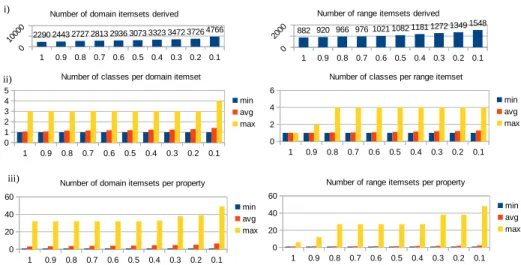
We induced restrictions for 1099 object properties and for1734 datatype properties (see Table 1) for values of τ in the range {1.0, 0.9, 0.8, 0.7, 0.6, 0.5, 0.4, 0.3, 0.2, 0.1} independently of whether domain or range restrictions already exist in DBpedia. Figure 1 shows: i) the number of domain and range itemsets that were induced for different values ofτ (e.g.,2290 domain itemsets (= domain restrictions) were induced forτ = 1.0and920range itemsets (= range restrictions) were induced for τ = 0.9), ii) the minimum, average, and maximal number of classes in itemsets in domain and range, and iii) the minimum, average, and maximum number of itemsets induced per property. It is no surprise that the number of domain itemsets and range itemsets grows when τ is decreased. Also, the number of classes within a frequent itemset and the number of frequent itemsets per property grow whenτ is decreased.
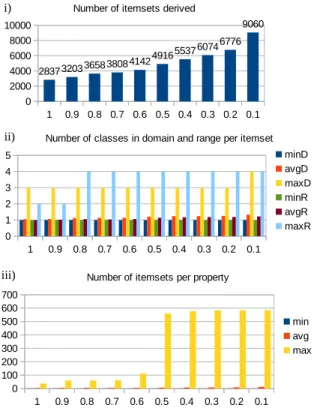
Results from inducing coupled domain/range restrictions are shown in Figure 2. In detail, it shows: i) the number of itemsets that were induced for different values ofτ (e.g., ), ii) the minimum, average, and maximal number of classes in itemsets in domain and range (e.g.,3203itemsets (= coupled domain/range restrictions were induced forτ = 0.9),minD, stands for the minimum number of classes in the sets of domain classes), and iii) the minimum, average, and maximum number of itemsets induced per property.
1 0.9 0.8 0.7 0.6 0.5 0.4 0.3 0.2 0.1 2290 2443 2727 2813 2936 3073 3323 3472 37264766
Number of domain itemsets derived
1 0.9 0.8 0.7 0.6 0.5 0.4 0.3 0.2 0.1 882 920 966 976 1021 1082 1181 12721349 1548
Number of range itemsets derived
1 0.9 0.8 0.7 0.6 0.5 0.4 0.3 0.2 0.1 0 1 2 3 4 5
Number of classes per domain itemset
min avg max 1 0.9 0.8 0.7 0.6 0.5 0.4 0.3 0.2 0.1 0 2 4 6
Number of classes per range itemset
min avg max 1 0.9 0.8 0.7 0.6 0.5 0.4 0.3 0.2 0.1 0 20 40 60
Number of domain itemsets per property
min avg max 1 0.9 0.8 0.7 0.6 0.5 0.4 0.3 0.2 0.1 0 20 40 60
Number of range itemsets per property
min avg max i) ii) iii)
Fig. 1.Basic statistics of induced independent domain and range restrictions.
5
Evaluation
We evaluate the results of both methods:
1. We compare the induced domain (range) restrictions against the domain (range) restrictions that already exist in DBpedia, which we treat as gold
standard.
2. We compare the induced coupled domain/range restrictions against the independent domain and range restrictions that already exist in DBpedia, which we treat as gold standard.
To compare against the gold standard of DBpedia, we selected704object properties and1497datatype properties for which both domain restriction and range restriction are known.
5.1 Evaluation of independent domain and range restrictions
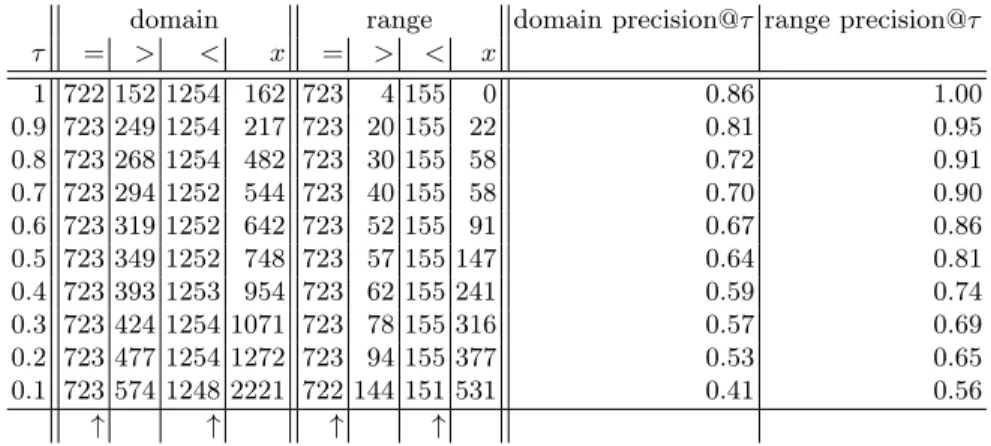
For each domain (range) restriction for which a gold domain (range) restriction exists we compare the induced set of classes against the gold set of classes. This comparison may result in four cases: i) the sets of classes are identical, ii) all induced classes are more specific than all gold classes, iii) all induced classes are less specific than all gold classes, and iv) else (some classes are more specific, some are less specific, some are neither less nor more specific when compared to the gold set). In Table 2 these cases are denoted with=,>,<, and x, respectively. We defineprecision@τ as the number of frequent maximal itemsets derived with the support thresholdτ where either the set of induced classes is the same as the gold classes or where the induced classes are less specific, divided by the number of all frequent maximal itemsets derived with the support thresholdτ. The arrows (↑) in Table 2 mark the columns where this is the case (i.e,=and<).
1 0.9 0.8 0.7 0.6 0.5 0.4 0.3 0.2 0.1 0 2000 4000 6000 8000 10000 28373203365838084142 4916553760746776 9060 Number of itemsets derived
1 0.9 0.8 0.7 0.6 0.5 0.4 0.3 0.2 0.1 0 1 2 3 4 5
Number of classes in domain and range per itemset minD avgD maxD minR avgR maxR 1 0.9 0.8 0.7 0.6 0.5 0.4 0.3 0.2 0.1 0 100 200 300 400 500 600 700
Number of itemsets per property
min avg max i) ii) iii)
Fig. 2.Basic statistics of induced coupled domain/range restrictions.
Table 3 shows an example for each of the four cases i) the induced domains and the gold domains are identical, ii) the induced domains are more specific than gold domains, iii) the induced domains are less specific than the gold domains, and iv) otherwise, denoted with=,>,<, andx, respectively.
5.2 Evaluation of coupled domain/range restrictions
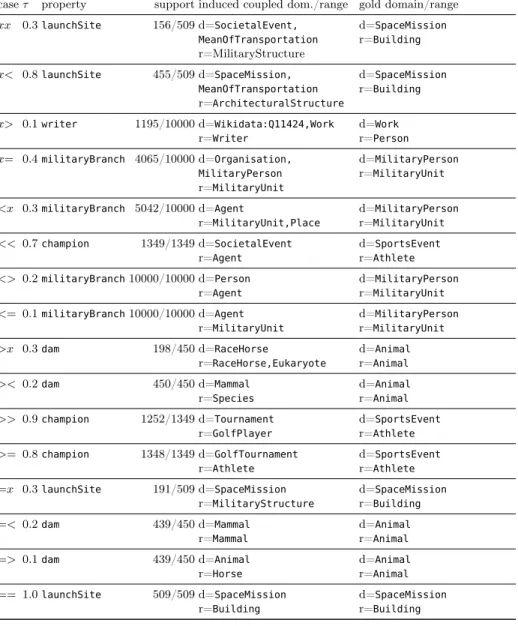
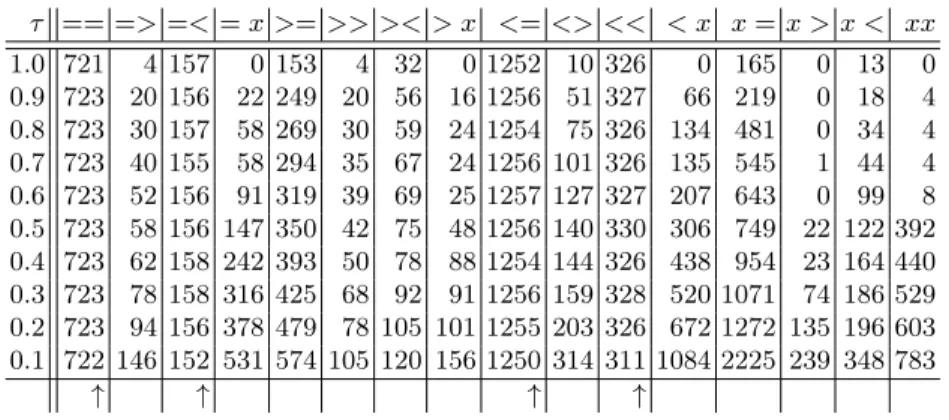
Induced coupled domain/range restrictions were evaluated similarly to the in-dependent domain and range restrictions. However, the number of cases that may occur is not 4 ({=, >, <, x}) but instead 4*4 ({=, >, <, x} × {=, >, <, x}). Table 4 shows an example for each of the 16 possible cases of itemsets with coupled domain and range.
We defineprecision@τ as the number of frequent maximal itemsets derived with the support thresholdτ where either the set of induced domain classes is the same or less specific than the gold domain classes and where the induced range classes is the same or less specific than the gold range classes, divided by the number of all frequent maximal itemsets derived with the support threshold τ. The arrows (↑) in Table 5 mark the columns where this is the case (i.e.,==, =<, <=, and<<). Table 6 shows the precision@τ values.
Table 2.Induced independent domain and range restrictions, the frequency of cases, and precision values.
domain range domain precision@τ range precision@τ τ = > < x = > < x 1 722 152 1254 162 723 4 155 0 0.86 1.00 0.9 723 249 1254 217 723 20 155 22 0.81 0.95 0.8 723 268 1254 482 723 30 155 58 0.72 0.91 0.7 723 294 1252 544 723 40 155 58 0.70 0.90 0.6 723 319 1252 642 723 52 155 91 0.67 0.86 0.5 723 349 1252 748 723 57 155 147 0.64 0.81 0.4 723 393 1253 954 723 62 155 241 0.59 0.74 0.3 723 424 1254 1071 723 78 155 316 0.57 0.69 0.2 723 477 1254 1272 723 94 155 377 0.53 0.65 0.1 723 574 1248 2221 722 144 151 531 0.41 0.56 ↑ ↑ ↑ ↑
Table 3. Examples of induced domain classes and the corresponding gold domain
classes. The entries for the column case correspond to the comparison of induced domains to gold domains, where four cases are possible:=(the induced domain classes are identical with the gold domain classes),>(the induced domain classes are more specific than gold domain classes),<(the induced domain classes are less specific than gold domain classes), andx(otherwise).
caseτ property support induced domain gold domain
= 1.0dbo:leftTributary 4881/4881dbo:River dbo:River
> 0.5dbo:composer 5847/10.000dbo:TelevisionShow dbo:Work < 1.0dbo:chef 54/54dbo:ArchitecturalStructuredbo:Restaurant x 0.8dbo:launchSite 45/509dbo:MeanOfTransportation dbo:SpaceMission
Note that the precision of induced coupled restrictions (Table 2) tends to be below the precision of induced independent restrictions (Table 6). The main reason for the lower precision is that domain and range classes of coupled domain/range restrictions are often more specific than the gold domain and range classes. See for example Table 4 case>>. Adding restrictions with classes that are too specific to a knowledge graph would result in wrong entailment. For example, by adding the restriction (dbo:champion, rdfs:range, dbo:GolfPlayer), from every triple with that property we can then infer via RDFS entailment that the object of the triple is an instance of the class dbo:GolfPlayer – in other words: every champion is a golf player. However, these specific classes are helpful as heuristics for certain Natural Language Processing tasks as motivated in the introduction.
Table 4.Examples of induced coupled domain and range classes and the corresponding gold classes. The namespace prefix (dbo) has been consistently omitted.dcorresponds to domain restriction andrto range restriction. The entries for the columncasecorrespond to the comparison of induced domains to gold domains and induced ranges to gold ranges, respectively, where for each comparison four cases are possible:=(the induced classes are identical with the gold classes),>(the induced classes are more specific than gold classes),<(the induced classes are less specific than gold classes), andx (otherwise).
caseτ property support induced coupled dom./range gold domain/range xx 0.3launchSite 156/509 d=SocietalEvent, MeanOfTransportation r=MilitaryStructure d=SpaceMission r=Building x< 0.8launchSite 455/509 d=SpaceMission, MeanOfTransportation r=ArchitecturalStructure d=SpaceMission r=Building x> 0.1writer 1195/10000 d=Wikidata:Q11424,Work r=Writer d=Work r=Person x= 0.4militaryBranch 4065/10000 d=Organisation, MilitaryPerson r=MilitaryUnit d=MilitaryPerson r=MilitaryUnit <x 0.3militaryBranch 5042/10000 d=Agent r=MilitaryUnit,Place d=MilitaryPerson r=MilitaryUnit << 0.7champion 1349/1349 d=SocietalEvent r=Agent d=SportsEvent r=Athlete <> 0.2militaryBranch10000/10000 d=Person r=Agent d=MilitaryPerson r=MilitaryUnit <= 0.1militaryBranch10000/10000 d=Agent r=MilitaryUnit d=MilitaryPerson r=MilitaryUnit >x 0.3dam 198/450 d=RaceHorse r=RaceHorse,Eukaryote d=Animal r=Animal >< 0.2dam 450/450 d=Mammal r=Species d=Animal r=Animal >> 0.9champion 1252/1349 d=Tournament r=GolfPlayer d=SportsEvent r=Athlete >= 0.8champion 1348/1349 d=GolfTournament r=Athlete d=SportsEvent r=Athlete =x 0.3launchSite 191/509 d=SpaceMission r=MilitaryStructure d=SpaceMission r=Building =< 0.2dam 439/450 d=Mammal r=Mammal d=Animal r=Animal => 0.1dam 439/450 d=Animal r=Horse d=Animal r=Animal == 1.0launchSite 509/509 d=SpaceMission r=Building d=SpaceMission r=Building
Table 5.Induced coupled domain/range restrictions and the frequency of cases. τ == =>=<=x >=>> >< > x <=<> << < x x=x > x < xx 1.0 721 4 157 0 153 4 32 0 1252 10 326 0 165 0 13 0 0.9 723 20 156 22 249 20 56 16 1256 51 327 66 219 0 18 4 0.8 723 30 157 58 269 30 59 24 1254 75 326 134 481 0 34 4 0.7 723 40 155 58 294 35 67 24 1256 101 326 135 545 1 44 4 0.6 723 52 156 91 319 39 69 25 1257 127 327 207 643 0 99 8 0.5 723 58 156 147 350 42 75 48 1256 140 330 306 749 22 122 392 0.4 723 62 158 242 393 50 78 88 1254 144 326 438 954 23 164 440 0.3 723 78 158 316 425 68 92 91 1256 159 328 520 1071 74 186 529 0.2 723 94 156 378 479 78 105 101 1255 203 326 672 1272 135 196 603 0.1 722 146 152 531 574 105 120 156 1250 314 311 1084 2225 239 348 783 ↑ ↑ ↑ ↑
Table 6.Precision@τ for induced coupled domain/range restrictions.
τ 1.0 0.9 0.8 0.7 0.6 0.5 0.4 0.3 0.2 0.1 precision@τ 0.87 0.77 0.67 0.65 0.59 0.50 0.44 0.41 0.36 0.27
6
Related Work
Our approach is an extension of a method for statistical schema induction from RDF data introduced by Völker and Niepert [9] which we discuss in detail in Section 3.1. Besides inducing domain and range restrictions of prop-erties, in their work further axioms are induced such as subsumption axioms (e.g., (ex:A, rdfs:subClassOf, ex:B)) and transitivity axioms (e.g., (ex:P,
rdf:type, owl:TransitiveProperty)). This work was subsequently extended in [4] and [5] with further types of axioms. The main difference to this work is that we induce independent domain and range restrictions as well as coupled domain/range restrictions whereas in these works only independent domain and range restrictions are induced. However, all methods are based on Frequent Itemset Mining and only differ in some technical details, such as, how the set of classes an entity belongs to are created (e.g., whether equivalent classes (via owl:equivalentClass), superclasses (via rdfs:subClassOf), and existing do-main and range restrictions are regarded). In both approaches the sets of classes are approximated and it cannot be guaranteed that the sets are complete since data is accessed via SPARQL only. As long as endpoints do not support RDFS and OWL entailment, or as long as not all inferences are materialized, some classes may be missing.
Instead of inducing domain and range restrictions from RDF data, restrictions can also be induced from unstructured data. In [3], Cimiano et al. derive the classes of arguments of verbs from natural language text, which can be seen as a subtask in the context of ontology learning from text. Since in their work verbs are interpreted as binary relations, what they induce are domain and range restrictions. Given an existing taxonomy, for the domain and the range of a
property the appropriate level in the taxonomy is selected considering the classes’ conditional probabilities. Interestingly, the authors note that "the domain and range of a relation can actually not be regarded as independent from each other," which is exactly what we do in this paper. However, due to a lack of training data, they refrain from regarding coupled domain/range restrictions.
In [8], Töpper et al. induce domain and range restrictions as well as class disjointness axioms from RDF data for the purpose of enabling to detect logical inconsistencies via reasoning. In their work, the domain (range) of a property is the class that most of the subjects (objects) in triples with this property belong to. This has the drawback that if for a property entities belonging to several diverse classes appear in subject (object) position, then the induced domain (range) restriction only regards the most specific superclass of these classes. While this is not wrong, for Natural Language Processing more fine-grained domain and range restrictions are interesting.
7
Conclusion
In this paper we presented the concept of coupled domain/range restrictions and presented an approach to apply Frequent Itemset Mining to induce independent domain and range restrictions as well as coupled domain/range restrictions from an RDF graph. Experiments carried out with the DBpedia dataset showed that high precision can be achieved. We believe that these restriction statements can be beneficially applied in Natural Language Processing scenarios such as Semantic Parsing, Question Answering, and Entity Classification. Therefore, all data obtained as well as our implementation is available to the community on a dedicated website.
Acknowledgements
This work was supported by the Cluster of Excellence Cognitive Interaction Technology ’CITEC’ (EXC 277) at Bielefeld University, which is funded by the German Research Foundation (DFG).
References
1. S. Auer, C. Bizer, G. Kobilarov, J. Lehmann, R. Cyganiak, and Z. Ives. DBpedia: A Nucleus for a Web of Open Data. In6th International Semantic Web Conference (ISWC 2007), pages 722–735. Springer, 2007.
2. C. Borgelt. Frequent item set mining. Wiley Interdisciplinary Reviews: Data Mining and Knowledge Discovery, 2(6):437–456, 2012.
3. P. Cimiano, M. Hartung, and E. Ratsch. Finding the appropriate generalization level for binary ontological relations extracted from the genia corpus. In5th International Conference on Language Resources and Evaluation (LREC 2006), pages 161–169. Citeseer, 2006.
4. D. Fleischhacker and J. Völker. Inductive Learning of Disjointness Axioms. InOn the Move to Meaningful Internet Systems (OTM 2011), pages 680–697. Springer, 2011.
5. D. Fleischhacker, J. Völker, and H. Stuckenschmidt. Mining RDF Data for Property Axioms. InOn the Move to Meaningful Internet Systems (OTM 2012), pages 718–735. Springer, 2012.
6. P. Fournier-Viger, A. Gomariz, T. Gueniche, A. Soltani, C.-W. Wu, V. S. Tseng, et al. SPMF: a Java open-source pattern mining library. Journal of Machine Learning Research, 15(1):3389–3393, 2014.
7. J. Leskovec, A. Rajaraman, and J. D. Ullman. Mining of Massive Datasets, 2nd Ed. Cambridge University Press, 2014.
8. G. Töpper, M. Knuth, and H. Sack. DBpedia Ontology Enrichment for Inconsistency Detection. In8th International Conference on Semantic Systems 2012 (i-Semantics 2012), pages 33–40. ACM, 2012.
9. J. Völker and M. Niepert. Statistical Schema Induction. In8th Extended Semantic Web Conference (ESWC 2011), pages 124–138. Springer, 2011.