On Fully Homomorphic Encryption
Prastudy Fauzi
Master in Security and Mobile Computing Supervisor: Danilo Gligoroski, ITEM
Co-supervisor: Helger Lipmaa, University of Tartu
Department of Telematics Submission date: June 2012
Problem Description
Name of student: Prastudy Mungkas FauziThe student will analyse the most recent developments in fully homomorphic encryp-tion. The student will start with the basic mathematical concepts used in the latest fully homomorphic cryptosystems based on learning with errors, and the main ideas common to these cryptosystems. Later, the student will make a comparison of the latest schemes and discuss some possible improvements. The student will conclude with some possible applications of fully homomorphic encryption.
Assignment given : 15 January 2012
Supervisor : Dr. Helger Lipmaa, Prof. Danilo Gligoroski
Abstract
In this thesis, we do a survey of the most recent fully homomorphic encryption schemes. We study some of the latest fully homomorphic encryption schemes, make an analysis of them and make a comparison. We start with Gentry’s scheme, which was the first fully homomorphic encryption scheme, and choose four other fully homomorphic encryption schemes to analyze. We discuss the main ideas of each scheme, and how each scheme improves upon the previous ones. Whenever possible, we rewrite the main results of these schemes in a more detailed and readable format.
Contents
Abstract 2 Contents 3 Acknowledgements 6 1 Introduction 7 1.1 Problem Statement . . . 7 1.2 Outline . . . 9 1.3 Author’s Contribution . . . 9 2 Preliminaries 11 2.1 Basic Definitions . . . 112.1.1 Elementary Number Theory. . . 11
2.1.2 Algebraic Structures.. . . 12
2.1.3 Inner Products. . . 14
2.1.4 Norms. . . 14
2.1.5 Expansion Factor. . . 14
2.1.6 Negligible Functions. . . 15
2.2 Definitions from Lattice Theory . . . 15
2.2.1 Lattice. . . 15
2.2.2 Shortest Vector Problem. . . 15
2.2.3 GapSVP. . . 16
2.3 Learning With Errors . . . 16
2.4 Ring Learning With Errors . . . 16
2.5 Public Key Cryptosystem . . . 17
2.6 Probabilistic Encryption . . . 17
2.7 Homomorphic Encryption . . . 18
2.7.1 Definition . . . 18
2.7.2 Homomorphic Under Addition: Paillier . . . 19
2.7.3 Homomorphic Under Multiplication: ElGamal . . . 20
3 Recent Developments 22 3.1 Fully Homomorphic Encryption . . . 22
3.2 Gentry’s Scheme [Gen09] . . . 22
3.3 Brakerski and Vaikuntanathan’s Scheme [BV11]. . . 23
CONTENTS 4
3.3.1 Overview . . . 23
3.3.2 Encryption Scheme . . . 23
3.3.3 Ideas . . . 24
3.3.3.1 Relinearization (Key Switching). . . 24
3.3.3.2 Modulus Switching. . . 25
3.3.4 Analysis . . . 25
3.4 Brakerski, Gentry and Vaikuntanathan’s Scheme [BGV12] . . . 26
3.4.1 Overview . . . 26
3.4.2 Encryption Scheme . . . 26
3.4.3 Ideas . . . 27
3.4.3.1 Key Switching (Dimension Reduction). . . 27
3.4.3.2 Modulus Switching. . . 28
3.4.4 Analysis . . . 29
3.5 Brakerski’s Scheme [Bra12] . . . 29
3.5.1 Overview . . . 29
3.5.2 Encryption Scheme . . . 29
3.5.3 Ideas . . . 31
3.5.3.1 Homomorphic properties. . . 31
3.5.3.2 Vector Decomposition and Key Switching. . . 32
3.5.4 Analysis . . . 32
3.6 Fan and Vercauteren’s Scheme [FV12] . . . 32
3.6.1 Overview . . . 32 3.6.2 Encryption Scheme . . . 32 3.6.3 Ideas . . . 34 3.6.3.1 Homomorphic Properties . . . 34 3.6.3.1.1 Additive homomorphism. . . 34 3.6.3.1.2 Multiplicative homomorphism. . . 34 3.6.3.2 Relinearization. . . 35 3.6.3.2.1 Relinearization version 1. . . 36 3.6.3.2.2 Relinearization version 2. . . 36
3.6.3.3 Redefinition of homomorphic multiplication. . . 36
3.6.3.4 Towards Fully Homomorphic Encryption. . . 37
3.6.3.4.1 Optimized case: q = 2n and t= 2n−k, k >0. . . 37
3.6.3.4.2 General Case. . . 37
3.6.4 Analysis . . . 37
3.7 Comparison of Fully Homomorphic Encryption Schemes . . . 38
4 Possible Improvements 41 4.1 Finding a Good Upper Bound for the Expansion Factor . . . 41
4.2 Batching. . . 41
5 Applications 42 5.1 Secure two-party computation [DFH12] . . . 42
5.2 Oblivious databases [LNV11, BV11] . . . 42
CONTENTS 5
References . . . 46
Acknowledgements
I would like to thank my main supervisor Helger Lipmaa for the time and effort he has put into guiding me in my work. He has continually given me valuable feedback on which recent work to take a closer look upon, which details I am missing from my work, how to write correctly in LaTeX and, along with Bingsheng Zhang, engaged me in informative discussions on lattice-based cryptography in general, and fully homomorphic encryption in particular. I would also like to thank my second supervisor Danilo Gligoroski for his feedback in writing this master’s thesis.
Chapter 1
Introduction
1.1
Problem Statement
Cryptography, generally speaking, is the study of secret writing. As such, one important aspect of cryptography is encryption, which is the process of converting readable infor-mation into something unreadable. The readable inforinfor-mation is known as plaintext, the unreadable output is known as ciphertext, and the conversion is done using a so called encryption algorithm. Encryption requires additional information to perform, which is known as the encryption key. For encryption to be useful, there must be a way to convert the ciphertext back to the plaintext. This process is called decryption, and it usually requires some additional knowledge that only privileged parties have access to, which is called the decryption key.
The decryption key used in a decryption algorithm may or may not be the same as the encryption key. When the decryption key is the same as the encryption key, we have symmetric encryption. When these two keys are different, we have public-key encryption. There are then two types of cryptography based on the type of encryption used: symmetric cryptography and public-key cryptography.
Symmetric cryptography is typified by the use of a common key between the sender and receiver. The most used encryption schemes today in symmetric cryptography are known to be very efficient, but difficult to break in a short amount of time. However, symmetric cryptography has some drawbacks. The main challenge is distributing the common key: the sender and receiver must somehow ensure that they share the same key, and that in the process of sharing this key no other party knows anything about it. This will be true for every pair of parties who want to communicate, meaning every party will also have to store many common keys. For security reasons, a common key is used for only a short amount of time, usually called one session.
Public-key cryptography, meanwhile, uses two different keys: a public key and the secret key. A public key is published by a party who wants to receive a message, and has the corresponding secret key that no one else knows. The public key and secret key are mathematically related in such a way that even if a party knows another party’s public key, finding out the corresponding secret key is extremely difficult. The main advantage of public key cryptography is that key distribution is very easy. A party only
CHAPTER 1. INTRODUCTION 8
has to publish his public key to a common server that all parties trust, and anyone who wants to communicate simply uses this public key to send messages. However, public key encryption schemes are much less efficient than symmetric encryption schemes.
Encryption started out as a tool used mainly for military purposes, that is to send secret messages containing military information. Over time, it has been used much more widely. We use encryption very frequently in everyday life, from doing transactions with our favourite bank, to communicating privately with other individuals using email or instant messaging. One interesting use of encryption is in cloud computing. At a glance, it seems to be a very convenient way to store data and use cloud services to make use of the data. However, current implementations of cloud computing require a user to trust the cloud provider, who can get access to a user’s private data if required. Storing the data in an encrypted form does not help, as the cloud service will not be able to do most of its operations on encrypted data without decrypting it first. If it were possible to store the data in an encrypted form while still enabling the cloud services to do operations on it, this trust requirement could be removed. Fully homomorphic encryption is a way of solving this challenge.
Fully homomorphic encryption is an encryption scheme where a party can receive encrypted data and perform arbitrary operations on this data efficiently. The data remains encrypted throughout, but the operations can be done regardless, without having to know the decryption key. Such a scheme would be very advantageous, for example in ensuring the privacy of data that is sent to a third-party service. This is in contrast with schemes like Paillier [Pai02] where you can not perform a multiplication of encrypted data without decrypting the data first, or ElGamal [Gam84] where you can not perform an addition of encrypted data without decrypting the data first.
Fully homomorphic encryption is a very new area of research: the first such scheme was constructed by Gentry [Gen09] in 2009. Gentry’s scheme used ideals over polynomial rings, with security related to that of ideal lattices. Gentry’s idea consists of two parts. First, define addition and multiplication on the ciphertext, in this case ordinary addition and multiplication over a polynomial ring. This will create a somewhat homomorphic scheme, which can evaluate circuits of additions and multiplications up to a certain depth. However, every multiplication operation increases the noise by a significant amount, meaning that at some point the noise will be too big. The second idea tries to solve this by doing noise reduction. Gentry modified his scheme to be bootstrappable, that is it can evaluate its own decryption circuit. He then showed that any somewhat homomorphic scheme that is bootstrappable can be changed into a fully homomorphic scheme, as by the use of bootstrapping, the noise in any ciphertext can be reduced to be the same noise of evaluating the decryption circuit.
Since Gentry’s breakthrough, there have been many advances inspired by Gentry’s work. The latest fully homomorphic encryption schemes use public key cryptography and are based on lattices. Lattice-based cryptography is gaining more interest due to its security against quantum computers, and its worst case security guarantee. However, the main problem remains: the schemes do not yet have an efficient implementation that still maintains adequate security requirements. Seen in this light, recent advances in fully homomorphic encryption either improves the efficiency of previous schemes, or proposes
CHAPTER 1. INTRODUCTION 9
a new scheme with better efficiency.
1.2
Outline
The work in this thesis consists of three parts. First, we will look at the preliminary knowledge required to understand the later sections on fully homomorphic encryption. We start with definitions on algebraic number theory, lattice theory, and public key encryption. We then move to an important security assumption named learning with errors. Learning with errors is a lattice-based security assumption introduced in [Reg05], and it can be shown to be related to the hardness of the shortest vector problem in lattice theory.
Second, we will discuss in detail the most recent fully homomorphic encryption schemes. The main elements that will be analyzed here are the use of learning with errors and its variant ring-learning with errors, and techniques such as key switching and modulus reduction. We will also show how each scheme improves upon the previous schemes that we have discussed.
One work we start with is the scheme of Brakerski and Vaikuntanathan [BV11], which improves upon Gentry’s scheme by the introduction of relinearization and mod-ulus switching, removing the need of a squashing step. We continue with the scheme of Brakerski, Gentry, and Vaikuntanathan [BGV12], which improves upon Brakerski and Vaikuntanathan’s scheme by having a general scheme that can be used both in the learning with errors setting, or its ring variant, and by improving the relinearization and modulus switching techniques to obtain fully homomorphic encryption without boot-strapping. We will then continue with Brakerski’s scheme [Bra12], which uses Regev’s LWE-based scheme under the invariant perspective, and modulus switching is not re-quired. Finally, we focus on Fan and Vercauteren’s scheme [FV12], that implements Brakerski’s scheme in the ring learning with errors setting, improving its efficiency.
Apart from Gentry’s scheme, the schemes that we choose to discuss are very new. Brakerski and Vaikuntanathan’s scheme [BV11] was published in October 2011, Brak-erski, Gentry, and Vaikuntanathan’s scheme [BGV12] was published in January 2012, while both Brakerski’s work [Bra12] and Fan and Vercauteren’s work [FV12] are still only available as eprints.
Third, we will analyze and compare the bounds, size and complexity of the chosen schemes. A discussion of possible improvements for future work, and a look of possible applications of fully homomorphic encryption will also be included.
1.3
Author’s Contribution
This work acts as a survey of the most recent fully homomorphic encryption schemes. We study some of the latest fully homomorphic encryption schemes, make an analysis of them and make a comparison. Whenever possible, we rewrite the main results of these schemes in a more detailed and readable format. This includes the proof of Lemma 3.4.1, Lemma 3.4.2, Lemma 3.5.1, Lemma 3.5.2, and Lemma 3.6.1, the observations of
CHAPTER 1. INTRODUCTION 10
the performance for each of the schemes, and the comparison of the schemes. We hope this work can help readers be up to date with the field of fully homomorphic encryption, paving way to further advances in the field.
For the author, this work will serve as a foundation for ongoing and future work. One direction we are working on is finding a tighter bound for the expansion factor than those used in [BGV12]. This will be discussed in Section 4.1. Another way to proceed is to go deeper into the idea of batching, which will be discussed in Section 4.2. A third way is to improve the bounds given in [FV12], which is the most recent result we focus on in this work.
Chapter 2
Preliminaries
Before we go into the encryption schemes, we will give an overview of the mathematical concepts used in the later sections. This will mostly consist of definitions in algebraic number theory and lattice theory, then continue with learning with errors and its ring variant.
2.1
Basic Definitions
2.1.1 Elementary Number Theory.
Letn, xbe positive integers. The division algorithm states that there are unique integers a, bsuch that
x=an+b,with−n 2 < b≤
n 2.
Ifb= 0, we say thatndividesx, and that nis adivisorofx. Ifx has no divisors except 1 andx itself, we say thatx isprime.
Define [x]n =b, where b∈Zn satisfies the above requirement. Moreover, if we have
values c= (c1,· · · , ck) withc1, . . . , ck∈Z, define
[c]q= ([c1]q, . . . ,[ck]q) = (c01, . . . , c 0 k),with− q 2 < c 0 i ≤ q 2. Letabe a real number. Then we define three operations below:
• Define the floor function bac to be the largest integer which is not larger than a. This is also known as the integer part ofa.
• Define the ceiling functiondae to be the smallest integer which is not smaller than a.
• Define the round functionbae to be the closest integer toa. For example,b1.49c=b1.49e= 1, and d1.51e=b1.51e= 2.
Given two integers a, bnot both zero, we define the two operations below:
• Define thegreatest common divisorof aand b, denotedgcd(a, b), to be the largest positive integer that divides both aand b.
CHAPTER 2. PRELIMINARIES 12
• Define thelowest common multipleofaandb, denotedlcm(a, b), to be the smallest positive integer that is both a multiple ofaand a multiple of b.
For example,gcd(9,12) = 3,gcd(2,7) = 1, lcm(9,12) = 36, and lcm(2,7) = 14.
When gcd(a, b) = 1, we say that a and bare relatively prime. For example, 2 and 7 are relatively prime, but 9 and 12 are not relatively prime.
For a positive integer n, define Euler’s totient function φ(n) to be the number of positive integers not greater thannbut relatively prime ton. For example, 6 is relatively prime to 1 and 5, but not relatively prime to 2,3,4, or 6, soφ(6) = 2.
We will present two theorems related to the totient function, which will be used in later sections. The first one is useful to computeφ(n), while the second one is useful to simplify modular exponentiation.
Theorem 2.1.1 Let nbe a positive integer which can be written as n=pa1
1 ·p
a2
2 · · ·p
ak
k ,
where p1, p2, . . . , pk are the k distinct prime factors of n. Then we have
φ(n) =n·(1− 1 p1 )·(1− 1 p2 )· · ·(1− 1 pk ).
Theorem 2.1.2 (Euler’s Theorem) Let n, a be positive integers which are relatively prime. Then
aφ(n)≡1 (modn).
For a positive integer n, define the Carmichael function λ(n) to be the smallest positive integer msuch that
am≡1 (modn).
for an integer arelatively prime to n.
Carmichael’s theorem is a way to easily computeλ(n).
Theorem 2.1.3 (Carmichael’s Theorem) Letn be a positive integer. Then
λ(n) = φ(n), n= 2,4, pk,2pk, podd prime, λ(n) = 1 2φ(n), n= 2 k, k≥3,and λ(lcm(a, b)) = lcm(λ(a), λ(b)). 2.1.2 Algebraic Structures.
A group(G,+) is an algebraic structure where:
1. The operation (+) is closed and associative in G,
2. There exists an identity element 0 ∈ G and inverse element −a for each element a∈G.
CHAPTER 2. PRELIMINARIES 13
If the operation (+) is also commutative, we say that (G,+) is anabelian group. For an integernand an elementg∈G, definengto be the result of:
• g+g+· · ·+g(ntimes), whenn >0,
• (−g) + (−g) +· · ·+ (−g) (−ntimes), when n <0, or • 0, when n= 0.
If every elementa∈Gcan be written asa=ng for somen∈Z, we say that (G,+) is a
cyclic group. In this case,g is said to be ageneratorof the group.
A ring(R,+,·) is an algebraic structure that satisfies the following conditions: 1. (R,+) is an abelian group.
2. (R,·) is associative.
3. The distributive laws apply to (R,+,·).
We usually work with rings which are commutative and have an identity element under the operation (·).
Given a ring (R,+,·), a subset I of R is called an ideal if it satisfies the following conditions:
1. (I,+) is a subgroup of (R,+).
2. For any two elementsx∈I, r∈R,x·r∈I and r·x∈I.
For example, in the ringR=Z, the idealI = 2Zis the set of even integers.
Givena∈R and an ideal I, we can define the equivalence class
[a] ={a+x|x∈I}.
Then [a] = [b] ⇐⇒ a−b ∈ I. The set of all distinct equivalence classes is the
quotient ring R/I. For example, in the ring R = Z, with ideal I = 2Z, the quotient
ring R/I = Z/2Z has two equivalence classes [0] = {. . . ,−4,−2,0,2,4, . . .} and [1] =
{. . . ,−3,−1,1,3. . .}.
A field (F,+,·) is a commutative ring which under (·) has an identity element and inverses. (F,+,·) is a field iff (F,+) and (F − {0},·) are both abelian groups and the distributive laws apply. We will mostly use the fieldsZq (whereq is a prime number) and
GF(2) (the Galois field of two elements), which is mostly used for studying arithmetic circuits with operations XOR and AND. Here, XOR is associated with the addition operator, while AND is associated with the multiplication operator.
Apolynomial ringF[X] is a ring formed from a set of polynomials in the variableX, where the coefficients are from a fieldF. Iff(X) =adXd+· · ·+a1X+a0 ∈F[X] is an
irreducible polynomial, we have the quotient ringR=F[X]/(f(X)). Moreover, whenF is the field Zq we write Rq =Zq[X]/(f(X)). Additionally, if we have that f has degree
CHAPTER 2. PRELIMINARIES 14
2.1.3 Inner Products.
Let V be an n-dimensional vector space over a field F. For a = (a1, . . . , an)T,b =
(b1, . . . , bn)T ∈V, define the inner product
ha,bi=
n X i=1
aibi.
We will mostly use the polynomial ringR[x] =Zq[x]/(f(x)), wheref is a monic
polyno-mial (polynopolyno-mial with leading coefficient 1) with degreed. In this case,
a= d−1 X i=0 aixi,b= d−1 X i=0 bixi. 2.1.4 Norms. Lets= d X i=0
sixi be an element of a polynomial ringR. Define the Euclidean norm
ksk2= v u u t d X i=0 s2i,
and theinfinity norm
ksk∞= maxi|si|.
Also, forx∈Rn, we define the `1-norm
`1(x) =
n X i=1
kxik2.
We will be using norms in many of the inequalities in this work. For that reason, we will give two well-known inequalities related to norms that we will be using often in the following sections.
Theorem 2.1.4 (Triangle Inequality) Given two vectors a,bof the same size, we have that
ka+bk ≤ kak+kbk.
Theorem 2.1.5 (Cauchy-Schwarz) Given two non-zero vectors a,b of the same size, we have that
|ha, bi| ≤ kakkbk,
where equality holds if and only if a=kbfor some scalar k.
2.1.5 Expansion Factor.
LetR be a polynomial ring. The expansion factor of R is defined as γR= max{
ka·bk2 kak2kbk2
:a, b∈R}.
When R=Z[x]/(xd+ 1), we can prove using Cauchy-Schwarz thatγR≤
√ d.
CHAPTER 2. PRELIMINARIES 15
2.1.6 Negligible Functions.
A function f :N → R is negligible if for every positive integer c there exists an integer
N =N(c) such that for all x > N,
|f(x)| ≤ 1
xc.
We usually denote negligible functions asnegl(x).
2.2
Definitions from Lattice Theory
Lattice theory is a study of mathematical structures called lattices. They have many interesting applications in cryptography, and as we will see, some lattice problems have convenient properties in terms of complexity.
2.2.1 Lattice.
A latticeis a set of points in n-dimensional space with a periodic structure. As such, it is a discrete subgroup of Rnunder addition of vectors in Rn.
Let b1, b2,· · ·, bk be k linearly independent vectors in Rn. Then we can define the
lattice generated by these vectors as
L(b1, b2,· · ·, bk) ={ X
aibi|ai∈Z}
By this definition, {b1, b2,· · ·, bk} form a basis of this lattice, which has dimension k.
Every lattice has a basis, but this basis is not unique. For example, if{b1, b2} is a basis
of a lattice L in R2 then {b1, b1+b2} is also a basis of L. In general, ifB is a basis of
a lattice Lof dimension n, and Un×n is an integer matrix of determinant 1, then BU is
also a basis ofL.
A cryptographic construction using lattices can have strong provable security guar-antees based on the worst-case hardness of lattice problems. This is done by having parameters chosen such that breaking the construction is as hard as solving lattice prob-lems in the worst case [MR08]. One of the most efficient ones are cryptosystems based on learning with errors, which will be discussed later.
2.2.2 Shortest Vector Problem.
One important property of a lattice is the length of the shortest non-zero vector v∈L, denoted as λ1(L). Here we use the Euclidean norm k · k2
This leads to the shortest vector problem (SVP): Given a latticeL with basisB = (b1, b2,· · · , bk), find a vectorv∈Lsuch that v=λ1(L).
The hardness of SVP depends on the basis used. One algorithm that approximate a solution for SVP is the LLL algorithm. The strength of LLL is that it runs in polynomial time, but with a good choice of a basis, the LLL algorithm may reach errors of up to an exponential factor 2O(n), wheren is the dimension of the lattice [MR08].
CHAPTER 2. PRELIMINARIES 16
Figure 2.1: 2-dimensional lattice with base {(1, 0), (1 2, 1 2 √ 3)} 2.2.3 GapSVP.
Another problem related to SVP is to determine whether the length of the shortest non-zero vector inLis at most 1 or larger thanβ >1. This is known as GapSV Pβ: Given a
basisB = (b1, b2,· · · , bk) of a latticeL, decide whether λ1(L)≤1 or λ1(L)> β.
SVP and GapSVP are NP-hard problems, and no efficient quantum algorithm has yet been found that solves these problems or approximates them with a small error [MR08].
2.3
Learning With Errors
Suppose we want to get values of the form (a, b)∈Zn+1
q , wherea∈Znq, b∈Zq. Consider
the two distributions below:
1. Select random values (ai, bi) uniformly fromZnq+1.
2. Uniformly choose s∈ Zn
q. Select random ai uniformly from Znq and ei ∈Zq from
some distributionχ overZq. Setbi =hai, si+ei ∈Zq. Give the values (ai, bi).
The learning with errors assumption LWEn,q,χstates that given samples from the second
distribution, we cannot approximate the value of s. A variant of this problem, the decision learning with errors assumption DLWEn,q,χ states that these two distributions
are indistinguishable. Regev [Reg05] proved that by choosing correct parametersn, q, χ, LWEn,q,χ is as hard as the shortest vector problem, and that LWE and DLWE are
equivalent provided that the primeq is bounded by a polynomial in n.
2.4
Ring Learning With Errors
We will use the variation of ring learning with errors (RLWE) used in [BGV12]. Let λ be the security parameter, and f(x) = xd+ 1 where d = d(λ) is a power of 2. Let
q = q(λ) ≥ 2 be an integer satisfying q ≡ 1 mod d. Let R = Z[x]/(f(x)) and let
Rq =R/qR. Letχ=χ(λ) be some distribution over R.
CHAPTER 2. PRELIMINARIES 17
1. Sample values (ai, bi) uniformly fromR2q.
2. Uniformly choose s ∈Rq. Sample ai uniformly from Rq and ei ∈ R from χ. Set
bi=ai·s+ei ∈Rq. Give the values (ai, bi).
The ring learning with errors assumption RLWEd,q,χstates that these two distributions
are indistinguishable. The importance of the RLWE comes from the fact that by choosing B =ω(√dlogd) and χ that outputs elements of R with length at most B (except for a negligible probability), the worst case shortest vector problem over ideal lattices, which are lattices corresponding to ideals I of polynomial ring R, can be reduced to RLWE [LPR10].
LWE is the more standard assumption and is a harder problem than RLWE, but RLWE can be shown to be more efficient [LPR10]. Notice that LWE uses elements in
Znq+1, but RLWE only uses elements in Rq2. This means that RLWE uses smaller keys,
and arithmetic inRq is more efficient.
2.5
Public Key Cryptosystem
A public key cryptosystem consists of three elements: key generation, encryption, and decryption.
• Key generation is the process of generating a public key and secret key pair for encryption and decryption. It requires a security parameterλ, typically the size of the resulting public key.
• Encryption is the function that maps a plaintext into a ciphertext, using a public key. The domain of this encryption function is called plaintext space.
• Decryption is the function that maps a ciphertext back into plaintext, using a secret key.
A public key cryptosystem with a key generation algorithm KG, encryption algorithm E and decryption algorithm D can then be written as (KG, E, D).
2.6
Probabilistic Encryption
Aprobabilistic encryption schemeis an encryption scheme which introduces randomness in the encryption algorithm. This is done so that encrypting the same message more than once will result in different ciphertexts, making it difficult to detect two different encryptions of the same message. The randomness factor introduced in the encryption of a particular message is often called thenoise. We defineEpk(m;r) to be an encryption of
a messagem using the encryption algorithmE and public keypk, with noise parameter r.
For a probabilistic public key cryptosystem (KG, E, D) and adversary A, and let λ be the security parameter. Consider the following two games:
CHAPTER 2. PRELIMINARIES 18
1. Game 1:
• Set (pk, sk)←KG(1λ). • Get (m1, m2) ←A(pk).
• OutputEpk(m1;r) for random noise r.
2. Game 2:
• Set (pk, sk)←KG(1λ). • Get (m1, m2) ←A(pk).
• OutputEpk(m2;r) for random noise r.
(KG, E, D) is indistinguishable under chosen plaintext attack (IND-CPA) if for all ad-versaries A running in polynomial time, there is no way to distinguish between these two games except with negligible probability. That is, for all adversaries Aand security parameterλ, there exists a negligible functionf such that:
|P r[A= 1 : Game 1]−P r[A= 1 : Game 2]| ≤f(λ).
2.7
Homomorphic Encryption
We will give the definition of homomorphic encryption under addition and multiplication, and show two schemes that do not quite match the criteria: homomorphic under one operation but not the other.
2.7.1 Definition
Let the plaintext space P have ”addition” operator + , and ”multiplication” operator ×, and let the ciphertext space C have ”addition” operator ⊕ , and ”multiplication” operator⊗. Let E :P → C be a probabilistic encryption scheme, andD :C → P the corresponding decryption scheme.
A public key cryptosystem (KG, E, D) is homomorphic under addition and multiplica-tion, if
D(E(a)⊕E(b)) =a+b and
D(E(a)⊗E(b)) =a×b for all a, b∈P.
In general, an encryption scheme homomorphic under addition and multiplication has a homomorphic evaluation function f : Cn → C that when decrypted will result in a corresponding function g : Pn → P where D(f(c1,· · · , cn)) = g(p1,· · · , pn) with
ci =E(pi), andg isf with⊕ replaced by +,⊗replaced by×.
Typically, we use a public key encryption scheme with public key pk and secret key sk, and the evaluation functionf might also need an evaluation key evk. These keys are generated by a key generator (pk, sk, evk)←KG(1λ), whereλis the security parameter. In this case, the encryption function is Epk:P →C.
CHAPTER 2. PRELIMINARIES 19
2.7.2 Homomorphic Under Addition: Paillier
Paillier is a public key cryptosystem that relies on the Decisional Composite Residuosity Assumption (DCRA) [Pai02]: given a composite integernand integerx∈Zn2, it is hard
to decide whether or not there is a y∈Zn2 such that
x≡yn (mod n2).
Key generation in Paillier is as follows:
1. Generate distinct prime numbers of the same size p, q, and let n = p·q. Ensure thatnis an integer where DCRA holds.
2. Setλ=lcm(p−1, q−1). The public key isn.
3. For the corresponding secret key, compute, µ = λ−1 mod n The secret key is (λ, µ).
To encrypt a messagem∈Zn, we do the following:
1. Select a random r∈Z∗
n.
2. Output the ciphertextE(m;r) = (n+ 1)mrn mod n2.
Under the DCRA assumption, this scheme is IND-CPA secure.
To decrypt a ciphertext c ∈ Z∗n2, simply compute m = L(cλ mod n2)·µ, where L
is the discrete logarithm function. In Paillier, this function can be simplified as L(u) = bu−n1c. Decryption works, because due to Carmichael’s Theorem,
λ(n2) = lcm(λ(p2), λ(q2)) = lcm(p2−p, q2−q) = pq·lcm(p−1, q−1) = n·λ.
So by definitionrn·λ ≡1 (mod n2). So we have
L(cλ mod n2)·µ = L((n+ 1)m·λ·rn·λ mod n2)·µ = L((n+ 1)m·λ mod n2)·µ = m·λ·µ
≡ m (modn).
Note that if we have two ciphertextsE(m0;r0) andE(m1;r1) which are encryptions
ofm0, m1 respectively, then
E(m0;r0)·E(m1;r1) ≡ ((n+ 1)m0r0n)·((n+ 1)m1r1n)
≡ (n+ 1)m0+m1(r
0·r1)n
CHAPTER 2. PRELIMINARIES 20
ThenD(E(m0;r0)·E(m1;r1)) =m0+m1. So Paillier is an additively homomorphic
scheme: given encryptions ofm0 andm1, we can get an encryption ofm0+m1 without
having to know the secret key. However, given encryptions of m0 and m1 there is no
known way of obtaining an encryption of m0·m1 without knowing m0 orm1 first. So
Paillier is not known to be homomorphic under multiplication.
2.7.3 Homomorphic Under Multiplication: ElGamal
ElGamal [Gam84] is a public key cryptosystem that relies on the hardness of the deci-sional Diffie-Hellman (DDH) problem [Bon98]: LetGbe a group with generatorg. Then it is hard to distinguish between the distributionshga, gb, gabiandhga, gb, gciwherea, b, c
are integers chosen randomly from [1,|G|] Key generation in ElGamal is as follows:
1. LetGbe a cyclic group with prime order q, where the DDH assumption holds.
2. Letg be a generator ofGchosen randomly from Z∗q.
3. Generate the secret keys←Zq, and the public key h=gs.
To encrypt a messagem∈G, we do the following:
1. Select a random r←Zq. 2. Compute c1=gr.
3. Compute c2=m·hr.
4. OutputE(m;r) = (c1, c2).
Under the DDH assumption, this scheme is IND-CPA secure [Bon98].
To decrypt a ciphertext c = (c1, c2), compute m = D(c) = c2 ·(cs1)−1. Decryption
works, because
c2·(cs1)−1 = (m·hr)·(gr)−s
= (m·hr)·(gs)−r = (m·hr)·h−r = m.
Note that if we have two ciphertexts E(m0;r0) and E(m1;r1), then
E(m0;r0)·E(m1;r1) = (gr0 ·gr1,(m0·hr0)·(m1·hr1))
= (gr0+r1,(m
0·m1)·hr0+r1)
= E(m0·m1;r1+r2).
Then D(E(m0;r0)·E(m1;r1)) = m0 ·m1. So ElGamal is a multiplicatively
CHAPTER 2. PRELIMINARIES 21
without having to know the secret key. However, given encryptions ofm0 and m1 there
is no known way of obtaining an encryption ofm0+m1 without knowing both m0 and
Chapter 3
Recent Developments
This section will discuss the latest fully homomorphic encryption schemes, and a com-parison of complexities for these schemes. We will start with Gentry’s scheme and his bootstrapping theorem, how bootstrapping could reduce noise and how this theorem was a blueprint for later results, until schemes were found that did not require bootstrapping.
3.1
Fully Homomorphic Encryption
We will use the definitions in [BV11]. A scheme is somewhat homomorphic if it can achieve homomorphism under addition and multiplication, without doing any noise re-duction, i.e., without any process of reducing the size of the noise relative to the size of the ciphertext.
An encryption scheme is compact if there exists a polynomial (over the security parameterλ) p=p(λ) such that the output of the evaluation function is at mostp bits long, regardless off or the number of inputs.
Moreover, an encryption scheme isfully homomorphicif it is compact and homomor-phic for all arithmetic circuits over GF(2).
3.2
Gentry’s Scheme [
Gen09
]
Gentry’s scheme used an idealI of a ringR, where the noiseeis chosen to be an element in I, so that it has the form e = rI for some r ∈ R. This means that the message m is encrypted to m+rI, and decrypting is the process of getting rid of the ideal. The homomorphic properties can be seen from the fact that ifc1 =m1+r1I andc2 =m2+r2I,
then
c1+c2=(m1+m2) + (r1+r2)I
c1c2=(m1+r1I)(m2+r2I) = (m1m2) + (m1r2+m2r1+r1r2I)I.
Notice that after addition, the noise is (r1+r2)I, while after multiplication the noise is
dominated by r1r2I. This means that addition approximately doubles the noise, while
multiplication approximately squares the noise. After a number of operations, the noise will overwhelm the ciphertext and make decryption incorrect. Gentry solved this problem
CHAPTER 3. RECENT DEVELOPMENTS 23
by evaluating the decryption function homomorphically with the ciphertext as input, which will create an equivalent ciphertext which has a small noise again. This is known as bootstrapping, and requires that the decryption function to be efficient, with the decryption circuit as simple as possible.
Gentry’s scheme relied on the hardness assumptions on ideal lattices. The main drawback here is that the field of ideal lattices has not been very well studied. Also, there is a need for a squashing step to reduce the decryption complexity, but requires an additional strong assumption, that is the sparse subset-sum assumption: given a big set of integers S, a modulus M and a target sum t, it is difficult to find a sparse subset of S that sums up to t (modM). However, his work is very significant because it was the first scheme proved to be fully homomorphic, and because of his bootstrapping theorem [Vai11].
A homomorphic encryption scheme E is bootstrappable if it can evaluate its own decryption circuit, and slightly augmented versions of it. A PKE scheme is weakly circular secureif it is IND-CPA secure even for an adversary with additional information containing encryptions of all secret key bits {E(ski)}, where ski is the i-th bit of the
secret keysk. Gentry’s theorem states that ifEis bootstrappable and the PKE is weakly circular secure, thenE can be modified into a fully homomorphic encryption scheme.
This method of starting from a somewhat homomorphic encryption scheme and applying the bootstrapping theorem became a blueprint for many of the subsequent schemes.
3.3
Brakerski and Vaikuntanathan’s Scheme [
BV11
]
3.3.1 Overview
The scheme uses relinearization to make it somewhat homomorphic. The noise is man-aged by modulus switching discussed below. The scheme is then shown to be bootstrap-pable which turns it into a fully homomorphic encryption scheme.
The most significant development of [BV11] compared to Gentry’s scheme is the use of well-known security assumptions based on DLWE, and the introduction of the relin-earization and modulus switching techniques. Modulus switching in particular removes the need of the expensive squashing step used in Gentry’s scheme.
3.3.2 Encryption Scheme
Brakerski and Vaikuntanathan define an LWE-based public key encryption scheme as follows. Let λ be the security parameter, n be a positive integer polynomial in λ, k be a positive integer polynomial in n, and q an odd number sub-exponential in n. Let χ be a noise distribution that produces small numbers. We have the secret key s = (s[1],· · · , s[n])∈Znq and public key (A,v =As+ 2e) where A is ak×nmatrix chosen
uniformly fromZkq×n and eis chosen uniformly fromχk.
j
CHAPTER 3. RECENT DEVELOPMENTS 24
1. Select a random r∈ {0,1}k.
2. Compute a=ATr andb=vTr+m.
3. Output (a, b).
The ciphertext is an element in Znq+1 generated the same way as the distribution we
have seen in Section 2.3. on learning with errors. Thus according to DLWEn,q,χ (where
χ is a uniform distribution over Zq), we can use this scheme a polynomial number of
times with negligible probability that an adversary can guess s.
To decrypt a ciphertext (a, b), we do the following:
1. Compute b0=b− ha,si= 2e+m∈Zq for some noisee.
2. Outputm=b0 mod 2. Decryption works because
b− ha,si = (vTr+m)−(aTs)
= (vTr+m)−(vTr−2eTr) = 2eTr+m
so taking this value modulo 2 results inm.
3.3.3 Ideas
3.3.3.1 Relinearization (Key Switching).
Given a ciphertext (a, b),a = (a[1],· · · , a[n]), consider the linear evaluation function fa,b : Znq → Zq as follows: fa,b(x) = b− ha,xi =b−
n X
i=1
a[i]·x[i] (modq), where the variables are x= (x[1],· · · ,x[n]). Note that m =fa,b(s) (mod 2). Now, one wants to
make an evaluation function which is a combination of additions and multiplications of these f over different ciphertexts (ai, bi).
First note that
f(a,b)(x) +f(a0,b0)(x) = (b− n X i=1 a[i]·x[i]) + (b0− n X i=1 a0[i]·x[i]) = (b+b0)− n X i=1
(a[i] +a0[i])·x[i] = f(a+a0,b+b0)(x),
so addition in f is homomorphic.
However, multiplication seems problematic, as f(a,b)(x)·f(a0,b0)(x) = (b− n X i=1 a[i]·x[i])·(b0− n X i=1 a0[i]·x[i]) = h0+ n X i=1 hi·x[i] + X 1≤i≤j≤n hi,j·x[i]x[j],
CHAPTER 3. RECENT DEVELOPMENTS 25
where
h0 = bb0,
hi = −(ba0[i] +b0a[i]),
hi,j = a[i]a0[j] +a[j]a0[i].
The problem here is that the number of coefficients is 1 +n+ n+12 = (n+1)(2n+2), so the ciphertext becomes quadratic in the size ofs.
This can be overcome by a method calledrelinearization[BV11]. Suppose that the secret keys= (s[1], . . . ,s[n]) is changed into a secret key
t= (s[1], . . . ,s[n],s[1]s[1],s[1]s[2], . . . ,s[n]s[n]).
Then ha,b(x) = f(a,b)(x)·f(a0,b0)(x) becomes linear in t. Moreover, ha,b(t) mod 2 =
m·m0.
Relinearization makes our public key encryption scheme become a somewhat homo-morphic scheme. The secret key is somewhat larger, but as this is only used in decryption, this does not increase the communication or homomorphic evaluation complexity.
3.3.3.2 Modulus Switching.
We have shown how to use relinearization to make a homomorphic evaluation function with the LWE-based encryption scheme. To make this scheme fully homomorphic, the challenge is to manage the noise. One such method is modulus switching [BV11]. Es-sentially, this method changes the ciphertext c ∈ Zn
q to a ciphertext c0 ∈ Znp, where
decryptingc0 still givesm. This method will be discussed in more detail when discussing the [BGV12] scheme.
3.3.4 Analysis
The performance of the [BV11] scheme is as follows: • Secret key: The secret keys∈Zn
q, with sizenlogq =O(λlogλ) bits.
• Single ciphertext: The ciphertext c ∈ Znq+1, with size (n+ 1) logq = O(λlogλ)
bits.
• Public key: (n+ 1)((n+ 1) logq+ 2λ) logq bits. • Evaluation key: ˜O(n2+2) bits.
• Per-gate computation: ˜O(k3·L5),
where λ is the security parameter, ∈ (0,1), q = 2n, p = 16nklog 2q, and L is the maximum depth that the scheme can correctly evaluate circuits.
CHAPTER 3. RECENT DEVELOPMENTS 26
3.4
Brakerski, Gentry and Vaikuntanathan’s Scheme
[
BGV12
]
3.4.1 Overview
The scheme uses a technique named key switching / modulus reduction which generalises the relinearization method we have seen in [BV11]. Here the relinearization procedure can be used to transform any ciphertextc1 decryptable tom with secret key s1 into a ciphertextc2decryptable tomwith secret keys2, not necessarily reducing the dimension
of the ciphertext. This enables the evaluation function to be somewhat homomorphic. To achieve a fully homomorphic scheme, the modulus switching method from [BV11] is again introduced. However, the technique is refined to manage the noise better, so that a fully homomorphic scheme can be achieved without bootstrapping. Bootstrapping is later introduced, but as an optimization technique.
The most significant development of [BGV12] compared to [BV11] is the use of well-known security assumptions based on RLWE, where the use of RLWE over standard LWE paves way to a more efficient fully homomorphic scheme. Also, a careful use of modulus switching achieves fully homomorphic encryption without the need for bootstrapping.
3.4.2 Encryption Scheme
Brakerski, Gentry and Vaikuntanathan use general encryption scheme that can be in-stantiated to both LWE and RLWE. However, we will focus on the more efficient RLWE setting. The RLWE-based public key encryption scheme as follows. Given the security parameterλand an additional parameterµ, first choose aµ-bit modulusq. Then choose d=d(λ, µ),χ=χ(λ, µ), n=d3 logqe.
Let Rq = Zq[x]/(f(x)) with f(x) a polynomial of degree d. To get the secret key,
we first draw s0 uniformly from χ. The secret key is then s = (1,s0) ∈R2q. To get the public key, first generate vectors A0 ← Rnq,e ← χn, then set b=−A0s0+ 2e. Set the public keyA= (b|A0)∈Rqn×2. Note that A·s= 2e.
Supposem∈ {0,1} is the bit we want to encrypt. To encrypt, we do the following: 1. Select a random r∈Rn2 and expand the message to m= (m,0)∈R2q.
2. Outputc=m+ATr∈R2q.
According to RLWEd,q,χ (where χ is a uniform distribution over Rq), we can use this
scheme a polynomial number of times with negligible probability that an adversary can guess s.
To decrypt, we do the following: 1. Compute b0= [hc,si]q.
CHAPTER 3. RECENT DEVELOPMENTS 27
3.4.3 Ideas
3.4.3.1 Key Switching (Dimension Reduction).
This technique generalizes the relinearization method we have seen in [BV11]. It consists of two basic operations as follows:
• BitDecomp(x ∈ Rnq, q) decomposes x into its bit representation u ∈ Rn2·dlogqe.
We do this by first writing x = dlogqe
X i=0
2i ·ui with all ui ∈ Rn2, then output u =
(u0,u1,· · · ,udlogqe)∈Rn ·dlogqe 2 . • P owersof2(x∈Rn q, q) expandsxintou∈R n·dlogqe
q that has copies ofxmultiplied
by powers of 2. The output is (x,2·x,· · ·,2dlogqex)∈Rnq·dlogqe.
Lemma 3.4.1 hBitDecomp(c, q), P owersof2(s, q)i=hc, si mod q.
Proof We will give a more detailed proof than in [BV11]. Writing c = dlogqe
X i=0
2i ·ci,
we have BitDecomp(c, q) = (c0,c1,· · · ,cdlogqe). Also, P owersof2(s, q) = (s,2 ·
s,· · ·,2dlogqes). Hence,
hBitDecomp(c, q), P owersof2(s, q)i =
dlogqe X i=0 hci,2i·si = dlogqe X i=0 2i· hci,si = dlogqe X i=0 h2i·ci,si = h dlogqe X i=0 2i·ci,si = hc, si mod q
The key switching technique can be defined by the following two operations. SwitchKeyGen(s1∈Rnq1, s2 ∈Rqn2):
1. Generate a public key A as previously described, but with secret key s2 and
pa-rametern=n1· dlogqe .
2. Set B = [P owersof2(s1)|O], that is the matrix with first column containing
P owersof2(s1) and augmenting some columns with all elements zero until it
matches the size ofA.
CHAPTER 3. RECENT DEVELOPMENTS 28
SwitchKey(τs1→s2, c1): Outputc2 =BitDecomp(c1)
T ·C.
The following lemma proves that key switching works.
Lemma 3.4.2 Let s1, s2, q,A,B,C be as in SwitchKeyGen(s1, s2), and let A·s2 =
2e2∈RNq . Let c1 ∈Rnq1 and c2 ←SwitchKey(τs1→s2, c1). Then we have
hc2, s2i= 2hBitDecomp(c1), e2i+hc1, s1i mod q.
Proof We will give a more detailed proof than in [BV11]. By definition, hc2, s2i = hBitDecomp(c1)T ·C, s2i
= BitDecomp(c1)T ·C ·s2
= BitDecomp(c1)T ·(A+B)·s2
= BitDecomp(c1)T ·(2e2+P owersof2(s1))
= 2hBitDecomp(c1), e2i+hBitDecomp(c1), P owersof2(s1)i
= 2hBitDecomp(c1), e2i+hc1, s1i mod q. (from Lemma 3.4.1)
This lemma implies that key switching only produces an error k2hBitDecomp(c1), e2ik2 which is small because BitDecomp(c1) only has coefficients 0
or 1 in the inner product.
3.4.3.2 Modulus Switching.
The modulus switching technique used is a variant of the one used in [BV11]. This method changes the ciphertext c∈R2
q to a ciphertext c0 ∈R2p, where decrypting c0 still
givesm.
Suppose we have a ciphertext c = (c1, c2) ∈ Rq2, and consider c0 to be the vector
closest (using`1-norm) to (p/q)·c. such thatc0 ≡c mod 2. Note that for somek∈Zwe
have [hc,si]q =hc,si−kq. Definee=hc0,si−kp= [hc,si]q+(hc0,si−hc0,si)+(kq−kp). So e ≡[hc,si]q mod 2. Also, if s is chosen such that |[hc,si]q|< q/2−(q/p)`1(s), we
can then show that e ≡ [hc,si]p mod 2, which means that decrypting c and c0 will
result to the same message. Moreover with this choice of s, we can also show that |[hc,si]p|<|[hc,si]q|+`1(s). This means that if we choose a short secret keys(i.e. with
a small`1(s)) and small enoughprelative toq, we can significantly decrease the amount
of noise in the ciphertext.
Now we will give a short analysis (slightly modified from [BGV12]) of how much noise can actually be reduced. Suppose q is approximately xk, and we have two ciphertexts with noise approximately x. Without modulus switching, note that addition creates noise of size 2x, and multiplication creates noise of size x2. Hence, we can evaluate multiplication with depth at most logk before the noise becomes too large. However, using modulus switching, we get that the noise after multiplication comes down fromx2 back to x, with the modulus reduced from qi to qi/x. So by choosing a good chain of
CHAPTER 3. RECENT DEVELOPMENTS 29
decreasing moduli (q, q/x, q/x2,· · ·), there can be up to klevels of multiplication. Also, this method can be used at any time during evaluation because we did not require the secret key to perform it.
3.4.4 Analysis
The performance of the [BGV12] scheme is as follows (RLWE case):
• Secret key: The secret key is 2 ring elements, which require 2dlogq bits.
• Single ciphertext: The ciphertext also consists of 2 ring elements, which require 2dlogq bits.
• Public key: The public keyA ∈Rqn×2 consists of 2n ring elements, which require 2dnlogq bits.
• Key switching: ˜O(dn3log2q). • Modulus switching: ˜O(dn2logq). • Per-gate computation: ˜O(k·L3),
where, with λas the security parameter,q = Θ(2λ),d= Ω(λlogλ),n=d3 logqe, andL is the maximum depth that the scheme can correctly evaluate circuits. Here, we recall that Rq = Zq[x]/(f(x)) with f(x) a polynomial of degree d. So an element in Rq has
size logqd=dlogq bits. Also, we focus the analysis on the RLWE version, as it is more
efficient than the LWE instantiation.
3.5
Brakerski’s Scheme [
Bra12
]
3.5.1 Overview
The scheme works in an invariant perspective, where only the ratioq/B matters. This is done by scaling the ciphertext down by a factor ofq(that is,c0 =c/q). In this perspective, homomorphic multiplication multiplies the noise by a polynomial factorp(n), which is an improvement from [BGV12] where homomorphic multiplication squares the noise. One significant change in this scheme is that it does not use modulus switching as in the previous two schemes.
3.5.2 Encryption Scheme
Brakerski uses Regev’s LWE-based public key encryption scheme [Reg05] as follows. Given the security parametern, letq=q(n) be an integer andχ=χ(n) be a distribution overZ. We have the secret keys= (s[1],· · ·, s[n])∈Znq. To get the public key, first let
N = (n+ 1)·(logq+O(1)). SampleA←ZN×nande←χN. Computeb= [A·s+e] q.
The public key is thenP = [b|−A]∈ZN×(n+1).
Supposem∈ {0,1}. To encrypt m, we do the following: 1. Select a random r∈ {0,1}N.
CHAPTER 3. RECENT DEVELOPMENTS 30
2. Setm= (m,0,· · · ,0)∈ {0,1}n+1.
3. Outputc= [PT ·r+bq/2c ·m]q∈Znq+1
To decrypt a ciphertextc, we do the following: 1. Compute c0= [hc,(1,s)i]q.
2. Outputm= [b2·c0/qe]2.
The correctness of this scheme can be seen from analyzing the encryption and de-cryption noise. The noise magnitude of properly encrypted ciphertexts can be shown to be small, by the following lemma.
Lemma 3.5.1 Let q, n, N,|χ| ≤ B be parameters for Regev’s public key encryption scheme. Let s ∈ Zn be a vector and m ∈ {0,1} be some bit. Set P as the public
key generated from Regev’s scheme with secret key s, and c be the ciphertext created by encryptingm under public keyP. Then for some ewith |e| ≤N ·B it holds that
hc,(1,s)i=bq/2c ·m+e (modq)
Proof We will give a detailed and more elementary proof than in [Bra12]. Let r be the random element sampled, and m be the extended message vector in the Regev encryption. Then we have that
hc,(1,s)i = hPT ·r+bq/2c ·m,(1,s)i = hbq/2c ·m,(1,s)i+hPT ·r,(1,s)i = bq/2c ·m+rTP ·(1,s) = bq/2c ·m+rT(b−As) = bq/2c ·m+rT ·e = bq/2c ·m+hr,ei (modq).
Asr∈ {0,1}N, we have|r| ≤N. Also, by definition|e| ≤B. So by Cauchy-Schwarz,
we have that|hr,ei| ≤ |r||e| ≤N·B, and the lemma follows by settinge=hr,ei. Moreover, for ciphertexts with a small noise, decryption gives the correct message according to the following lemma:
Lemma 3.5.2 Let s∈Zn be some vector, and let c∈Znq+1 be such that
hc,(1,s)i=bq/2c ·m+e (modq)
CHAPTER 3. RECENT DEVELOPMENTS 31
Proof By definition, we have that in the decryption,c0 = [hc,(1,s)i]q =bq/2c ·m+e.
So, decryption outputs
[b2·c0/qe]2 = [b2·(bq/2c ·m+e)/qe]2
= [b2bq/2c ·m/q+ 2e/qe]2
= m
since|2e/q|<2(q/4)/q = 1/2 so the rounding is correct.
3.5.3 Ideas
3.5.3.1 Homomorphic properties.
We start from Regev’s public key encryption scheme, where the encryption ofm∈ {0,1} is a vector c ∈ Zn
q such that [hc,si]q = bq2c · m+e with |e| ≤ E. First take the
invariant perspective, and setc0=c/q. Then [hc0,si]1 = 12 ·m+e0 with|e0| ≤E/q=.
Additive homomorphism can be seen directly in this perspective: ifc1,c2encryptm1, m2
respectively, then
cadd=c1+c2
encrypts [m1+m2]2, with noise approximately 2. Multiplicative homomorphism is done
by defining
cmult = 2·c1⊗c2.
The above tensored ciphertext can be decrypted using a tensored secret keys⊗s, because h2·c1⊗c2,s⊗si= 2hc1,si · hc2,si.
To show why this definition works, we have to show that [2hc1,si·hc2,si]1 ≈ 12m1m2+
e0 , for a small e0. We start by letting I1, I2 ∈ Z be integers, and e1, e2 with absolute
value less than be rational numbers such that hc1,si = 1 2m1+e1+I1 hc2,si = 1 2m2+e2+I2 Then we have: 2hc1,si · hc2,si = 2·(1 2m1+e1+I1)·( 1 2m1+e2+I2) = 1 2m1m2+ 2(e1I2+e2I1) + (e1m2+e2m1+ 2e1e2) +(m1I2+m2I1+ 2I1I2)
Butm1, m2∈ {0,1}so m1I2+m2I1+ 2I1I2 ∈Z. Also, the term 2e1e2 that squares
the noise in [BV11] and [BGV12] can now be ignored as |2e1e2| ≤ 22 . By the
triangle inequality, we also have that|e1m2+e2m1| ≤ |e1m2|+|e2m1| ≤ |e1|+|e2|<2.
CHAPTER 3. RECENT DEVELOPMENTS 32
this term is bounded byO(ksk1)·, and that by choosing q≤2n,ksk1 only depends on
nand independent ofB, q. Hence we have: [2hc1,si · hc2,si]1 = 1 2m1m2+ 2(e1I2+e2I1) + (e1m2+e2m1+ 2e1e2) ≈ 1 2m1m2+ 2(e1I2+e2I1) ≈ 1 2m1m2+e 0
3.5.3.2 Vector Decomposition and Key Switching.
Vector decomposition is done to reduce the norm ofs, resulting in the previous discussion having a smaller noise. Initially, ksk1 ≤ n ·q, as the elements of the secret key s
are sampled uniformly from Zq. As in [BGV12], vector decomposition uses two basic
operations BitDecompand P owersof2.
Key switching is done as in Brakerski, Gentry and Vaikuntanathan’s scheme. It also uses the operations BitDecomp and P owersof2 to define SwitchKeyGen(s1, s2) and
SwitchKey(τs1→s2, c1).
3.5.4 Analysis
The performance of the [Bra12] scheme is as follows: • Secret key: s∈Zn
q, with sizenlogq bits.
• Single ciphertext: c∈Zn+1
q , with size (n+ 1) logq bits.
• Public key: P ∈ZN×n
q , with size N ·nlogq bits. But N = O(nlogq), so P has
sizeO(n2log2q) bits.
3.6
Fan and Vercauteren’s Scheme [
FV12
]
3.6.1 Overview
This scheme improves upon Brakerski’s scheme by using a more efficient scheme that bases its assumptions on RLWE instead of LWE. Specifically, it contains a modified version of the LPR scheme for optimization and easier analysis. Also, there will be a re-linearization process similar to that discussed in Brakerski, Gentry and Vaikuntanathan’s scheme, so there will be a need to have an additional element to the LPR scheme which is the relinearization key rlk. This relinearization key will be used to compute the ho-momorphic multiplicationcmult.
3.6.2 Encryption Scheme
Fan and Vercauteren uses the RLWE-based LPR scheme as follows [LPR10].
• R=Z[x]/(xd+ 1), wheredis a power of 2, and set the message space to be Rt for
CHAPTER 3. RECENT DEVELOPMENTS 33
• Secret key: s∈Rq, sampled from a noise distributionχ.
• Public key: (b=−(a·s+e) modq, a)∈R2q, whereais sampled from Rq
• Encryption: Suppose we want to encryptm∈Rt.
Sampler, e1, e2 from χ. Return (u, v) where
u = a·r+e1+ ∆·m mod q,
v = b·r+e2 mod q.
• Decryption: First compute u+v·s = (r·e−s·e1+e2) + ∆·m mod q. Then
multiply by tq and round to the nearest integer modulo t.
As in Brakerski’s scheme, we can show that decryption is correct for properly en-crypted ciphertexts. This is dealt with by the following lemma. One important thing to note is that all norms used in this scheme is the infinity norm k.k∞, not the Euclidean norm as in the previous schemes. The expansion factor also uses the infinity norm:
δR= max{
ka·bk∞ kak∞kbk∞
:a, b∈R}. With this in mind, we can proceed to the lemma:
Lemma 3.6.1 If ||χ||∞< B, then for some ||v||∞≤2·δR·B2+B we have that
[u+v·s]q = ∆·m+v. (3.1)
Moreover, if 2·δR·B2+B <∆/2, decryption works correctly.
.
Proof We will give a partial proof, which is more detailed, but use a claim in [FV12]. Using the definitions from the encryption, we have
u+v·s = a·r+e1+ ∆·m+b·r·s+e2·s
= ∆·m+ (e·u+e1+e2·s) mod q.
If we setv=e·r+e1+e2·s, then as||x·y||∞≤ kxk∞· kyk∞δR≤B2δR, we have
v ≤ ke·rk∞+ke1k∞+ke2·sk∞ ≤ δR·B2+B+δR·B2
= 2·δR·B2+B.
Letr be an element such that u+v·s= ∆·m+v+q·r. Then we have t
q(u+v·s) = t/q·∆·m+ (t/q)·v+t·r = t/q·(q/t−)·m+ (t/q)·v+t·r
CHAPTER 3. RECENT DEVELOPMENTS 34
where=q/t−∆ =q/t− bq/tc<1.
Fan and Vercauteren claim that (t/q)· kv−·mk∞<1/2 [FV12]. With this claim, and noting thatm∈Rt,m+ (t/q)·(v−·m) +t·r mod t=m+ (t/q)·(v−·m) rounds
tom.
3.6.3 Ideas
The encryption scheme is a modified version of the LPR scheme, where the s, u are sampled from R2 instead of χ. Fan and Vercauteren argue that assuming the results
for the LWE setting carry over to the RLWE setting, this modification will have minor security implications. This will implyksk∞=krk∞= 1, and the bound in the previous lemma becomes
v ≤ δRkek∞· krk∞+ke1k∞+δRke2k∞· ksk∞ ≤ δR·B·1 +B+δR·B·1
= 2·δR·B+B.
The main invariant is given in (3.1), where if we interpret the elements of the ciphertext as the coefficients of the polynomialct(x) (that is,ct(x) =u+v·s), then evaluating this polynomial with x=swill give us:
[ct(s)]q = ∆·m+v,
which using the previous lemma enables us to correctly recover the message m.
3.6.3.1 Homomorphic Properties
3.6.3.1.1 Additive homomorphism. An appropriate operation for additive homo-morphism can be seen directly. First note that if [cti(s)]q = ∆·mi+vi, then we have
that
[ct1(s) +ct2(s)]q= ∆·[m1+m2]t+v1+v2−·t·r
where=q/t−∆ =q/t− bq/tc<1. Moreover, using the modified version,krk∞≤1, so the noise grows additively with maximum kt·rk∞≤t. So we can define:
cadd(ct1, ct2) = ([ct1[0] +ct2[0]]q,[ct1[1] +ct2[1]]q)
3.6.3.1.2 Multiplicative homomorphism. Finding an operation for multiplicative homomorphism is not so straightforward. First we define
cti = ∆·mi+vi+q·ri.
Then multiplying fori= 1,2 gives us:
(ct1·ct2)(s) = (∆·m1+v1+q·r1)·(∆·m2+v2+q·r2)
= ∆2·m1·m2+ ∆·(m1·v2+m2·v1) +q(v1·r2+v2·r1)
+ v1·v2+q·∆·(m1·r2+m2·r1) +q2·r1·r2.
We can see that to get an encryption of [m1·m2]t, we must divide the above equation
CHAPTER 3. RECENT DEVELOPMENTS 35
To prevent rounding errors, we instead divide by q/t (or equivalently multiply by t/q). Letct1(x) +ct2(x) =c0+c1·x+c2·x2. Then we can get the approximation:
t
q ·(ct1·ct2)(s) =bt·c0/qe+bt·c1/qe ·s+bt·c2/qe ·s
2+r
a
where
ra = (bt·c0/qe −t·c0/q) + (bt·c1/qe −t·c1/q)·s+ (bt·c2/qe −t·c2/q)·s2
and by the triangle inequality and the fact that ka− baek∞ ≤1/2 for all real numbers a, we have krak∞ ≤ kbt·c0/qe −t·c0/qk∞+k(bt·c1/qe −t·c1/q)·sk∞ +k(bt·c2/qe −t·c2/q)·s2k∞ ≤ 1/2 + 1/2·δR· ksk∞+ 1/2·δR2 · ksk2∞ < 1/2 +·δR· ksk∞+ 1/2·δR2 · ksk2∞ = (δR· ksk∞+ 1)2/2.
This gives an idea of a homomorphic multiplication wherect1, ct2each with two elements
is multiplied into a result with three elements.
cbasicmult(ct1, ct2) =
t
q ·(ct1·ct2)(s)
Fan and Vercauteren analyze the noise using the following lemma [FV12].
Lemma 3.6.2 Let cti for i= 1,2 be two ciphertexts, with [cti(s)]q = ∆·mi+vi andE
such that kvik∞< E <∆/2. Let ct1(x) +ct2(x) =c0+c1·x+c2·x2. Then
[bt·c0/qe+bt·c0/qe ·s+bt·c2/qe ·s2]q= ∆·[m1m2]t+v3
withkv3k∞<2·δR·t·E·(δR· ksk∞+ 1) + 2·t2·δR2 ·(ksk∞+ 1)2.
By using this lemma, and noting that the term 2·δR·t·E·(δR·ksk∞+1)+2·t2·δ2
R·(ksk∞+1)2
is dominated by 2·t2 ·δ2R· ksk2
∞, we can see that the noise is multiplied roughly by 2·t·δR2 · ksk∞. Using the optimization stated before with ksk∞ = 1, the noise is multiplied roughly by a much smaller factor 2·t·δ2Rafter multiplication.
3.6.3.2 Relinearization.
The previous lemma shows that we can do multiplication, at the cost of increasing the size of the ciphertext. To keep the number of ciphertext elements down, Fan and Vercauteren use relinearization like in the previous schemes. The goal is to transform a degree 2 ciphertext we obtained from basic multiplication, ct= [c0,c1,c2] into a degree
1 ciphertextct0 = [c00,c01], such that
[c0+c1·s+c2·s2]q= [c00+c
0
1·s+r]q
wherekrkis a small error, meaning thatctandct0will both correctly decrypt to the same message m ∈Rt. This step will require a relinearization key rlk. Fan and Vercauteren
CHAPTER 3. RECENT DEVELOPMENTS 36
3.6.3.2.1 Relinearization version 1. The first idea is to further generalize the key switching technique in [BGV12], by decomposing into a base T (the previous schemes use T = 2). This is done by writing c2 in base T, that is c2 =
l X i=0
Ti ·c(2i) mod q.
Generalizing the relinearization key in the previous schemes, the relinearization keyrlk will consist of elementsTis2 masked with some noise:
rlk= [([−(ai·s+ei) +Ti·s2]q, ai) :i∈[0...l].
Here, the relinearization keyrlkuses l+ 1 bits, withl=blogT qe. This means that when T increases, logT q= loglogTq decreases, and hence the relinearization key is smaller.
3.6.3.2.2 Relinearization version 2. The second idea uses some form of modulus switching, by switching from moduloq to modulop·q for some integerp. The idea here is that it is sufficient to approximate c2·s2 modulo q, that is find c2,0, c2,1 such that
c2,0+c2,0·s=c2·s2+r for a small r. So the relinearization key is of the form:
rlk= ([−(a·s+e) +p·s2]p·q, a), a∈Rp·q, e←χ.
3.6.3.3 Redefinition of homomorphic multiplication.
By using one of these two relinearization techniques, we can define homomorphic multi-plication such that evaluating a multimulti-plication still results in two elements.
In the first version, we have
cmult= (c00, c 0 1), where c00 = [c0+ l X i=0 rlk[i][0]·c(2i)]q, c01 = [c1+ l X i=0 rlk[i][1]·c(2i)]q, and rlk= [([−(ai·s+ei) +Ti·s2]q, ai) :i∈[0...l].
In the second version, we have
cmult= ([c0+c2,0]q,[c1+c2,1]q), where c2,0 = [b c2·rlk[0] p e]q, c2,1 = [b c2·rlk[0] p e]q,
CHAPTER 3. RECENT DEVELOPMENTS 37
3.6.3.4 Towards Fully Homomorphic Encryption.
The previous idea gives us a somewhat homomorphic encryption scheme, as it can only evaluate functions up to some maximum level before the noise becomes too big. To turn the scheme into a fully homomorphic encryption scheme, Fan and Vercauteren use Gentry’s bootstrapping technique. Here, the decryption function of the somewhat homomorphic scheme is evaluated homomorphically to obtain an encryption of the same message as before, but with a smaller noise (according to the depth of the decryption circuit.) Fan and Vercauteren consider two cases: the optimized case which gives the simplest decryption function, and a general case.
3.6.3.4.1 Optimized case: q = 2nandt= 2n−k, k >0. Then we can write ∆ = 2k, so any division by ∆ will be a simple right shift. Also, since
t
q ·[c0+c1·s]q =
[c0+c1·s]q
∆ ,
decryption can be done fast.
3.6.3.4.2 General Case. This case is dealt with by reducing to the optimized case by a form of modulus switching. From section 3.6.3.1 and lemma 3.6.1, a ciphertextct satisfies ct[0] +ct[1]·s = ∆·m+v+q·r, with kvk∞ < ∆/2. Assuming the noise v has not reached is maximal size, we can switch from modulus q to modulus 2n where 2n≤q <2n+1 by multiplying the ciphertext by 2n/q. So if we set
c0 = b2n·ct[0]/qe,
c1 = b2n·ct[1]/qe,
and note that 2qn ·qt = 2tn and 2qn ·q= 2n, we get that
c0+c1·s = b2n·ct[0]/qe+b2n·ct[1]/qe ·s
= b2
n
t cm+e+ 2
n·r.
As long as the new errorkek∞<b2n/tc/2, lemma 3.6.1 says we will now obtain a valid ciphertext modulus 2n. By considering (c0, c1) as the ciphertext to decrypt, decryption
now becomes as simple as the optimized case.
3.6.4 Analysis
The performance of the [FV12] scheme is as follows:
• Secret key: The secret key s is sampled from a distribution χ over R, so its size will be a function of dand λ. With the optimization that s is sampled fromR2,
we have that the secret key is dbits.
• Single ciphertext: The ciphertext is two elements inRq, so it has size 2dlogq bits.
CHAPTER 3. RECENT DEVELOPMENTS 38
• Relinearization version 1:
– Relinearization key: As discussed in Section 3.6.3.2, the relinearization keyrlk uses l+ 1 bits, with l=blogT qe. So the relinearization key is approximately logT q bits.
– Number of operations: The formula shown in Section 3.6.3.2 shows that c0
and c1 each do l = blogT qe multiplications and 1 addition. So there are
approximately 2·logTq multiplications and 2 additions in the relinearization.
HereT is the base used in relinearization. • Relinearization version 2:
– Relinearization key: Only 2 elements inRp·qare used, wherepis the parameter
for the relinearization. So the relinearization key is 4dlogp·q bits.
– Number of operations: The formula shown in Section 3.6.3.2 shows that c0
and c1 each do one multiplication, one division, and one rounding . So there
are 2 multiplications, 2 divisions, and 2 roundings.
Here we use the fact thatλis the security parameter, and that elements inRhave degree at mostd.
3.7
Comparison of Fully Homomorphic Encryption
Schemes
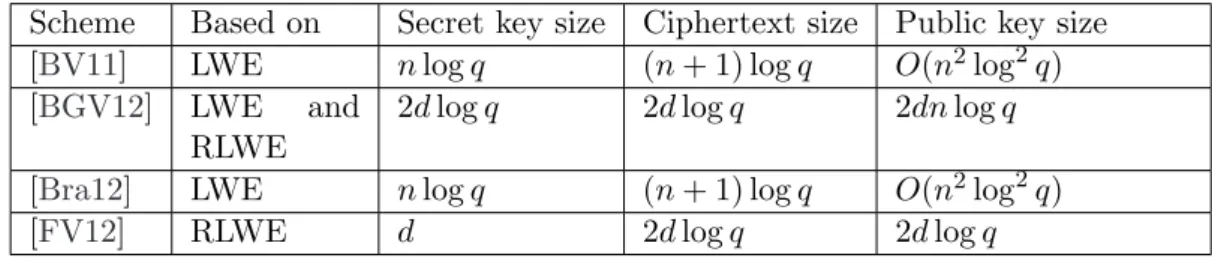
In this section we will give a comparison of the latest fully homomorphic encryption schemes discussed in this section. Table 3.1 compares the key and ciphertext sizes for each scheme. Note that while [BGV12] has instantations for both LWE and RLWE, we only use the result of the more efficient RLWE case.
Scheme Based on Secret key size Ciphertext size Public key size
[BV11] LWE nlogq (n+ 1) logq O(n2log2q)
[BGV12] LWE and RLWE
2dlogq 2dlogq 2dnlogq
[Bra12] LWE nlogq (n+ 1) logq O(n2log2q)
[FV12] RLWE d 2dlogq 2dlogq
Table 3.1: Comparison of key and ciphertext sizes (in bits).
From this table we can see the similarities between the schemes based on the same assumption, with respect to key and ciphertext sizes. The schemes [BGV12] and [FV12] that are based on RLWE, use less bits than [BV11] and [Bra12] that are based on LWE. The [FV12] scheme uses the least bits overall, due to the optimization of the secret key, and a much smaller public key that is not a matrix, in contrast to the other schemes.
CHAPTER 3. RECENT DEVELOPMENTS 39
We will now take a look at the ideas and improvements for each work. Brakersi and Vaikuntanathan’s work introduced the following concepts:
1. An LWE-based scheme with security that is better studied than Gentry’s scheme that used ideal lattices.
2. Relinearization as a way of keeping the ciphertext size constant, and create a somewhat homomorphic scheme.
3. Modulus switching as a way to manage the noise and remove the need for the expensive squashing step as in Gentry’s scheme.
Meanwhile, Brakersi, Gentry, and Vaikuntanathan’s work introduced the following con-cepts:
1. A general scheme with both LWE-based and RLWE-based instantiations, with the RLWE version more efficient than Brakersi and Vaikuntanathan’s scheme.
2. Relinearization generalized into key switching .
3. Modulus switching that is better implemented to reduce noise without bootstrap-ping.
4. Better analysis on noise than in [BV11]. Brakersi’s work introduced the following concepts:
1. An LWE-based scheme that has classical reduction to GapSVP. This is in contrast with previous schemes that only have quantum reduction.
2. Invariant perspective, where the noise isn’t squared by multiplication but only multiplied by a fixed polynomial .
3. Key switching as in [BGV12].
Finally, Fan and Vercauteren’s work introduced the following concepts:
1. A scheme that extends Brakerski’s idea to the RLWE setting. This scheme is more efficient than all the other schemes discussed.
2. Two variations of relinearization to make the scheme somewhat homomorphic. The first version is a generalization of the key switching in [BGV12]. While the second one uses a method similar to modulus switching.
3. A simpler decryption circuit with simpler analysis than previous work. The simplic-ity comes from reducing all cases to the optimal case, where scaling is implemented by binary right shift.
CHAPTER 3. RECENT DEVELOPMENTS 40
The following table gives an overview of the main ideas of the FHE schemes.
Scheme Main Ideas
[BV11] Relinearization, modulus switching, LWE-based
[BGV12] Key switching, better modulus switching, LWE and RLWE-based [Bra12] Invariant perspective, key switching, LWE-based, classical reduction to
GapSVP
[FV12] Two versions of relinearization, more efficient RLWE-based cryptosys-tem, simpler decryption circuit