Preface
This book is, in essence, the dissertation I submitted to the University of Edinburgh in early January 1994. My examiners, Peter Harrison of the Imperial College, and Stuart Anderson of the University of Edinburgh, suggested some corrections and revisions. Apart from those changes, most chapters remain unaltered except for minor corrections and reformatting. The exceptions are the first and final chapter.
Since the final chapter discusses several possible directions for future work, it is now supplemented with a section which reviews the progress which has been made in each of these directions since January 1994. There are now many more people interested in stochastic process algebras and their application to performance modelling. Moreover, since these researchers have backgrounds and motivations different from my own some of the most interesting new developments are outside the areas identified in the original conclusions of the thesis. Therefore the book concludes with a brief overview of the current status of the field which includes many recent references. This change to the structure of the book is reflected in the summary given in Chapter 1. No other chapters of the thesis have been updated to reflect more recent developments. A modified version of Chapter 8 appeared in the proceedings of the 2nd International Workshop on Numerical Solution of Markov Chains, January 1995.
I would like to thank my supervisor, Rob Pooley, for introducing me to performance modelling and giving me the job which brought me to Edinburgh initially. Many colleagues on the IMSE project provided stimulating discussions which influenced this work. My second supervisor, Julian Bradfield, provided support and advice in large quantities for which I am very grateful. Many other people also influenced this work through helpful comments, discussions and encouragement; they include Graham Birtwistle, Stephen Gilmore, Peter King, James McKinna, Faron Moller, Michael Rettelbach, Ben Strulo and Nico van Dijk. Stephen also provided the tools which made constructing and solving the large models in Chapter 4 possible.
I would never have finished this thesis without the support, encouragement and distrac-tions provided in appropriate propordistrac-tions by my parents and many friends, during the four and a half years it took to complete.
I am grateful to David Miles and Juliet Sheppard at Kingston Business School who ar-ranged for my first year tuition fees to be paid. The final two years of my work were supported by a SERC studentship.
Jane Hillston December 1995
Abstract
Performance modelling is concerned with the capture and analysis of the dynamic beha-viour of computer and communication systems. The size and complexity of many modern systems result in large, complex models. A compositional approach decomposes the system into subsystems that are smaller and more easily modelled. In this thesis a novel com-positional approach to performance modelling is presented. This approach is based on a suitably enhanced process algebra, PEPA (Performance Evaluation Process Algebra). The compositional nature of the language provides benefits for model solution as well as model construction. An operational semantics is provided for PEPA and its use to generate an underlying Markov process for any PEPA model is explained and demonstrated. Model simplification and state space aggregation have been proposed as means to tackle the prob-lems of large performance models. These techniques are presented in terms of notions of equivalence between modelling entities.
A framework is developed for analysing such notions of equivalence and it is explained how the bisimulation relations developed for process algebras fit within the framework. Four different equivalence relations for PEPA, two structural and two based on bisimulation, are developed and considered within this framework. For each equivalence the implications for the underlying Markov process are studied and its potential use as the basis of a model simplification technique is assessed. Three of these equivalences are shown to be congru-ences and all are complementary to the compositional nature of the models considered. As well as their intrinsic interest from a process algebra perspective, each of these notions of equivalence is also demonstrated to be useful in a performance modelling context. The strong structural equivalence, isomorphism, generates equational laws which form the basis of model transformation techniques. This is weakened to define weak isomorphism. This equivalence, together with judicious use of the PEPA abstraction mechanisms, forms the basis of a model simplification technique, provided certain insensitivity conditions are satis-fied. Strong bisimilarity is shown to exhibit no clear relationship to the underlying Markov process although it may be used to replace one component of a model by another which will have the same apparent behaviour. Finally,strong equivalence, provides an alternative method of formulating the Markov process capturing the stochastic behaviour of the model. This equivalence is the basis of an aggregation technique based on lumpability.
Throughout the thesis the concepts introduced are illustrated by examples modelling multi-server multi-queue (MSMQ) systems. These systems, an extension of classical polling systems, have been shown to be useful representations of many local area network architec-tures, with ring topologies and scheduled access, in which more than one node may transmit simultaneously.
1 Introduction 1
2 Background 5
2.1 Introduction . . . . 5
2.2 Performance Modelling . . . . 5
2.2.1 Queueing Networks . . . . 6
2.2.2 Stochastic Extensions of Petri Nets . . . . 7
2.3 Process Algebras . . . . 9
2.3.1 Timed Extensions of Process Algebras . . . . 9
2.3.2 Probabilistic Process Algebras . . . . 10
2.4 Process Algebra for Performance Modelling. . . . 10
2.4.1 Process Algebras as a Design Methodology . . . . 11
2.4.2 The “Cooperator” Paradigm and Hierarchical Models . . . . 11
2.4.3 Structure within Models . . . . 12
2.4.4 The Work Presented in This Thesis . . . . 12
2.5 Related Work . . . . 12
2.5.1 Early Work on Protocol Specification . . . . 13
2.5.2 TIPP. . . . 13
2.5.3 CCS+ . . . . 14
2.5.4 Relating DEMOS to TCCS and WSCCS . . . . 15
2.5.5 Performance Equivalence as a Bisimulation . . . . 15
3 Performance Evaluation Process Algebra 17 3.1 Introduction . . . . 17
3.2 Design Objectives for PEPA . . . . 17
3.3 The PEPA Language . . . . 18
3.3.1 Informal Description . . . . 18
3.3.2 Syntax . . . . 20
3.3.3 Execution Strategies and the Exponential Distribution . . . . 23
3.3.4 Examples . . . . 24
3.3.5 Passive Activities . . . . 26
3.3.6 Some Further Definitions . . . . 26
3.3.7 Formal Definition: Operational Semantics . . . . 28
3.3.8 Examples . . . . 30
3.4 Basic Properties. . . . 31 iii
3.5 The Underlying Stochastic Model . . . . 32
3.5.1 Generating the Markov Process . . . . 32
3.5.2 Some Definitions . . . . 33
3.5.3 Stochastic Processes with an Equilibrium Distribution . . . . 35
3.5.4 PEPA Models with Equilibrium Behaviour . . . . 36
3.5.5 Solving the Markov Process . . . . 37
3.5.6 Derivation of Performance Measures: Reward Structures . . . . 37
3.5.7 Example . . . . 38
3.6 Comparison to other Modelling Paradigms . . . . 40
3.6.1 Model Construction . . . . 40
3.6.2 Model Manipulation . . . . 41
3.6.3 Model Solution . . . . 42
4 Modelling Study: Multi-Server Multi-Queue Systems 45 4.1 Introduction . . . . 45
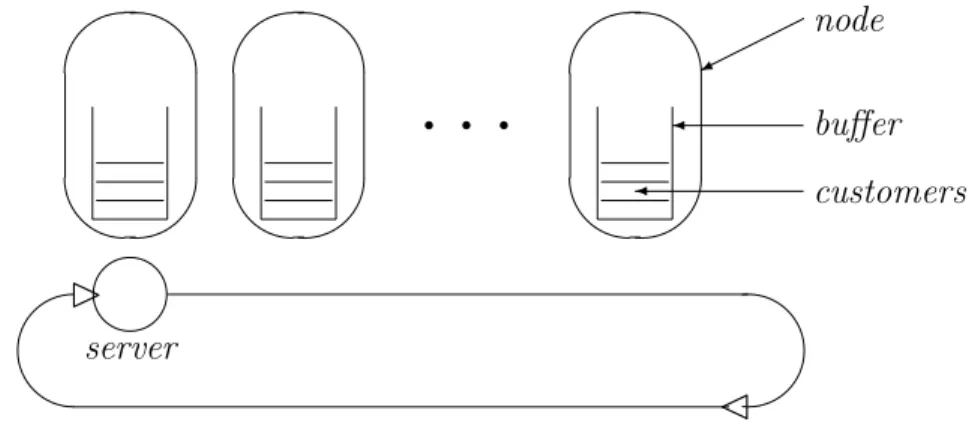
4.2 Polling Systems . . . . 46
4.2.1 Solution of Polling System Models. . . . 48
4.2.2 Example: A PEPA Model of a Polling System . . . . 49
4.3 Multi-server Multi-queue Systems . . . . 50
4.3.1 Solutions of Multi-Server Multi-Queue Systems . . . . 53
4.4 Examples: PEPA Models of MSMQ Systems . . . . 54
4.4.1 Introduction . . . . 55
4.4.2 MSMQ System with Cyclic Polling, Without Overtaking . . . . 55
4.4.3 Asymmetric MSMQ System with Cyclic Polling . . . . 56
4.4.4 Asymmetric MSMQ System with Random Polling . . . . 59
4.4.5 MSMQ System with Detailed Nodes . . . . 62
5 Notions of Equivalence 65 5.1 Introduction . . . . 65
5.2 Process Algebras and Bisimulation . . . . 66
5.2.1 Bisimulation for Pure Process Algebras . . . . 66
5.2.2 Bisimulation for Timed Process Algebras . . . . 67
5.2.3 Bisimulation for Probabilistic Process Algebras . . . . 67
5.2.4 Bisimulation and Entity-to-Entity Equivalence . . . . 68
5.3 Performance Modelling and Equivalences . . . . 69
5.3.1 Performance Model Verification . . . . 69
5.3.2 Model-to-Model Equivalence . . . . 70
5.4 State-to-State Equivalence . . . . 71
5.4.1 Aggregation of Markov Processes . . . . 71
5.4.2 Lumpability . . . . 72
5.4.3 Folding in GSPNs. . . . 73
5.5 Notions of Equivalence for PEPA . . . . 73
6 Isomorphism and Weak Isomorphism 75 6.1 Introduction . . . . 75
6.2 Definition of Isomorphism . . . . 75
6.3 Properties of Isomorphism . . . . 76
6.3.1 Equational Laws for Isomorphic Components. . . . 76
6.3.2 The Expansion Law. . . . 77
6.3.3 Isomorphism as a Congruence . . . . 78
6.4 Isomorphism between System Components . . . . 80
6.5 Isomorphism and the Markov Process . . . . 80
6.6 Definition of Weak Isomorphism . . . . 81
6.7 Properties of Weak Isomorphism. . . . 85
6.7.1 Preservation by Combinators . . . . 86
6.7.2 Equational Laws for Weak Isomorphism . . . . 87
6.8 Weak Isomorphism and System Components . . . . 88
6.9 Weak Isomorphism and the Markov Process . . . . 89
6.9.1 Insensitivity of Reducible Sequences. . . . 91
6.10 Weak Isomorphism for Model Simplification . . . . 93
6.10.1 An Approach to Model Simplification . . . . 93
6.10.2 Simplifying an MSMQ Model using Weak Isomorphism . . . . 94
7 Strong Bisimilarity 97 7.1 Introduction . . . . 97
7.2 Definition of Strong Bisimilarity . . . . 97
7.3 Properties of the Strong Bisimilarity Relation . . . . 100
7.3.1 Strong Bisimilarity as a Congruence. . . . 100
7.3.2 Isomorphism and Strong Bisimilarity . . . . 104
7.4 Strong Bisimilarity and System Components . . . . 106
7.5 Strong Bisimilarity and the Markov Process . . . . 107
7.6 Strong Bisimilarity for Model Simplification . . . . 110
7.6.1 An Approach to Model Simplification . . . . 110
7.6.2 Simplifying an MSMQ Model using Strong Bisimilarity . . . . 110
8 Strong Equivalence 113 8.1 Introduction . . . . 113
8.2 Definition of Strong Equivalence . . . . 113
8.3 Properties of the Strong Equivalence Relation . . . . 116
8.3.1 Strong Equivalence as a Congruence . . . . 116
8.3.2 Isomorphism and Strong Equivalence . . . . 121
8.3.3 Strong Bisimilarity and Strong Equivalence. . . . 122
8.4 Strong Equivalence and System Components . . . . 123
8.5 Strong Equivalence and the Markov Process . . . . 124
8.6 Strong Equivalence for Aggregation . . . . 126
8.6.1 Basic Application of Strong Equivalence Aggregation . . . . 127
8.6.2 Compositional Strong Equivalence Aggregation . . . . 128
8.6.3 Aggregating an MSMQ Model using Strong Equivalence . . . . 132
9 Conclusions 137 9.1 Introduction . . . . 137
9.2 Summary . . . . 137
9.3 Evaluation . . . . 138
9.4 Further Work and Future Directions . . . . 139
9.5 Developments Since the Completion of the Thesis . . . . 140
9.5.1 Stochastic Process Algebras . . . . 140
9.5.2 Integrating Performance Analysis into System Design . . . . 141
9.5.3 Representing Systems as Models. . . . 142
Table of Notation
C set of possible components
A set of possible action types
Act set of possible activities
A(C) set of current action types of component C
Act(C) multiset of current activities ofC
Act(Ci |Cj) multiset of current activities ofCi with derivativeCj
~
A(C) complete action type set ofC
τ unknown action type
> unspecified activity rate
wi weight of a passive activity
rα(C) apparent rate of action type α in component C
ds(C) derivative set
D(C) derivation graph
SysP the system component represented byP
C/∼= set of equivalence classes induced by∼= on C
C/R set of equivalence classes induced byR on C (α, r).P activity prefix
P +Q component choice
P
BC
L Q cooperation betweenP and Q on the set of action types L P kQ parallel composition ofP and Q, cooperation on ∅
P/L activities of P with types in L appear as unknown type
E{P/X} every occurrence ofX in E is replaced by P
˜
X,P˜ indexed sets of variables and components respectively
Adef=P defining equation for the constant A IdC identity function on components
P ≡Q syntactic equivalence P =Q P is isomorphic to Q C ≤P C is a compact form of P P ≈Q P is weakly isomorphic to Q P ∼Q P is strongly bisimilar to Q P ∼=Q P is strongly equivalent to Q P the compact form of component P
b
P the lumped component of P
V(τ,r)(C) visible (τ, r)-derivative of C
Act∼=(T) lumped activity set
ds(S)/∼= lumped derivative set
D∼=(S) lumped derivation graph
~
R+
set of activity rates, {x|x >0;x∈R} ∪ {>}
N natural numbers, {1,2,3, . . .}
Fa(t) probability distribution function associated with a
fa(t) probability density function associated with a
Xi state in a Markov process
Q infinitesimal generator matrix
qij transition rate between state Xi and Xj Π(·) steady state probability distribution
Πj(·) conditional steady state probability distribution
X[j] aggregated state in a Markov process
xn state in a generalised semi-Markov process (GSMP)
s active element in a GSMP
p(xi, s, xj) transition probability in a GSMP
q(C) exit rate from component C q(Ci, Cj) transition rate from Ci toCj
q(Ci, Cj, α) conditional transition rate via activities of type α
q(C, α) conditional exit rate via activities of type α
q[C, S] total transition rate from C to the set of derivatives S q[C, S, α] total conditional transition rate via activities of type α
p(C, a), p(C, α) conditional probabilities that C completesa, or an activity of type α p(Ci, Cj) transition probability from Ci toCj
p[C, S] total transition probability from C to the set of derivativesS p[C, S, α] total conditional transition probability via activities of type α ρi reward associated with derivative Ci
R total reward
] multiset union
Introduction
Performance modelling is concerned with the capture and analysis of the dynamic behaviour of computer and communication systems. The size and complexity of many modern systems result in large, complex models. A compositional approach decomposes the system into subsystems that are smaller and more easily modelled. In this thesis a novel compositional approach to performance modelling is presented. This chapter presents an overview of the thesis. The major results are identified.
A significant contribution is the approach itself. It is based on a suitably enhanced process algebra, PEPA (Performance Evaluation Process Algebra). As this represents a new depar-ture for performance modelling, some background material and definitions are provided in Chapter 2 before PEPA is presented. The chapter includes the motivations for applying pro-cess algebras to performance modelling, based on three perceived problems of performance evaluation. The recent developments of timed and probabilistic process algebras are unsuit-able for performance modelling. PEPA, and related work on TIPP [1], represent a new area of work,stochastic process algebras [2]. The extent to which work on PEPA attempts to ad-dress the identified problems of performance evaluation is explained. The chapter concludes with a brief review of TIPP and other related work.
Chapter 3 presents PEPA in detail. The modifications which have been made to the lan-guage to make it suitable for performance modelling are explained. An operational semantics for PEPA is given and its use to generate a continuous time Markov process for any PEPA model is explained. Thus it is demonstrated that PEPA may be used as a paradigm for specifying Markov models. At the end of the chapter the relationship between PEPA and established performance modelling paradigms is discussed.
A compositional approach offers potential for complex systems to be modelled systemat-ically. Separate aspects or components of a system may be considered in detail individually, but subsequently in a more abstract form as the interactions between them are developed. The benefits of the compositional approach to model construction provided by PEPA are demonstrated in Chapter 4. The modelling study presented investigates the characterist-ics of various multi-server multi-queue (MSMQ) systems. These systems, an extension of classical polling systems, have been shown to be useful representations of many local area network architectures, with ring topologies and scheduled access, in which more than one node may transmit simultaneously. However, they are not readily amenable to queueing theory solution. These systems are straightforward to model using PEPA and exact analysis based on solution of the underlying Markov process is carried out in each case. These case studies also demonstrate how the size of the state space of this underlying process grows rapidly as the dimensions and complexity of the modelled system increase. The remainder of the thesis addresses this problem. It is demonstrated that the compositional structure of
PEPA models can also benefit model simplification techniques.
Model simplification and state space aggregation have been proposed as means to tackle the problems of large performance models. These techniques, particularly aggregation, are typically applied at the level of the Markov process rather than the modelling paradigm. This means that the whole state space of the process must be constructed before it can be reduced. In Chapter 5 these techniques of model simplification and aggregation are presented in terms of notions of equivalence between modelling entities. A framework is developed for analysing such notions of equivalence. It is explained how this framework may also be applied to the bisimulation relations defined for process algebras.
A process algebra incorporates an apparatus for reasoning about the structure and beha-viour of the model. Such an apparatus is not usually available in Markovian based modelling paradigms. The next three chapters of the thesis present three model simplification tech-niques for PEPA models which take advantage of this apparatus together with the compos-itional nature of the language. These techniques avoid the construction of the state space of the original model. In each case the integrity of the performance measures to be derived from the model can be guaranteed. They represent the major contribution of the thesis. Each is illustrated using one of the MSMQ models presented in Chapter 4.
Based on the operational semantics of the language four different notions of equivalence for PEPA are developed. These are considered within the framework presented in Chapter 5. For each equivalence its properties in the context of a process algebra, and its implications for the underlying Markov process, are studied. Three of these equivalences are shown to be congruences and all are complementary to the compositional nature of the models considered. The strongest notion of equivalence for PEPA components, isomorphism, is presented in Chapter 6. This is a structural equivalence, similar to the equivalence between Markov pro-cesses discussed in Chapter 5. Nevertheless it is the basis of equational laws which may be used to transform the presentation of a model, and so make it amenable to simplification. A weaker form of this equivalence,weak isomorphism, is the basis of one of the model simplifica-tion techniques—state space reducsimplifica-tion via the amalgamasimplifica-tion of states. This takes advantage of judicious use of PEPA abstraction mechanisms, provided certain insensitivity conditions are satisfied. Although weak isomorphism is not a congruence for PEPA it is shown to be preserved by some combinators of the language. This means that the model simplification technique it provides can be applied compositionally in some circumstances. These circum-stances are identified. It is proved that the integrity of the performance measures to be derived from the model is guaranteed.
The other two equivalence relations developed are based on the process algebra notion of bisimulation. The first,strong bisimilarity, is presented in Chapter 7. A strong bisimulation aims to capture the notion of indistinguishability under observation used in many process algebras. Two components are strongly bisimilar if they are able to perform the same activities, resulting in derivatives which are strongly bisimilar. Strong bisimilarity is the largest relation satisfying the conditions of a strong bisimulation relation. It is shown that the relation does not ensure exact equivalence of behaviour. However, circumstances in which a strongly bisimilar component may be substituted within a model, resulting in a simpler model, are identified.
The other notion of equivalence in the bisimulation style,strong equivalence, is presented in Chapter 8. This is developed analogously to aprobabilistic bisimulationused in probabilistic extensions of process algebras. However, transition rates, already embedded in the PEPA labelled transition system as activity rates, are used instead of probabilities. The relation again aims to capture a notion of equivalent observed behaviour, but the observation is now
assumed to be less detailed than in strong bisimilarity. The resulting relation is closely allied to the notion of lumpability in the underlying Markov process. The use of strong equivalence to partition the state space as a basis of exact aggregation is outlined. The conditions under which the integrity of the performance measures is guaranteed are discussed.
Finally, in Chapter 9, the results of the thesis are summarised. The direction for further work and the future development of PEPA are discussed as they appeared at the end of the thesis. The book concludes with a review of the extent to which these outlined objectives have been addressed by more recent work, and a summary of current work on stochastic process algebras and their application to performance modelling.
Background
2.1
Introduction
This chapter presents the background material for the thesis. The field of performance modelling is introduced and the standard paradigms for specifying stochastic performance models, queueing networks and stochastic Petri nets, are reviewed. In Section 2.3 process algebras are introduced, and some of the extensions into timed and probabilistic processes are considered in the following subsections. In particular we describe the Calculus of Com-municating Systems (CCS), and various extended calculi based upon it.
We present the motivation for applying process algebras to performance modelling in Section 2.4. This outlines the objectives of the work presented in the remainder of the thesis. Finally, in Section 2.5, some related work, involving process algebras and performance evaluation, is discussed.
2.2
Performance Modelling
Performance evaluation is concerned with the description, analysis and optimisation of the dynamic behaviour of computer and communication systems. This involves the investigation of the flow of data, and control information, within and between components of a system. The aim is to understand the behaviour of the system and identify the aspects of the system which are sensitive from a performance point of view.
In performance modelling an abstract representation, or model, of the system is used to capture the essential characteristics of the system so that its performance can be reproduced. A performance study will address some objective, usually investigating several alternatives— these are represented by values given to the parameters of the model. The model will be evaluated to determine its behaviour and performance measures under the current set of parameter values. Evaluation may take place via the solution of a set of equations by some analytical, possibly numerical, technique or via the simulation of the model. Analytical models are usually based on stochastic models and throughout the rest of the thesis the term performance modelling will apply to stochastic models solved analytically unless otherwise stated. There are two established notations for constructing such models—queueing networks and stochastic Petri nets. These are described in Sections 2.2.1 and 2.2.2 respectively. In many cases these underlying stochastic models are assumed to be Markov processes.
The size and complexity of many modern systems result in large complex models. This is problematical for both model construction and model solution, and has led to an interest in
compositional approaches to performance modelling. These approaches decompose a system into subsystems that are smaller and more easily modelled. Several authors have advocated the adoption of software engineering style structuring techniques for performance model construction [3, 4, 5, 6].
Finding techniques for the solution of large Markov chains, whose state spaces are finite but exceedingly large, has been a major preoccupation of performance analysis research for many years [7]. Standard numerical techniques cannot cope with such models—a problem often referred to asstate space explosion. Compositional approaches which would be applicable to model solution as well as model construction, allowing separate solution of submodels, have been sought.
In this thesis we offer a technique which allows subsystems to be modelled separately al-though the model must be considered as a single entity for the purposes of solution. However, we also present some approaches to model simplification which may be applied to the sub-system models in isolation but which are guaranteed not to affect the integrity of the whole model. Thus, although compositional solution is not, in general, feasible, a large model may be tackled in a systematic way and formally manipulated to reduce it to a manageable size.
2.2.1
Queueing Networks
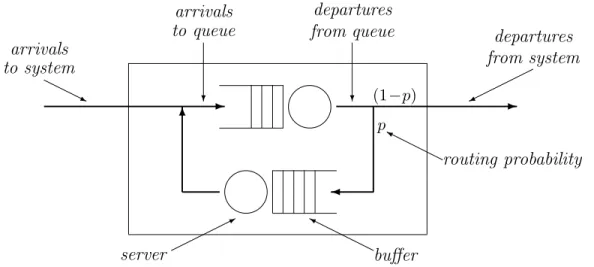
The use of queueing networks for performance modelling is well-established. In this section we briefly introduce the main ideas and some terminology which will be useful later in the thesis. More details can be found in any one of the many books written on the subject, for example [8, 9, 10, 11, 12]. p (1−p) Y routing probability j to system arrivals from system departures ? to queue arrivals ? from queue departures * server Y buffer 6
Figure 2.1: A Simple Open Queueing Network
A queue consists of an arrival process, a buffer where customers await service and one or more servers representing a resource which must be retained by each customer for some period before leaving the queue. The queue may be characterised by five factors: the arrival rate, the service rate, the number of servers, the capacity of the buffer and the queueing discipline. The first four of these characteristics may be concisely represented using Kendall’s notation for classifying queues. In this notation a queue is represented as A/S/c/m/N:
D, deterministic distributions. Identifiers for other distributions, such as Hk (hyper-exponential with parameter k), may also be used.
S denotes the service rate and uses the distribution identifiers as above.
c denotes the number of servers available to provide service to the queue.
m denotes the capacity of the buffer, infinite by default. Customers who arrive when the buffer is full may be lost or blocked.
N denotes the customer population, also infinite by default.
The last two classifiers may be omitted in the default case. The queueing discipline de-termines how a server selects a customer from the queue for next service. For example, the discipline might be first-come-first-served (FCFS) in which the customer who has been waiting longest is served next, or processor sharing (PS) in which the service capacity is shared by all the customers present at the queue.
A queueing network is a directed graph in which the nodes are queues, often calledservice centres in this context, each representing a resource in the system being modelled. Cus-tomers, representing the jobs in the system, flow through the system and compete for these resources. The arcs of the network represent the topology of the system, and together with routing probabilities, determine the paths that customers take through the network. De-pending on the demand for the resources and the service rate that the customers experience, contention over a resource may arise leading to the formation of a queue of waiting customers. The state of the system is typically represented as the number of customers currently occupying each of the service centres. There may be a number of differentclassesof customers each exhibiting different characteristics within the network. In this case the state is the number of customers of each class at each service centre. A network may be closed, open or mixed depending on whether a fixed population of customers remain within the system; customers may arrive from, or depart to, some external environment; or there are classes of customers within the system exhibiting open and closed patterns of behaviour respectively. A large class of queueing networks have been shown to have a straightforward and compu-tationally efficient solution [13]. Although this class excludes some interesting and important system features, when applicable they allow performance measures to be derived without re-sorting to the underlying Markov process. The solution of these models, often termed a product form solution, allows individual queues within a network to be considered separ-ately. Based on this, relatively simple algorithms exist for computing most performance measures based directly on the parameters of the queueing network.
2.2.2
Stochastic Extensions of Petri Nets
Petri nets are directed graphs with two types of node, places and transitions, and unidirec-tional arcs between them. Tokensmove between places according to the firing rules imposed by the transitions. A transition can fire when each of the places connected to it has at least one token; when it fires, the transition removes a token from each of these places and deposits a token in each of the places it is connected to.
The state of the system is denoted by the number of tokens at each place in the network. This is termed the markingof the net. A Petri net is defined by its structure and an initial markingwhich is the initial placement of tokens. Thereachability set is the set of all possible markings that a net may exhibit, starting from the initial marking and following the firing rules. This is used to form the reachability graph in the natural way.
K token K transition K place
•
- * j=
⇒
fires-•
•
* jFigure 2.2: A Simple Petri Net Firing
Various timed and stochastic extensions of Petri nets have been proposed for performance modelling [14, 15, 16, 17, 18, 19, 20, 21]. Amongst the most influential have been the stochastic Petri nets (SPNs) proposed by Molloy [22] and their subsequent refinement by Ajmone Marsan et al., generalised stochastic Petri nets (GSPNs) [17].
In SPNs an exponentially distributed firing rate (possibly dependent on the marking) is associated with each transition. Once a transition is enabled (each input place is marked) a drawing is made on the distribution to define a delay before the transition will fire; if the transition is still enabled at the end of that time it then fires. Molloy showed that the reachability graph underlying such nets is isomorphic to a Markov process when this delay is exponentially distributed [16]. Thus SPNs provide an alternative means of specifying the stochastic models used for performance modelling. Moreover they are able to easily express some of the features not readily modelled in queueing networks such as multiple resource usage. Performance measures are usually extracted from the models via numerical solution of the underlying Markov process. There has been some work on product form solutions for SPNs, for example [23], but these rely on restrictive conditions on the structure of the net.
In GSPNs the transitions of the net are partitioned into two subsets—timed transitions which behave like the transitions in SPNs, each with an exponentially distributed firing time, and immediate transitions which fire immediately upon being enabled. It is assumed that all enabled immediate transitions fire before any timed transitions. Consequently the reachability graph of a GSPN can be partitioned into tangible and vanishing markings. Ajmone Marsan et al. showed that since no time elapses in vanishing markings they can be eliminated prior to the solution of the embedded Markov chain. Thus immediate transitions are disregarded during model solution. GSPN models have been used widely for performance analysis, for example [24, 25, 26]. As well as immediate transitions GSPNs also sometimes include inhibitor arcs. Such extensions to the notation often make it possible to express a model more concisely but they have been shown not to increase the modelling power of GSPNs [27].
Stochastic activity networks (SAN), introduced by Movaghar and Meyer [19], are also of interest because, like PEPA, they place emphasis on the activities of the system. Although similar to GSPNs these nets, intended for performability modelling (joint consideration of the performance and the availability of a system), have more structure. As well as immediate transitions and inhibitor arcs they includegatesandcaseswhich introduce more sophisticated firing rules into the net. In [28] the authors introduce an abstract underlying model, the stochastic activity system, which may be used to reason about the SAN. In [5] the use of compositional techniques for SAN is investigated. Work on SAN is discussed in more detail in Section 5.3.
2.3
Process Algebras
Process algebras are mathematical theories which model concurrent systems by their al-gebra and provide apparatus for reasoning about the structure and behaviour of the model. Examples include the Calculus of Communicating Systems (CCS) [29], Communicating Se-quential Processes (CSP) [30], and the Algebra of Communicating Processes (ACP) [31]. A system is characterised by its active components and the interactions, or communications, between them. Unlike queueing networks or Petri nets there is no notion of entity or flow within a model. However, in recompense, compositional reasoning is an integral part of the language.
In CCS the active components of a system are calledagentsor processesand these under-take actions, representing the discrete actions of the system. Any action may be internal to an agent or may constitute the interaction or communication between neighbouring agents. Agents may proceed with their internal actions simultaneously, but it is important to note that this behaviour is given an interleaving semantics. Combinators of the language make it possible to construct an agent which has a designated first action (prefix); has a choice over alternatives (choice); or has concurrent possibilities (composition). In PEPA prefix and choice are retained but composition is replaced bycooperation.
Like many other process algebras, CCS is given an operational semantics, in the style of Plotkin [32], using a labelled transition system. From this a derivative tree, or graph, in which language terms form the nodes and transitions are the arcs, may be constructed. This structure is a useful tool for reasoning about agents and the systems they represent. It is the basis of the bisimulation style of equivalence. The actions of an agent characterise it, so two agents are considered to be equivalent if they are observed to perform exactly the same actions. Strong and weak forms of equivalence are defined depending on whether the internal actions of an agent are also considered to be observable. Bisimulation and related notions of equivalence are presented in more detail in Section 5.2.
CCS models have been used extensively to establish the correct behaviour of systems, both with respect to a given specification and in the more abstract sense. This is sometimes termed functionalorqualitativemodelling. Behavioural properties such asfairnessand freedom from deadlockare investigated, in contrast to the quantitative values extracted from performance models.
In the following sections we discuss some of the extensions which have been made to process algebras to incorporate time and probability. Most of these can be exemplified by an extension of CCS. When we want to refer to a process algebra without such extensions we will sometimes find it convenient to refer to it as a pureprocess algebra.
2.3.1
Timed Extensions of Process Algebras
In pure process algebras time is abstracted away within a process so that all actions are assumed to be instantaneous and only relative timing is represented via the traces of the process. The simplest way in which time may be incorporated into such an algebra is by making it synchronous. In synchronous calculi, such as SCCS [33], it is assumed that there is an implicit global clock, and one action must occur at each clock tick. However in order to model the real time behaviour of systems a more sophisticated representation of time is needed.
Time may be represented explicitly in a process algebra by allowing an agent to witness periods of delay, of specified lengths, in addition to witnessing actions, as in Temporal
CCS (TCCS) [34]. In TCCS actions are still assumed to be instantaneous, and the time domain is taken to be the natural numbers. The language is given an operational semantics with two different types of transition: action transitions and time transitions. Observation equivalence may be defined as before but with the additional condition that any period of delay experienced by one agent must also be possible for the other agent.
An alternative approach is taken in Real Time ACP [35]. Here an absolutetime is associ-ated with each event, where an event is the completion of an action by a process. It is also possible to specify a relative time for each action, or an interval during which an event must occur. Such intervals lead to the introduction of an integration operator since it represents a choice over a continuum of alternatives.
2.3.2
Probabilistic Process Algebras
Process algebras will often be used to model systems in which there is uncertainty about the behaviour of a component but, like time, this uncertainty will be abstracted away so that all choices become nondeterministic. Probabilistic extensions of process algebras allow this uncertainty to be quantified because nondeterministic choice is replaced by a probabilistic choice. In this case a probability is associated with each possible outcome of a choice.
The operational semantics for probabilistic process algebras are given in terms of prob-abilistic labelled transition systems, labelled transition systems in which probabilities are associated with the transitions. These systems may be classified as beingreactive or gener-ative. In a reactive system the probabilities of the transitions of an agent may depend on the environment in which the agent is placed. In a generative system the transition probabilities are independent of the environment. In effect, in the reactive case a probability distribution is defined over the possible derivatives of an agent given that a particular action is performed and in the generative case a probability distribution is defined over the possible actions of the agent.
In [36] Jou and Smolka describe a language PCCS which is similar to SCCS but with probabilistic choice replacing nondeterministic choice. Another extension of SCCS is Tofts’ WSCCS [37] which uses weights to assign probabilities. Here nondeterministic choice is replaced by probabilistic and prioritised choice.
Probabilistic process algebras have been proposed as a more suitable way of testing equi-valence between a system’s specification and its implementation [38]. Two processes are probabilistically bisimilar, or equivalent, if their visible behaviour will be the same with probability 1−ε, where ε is an arbitrary small number. Another alternative is the use of preorders which express the idea that one process may be probabilistically better than another [39]. In this case it is necessary to show that a system’s implementation improves on its specification. Thus if the specification allows 0.05 probability of breakdowns, an implementation which ensures that the probability of breakdown is less than 0.04 will be satisfactory.
2.4
Process Algebra for Performance Modelling
In this section we present some of the motivations for investigating the use of process algebras for performance modelling. These can be regarded as arising from three distinct problems of performance analysis which have been identified in recent years.
Integrating Performance Analysis into System Design: Several authors have poin-ted out the importance of the timely consideration of performance aspects of a planned system [40, 41, 42, 3, 43, 6, 2]. However, most have also highlighted the limited extent to which this occurs in practice.
Representing Systems as Models: The restricted expressiveness of queueing networks has been highlighted by recent developments in computer and telecommunication systems.
Model Tractability: Solving models of the size and complexity necessary to model many modern systems is often beyond the capabilities of contemporary techniques and equip-ment. This has led to considerable interest in model simplification and aggregation techniques, for example [25, 7, 44, 45].
The adoption of a process algebra as a performance modelling paradigm has implications for each of these problems, as explained below. We consider the use of process algebras as a design methodology; the style in which process algebras express systems; and the apparatus provided by process algebras for manipulating models.
2.4.1
Process Algebras as a Design Methodology
The process algebra style of system description is close to the way that designers think about systems, and is gaining acceptance as a design methodology [46, 47], particularly in the area of communication system and protocol design. Using a process algebra based language for performance modelling introduces the possibility of a closer integration of performance analysis into design methodologies. Performance models can be formed by the annotation of existing system descriptions for design, as recent work with LOTOS has shown [42, 48]. This has clear implications for both the practice of performance evaluation and the verification of models against designs.
The use of system description formalisms for performance modelling has been investigated by several researchers. Examples include SDL (Specification and Description Language) in [49, 42], ACP in [50] and Estelle in [51, 42, 52].
Not only does the use of such a formal description language allow the integration of performance modelling into the design process but, as most of the authors point out, it presents the possibility of qualitative (or functional) and quantitative modelling using the same system description. An alternative approach to this integration of modelling aspects is presented by Pooley [53] (Section 2.5.4). This is similar to earlier work within the CUPID project [54, 55] (Section 2.5.1), in which CCS is used as a canonical representation language.
2.4.2
The “Cooperator” Paradigm and Hierarchical Models
A process algebra description represents a system as a collection of active agents who co-operate to achieve the behaviour of the system. This cooperator paradigm (as opposed to operator and operand) is appropriate for modelling many modern computer systems. These systems do not readily fit the traditional models of sequential flow of control and resource allocation, as captured by the established performance modelling paradigms. For example, in distributed systems and communications networks components have autonomy and the framework is one of cooperation. In a process algebra model all system elements have equal status; the model defines their individual behaviours and how they interact.
Similar expressiveness is offered by the stochastic extensions of Petri nets [17, 18, 28]. However, in addition process algebras include mechanisms for composition and abstraction, as well as apparatus for compositional reasoning, which are missing from performance mod-elling techniques [56, 4]. These mechanisms, which are an integral part of the language, facilitate the systematic development of large models with hierarchical structure.
The process algebra style of system description will be fully illustrated by a case study introduced in Chapter 4. The system studied, a polling system with multiple servers, cannot be solved exactly using conventional queueing network models. Moreover we will see in subsequent chapters that the structure introduced in the system description, reflecting the structure of the system itself, has useful implications for solution of the underlying Markov process.
2.4.3
Structure within Models
Model simplification and aggregation techniques are often based on conditions phrased in terms of the underlying Markov process or its generator matrix. For very large systems the size of the state space may prohibit the generation and storage of the complete Markov process [44].
The structure inherent in process algebra models offers the possibility of introducing model simplification and aggregation techniques based on the system description rather than the underlying stochastic model. Moreover the compositionality of the process algebra allows these techniques to be applied to part of the model whilst maintaining the integrity of the model as a whole.
The formal definition of the process algebra provides the basis for comparing and ma-nipulating models within a formal framework. In particular we will develop notions of equivalence based on this formal definition which will allow one model, or part of a model, to be substituted for another whilst retaining the same observable behaviour. These notions of equivalence will be presented in Chapters 6, 7 and 8 and form the main results of the thesis.
2.4.4
The Work Presented in This Thesis
The work presented in this thesis concentrates on the compositionality offered by a partic-ular process algebra, PEPA, and its benefits for performance modelling. It is shown that this language supports a compositional approach to model construction, resulting in models which are easy to understand and readily modified. Moreover, it is also demonstrated that the structure provided within a model can be exploited for model manipulation and sim-plification. In particular model simplification techniques which avoid the generation of the complete state space of the underlying stochastic process are presented. As these techniques are formally defined, in terms of the operational semantics of PEPA, they offer potential for automation or machine-assistance of model simplification.
The thesis does not address the problem of using the compositional structure of a model during its solution although this appears to be a promising area for future research.
2.5
Related Work
Some related work is now reviewed, showing how process algebras have been applied to per-formance modelling. The approaches adopted vary considerably. Most of the work presented
has originated in the area of performance modelling, and has been motivated by the attract-ive features of process algebras.
2.5.1
Early Work on Protocol Specification
Early work arose from the consideration of correctness of communication protocols and the recognition that timing behaviour was often disregarded during protocol design only to cause problems subsequently [54].
Columbia’s Unified Protocol Implementation and Design (CUPID) environment was an ambitious project, started in the early 1980’s, aiming at the integration and automation of protocol design and implementation tools [54]. Central to the approach was a single repres-entation of the system, developed in an algebraic form, based on value passing CCS. From this canonical representation alternative views of the system could be developed to address different objectives during the development process. Moreover the translation into a differ-ent represdiffer-entation was formally defined and consistency between differdiffer-ent represdiffer-entations guaranteed.
For example, in order to carry out performance analysis, in [54] the authors define a formal procedure to map each port of an agent to a distribution function specifying the delay corresponding to the associated action. Sequential composition (prefix) is mapped onto convolution and choice is mapped onto the convex combination of the respective dis-tributions. In order to calculate performance measures an execution tree (derivative tree) is formed and the appropriate distribution is associated with each branch together with the probability that the branch is executed. An alternative approach to performance evaluation is via the use of a simulation model developed by associating suitable terms from an algebra of routines with each agent in the canonical representation. In subsequent work, [55], the canonical representation was revised to be a variant of CCS, in which a strict one-to-one correspondence between conjugate ports is enforced and synchronisingτ actions are labelled by the action they replace.
Later work by Zic, [57], advocates the use of a variant of Timed CSP for performance analysis of protocol specifications. In this approach stochastic determinism is introduced as an operator over the traces generated by Timed CSP processes. This generative probabilistic choice ensures fairness and allows reasoning about the probability of event sequences such as breakdowns and failures. In this way it is proposed that designers may specify acceptable error probabilities and use the specification to ensure that these are not exceeded.
2.5.2
TIPP
The work on the language TIPP (TImed Process for Performance Evaluation), developed in Herzog’s group at Erlangen, is the closest to the work presented in this thesis. This work has been motivated by a desire to encourage the timely consideration of performance characteristics of developing systems, particularly distributed systems [4]. Herzog recog-nised that process algebras are well-suited to modelling such systems due to their inherent compositionality.
The initial work was carried out with a process algebra EXL which was a variant of CSP in which a random variable is associated with each event and a probabilistic choice operator replaces non-deterministic choice [4]. This language evolved into TIPP.
The language captures three basic patterns of interaction of behaviours—sequential execu-tion, rivalry and concurrent execution—and these are represented by the combinators of the
language—prefix, choice and parallel composition respectively. A distribution functionFa is associated with each action a, and is regarded as a fixed property of the action, i.e. all in-stances of ahave the same distribution function. In general no assumptions are made about the nature of the distribution function but in later papers a subset of the language, in which all times are assumed to be exponentially distributed, is discussed [1]. The core language also includes a hiding operator and a recursion operation. Extended versions of the language have also been studied and these included probabilistic choice, sequential combination (;) and asymmetric synchronisation.
The operational semantics of the language is given in terms of transitions labelled by the action, the distribution of its delay and a natural number called the start reference counter. This is used to indicate the number of completed lifetimes an interrupted process has witnessed. These additional labels are unnecessary when the restriction to exponential distributions is made. Unlike work with PEPA, it is assumed that the semantic rules generate a graph as in CCS, rather than amultigraph. Thus in order to maintain the correct behaviour with respect to the probability distributions simultaneous instances of the same action are distinguished by supplementary labels [2]. When necessary these left and right labels may be concatenated in the natural way.
For the general language, the approach to performance analysis is similar to CUPID. Timing information is extracted from an execution graph of the model. Time distributions are attached to the arcs of this execution graph which is derived from the operational se-mantics. The execution time for any subtree can be calculated from the probability of the corresponding trace and the execution time for each branch, using the convolution and the convex combination of the distribution functions. A steady state analysis of an underlying stochastic process may be used when the distributions are all assumed to be exponential.
Work on TIPP has demonstrated the practicality of the process algebra approach to performance modelling. It has been shown that models developed in TIPP can be successfully used to derive functional and timing properties of systems such as a communication protocol and a multiprocessor system [1, 2].
2.5.3
CCS+
In [58] an extension of CCS is developed with the objective of reasoning about simulation models representing the performance of a system. This language, CCS+, is intended to give the semantics of simulation models thus providing more support for the rigorous development of simulation models than has been previously available.
The language is given an operational semantics in terms of three transition systems repres-enting probabilistic, action and time evolution. Probabilistic evolution resolves probabilistic choices and assigns values to random variables representing delays within the system by drawing from appropriate distributions. Action evolution, resulting in labelled transitions, represents the computation of the system. The real time variables in the language represent simulation time, not computation time, and this is updated by time evolution.
It is intended that the language may be used to establish properties of a simulation once it has been written or to transform it into some more desirable form using formal rules at the syntactic level. Strong and weak bisimulation are defined for the language and are used for these purposes. A relationship between CCS+ expressions and generalised semi-Markov processes (GSMP) , a low-level representation sometimes used to reason about simulations, has been established.
2.5.4
Relating DEMOS to TCCS and WSCCS
Another use of process algebras in relation to discrete event simulation models is exemplified in the work of Pooley [59] and Birtwistle et al. [60]. This work aims at incorporating the analysis of functional properties of systems into the development of discrete event simulation models. In Pooley’s approach a concise graphical notation is used as a high level represent-ation of the system. This graph may then be automatically transformed into a program in the process interaction simulation language DEMOS [61], suitable for simulating the system and deriving performance characteristics. Alternatively it may be transformed into a TCCS expression which can be analysed to investigate the functional properties of the system, such as liveness. In Birtwistle et al.’s work, a more direct approach is taken deriving CCS expressions from simulation programs.
2.5.5
Performance Equivalence as a Bisimulation
A recent paper by Gorrieri and Rocetti [62] reports some preliminary work using a timed process algebra for performance modelling. A fixed time, specified as a natural number, is associated with each action. It is assumed that each agent has a local clock which it updates each time an action is completed. Whenever a synchronisation action occurs between two agents their clocks are brought into agreement. This corresponds to an assumption that the first agent arriving at the synchronisation will wait for the second. A bisimulation is defined if they are capable of the same actions in the same period of time—this is termed performance equivalence. Unfortunately this relation is not a congruence.
Performance Evaluation Process
Algebra
3.1
Introduction
This chapter presents the Performance Evaluation Process Algebra (PEPA). This language has been developed to investigate how the compositional features of process algebra might impact upon the practice of performance modelling. Section 3.2 outlines the major design objectives for the language. Most of the rest of the chapter is taken up with the subsequent informal and formal descriptions of the language, and a description of its use as a paradigm for specifying Markov models. Some simple examples are presented to introduce the reader to the language and its use in describing systems. This establishes PEPA as a formal system description technique. Presentation of more complex examples is postponed until Chapter 4. The use of PEPA for performance modelling is based on an underlying stochastic process. It is shown that, under the given assumptions, this stochastic process will be a continuous time Markov process. Generating this Markov process, solving it and using it to derive performance results are presented and illustrated by a simple example. The relationship between PEPA and established performance modelling paradigms is discussed in Section 3.6.
3.2
Design Objectives for PEPA
An objective when designing a process algebra suitable for performance evaluation has been to retain as many as possible of the characteristics of a process algebra whilst also incorpor-ating features to make it suitable for specifying a stochastic process. The aim is to develop a language in which the performance evaluation features can be regarded as an extension, offering the potential for the “basic” process algebra to be used as a design formalism with the performance model being developed by annotation of the design.
Several features of process algebras are regarded as being essential:
Parsimony: Process algebras are simple languages with only a few elements. This parsi-mony means that it is easy to reason about the language and provides a great deal of flexibility to the modeller. In PEPA the basic elements of the language arecomponents and activities—these correspond to states and transitions in the underlying stochastic model.
Formal Definition: The language is given a structured operational semantics, provid-ing a formal interpretation of all expressions. The notions of equivalence which are
subsequently developed are based on these semantic rules. This gives a formal basis for the comparison and manipulation of models and components, and introduces the possibility of developing tools to automate, or semi-automate, these tasks.
Compositionality: The model structure provided by the compositional nature of process algebras, and the ability to reason about that structure, have already been highlighted in Section 2.4.3 as a major motivation for investigating the use of such a language for performance modelling. In PEPA the cooperation combinator forms the basis of composition. In the later chapters of the thesis we show that model simplification and aggregation techniques can be developed which are complementary to this combinator. This means that part of a model can be simplified in isolation, if its interaction with the rest of the system is modelled by such a combinator, and replaced by the simplified component without jeopardising the integrity of the whole model.
The main attribute which is missing from a process algebra such as CCS, and which is necessary for performance evaluation, is thequantificationof time and uncertainty. The time associated with actions in CCS, for example, is implicit and the models are nondetermin-istic. In performance models, in order that performance measures can be extracted from the model, it is important that timing behaviour and uncertainty be quantifiable. This is achieved in PEPA by associating a random variable with each activity, representing its dur-ation. This is presented in more detail in Section 3.3 when the language is described. A delay is thus inherent in each activity in the model and the timing behaviour of the system is captured. Moreover since the duration is a random variable, temporal uncertainty [28], the uncertainty of how long an action will take, is represented. As in probabilistic process algebras, nondeterministic branching is replaced by probabilistic branching—here the prob-abilities are determined by a race condition between the enabled activities. This represents so-calledspatial uncertainty, the uncertainty about what will happen next within a system. Thus adapting the process algebra to make it suitable for performance modelling is achieved by introducing a random variable for each activity within the system. Clearly, this may be regarded as an annotation of the pure process algebra model. The construction is analogous to the association of a duration with the firing of a timed transition in GSPNs and the other stochastic extensions of Petri nets.
3.3
The PEPA Language
In this section we describe the language PEPA in some detail, starting with an informal outline of the language and the syntax. Some examples of PEPA terms and their intended interpretation are presented.
3.3.1
Informal Description
In PEPA a system is described as an interaction ofcomponentsand these components engage, either singly or multiply, inactivities. The components will correspond to identifiable parts in the system, or roles in the behaviour of the system. They represent the active units within a system; the activities capture the actions of those units. For example, a queue may be considered to consist of an arrival component and a service component which interact to form the behaviour of the queue.
A component may be atomic or may itself be composed of components. Thus the queue in the above example may be considered to be a component, composed of the atomic arrival
and service components. We assume that there is a countable set of possible components,C. Each component has a behaviour which is defined by the activities in which it can engage. Actions of the queue might be accept, when a customer enters the queue, service, or loss, when a customer is turned away from a full buffer.
When talking about PEPA we use the termactivityto distinguish it from the usual process algebra notion of an instantaneousaction. Every activity in PEPA has an associated duration which is a random variable with an exponential distribution. In this thesis the term action will relate to the behaviour of the system.
Each activity has an action type (or simply type). We assume that each discrete action within a system is uniquely typed and that there is a countable set, A, of all possible such types. Thus the action types of a PEPA term correspond to the actions of the system being modelled. If there are several activities within a PEPA model which have the same action type then they represent different instances of the same action by the system.
There are situations when a system is carrying out some action (or sequence of actions) the identity of which is unknown or unimportant. To capture these situations there is a distinguished action type, τ, which can be regarded as the unknown type. Activities of this type will be private to the component in which they occur. These activities are not instantaneous—each instance of an activity with action type τ will have an associated duration, as with any other type. However, unlike all other types, multiple instances of τ
type activities within a PEPA model do not necessarily represent the same action by the system.
Since an exponential distribution is uniquely determined by its parameter, the duration of an activity, an exponentially distributed random variable, may be represented by a single real number parameter. This parameter is called the activity rate (or simply rate) of the activity; it may be any positive real number, or the distinguished symbol >, which should be read as unspecified.
Throughout the thesis we adopt the following conventions:
• Components will be denoted by names which start with a large roman letter; for example,P, System or Cj.
• Activities will be denoted by single roman letters taken from the beginning of the alphabet; for example,a, b, or c.
• Action types will be denoted by small greek letters, such as α, β, etc., or by names which start with a small roman letter, such astask, serve or use2.
• Activity rates will be denoted by single roman letters taken from towards the end of the alphabet, typically r, but also ri, s, t etc. Occasionally the greek letters µ and λ will designate rates when a queue is being considered (the service rate and arrival rate respectively).
• The charactersL, K, and M will typically be used to denote subsets of A.
Thus each activity, a, is defined as a pair (α, r) where α ∈ A is the action type and r is the activity rate. It follows that there is a set of activities,Act⊆ A ×R+, where R+ is the set of positive real numbers together with the symbol >.
Some Terminology
When the behaviour of the system is determined by a component P the system is said to behave as P. The action types which the component P may next engage in are the current
action types of P, a set denoted A(P). The activities which the component P may next engage in are the current activities of P, a multiset denotedAct(P).
Note the distinction we make between action types and activities: the dynamic behaviour of a component depends on the number of instances of each enabled activity and therefore we considermultisets of activities as opposed tosetsof action types. Throughout the rest of the thesis we will assume that collections of action types are sets, and collections of activities are multisets, unless otherwise stated.
When enabled an activity, a= (α, r), will delay for a period determined by its associated distribution function, i.e. the probability that the activityahappens within a period of time of lengthtisFa(t) = 1−e−rt. We can think of this as the activity setting a timer whenever it becomes enabled. The time allocated to the timer is determined by the rate of the activity. If several activities are enabled at the same time each will have its own associated timer. When the first timer finishes that activity takes place—the activity is said to complete or succeed. This means that the activity is considered to “happen”: an external observer will witness the event of an activity of type α. An activity may be preempted, or aborted, if another one completes first.
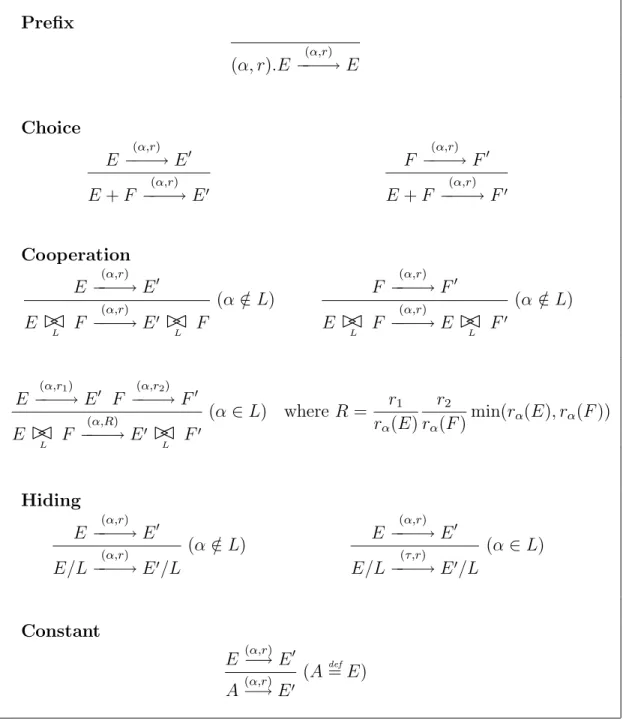
For each a ∈ Act(P) there is some component P0 which describes the behaviour of the system whenP has completeda. This componentP0 is not necessarily distinct from P. We write P −→a P0, or P −−−→(α,r) P0 to denote the completion of activity a and the subsequent behaviour of the system as P0. A more precise definition of−→a will be given in Section 3.3.7.
3.3.2
Syntax
Components and activities are the primitives of the language PEPA; the language also provides a small set of combinators. As explained in the previous section the behaviour of a component is characterised by its activities. However, this behaviour may be influenced by the environment in which the component is placed. The combinators of the language allow expressions, or terms, to be constructed defining the behaviour of components, via the activities they undertake and the interactions between them.
The syntax for terms in PEPA is defined as follows:
P ::= (α, r).P | P +Q | P
BC
L Q | P/L | A
The names of these language constructions and their intended interpretations are presented in some detail below.
Prefix: (α, r).P
Prefix is the basic mechanism by which the behaviours of components are constructed. The component (α, r).P carries out activity (α, r), which has action typeα and a duration which is exponentially distributed with parameter r (mean 1/r). The time taken for the activity to complete will be some ∆t, drawn from the distribution. The component subsequently behaves as component P. If the component is (α, r).P at some time t, the time at which it completes (α, r) and becomesP, enabling all the activities inAct(P), will be t+ ∆t. When
a= (α, r) the component (α, r).P may be written asa.P.
It is assumed that there is always animplicit resource, some underlying resource facilitating the activities of the component which is not modelled explicitly. Thus the time elapsed before activity completion represents use of this resource by the component. For example, this