SECTION 5
LOAD SECURITY & SAFETY
Building a safe operation means being conscious of safety every day in every way. Think Safe is a commitment to make sure people stay safe, right down the line, and to cut out damage and delays.
Safety is paramount in all freight handling.
Think Safe, Behave Safe and Watch Out for the Safety of Others—fellow workmates and the public at large. This will ensure that no lives or limbs are put in jeopardy.
Think Safe means safe loading, good stowage and increased customer satisfaction.
27 November, 2020 FREIGHT HANDLING CODE Page 5.1
5.1
SAFETY
5.1 Safety
5.2 Load Stability 5.3 Load Movement 5.4 Load Distribution 5.5 Door & Hatches 5.6 Container Seals
5.7 Tie-Down Points & Lashings 5.8 Baulking & Chocking
5.9 Chains 5.10 Dunnage
5.11 Strops (or Load Binders) 5.12 Steel Strapping
5.13 Nets & Tarpaulins 5.14 Twistlocks
5.15 Stanchions
27 November, 2020 FREIGHT HANDLING CODE Page 5.2
Load stability is all about weight and gravity.
The weight of an object is a downward force which acts through the centre of gravity as shown in Diagram 5.1. The weight of the freight can help keep the freight stable. It can also make the freight unstable and fall over.
THINK STABILITY
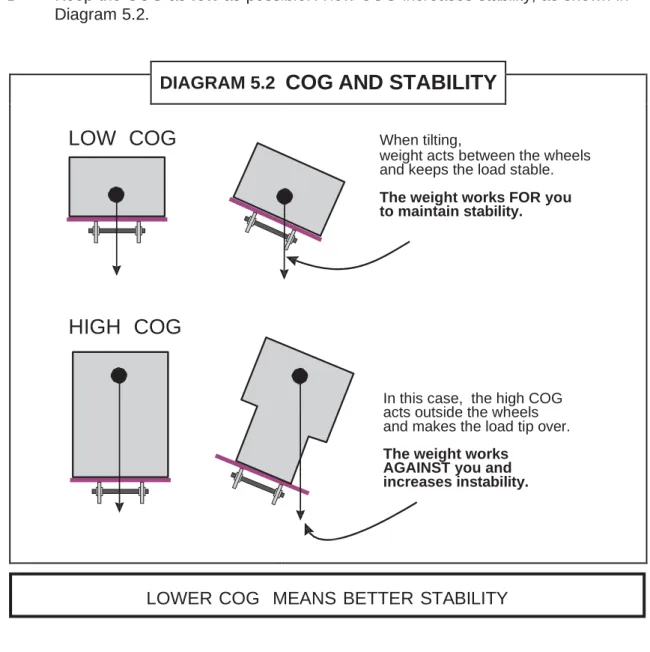
Keep the COG as low as possible. A low COG increases stability, as shown in Diagram 5.2.DIAGRAM 5.2
COG AND STABILITY
LOW COG
HIGH COG
When tilting,
weight acts between the wheels and keeps the load stable.
The weight works FOR you to maintain stability.
In this case, the high COG acts outside the wheels and makes the load tip over.
The weight works AGAINST you and increases instability.
Remember that wagons tilt when travelling round curves, so the load may be stable when stationary but might topple over in transit.LOWER COG MEANS BETTER STABILITY
5.2
LOAD STABILITY
COG
WEIGHT DIAGRAM 5.1
Loads MUST NOT move when in transit.
They must be restrained either individually or in combination so as to prevent movement under normal travelling conditions.
The following examples show what happens when loads are not secured properly: A neat and tidy load that started like this…
… could end up like any one of these:
Restraints to stop movement can be provided using lashings, chains, baulks, nets, air bags etc.
Provide extra restraints…
When loading on slippery surfaces.
When loading steel on steel (see Section 13 of this Manual).
When loading manufactured boards, e.g., hardboard (see Section 18.2 of this Manual).The remainder of this Section gives more details about restraining loads in a secure
FREIGHT HANDLING CODE Page 5.3
5.3
LOAD MOVEMENT
FREIGHT HANDLING CODE Page 5.4
DO…
Stay within wagon and axle weight limits. See Diagram 5.4 ‘Check Axle Loading’.
Stay within the size limitations
Keep COG low.
Position the load for ease of removal, i.e., put last off freight on first.
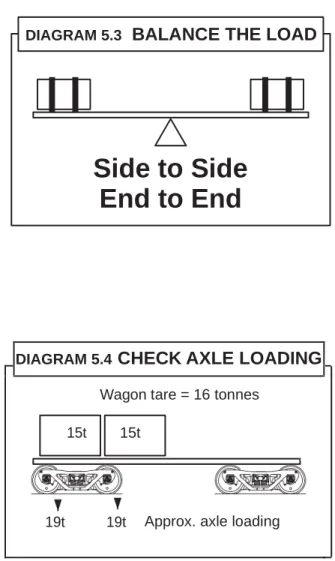
Balance the load evenly. See Diagram 5.3 ‘Balance the Load Evenly’.DO NOT…
light loads.
DO NOT load at one end only (unless loading centrally is impossible).
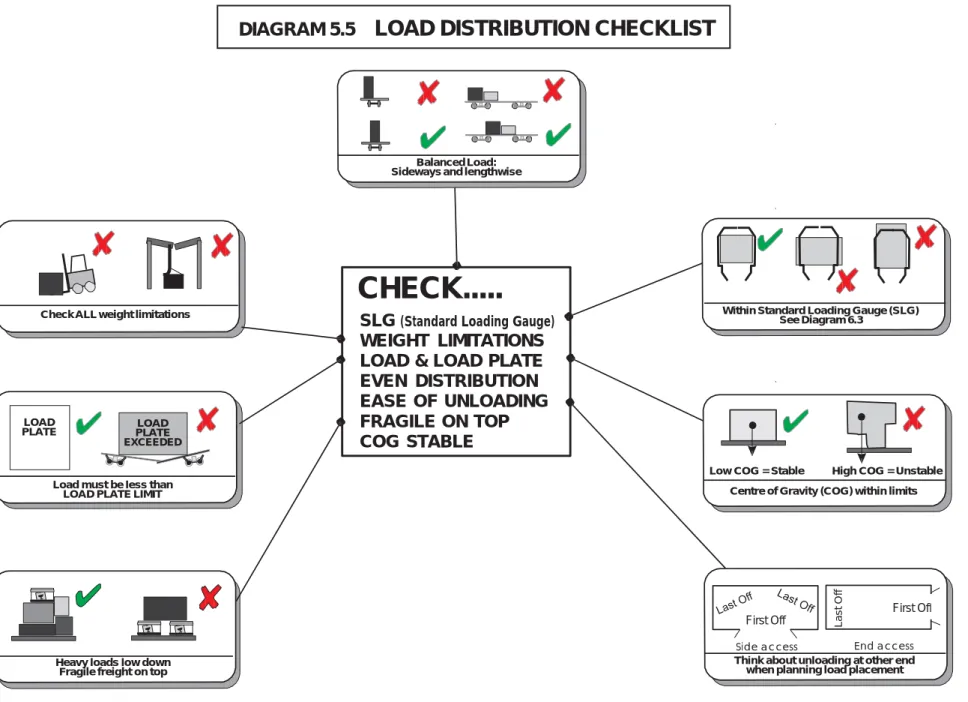
DO NOT load on one side only. Diagram 5.5 illustrates these points.CHECK AXLE LOADING
A load might be within the overall weight limit for one wagon, but if placed at one end, it might exceed the axle limit. For example, take two containers each weighing 15 tonnes and place them on one wagon whose tare is 16 tonnes. The combined weight is 46 tonnes. This is within the overall wagon limit.
But the axle loading would be similar to Diagram 5.4. For 16 tonne axle routes (see Diagram 22.6) loads like that shown here would exceed the axle limit.
5.4
LOAD DISTRIBUTION
DIAGRAM 5.3
BALANCE THE LOAD
Side to Side
End to End
DIAGRAM 5.4
CHECK AXLE LOADING
Wagon tare = 16 tonnes
15t 15t
19t 19t Approx. axle loading
LOAD
PLATE PLATE LOAD EXCEEDED
First Off Balanced Load:
Sideways and lengthwise
J
Low COG = Stable High COG = Unstable
First Off Check ALL weight limitations
CHECK...
SLG (Standard Loading Gauge) WEIGHT LIMITATIONS LOAD & LOAD PLATE EVEN DISTRIBUTION EASE OF UNLOADING FRAGILE ON TOP COG STABLE
Within Standard Loading Gauge (SLG) See Diagram 6.3
Load must be less than
LOAD PLATE LIMIT Centre of Gravity (COG) within limits
Side access End access
Heavy loads low down Fragile freight on top
Think about unloading at other end when planning load placement
DIAGRAM 5.5
LOAD DISTRIBUTION CHECKLIST
La
s
t
O
ff
FREIGHT HANDLING CODE Page 5.5
27 November, 2020 FREIGHT HANDLING CODE Page 5.6
All doors, hatches, covers, flaps etc. on containers, wagons or any form of transportation unit MUST be properly CLOSED and SECURED.
This applies to all containers, wagons and any form of transportation unit, whether empty, partly loaded or full.
Before Loading Containers, Wagons or any Form of
Transportation Unit, DO…
Check that all door locking mechanisms are undamaged, intact and fit for purpose Containers with damaged, faulty or missing door locking mechanisms, MUST NOT BE LOADED. If a KiwiRail owned container requires repair contact the nearest KiwiRail office or Customer Service Centre on 0800 351-351.Closing and Securing Side Opening Containers, DO…
After closing side opening container doors, check that ALL doors are FULLY latched and that door guides (top and bottom) are located in their channels. DO NOT despatch containers that cannot be PROPERLY secured—they must be ‘bad ordered’ and repaired before use.
Ensure that an approved container seal is securing at least 1 locking bar per DOOR PANEL (4 seals per side opening container)
Check that cable ties are NOT used as a replacement for a broken latchALL 4 locking bars require seals, 1x lock bar per door panel (examples circled)
FREIGHT HANDLING CODE
27 November, 2020 Page 5.7
Closing and Securing End Opening Containers, DO…
Ensure that one seal is securing the OUTER door lock bar - the seal is either positioned on the handle or at the base of the lock bar
Check that cable ties are NOT used as a replacement for a broken latch1 seal, in EITHER circled location is required
If required for load security and/or cleanliness, security seals should be applied immediately after closing.
Before despatch, DO…
Check that all doors, hatches etc are closed.
Check that all container door handles are seated correctly in the door catch, the door handle retainer / latch is lowered, and an approved seal is securing the container
‘THINK SAFETY’27 November, 2020 FREIGHT HANDLING CODE Page 5.8
Where doors and hatches etc cannot be closed
and
secured
, DO…
Immediately INFORM your supervisor, nearest KiwiRail office, or the Customer Service Centre on 0800 351-351
Mark the wagon, container, or transportation unit as follows: ‘NTR’. NTR means NOT TO RUN.DO NOT…
DO NOT load the wagon, container or transportation unit.FREIGHT HANDLING CODE
27 November, 2020 Page 5.9
Seals must be attached to all:
Container Doors
Container Door panels for side opening containersOnly approved seals are to be used, these are:
Transit Bolts
Cable Ties
Padlocks
Shippers SealsTransit Bolt Cable Tie
Padlock Shippers Seal
FREIGHT HANDLING CODE
27 November, 2020 Page 5.10
Lashings include chains and strops (webbing). All methods of securing, lashing and tying a load are only as strong as the tie-down points and the strength of the lashings.
Tie-down points must be able to resist movement in all directions, i.e.,
Forward or backward;
Sideways;
Up and down.DO CHECK…
That the tie-down points cannot move.
That the tie-down points will not come loose in transit.
That the tie-down points are strong enough for the type of load being restrained.IF TIE-DOWN POINTS ARE NOT GOOD ENOUGH…
Seek advice from your supervisor.
Use additional means of securing the load. For example, place the load in a corner or against the headboard, or use extra chocks, cradles or dunnage/gluts. Lashings must be strong enough to secure the load. A lashing that breaks in transit can, potentially, cause serious problems.RULES FOR SATISFACTORY LASHING
For chains (and steel wire) the rated strength shall be equivalent to, but not more than, the specified minimum breaking strength.
For strops, (webbings) the rated (assembly) strength shall be equivalent to, but not more than, half the breaking strength.
Unrestrained loads: Combined rated strength of lashings must be at least twice the weight of the load.
Loads restrained against headboards or end walls: Combined rated strength must be at least equal to the weight of the load. See Diagram 5.6.Note: The lightweight lashing points (’crinkle bars’) fitted to some wagons are mainly intended for securing tarpaulins. They have load rating of only 1.25 tonnes. The can be used to secure items using ropes or 38mm commercial webbing strop assemblies. They are not suitable for use with securing chains or 50mm webbing strops.
Danger: Ropes MUST NOT be used
FREIGHT HANDLING CODE Page 5.11
DIAGRAM 5.6
MINIMUM LASHING STRENGTHS
UNRESTRAINED LOAD
Combined rated strength of lashings must be at least TWICE the WEIGHT of the LOAD Combined strength Weight W
at least 2 × W
LOAD RESTRAINED AGAINST ENDS
Combined rated strength of lashings must be at least EQUAL to the WEIGHT of the LOAD
Baulking End
Freight weight W kg Freight weight X kg Freight weight Y kg
Combined rated Combined rated Combined rated
lashing strength lashing strength lashing strength at least W kg at least X kg at least Y kg
Chocking is the technique of using blocks, wedges and chocks to secure a load. Where possible, loads should be secured against solid walls, ends or headboards. However, this is not always possible since it might produce an unbalanced load. Chocking should, where possible, be in addition to other methods of obtaining load security.
WHEN CHOCKING, DO…
Check that the chocking cannot work loose or move.5.8
BAULKING & CHOCKING
FREIGHT HANDLING CODE
27 November, 2020 Page 5.12
For chains (and steel wire) the rated strength shall be equivalent to, but not more than, the specified minimum breaking strength.
The standard railway bond chains fitted to wagons have a rated strength of 10 tonnes. They are designed to be loaded through the winch scroll only. The end lug that the long chain is attached to is not a load anchor point.
WRONG
A loaded wagon shouldNOT look like this. The lug at the end of the chain
has no restraint rating
CORRECT
The chain on the loaded wagon should look like this, the chain is wrapped around the main shaft of the tensioner
(winch scroll). This gives a restraint rating of 10 tonne
RULE
Chains must not be loose in transit. When not in use, chains must be:
Laced across the wagon deck (1st option);
Layered into serviceable chain boxes, free of ballast, with the last link slotted into the locking slot (2nd option);
Stowed along or across the deck of flat top wagons with stanchions, with the end secured and the chain taut so that it will not move in transit. (3rd option).DO…
Tension the chains up from both sides..
Use tyre dunnage on the edges under the chains when securing plate or flat sheet metal.DO NOT…
DO NOT load any freight when tensioning hooks are missing.27 November, 2020 FREIGHT HANDLING CODE Page 5.13
Dunnage is used to separate loads from each other, and from the load platform. It provides protection for the freight, and reduces any damage that the load might inflict on the load platform.
DO…
Use the same thickness under each piece of freight.
Use dunnage with the maximum possible width.
Use single layers of thicker dunnage rather than double layers of thinner dunnage.
Secure the dunnage to the freight if there is any chance of movement in transit. See later sections in this Manual for dunnage requirements for different types of freight, e.g., Section 13 for metallic product.AVOID…
Loose dunnage between loads and between the load and the load platform.
For strops, the rated (assembly) strength shall be equivalent to, but not more than, half the breaking strength.
Strops, or load binders, have several major advantages for lashing loads to the load platform:
They have quick-fastening and release mechanisms.
They have built-in tensioning mechanisms.
They can not damage freight as easily as chains can.
They do not tighten or slacken in response to moisture.RULES
Strops must demonstrate compliance with AS/NZS 4380
Strops must be at least 38 mm wide.
Strops must be secured across the wagon deck when not in use.5.11
STROPS (or Load Binders)
FREIGHT HANDLING CODE
27 November, 2020 Page 5.14
DO…
Inspect every piece of webbing every time before using it.DO NOT...
Use strops that are knotted
Use strops that are twisted more than half a turn. Half a turn is allowable to prevent vibration or flappingSteel strapping (banding) is often used to unitize loads.
Steel strapping is not acceptable for use as primary load restraint for general freight.
There are a variety of commercially produced strapping products in use and the strength rating of the system is not identified in a standard manner1, making it difficult to assess that a load is adequately secured.
Steel strapping performance is subject to variations in tooling, end finishing and operator skill.
Steel strapping which comes loose in transit cannot be re-tensioned.
Steel strapping is not included in the Land Transport New Zealand TruckLoading Code as a “standard” means of primary load restraint for similar reasons.
High tensile steel strapping has a low securing rating compared to chains or strops.
A typical strop might have a securing rating of about half that of a webbing strop,so a very large number of straps would be required to secure a heavy load. Steel strapping may be approved as primary or significant load restraint for specific regular ongoing traffic.
Approval would involve calculations and / or physical tests that prove that the securing system meets the requirements of Section 5.6 of this code. It would require processes to be in place at the loading site to ensure that strap quality, tool maintenance and operator training are controlled.Note: In view of the cost of setting up and operating such an approval scheme, this approach can only be adopted in exceptional cases where conventional securing methods cannot be used and traffic volume and consistency justifies such an investment.
Approved loading schemes for specific products will be documented in an M9204 loading quick guide. If no quick guide document exists, the loading scheme is not approved.
1 - The timber packaging industry has been encouraged by NZTA to develop a standard way of identifying strapping, but to date this has not happened.
5.12
STEEL STRAPPING
27 November, 2020 FREIGHT HANDLING CODE Page 5.15
DO...
Use nets for light, fragile top storage where additional security is needed.
Use tarpaulins for protection.
Use tarpaulins to contain bulk loads in open-top wagons.DO NOT...
DO NOT use tarpaulins to secure the load. Secure the load by approved methods.Most purpose-built rail wagons have specially designed locking mechanisms to secure the load during transportation.
These mechanisms are called twistlocks.
DO…
Always check that twistlocks have been secured before despatching the load. For details on loading and securing containers, see Section 12.DO…
Ensure stanchions are put in place for all unenclosed loads on flat deck wagons. This will provide a restraint in case the load should shift in transit.5.15
STANCHIONS
5.14
TWISTLOCKS
FREIGHT HANDLING CODE
27 November, 2020 Page 5.16
DO...
Ensure that side curtains are properly secured and tensioned.DO NOT...
DO NOT use tarpaulins to secure the load. Secure the load by approved methods.
DO NOT use side curtains alone to secure loads travelling interisland.Load bearing curtains (as fitted to a number of wagons and container types) may only be relied on as the primary load restraint where the load is the one the wagon or container was specifically designed and tested to handle.
Where other load types are transported in a curtainside wagon or container, the load must be secured using strops or chains in accordance with standard freight securing requirements.
Controlled Loading Trials:
Are required in order to approve curtainside equipment for a load type it was not originally designed or previously approved for.
Loads in Curtainside Wagons and Containers - Background document
Some wagons and containers are fitted with load bearing side curtains. These provide good access to the load space while retaining good weather protection for the load. They may also form part or all of the load restraint system for the wagon or container. In most cases, these curtain side wagons and containers were designed for specific products and testing was carried out to ensure that the specific loads did not move in transit.
Some of these wagons and containers are now used in general freight traffic. In some cases it may be acceptable to carry products restrained by only the curtains. If the curtain is not in direct contact with the load, extra restraints will be required, even if the weight is less than the rated load for the curtain.
Curtains cannot restrain loads they are not touching and as a result they can allow entire loads or parts of loads to move sideways far enough to make the wagon unstable or out of gauge before stopping further load shift. Unsecured general loads need to be carefully monitored and, if significant movement is occurring in transit, extra restraints used.
Note: Loads restrained by curtains only are not permitted to travel on the Interisland ferries.
27 November, 2020 FREIGHT HANDLING CODE Page 5.17
Basic Curtain Ratings for Rail Operation Only
Many of the load bearing curtains on KiwiRail wagons and containers were
manufactured by Structurflex. The load bearing capability of these curtains is provided by the built-in webbing straps. The spacing of these straps (typically between 500- 700mm) affects the curtain rating. Structurflex tests have shown that a single strap can safely carry a distributed (i.e. full height) load of 723kg. Maximum design lateral
acceleration on rail is 0.3g. This means each strap can restrain 0.723 x 0.3 = 2.4 tonnes of product.
Structurflex curtains typically have a load rating plate attached to one of the end tensioner poles. The load rating is usually expressed as 1200kg/m, which will calculate out to give the same result as the counting straps approach. Other common KiwiRail curtain suppliers (Polyweld and YJTC) use equivalent technology and certify their products to the same rating.
Note: The Road Transport legislation allows no more than 100mm of curtain deflection under a sideways acceleration of 0.5g. This reflects the concern that curtains can allow loads to move significantly in transit. However curtain contact with the load and/or some deflection around the load is essential to the curtain developing an effective restraining force. New Zealand curtain manufacturers claim that it is not practical to achieve the road requirement with a hand tensioned curtain system and continue to rate their products on strength alone, with responsibility for meeting the requirements of the legislation falling on the operator.
100mm nominal curtain deflection is acceptable for rail transport.
Weight limit for common curtain side wagons and containers
Vehicle Approved Unsecured Load Body capacity (tonne) Number of Straps per side Total curtain capacity (tonne) GXT (including previous GCT & GCM designations) Palletised Domestic Freight 20.0 11 26.4 TSD, TSF, TSH, TSL, TSM
Specific Dairy Products. Parachute strops or air bag also required
26.3 (TSM has max rating) 11 26.4 ZHC Palletised Domestic Freight 38.0 22 52.8
ZK Paper Reels, Baled Pulp 41.0 22 52.8 ZWT (2x GWT on IA wagon) Palletised Domestic Freight 23.8 per GWT 11 per GWT 26.4 per GWT ZWX & ZWF (Prototype
and production versions of GWF on 50' CFT wagons) Palletised Domestic Freight 47.7 26 55.4 ZXF (GCF on UK wagon) Palletised Domestic Freight 35.0 24 51.5
27 November, 2020 FREIGHT HANDLING CODE Page 5.18
In all cases, the curtain capacity exceeds the load capacity of the vehicle. Therefore for these approved products only, loading up to the wagon body load capacity is
acceptable using the curtain as the primary load restraint, noting:
Controlled loading trials are required in order to approve curtain-side equipment for a load type it was not originally designed or previously approved for.
The unsecured load must not exceed 2.4 tonne per curtain strap. Thus heavy items must be separately stropped and secured.
The total load must not exceed the lower value of the load capacity of the wagon or container.
Curtains are best suited to restraining uniformly distributed full height loads. The load must be packed so gaps are minimised and so the load cannot move, toppleor make the wagon unbalanced.