Title The implementation of a literacy intervention 'Station Teaching' in infant classes in Irish primary schools
Author(s) Daly, Dympna
Publication date 2015
Original citation Daly, D. 2015. The implementation of a literacy intervention 'Station Teaching' in infant classes in Irish primary schools. PhD Thesis, University College Cork.
Type of publication Doctoral thesis
Rights © 2015, Dympna Daly.
http://creativecommons.org/licenses/by-nc-nd/3.0/
Embargo information No embargo required
Item downloaded
from http://hdl.handle.net/10468/2588 Downloaded on 2017-02-12T07:35:27Z
The Implementation of a literacy intervention
‘Station Teaching’ in Infant classes in Irish primary
schools
Dympna Daly
Thesis submitted in fulfilment of the requirement for the Degree of Doctor of
Philosophy, School of Education, National University of Ireland, Cork.
Supervisors: Professor Kathy Hall and Dr. Brian Murphy
Head of School: Professor Kathy Hall
Table of Contents
DECLARATION………...IX ABSTRACT………. X ACKNOWLEDGEMENTS……….XI DEDICATION………....XII LIST OF TABLES………....XIII LIST OF CHARTS, DIAGRAMS AND FIGURES………..XVCHAPTER 1 INTRODUCTION……….…1
1.1 INTRODUCTION………...1
1.2 BACKGROUND TO THE STUDY ………..1
1.3 FOCUS OF THIS STUDY……….6
1.4 RESEARCH QUESTIONS………7
1.5 RESEARCH METHODS………...7
1.6 THESIS OVERVIEW………8
1.7 PERSONAL / PROFESSIONAL JOURNEY WITH LITERACY………...10
1.8CONCLUSION……….13
CHAPTER 2 LITERATURE REVIEW: EFFECTIVE LITERACY TEACHING IN THE EARLY YEARS OF SCHOOL………....15
2.1 INTRODUCTION……….…15
2.2 DEFINITION OF LITERACY……….….16
2.3 DIFFERENT WAYS OF TEACHING LITERACY……….…20
2.4 RESEARCH ON ‘GOOD’ TEACHERS AND EFFECTIVE LITERACY TEACHING……….25
2.5 WHAT IS AN EFFECTIVE TEACHER OF LITERACY? STUDIES FROM THE UNITED STATES………...33
2.6 RESEARCH FROM AUSTRALIA AND NEW ZEALAND………...41
2.7 STUDIES FROM THE UNITED KINGDOM………...44
2.8 SOCIO-CULTURALCONCEPTS OF LITERACY………..……….…….50
2.9 CONCLUSION………..57
CHAPTER 3: REVIEW OF IRISH POLICY CONTEXT AND POLICY LITERATURE ON LITERACY IN THE EARLY YEARS………....58
3.2 POLICY CONTEXT AND OFFICIAL GUIDANCE ON THE TEACHING OF LITERACY IN
IRISH PRIMARY SCHOOLS……….59
3.3 PISA 2009………..65
3.4. THE NATIONAL STRATEGY TO IMPROVE LITERACY AND NUMERACY……….68
3.4.1 Targets for schools……….…...70
3.4.2 The National Literacy and Numeracy Strategy: Pedagogy or Politics? ...77
3.5 QUALITY AND STANDARDS IN IRISH PRIMARY SCHOOLS………78
3.5.1 Chief Inspector’s Report 2010 – 2012………..78
3.5.2 NCCA Research Reports on Literacy in Early Childhood and Primary Education………...80
3.6 CONSULTATION PROCESS ON THE NEW PRIMARY SCHOOL LANGUAGE CURRICULUM ………. 81
3.7 THE 2014 NATIONAL ASSESSMENTS OF ENGLISH READING AND MATHEMATICS………83
3.8 CHILDREN’S PARTICIPATION AND VOICE IN EDUCATION AND LITERACY LEARNING……….88
3.9 GROWING UP IN IRELAND STUDY………...89
3.10 CONCLUSION………...94
CHAPTER 4: WHAT DO WE KNOW ABOUT IRISH TEACHERS’ PRACTICE OF TEACHING LITERACY IN THE EARLY YEARS OF PRIMARY SCHOOL…………... 95
4.1 INTRODUCTION……….95
4.2 READING INSTRUCTION……….96
4.2.1 Reading practice and comprehension instruction in Irish primary classrooms……….97
4.2.2 Raising Literacy Levels With Collaborative On-Site Professional Development in an Urban Disadvantaged School………...99
4.2.3 Learning in Focus: The Primary Classroom: Insights from the Growing Up in Ireland Study………...102
4.2.4 Effective literacy practices in DEIS schools in Ireland………..103
4.2.5 Summary of effective literacy practices in DEIS schools………..108
4.2.6 Literacy lessons from the schools………...110
4.2.7 Areas needing improvement………...111
4.2.8 Doodle Den………...112
4.2.9 The use of Popular culture to Teach Writing in the Primary Classroom………....114
4.3 ESSENTIAL LITERACY SKILLS……….117
4.3.1 Developing concepts about print………....117
4.3.2 Vocabulary and fluency………...117
4.3.3 Phonological Awareness………...120
4.3.5 Comprehension……….122
4.4 ASSESSMENT………...124
4.4.1 Assessment in Reading………124
4.4.2 Trinity Early Screening Test in Reading and Writing (TEST2r)………..………..126
4.5 EFFECTIVE INTERVENTIONS FOR STRUGGLING READERS………128
4.6 STRATEGIES IN USE IN SCHOOLS TO IMPROVE LITERACY………130
4.6.1 Peer Tutoring……….130
4.6.2 Reading Recovery………..131
4.6.3 Co-teaching………...133
4.7 STATION TEACHING IN PRIMARY SCHOOLS IN IRELAND…………... ………...136
4.7.1 Getting ‘Station Teaching’ started………...137
4.7.2 Outline of the ‘Stations’: advice for teachers………...138
4.7.3 Guided Reading………...139
4.8 CONCLUSION………...142
CHAPTER 5: RESEARCH DESIGN………..144
5.1 INTRODUCTION: CHOICE OF DESIGN………144
5.2 QUANTITATIVE DATA: QUESTIONNAIRE SURVEY………...146
5.2.1 The postal survey………...146
5.2.2 Questionnaire design……….147
5.2.3 Pilot testing the questionnaire………149
5.2.4 Letter of transmittal/Cover letter………...151
5.2.5 Sample………. ……….151
5.2.6 Data collection - Conducting the Survey………..152
5.2.7 Survey response rate………..153
5.2.8 Data analysis………..153
5.2.9 Validity and reliability………...155
5.2.10 Limitations of the Study………..156
5.2.11 Timelines……….157
5.3 QUALITATIVE DATA: CASE STUDY………...157
5.3.1 Sample………159
5.3.2 Measures……….160
5.3.4 Children’s drawings……….………...165
5.3.5 Data collection procedures and further contextualisation of the Study………165
5.3.6 Pilot testing: Observations………..168
5.3.7 Interview protocol………...168
5.3.8 Preparing for the interview………...169
5.3.9 My ethical dilemmas………..172
5.3.10 Data analysis procedures………..174
5.3.11 Limitations of the Study………...176
5.3.12 Timelines………..177
5.4 CONCLUSION………...178
CHAPTER 6: TEACHERS’ VIEWS AND EXPERIENCE OF STATION TEACHING IN PRIMARY SCHOOLS: RESULTS OF QUESTIONNAIRE SURVEY………...180
6.1 INTRODUCTION………...………180
6.2 SAMPLING DETAILS……….…..181
6.3 THEME 1: ORGANISATION OF STATION TEACHING (ST)……….…….184
6.3.1 Personnel involved in classes for ST, the number of groups in ST and the numbers of pupils in groups………...186
6.3.2 Movement from Station to Station during the intervention………....189
6.4 THEME 2: FOCUS OF LITERACY ACTIVITIES IN STATION TEACHING SESSIONS……….………190
6.4.1 Effective teaching practices for teaching literacy………...…………194
6.4.2 Phonological awareness and Phonics teaching………..……….195
6.4.3 Oral language and vocabulary work………..……… 195
6.4.4 Comprehension strategies………..…… 196
6.4.5 Reading strategies………...………196
6.4.6 Writing strategies………..……..197
6.5 THEME 3: RESOURCES TEACHERS USE IN ST AND INSIGHTS INTO LITERACY CURRICULUM……… 198
6.6 THEME 4: ASSESSMENT APPROACHES………. 203
6.6.1 Useful for assessing pupil’s progress………...………204
6.6.2 Type of groupings for ST……….………. 204
6.6.3 How teachers judge the success of ST……….…………..205
6.7 THEME 5: TEACHERS’ PERCEPTIONS OF THE EFFECTIVENESS OF STATION TEACHING……….……..209
6.7.2 Aspects of literacy which may be neglected or limited in ST………...…… 212
6.8 THEME 6: CONTINUOUS PROFESSIONAL DEVELOPMENT FOR TEACHERS ON STATION TEACHING……… 215
6.8.1 Younger teachers observing and learning from more experienced teachers...216
6.8.2 Teachers enjoy working with small groups of pupils and engaging in professional dialogue………... 216
6.8.3 Enhancing teachers’ teaching of literacy……….…….. 217
6.8.4 ST has improved literacy instruction……….… 219
6.9 THEME 7: PUPILS’ ENGAGEMENT WITH STATION TEACHING………...….220
6.9.1 Children love working in small groups………... 221
6.10 THEME 8: FACTORS HINDERING AND ENHANCING IMPLEMENTING STATION TEACHING………... ………..222
6.10.1 Children’s learning……….………. 224
6.10.2 Teacher learning……….……. 225
6.10.3 Concerns regarding the organisation of ST………. …………226
6.10.4 How other teaching approaches complement ST………... ……….227
6.11 THEME 9: HOW STATION TEACHING CAN BE IMPROVED………. 228
6.11.1 A longer block of Station Teaching in classes each year………...228
6.11.2 More time, more staff and more resources needed………..……… 229
6.11.3 Children should be grouped according to ability; graded and individual instruction should be provided………...230
6.11.4 Training should be available for teachers for ST………...231
6.11.5 Planning and organisation of ST are vital………..………..231
6.11.6 Difficulty setting up LLO: Soapbox………...232
6.12 CONCLUSION………....233
CHAPTER 7 CASE STUDY FINDINGS AND ANALYSIS………....234
7.1 INTRODUCTION……….………..234
7.2 Theme 1: Enjoyment and motivation………...237
7.2.1 My observations of pupils’ enjoyment and motivation in Station Teaching classes ….240 7.2.2 Pupils’ drawings of Station Teaching……….242
7.3 Theme 2: Engagement and praise………244
7.3.1 Junior Infant classrooms……….245
7.4 Theme 3: Pupils’ learning is extended……….254
7. 5 Theme 4: Working in small groups………...259
7.6 Theme 5: Staff collaboration, professional dialogue and professional development………..263
7.6.1 My observations on staff collaboration, professional dialogue and professional development ………..264
7.7 Theme 6: Making a difference to and enhancing teachers’ teaching of literacy………..269
7.8 Theme 7: Improvement in pupils’ literacy skills……….274
7.8.1 Progress in Junior Infants………...275
7.8.2 Progress in Senior Infants………...278
7.9 Theme 8: Pre and Post test results of literacy tests……….284
7.9.1 Concepts about Print in Junior Infants………...285
7.9.2 Middle Infant Screening Test in Senior Infants………..289
7.10 Theme 9: Development of reading and writing practices from the pupils’ and parents’ perspectives………..293
7.10.1 Junior Infants – pupils’ perspectives on reading and writing………...294
7.10.2 Parents’ perspectives on reading and writing at the end of Junior Infants…………...295
7.10.3 Senior Infants: pupils’ perspectives on reading and writing………296
7.10.4 Senior Infants - Parents’ perspectives on reading and writing……….299
7.10.5 Supporting children’s literacy skills……….301
7.11 Conclusion……….303
CHAPTER 8: CONCLUSIONS AND IMPLICATIONS………..304
8.1 Introduction……….304
8.2 Background………..304
8.3 Summary of the empirical study………..306
8.4 Research Questions………...308
8.5 Limitations of the study………...316
8.6 Implications for practitioners, policy makers and researchers………...317
8.7 Contribution of this work to literacy theory………322
8.8 Conclusion………...326
8.9 A BRIEF REFLECTION……….327
BIBLIOGRAPHY………329
APPENDICES………..358
APPENDIX 2: Questionnaire To Ascertain Teachers’ Views and Experience of Station Teaching in
Primary Schools……….359
APPENDIX 3: Letter of Transmittal……….367
APPENDIX 4: Informed consent………..368
APPENDIX 5: Information note on Resources teachers use in ST………...371
APPENDIX 6: Resources teachers use in Station Teaching ………....372
APPENDIX 7: Information note on assessments teachers use to select groupings……….………...373
APPENDIX 8: Criteria Class Teachers use to judge the success of ST………374
Declaration
I hereby declare that this dissertation has not been submitted to any other institution, and is, except where otherwise stated, the original work of the researcher.
Signed________________________________________________________________ Dympna Daly
Abstract Background
I conducted my research in the context of The National Literacy Strategy (DES, 2011), which maintains that every young person should be literate and it outlines targets for improving literacy in schools from 2011 to 2020. There has been much debate on the teaching of literacy and in particular the teaching of reading. Clark (2014) outlines how learning to read should be a developmental language process and that the approaches in the early years of schooling will colour the children’s motivation and their perception of reading as a purposeful activity.
The acquisition of literacy begins in the home but this study focuses on the implementation of a literacy intervention Station Teaching in the infant classes in primary school. Station Teaching occurs when a class is divided into four or five small groups of pupils and they receive intensive tuition at four or five different Stations with the help of Support teachers: New Reading, Familiar Reading, Phonics, Writing and Oral Language.
Research Questions
These research questions frame my study: • How is Station Teaching implemented?
• What is the experience of the intervention Station Teaching from the participants’ point of view: teachers, pupils, parents?
• What notion of literacy is Station Teaching facilitating?
Methods
I chose a pragmatic parallel mixed methods design as suggested by Mertens (2010). I collected and analysed both the quantitative and qualitative data to answer the study’s research questions.
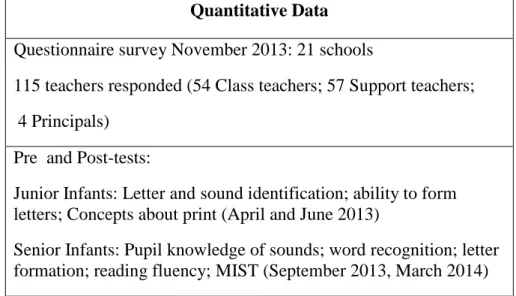
In the study the quantitative data were collected from a questionnaire issued to 21 schools in Ireland. I used Excel as a data management package and thematic analysis to analyse and present the data in themes.
I collected qualitative data from a case study in a school. This data included observations of two classes over a period of a year; interviews with teachers, pupils and parents; children’s drawings, photographs, teachers’ diaries and video evidence. I analysed and presented the evidence from the qualitative data in themes. Main Findings
• There are many skills and strategies that are essential to effective literacy teaching in the early years including phonological awareness, phonics, vocabulary, fluency, comprehension and writing. These skills can be taught during Station Teaching. Early intervention in the early years is essential to pupils’ acquisition of literacy. The expertise of the teacher is key to improving the literacy achievement of pupils
• Teachers and pupils enjoy participating in ST. Pupils are motivated to read and engage in meaningful activities during ST. Staff collaboration is vital for ST to succeed
• ST facilitates small group work and teachers can differentiate accordingly while including all pupils in the groups. Pupils’ learning is extended in ST but extension activities need to be addressed in the Writing Station
• More training should be provided for teachers on the implementation of ST and more funding for resources should be available to schools
Significant contribution of the work
The main significance of the study includes: insights into the classroom implementation of Station Teaching in infant classes and extensive research into characteristics of an effective teacher of literacy.
Acknowledgements
My PhD journey has been a very exciting one and I thoroughly enjoyed being part of the cohort PhD in the School of Education in UCC.
I extend a special thank you to my supervisor, Professor Kathy Hall, who encouraged and supported me at all times. She was a source of great inspiration, fuelling my enthusiasm, motivating me and channelling me in the right direction. Kathy was always available to discuss my research and we engaged in many interesting discussions late into the evening. For her excellent advice and affirmation I cannot thank her enough. Thank you also to Dr. Brian Murphy for your help with my classroom observations.
Thank you to the academic staff in UCC who taught us over the last four years. Thank you to Dr. Paul Conway who coordinated the cohort PhD group initially; to Dr. Siobhán Dowling who took over from Paul; to Professor Kathy Hall, Dr. Karl Kitching, Dr. Stephen O’Brien, Dr. Alicia Curtin, Dr. Vanessa Rutherford and Dr. Maura Cunneen. Thank you for your great support, guidance and encouragement on my PhD journey.
Thank you to all my colleagues in the cohort PhD who were always so supportive and willing to share their knowledge and skills as we soldiered our way along the research path and became friends through the process.
Thank you to all the participants in the study: the teachers, children and parents in our school and the teachers who completed the questionnaire. Thank you in particular to my teaching colleagues who never tired of supporting me in my work for four years and who made valuable contributions to my work along the way. I want to pay particular tribute to my friends, family and colleagues who proof-read various sections of this thesis: to Fiona, Liz, John Paul, Anne, Gerald, Karen, Ann, Catherine and Patrick. A special thank you to Eileen who undertook the final proof reading, to whom I will be forever grateful.
Finally, I wish to thank my family for their support, patience and love: my husband Hugh for his constant affirmation, encouragement and love; my daughters Ann and Catherine who helped with proof reading and my son Patrick for your technical support.
Dedication
This work is dedicated to my parents Joe and Kathleen Murphy who recently
celebrated their 61
stwedding anniversary. They worked extremely hard all their
lives and their main priority was encouraging and supporting their children’s
education, thus enabling us to realise our dreams.
List of tables
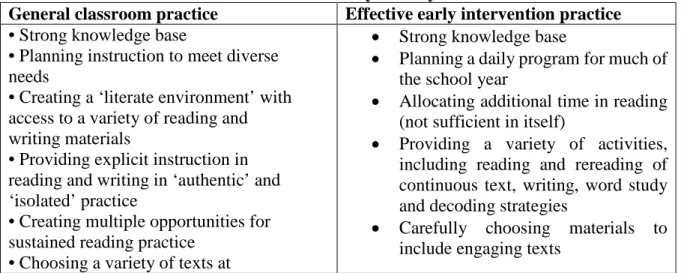
Table 2A: Some characteristics of effective early literacy teachers………38
Table 2B: Attributes of teacher expertise……….43
Table2C: Differences of practice between effective and validation literacy teachers...45
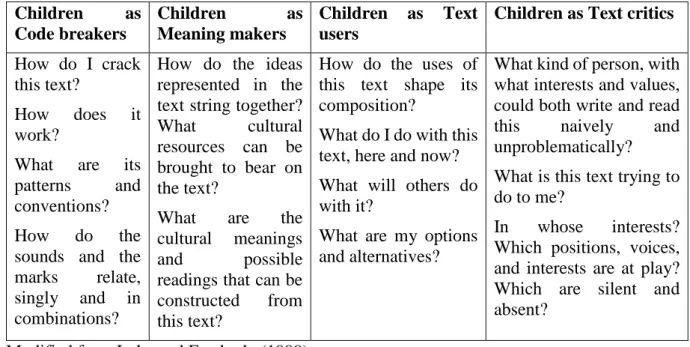
Table 2D: Summary of the elements that need to be part of a literacy curriculum….57 Table 2E: Daly Synthesis of strategies effective teachers use in the teaching of literacy in the early years……….57
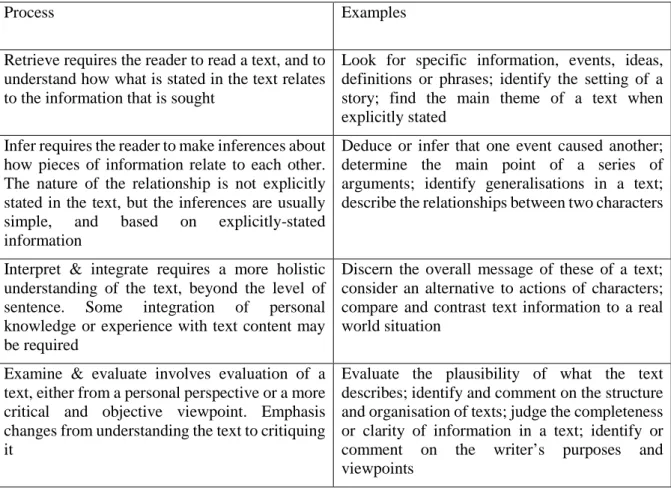
Table 3A: Processes of reading comprehension, and related examples, NA ’ 09 and NA ’14……….84
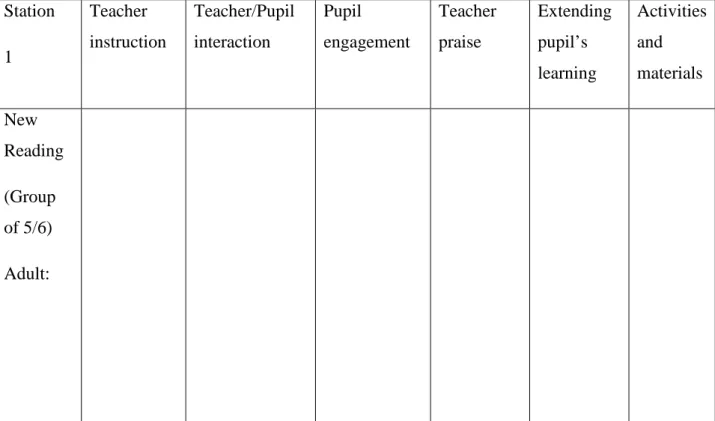
Table 5A: Observation Checklist………163
Table 5B: Summary of Data Collection……….179
Table 6A: Status of schools from which teachers responded (DEIS, non DEIS) and location of schools (rural, urban)……….181
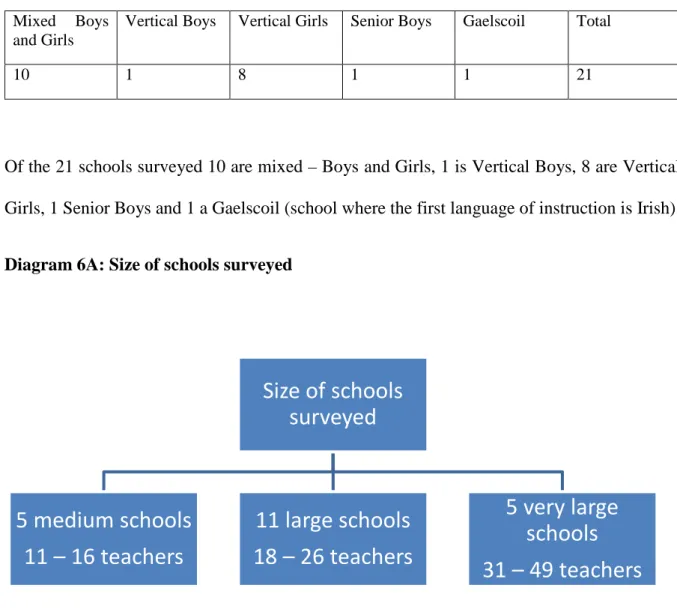
Table 6B: Types of schools represented in the survey……….182
Table 6C: Size of classes the 54 Class teachers teach………..185
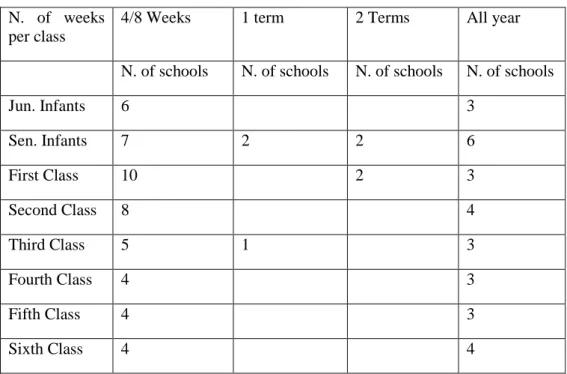
Table 6D: Length of time schools use the intervention in each class……….186
Table 6E: Curricular focus of Station Teaching……….192
Table 6F: Resources teachers of different classes use in Station Teaching………..199
Table 6G: Assessment Approaches teachers employ for selection of pupils for groups in Station Teaching………....203
Table 6I: Overall summary of criteria class teachers use to judge success of ST…………207
Table 6J: Teachers’ views on Station Teaching………223
Table 7A: Pupils’ scores in Concepts about Print Pre and Post-tests………...286
Table 7B: Pupils’ scores in knowledge of letter names pre and post-tests………287
Table 7C: Pupils’ scores in knowledge of initial letter sounds, pre and post-tests…..288
Table 7D: MIST scores 2011, 2012, 2013 and 2014……….290
Table 8A: Summary of themes emanating from the survey and case study…………..308
Table 8B: Summary of combined outcomes from questionnaire survey and case
study……….313
List of charts, diagrams and figures
Chart 6A: Number of schools and classes providing Station Teaching……….184
Chart 6B: Percentage of schools reporting numbers of pupils in groups for ST……..187
Chart 6C: Number of minutes pupils spend at each Station in 21 schools………188
Chart 6D: How teachers learned how to do Station Teaching in percentages……….215
Chart 6E: How other teaching approaches complement ST………..227
Diagram 6A: Size of schools surveyed………182
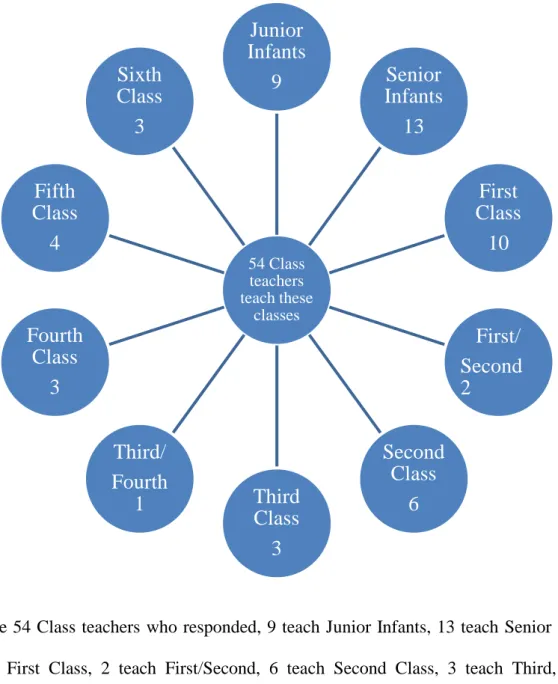
Diagram 6B: Breakdown of the 54 Class teachers who responded to the questionnaire..183
Diagram 6C: Summary of organisation of ST in classes………...190
Figure 7A: Pupil’s Drawing 1……….236
Figure 7B: Pupil’s Drawing 2……….242
Figure 7C: Pupil’s Drawing 3……….245
Figure 7D: Pupil’s Drawing 4……….252
Figure 7E: Pupil’s Drawing 5……….253
Figure 7F: Pupil’s Drawing 6……….293
Chapter 1: Introduction
Literacy is more than having the ability to read and write. It is about helping children to communicate with others and to make sense of the world. It includes oral and written language and other sign systems such as mathematics, art, sound, pictures, Braille, sign language and music (Aistear, National Council for Curriculum and Assessment, 2009, p. 56)
‘If you only knew about literacy from being in this classroom what would you think it was for?’ (Comber, in Hall, 2003)
1.1 Introduction
The opening chapter sets the scene for this research on the implementation of a literacy intervention, Station Teaching, in the Infant classes in primary schools. Firstly I consider the context for examining literacy practices in the present day. I review the current discussions around literacy teaching methods and give a brief overview of recommended good practices on teaching children to read. I outline the focus of my study, my research questions and research methods and I also provide an overview of the thesis. Finally my personal rationale for embarking on this research is explained.
1.2 Background to the study
Literacy includes the capacity to read, understand and critically appreciate various forms of communication including spoken language, printed text, broadcast media and digital media (DES, 2011, p. 8)
This broad definition of literacy is proffered by the Department of Education and Skills in the National Strategy for Literacy and Numeracy in Ireland (DES, 2011). It recognises the importance of including reading, writing, communication and oral language in both print and digital formats as literacy concepts. The National Strategy (DES, 2011) expounds that every young person should be literate and numerate and that we need these skills in all parts of our lives so we can contribute to a more just and equitable society. The National Strategy (DES, 2011) outlines the targets for improving literacy and numeracy in Ireland during the period
2011 to 2020. As I write the Primary School Language Curriculum in Ireland is being reviewed and should be ready for dissemination shortly.
How to teach literacy has been considered very controversial historically. While all are interested in literacy and while politicians of all colours and persuasions express views on it, in some countries political commentary can carry over to narrow prescription which of course is heavily criticised by the research and professional communities. Policy makers often link literacy achievement with opportunities to be successful in life and maintain that poor literacy leads to dysfunctional society. Clark (2014) posits that there is concern in countries surrounding children who leave school with limited literacy skills and that ‘their failure has adverse consequences for their employability, their family and their social life’ (Clark, 2014, p. 196). Clark (2014) advises that if we wish to develop literacy in all children, ‘then we must proceed developmentally from oral communication for a purpose in a wide range of contexts to an integrated approach to reading and writing’ (Clark, 2014, p. 15).
One study in England by the Office for Standards in Education, Children’s Services and Skills (Ofsted) (the inspection body for England) Removing Barriers to Literacy (Ofsted, 2011) identified these features as being crucial for teaching literacy in schools, particularly for those at risk:
• The importance of an emphasis on speaking and listening skills from an early age • Teachers with high expectations
• Carefully planned provision to meet individual needs with early diagnosis and early intervention for those with problems
In this study I focus on literacy in the early years in primary school and in particular reading. Kim Dorian-Kemp, head teacher of High View School Plymouth, United Kingdom, on accepting the prestigious award for The 2014 United Kingdom Literacy Association (UKLA) Literacy School of the Year at the UKLA 51st International Conference in Nottingham in July
2015 opened her acceptance speech with this quote: 'A book is a dream you hold in your hand’. Dorian-Kemp (2015) uses this quote to relay to her pupils the magic of being able to read.
Sally Elborn (2015) in the introduction to the Handbook of Teaching Early Reading: more than phonics, elaborates on the importance of children being able to read:
Reading is a skill we use every day. Whether a road sign, or a novel, at the supermarket or the library, reading is an integral part of our lives. It is not merely a functional tool to meet the demands of society, but a mechanism by which we can acquire knowledge and new ideas, gaining a greater understanding of the world around us. It opens the door to a feast of imagination and creativity which provides enjoyment to reader and author alike (Elborn, UKLA, 2015, p. 4)
There has been much debate on the teaching of reading and in particular in the UK at the moment. At the UKLA 51st International Conference (2015) there was much discussion
surrounding the implementation of the National Curriculum in England and Wales (DfE, 2014) which requires that teachers teach children to read using synthetic phonics in the first instance. Clark (2014) is very critical of using this approach. Synthetic phonics refers to an approach in which ‘the sounds identified with letters are learned in isolation and blended together, for example, a synthetic approach to reading ‘cat’ would require children to decode the word phoneme by phoneme ‘c-a-t’ (Elborn, 2015, p. 47). Analytic phonics on the other hand refers to an approach in which ‘the sounds associated with letters are not pronounced in isolation but children identify phonic elements for words which each contain a similar element, either at the start of the word – onset – or in the later part of the word – rime’ (Elborn, 2015, p. 47). Research
indicates that using both approaches in combination is more effective than using one approach on its own (Juel & Minden-Cupp, 2001).
Clark (2014) suggests that governments seem to ignore evidence from research in relation to the teaching of reading and in particular this dominance of using synthetic phonics. She paints a disquieting picture in some developing countries of how ‘the power being wielded by large commercial organisations to influence government literacy policies, often falsely claiming a research basis for the policy’ (Clark, 2014, p. 6). Clark (2014) also warns against undervaluing the role and contribution of parents in helping their children to learn to read.
Clark (2014) outlines how learning to read in school should happen:
Learning to read should not be regarded as a hierarchy of skills from lower to higher order, but as a developmental language process. The approaches in the initial stages will colour the children’s motivation and their perception of reading as a purposeful valuable activity. On completing their schooling children should not only be able to read with comprehension for a variety of purposes, but also be motivated to read (Clark, 2014, pp11, 12).
There are many skills and strategies that are essential to effective literacy teaching in the early years including ‘phonological awareness, phonics (for reading/spelling), vocabulary, fluency, comprehension and writing (composition)’ (Kennedy, E., Dunphy, E., Dwyer, B., Hayes, G., McPhillips, T., Marsh, J., O’Connor, M. & Shiel, G. 2012, p. 15).
Reading is one strand of literacy and the reading process is very complex. Effective teachers of literacy understand this complexity and use a range of strategies to teach reading successfully. Kennedy et al. (2012) identified a number of components that need to be considered in the teaching of reading:
• The establishment of varied and rich vocabulary • The development of phonological processes
• The provision of a framework for teaching comprehension strategies
• A need to ensure that motivation and enjoyment of reading are key aspects of the reading process
• A renewed focus on reading fluency (Kennedy et al, 2012, pp114-117 )
Ellis (2005) introduced the idea of teachers using a balanced approach to teaching reading:
There is no single instructional method that deserves sole claim to being ‘best practice’. Of course, this comes as no surprise to teaching practitioners operating in the real worlds of their classrooms. Rather than single strategy solutions, the common wisdom of research in the field currently points to the need for balanced approaches to be employed to accommodate the diverse needs of students (Ellis, 2005, p. 44)
The most recent Handbook on teaching early reading has just been published in time for the UKLA 51st International Conference (Elborn, 2015). Elborn (2015) recommends that good
practice in teaching reading includes having effective teachers with sound subject knowledge in schools; the use of consistent approaches throughout the school; having quality resources which are well organised; rigorous assessments which are used effectively; daily reading sessions based on assessed needs; story time; reading to children; literacy rich environments and a high level of parental involvement (Elborn, 2015, p. 5). Underpinning all of these elements has to be a broad and rich reading curriculum which engages teachers and children alike and which promotes a positive reading ethos throughout the school (Elborn, 2015).
Clark (2014) highlights how the skill of the teacher is ‘to capitalise on and to develop the strengths of individual children, aware of and sensitive to the contribution of the parents to the process of education.’ Marie Clay (1972) refers to reading as ‘a patterning of complex behaviour, so also is teaching’ (Clark, 2014, p. 40). Therefore it is incumbent on teachers to provide supportive interactions with children to help them in the acquisition of reading. This
study focuses on one such intervention to help children in the acquisition of literacy in the infant classes in primary school.
1.3 Focus of this study
The acquisition of literacy does not begin in school but rather in the home; however this study focuses on a literacy intervention in the early years in primary school. Pupils can commence primary education in Ireland in the September after they reach the age of four, beginning in Junior Infants class. Some pupils do not commence primary school until they are nearer the age of five. Pupils spend eight years in primary school. Pupils spend year one in Junior Infants and year two in Senior Infants.
Station Teaching is a literacy intervention that teachers in Ireland are now implementing. In this study I focus on the implementation of Station Teaching in the infant classes. Station Teaching occurs when a class is divided into four or five small groups of pupils and they receive intensive tuition at four or five different Stations. Members of the Special Education team in a school, in collaboration with the class teacher, work in the classroom at the different Stations providing a range of literacy activities, for example: New Reading, Familiar Reading, Phonics and Writing activities. In some schools the intervention lasts for six to eight weeks per year, in other schools the intervention continues all year – it all depends on availability of staff.
In this study these are the research questions that I aim to answer: • How is Station Teaching implemented?
• What is the experience of the intervention Station Teaching from the participants’ point of view: teachers, pupils, parents?
• What notion of literacy is Station Teaching facilitating?
I explore in detail the implementation of Station Teaching in Junior and Senior Infant classes. I report on the experience from the participants’ point of view: teachers – both Class and Support, the pupils in the classes and their parents. All of their experiences allow a story to unfold.
1.5 Research Methods
In following Mertens’ guidelines (2010) I chose a mixed methods design in researching my topic and included both quantitative and qualitative data collection in parallel form. I approached the research from a pragmatic paradigm. Onwuegbuzie & Teddie (2002) describe the Pragmatic Parallel Mixed Methods Design as one in which qualitative and quantitative data are collected and analysed to answer a single study’s research questions. The final inferences are based both on data analysis results and the two types of data are collected independently at the same time or with a short time lag.
The research methods are outlined in detail in Chapter 5 and aim to present an accurate account of how the research was conducted.
In my study the quantitative data were collected from a questionnaire issued to teachers in 21 schools in Ireland. 115 teachers responded to this survey. The title of the questionnaire was
‘Teachers’ views and experiences of Station Teaching in primary schools’. The questionnaire results presented a snap shot of what is happening in schools nationally in relation to the implementation of Station Teaching.
The qualitative data were collected by way of a case study approach. By using a case study approach it facilitated an in depth exploration of the implementation of Station Teaching in infant classes. This involves extensive observations of class activities; interviews with class and Support teachers, pupils and parents; collections of field notes; videotapes of classes and the acquisition of children’s drawings.
1.6 Thesis overview
Following this introductory chapter, I present a review of literature in relation to literacy spanning three chapters. In Chapter 2, I consider definitions of literacy and what the research literature says about effective literacy teaching in the early years. I review national and international research. I also explore socio-cultural concepts of literacy and Vygotsky’s (1978) ideas on how children learn and how this supports the acquisition of literacy. I conclude this chapter with a synthesis of strategies that effective teachers use in the teaching of literacy.
Chapter 3 offers an in depth analysis of literacy policy for the early years in Ireland. I refer to official guidance on the teaching of literacy by the Primary School Curriculum (DES, 1999) and reviews on its implementation by the National Council for Curriculum and Assessment (NCCA). I also consider the implications arising from the results of the Programme for International Student Assessment (PISA) (2009); the publication of the National Strategy (DES, 2011); the research reports commissioned by the NCCA (2012); the report by McCoy,
Smyth & Banks (2012) on the Growing Up in Ireland study as well as the National Assessments of English Reading by the Educational Research Centre (ERC) (2014).
Chapter 4 explores current practice by teachers in teaching literacy in Irish primary schools. The first section examines reports on effective literacy practices in schools in Ireland: reading and comprehension practice, raising literacy levels with collaborative on-site professional development in Irish classrooms, findings from the Growing Up in Ireland Study, a report on effective literacy practices in Delivering Equality of Opportunity in Schools (DEIS) in Ireland (2009). I explore the elements that are considered essential to the effective teaching of literacy in the early years, such as: developing concepts about print, vocabulary and fluency, phonological awareness, phonics and comprehension. I also address assessment methods and effective interventions for struggling readers. The second section presents effective strategies that teachers have found useful in improving literacy outcomes, such as: Peer Tutoring, Reading Recovery, Guided Reading and Station Teaching.
Chapter 5 provides an outline of the Research Design using the theory of educational research to frame the research process used in this study. The subsequent three chapters present and analyse the research findings. Chapter 6 presents the results of the questionnaire providing a national picture of the implementation of Station Teaching in 21 schools around the country. Chapter 7 provides an in depth report on the case study conducted on the implementation of Station Teaching in infant classes in one primary school. It relays experiences from the teachers’, pupils’ and parents’ perspectives. The final chapter, Chapter 8, discusses the conclusions and implications resulting from the research findings.
In the final section of this chapter I outline my personal rationale for this study.
I taught in an all boys’ primary school in Dublin for 16 years with an inspirational principal, Dr. Jim Bennett, leading the teaching and learning in the school community. I always had a passion for literacy and was an avid reader all my life. While only teaching for a few years with my principal’s encouragement I became a tutor on Induction courses for newly qualified teachers of Infants in Drumcondra Education Centre, Dublin. Through my work in the Centre I became a tutor for Oral language development and worked with schools in an initiative with the Department of Education in disadvantaged schools in the 1980’s and as a tutor for school planning. I was co-author and co-editor for a manual for teachers on teaching oral language: Twenty Steps Towards Language Development, which was published in 1988 and is still being sold. That book arose out of a need to help teachers with literacy in disadvantaged schools in North Dublin and an education subcommittee was formed through the local branch of the INTO. I introduced and co-ordinated the ‘Write a Book’ project in my own school and in the Education Centre for schools in North Dublin. In 1994 I trained as a tutor with School Planning with the INTO when their professional development unit was first established.
In 1997 I moved back home to Beara in West Cork and secured a teaching position in a small rural school. I taught multi grade classes at the junior level. I continued to implement various strategies to improve literacy in the school – shared reading programme, write a book project. In 2000 I became a full time facilitator with School Development Planning Support Service and had the privilege of working with schools in Cork and Kerry. I completed my M. Ed. Thesis in St. Patrick’s College of Education, Dublin on ‘Teachers’ Perceptions of the benefits of School Development Planning in small rural schools’ in 2005. The completion of my Masters coincided with my appointment as administrative principal in my present school – a large rural school with 260 pupils. For the last five years I have been a tutor with the National Induction Programme for newly qualified teachers and I always present the Literacy workshops to teachers. My passion for improving literacy continues unabated. Sometimes I have to walk
away from book sellers in school. Every opportunity I get to speak to parents I try to convey the important messages about the importance of developing oral language and reading skills with the pupils. I give talks to parents of Infant classes on tips for helping their children to read and have given out handouts from the First Steps Programme with suggestions for helping their children with literacy.
Since I became principal in our school we have introduced many initiatives to improve literacy standards. We send home books with the Junior and Senior Infants every night to ‘read’ with their parents. In 2011 we commenced Station teaching in Senior Infant classes from October to June and in Junior Infant classes for six weeks in the last term. In First Class we continue with Station Teaching and follow on with Guided reading for the last six weeks of term. All classes from Second to Sixth participate in either the Peer Tutoring programme or Guided Reading. Since 2009 the staff sponsor free library tickets in the local library for all pupils in the school. I take Third Class to visit the local library every fortnight for the year and all teachers teach comprehension strategies to the pupils.
In 2007, we became one of the nine pilot schools for the Building Bridges Comprehension programme and one of our teachers was a participant in the project - teachers often visit our school to see this in action. In March 2012, I invited Dr. Martin Gleeson to give a presentation to staff on Comprehension strategies and through the Education centre invited all the teachers in West Cork – 130 attended. For the second part of the presentation, at my suggestion, our project teacher brought in her class and taught them a new comprehension strategy. This was a brilliant real life session and was the highlight of the evening. She taught the Second Class pupils the strategy ‘Determining Importance’ using a basket with ingredients for making pancakes with essential and non-essential items. All teachers in the school implement this programme and teach the strategies to the pupils. Brendan Culligan also presented a workshop
in our school in the afternoon to teachers and at night to parents from all over West Cork, on Spelling strategies.
I have had the privilege of attending the Literacy Association of Ireland (LAI) conference in 2014 and most recently the United Kingdom Literacy Association (UKLA) 51st International
conference in 2015, after which I returned with renewed vigour and passion for improving literacy in school. I thoroughly enjoyed meeting and engaging with literacy experts from different countries – from Ireland, to the UK, Iceland, the United States, Australia and New Zealand. I am definitely going to implement an initiative recommended by key note speaker, Steven Layne from Illinois, United States of America. Layne (2015) contends that students read when teachers are both knowledgeable and excited about books and that students read when teachers are model readers. He suggests that all staff in a school have ‘Hot Reads’ each week. Layne (2015) explains that each adult working in the building displays a poster/sign with their ‘Hot Read’ – the book they are reading at the moment for the grade level they are working with. The school librarian has to ensure that they have four or five copies of this book in the school library. Once a week at assembly some member of the school community reads their ‘Hot Read’ thereby involving all the school and promoting reader engagement. I am very excited about this suggestion and am busily organising it in my head.
In our school teachers are encouraged and facilitated to attend any professional development in relation to Literacy. In October 2011 six teachers visited a school in north Cork to observe Station teaching in action in two classes. Following on from that fabulous visit we set up the project – this involved purchasing the books required for the different levels of ability in the guided reading groups, setting up the folders for these, organising equipment for the writing station, setting out the phonics programme and organising timetable for Support teachers required to facilitate the introduction of the programme. Most staff members have attended
workshops by the writer Stephen Graham who focused particularly on Writing and Guided reading.
All the strategies we have implemented in our school have prompted me to look at the implementation of these initiatives. I am anxious to pursue the experience and impact of these programmes, especially how they have impacted on the learning of the pupils and the teachers. What is the experience of the teachers involved in the introduction of these ground up initiatives, their professional development, how school culture has impacted on these? I am also interested in the parents’ perspectives on how their children are progressing with their reading.
From an ethical point of view I am conscious that as school principal I have a vested interest in the findings from this research. I am both a participant and an observer in these programmes. I attend all the professional development opportunities afforded the staff. I help out in the classrooms with the different initiatives, so I am very familiar with all the strategies being taught. I realise that when I am interviewing participants they will be conscious that I am the principal of the school as well as a researcher. However the staff know how committed I am to improving standards of literacy that I hope this will overcome any reticence with regard to recommendations! I am very open to all suggestions in our school to improve the teaching and learning and the staff are very aware of this, so I hope that my research will be fruitful and that our school and other schools can benefit from my findings.
1.8 Conclusion
In summary this study seeks to critically evaluate the implementation of a literacy intervention, Station Teaching, in the infant classes in primary schools from the perspectives of the teachers, pupils and parents. The whole point of introducing a literacy intervention is to improve the
literacy outcomes for the pupils involved, particularly in the light of the disappointing PISA 2009 findings. I hope this study provokes reflection among its readers and that it will encourage people to engage with the implementation of Station Teaching in classrooms.
This chapter has given an outline of why this study was undertaken, the focus of the study along with the research questions and research methods used. I also presented an overview of the chapters and presented my personal rationale for engaging in this research. Though the research on Station Teaching in Ireland is sparse we can draw on much international literature on the effective strategies teachers use in teaching literacy and these are addressed in the following chapters.
2.1 Introduction
Skills and strategies that are essential to effective literacy teaching in the early years include phonological awareness, phonics (for reading/spelling), vocabulary, fluency, comprehension and writing (composition) (Kennedy et al., 2012, p. 15).
Literacy and the effective teaching of literacy have been discussed at length by many educational researchers. It is a complex area of research and there is still much room for improvement in the teaching of literacy in classrooms. I am particularly interested in literacy in the early years and what teachers can do to improve literacy at this stage.
In this chapter I consider two themes. The first theme is examining what counts as literacy and the second theme explores what the research literature is saying about effective literacy teaching in the early years. Reviews of this area have already been carried out, so, for the purpose of this chapter on effective literacy teaching, I will draw on a selection of studies and reviews done since 1998 beginning with Snow et al. (1998) and concluding with Hall (2013) and McCarthy and Murphy (2014).
Firstly I define literacy and secondly I look at different ways of teaching literacy from four different theoretical perspectives. Thirdly I review the most recent report by Kennedy et al., (2012) on literacy in the early years in Ireland followed by a review of international research from The United States, Australia, New Zealand and The United Kingdom on effective literacy teaching. I also explore socio-cultural concepts of literacy and Vygotsky’s (1978) ideas on how children learn and how this supports acquisition of literacy. I present a summary of the elements that Luke and Freebody (1999) recommend should be part of a literacy curriculum and I conclude with a synthesis of strategies that effective teachers use in the teaching of literacy in the early years.
In Chapter 3, I report on official literature and the policy context in relation to teaching of literacy and in Chapter 4, I demonstrate what we know about teachers’ practice of teaching literacy in the early years of primary school.
2.2 Definition of Literacy
Literacy is one of the most important skills that teachers teach; it is a crucial skill for any pupil to acquire to enable them to live life fully.
The Oxford English Dictionary (1989) defines literacy as the ability to read and write. In England in the 1990s researchers tended to use the Oxford dictionary definition when referring to improving literacy levels and looked at improving the teaching of English in schools and in particular improving reading and writing standards. At this time the definition of literacy was very narrow but now the definition of literacy has expanded to include oral language development and appreciation of different types of media including broadcast and digital media.
The authors of the government-sponsored initiative Delivering Equal Opportunities in Schools (DEIS, 2005c) define literacy as ‘the integration of reading, writing, listening and speaking’. Flewitt (2008) explains how the children’s different modes of learning are influenced by the social and cultural environments in which they find themselves. She alludes to the various forms of technologies, such as mobile phones, computers and game consoles in which children have to become literate.
The Programme for International Student Assessment (PISA) (OECD, 2009) report defines literacy as ‘understanding, using, and reflecting on written texts, in order to achieve one’s
goals, to develop one’s knowledge and potential and to participate in society’ (OECD, 2009, p.14).
The definition of literacy in Aistear, the Early Childhood Curriculum Framework (NCCA, 2009) recognises the importance of multiple modes and representations in literacy:
Literacy is more than having the ability to read and write. It is about helping children to communicate with others and to make sense of the world. It includes oral and written language and other sign systems such as mathematics, art, sound, pictures, Braille, sign language and music. Literacy also acknowledges the changing nature of information communication technology and the many forms of representation relevant to children including screen-based (electronic games, computers, the internet, television) (NCCA, 2009, p.56).
The concept of emergent literacy is significant. Aistear (NCCA, 2009) views emergent literacy as developing through ‘play and hands-on experience where children see and interact with print as they build an awareness of its functions and conventions’ (p. 54). The most recent report by Kennedy et al. (2012), and commissioned by the NCCA, recommends taking account of the interconnectedness of oral language and reading and writing within the emergent literacy phase. The Department of Education and Skills (DES) (2011) in its publication Literacy and Numeracy for Learning and Life: The National Strategy to Improve Literacy and Numeracy among Children and Young People expands on the above definition and defines literacy in this way:
Traditionally we have thought about literacy as the skills of reading and writing; but today our understanding of literacy encompasses much more than that. Literacy includes the capacity to read, understand and critically appreciate various forms of communication including spoken language, printed text, broadcast media, and digital media (DES, 2011, p.8).
Kennedy et al.’s report (2012) on Literacy in Early Childhood and Primary Education (3-8 years) also uses the definitions from the National Strategy (DES, 2011) and Aistear (NCCA, 2009). They suggest that reading, writing, oral language skills and strategies are very important to develop but ‘it is important to espouse a broad vision of literacy which encompasses the
cognitive, affective, socio-cultural, cultural-historical, creative and aesthetic dimensions of literacy across the lifespan of the individual’ (Kennedy et al., 2012, p. 44).
Kennedy et al. (2012) recommend the importance of considering the definitions of literacy across the lifespan of the individual from ‘womb to tomb’ (Alexander, 1997). The report refers to three international assessment initiatives, the Programme for International Student Assessment (PISA), the Progress in International Reading Literacy Study (PIRLS) and the Programme for International Assessment of Adult Competencies (PIACC) which all ‘emphasise constructivist interactive processes of reading, where readers actively construct meaning from text’ (Kennedy et al., 2012, p. 10). These initiatives also recognise ‘the importance of literacy in empowering the individual to develop reflection, critique and empathy, leading to a sense of self-efficacy, identity and full participation in society’ (Kennedy et al., 2012, p. 10).
Socio-cultural theories of literacy are identified as they emphasise the role culture plays in the development of literacy, the social nature of learning and the way in which literacy practice is located within wider social, economic and political contexts (Kennedy et al., 2012, p.39). Schools are very aware that the acquisition of literacy does not begin in school but rather in the home. Síolta, the National Quality Framework (NCCA, 2006), was developed by the Centre for Early Childhood Development and Education (CECDE) to support quality in the provision of early years’ education and childcare facilities. Síolta (NCCA, 2006) is complemented by Aistear (NCCA, 2009), the early years’ curriculum framework for children from birth to six, which was developed by the NCCA.
A wide range of theoretical perspectives on literacy development indicates three paradigm shifts – from behaviourist to cognitive to socio-cultural perspectives (Kennedy et al., 2012, p. 48).
There is now acceptance of the critical importance of phonological awareness in early literacy development. The emphasis on reading for meaning, the role culture plays, how critical literacy empowers children and the key role in literacy learning of children’s motivation, engagement and sense of self-efficacy are all reviewed in the report (Kennedy et al., 2012). The authors also refer to key components of acquisition of literacy, as outlined in the introduction, including word recognition, vocabulary development, fluency, comprehension and the development of writing and spelling as they relate to the processing of print and digital texts (p.13).
The challenge of supporting literacy in a digital age: perspectives of Irish primary school teachers
McCarthy and Murphy (2014) examine digital literacy support from an Irish perspective. They refer to the definition of literacy which has developed to accommodate different literacies: digital literacy, media literacy and computer literacy. They claim that conventional literacy learning where use of the print media was the dominant resource is inadequate now and literacy teaching should begin with identifying the children’s needs and interests to ensure a meaningful learning environment. They refer to Dwyer (2010) who suggests different skills, ‘strategies and dispositions are required to successfully navigate the multimodal nature of online text’ (in McCarthy and Murphy, 2014, p. 16). The key strategies include critical literacy – where children have to be critical of the texts they are reading; searching online which is a crucial skill when negotiating the internet, and multimodality – multimodal online texts include words, pictures, audio and video clips in interactive and diverse digital spaces. McCarthy and Murphy (2014) contend that teachers with adequate levels of knowledge are vital in nurturing digital literacy in the classroom and that both the NCCA and DES need to address this with continuous professional development (CPD) for teachers where ‘needs-based individualised school
support with respect to literacy development in the broadest sense (including digital literacy), would be provided by literacy experts’ (2014, p. 21).
McCarthy and Murphy (2014) conducted a small scale qualitative interpretive research study of 17 primary classroom teachers in the south of Ireland on ‘The challenge of supporting literacy in a digital age’. Teachers in this study shared the traditional understanding of literacy as synonymous with reading and writing printed words on paper and skills such as phonics and fluency. The level of technological integration in Irish classrooms appears quite limited with the interactive whiteboard being the only consistent technological advancement mentioned for supporting literacy development. Despite a push for ICT integration into literacy learning lessons, children are still not generally accessing technology and the internet in schools (2014, p. 23). McCarthy and Murphy (2014) conclude that surveyed teachers’ understandings of how they should be developing digital literacy are at present insufficient. Even though research highlights the importance of digital literacy development, current classroom provision seems inadequate in this respect (2014, p. 24).
2.3 Different ways of teaching literacy
Kathy Hall (2003) in her book Listening to Stephen read presents multiple perspectives on reading: (i) a psycho-linguistic approach, (ii) a cognitive-psychological perspective, (iii) a socio-cultural perspective and (iv) a socio-political perspective and she invites us to develop our own perspective on reading development.
(i) A psycho-linguistic approach
Psycho-linguists speak about the importance of purpose, relevance and intrinsic motivation. Hall (2003) explains how they ‘believe that all language is used for authentic purposes and that language, whether oral or written, is best if it is learned for authentic purposes’ (2003, p. 41).
A psycho-linguistic perspective can define reading as a problem-solving activity. Frank Smith (1978) contends that all you need for children to read is to have books that are of interest to them and an understanding guide to help them to read. A whole language classroom with real books is recommended by psycho-linguists and reading-to-enjoy is an important aspect of the psycho-linguistic school. Hall (2003) concludes that psycho-linguistic theory helped us:
appreciate the significance of knowledge of likely linguistic sequences in text – the probabilities of not only letters in words, but also words in sentences, sentences in paragraphs, and larger genres of text. By giving us miscue analysis and by highlighting reading as a constructive process, psycho-linguistics gave us, respectively, a means of examining the reading process and a theory of reading that were distinct from previous ideas about reading (Hall, 2003, p. 51).
(ii) A cognitive-psychological perspective
Drawing on the work of Juel (1991), Hall (2003) describes how those taking a strong cognitive-psychological perspective suggest pupils follow a stage model when learning to read – that they go through different stages, which are characterised by the addition of more efficient ways of identifying words and that there are differences in the processes readers go through. They also believe that word identification is key to comprehension and that knowledge of orthography is more important in that task than syntactic or semantic knowledge and that efficient use of orthographic knowledge leads to better comprehension (Hall, 2003, p. 68). Cognitive-psychologists accord prime importance to decoding or deciphering words. Hall (2003) refers to Ehri’s (1995) thinking about the various stages or phases that children go through as they learn to recognise words by sight: pre-alphabet phase, partial alphabetic phase, full alphabet phase and consolidated alphabetic phase. Hall (2003) alludes to the influence of the cognitive-psychological perspective on the literacy curriculum in England, in particular to the emphasis on word recognition and within that on phonological awareness and secondly the emphasis on comprehension in the text-level work.
A socio-cultural perspective on reading shifts the emphasis according to Hall (2003) from ‘the individual per se to the social and cultural context in which literacy occurs’ (2003, p. 134). Literacy is discussed in relation to culture, to context and to authentic activity and that culture is the key to meaning making and that meaning emerges from social interactions (Vygotsky, 1978, Bruner, 1996 and Lee and Smagorinsky 2000). Bruner (1996) argues that mind could not exist without culture and that although meanings are in the mind, meanings originate in the culture in which they are created (Bruner in Hall, 2003, p. 135). Hilton, who was interviewed in Hall’s study (2003) advises that all children come from different home backgrounds and cultures and that teachers should familiarise themselves with the way that culture works and that they would be more effective teachers (2003, p. 131). Hilton contends that teachers can introduce children to great literature but it should be done with a sensitive knowledge of the child’s home culture. Hall (2003) expounds that learning and thinking are always situated, always in a context, and always dependent on the use of person-made tools or resources and that the primary tool of all person-made tools is language (2003, p. 135). She maintains that language is the primary symbol system that allows us to shape meaning and teachers of literacy are very interested in improving pupils’ capacity to use that symbol system and that learning is inherently social (2003, p. 136). Hall (2003) refers to communities of practice and funds of knowledge but stresses that understanding the nature of literacy interactions and practices in the home is crucial for maximising literacy learning opportunities in the school (2003, p. 138). Hall (2003) proposes that elements like partner reading, cooperative group work and reciprocal teaching approaches are consistent with socio-constructive perspectives on learning and highlight ‘the significance of context and the learner’s meaning in literacy events’ (2003, p.149).
Hall (2003) draws on the work of two scholars: Jackie Marsh and Barbara Comber. Marsh (in Hall, 2003, p. 153) contends that ‘literacy is embedded within discourses of power’ and that it is not a neutral technology and Comber (in Hall, 2003, p. 154) argues that ‘literacy is always political’ and she wants to discuss with children questions about language and power. She also argues that ‘who is holding the book is an indicator of who is responsible for producing the text’ (2003, p. 156) and that it is possible to have conversations with very young children about representations, about authors’ choices and decisions about how things could have been written differently (2003, p. 164). Marsh (in Hall, 2003) sees literacy as a socially situated practice and refers to the critical literacy discourse and Bourdieu’s (1977) concept of ‘cultural capital’ – ‘that notion that it is only some children’s cultural capital that is reflected within the curriculum, generally middle-class children’s cultural capital (2003, p. 172). Marsh (in Hall, 2003) also discusses how she considers that self-esteem is at the root of our learning and she alludes to the importance of media texts in children’s lives. Hall (2003) examines the status of critical literacy in practice and explains how it challenges inequities in society and promotes social justice and democracy where power is with all people (2003, p. 175). According to Hall (2003) those who have a socio-political view of literacy or a critical literacy, ‘hold that learning to read includes being able to determine underlying assumptions and hidden biases in texts. This is how literacy and power connect’ (2003, p. 176) and that learning to read in this perspective is as much about ‘learning identities and values as it is about learning skills and codes’ (2003, p.178).
Listening to Stephen read: Multiple perspectives on literacy
Hall (2003) explains that much research has been done on how best to teach literacy but she claims that there is no ‘one’ right approach for teaching reading. In this book Hall (2003) presents a story of Stephen who has struggled with reading tasks and she recorded him reading
and retelling a story to his teacher. Hall (2003) then transcribed this recording and approached eight well-known literacy educators and asked them to participate in the project. She asked all of them the same questions including what his teacher should do to enhance his reading (p. 3). One of the experts Mary Hilton (2003) explains how literacy is now a multidisciplinary field and that ‘understanding the nature of literacy interactions and practice in the home is critical for maximising literacy learning opportunities in the school’ (2003, p. 138). Hilton (2003) also states that ‘Literacy is what literacy does. Literacy can only be understood from knowledge of the conditions under which it occurs’ (p. 139). The replies from all the educators suggest that reading or literacy is not a simple matter but rather that it is complex and multidimensional. They recommend that ‘mandated programs should not replace the teacher’s professional prerogative and intellectual freedom’ (2003, p. 191). What is important is that children are ‘learning how to participate in the social activities of their classroom and that they form a community of learners’ (p. 192). All eight educators recommended that Stephen needed to improve his decoding skills and comprehending text as well as realising the importance of the purpose of reading. They advocated the ‘integration of reading and other language modes; the provision of lifelike contexts and real purposes for reading; the building up of confidence and positive expectations about what literacy can do for his life; and the use of a variety of texts’ (p. 192). The literacy experts also urged the explicit teaching of skills for meaningful purposes and suggested shifting the focus from oral reading to silent reading (to remove the stress of reading aloud). Hall (2003) outlines the broader notion of what literacy is and this requires teachers to use a ‘broader range of teaching strategies from direct explanation and explicit teaching to modelling, scaffolding, facilitating and guided participating’ (p. 192).
It is important for teachers to be familiar with the different perspectives on teaching literacy but they must use their professional discernment to choose which one suits the particular children they are teaching. Hall (2003) is adamant that teachers begin with children and their
needs, not methods or resources (p. 194). All of the experts agreed that ‘learners have to understand and believe that reading is important for them in the here and now of their lives’ (p. 194). Hall (2003) concludes with Barbara Comber’s question: ‘If you only knew about literacy from being in this classroom what would you think it was for?’ (p.194).This is an interesting question for me as I embark on my empirical study of Station Teaching in Infant classrooms. I return to this issue later in my analysis chapters. Station Teaching, as will be demonstrated later in the study, would appear to align with elements of both a cognitive psychological perspective and a socio-cultural perspective.
In the next section I discuss teachers’ perceptions of what is a ‘good’ teacher in Irish primary schools and then I focus on effective teachers of literacy.
2.4 Research on ‘good’ teachers and effective literacy teaching
There has been scant focused research on teacher effectiveness in Irish schools. Sugrue’s (1997) work with primary teachers indicated that teaching was perceived as a ‘craft’ and that ‘good’ teachers were born as much as made. Kitching’s (2009) work depicts the complexities and emotional challenges for new teachers.
Devine, Fahie and McGillicuddy (2013) conducted an in depth study in 6 primary schools and 6 post primary schools in Ireland on what constitutes a ‘good’ teacher, This involved 78 extensive observations, 82 interviews and 126 questionnaire surveys. The findings from the ‘Good’ Teacher Questionnaire produced very interesting data. ‘Good’ teachers were identified as having five factors: they have a passion for teaching and learning; they are socially and morally aware; they are reflective practitioners; they effectively plan for and manage learning and they have a love for children/young people. Contradictions are evident ‘between teacher beliefs and observations of their practice, the latter mediated by the socio cultural context of