Paper to be presented at the DRUID 2012 on
June 19 to June 21 at
CBS, Copenhagen, Denmark,
Balancing between Exploration and Exploitation across Acquisitions and
Alliances
Navid Asgari
National University of Singapore Business School
[email protected] Hossein Eslami
National University of Singapore NUS Business School [email protected]
Abstract
The notion of balance between exploration and exploitation has been studied from two perspectives: normative and positive. However, the results of the literatures which apply a positive view have not been in line with normative suggestions. Recent literatures have started to address these contradictions by specifying different domains for an activity within which exploration or exploitation is happening. A few studies have concentrated solely on alliances, neglecting a common substitute for that. This study offers a more complete set of activities through which firms
approach their environment for needed knowledge and skills by studying balance across alliances and acquisition. The results of the study based on a panel data of 136 observations from biopharmaceutical industry show that when a firm shows explorative behavior in acquisitions it makes, it will pursue exploitative tendency in alliances it forms.
BALANCING BETWEEN EXPLORATION AND EXPLOITATION
ACROSS ACQUSITIONS AND ALLIANCES
ABSTRACT
The notion of balance between exploration and exploitation has been studied from two perspectives: normative and positive. However, the results of the literatures which apply a positive view have not been in line with normative suggestions. Recent literatures have started to address these contradictions by specifying different domains for an activity within which exploration or exploitation is happening. A few studies have concentrated solely on alliances, neglecting a common substitute for that. This study offers a more complete set of activities through which firms approach their environment for needed knowledge and skills by studying balance across alliances and acquisition. The results of the study based on a panel data of 136 observations from biopharmaceutical industry show that when a firm shows explorative behavior in acquisitions it makes, it will pursue exploitative tendency in alliances it forms. Furthermore, the necessity of balance is moderated by resources the firm possesses showing that resourceful firms may be more able to tolerate the inefficiencies resulted form imbalance.
INTRODUCTION
The issue of balance between exploration and exploitation has been studied from two perspectives: normative and positive. Normative view (Levinthal & March, 1993) suggests that firms should maintain a balance between their explorative and exploitative activities to evade the inefficiencies resulted from overemphasis on either of them, while positive view tries to reveal the actual behavior of the firms regarding balance. However, there seems to be a contradiction between the results of different studies which apply different lenses (i.e. normative or positive) and current study is an attempt to resolve these contradictions and discrepancies.
Exploration and exploitation framework by March (1991) has been extensively used in the literature on organizational learning. Exploration and exploitation are located at two extreme sides of continuum of organizational learning. Exploration in organizational learning involves searching and grafting new knowledge, something which is entirely or relatively new to a firm. It is normally defined as a risky behavior which could be rewarding in the long run (March, 1991). For example, extension of the domain of operations of a firm into a new technology field is kind of explorative learning. By extending into a new area, firm will learn something new and as the knowledge grafted from this expansion is new to the firm it can be considered as an explorative activity. Exploration is necessary for a firm since it rejuvenates knowledge pool of the firm (Levinthal & March, 1993), but it is risky and resource consuming (March, 1991).
Exploitation, on the other hand, refers to the deployment of existing knowledge to create value (Grant & Baden-Fuller, 2004). Firms which engage into exploitative learning, leverage on what they possess and refine them further by doing. For example, formation of downstream alliances for a biotech firm could be categorized as exploitative behavior, since it does not add that much to the knowledge base of the firm. Compare to exploration the gains from exploitation are more certain and less variant. The firms need exploitation to the extend that they can increase the efficiency of their existing resources, but over emphasis on exploitation could results in the simplicity of the organizations and may engender their entity in an ever-changing and turbulent environment (Levinthal & March, 1993)
Normative view (e.g. March, 1991) suggest to maintain a balance between these two behaviors. In this paradigm, by keeping a balance between exploration and exploitation firms will benefit from both tendencies while evading the tarps of getting succumbed to any of them and suffering from their disadvantages.
The other perspective in the study of exploration and exploitation is positive view. Literatures which study exploration and exploitation from a positive view focus on the actual behavior of the firm and try to show whether firms can in fact maintain the balance suggested by normative view (e.g. Beckman, Haunschild & Philips, 2004). Their findings however, is not in line with the prescriptions of normative view and the results showed that firms show either of exploration and exploration within one specific domain of learning in different circumstances. Lavie and Rosenkopf (2006) suggested that the
discrepancy between normative view and positive view stems from the fact that all the hitherto studies have focused only on one specific domain of learning. In their paper they have studied the notion of balance in the context of alliances as a means of learning and exchange with the periphery by an organization. They suggested that in order to study the issue of balance in alliances we have to define multiple domains of alliances. They defined three domains of functional, attributive and structural for alliances and showed that firms suffer from path dependency of exploration or exploitation within one specific domain. As a conscious solution, firm pursue opposite behavior in (an) other domain(s).
However, we believe that studying the notion of balance in alliances needs to be complemented by looking into a common substitute for alliances as means of exchange of resources and capabilities with the environment (Hennart & Reddy, 1997). We study the issue of balance across firm boundaries by studying alliances and acquisitions at the same time. Acquisition and alliances are alternative forms of learning and exchange of resources, especially knowledge, with other players in the environment. An extensive line of literature on alliances and acquisitions have focused solely on the situation where either one is preferred by firms over the other (e.g. Villalonga & McGahan, 2005; Hennart & Reddy, 1997).
Here, we consider alliances and acquisitions as two distinct domains and argue that firms encounter path dependency within each of these domains. But, in line with normative view on balance, we hypothesize that if an organization is on exploitative mode in acquisitions it makes; it would pursue the other tendency, exploration, in the domain of
alliances it forms. In other words, firms make a trade-off between exploration across alliances and acquisitions and a trade-off between exploitation across alliances and acquisitions. Furthermore, we argue that resourceful firms may not be in the necessity of balance compared to other firms, and hypothesize that resources a firm possesses moderates the trade-off relationship between exploration (exploitation) within alliance-domain and exploration (exploitation) within acquisition-alliance-domain. The hypotheses are tested by using a panel data of U.S. biopharmaceutical firms and the acquisitions they made and alliances they formed from 1980 through 2005 (maximum). The results provide enough support for both hypotheses. We first broach the issue of exploration and exploitation and then discuss the concept of alliances and acquisitions. After that, we integrate these two concepts and develop two hypotheses. The paper goes on with the statistical analysis and results of the econometric models and conclusions. Future research possibilities and limitation are discussed as well.
THEORY AND HYPOTHESIS
Exploitation and Exploration
Strategic management scholars have turned their attention from market and industry, as the main determinant of the success of firms, to resources a firm possess and attributed the differences between firms’ performance to their learning abilities (Barney, 1997; Levinthal & March, 1993). This perspective focuses on the knowledge and skills as the main sources of competitive advantage. The resulted competitive advantage could become sustainable if the firm can use its current pool of resources (i.e. knowledge) effectively and renew it constantly (Rosenkopf & Nerkar, 2001). Innovating constantly for increasing chance of survival under ever-changing external environment requires efficient use of current knowledge and constantly finding new sources of fresh knowledge to keep the pool of resources up-to-date (Koza & Lewin, 1998; March, 1991). The exploration and exploitation model by March (1991) provides a frame work which becomes handy to categorize the knowledge search activity of a firm into two extremes of a continuum. At one end stands exploitation which include “such things as refinement, choice, production, efficiency, selection, implementation and execution” (March, 1991). On the other side of the continuum we have exploration to which “variation, risk, experimentation and discovery” are attributed (March, 1991).
Exploitation refers to the deployment of existing knowledge to create value (Grant & Baden-Fuller, 2004). Firms engage into exploitation to leverage on what they possess and to refine them further. For instance, engaging into production activity and leveraging on the current expertise by a firm is kind of exploitation of the resources. A Pharmaceutical
firm which forms an alliance with another similar firm to benefit from its marketing channel is exploiting its current knowledge. Exploitation increases the productivity of deployed resources, leads to cost reduction (Koza & Lewin, 1998) and can increase an organization’s reliability of functioning (Miller, 1993; Hannan & Freeman, 1984). Exploration, on the other hand, is attributed to risk. It involves searching for new knowledge, something which is entirely or relatively new to the firm, depending on the extent of exploration. Exploration could increase the capacity of a firm for change and for adaptation to the changing environment. This kind of infusing the firm with very fresh knowledge could be considered as a proactive strategy taken by firms to synchronize their knowledge pool with external environment which itself changes according to the pattern developed by Tushman and Romanelli (1985) (Vermeulen & Barkema, 2001). They theorized that long period of incremental change and inertia might be punctuated by sudden upheavals, turmoil and radical change. Therefore, the firms might need some kind of similar metamorphosis to adapt to the environment to avoid getting selected out.
From exploration perspective, if a firm wants to regulate itself against a variable environment, it needs to change according to a pattern at least as variable as its external environment. Since the external environment is always varying and characterized by change, firms need to pursue exploration to be able to adapt to the change in the environment. According to the law of requisite variety by Buckley (1968: 495) “the variety within a system must be at least as great as the environmental variety against which it is attempting to regulate itself. Put more succinctly, only variety can regulate variety” (Miller, 1993). This point is emphasized by Weick (1979:189): “If a simple
process is applied to complicated data, then only small portion of that data will be registered, attended to, and made unequivocal. Most of the input will remain untouched and will remain a puzzle to people concerning what is up and why they are unable to manage it” (Miller, 1993).
Explorative and exploitative activity could happen within internal and external boundaries of a firm (Rosenkopf & Nerkar, 2001). In other words, a firm could pursue explorative activity in its internal boundaries by say inventing a new technology inside its boundaries or may pursue explorative behavior in its relationship with its outside environment. Kao’s innovation in the floppy disk field by leveraging on its knowledge of surfactant technologies could be a good example of exploration inside firm boundaries (Rosenkopf & Nerkar, 2001). In the same vein, a firm’s alliance formation which transfers new knowledge to the firm could be considered as an explorative activity. A common alternative for alliances, depending on some circumstances, is acquisition within which a firm may show explorative or exploitative behavior.
Next section explains two important ways firms might take to approach their environment for accessing the resources they need. They may show explorative or exploitative behavior in either of these two activities.
Alliances and Acquisitions
As mentioned before, resources are important determinant of competitive advantage and the strategic management literature emphasizes the role of knowledge and other tacit resources as an important determinant of sustainable competitive advantage. However,
knowledge and skill, like many other types of resources are not free to access and are controlled by other parties and competitors. Therefore, organizations need to engage in exchange with those who control the resources in the environment (Barley, Freeman & Hybels, 1992; Pfeffer & Slancik, 1978).
Academic literature on strategic management has well recognized the role of alliances in acquiring or accessing the resources, especially knowledge (Grant & Baden-Fuller, 2004; Lavie & Rosenkopf, 2006). Teece (1992) defines alliances as “agreements characterized by the commitment of two or more firms to reach a common goal entailing the pooling of their resources and activities” (Grant & Baden-Fuller, 2004; Lavie & Rosenkopf, 2006). Alliances could be viewed as a firm’s adaptive strategy to achieve a match between its goals and strategies and resource pool on one hand and ever-changing external environment on the other hand (Grant & Baden-Fuller, 2004). Alliances could also be used by firms as means of developing market power and accessing complementary resources (Park, Chen & Gallagher, 2002), learning from partners (Inkepen, 1998) and exploiting firm-specific competencies (Park, et al., 2002) or curbing environmental uncertainty (Park et al., 2002, March, 1991). Alliances as strategic tools can take different forms such as licensing, research and development partnerships, co-promotion, joint ventures and many other types of arrangements (Inkepen, 1998). They specifically play an important role in high-tech industries. The shortened life-cycle and sophistication of high-tech products requires firms to innovate constantly and gain the know-how from external sources. The important point is that externally acquired capabilities cannot be assembled through markets, and therefore some alternative organizing forms like
alliances are needed (Lane & Probert, 2007). They play an important role in high-tech industries and have become common as conduits of knowledge and other types of resources. Alliances have become more than just agreement; they are rather an important part of identity of the new structure of the industries.
However, in some situations firms tend to have more control over the resources which are being accessed in a deal. The governance structure in an alliance is such that joins two companies through a loose relationship. In some situations firms prefer a tighter control and more integration with the new entity. If we consider alliances at one end of a governance structure continuum where the integration of two allying entity is not very high, acquisition stands at the other side where acquirer company takes full or partial control of the acquired firm. Similar to alliances, acquisitions could be used by organizations to graft external knowledge and technological resources (Lane & Probert, 2007; Lavie & Rosenkopf, 2006) and can take many forms such as merger, full or majority acquisitions, and minority acquisitions (Lane & Probert, 2007).
Scholars have well studied the situation where either of them is preferred over the other one. For example, Hennart & Reddy (1997) argue that a firm will choose acquisition over alliances when the needed assets are not mixed with other unnecessary assets within the firm that holds them (Hennart & Reddy, 1997).Similarly, when the appropriation hazard by partnering firms in alliances is high the firms may chose acquisition to acquire intangible resources and capabilities. The hazard is higher in the case of intangible
capabilities, because of their unspecified nature and firms may prefer more control over the exchange of assets in the deal.
On the other hand, alliances are preferred over acquisitions when the cost of valuing the target’s assets is high because of information asymmetry (Villalonga & McGahan, 2005) or when the target and acquirer belong to different industries, since the transaction costs could be higher (Hennart & Reddy, 1997). Here, we will not focus on theses specific situations, but just acknowledge that depending on the circumstances firms may choose one of the exchange forms, alliance or acquisition. Nevertheless, firms may show explorative or exploitative behaviors when they form alliances or make acquisitions.
The Balance between Exploitation and Exploration in Alliances and Acquisitions
Balance refers to the equilibrium between tendencies which conflict (Lavie & Rosenkopf, 2006). Strategic management literature has elaborated the issue of balance between exploration and exploitation from two different lenses. One view is the normative view and the other one is the behavioral (aka. positive) view.
Normative view prescribes the ways firms should balance between exploitation and exploration and explains why focusing on one activity could be detrimental to the firm, whereas behavioral view answers the question of whether firms, in fact, balance between the two conflicting tendencies. Normative view focuses on inefficiencies resulted from concentrating on either side of the continuum, either exploration or exploitation (e.g., March, 1991). According to this perspective, firms which focus solely on exploration will
never realize the return from their investment (Levinthal & March, 1993). The exploration is a risky activity and at the same time costly (March, 1991). Compared to exploitation the returns from exploration are less certain (March, 1991). Emphasized exploration could reduce the speed of improving the existing procedures and routines (Levinthal & March, 1993). At the same time, getting succumbed to exploitation could be also detrimental to the organizations in the sense that it may lead to the obsolescence of the pool of knowledge resources (Levinthal & March, 1993). A firm which concentrates particularly on the exploitation engenders its entity. Emphasis on exploitation could result in simplicity of the organization (Miller, 1993; Vermeulen & Barkema, 2001) and promotes ossification of procedures and routines (Vermeulen & Barkema, 2001). The exploitation may be rewarding in the short run, but in the long run it could result in atrophy of capabilities (Levinthal & March, 1993). Such an organization would be too weak to respond to the ever-changing external environment (Miller, 1993). This kind of myopia would become detrimental to the firm in the long–run (Levinthal & March, 1993). Firms which engage in exploitative activities would suffer from inertia and resist changing. The normative perspective suggests firms to strike a balance between these two extremes. By balancing between these two conflicting tendencies firm would search for new knowledge to keep its resource pool vivid and fresh and at the same time leverages on the existing resources to ensure the efficient use of them.
The other perspective on exploration and exploitation is the behavioral (aka. positive) view. Despite the normative view, the behavioral perspective has remained just an assumption in most of the studies (Lavie & Rosenkopf (2006) is an exception) and the
research has found conflicting results (Lavie & Rosenkopf, 2006). In fact, there are situations where firms may emphasize on exploration or exploitation in their relationships with their external environment and fail to maintain a balance between their explorative and exploitative behaviors. For example, Beckman et al. (2004) implicitly showed how the level of market uncertainty or firm-specific uncertainty may push an organization toward either exploration or exploitation in their alliance structural domain (Lavie & Rosenkopf, 2006). The study of inconsistency between normative view and the results of literatures which apply positive paradigm for studying balance could be interesting from a research perspective.
The first step forward in solving this discrepancy can be credited to Lavie & Rosenkopf (2006) who dissected the subject of their study, alliances, into different domains. Distinguishing between various domains in which exploration and exploitation can happen is the key to study the issue of balance. In fact, hitherto literatures like Beckman et al. (2004) only studied one specific domain of, say, alliances. Beckman et al. (2004) studied only the exploration and exploitation within structural domain of alliances. Structural domain of an alliance refers to the network positions of a firm’s partners and exploration in this domain implies that the focal firm is allying with a new partner rather than those with whom it had alliances. In the same vein, exploitation means that the focal firm is forming alliances with its existing partners. Here, we argue that in order to study the balance between exploration and exploitation we have to take into account a more complete set of search strategies. As mentioned before, firms may prefer acquisitions
over alliances in certain circumstances. Therefore, we go further and build my arguments in relation to both acquisitions and alliances.
Exploration and exploitation regarding firms’ relationships with their external environment can happen within alliances they form and acquisitions they make. For example some alliances are more explorative than others. Normally, R&D alliances infuse a firm with new knowledge and expertise even if the research venture is based on the existing expertise of the firm. In the same manner, some acquisitions are more explorative than others. For example, acquisition of a firm which is from a different industry will inevitably bring much unexplored know-how and expertise into the focal firm. On the other hand, the acquisition of a rival firm which is in the same industry as the acquirer, by the focal firm is far more exploitative than explorative.
But what drives exploitation in each specific domain? Exploitation is driven by organizational inertia (Lavie & Rosenkopf, 2006) and is very much attributed to irreversible managerial commitments and previous investments. Inertia defined as the resistance to change and experience, itself stems from routines (Collinson & Wilson, 2006). Routines and current procedure of the organization and the difficulty of shifting away from them on a regular basis push the organizations toward exploitation; hence they may not be able to circumvent path dependency trap. Exploitation is rewarding in the short-term and can seduce managers to stick to it. The short term success causes myopia in the organization and the myopic organization and the individuals in it become reluctant to give up their enacted mental model (Levinthal & March, 1993). For instance, when a
firm makes exploitative acquisitions, it enjoys short term benefit stemming from higher chance of success. The acquisitions which are mainly between firms from same industry background are normally more rewarding (Hennart & Reddy, 1997). So the focal firm gets used to it and continues to show that behavior again and again. Now, we look at the other side of the continuum where something drives firm to explore.
Absorptive capacity is the driver of exploration and itself intensifies with exploration (Mowery, Oxley & Silverman, 1996). It is defined as the ability to recognize, absorb and apply external knowledge (Cohen & Levinthal, 1990). Whereas inertia pushes firms toward selection and retention, absorptive capacity leads to variation and more risky behaviors (Zollo & Winter, 2002; Lavie & Rosenkopf, 2006). Absorptive capacity can be honed by exercise of exchange of new knowledge with the peripheral environment of an organization. An organization which engages into formation of R&D alliances with the other parties in the environment fortifies its absorptive capacity. Similar to inertia, absorptive capacity is also path dependent since the ability to explore, evaluate and acquire new knowledge hinges on a firm’s previous experience in “relevant knowledge domain”(Lavie & Rosenkopf, 2006).
The path dependency in each behavior may imply that firms may show overly explorative or explorative behavior in each specific domain. They may need some times to shift from exploration to exploitation and vice versa. This was shown by Lavie and Rosenkopf (2006). In their study, where they defined three separate domains of alliances, they could show that path dependency prevents firms from showing a moderate behavior in a
specific domain in the short term. By the same token, we argue that firms suffer from path dependency in each domain (i.e. alliances and acquisitions) and need some time to shift away from the dominant tendency of exploration or exploitation within one specific domain. But this contradicts the prescriptions of normative view which suggests firms to maintain a balance between exploration and exploitation at any time. My conjecture is that firms balance between exploration and exploitation in the short term not within one specific domain. Rather, they try to pursue the opposite behavior in another domain which gives them the opportunity to evade the path dependency trap within one specific domain. For example, if they are showing explorative tendency in their acquisitions, they will pursue exploitative behavior in their alliance formations.
We can also use the two opposite tendencies (i.e. inertia and absorptive capacity) in another way to explain why balancing between exploration and exploitation within one domain is not possible. These two tendencies, additional to being path dependent within a specific domain, are completely opposite to each other. While Absorptive capacity propels the organization toward exploring new ventures, inertia drives the organization toward exploitative behaviors (Mowery et al., 1996). Therefore, the two opposite tendencies may not exist in one specific domain and consequently the balance may not be possible within one specific domain.
At any time we would witness either exploration or exploitation within one specific domain. And organization may pursue the other tendency within another domain of knowledge search (alliance or acquisition).
Hypothesis 1: Firms tend to balance exploration and exploitation across alliances they form and acquisitions they make, so that the tendency to form explorative alliances will be compensated by making exploitative acquisitions and vice versa.
The risky exploration is costly to organizations (March, 1991) and attracts many resources. However, it is needed for an organization and a firm can not over-emphasize exploitation. A firm should engage in enough exploration and exploitation to gain benefits of both and reduces the risk of the both behaviors, but these two conflicting tendencies compete for scares resources (March, 1991; Cheng & Kesner, 1997). As a result, organizations make explicit and implicit choices between the two.” (March, 1991: 71). When few resources exists the range of available choices to managers is substantially limited, therefore the firm will not be flexible enough to show very risky behaviors (Cheng & Kesner, 1997). We argue that when the resources are available and abundant, a firm may be more capable of tolerating the imbalance between exploration and exploitation. Whereas when the resources are limited firms ought to “juxtapose intra- and interorganizational exploration-exploitation to overcome trade-offs in resources allocation” (Cheng & Kesner, 1997). Assume an organization which is forming many R&D alliances. If this organization is resource abundant it may be able to make explorative acquisitions comfortably, since it can dodge the threats of risky behaviors easier. In other words, the resources may act as a cushion against the consequences of risky exploration. For instance, in biopharmaceutical industry, the risk of investment in R&D is very high and organizations form many alliances with different parties to conduct
scientific research. Developing a drug which involves many alliances requires almost 10 years and an investment of over $ 500 million (Gulati, Sawhney & Paoni, 2003). Furthermore, in average, out of 5000 to 10000 tested combinations and compounds only 250 make it to the clinical-test stage and finally only one of these gains FDA approvals (Gulati et al., 2003). In such a situation only resource full firms may be able to show less exploitative behavior than other firms and may suffer less from inefficiencies resulted from imbalance (implied by normative view) .So, we argue that resources available to a firm could moderate the balance necessity.
Hypothesis 2: The resources available to a firm moderates the necessity of the balance between exploration and exploitation positively, so that firms with more resources are more flexible in their choice between exploration and exploitation across acquisitions they make and alliances they form.
METHODS
Research Setting and Sample
For this study, we designed a panel data of alliances formed and acquisitions made by biopharmaceutical firms. The U.S biopharmaceutical setting provides a good sample for the study of alliances because the mutual collaboration and alliance formation is very common in this industry leading to enough variance and reliability of the variables (Rothaermel & Deeds, 2004; Lavie & Rosenkopf, 2006). The data on alliances is collected from Recombinant capital database (RECAP). This database is a comprehensive collection of alliances in biotech and pharmaceutical industry. The database provides researchers with the name of the biopharmaceutical companies and their alliances with other firms. Besides, the type of the alliance and description of each alliance is also provided. We first sorted the firms based on their average annual R&D expenditure. Then we selected the top 30 companies. The range of the panel for each firm is maximum 26 years, from 1980 to 2005. The total sample size is 554 observations, but because of multiple missing observations the effective sample size in econometrics models comes to 136 observations.
To collect data on acquisition history of the each firm we relied on Securities Data Corporation (SDC) database. Both SDC and RECAP are reliable source of data on alliances and acquisitions and have been used by many studies in strategic management. We further used Wharton Research Data Services (WRDS) to collect financial data for each firm.
Dependent variables:
We operationalized exploration extent with a continuous measure instead of a dichotomous measure. This method is consistent with the assumption that exploration inhibits exploitation and vice versa (Lavie & Rosenkopf, 2006).
Alliance exploration
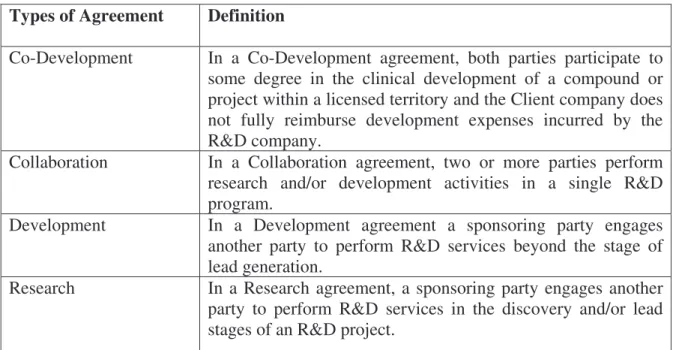
Certain types of alliances are considered as knowledge generating or learning-alliances. The alliance formation which is aimed at basic research and transfer of a technology to the firm can be considered as uncertain search (March, 1991) and in the context of this study could be categorized as explorative alliances. Some other alliances, on the other hand, are merely marketing, production or licensing agreements which do not engage the firm into the process of learning new methods and do not infuse the firm with fresh knowledge. Following Lavie and Rosenkopf (2006), and using RECAP’s definition of types of alliances, we coded four types of alliances as explorative alliances and the rest of alliances as exploitative alliances. The explorative alliances are assigned a score of 1 and the rest are assigned a score of 0. Four types of alliances are co-development, collaboration, research and finally development agreements between focal firm and its partners. The definition of each alliance and their functionalities are provided in Table1. ---
Insert Table1 about here ---
To calculate the explorative score of a focal firm’s alliances in each year, we counted the number of incidence of the learning-alliances and divided them by total number of alliances formed in that year. This score ranges between 0 (very exploitative) to 1 (very
explorative). In my sample the score of alliance exploration in each year for each firm has a mean of 0.289.
Acquisition exploration:
The externally acquired capabilities in acquisitions can be categorized as non-core and core capabilities (Lane & Probert, 2007). Core capabilities are the capabilities which already exist in the focal firm and acquisition of them could be considered as exploitative acquisition, whereas non-core capabilities do not exist in the focal firm and acquisition of them could be categorized as an explorative activity. In this study, we used SIC code as a proxy for the similarity between capabilities of the focal firm and the acquired firm. In each year for each firm, we assigned a score of 1 to an acquisition deal in which all four digits of SIC codes are different between two firms. When only the first two SIC code-digits are the same and the last two are different we assigned a score of 0.5 to the deal and when SIC codes of two firms are completely the same a score of 0 is assigned to the deal.
For example Abbott acquired Omni Flow Inc. in 1989. The acquired firm had a SIC code of 3841 while Abbott (the focal firm) which is the acquiring firm has a SIC code of 2834. SIC code of 2834 corresponds to pharmaceutical preparations while SIC code of 3841 is assigned to the firms which are active in the field of surgical and medical instruments and apparatus. In this case we gave a score of 1 to this deal. In the same year, Abbott acquired Damon Biotech Inc which had SIC code of 2836 (biological products, except diagnostics).
As can be seen the similarity between types of activities of the firm in the second deal is higher; hence we assigned a score of o.5 instead of 1 in the first deal. Then the average of the acquisition exploration scores in each year for each firm is calculated as the total score of explorative acquisitions a firm made in each year. This score, similar to the alliance exploration score, ranges between 0 (very exploitative) to 1 (very explorative).
Independent variables:
In order to study the balance across alliances and acquisitions (Hypothesis2), we followed Lavie and Rosenkopf (2006)’s method and considered acquisition exploration as independent variable when alliance-exploration is dependent variable. Since the balance is under study and not causation, we used alliance exploration as independent variable where acquisition- exploration is dependent variable in a separate model.
To test Hypothesis2, we used four different measures as proxy for resources as there are many ways in which resources can be operationalized (Cheng & Kesner, 1997). The choice of the measures, especially financial measures seems to be very idiosyncratic, and one needs to consider different measures to operationalize the concept of resources. In order to enhance construct validity Firm Solvency, defined as log-transformed ratio of cash to long-term debt is used as moderating variables besides logarithmic transformation of assets, net income and number of employees.
Control variables:
We controlled for R&D intensity (R&D expenses divided by total sales) which can affect the innovative capacity of a firm (Lavie & Rosenkopf, 2006). R&D intensity might also
affect the preference of acquisitions over alliances by the firm (Hennart & Reddy., 1997). Though, the preference of alliance over acquisition is not the focus of this study and only the balance between exploration and exploitation across these two activities is the focus, controlling for that could help to absorb any unknown heterogeneity.
Furthermore, the proxies for resources which are explained above are used as control variables when we tested Hypothesis 1. When we tested Hypothesis2 we used one of them as moderating variable and the rest as control variables. The year dummy variables (Lavie & Rosenkopf, 2006) and SIC dummy variables (Hennart & Reddy 1997) are also used to control for any unknown heterogeneity.
Analysis:
Table2 reports the descriptive statistics and table 3 contains the results of the random effect regression. Models 1a trough 5a have alliance-exploration as dependent variable and acquisition-exploration as independent variable. Models 1b through 5b are models in which acquisition-exploration is regressed over alliance-exploration. Models 1a and 1b are the main models which test Hypothesis1. The other models contain the interaction effect between main independent variables and four categories of resources which are mentioned before. As can be seen in Model 1a the coefficient of acquisition-exploration is negative (-.13) and highly significant. In model 1b also the coefficient of alliance exploration is negative (-.61) and highly significant. These two models together provide strong support for Hypothesis1.
--- Insert Tables 2 and 3 about here ---
In model 2a, the coefficient of acquisition exploration is negative (-.15) and highly significant and the interaction term is positive and highly significant. This means that the employee as types of resource is moderating the negative balance between alliance exploration and acquisition-exploration. Other resources in models 3a, 4a and 4b also moderate the relationship but coefficient of interaction term is not significant, though positive, in these models. However, the main independent variable (acquisition exploration) has still negative and significant coefficients. The same trend can also be seen in modes 2b, 2c and 2d.
--- Insert Table4 about here ---
In order to find further support for Hypothesis2, we ran the GLS models separately on split samples. We split the sample into high and low (above mean and below mean) on solvency and number of employees. Table4 reports the results of regressions. As can be seen, the coefficients are negative and significant when the resources are low, showing that when resources are low firms need to balance between alliance-exploration and acquisition-exploration. On the other hand, when the resources are high, the coefficients are not as large as the low-resource cases and are insignificant. The results of table 4 and the interaction terms in Table3, together, corroborate Hyothesis2.
CONCLUSION
This paper is one step ahead in resolving the contradiction of the results of studies in the filed of balance between exploration and exploitation. Studies which look at the issue of balance from a normative perspective suggest firms to maintain a balance between exploration and exploitation in their learning and grafting of knowledge. However, positive studies have found out that balance is an arduous task and firms fall into the path dependency trap of one of these two opposing tendencies.
The paper tries to add to the literature on balance by taking into account acquisitions along with alliances as a way to exchange resources, especially knowledge, with the players in the environment. Acquisition is shown to be a substitute for alliances depending on certain circumstances mentioned before. Though Lavie and Rosenkopf (2006) are first who suggested that dissecting alliances into separate domains could be the key to overcome the putative discrepancy between findings of positive and normative studies, this study applies the notion of balance across organizational boundaries more carefully.
We argue that path dependency of inertia and absorptive capacity could exist within domains of alliances and acquisitions, and firms may need some times to shift from exploration to exploitation and vice versa within each domain. As a matter of fact, firms pursue the opposite behavior within another domain. The other reason for this phenomenon is argued to be the opposing nature of inertia and absorptive capacity.
And finally, resources of a firm are shown to be moderating factors for the balance relationship. Since concept of resource could cover many things, we have considered different measures for resources to enhance the construct validity.
One limitation of this study, which is in fact an opportunity for future studies, is that we have not segmented alliances and acquisitions into separate domains. Following Lavie and Rosenkopf (2006) future studies could dissect both alliances and acquisitions and consider the functional, attribute and structure domains of them together. Functional domain of alliance refers to the purposes that an alliance fulfils, such as R&D or marketing. Attribute domains of an alliance refers to the similarities of two parties and exploration in this domain means that focal firm allies with a firm which is very different from the allying firm with respect to some attributes. Again the choice of the attributes is a place of controversy and needs to be addressed carefully. Structure domain refers to the network position of a firm’s partners. Exploration in this domain means that focal firm is allying with a firm with whom it had not any alliance. So future studies can find meaningful domain for acquisitions and study the balance within them along with alliance domains. However, there are some difficulties regarding these considerations. First, attributive domain can not be defined for an acquisition in the case a firm is fully acquired. Second, in many cases the acquired firms and allying firms are not listed companies and data is not easily available.
However, the gauntlet is thrown and future studies may discover more by taking into account the point that defining meaningful domains for learning activities is the key to
resolve the contradictions between results of normative studies and positive studies of balance between exploration and exploitation.
References:
Barley, S.R., Freeman, J. & Hybles R.C., 1992. Strategic Alliances in Commercial Biotechnology. In: Nohria, N., and Eccles, R.G. “Networks and Organizations: Structure, Form and Action”. Harvard Business School Press, Boston, Mass, pp.311-347
Barney, J. 1991. Firm resources and sustained competitive advantage' Journal of Management, 17:99-120.
Beckman, C. M., Haunschild, P. R., & Phillips, D. J. 2004. Friends or strangers? Firm-specific uncertainty, market uncertainty, and network partner selection. Organization Science, 15: 259–275
Buckley, W. 1968. Society as a complex adaptive system. In W. Buckley (ED.), Modern System Research for the behavioral Scientist: 490-513. Chicago: Aldine.
Cheng, J., & Kesner, I. 1997. Organizational slack and response to environmental shifts: The impact of resource allocation patterns. Journal of Management, 23(1): 1–18.
Cohen, W. & Levinthal, D., 1990. Absorptive capacity: a new perspective on learning and innovation. Administrative Science Quarterly, 35, 128–152.
Collinson, S. & Wilson, D.C. 2006. Inertia in Japanese organizations: Knowledge Management Routines and failure to Innovate. Organization Studies, 27(9): 1359-1378 Grant, R.M., & Baden-Fuller, C. 2004. A knowledge accessing theory of strategic alliances. Journal of Management Studies, 41(1): 61-84
Gulati, R., Sawhney, M. & Paoni.A, 2003. Kellogg on Technology & Innovation. John Wiley & Sons
Hannan, M. T., & Freeman, J. H. 1984. Structural inertia and organizational change. American SociologicalReview, 49: 149–164.
Hennart, J. F., & Reddy, S. 1997. The choice between mergers/acquisitions and joint ventures: The case of Japanese investors in the United States. Strategic Management Journal, 18: 1–12.
Inkepen, A.C. 1998. Learning and knowledge acquisition through international strategic alliances. Academy of Management Executive, 12: 69-80
Koza, M. P., & Lewin, A. Y. 1998. The co-evolution of strategic alliances. Organization Science, 9: 255– 264.
Lane, C., & Probert, J. 2007 .The external sourcing of technological knowledge by US pharmaceutical companies: Strategic goals and inter-organizational relationships. Industry and innovation, 14(1): 5-25
Lavie, D., & Rosenkopf, L. 2006. Balancing exploration and exploitation in alliance formation. Academy of Management Journal, 49(4), 797-818
Levinthal, D. A., & March, J. G. 1993. The myopia of learning. Strategic Management Journal, 14(special issue): 95–112.
March, J. G. 1991. Exploration and exploitation in organizational learning. Organization Science, 2: 71–87.
Miller, D. 1993. The architecture of simplicity. Academy of Management Review, 18(1): 116-138.
Mowery, D. C., Oxley, J. E., & Silverman, B. S. 1996. Strategic alliances and interfirm knowledge transfer. Strategic Management Journal, 17(winter special issue): 77–91 Park, S. H., Chen, R., & Gallagher, S. 2002. Firm resources as moderators of the relationship between market growth and strategic alliances in semiconductor start-ups. Academy of Management Journal, 45: 527–545.
Pfeffer, J. & Slancik, G.R., 1978. The External Control of Organizations: A Resource Dependence Perspective. New York: Harper and Row
Rosenkopf, L., & Nerkar, A. 2001. Beyond local search: Boundary spanning, exploration, and impact in the optical disk industry. Strategic Management Journal, 22: 287–306. Rothaermel, F. T., & Deeds, D. L. 2004. Exploration and exploitation alliances in biotechnology: A system of new product development. Strategic Management Journal, 25: 201–222.
Tushman, M.L., & Romanelli, E. 1985. Organizational evolution: A metamorphosis model of convergence and reorientation. In L.L. Cummings & B.M.Staw (Eds.). Research in organizational behavior: 355-389. Greenwich. CT: JAI Press.
Vermeulen, F., & Barkema, H. 2001. Learning through acquisitions. Academy of Management Journal, 44 (3): 457-476
Villalonga, B., & McGahan, A. M. 2005. The choice among acquisitions, alliances, and divestitures. Strategic Management Journal, 26: 1183–1208.
Zollo, M., & Winter, S. G. 2002. Deliberate learning and the evolution of dynamic capabilities. Organization Science, 13: 339–351.
Table 1: Four types of learning alliances Types of Agreement Definition
Co-Development In a Co-Development agreement, both parties participate to some degree in the clinical development of a compound or project within a licensed territory and the Client company does not fully reimburse development expenses incurred by the R&D company.
Collaboration In a Collaboration agreement, two or more parties perform research and/or development activities in a single R&D program.
Development In a Development agreement a sponsoring party engages another party to perform R&D services beyond the stage of lead generation.
Research In a Research agreement, a sponsoring party engages another party to perform R&D services in the discovery and/or lead stages of an R&D project.
Table2. Descriptive Statistics and Correlations
† p<.10; * p<.05; ** p<.01; *** p<.001; two tailed tests.
Variables Mean S.D 1 2 3 4 5 6 7 1.Alliances-Exploration .29 .19 1.00 2.Acquisition-Exploration .44 .30 .02 1.00 3.R&D Intensity 1.92 10.86 .18*** .11† 1.00 4.Employee 19.24 24.69 -.10 † -.01 -.12** 1.00 5.Assets 7.31 1.97 -.19 *** -.06 -.19*** .77*** 1.00 6.Net Income 5.80 1.94 -.04 -.03 -.46*** .54*** .71*** 1.00 7.Solvency -.04 2.17 .17** -.03 .01 -.20*** -.42*** -.12† 1.00
Table3: Results for Random-Effect GLS Models for Exploration-Exploitation across Alliances and Acquisitions.
Alliance-Exploration Acquisition Exploration
Independent variables Model 1a Model 2a Model 3a Model 4a Mode 5a Model 1b Model 2b Model 3b Model 4b Model 5b
R&D Intensity -.01 (.15) (.15) .02 (.15) -.02 (.15) -.01 (.15) -.01 (.33) -.15 (.32) -.16 (.34) -.26 (.34) -.21 (.34) -.23 Employee -.0002 (.000) (.00) .00 (.00) .00 (.00) .00 (.00) .00 (.00) .00† (.00) .00* (.00) .00 (.00) .00 (.00) .00 Assets .02 (.03) (.03) .02 (.03) .01 (.03) .02 (.03) .02 (.00) .00* (.00) .00* (.08) .04 (.08) .07 (.08) .06 Net Income -.01 (.01) (.01) -.01 (.01) -.01 (.01) -.01 (.01) -.01 (.02) .01 (.02) .00 (.02) .00 (.02) .00 (.02) .00 Solvency .03*** (.01) 0.03*** (.01) .03*** (.01) .03** (.01) .03** (.01) (.02) .02 (.02) .02 (.02) .02 (.21) .21 (.02) .02 Acquisition Exploration -.13*** (.04) -.015*** (0.04) -.18** (.07) -.13** (.04) -.12† (.05) Alliance Exploration -.61** (.21) -.61** (.20) (.29) -.42 -.62** (.21) -.63** (.21) Acquisition Exploration* Employee (.002) .004* Acquisition Exploration* Assets (.04) .04 Acquisition Exploration* Net Income (.04) .04 Acquisition Exploration* Solvency (.09) -.01 Alliance Exploration* Employee (.01) .01 Alliance Exploration* Assets (.20) -.20 Alliance Exploration* Net Income (.14) .09 Alliance Exploration* Solvency (.11) -.04 Observations 136 136 136 136 136 136 136 136 136 136 Wald 2 96.45*** 104.42*** 96.62*** 98.69*** 95.57*** 66.84*** 69.27*** 62.24** 61.06** 60.59**
Table4: Results for Random-Effect GLS Models for Exploration-Exploitation across Alliances and Acquisitions (Sample splitting into high and low resources)
Alliance Exploration Acquisition Exploration
Independent
Variables Solvency High Solvency Low Employee High Employee Low Solvency High Solvency Low Employee High Employee Low
R&D Intensity -.52 (.51) (.18) -.12 (.40) .24 (.34) .20 (1.22) -.12 (.45) -.61 (1.03) -.68 (.65) .42 Employee .00 (.00) (.00) .00 (.00) .00 (.02) .01 (.01) .01 (.00) .00 (.00) .00 .07** (.03) Assets .00 (.00) (.00) .00 (.00) .00 (.00) .00 (.00) .00† (.00) .00 (.00) .00† (.00) .00 Net Income -.13*** (.04) (.01) -.01 (.01) .00 (.02) -.13 (.12) .01 (.02) -.01 (.02) .00 (.11) -.07 Solvency 0.00 (.02) (.02) .04* .03** (.01) (.1) .02 (.05) .00 (.05) .08 (.03) .03 (.05) .05 Acquisition Exploration (.09) -.08 -.12* (.05) (.05) -.02 -.26** (.01) Alliance Exploration (.51) -.44 -.73* (.32) (.35) -.17 -.94** (.34) Observation 49 87 82 54 49 87 82 54 Wald 2 405.46*** 56.00** 85.83*** 63.62*** 189.88*** 45.83* 68.82*** 55.01**