tension
Learning Objectives
➤bleeding
Introduction
Despite progress over the past few decades in awareness, diagnosis, and treatment of hyperten-sion, undertreatment continues to undermine national goals to reduce the impact of hyper-tension on cardiovascular (CV) health.1Used appropriately, antihypertensive treatment can reduce the incidence of stroke by 30% to 40%, other major vascular events by 20% to 30%, and CV death by 30% to 40%.2Conversely, in patients aged 40 to 69 years, the risk of death from a CV event doubles with each increase in blood pressure (BP) of 20/10 mm Hg, start-ing at 115/75 mm Hg.
The Seventh Report of the Joint National Committee on Prevention, Detection, Evaluation, and Treatment of High Blood Pressure (JNC 7),3 published in 2003, provides a framework for management of hypertension. However, in the 8 years since its publication, innovative new treatments and therapeutic approaches, supported by results of rigor-ous clinical research, challenge conventional approaches to antihypertensive treatment. Many clinicians are adopting an earlier aggressive therapeutic approach, drawing on evi-dence that favors earlier use of combination therapies to achieve treatment goals for many patients.
The JNC 7 guidelines
acknowledge the
inevitability of
combination therapy
for most hypertensive
patients.
Achieving Optimal Blood
Pressure Control: Does Your
Initial Choice of Medication Matter?
Learning Objectives
After completing this activity, participants should be better able to:
➤Recognize the impact of coexisting conditions on global cardiovascular disease (CVD) risk and hypertension management
➤Identify patients who would benefit from aggressive combination antihyperten-sive therapy based on guidelines and recent clinical evidence
➤Translate current clinical data and evidence-based guidelines into treatment plans for patients who require aggressive therapy
A Complex Disease With Dire Sequelae
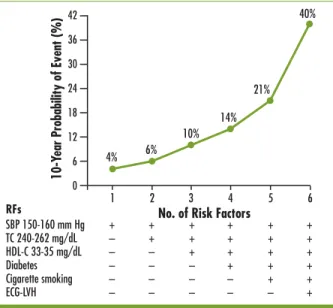
Uncomplicated hypertension is not the rule; it accounts for less than 20% of all cases.4Data from the Framingham Heart Study showed that 2 or more additional risk factors—eg, obe-sity, glucose intolerance, hyperinsulinemia, dyslipidemia, left ventricular hypertrophy (LVH), physical inactivity, cigarette smoking—are present in more than half of all individ-uals with hypertension.4This clustering of CV risk fac-tors becomes more pronounced in overweight persons. With each additional risk factor, the likelihood of expe-riencing and dying from a myocardial infarction (MI) in 10 years increases substantially (Figure 1).4
Using these findings, the Framingham researchers developed a risk calculator to estimate the 10-year risk of a CV event. This tool considers age, gender, systolic blood pressure (SBP), total cholesterol (TC), high-density lipoprotein cholesterol (HDL-C), and smoking status to evaluate risk. JNC 7 endorses this formula.
More recently, in order to enhance CV risk assess-ment, Ridker and colleagues examined 35 factors in more than 24,000 women over a median period of 10 years and derived from the results a novel risk calculator, the Reynolds Risk Score.5They also evaluated these factors in men.6 Using this algorithm, which takes into account blood levels of C-reactive protein (CRP) and whether a parent had an MI before age 60, resulting predictions were more accurate than those of the Framingham calculator. While the results in patients at high or low CV risk were similar with either method, 45% of women and 20% of men deemed to be at intermediate risk by Framingham criteria were reclas-sified into higher or lower risk groups using the Reynolds risk calculator. The Reynolds calcula-tions, done by computer, corre-sponded almost perfectly to what actually happened in the next 10 years. However, the Reynolds risk calculator also has shortcomings. For example, it does not apply to persons with diabetes. As our knowledge of CV risk continues to grow, so, too, should our ability to better evaluate patients for CVD.
Innovative treatments and
therapeutic approaches
challenge conventional
approaches to
anti-hypertensive treatment…
evidence favors early use
of combination therapies.
Hyper
tension
10-Y
ear Probability of Event (%)
No. of Risk Factors
1 2 3 4 5 6 4% 6% 10% 14% 21% 40% 0 6 12 18 24 30 36 42
Figure 1. Rise in the 10-year probability of a coronary event as the number of CV risk factors increases. Two or more risk factors are present in more than half of hyperten-sive patients, and such clustering intensifies as patient weight increases.4 SBP 150-160 mm Hg + + + + + + TC 240-262 mg/dL – + + + + + HDL-C 33-35 mg/dL – – + + + + Diabetes – – – + + + Cigarette smoking – – – – + + ECG-LVH – – – – – + RFs
JNC 7 Stepwise Approach to Treating High BP
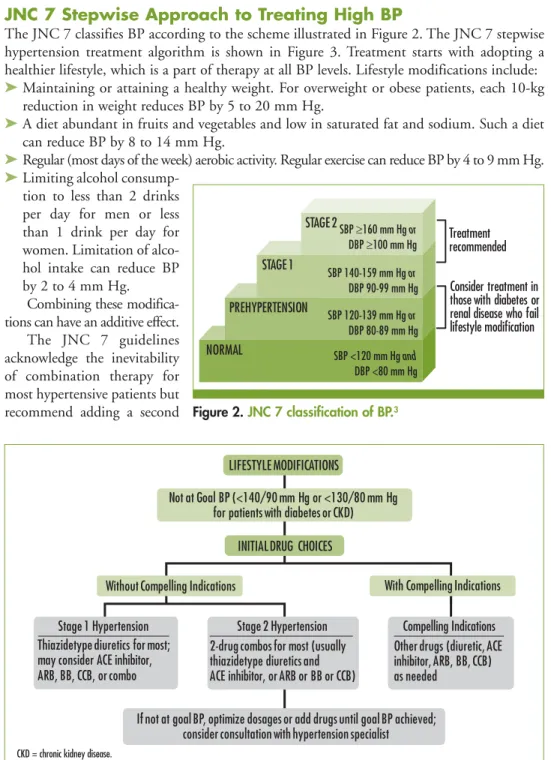
The JNC 7 classifies BP according to the scheme illustrated in Figure 2. The JNC 7 stepwise hypertension treatment algorithm is shown in Figure 3. Treatment starts with adopting a healthier lifestyle, which is a part of therapy at all BP levels. Lifestyle modifications include: ➤Maintaining or attaining a healthy weight. For overweight or obese patients, each 10-kg
reduction in weight reduces BP by 5 to 20 mm Hg.
➤A diet abundant in fruits and vegetables and low in saturated fat and sodium. Such a diet can reduce BP by 8 to 14 mm Hg.
➤Regular (most days of the week) aerobic activity. Regular exercise can reduce BP by 4 to 9 mm Hg. ➤Limiting alcohol
consump-tion to less than 2 drinks per day for men or less than 1 drink per day for women. Limitation of alco-hol intake can reduce BP by 2 to 4 mm Hg.
Combining these modifica-tions can have an additive effect.
The JNC 7 guidelines acknowledge the inevitability of combination therapy for most hypertensive patients but recommend adding a second
tension
NORMAL PREHYPERTENSION STAGE 2 SBP ≥160 mm Hg or DBP ≥100 mm Hg STAGE 1 SBP 140-159 mm Hg or DBP 90-99 mm Hg SBP 120-139 mm Hg or DBP 80-89 mm Hg SBP <120 mm Hg and DBP <80 mm Hg Treatment recommended Consider treatment in those with diabetes or renal disease who fail lifestyle modificationFigure 2. JNC 7 classification of BP.3
LIFESTYLE MODIFICATIONS
Not at Goal BP (<140/90 mm Hg or <130/80 mm Hg for patients with diabetes or CKD)
Without Compelling Indications With Compelling Indications
Thiazidetype diuretics for most; may consider ACE inhibitor, ARB, BB, CCB, or combo
Stage 1 Hypertension
2-drug combos for most (usually thiazidetype diuretics and ACE inhibitor, or ARB or BB or CCB)
Other drugs (diuretic, ACE inhibitor, ARB, BB, CCB) as needed
If not at goal BP, optimize dosages or add drugs until goal BP achieved; consider consultation with hypertension specialist
INITIAL DRUG CHOICES
Stage 2 Hypertension Compelling Indications
Figure 3. JNC 7 algorithm for treatment of hypertension.3
drug from a different class when adequate doses of an initial drug fail to achieve target BP (sequential dosing).3Initial combination therapy is recommended only for patients whose BP is above goal by >20 mm Hg SBP or >10 mm Hg DBP. Concomitant conditions that impart greater CV risk are considered “compelling indications” for particular drug classes (Table 1).3
Rationale for Initial Combination Antihypertensive Therapy
The recognition that 2 or more antihypertensive agents will likely be necessary to reach target BP is well established.7-13A recently published systematic review delineates the advantages of initial combination therapy with agents from different classes over initial monotherapy.14
Combination therapy, whether administered as separate pills given together or in a formu-lation containing fixed doses of 2 or more drugs in a single pill, should reduce BP more effec-tively and often more rapidly than a single agent alone (Figure 4).14,15Moreover, through an additive effect, the combination achieves this result with lower doses of each agent than if 1 of the agents was given singly. An additional advantage of lower doses is the modulation of adverse effects that might cause patients to discontinue treatment or that could lead to end-organ damage.14Based on a retrospective analysis of 119 randomized, placebo-controlled trials,
Hyper
tension
Table 1.
JNC 7 Compelling Indications for Specific Treatments3
Drugs/Mechanism of Action Failure Post-MIHeart CV Risk T2DMHigh CKD Recurrent StrokePrevention Diuretics
Rid the body of excess fluids and sodium through urina-tion; may enhance the effect of other BP medications
• • • •
and • ACE inhibitors
Lower levels of angiotensin II
and vasodilate • • • • •
ARBs
Block angiotensin II receptors
and vasodilate • • •
BBs
Decrease heart rate and
cardiac output • • • •
CCBs
Interrupt movement of calcium
into heart and vessel cells • •
Aldosterone antagonists Inhibit the action of aldosterone at mineralocorticoid receptors, reducing sodium resorption
• •
investigators hypothesized that a 3-drug combination would likely lower BP by 20/11 mm Hg and thereby reduce risk of stroke by 63% and ischemic heart disease by 46% in patients 60 to 69 years old.15
Further support comes from the Strategies of Treatment in Hyper-tension: Evaluation (STRATHE) study.16Therapy initiated with a low-dose combination was compared with monotherapy in which patients were first treated with a β-blocker (BB) but could be switched to an angiotensin-converting enzyme (ACE) inhibitor or a calcium channel blocker (CCB) if BP remained >140/90 mm Hg. At the end of 9 months, a significantly larger
percentage of patients randomized to the low-dose combination achieved target BP compared with those receiving sequential monotherapy (62% vs 49%, P=.02).
A fixed-dose combination pill simplifies the daily regimen for patients and reduces the “pill burden,” possibly improving compliance. Cost to the patient may also be reduced because only a single co-pay is required.14
A Compelling Rationale for RAAS-Based Combination Therapy
Hypertension and its common comorbidities, such as diabetes and hyperlipidemia, create oxidative stress, which leads to physiologic conditions that promote excessive accumulation of angiotensin II, a key
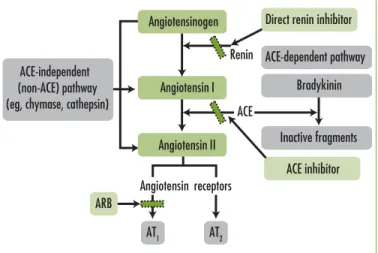
component in the renin-angiotensin-aldosterone system (RAAS). Angio-tensin II, through its action at type 1 cellular recep-tors, contributes to each successive step of the CVD continuum (Figure 5).17-19 Beyond its effect on BP, angiotensin II, either directly or through signal-transduction pathways, promotes cellular prolifer-ation, increases oxidative stress, and reduces levels of nitric oxide.20
tension
Placebo Subtracted BP Response (mm Hg) -15 -10 -5 0 Diastolic “First” drug alone “Second”
drug alone Combination
Systolic
Figure 4. Fixed-dose combination therapy with 2 drugs reduces BP to a greater extent and more rapidly than either agent alone. The enhanced effect of the combination therapy is achieved with lower doses of each agent.15
ACE-dependent pathway ACE-independent
(non-ACE) pathway (eg, chymase, cathepsin)
Bradykinin Inactive fragments AT2 AT1 ACE Renin Angiotensin II Angiotensin receptors Angiotensin I ACE inhibitor ARB
Direct renin inhibitor Angiotensinogen
The action of angiotensin II may be blocked by 3 routes: (1) Inhibition of the enzyme that converts angiotensin I to angiotensin II and also degrades bradykinin–ACE inhibitors perform this function; (2) Prevention of angiotensin II from connecting with its cell receptors in blood vessels to cause vasoconstriction and in the adrenal gland to produce aldosterone; angiotensin receptor blockers (ARBs) perform this function; and (3) Blockade of the renin-mediated con-version of angiotensinogen to the precursor 10-amino acid polypeptide angiotensin I–direct renin inhibitors (DRIs) perform this function.
RAAS-blocking agents are thus a logical component in any combination regimen. Additional benefits with ACE inhibitors and ARBs are that they decrease the risk of diabetes developing during treatment and that they result in better clinical out-comes for patients who already have diabetes (particularly those with proteinuria).13,21-27
Thus, it is not surprising that the American Society of Hypertension (ASH), in its 2010 position paper on combina-tion therapy, places emphasis on RAAS inhibitors in its assess-ment of preferred, acceptable, and unacceptable agents, including them in each of the “preferred” options.28The ASH guidelines include use of DRIs, which were not available in the United States at the time JNC 7 was published:
➤Preferred 2-drug combinations are ACE inhibitor/diuretic, ARB/diuretic, ACE inhibitor/CCB, or ARB/CCB. All 4 combinations are available in a fixed-dose formula-tion. Diuretics augment agents that work through the RAAS. CCBs enhance the vasodila-tory effect of ACE inhibitors and ARBs through a different mechanism and also have a natriuretic effect.29
➤Acceptable 2-drug combinations are BB/diuretic, CCB/diuretic, DRI/diuretic, or a thiazide diuretic/potassium-sparing diuretic. All these agents are available as fixed-dose combina-tion agents except for the CCB/diuretic.
➤Unacceptable 2-drug combinations are ACE inhibitor/ARB, ACE inhibitor/BB, ARB/BB, BB/CCB (nondihydropyridine), and BB/centrally acting agent. Combining 2 RAAS blockers is inadvisable as initial therapy, as is combining agents that both work through the central nervous system.
Clinical Trials of RAAS-Based Combinations
Use of RAAS-based drug combinations as initial therapy is supported by large randomized controlled trials.
In the ACCELERATE (Aliskiren and the Calcium Channel Blocker Amlodipine Combination as an Initial Treatment Strategy for Hypertension) trial, more than 1200 patients with newly diagnosed essential hypertension and an SBP between 150 and 180 mm Hg were randomly assigned to receive initial monotherapy with the DRI aliskiren 150 mg plus placebo (n = 318), amlodipine 5 mg plus placebo (n = 316), or a combination of aliskiren 150 mg and amlodipine 5 mg in separate tablets (n = 620).30These treatments continued for 15 weeks. For weeks 16 to 32, all patients received aliskiren 300 mg and amlodipine 10 mg. Three important findings emerged:
Hyper
tension
It is not surprising
that ASH, in its 2010
position paper on
combination therapy,
places emphasis on
RAAS inhibitors.
➤Patients who received combination therapy at the outset had a greater reduction in SBP (-6.5 mm Hg; P<.0001) more rapidly (by ∼25%) than those who initially received either of the agents singly
➤The combination therapy was well tolerated
➤Although all patients at week 16 received the combination therapy at increased doses, by 32 weeks, the patients who had started on combination therapy exhibited lower SBP than those who began the study on monotherapy
In the ACCOMPLISH (Avoiding Cardiovascular Events through Combination Therapy in Patients Living with Systolic Hypertension) trial, which involved nearly 11,500 subjects, a subset of 573 patients receiving combination therapy with either benazepril and amlodipine or benazepril and hydrochlorothiazide (HCTZ) underwent ambulatory BP monitoring for 24 hours. BP was measured every 20 minutes.31Mean SBP differences between the groups were minimal, slightly favoring the ACE inhibitor-CCB group, which experienced fewer CV events (death, nonfatal MI, nonfatal stroke, hospitalization for angina, sudden cardiac death resusci-tation, coronary revascularization). The investigators concluded that intrinsic metabolic or hemodynamic factors account for the superiority of the ACE inhibitor-CCB combination over ACE inhibitor-HCTZ.
ASCOT (Anglo-Scandinavian Cardiac Outcomes Trial) was a prospective, randomized, open, blinded end point trial designed to compare CV outcomes in hypertensive patients tak-ing CCB/ACE inhibitor or BB/HCTZ combinations.32 One group (n = 9639) received amlodipine 5 to10 mg and, as needed, perindopril 4 to 8 mg; the other group (n = 9618) received atenolol 50 to 100 mg and, as needed, bendroflumethiazide 1.25 to 2.5 mg and potassium. BP was well controlled in both treatment arms, although it was lower in the CCB/ACE inhibitor group by 2.7/1.9 mm Hg. The investigators stopped the trial early because, compared with BB/HCTZ, the CCB/ACE inhibitor combination yielded reductions in: ➤Major CV events by 16% (P<.001); stroke by 23% (P=.003)
➤CV mortality by 24%
➤Overall mortality by 11% (P=.025)
➤Incidence of new-onset diabetes by 29% (P<.0001) ARBs may block the angiotensin II system more completely than ACE inhibitors and provide equivalent end-organ protection. Also, ARBs are not associated with the angiotensin II “escape” phenomenon (incomplete suppression of angiotensin II), as are ACE inhibitors. Whether these pharmacodynamic differences translate into a demonstrable clinical advantage is unclear. Although ARBs are associated with lower incidences of cough (0.9%-3% vs 7%-39%) and angioedema (0.2% vs 0.1%-0.5%)
than ACE inhibitors, differences in other meaningful clinical effects are minimal.33A large-scale, prospective comparative trial of ARB/CCB and ACE inhibitor/CCB regimens would help to determine the true efficacy, tolerability, and economics of these combinations.
Triple-Drug Combinations for Moderate to Severe Hypertension
Patients with moderate to severe hypertension can benefit from triple-drug therapy. In a 10-week, randomized, double-blind study, 2271 patients received 1 of 4 regimens: amlodipine 10 mg,
tension
The benefits of
RAAS-based drug
combinations as
initial therapy are
supported by large
randomized
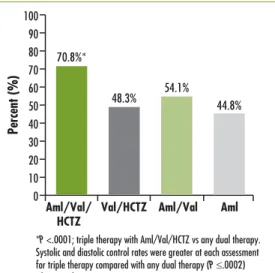
valsartan 320 mg, and HCTZ 25 mg; amlodipine 10 mg and valsartan 320 mg; valsartan 320 mg and HCTZ 25 mg; or amlodipine 10 mg and HCTZ 25 mg.34At week 2 of treatment, all 4 groups showed considerable reductions in both SBP (base-line mean of 169.9 mm Hg) and DBP (baseline mean 106.5 mm Hg). By week 5, after titration of agents to maximal dosages, results with triple therapy were far superior to those achieved with any of the dual therapies (P<.0001). This difference continued to the conclusion of the trial, at which point 70.8% of those who received triple therapy had reached goal, compared with 54.1% for amlodipine/valsartan, 48.3% for valsartan/HCTZ, and 44.8% for amlodipine/HCTZ (Figure 6).
In a similar study, 2492 patients with a mean seated BP ≥140/100 mm Hg or ≥160/90 mm Hg were randomized to receive either triple combination therapy with olmesartan 40 mg, amlodipine 10 mg, and HCTZ 25 mg or a dual fixed-dose combination of these same components: olmesartan 40 mg and amlodi-pine 10 mg; olmesartan 40 mg and HCTZ 25 mg; or amlopidine 10 mg and HCTZ 25 mg.35 Baseline mean BP was 168.5/100.9 mm Hg. By week 12, triple combination therapy had reduced mean BP to a significantly greater extent than all of the dual therapies—DBP of –21.8 mm Hg vs –15.1 to –18.0 mm Hg (P<.0001) and SBP of –37.1 vs –27.5 to –30.0 mm Hg (P <.0001). Moreover, 69.9% of those who received triple combination therapy reached the BP target of <140/90 mm Hg by week 12, compared with 52.9% of the olme-sartan/amlodipine group, 53.4% of the olmesartan/HCTZ group, and 41.1% of the amlodipine/HCTZ group.
In another study, 728 patients with uncontrolled hyperten-sion and a mean sitting SBP ranging from ≥150 to <200 mm Hg were randomly assigned to receive either amlodipine 5 mg and valsartan 320 mg or amlodipine 5 mg and valsartan 160 mg.36 In the intensive arm, amlodipine was raised to 10 mg at week 2. HCTZ 12.5 mg was added to both regimens at week 4. At week 8, SBP in the intensive group had dropped from 167.2 mm Hg to 144.5 mm Hg and in the moderate group, from 165.4 mm Hg to 149.0 mm Hg. Clinicians had the option of raising HCTZ to 25 mg at week 8 if a patient’s SBP remained >140 mm Hg. By week 12, only those receiving the full dose of HCTZ exhibited additional declines in SBP (intensive group, 4.5 mm Hg; moderate group, 5.8 mm Hg). Adverse events overall were sim-ilar in the treatment groups (intensive, 36.3%; moderate, 37.6%).
Hyper
tension
Percent (%) 0 40 70 30 60 90 20 10 50 80 100*P <.0001; triple therapy with Aml/Val/HCTZ vs any dual therapy. Systolic and diastolic control rates were greater at each assessment for triple therapy compared with any dual therapy (P ≤.0002) (data not shown).
Aml/Val/ HCTZ 70.8%*
48.3% 54.1% 44.8%
Val/HCTZ Aml/Val Aml
Figure 6. Proportion of patients achieving overall BP control (<140/90 mm Hg) by end point (N = 2060).34
Combination therapy,
particularly with
fixed doses of 2
drugs in a single
tablet, reduces SBP
and DBP and does so
more quickly than 1
agent given alone.
Considerations in Improving Patient Outcomes
The unique characteristics of each patient—physical or mental conditions, comorbidities— guide the choice of treatment. A person whose job involves strenuous physical activity, for instance, should avoid diuretic therapy and its potential for causing hypokalemia and result-ant muscle weakness or cramping. A person who depends on mental acuity and alertness may want to avoid BBs because they may produce drowsiness and dizziness.
As noted, the presence of comorbidities of hypertension that heighten the risk for CV events influences drug selection (Table 1). Conditions unassociated with the CVD continuum also respond differentially to particular antihypertensive agents, sometimes favorably. In osteo-porosis, thiazide diuretics can slow bone demineralization. BBs are useful in treating migraine, thyrotoxicosis, essential tremor, perioperative hypertension, and atrial tachyarrhythmias or fibrillation. CCBs have a place in the treatment of Raynaud disease and in certain supraven-tricular arrhythmias. Alpha blockers can alleviate symptoms of prostatic hypertrophy.
The potential for drug interactions with medications a patient is already taking (eg, non-steroidal anti-inflammatory drugs [NSAIDs]) must be taken into account. Other considerations include cost and formulary restrictions associated with a patient’s health plan, which may require generic formulations whenever available.
Hyper
Presentation
Barbara, a 45-year-old white woman, is new to your practice and has arrived for a scheduled physical examination. Her last medical appointment was 2 years prior. She works as an office manager, is married, and has 2 children in their early 20s. Both of her parents, who are in their 70s, are being treated for hypertension, as is her 52-year-old brother, who also has dyslipidemia. Barbara has never had a lipid panel. She doesn’t smoke, has a sedentary lifestyle, eats mostly prepared foods, and enjoys a glass of wine with dinner.
Clinical Decision Point
How would you characterize Barbara’s CV risk using Framingham criteria? ■Low
■Moderate
■High
■Unsure
What other measurement or testing could be useful in determining CV risk in this patient?
■CRP
■Lipid particle size ■Cardiac ultrasound ■Exercise stress test Comment
Barbara’s Framingham score for CV risk is low to moderate, although this characteri-zation may be deceptive. She has stage 1 hypertension, and while she seems to be healthy overall, consider that she is overweight and has a mildly elevated fasting blood Physical Findings ■Height: 5 ft 5 in ■Weight: 168 lb ■Waist circumference: 35 in ■BMI: 28 kg/m2 ■Sitting BP: 152/92 mm Hg
■Funduscopic exam: normal
■Jugular venous pressure: normal
■Cardiac exam: unremarkable
■Abdomen: unremarkable ■Extremities: no edema Laboratory Workup ■Urinalysis: no proteinuria ■Hematocrit: normal ■Potassium: 4.5 mmol/L ■Creatinine: 0.9 mg/dL ■Calcium: normal ■FBG: 115 mg/dL ■A1C: 7% ■Lipids (mg/dL): TC, 235; TGs, 158; HDL-C, 40; LDL-C, 130
■Electrocardiogram: normal sinus rhythm, no evidence of LVH
tension
glucose (FBG) and less-than-desirable total cholesterol (TC), low-density lipoproteincholesterol (LDL-C), and triglyceride (TG) levels. Measuring CRP, per the Reynolds risk profile, could be useful in this case given that the LDL-C level is marginal; an elevated CRP level could be the deciding factor in starting a statin.
Particle size has not been tested as an independent variable in any clinical trial, so it would be difficult to know what to do with that information. Cardiac ultrasound may reveal LVH, but pharmacologic treatment of Barbara’s hypertension will likely lead to regression of LVH in any event. An exercise stress test would have marginal value, in that any recommendation for exercise would be walking, biking, swimming, or some other moderately strenuous activity.
Clinical Decision Point
What is your primary treatment goal for this patient?
■Reduce BP to <140/90 mm Hg
■Reduce BP to <120/80 mm Hg
■Reduce LDL-C to <70 mg/dL
■Reduce alcohol consumption
■Reduce TG to <100 mg/dL Comment
Reducing BP to <140/90 mm Hg is a reasonable goal for Barbara. A BP of 120/80 mm Hg is “normal,” according to the JNC 7, but pharmacologic reduction of stage 1 hypertension to this extent has not resulted in a commensurate reduction in CV events. Her alcohol consumption is modest and not likely a contributing fac-tor to her hypertension. Barbara does have dyslipidemia, but in the absence of dia-betes and coronary heart disease, attainment of the levels cited is not a priority.
Clinical Course
You prescribe olmesartan 40 mg and advise Barbara to lose 15 to 20 pounds, exer-cise for 30 minutes 5 times a week, and eat more fruits and vegetables and fewer processed foods. At a follow-up appointment 1 month later, her BP is 146/92 mm Hg and she admits that she has done little in the way of adopting a healthier lifestyle. You reiterate the importance of a lifestyle change and give her written materials and links to online resources. You add amlodipine 5 mg to her regimen. One month later, her BP has decreased to 130/85 mm Hg.
2 Years Later
Barbara presents with menopausal symptoms. Her BP is still 130/85 mm Hg, but she has gained 20 lb and her body mass index (BMI) is now 31.3 kg/m2. The stress of her job, she says, leaves her with little energy; she does not exercise and rarely cooks, relying instead on fast food. A repeat laboratory workup reveals an FBG of 125 mg/dL and a worsening lipid profile of TC, 235 mg/dL; TG, 235 mg/dL; HDL-C, 40 mg/dL; and LDL-C, 150 mg/dL.
Hyper
■Yes ■No
■Unsure
Comment
Barbara has metabolic syndrome. Hyperglycemia, hypercholesterolemia, obesity, low HDL-C level, and hypertension are components of this syndrome (Table 2), the diagnosis of which requires the presence of just 3 components.37
Clinical Decision Point
What is the next step in reducing global CV risk?
■Treat dyslipidemia ■Lower FBG level
■Stress the importance of weight loss ■Reinforce healthy lifestyle measures ■All of the above
Comment
All of the above are appropriate. The patient’s BP has been well controlled with olmesartan/amlodipine therapy. However, other key parameters of global CV risk have worsened. She should start taking a statin to lower her LDL-C level and probably a glucose-lowering agent. Aspirin, too, may be beneficial. Weight loss, carbohydrate restriction, and salt restriction are necessary lifestyle goals at this point.
Table 2.
Metabolic Syndrome37
Diagnosis is established when ≥3 risk factors are present
Risk Factor Defining Level Waist circumferencea
Men
Women >102 cm (>40 in)>88 cm (>35 in)
TGsb ≥150 mg/dL HDL-Cb Men Women <40 mg/dL<50 mg/dL BPb ≥130/≥85 mm Hg FBGb ≥100 mg/dL
aSome US adults of non-Asian origin with marginal
increases could benefit from lifestyle changes; lower cut points (≥90 cm in men and ≥80 cm in women) for Asian Americans.
tension
1. Lewington S, Clarke R, Qizilbash N, Peto R, Collins R; Prospective Studies Collaboration. Age-specific relevance of usual blood pressure to vascular mortality: a meta-analysis of individual data for one million adults in 61 prospective
studies. Lancet.2002;360:1903-1913.
2. Neal B, MacMahon S, Chapman N; Blood Pressure Lowering Treatment Trialists’ Collaboration. Effects of ACE inhibitors, cal-cium antagonists, and other blood-pressure-lowering drugs: results of prospectively designed overviews of randomised trials. Blood Pressure Lowering Treatment Trialists’
Collaboration. Lancet.2000;356:1955-1964.
3. Chobanian AV, Bakris GL, Black HR, et al; National Heart, Lung, and Blood Institute Joint National Committee on Prevention, Detection, Evaluation, and Treatment of High Blood Pressure; National High Blood Pressure Education Program Coordinating Committee. The Seventh Report of the Joint National Committee on Prevention, Detection, Evaluation, and Treatment of High Blood Pressure: the JNC 7 report. JAMA.2003;289:2560-2572.
4. Kannel WB. Risk stratification in hyperten-sion: new insights from the Framingham
Study. Am J Hypertens.2000;13:3S-10S.
5. Ridker PM, Buring JE, Rifai N, Cook NR. Development and validation of improved algorithms for the assessment of global car-diovascular risk in women: the Reynolds Risk
Score. JAMA. 2007;297:611-619.
6. Ridker PM, Paynter NP, Rifai N, Gaziano JM, Cook NR. C-reactive protein and parental history improve global cardiovascu-lar risk prediction: the Reynolds Risk Score
for men. Circulation.2008;118:2243-2251.
7. Cushman WC, Ford CE, Cutler JA, et al; ALLHAT Collaborative Research Group. Success and predictors of blood pressure con-trol in diverse North American settings: the Antihypertensive and Lipid-Lowering to
Prevent Heart Attack Trial (ALLHAT). J Clin
Hypertens (Greenwich). 2002;4:393-404. 8. UK Prospective Diabetes Study Group. Tight
blood pressure control and risk of macrovascu-lar and microvascumacrovascu-lar complications in type 2
diabetes: UKPDS 38. BMJ.1998;317:703-713.
9. Estacio RO, Jeffers BW, Hiatt WR, Biggerstaff SL, Gifford N, Schrier RW. The effect of nisoldipine as compared with enalapril on
cardiovascular outcomes in patients with non-insulin-dependent diabetes and hypertension. N Engl J Med.1998;338:645-652.
10. Lazarus JM, Bourgoignie JJ, Buckalew VM, et al. Achievement and safety of a low blood pressure goal in chronic renal disease. The Modification of Diet in Renal Disease Study
Group. Hypertension.1997;29:641-650.
11. Hansson L, Zanchetti A, Carruthers SG, et al. Effects of intensive blood-pressure lowering and low-dose aspirin in patients with hypertension: principal results of the Hypertension Optimal Treatment (HOT) randomised trial. HOT
Study Group. Lancet.1998;351:1755-1762.
12. Appel LJ, Wright JT Jr, Greene T, et al; AASK Collaborative Research Group. Intensive blood-pressure control in hypertensive chronic kidney
disease. N Engl J Med.2010;363:918-929.
13. Lewis EJ, Hunsicker LG, Clarke WR, et al; Collaborative Study Group. Renoprotective effect of the angiotensin-receptor antagonist irbe-sartan in patients with nephropathy due to type
2 diabetes. N Engl J Med.2001;345:851-860.
14. Brook RD, Weder AB. Initial hypertension
treatment: one combination fits most? J Am
Soc Hypertens.2011;5:66-75.
15. Law MR, Wald NJ, Morris JK, Jordan RE. Value of low dose combination treatment with blood pressure lowering drugs: analysis of 354
randomized trials. BMJ.2003;326:1427-1434.
16. Mourad JJ, Waeber B, Zannad F, Laville M, Duru G, Andréjak M; investigators of the STRATHE trial. Comparison of different ther-apeutic strategies in hypertension: a low-dose combination of perindopril/indapamide versus a sequential monotherapy or a stepped-care
approach. J Hypertens.2004;22:2379-2386.
17. Dzau V, Braunwald E. Resolved and unresolved issues in the prevention and treatment of coro-nary artery disease: a workshop consensus
state-ment. Am Heart J.1991;121:1244-1263.
18. Dzau VJ, Antman EM, Black HR, et al. The cardiovascular disease continuum validated: clinical evidence of improved patient outcomes: part I: Pathophysiology and clinical trial evidence (risk factors through stable coronary artery
disease). Circulation.2006;114:2850-2870.
19. Gradman AH, Kad R. Renin inhibition
in hypertension. J Am Coll Cardiol.
2008;51:519-528.
20. Morawietz H, Erbs S, Holtz J, et al. Endothelial protection, AT1 blockade and
Hyper
tension
cholesterol-dependent oxidative stress: the
EPAS trial. Circulation.2006;114:I296-I301.
21. Brenner BM, Cooper ME, de Zeeuw D, et al; RENAAL Study Investigators. Effects of losar-tan on renal and cardiovascular outcomes in patients with type 2 diabetes and nephropathy. N Engl J Med.2001;345:861-869.
22. Lindholm LH, Ibsen H, Borch-Johnsen K, et al; LIFE study group. Risk of new-onset diabetes in the Losartan Intervention For Endpoint reduction in hypertension study. J Hypertens.2002;20:1879-1886.
23. Mann JF, Gerstein HC, Pogue J, Bosch J, Yusuf S. Renal insufficiency as a predictor of cardiovascular outcomes and the impact of
ramipril: the HOPE randomized trial. Ann
Intern Med.2001;134:629-636.
24. Hansson L, Lindholm LH, Niskanen L, et al. Effect of angiotensin-converting-enzyme inhibition compared with conventional ther-apy on cardiovascular morbidity and mortal-ity in hypertension: the Captopril Prevention
Project (CAPPP) randomised trial. Lancet.
1999;353:611-616.
25. Agodoa LY, Appel L, Bakris GL, et al; African American Study of Kidney Disease and Hypertension (AASK) Study Group. Effect of ramipril vs amlodipine on renal outcomes in hypertensive nephrosclerosis: a randomized
controlled trial. JAMA.2001;285:2719-2728.
26. Julius S, Kjeldsen SE, Weber M, et al; VALUE trial group. Outcomes in hypertensive patients at high cardiovascular risk treated with regimens based on valsartan or amlodipine: the VALUE
randomised trial. Lancet.2004;363:2022-2031.
27. ALLHAT officers and coordinators. Major out-comes in high-risk hypertensive patients ran-domized to angiotensin-converting enzyme inhibitor or calcium channel blocker vs diuretic: The Antihypertensive and Lipid-Lowering Treatment to Prevent Heart Attack
Trial (ALLHAT). JAMA.2002;288:2981-2997.
28. Gradman AH, Basile JN, Carter BL, Bakris GL; American Society of Hypertension Writing Group. Combination therapy in hypertension. J Am Soc Hypertens.2010;4:42-50.
29. Kjeldsen SE, Weber M, Oparil S, Jamerson KA. Combining RAAS and calcium channel blockade: ACCOMPLISH in perspective. Blood Press.2008;17:260-269.
30. Brown MJ, McInnes GT, Papst CC, Zhang J, MacDonald TM. Aliskiren and the calcium
channel blocker amlodipine combination as an initial treatment strategy for hypertension control (ACCELERATE): a randomised,
par-allel-group trial. Lancet.2011;377:312-320.
31. Jamerson KA, Devereux R, Bakris GL, et al. Efficacy and duration of benazepril plus amlodipine or hydrochlorothiazide on 24-hour ambulatory systolic blood pressure
con-trol. Hypertension.2011;57:174-179.
32. Dahlöf B, Sever PS, Poulter NR, et al; ASCOT Investigators. Prevention of cardiovascular events with an antihypertensive regimen of amlodipine adding perindopril as required ver-sus atenolol adding bendroflumethiazide as required, in the Anglo-Scandinavian Cardiac Outcomes Trial-Blood Pressure Lowering Arm (ASCOT-BPLA): a multicentre randomised
controlled trial. Lancet.2005;366:895-906.
33. Matchar DB, McCrory DC, Orlando LA, et al. Systematic review: comparative effec-tiveness of angiotensin-converting enzyme inhibitors and angiotensin II receptor
block-ers for treating essential hypertension. Ann
Intern Med.2008;148:16-29.
34. Calhoun DA, Lacourcière Y, Chiang YT, Glazer RD. Triple antihypertensive therapy with amlodipine, valsartan, and
hydrochlorothiazide: a randomized clinical
trial. Hypertension.2009;54:32-39.
35. Oparil S, Melino M, Lee J, Fernandez V, Heyrman R. Triple therapy with olmesartan medoxomil, amlodipine besylate, and hydrochlorothiazide in adult patients with hypertension: the TRINITY multicenter, randomized, double-blind, 12-week,
parallel-group study. Clin Ther.2010;32:1252-1269.
36. Oparil S, Giles T, Ofili E, et al. Triple combina-tion therapy with amlodipine/valsartan/HCTZ at maximal doses is safe and effective for hyperten-sive patients uncontrolled on ARB monotherapy:
the EXTRA study. J Hypertens.2010;28:e113.
http://journals.lww.com/jhypertension/Fulltext/2 010/06001/Triple_Combination_Therapy_ With.306.aspx#. Accessed August 12, 2011. 37. Grundy SM, Cleeman JI, Daniels SR, et al;
American Heart Association; National Heart, Lung, and Blood Institute. Diagnosis and management of the metabolic syndrome: an American Heart Association/National Heart, Lung, and Blood Institute Scientific
Statement. Circulation.2005;112:2735-2752.