Development of Distributed Systems with Java and CORBA
Issues and Solutions
Adomas Svirskas
Computer Network Research Center, St. Cloud State University St. Cloud, Minnesota, USA
E-mail: [email protected], [email protected]
Jurgita Sakalauskait
ė
Vilnius University, Faculty of Mathematics and Informatics Vilnius, Lithuania
E-mail: [email protected]
Abstract
This paper summarizes experience gained designing, developing, deploying and promoting distributed objects systems using Java platform, Common Object Request Broker Architecture (CORBA) and the World Wide Web during more than 3 years. The main question to be answered is: “How to build distributed business information systems with reasonable costs and time to market?” Paper provides three contributions to the study of distributed object computing in practice. First, we outline generic system architecture, which is quite common for many applications, and identify some issues that are important in applications of this type. Second, we discuss our solutions, which proved to be reusable across several different projects. And third, we present analysis of our CORBA components and Java class libraries from the reusability point of view.
Keywords: Distributed Object Systems, Internet, E-Commerce, WWW, HTML, Java, CORBA, Multi-Tier Architecture, Software Component, Business Object, Servlets, XML.
1
Introduction
The component-based approach becomes the true standard of today’s information systems development. This paradigm allows delivering more scalable, robust and adaptive systems by promoting software assembly from reusable parts. However, the component-oriented system design raises high demands for a lot of development techniques: components must be portable across different platforms at run time, interoperable with each other, customizable for the deployment, manageable - this list can be continued. In addition to the listed features of the components, the robust infrastructure for the component deployment, the efficient, service-rich middleware and powerful development tools are necessary. And last but not least – skilled software architects and developers. This approach is by no means simple for developers, yet it is the way to go - huge industry investments and success stories prove the power of the mentioned technologies.
The architectures of the distributed object systems evolved dramatically during the last decade. There is a long way from the first object request brokers (ORB) introduced 7-8 years ago and today’s Web Application Servers powered by the object transaction monitors (OTM), integrated with industry best DBMS. Some of our solutions seem to be redundant today in the context of modern Application Server and, of course, our proprietary frameworks are gradually replaced by the standards-based commercial of the shelf software (COTS). However, even now, not every project has a budget, which allows purchasing of this expensive software. On the other hand, the highly praised “Their Majesty Application Server” not always keeps its promises, so our component development investment still pays dividends.
At the time we started our CORBA/Java development (1997), there was no Application Server, as we understand it now (object persistence, transaction support, connection pooling, etc.) on the market, nor was there the architecture like Enterprise Java Beans (EJB) in place. All we had was shaky Java JDK 1.1.3, the implementation of CORBA 2.0 from Visigenic (acquired by Borland later) and our experience of working with IBM’s implementation of CORBA 1.x – System Object Model (SOM). And, of course, the strong commitment to the platform-neutral distributed object technology – the sad experience of the poorly portable software fueled our desire to put Java’s promises to work. Many of our solutions proved themselves over time either to be reused directly or as a foundation for the further development of the reusable parts. There were some projects, where the degree of reuse and customized assembly was really high and time to market pretty short.
This paper is organized as follows: Section 2 provides a short background about the general system architecture and the choice of technologies; Section 3 identifies some issues, which are common to multiple projects and application domains, and presents our reusable solutions in detail; Section 4 presents the results of our reusability analysis; and Section 5 provides concluding remarks.
2
Overall Background
We shall not spend much time explaining details of the particular distributed architectures – this information is widely available from a number of sources these days. It is more useful to outline the main principles of our architectural decisions and explain our choices of the implementation tools and techniques.
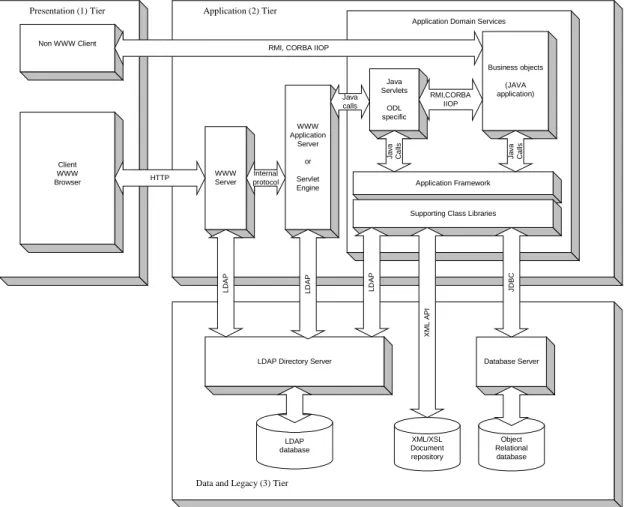
LDAP Directory Server WWW Server Internal protocol WWW Application Server or Servlet Engine Client WWW Browser HTTP Database Server LDAP database Object Relational database LD A P LD A P
Application Domain Services
Java Servlets ODL specific Ja va C a lls RMI,CORBA IIOP Business objects (JAVA application) Application Framework Ja va C a lls Java calls Non WWW Client
RMI, CORBA IIOP
Supporting Class Libraries
LD A P JD B C XML/XSL Document repository XML A P I
Presentation (1) Tier Application (2) Tier
Data and Legacy (3) Tier
2.1 General architecture
A great deal of modern information systems are to be used in situations where Internet, intranet and extranet are used as a common infrastructure, when the intensity of the system load varies and the usage of the thin client is highly desirable. For example, one our project was IS for the mass-media business, which had to interact with its customers via the WWW, maintain business-to-business (B2B) relations with information suppliers and corporate consumers using the proprietary protocols and provide the back-office interfaces for the internal usage.
We have had to design and implement systems, which meet these requirements. Having recognized the need for flexibility, portability, scalability and the commitment to standards, we chose 3-tier architecture as a basis. This architecture provides a very clear separation of the functionality between logical tiers and, in our opinion, it is the best choice for the modern distributed information systems.
The architectural model shown in Figure 1 illustrates the typical usage of the different kinds of the software in each of logical tiers.
2.2 Middleware choices
One of the most important things in the development of the distributed system is to choose the proper type of middleware for interaction between the components of the system. In fact, several types of middleware are used simultaneously in many cases. This diversity is frequently caused by the need to optimize particular segment of interaction, comply with standards, meet security restrictions, ensure reliability, etc.
There is quite a wide choice of different middleware tools: conversational middleware (proprietary application protocol on top of the transport layer API), remote procedure calls (RPC), distributed objects, message oriented middleware (MOM), database middleware, etc. Sometimes the usage of general-purpose middleware becomes standard-de-facto and a new type of middleware emerges – Hypertext Transfer Protocol (HTTP) or the so-called Web Middleware, for example. HTTP protocol itself is quite an ordinary application of TCP transport protocol – Sockets API, but the usage of it became so common to produce the concept of Web Middleware as such.
The following types of middleware will be discussed in this paper: Distributed Objects – CORBA and Remote Method Invocation (RMI), some CORBA services, HTTP, database middleware.
2.3 Distributed Objects
This type of middleware its the component oriented approach of the system design and development. There is no impedance mismatch between the object model of the system and its implementation – all the abstractions of the application domain entities and design artifacts map to the implementation entities quite straightforwardly.
We suppose that the advantages of this approach over other kinds of middleware are so obvious, that we do not need to advocate this paradigm further. Let’s explain our preference to the certain type of ORB. We had the following options to consider: Java Remote Method Invocation (RMI) and CORBA 2.0 compliant ORB. Microsoft’s DCOM was not among the candidates, since we needed the true platform-neutral solution for the very first of our Java projects (the system is deployed on HP-UX, Windows NT and Linux). The need of portability also led to the choice of Java as the main development language, except for the few places where legacy systems had no Java API. Enterprise Java Beans were not invented yet, so we were lucky to have one of the the first commercial CORBA implementations up and running.
• Language neutrality - some parts of the system were to be implemented in C++;
• Java RMI was not so stable and mature in 1997 – otherwise we could have used RMI in some pure Java subsystems;
• Third-party software (Netscape SuiteSpot), which was used, provided CORBA 2.0 ORB and some CORBA services (Event and Naming).
There was no RMI over Interoperable Internet ORB Protocol (IIOP) or EJB, which would allow us to use mostly pure Java middleware approach at that time. Furthermore, RMI lacks asynchronous invocation capability, which is important in some situations and which was necessary for our system. So we decided to specify interfaces of components, which were to be used across different address spaces, via CORBA Interface Definition Language (IDL), and to implement these interfaces using Java objects.
Initially our idea was to use CORBA for interaction between all tiers of system, including Java applets running in WWW browser, but quite soon a number of problems cropped up. CORBA-enabled applets were quite heavyweight, their stability and performance were not adequate, attempts to run this kind of communications across Internet firewalls also revealed certain issues, so we decided to use ORB inside the intranet, while leaving the rest of the job for HTTP. Having made this decision we received some security bonus as a compensation: HTTP support of Secure Socket Layer (SSL) protocol. Otherwise it would be necessary to use some ORB security extension (Inprise Secure GateKeeper, for example) for transmission of sensitive data. This would have complicated things, which were already fairly complex.
HTTP protocol has also been used from within components for data transfer to and from some legacy systems, which exposed data by means of authorized access to HTTP server. Automated interactions with Web-based administration interface of certain systems (to restart automatically Netscape Enterprise server after scheduled user registry and Access Control List (ACL) synchronization session, for example) were also held via HTTP.
In some of our recent projects we chose RMI as an alternative to CORBA due to the following reasons: RMI is free of charge, it became more reliable and robust, EJB – emerging server-side component infrastructure is based on RMI. There also are ways of interoperability between RMI and CORBA via Java-to-IDL and RMI over IIOP. Some modern application servers (BEA Weblogic, for example) provide their own implementations of Sun JavaSoft RMI specification, which are more scalable and optimized.
The absence of pass-by-value mechanism in CORBA 2.0 made things inconvenient when it was necessary to pass parameters and return results in operations of CORBA components. This created some Java-CORBA object model impedance mismatch and required mapping from Java objects to CORBA IDL structures. Sometimes we used Java serialization to pass flattened Java object as a parameter of CORBA object operation.
2.4 CORBA Services
There were not so many commercially available CORBA services at the time we started to design and build our first CORBA/Java system. Another problem is that implementations of CORBA services are expensive and quite difficult to use. For these reasons we use only two services: Naming and Events. The usage of the Events service will be described later, when we shall present one of the particular design solutions.
2.5 Java Platform
As it has been mentioned before, we made a decision to use Java in all possible places of implementation, to achieve maximum portability of system components via promised “write once, run anywhere” technology. We think that this decision was right – we have achieved our main goals and Java Platform itself took a big leap towards the stable and mature application
development environment. Major software vendors also proved their commitment to Java technology. However, two or three years ago Java was not as mature as it is now and this caused much trouble, sometimes resulting in project delays. We can mention several reasons of this: first, the latency of 3rd party Java-based product supplies or the inadequate quality of products; second, the underestimation of the necessary development resources and their qualification; third, the rapidity of changes in Java technology area. Sometimes it was painful “write once, debug everywhere” experience.
2.6 Dynamic Web Content
The significant part of the user interface in our systems is Web-based. This requirement causes a strong need of tight integration between HTTP server and application services at the middle tier of the system, because the most part of the Web interface is to be generated dynamically on demand. This integration was not such a trivial issue, since there was no universal solution to the problem. Common Gateway Interface (CGI) is quite slow and very inelegant from the architectural point of view. It also poorly integrates with Java-based application services. Some proprietary solutions from different vendors like Server-Side Java Script (SSJS) or different HTTP Server APIs are not portable across different HTTP servers, yet suffer from the same integration problems. Scripting tools like Perl and Php3 do not scale well, and, in our opinion, scripting tools should be used sparingly.
Having tried some proprietary solutions (SSJS, namely) we experienced troubles due to poor integration, portability, and limited functionality. Server-side Java standard – Servlet specification and reference implementation issued by Sun Microsystems was just on time for us. This pure Java HTTP server extension has the following main advantages: it is portable across different HTTP servers (most HTTP servers provide means to integrate servlets); it is simple and easy to use; it has direct access to all the Java APIs, and, inherently, has no integration problems with the rest of the system. This choice proved to be a reliable and portable solution, and we have used it in different environments - from simple Servlet Runner available free of charge from Sun, to quite sophisticated products like IBM WebSphere Application Server.
3
Common issues and reusable solutions
In this section we shall discuss the most important issues, which are quite general to a number of distributed object-oriented applications, and present our solutions for these problems.
3.1 Object Persistence Framework
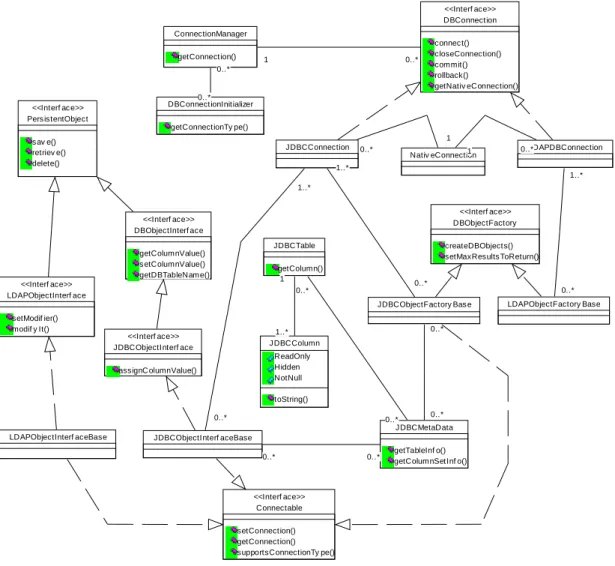
Perhaps one of the most important issues for a lot of applications is the external storage access. There are two main problem areas – the manipulation of the data, and the persistence of the run-time objects. These areas are often tightly coupled – tables in relational database are often used to store application entities and, on the other hand, some run-time entities are stored in a different kind of external storage - Lightweight Directory Access Protocol (LDAP) server, for example. Since there is a great deal of interaction with database, both for object persistence and data access, there is a need for the convenient persistence framework, abstract enough to be reusable independently of the particular application logic and the external storage type. This framework should provide interfaces to obtain the connection to the data store, add, update, search and retrieve persistent entities. Implementation of this interface should also be independent of changes in the database layout.
Connectable setConnection() getConnection() supportsConnectionTy pe() <<Interf ace>> DBObjectInterf ace getColumnValue() s etColumnValue() getDBTableName()
<<Interf ace>> DBObjectFactory createDBObjects() setMaxResults ToReturn() <<Interf ace>> JDBCObjectInterf ace assignC olumnValue() <<Interf ace>> Pers istentObject s av e() retriev e() delete()
<<Interf ac e>> DBConnectionInitializer getConnectionTy pe() DBConnection connec t() closeConnection() commit() rollback() getNativ eConnection() <<Interf ace>> ConnectionManager getConnection() 0..* 0..* 0..* 0..* 0..* 1 0..* 1 LDAPObjectInterf ace setModif ier() modif y It() <<Interf ace>> LDAPObjectInterf aceBase J DBCColumn ReadOnly Hidden NotNull toString() JDBCTable getColumn() 1 1..* 1 1..* J DBCMetaData getTableInf o() getColumnSetInf o() 0..* 0..* 0..* 0..* JDBCObjectFactory Bas e 0..* 0..* 0..* 0..* JDBCObjectInterf aceBase 0..* 0..* 0..* 0..* JDBCConnection 1..* 0..* 1..* 0..* 1..* 0..* 1..* 0..* LDAPObjectFactory Base Nativ eConnection 0..* 1 0..* 1 LDAPDBConnection 1..* 0..* 1..* 0..* 1 0..* 1 0..*
Figure 2 - Object Persistence Framework
We designed persistence frameworks in Java and in CORBA and implemented them on top of JDBC - relational database middleware of choice for our applications. These frameworks are able to accommodate any storage-dependant implementation under single interface. Later we expanded the implementation of our framework by adding classes for an interaction with LDAP services and we have plans to implement access to the XML-based storage using the same interface.
The usage of the relational database meta-data allowed us to develop implementation, which is independent of RDBMS table structure. The Factory pattern is used to obtain the results of the queries against the databases. The set of application objects is produced based on SQL or other type of (LDAP, for example) queries. There is also a possibility to specify a set of the so-called data sinks for a factory. We can define data sink as an object, which is able to consume and process a single data item from the query result set. Each sink class implements uniform interface and encapsulates the logic of the data item conversion to some alternative representation. Sink is supplied with the data transformation object, which is in charge of the actual further presentation of the data. Thus, an item of the query result set can be passed to the array of sinks and directed to different destinations, if necessary.
The main idea behind this factory/sink framework is to speed-up the delivery of the retrieved data to the destination. This is especially important when the number of items can be large and network transfer rate between the components is limited – in WWW based
search/retrieve applications, for example. Having data sinks, which share the same interface, it is possible to use the pipelining techniques to retrieve data items and transfer objects simultaneously. This architecture proved itself to be very efficient for handling of bulky data retrieves and presentation, especially in WWW applications. The users of WWW based search/retrieval system were satisfied when the results of their queries started to appear on the browser screen sooner than all results of the query were processed.
Figure 2 shows part of UML class diagram of our persistence framework. We also use some connection pooling mechanism, which allows more efficient usage of database connections. Modern application servers provide connection pooling, but sometimes they are limited to specific database vendors, so our simple pooling technique can be useful even in that case.
3.2 De-coupled Processing of Database Operations
Another important persistence-related issue is where to concentrate the processing activities of database interactions, since they mostly are resource hungry. Sometimes it is highly desirable to have a possibility to relocate database processing to another physical machine(s) when workload grows.
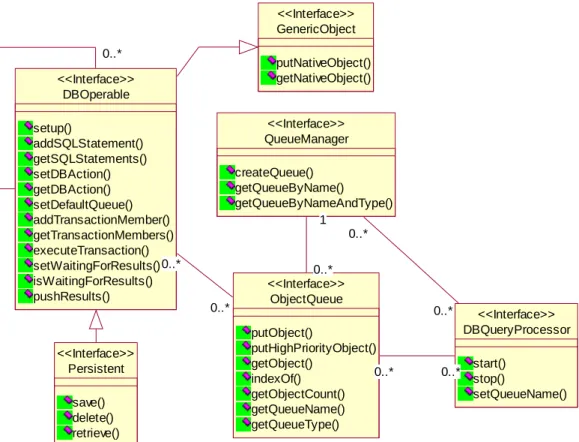
Persistent save() delete() retrieve() <<Interface>> GenericObject putNativeObject() getNativeObject() <<Interface>> DBOperable setup() addSQLStatement() getSQLStatements() setDBAction() getDBAction() setDefaultQueue() addTransactionMember() getTransactionMembers() executeTransaction() setWaitingForResults() isWaitingForResults() pushResults() <<Interface>> 0..* 0..* ObjectQueue putObject() putHighPriorityObject() getObject() indexOf() getObjectCount() getQueueName() getQueueType() <<Interface>> 0..* 0..* 0..* 0..* QueueManager createQueue() getQueueByName() getQueueByNameAndType() <<Interface>> 1 0..* 1 0..* DBQueryProcessor start() stop() setQueueName() <<Interface>> 0..* 0..* 0..* 0..* 0..* 0..* 0..* 0..* DB operations components class diagram
DECOUPLED DATABASE OPERATIONS
Figure 3 - Decoupled Database Operations
We have designed the distributed framework based on the producer-consumer pattern, which uses queue-based mechanism to separate the producers and the consumers. The main aim
is to encapsulate the processing of all forms of database operations – SELECT, UPDATE, DELETE statements, etc. Two essential parts of the implementation are:
• CORBA object implementing specific interface (DBOperable), which contains information needed for executing of the database operations – query or other SQL statement to be executed, what results are to be returned, etc.
• CORBA object (DBQueryProcessor), which has the connection to the database and can process objects implementing interface mentioned above.
The main goal is load balancing and the optimal usage of the system processing power – it is possible to plug additional machines running DB query processors, they would connect to Queue Manager, obtain ObjectQueue name and would participate in the query or, to be more exact, database operations processing activity. Upon completion of database operation, DB processor returns results to the client component via callback interface.
We have designed and implemented a simple object queue framework with two different communication options:
• Communication via simple data structures – client just puts other objects or itself into a queue, and processor of database operations (DBProcessor) gets them from it. Object queue has a possibility to accept objects only of specific type, process objects with different priorities, etc. DBProcessor also can choose queue of specific type.
• Communication via encapsulated CORBA Event Service. DBProcessor objects register as pull consumers; some objects can register as push suppliers for the specific event channel. One queue can have multiple Event Service channels. The implementation of the queue encapsulates the creation of the channels, etc. and exposes comprehensive interface for the clients.
•
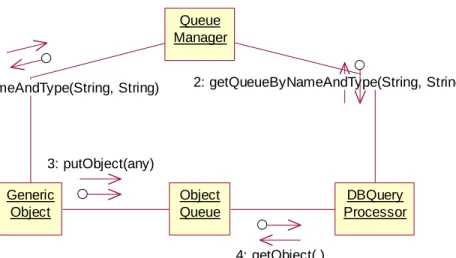
In both cases, the operation processing can be initiated by the object to be processed or by any other object, which would put object into particular queue
Generic Object Object Queue DBQuery Processor Queue Manager
DB operations components collaboration diagram
3: putObject(any) 1: getQueueByNameAndType(String, String)
4: getObject( )
2: getQueueByNameAndType(String, String)
3.3 Shared Object Pool
One of the questions, which frequently arises when the distributed systems for the multiple concurrent usage are designed, is how to reuse the objects instead of instantiating them repeatedly. We are talking about objects that share the same data and need to be accessed by multiple concurrent users. There is quite a simple solution using the pool of shared remote objects. The instance of remote object (for example, CORBA or RMI) resides where it was created – on the server side. When the client needs the specific object, it looks up in the pool for such an object. If there’s no object with such properties, the new object is created, the implementation is left in the pool on the server side, and reference to that object is returned to the client. When some client is looking up for the particular object for the second time, there’s no need to create another similar object. When the client invokes any method, which changes the state of a shared object, all clients using the same object can see these changes instantly – there is no need for refreshing of object set at the client side. Moreover, object pool can implement such features as periodical and asynchronous cleaning up of the objects that are not used by any client.
3.4 Separation of Presentation and Contents using Templates
The creation of the user interface components or data output results is often the area of activities of the WWW designers rather than the software developers. On the other hand, the content of the presentation is determined by the application, thus it is necessary to separate the presentation layout from its contents. This issue is especially important in WWW applications, where the layout is the most flexible and dynamic. We shall present our approach to this problem and outline some future steps and work in progress.
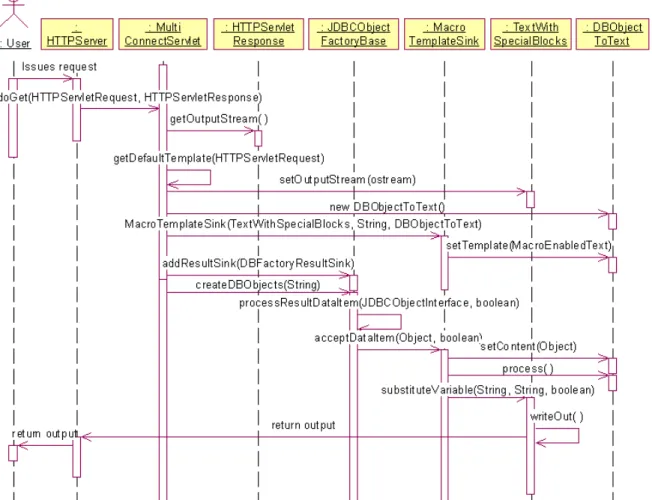
The simplest way to produce HTML output on the WWW server is to write HTML elements one by one to the output stream, producing contents for WWW client. This technique, however, is very poorly scalable, since it locks the layout of the document inside an application, making it impossible to change the presentation part without changing the processing part. Another approach is to mix scripting language and HTML, but since we decided to use pure Java implementation of HTTP server extension, this option was also inappropriate. We have designed and implemented a solution based on the usage of the templates. Each presentation element can have a template, which contains placeholders of the macro variable names and optionally special tags for the recursive data.
The administrators and the end-users can freely edit templates, provided that the placeholders and the other reserved constructs remain unchanged. Each visual entity (HTML page, for example) is represented at runtime by Java object, which is constructed by using particular template. These objects have methods for setting values of the macro variables, expansion of the template, writing expanded contents to the stream, etc. Two approaches are possible to the externalization of the contents. When output element is relatively small, all the processing is performed in memory, then expanded contents is written to the output stream. However, when the template contains recursive constructs, the processing can take a lot of memory, so there is a possibility to specify output stream and make the so-called “shadow writing”, i.e. to write portion of the formatted data to that output stream, when the data becomes available. This technique works well together with the data sinks discussed earlier, especially in WWW applications, where considerable amounts of output are being generated.
We are working towards using Extensible Markup Language (XML) for template specification and separating of the presentation layout via Extensible Stylesheet Language (XSL), to be compliant with the emerging industry standards and to use the advantages of XML parsers rather than implementing our own. XML will also allow us to create Document Type
Definitions (DTD) for the contents validation, if need be. At the time we devised our template-based approach, XML was not as popular as it is now, there was a significantly smaller choice of XML parsers and other XML-related software.
Figure 5 - Example of usage of templates and data sinks with Servlets
4
Analysis of Created Software for Reusability
At first we would like to review all of our software code and to evaluate its reusability percentage in terms of lines of code (LOC) and number of Java source files (one source file -one public class in Java).
LOC Source files
Number Percent Number Percent
Reusable 17755 24.88% 150 37.88%
Domain dependent 15891 22.27% 61 15.40%
Application dependent 37718 52.85% 185 46.72%
Total 71364 100% 396 100%
Table 1 – Distribution of code according to reusability level
We shall sort out all implemented components and classes in three groups: reusable -context independent, can be used in any application, in any business domain, domain dependent
- can be used in any application for this business domain, reusable in domain context,
application dependent - used only in particular applications, not reusable.
From these numbers we can see that reusable components (one Java source file corresponds to one class or component) are usually smaller in terms of LOC, they have lower degree of cohesion than application or domain dependent components. Now let us examine what part of total components is Java class libraries and what CORBA components.
Figure 6 shows the distribution of CORBA components and Java class libraries by source files. The percentage of CORBA in reusable components is not high - about 14 percents. The other part of reusable components is implemented as Java class libraries. One of the reasons for this is that usage of CORBA is not always required, sometimes Java is quite sufficient. If there is some reusable Java class, its CORBA wrapper, if needed, can be implemented at any time and at low cost. In addition, the latest developments like RMI-IIOP allow reusing Java components by CORBA clients, if necessary. CORBA components take greater part in domain dependent 21 129 43 18 0 185 0 50 100 150 200 Number of source files Reusable Domain dependent Application dependent Java Corba
Figure 6 - Reusability of Java and CORBA code by number of source files
components. They were developed for two projects from the same domain, where CORBA component framework was necessary. Application dependent components consist mainly of Java applications or quite independent application parts, and these applications only use domain dependent CORBA components, but are not CORBA components themselves.
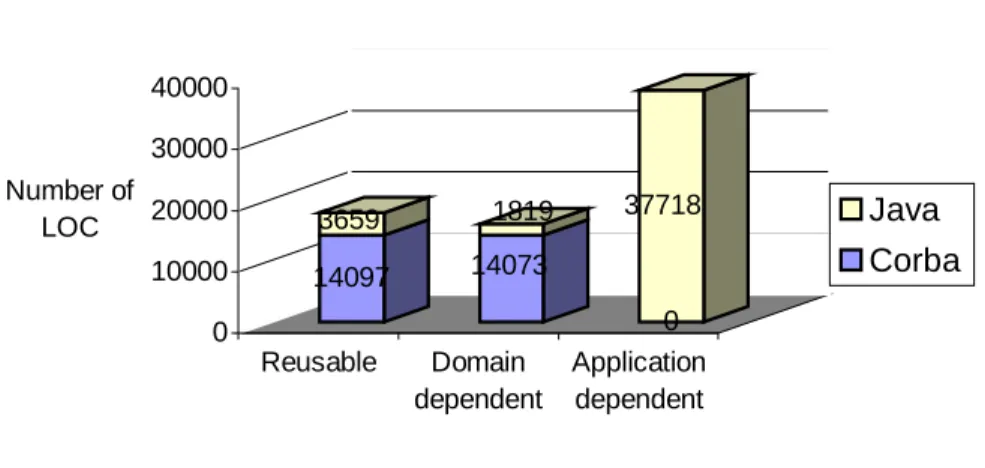
14097 3659 14073 1819 0 37718 0 10000 20000 30000 40000 Number of LOC Reusable Domain dependent Application dependent Java Corba
Figure 7 - Reusability of Java and CORBA code by LOC
The difference between the diagram in Figure 6 and the one presented above is that CORBA components take much higher percent in lines of code. The main reason for this is that the implementation of CORBA component in Java, especially if that component takes a lower
place in component inheritance hierarchy, consumes much more lines of the code. This happens because CORBA does not allow the inheritance of particular implementation, so CORBA component operations always must be overwritten, which is not necessary in Java class inheritance hierarchy.
Now, let us examine reusable components - what kind of components usually need to be implemented, what domains of standard Java API lack some functionality. Figure 8 shows the distribution of reusable components by source files in such domains like persistence, graphical user interface, network and input output, data models and collections, various handy utilities and generic classes (generic exceptions, objects, etc.).
Gui 11% Persistence 23% Data models, collections 7% Utilities 28% Net, IO 19% Generic 12%
Figure 8 - Distribution of reusable components by domain/source files
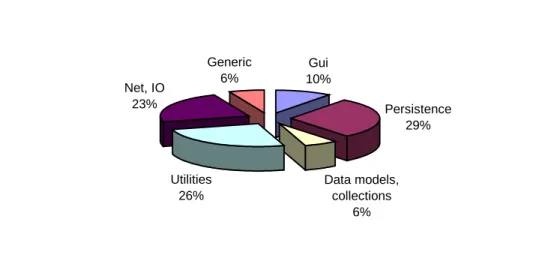
Figure 9 shows the distribution of reusable components by lines of code in the corresponding domains. In both figures we can see that persistence takes one of the greatest parts, thus convenient interface for work with database objects is obviously necessary.
Gui 10% Persistence 29% Data models, collections 6% Utilities 26% Net, IO 23% Generic 6%
Figure 9 - Distribution of reusable components by domain/lines of code
The third highest number is taken by network and input/output domain. Though Java was created to work in network and has many useful classes in standard packages java.net, java.io, there is a shortage of that kind functionality. We have developed reusable components to work with URL’s, Java Servlet hierarchy (Servlets with connection to databases, to work with dynamic HTML templates, etc.).
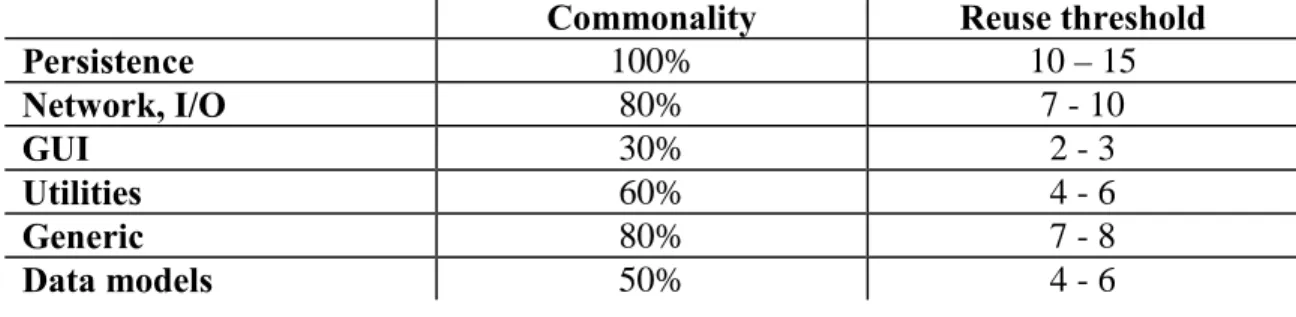
Now let us evaluate reusable components according to the following reuse metrics: commonality (frequency of use across systems) and reuse threshold (minimum number of reuse for paying back). We shall try to examine sets of components according to the domains discussed earlier (GUI, persistence, etc.).
Commonality Reuse threshold Persistence 100% 10 – 15 Network, I/O 80% 7 - 10 GUI 30% 2 - 3 Utilities 60% 4 - 6 Generic 80% 7 - 8 Data models 50% 4 - 6
Table 2 – Degree of reusability in different design domains
As we can see, persistence related reusable components are most frequent. If there is no need for the relational database, then sometimes LDAP servers are necessary when working through LDAP protocol. Reusable components that encapsulate the main LDAP operations fall into the same Java persistence framework. Other frequent domains are network and generic. Note that the more frequent the usage of the component is, the more times it must be reused for paying back. It, of course, depends on the implementation and maintenance costs of component. Frequently used components need more careful implementation (to cover all inconveniences and create really good interface) and more intensive maintenance.
5
Conclusions
In this paper we summarize our experience in design and development of the distributed object systems. Due to the limited space of this paper we were not able to discuss all of our reusable solutions, so we have chosen those, which we think, are the most important and successful, and hope that our experience can be useful. Of course, some solutions may be unnecessary if some more expensive application server software is used, however this is the lower-cost approach; high cost and sound promises of application server vendors also need proof that they deliver right functionality.
It is our opinion that distributed object technologies and Java platform is suitable for the development of the production-level information systems. There were quite hard times to develop working systems using Java, however it seems that it has changed for the better. Software industry is taking these technologies seriously, making the promise of the portability a reality.
6
References
[1] Orfali, R., D. Harkey, and J. Edwards. The Essential Distributed Objects Survival Guide, Wiley, 1996
[2] Edwards, J. 3-Tier Client/Server at Work, Wiley, 1997
[3] Orfali, R., D. Harkey, and J. Edwards. Instant CORBA, Wiley, 1997
[4] Orfali, R., D. Harkey, and J. Edwards. Client/Server Programming with Java and CORBA, Wiley, 1997
[5] Object Management Group. UML 1.1. Specification, OMG Document, 1998 [6] Stal, M. “Worldwide CORBA: Distributed Objects and the Net”, Object Magazine, March 1998
[7] Kara D. “Next Up… Java Application Servers”, Object Magazine, March 1998 [8] Ohnjec, V, D. Kranz “Developing Distributed Object Systems” Object Magazine, February 1998
[9] Morgenthal, J.P. “The Impact of Enterprise JavaBeans” Object Magazine, March 1998
[10] Allen, P., S. Frost. “An Integrated Component-Based Process” Object Magazine, February 1998
[11] Eastman J. “Building Scalable CORBA Distributed Systems” Object Magazine, April 1997
[12] Roman E. “Mastering Enterprise JavaBeans and the Java 2 Platform, Enterprise Edition”, Wiley, 1999
[13] Goldman, J., P. Rawles, and J. Mariga. Client/Server Information Systems A Business-Oriented Approach Wiley, 1999
[14] Wong, D., Paciorek, N. and Moore, D. Java-based mobile agents. Communications of the ACM, 3(42), 1999, pp. 92-104.
[15] Glushko, R.J., Tenenbaum, J.M. and Meltzer, B. An XML framework for agent-based E-commerce. Communications of the ACM, 3(42), 1999, pp. 106-114.
[16] Vinoski, S. New Features for CORBA 3.0. Communications of the ACM, 10(41), 1998, pp. 44-52.
[17] Schmidt, D. Evaluating architectures for multithreaded object request brokers.
Communications of the ACM, 10(41), 1998, pp. 54-60.
[18] Morghental, J.P., Enterprise Application Integration Tutorial, Presentations of OMG Enterprise Application Integration Workshop, February 7-10, 2000 - Orlando, FL, USA
[19] Henning, M. Binding, migration, and scalability in CORBA. Communications of the ACM, 10(41), 1998, pp. 62-71.
[20] Pyarali, I., Schmidt, D.C. An overview of the CORBA portable object adapter. Standard View, ACM perspectives of standardization, 1(6), 1998, pp. 40-43.