c
PERFORMANCE PORTABILITY OF PARALLEL KERNELS ON SHARED-MEMORY SYSTEMS
BY
JOHN ANDREW STRATTON
DISSERTATION
Submitted in partial fulfillment of the requirements
for the degree of Doctor of Philosophy in Electrical and Computer Engineering in the Graduate College of the
University of Illinois at Urbana-Champaign, 2013
Urbana, Illinois
Doctoral Committee:
Professor Wen-mei W. Hwu, Chair Associate Professor Deming Chen Associate Professor Steven Lumetta Professor David Padua
ABSTRACT
This work describes my solution to the performance portability problem: between CPUs and GPUs in particular, but laying the foundation for even broader performance portability support. I argue that the best approach is to use a language like OpenCL as a portable, low-level programming model with well-defined mechanisms for expressing multi-level parallelism and locality. That low-level program representation can be supported with architecture-specific compilers, runtimes, and libraries to target the application code to various platforms with high performance. High-level language designers or tool developers could then target this single, low-level programming and par-allelism model as a portable, high-performance intermediate program repre-sentation.
To demonstrate the feasibility of this approach, I show how one would design a good CPU implementation of OpenCL given that the programs are written according to the current high-level GPU vendor optimization guidelines. Programs written in such a way already meet the criteria of good GPU performance, and in this work, I show that those same programs on a CPU platform implemented according to my proposals can out-perform an OpenMP implementation of the same algorithm on the same system.
To my wife, Jenny, Thanks for everything
ACKNOWLEDGMENTS
I would like to thank my adviser, Wen-mei Hwu, for having faith in my poten-tial when it was just that, and for giving me more public credit than a grad-uate student often gets. Thanks to the IMPACT research group’s current, former, and ancillary members, who have been excellent mentors, colleagues, and supporters. Special thanks go to Shane Ryoo and Sain Ueng for helping me get started in research, and to Hee-Seok Kim for helping with many im-plementation details and carrying out several experiments. And thanks to Professors Steve Lumetta, Sanjay Patel, Deming Chen, David Padua, and Nacho Navarro, for welcoming me into the academic community, especially those who served on my dissertation committee.
Thanks to MulticoreWare Inc. for believing that this technology was worth a significant financial and development investment. I will be glad to help make it pay off.
Thanks to all the people and organizations that have supported me and my research materially and financially during my graduate studies. My salary has, at various times, been paid in part by the following: the Gigascale Research Center of the Semiconductor Research Corporation, the Microsoft-/Intel Universal Parallel Computing Research Center, NVIDIA Corporation, MulticoreWare Inc., and the University of Illinois at Urbana-Champaign through its Department of Electrical and Computer Engineering. Many of the named financial supporters also provided significant equipment dona-tions for the experiments presented here. I also want to thank the donors and judges who have encouraged me through awards and honors, including Dan Vivoli and the Dan Vivoli Endowed fellowship committee, Nell W. Reid and the E. A. Reid Fellowship committee, and Dr. Frederic T. and Edith F. Mavis and the administrators of the Mavis Future Faculty Fellows program. Any finally, greatest thanks to my ever-growing family for their love and support.
TABLE OF CONTENTS
LIST OF ABBREVIATIONS . . . vii
CHAPTER 1 INTRODUCTION . . . 1
1.1 Software and Hardware Industry Context . . . 4
1.2 Kernel Programming in the Software Abstraction Hierarchy . 5 1.3 Organization of this Document . . . 8
CHAPTER 2 CURRENT PRACTICES . . . 10
2.1 Characterizing Optimization Patterns for Massively Threaded Systems . . . 10
2.2 Practical Details of Implementing High-Performance Ac-celerator Code . . . 25
CHAPTER 3 PERFORMANCE IMPACT OF ARCHITECTURES . 32 3.1 Hardware-Software Co-Design Results . . . 34
3.2 Baseline Performance Improvements . . . 35
3.3 Optimization and Architecture Interactions . . . 37
3.4 Summary and Conclusions . . . 39
CHAPTER 4 MEMORY SPACE MAPPING AND COMPILER DETAILS . . . 40
4.1 Implementing the Memory Spaces . . . 41
4.2 Work Distribution and Runtime Framework . . . 42
CHAPTER 5 SERIALIZING SPMD PROGRAMS . . . 46
5.1 Simple Serialization . . . 47
5.2 Enforcing Synchronization . . . 49
5.3 Replicating Thread-Local Data . . . 55
5.4 Comparison with Industry Implementations . . . 56
5.5 Performance Analysis . . . 63
CHAPTER 6 A VECTOR MACHINE MODEL OF ACCELER-ATED KERNEL EXECUTION . . . 65
6.1 C Extensions for Array Notation . . . 66
CHAPTER 7 PORTABILITY . . . 72
7.1 CPU Performance Effects of Programming in OpenCL . . . . 73
7.2 Comparing OpenMP and OpenCL as Parallel Program-ming Models for a CPU . . . 75
CHAPTER 8 EXTENDING PERFORMANCE PORTABILITY TO BROADER ARCHITECTURE CLASSES . . . 77
8.1 Rigel . . . 77
8.2 FPGAs . . . 85
8.3 Coarse-Grained Reconfigurable Arrays . . . 93
8.4 Initial Evaluation . . . 101
8.5 Summary and Conclusion . . . 103
CHAPTER 9 CONCLUSIONS AND FUTURE WORK . . . 104
9.1 Future Work: Additional Libraries for System-Specific Op-erations . . . 104
9.2 Extending Serialization Techniques to Handle True Functions . 107 9.3 Alternatives and Related Work . . . 108
LIST OF ABBREVIATIONS
BRAM Block Random Access Memory CGRA Coarse-Grained Reconfigurable Array CPU Central Processing Unit
DMA Direct Memory Access DSP Digital Signal Processor ESL Electronic System Level
FPGA Field-Programmable Gate Array
FSB Front-Side Bus
FSM Finite State Machine GPU Graphics Processing Unit HLS High-Level Synthesis
I/O Input/Output
ILP Instruction-Level Parallelism MPMD Multiple-Program Multiple-Data SIMT Single-Instruction Multiple-Threads
OoO Out-of-Order
RISC Reduced Instruction Set Computing RTL Register Transfer Logic
SDC System of Difference Constraints SIMD Single-Instruction Multiple-Data
SIMT Single-Instruction Multiple-Threads SPMD Single-Program Multiple-Data VLIW Very Long Instruction Word
CHAPTER 1
INTRODUCTION
In years past, a system’s inability to achieve reasonable performance for generic codes that performed well on other systems were typically attributed to architecture design flaws or compiler limitations. Once such expectations are established, they are self-fulfilling, because new system designs are often constrained by legacy programs.
With the advent of widespread parallel programming, the mindset of the field has changed drastically, primarily because legacy applications were no longer regarded as the sole or even primary constraint on system design. The fragmenting of the parallel programming realm meant that programmers could not choose any language or programming model that was supported by a wide variety of relevant architectures. Among the various proposals for an industry standard language for both CPU and accelerator architectures, the most widely supported and adopted is OpenCL [23], specifically the hierar-chical SPMD programming model component it shares in common with the CUDA language [6]. Yet even after the standardization and implementation process, there is still a serious disagreement among industry vendors about what kind of OpenCL code people should write for good performance.
To illustrate the issue of performance portability, let us use the exam-ple of a typical, experienced software engineer as recently as ten years ago. Computer architectures have a wide variety of instruction sets and processor designs: Alpha, x86, Itanium, PowerPC, SPARC, MIPS, and ARM, just to name several. Yet the typical software developer did not have to assume a particular processor to write good programs in high-level languages like C or C++. That is to say, whatever made a generic C or C++ program “good” was independent of the specific architecture on which it would eventually be executed.
set of computer systems when that piece of software, executed on each system, achieves reasonable performance while producing valid results.
The performance portability problem has gotten a lot of attention, and for good reason. In this thesis, I define performance portability as a property ex-hibited by some piece of software for some collection of architectures, where that piece of software achieves a good level of performance on each architec-ture. The use of the word “good” in the definition means that performance portability is necessarily subjective. Essentially, a software developer decides that a particular piece of software does not have performance portability for the class of processors they care about when they decide to split their code into multiple versions for multiple processors. That decision is determined by context-specific weightings given to the cost of creating and maintaining multiple versions of code versus the potential loss of performance on certain platforms.
Performance portability as a general metric is applied differently in dif-ferent software and system contexts. In the world of sequential computing, performance portability usually meant that a single piece of software was able to compile and execute on a variety of microprocessors from multiple vendors. Although x86 architectures dominated the consumer-level comput-ing market, the instruction set and architectures have not remained static. Yet many software developers never consider which specific architecture gen-eration with specific ISA extensions will be running their code. In paral-lel clusters, performance portability among cluster MPI programs usually means that the software package works well on a variety of clusters and in-terconnects. This dissertation focuses on the emerging parallel accelerator programming model of hierarchical, fine-grained SPMD kernel programming. This programming model is embodied in many widely used languages, such as OpenCL [23], CUDA [33], C++AMP [32], and OpenACC [37]. In prac-tice, OpenCL is the only language with multiple mature implementations from multiple vendors, in large part because it was the first language pro-posed with an open specification and the explicit goal of portability among multiple devices.
Despite portability being a goal of the OpenCL language, a belief in the performance portability of applications written in OpenCL is noticeably
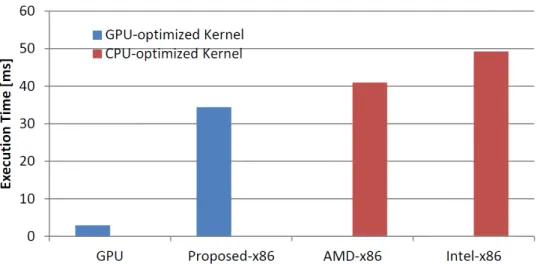
ab-Figure 1.1: The EP NAS Parallel Benchmark in OpenCL executed on cur-rent and proposed OpenCL implementations. GPU results were run on an NVIDIA Tesla C2050. All platforms targeting x86 were executed on an Intel CoreTMi7-3770 CPU.
sent from today’s accelerated code developers. To some extent, this is to be expected; software projects that chose an accelerator programming model typically place a higher-than-average priority on performance, and there-fore a higher standard for performance portability. However, if publications are any indication, there is a widespread belief that optimizing OpenCL pro-grams for a GPU architecture requires drastically different optimizations and coding practices than does optimizing an OpenCL application for a multi-core CPU architecture or non-GPU accelerator [46, 41]. For example, let us take a recent work studying the NAS Parallel benchmarks in OpenCL on a variety of architectures. Seo et al. saw that with the OpenCL language im-plementations available to them for GPUs and CPUs, they had to optimize the GPU-targeted and CPU-targeted OpenCL kernels very differently to get good performance on each [46]. When their results are reproduced for the “Embarrassingly Parallel” benchmark on updated hardware in Figure 1.1, we can confirm that the GPU-optimized kernel greatly outperforms the Intel and AMD OpenCL language implementations on x86 for the CPU-optimized kernel, largely because of the accelerator device’s higher peak throughput.
In this dissertation, I argue that the perceived lack of performance porta-bility of OpenCL applications for CPU and GPU architectures does not mean that the architectures lack features necessary for achieving high performance
ity problem between modern GPUs and CPUs has more to do with the fact that certain implementations of the OpenCL language have differing implicit performance costs. For some applications, performance portability will never be truly achieved, if the chosen algorithms are clearly much more suited to one kind of architecture. For algorithms that can perform well on both CPUs and GPUs in theory, I demonstrate that there is nothing fundamentally de-ficient about programming for a CPU in OpenCL as opposed to OpenMP or other more traditional CPU parallel programming models.
As Figure 1.1 also shows, the work implemented in this dissertation achieves higher performance on the x86 processor than either existing industry OpenCL language implementation, but most importantly gets very high CPU perfor-mance for the GPU-optimized kernel. In this example, the language imple-mentation methodology described here obviates the need to maintain the distinct “CPU-optimized” version of the code, achieving single-source per-formance portability.
1.1
Software and Hardware Industry Context
The context for this material is set by the current trends towards paral-lel and heterogeneous computing in large consumer device markets. Energy consumption limitations on practically every class of computing device led CPU vendors to abandon the single-core design methodology. Fully auto-matic exploitation of explicitly parallel platforms is largely seen as ineffec-tive for most application code written under the assumption of sequential program execution. The software industry experienced a major disruption, because sequential legacy codes could no longer fully utilize the CPUs of their customers. The software industry has been effectively forced to invest a significant amount of development effort to migrate away from sequential programming models for performance-sensitive code regions.
Simultaneously, forces in various special-purpose architecture markets were leading architects in those markets to increase the flexibility and programma-bility. In particular, GPUs began as fixed-function units whose only output was four-channel pixel colors at eight unsigned bits per channel. Demand for increasing realism and artistic expression in rendered scenes led GPUs to increase in flexibility. The vertex and fragment units adopted more and
more programmability, moving from being fixed-function only, to adopting programmability with straight-line assembly, to supporting limited and fi-nally arbitrary branching. Pioneers tracked the increasing capabilities of the GPU with increasingly varied applications, hijacking graphics programming interfaces to perform various linear algebra and scientific simulation calcula-tions.
GPU vendors realized that with CPU software developers being forced to parallelize code anyway, those developers may be willing to parallelize their code for a GPU. GPU vendors released GPU-friendly programming languages and tools that eschewed explicit graphics terms or constructs to attract general developers. However, in 2007, when CUDA was released, it would still not have been fully feasible to make serious claims regarding per-formance portability between CPUs and GPUs. The GPU architectures of the time imposed stringent requirements on software to achieve a significant fraction of peak performance, which have since been significantly softened as described in Chapter 3. Today, the first-order performance guidelines of-fered by GPU vendors are mostly limited to fundamental performance issues shared in common with CPU architectures, namely good locality manage-ment, vector execution, and scalability.
1.2
Kernel Programming in the Software Abstraction
Hierarchy
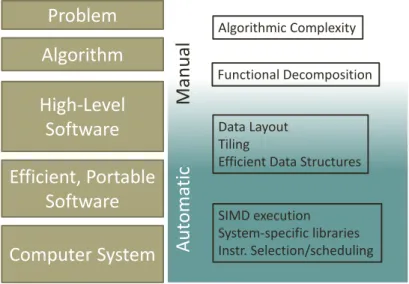
Figure 1.2 shows a few levels of abstraction and translation in the process of expressing and solving real-world problems on computing hardware, anno-tated with some typical performance-impacting decisions or transformations. From the programmer’s standpoint, anything addressed by tools, libraries, and architecture after the application code has been written is part of the “system”. The programmer does not care whether the CPU is a VLIW processor relying on the compiler to completely control dynamic instruction scheduling, or an OoO architecture that takes on much of the scheduling bur-den in hardware. Neither does the programmer care about the complexity of the code behind library interfaces, which could be implemented differently for every system. Those optimizations that differ most among architectures are typically assigned to the tools, libraries, and compilers for that architecture.
A
u
to
m
a
ti
c
M
a
n
u
a
l
Levels of Abstraction:
Sequential Software
Problem
Algorithm
Efficient, Portable
Software
Computer System
High-Level
Software
Algorithmic Complexity Data Layout TilingEfficient Data Structures Functional Decomposition
SIMD execution System-specific libraries Instr. Selection/scheduling
Figure 1.2: Levels of abstraction translating a high-level problem into a se-quential, computational solution. On the right are tasks roughly associated with the level of abstraction at which they are typically addressed.
This is another way of describing performance portability, that the applica-tion programmer is not expected to perform those optimizaapplica-tions unique to one architecture.
A widespread sentiment today is that it is no longer possible to write one piece of parallel software and expect it to get reasonable performance on both CPUs and GPUs from various vendors [43, 46, 41]. This adds a heavy burden to software engineers, who must now consider additional development and perpetual maintenance costs for every additional platform they wish to target. Software developers also have no reasonable guarantees that their code will remain viable for future hardware platforms.
In this work I demonstrate that the lack of performance portability is far from inevitable. In sequential processors, certain architecture design princi-ples were fundamental, whereas others were addressed by the compilers and libraries associated with that processor. Similarly, fundamental architecture design principles govern parallel architectures, and other design variations can typically be abstracted in a general way.
1.2.1
Generic, high-level translation and optimization
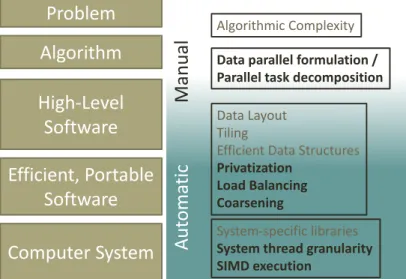
Figure 1.3 illustrates how the abstraction and optimization hierarchy should be adjusted in my proposal for performance portability among parallel
archi-Levels of Abstraction:
Parallel Software
A
u
to
m
a
ti
c
M
a
n
u
a
l
Problem
Algorithm
Efficient, Portable
Software
Computer System
High-Level
Software
Algorithmic Complexity Data Layout TilingEfficient Data Structures
Privatization Load Balancing Coarsening
Data parallel formulation / Parallel task decomposition
System-specific libraries
System thread granularity SIMD execution
Figure 1.3: Levels of abstraction translating a high-level problem into a par-allel computational solution. On the right are tasks roughly associated with the level of abstraction at which they are typically addressed. Tasks not typically necessary for a sequential execution context are shown in bold. tectures. Specifically, it is a proposal for how we can categorize most opti-mizations as either generically applicable and expressible, or system-specific. Achieving performance portability means that the programmer or high-level programming tools can perform generic optimizations targeting a system-agnostic interface. It also requires that system-specific performance concerns are hidden behind portable abstractions with system-specific implementa-tions.
The most important responsibility of the programmer is choosing a fine-grained parallel decomposition of their application. Fine-fine-grained decompo-sition is most portable for parallel architectures, primarily because tools can more robustly aggregate work into coarser tasks than they can further decom-pose tasks into finer threads. Therefore, the initial parallel decomposition should create a very large number of parallel tasks, to fill a current GPU’s tens of thousands of thread contexts many times over and still have room to scale for several more architecture generations. The parallel decomposi-tion should also embody good locality principles, with tasks within a group assigned to nearby or overlapping input and output data.
Beyond decomposition, several other high-level optimizations are often nec-essary to get good performance, such as tiling and data layout [48, 52]. These optimizations are nearly universal, as they address fundamental architecture
design principles such as locality, line-oriented memory systems, and resource contention. Chapter 2 will summarize the most important high-level opti-mization patterns or techniques as they apply to the hierarchical SPMD programming model. Even so, it is critical for researchers now to consider how to design high-level parallel programming languages and compilers such that we can practically move responsibility for many of these optimizations away from the programmer and onto the system implementers. While the specific parameters for optimizations like tiling may need to be tuned to each specific system for best performance [44, 4], underestimating hardware resources is typically much preferable to overestimating those resources, and conservative parameter selections should often be reasonably portable.
1.2.2
Architecture-specific, low-level translation and
optimization
Performance portability requires that each system implementing the lan-guage have at least non-conflicting requirements of what “good” source code should look like. The most pressing issues are related to implementing uni-form abstractions for vectorization and multithreading, when the degrees of each vary widely from one architecture to another. A recent GPU will have several orders of magnitude more thread contexts than a recent CPU. Archi-tectures like GPUs that implement very fine-grained, low-overhead threads in hardware can often map the fine-grained tasks of the hierarchical SPMD kernel directly to hardware thread contexts. For a CPU architecture, the tool and runtime components of the system must bridge the gap between the many fine-grained tasks of the input program and the few hardware thread contexts available on the system. Challenging as this may seem, it is in prac-tice much easier to automate an increase in parallelism granularity than it is to automate a decrease in parallelism granularity, effectively autoparalleliza-tion.
1.3
Organization of this Document
Chapters 5 and 6 will cover the core proposals in this dissertation for how such low-level optimizations should be directed for CPU architectures. The
ex-perimental results supporting the feasibility of performance portability will be presented in Chapter 7. The work begun in this dissertation has al-ready made a significant impact in the research and industry communities, as evidenced by the commercial support of the development of the Multicore cross-Platform Architecture and the numerous research projects that built on the work presented here. Chapter 8 will highlight collaborative projects targeting the fine-grained SPMD kernel programming model to other archi-tectures, including FPGAs, Rigel, and others. Chapter 9 will summarize the conclusions of this dissertation, including recognition of areas for continued development.
CHAPTER 2
CURRENT PRACTICES
The modern field of GPU computing had a major inflection point approx-imately six years ago with the first support for C-based programming lan-guages for general computation on GPUs. Very quickly, the community discovered and published what worked well on GPU platforms and what did not at first. As the years progressed, GPU architects and application researchers continually pushed at the boundaries of what GPUs could do effectively, significantly improving performance for many workloads. In this chapter, I focus on characterizing the broad optimization problems facing high-performance software development in general, and examples of specific mechanics in current GPU programming models used to address those chal-lenges.
2.1
Characterizing Optimization Patterns for
Massively Threaded Systems
A segment of the parallel programming community has long been interested in characterizing the programming patterns that are effective for parallel sys-tems [31, 22]. However, in private conversations, some of authors in that field have confided that they sometimes struggle with the fact that once a parallel program is implemented, the optimization process involves software develop-ment practices completely outside the domain of their structural patterns. I would therefore like to begin the academic discussion of a set of patterns sys-tematizing theoptimization of parallel programs. The optimization patterns were drawn in particular from an informal survey of the GPU Computing
Much of this chapter has been adapted from portions of a previously published work, c
2012 IEEE, reprinted with permission [48]. The original paper was written in collabora-tion with the many others who contributed to the development and analysis of the Parboil benchmarks.
Gems contributions [17, 18], and from a focused and detailed analysis of the Parboil benchmarks [49].
Because accelerators are highly parallel devices, many of the techniques specifically address general performance issues that arise from programming a highly parallel shared-memory architecture, such as contention and load imbalance. Some techniques are not specific to highly parallel architectures, but avoid especially severe performance cliffs given the design of today’s ac-celerator architectures, such as the especially software-driven approaches to effective bandwidth utilization and locality management. Still other tech-niques are specifically targeted towards leveraging the benefits of a hybrid system, using the versatility of the CPU to not only process necessarily se-quential code regions but to also precondition GPU kernel inputs such that kernels can be further optimized more than would be possible for general input.
Finally, parallel architectures are fundamentally a collection of sequential processing units. When a parallel architecture is well used, the performance limitation of a program on that architecture is the efficiency of the sequen-tial programs running on each execution unit. Therefore, sequensequen-tial program performance optimization is still an area of interest for the SPMD code exe-cuted on the accelerator. I will not discuss those techniques here, as they are well studied and not unique to parallel programming systems, but acknowl-edge that immature compiler technology sometimes will necessitate direct programmer implementations of “trivial” code optimizations.
I firmly believe that every one of the patterns described here has been explained in previous work, but note that previous descriptions of these pat-terns as they apply to GPU workloads are typically embedded within im-plementations of specific workloads. While I do not take credit for being the first to discover any of these individual transformations, there is useful insight to be gained by consolidating summaries of all those that applied to the Parboil benchmarks in a way that highlights their generality to a variety of GPU computing workloads. By gathering the optimization patterns to-gether, anchored by the real benchmarks using them, we can study how they interact with one another, their variations among different applications, and their individual and cumulative results on real hardware systems.
1: Data Access Tiling
DRAM
DRAM
Cache
DRAM
Scratchpad
Explicit
Copy
Implicit
Copy
Local
Access
Local
Access
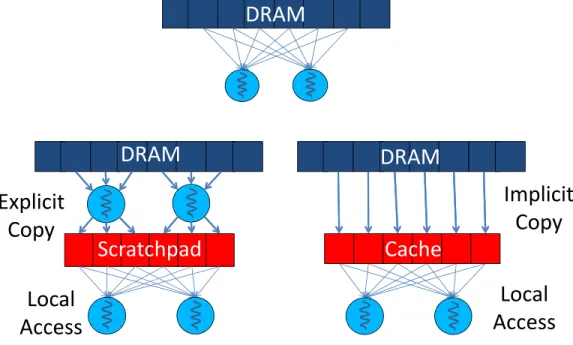
Figure 2.1: Tiling diagram for implicit storage (e.g. cache) and explicit stor-age (e.g. scratchpad)
provements from the highest-performing code we could write without that optimization to the highest-performing code we have. Except where noted otherwise, results in this section are collected from an NVIDIA Tesla S1070.
2.1.1
Tiling
Tiling is perhaps the most widely used and understood technique for best utilizing a tiered memory hierarchy. While the technique is fundamentally the same in sequential code optimization, the actual implementation can vary with the design of an architecture’s memory hierarchy, as shown in Figure 2.1. Tiling in the context of a CPU architecture with a large-capacity, implicitly managed cache hierarchy typically means writing regions of code that operate intensively on smaller sections of memory. The regions could then be repeated many times for different sections, or tiles, of data. The application need not explicitly define the region of memory being operated on, as the hardware should automatically respond to the heavy usage of certain regions and retain those regions in the cache.
Table 2.1: Tiling results
Benchmark Pattern performance impact Stencil 3.15×
TPACF 1.12×
SGEMM 6.18×
One of the most obvious differences of current GPU architecture is explic-itly managed on-chip memory, such as on the right side of Figure 2.1. To use the small-capacity, high-bandwidth scratchpad, software must explicitly move data into it before use. The threads themselves are mediators between DRAM and scratchpad, under the direction of source code written by appli-cation programmers.
Recent GPUs have also added small implicit caches to their general mem-ory system, providing a hybrid of implicitly and explicitly managed locality mechanisms. What makes even cached GPUs significantly different from typ-ical CPUs is that the ratio of cache capacity to the number of potentially active threads is incredibly small for GPUs. Indeed, the overall predicted trend for highly multithreaded processors is towards more limited resources per thread [26]. For instance, if all thread contexts were active in an NVIDIA Fermi GPU and cache space were partitioned among active threads, each thread would have a mere 32 bytes of L1 or L2 cache space.
Clearly, neither caches nor scratchpads in current GPUs were designed for CPU-style temporal locality and thread-private tiles, but for overlapping accesses among threads. A block of threads may collectively have 16kB of private cache or scratchpad space even when all thread contexts are active, which is often sufficient to hold worthwhile-sized tiles of data. Therefore, the software technique of tiling is still applicable for GPUs, but very often must take the form of cooperative tiling using the shared resources of several threads for sufficient impact.
The performance impacts of tiling are significant, as shown in Table 2.1. The 3× improvement in performance for the stencil benchmark corresponds to the fact that memory tiling reduces the number of bytes accessed from global memory per iteration from 5 words per thread to 1.25 words per thread on average. Performance does not increase by a full factor of 4×
pri-2. (Hierarchical) Privatization
Private
Results
Local
Results
Global
Results
Figure 2.2: Example of the common hierarchical privatization pattern marily because some accesses are still misaligned, not fully utilizing DRAM bandwidth. Although the results in Table 2.1 are for a cacheless GPU, our experiments in Section 3.3 verify, as any CPU high-performance programmer will assert, that software tiling is still critical for architectures with implicit caches.
2.1.2
Privatization
Privatization is the transformation of taking some data that was once com-mon or shared acom-mong parallel tasks and duplicating it such that different parallel tasks have a private copy on which to operate. Parallel threads typically operate most efficiently when they can operate completely inde-pendently, avoiding coordination with other threads, but many parallel al-gorithms require threads to interact to obtain a final result. Privatization is
Table 2.2: Privatization results Benchmark Pattern performance impact
BFS 3.15×
Histo 2.26× (GTX 480)
applied to isolate regions of code where threads can operate independently and efficiently, before eventually combining results.
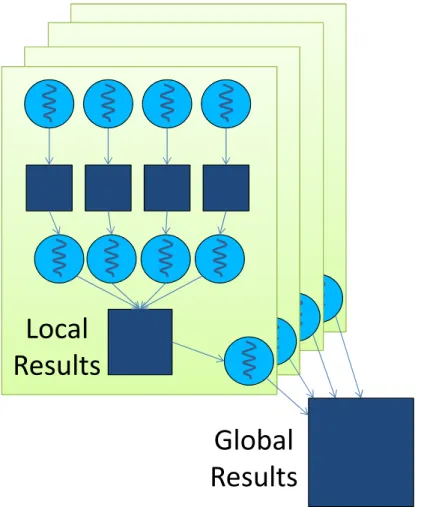
Figure 2.2 shows a common multi-level privatization pattern reflecting the hierarchical task decomposition common among highly parallel systems such as clusters or single-chip GPUs. Working up from the bottom of Figure 2.2, a global result is built from the partial results from many independent tasks (thread blocks in the case of a GPU). Those partial results are each in turn constructed from many more “private” results. This kind of privatization has applications in many different kinds of algorithms. Collective operations such as sorting or reductions will use this pattern, as will data structures such as histograms or queues.
One limitation of privatization is that the data footprint of the copies and the overhead of combining the copies scale with the amount of parallelism being exploited. Therefore, privatization is an extremely powerful technique for today’s CMPs, with a relatively small number of threads, but somewhat limited for the levels of thread parallelism in highly multithreaded architec-tures. Often the “private” results are still shared by several GPU threads due to resource limitations, but are intended to be constructed with as lit-tle inter-thread cooperation as possible. As shown in Table 2.2, the BFS Parboil benchmark privatizes the output work queues, resulting in a 3×
performance improvement over an unprivatized implementation. Privatiza-tion allows the BFS kernels to exchange more costly global memory atomic operations for shared memory atomic operations, and also collects irregu-lar updates in shared memory before bulk-committing results to the global queue in a more regular pattern, improving bandwidth. For the histogram benchmark, the privatization transformation was ineffective for the S1070 due to shared memory capacity limitations; we therefore report GTX 480 speedups in Table 2.2 for that benchmark.
3: Scatter to Gather Transformation
INPUT INPUT
OUTPUT OUTPUT
Figure 2.3: Depiction of a scatter-to-gather transformation
2.1.3
Scatter to gather transformation
A few Parboil applications demonstrate a computation pattern where an in-put datum would either contribute to many outin-put elements, or contribute to one or more statically unknown output elements, such as shown in Fig-ure 2.3. In either case, a common pattern for sequential implementation is to examine each input element, determine the output elements it affects, and update each one before moving on to the next input element.
This method works poorly as parallelism scales, because the output ac-cesses are either contentious or random or both. Examining the previous techniques, we see that tiling is very effective on input data, and privatiza-tion is very effective on output data. However, a kernel implemented with a scattering approach has no input read sharing to tile, and no outputs with multiple updates from the same thread to privatize. In these situations, it is often very important to transform the code such that input elements are read-shared, but output elements are private to a parallel task. This is more palatable than the converse case because shared reads can be much more ef-ficiently handled than conflicting writes, which typically require more costly atomic operations and coherence enforcement. A conversion to gather ac-cesses means that privatization can be applied to output writes, reducing their cost, while techniques such as tiling can be applied to improve shared read efficiency.
Scatter-to-Gather transformation works exceptionally well when the range of inputs affecting an output can be found without direct examination of the input data contents. If this input-to-output mapping cannot be done stat-ically, sometimes the transformation must be supplemented with a binning
Table 2.3: Scatter-to-Gather results
Benchmark Pattern performance impact (GTX 480)
Histo 1.22×
5, 6 & 7. Binning, Regularization &
Compaction
0
0
1
0
1
0
0
2
3
1
5
9
7
Raw Data Keys
Overflow Data for
Alternate Processing
0
1
2
3
5
7
9
Compacted
Data
0
1
2
3
5
7
9
0 1
2
3
4 5
6
7
Output
Binned
Data
Figure 2.4: An example showing the binning, regularization, and compaction optimization patterns
operation. The Parboil Histogram benchmark gains about 20% performance on a Fermi architecture by using a gather-based approach instead of a scat-tering approach. Results are presented on the GTX 480 because the gather approach for the Parboil Histogram benchmark is only effective for GPUs with sufficient shared memory space to privatize a reasonable portion of the output histogram. The S1070 system does not have sufficient scratch-pad capacity for the scatter-to-gather transformation to improve histogram benchmark performance, and is therefore inapplicable as an optimization for that architecture.
2.1.4
Binning
A gather operation can be difficult to orchestrate without a method of deter-mining, based on output location, which inputs contribute to that location.
Table 2.4: Binning results
Benchmark Pattern performance impact
CutCP 12.0×
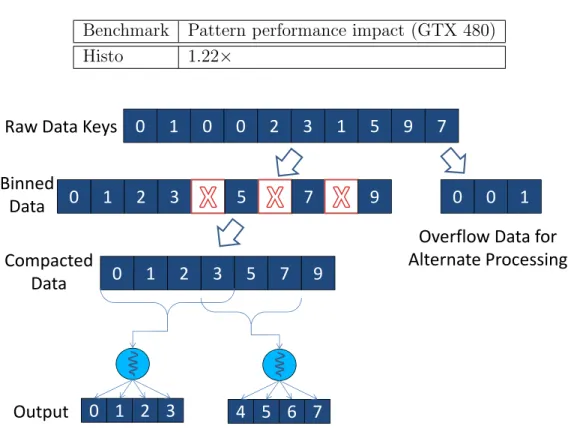
In the Parboil Histogram benchmark, for instance, a set of work-groups re-dundantly reads a section of the input data from off-chip DRAM, but each only processes the set falling within its own output range.1 In general, the bandwidth cost of reexamining data scales with the amount of parallelism. Therefore, for some applications it is beneficial to first create a data struc-ture creating a map from output locations to a small subset of the input data that may affect that output location, reducing the redundant reading of data. This data structure creation is called “binning” because it often reflects a sorting of input elements into bins representing a region of space containing those input elements. In the example of Figure 2.4, the unsorted data keys are examined and sorted into an array. If the input dataset were very regular, the sorting by key alone would likely create an efficiently ac-cessible data structure. However, in the presence of irregularity, there will either be empty or overflowing bins for any fixed bin size, which should be addressed by some combination of the following two optimization patterns: regularization and compaction.
Binning can improve system performance in several ways. If the GPU is performing both the binning and the computation, the overhead of binning can be outweighed by the improved efficiency of the main compute kernels. Alternatively, the binning operation could be offloaded to the CPU, poten-tially making better use of all available system resources. Binning is appli-cable in particular for the CutCP benchmark, as shown in Table 2.4. The speedups from binning are often very high, because binning input data for a kernel’s input changes the fundamental computational complexity of the kernel algorithm. A scatter-based kernel may not need binning to get com-parable computational complexity, but even for scattering kernels, binning is important because it can facilitate privatization of tiles of output data.
1An example of a Scatter-to-Gather transformation without binning. Binning is not a
useful technique for the Histogram benchmark because the actual histogram contribution is no more expensive in computation or bandwidth than the operation of sorting the data into bins would be itself.
Table 2.5: Regularization results Benchmark Pattern performance impact
SpMV 2.4×
MRI-Gridding 2.62×
2.1.5
Regularization
Load imbalance has been one of the banes of parallel processing throughout its history. Typically load imbalance is exacerbated when the level of par-allelism being exploited increases. Architectures exploiting SIMD or SIMT vector processing suffer from low-level imbalance if the tasks assigned to different execution lanes process different amounts or kinds of work. GPU architectures are no exception. Furthermore, if threads co-executing in a thread block have imbalanced loads, the shared resources of the entire thread block may be occupied until the last thread completes, potentially reducing the real amount of thread-level parallelism available for the architecture to exploit.
Some applications that exhibit load imbalance can predict at run-time where and how the load imbalance will occur. In the example of Figure 2.4, we assume that the program can count the number of data elements for each key at much lower cost than actually calculating its contribution to its particular output. A preprocessing step can limit the amount of imbalance in work units executed on the GPU by identifying regions of load imbalance and proactively addressing them. In our example, during the binning process, elements that “overflow” a bin can be put in a separate data structure, which can be processed by some method less sensitive to load imbalance.
Regularization is the optimization pattern of preconditioning GPU kernel input to improve performance. Among the Parboil benchmarks, there are examples of processing work separately using a GPU kernel insensitive to imbalance, offloading irregular work for the CPU to process concurrently with the accelerated kernel. Other cases have no visible impact on the kernel code except that load imbalance and warp divergence are on average improved, resulting in higher performance. Regularization increases the efficiency of the primary accelerated kernels handling the majority of the processing, resulting
Table 2.6: Compaction results
Benchmark Memory buffer size reduction
SpMV 49%
MRI-Gridding 68%
2.1.6
Compaction
Compaction has been a technique within extremely parallel, shared-memory systems and programming models for quite some time as well. The funda-mental issue is that when parallel work units produce a varying number of output elements into statically allocated output buffers, the buffer size must be overprovisioned. Because tasks determine output locations statically, un-used holes or spaces in the output are the consequence of overprovision, such as those bins marked by X’s in Figure 2.4. Output gaps interleaved with useful data cause bandwidth efficiency to drop for DRAM and cache ar-chitectures operating on transactions of larger, contiguous memory chunks. Compaction is a method of coordinating parallel tasks to dynamically deter-mine output locations such that no holes are introduced.
If compaction were a separate processing step, as depicted in Figure 2.4, it would simply move all the useful data elements into contiguous addresses, filling in the holes, while keeping track of where each output section begins, as it will be data-dependent [5]. More often, and in the MRI-Gridding and BFS Parboil benchmarks where GPU computation produces compacted output, the compaction is integrated into the kernel producing output itself.
The benefits from compaction primarily stem from the reduced memory footprint of the compacted data format. Performance impacts are typically only meaningful for bandwidth-bound kernels, and even then only minimally if the overprovisioned regions of the buffers are mostly contiguous. Thus, we quote not performance results but memory capacity reduction effects in Table 2.6. Compaction is essential for the MRI-Gridding benchmark in par-ticular, for which we cannot even run uncompacted versions of reasonable datasets on most GPUs due to insufficient global memory capacity.
4. Data Layout Transformation
struct foo{ float a; float b; float c; int d; } A[8]; struct foo{ float a[8]; float b[8]; float c[8]; int d[8]; } A; struct foo{ float a[4]; float b[4]; float c[4]; int d[4]; } A[2];Array of Structures
Array of Structures of Tiled Arrays (ASTA)
Structure of Arrays
Figure 2.5: Data layout example for a collection of structures. Different layouts affect the coalescing of each warp access and the locality of multiple accesses.
Table 2.7: Data layout results Benchmark Pattern performance impact
LBM 11.0×
SpMV 1.21×
2.1.7
Data layout transformation
DRAM systems supporting both CPU and GPU architectures are designed to transfer data in large, contiguous lines or rows. Poor usage of CPU cache lines or GPU coalesced bursts will result in poor performance. However, GPU coalescing rules are somewhat harsher, because of the shorter time window over which the software could make use of a data burst from DRAM before any unused data is “dropped,” requiring retransmission if needed at a future time. In some GPU architectures, the window is instantaneous, only exposed to a single SIMD instruction. More recent architectures introduce a small degree of caching extending this window, but because of the high degree of threading and the cache’s low capacity, the window in practice is still very small. This is in contrast to CPU cache lines, which will typically sit in the cache for a longer period of time before being replaced.
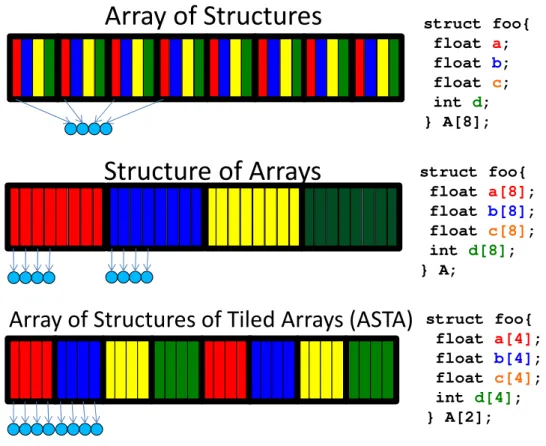
Programmers work within the DRAM system design with well chosen data traversal orders or task index organization. If the elements in question are single-word data and closely associated with task indexes, a good choice of task index to element index mapping is typically sufficient to get good memory system performance. However, that pleasant situation is not always feasible. Sometimes, the data elements needed within a particular time win-dow are not naturally adjacent to each other in the memory address space. Take, for example, the diagram in Figure 2.5, which shows a warp access-ing fields from a set of cells for various layouts. In the top case, usaccess-ing C standard data structure layout, the warp access addresses with a large stride between them, requiring multiple memory lines of mostly unused data to fulfill the requests. The middle case of Figure 2.5 shows equivalent accesses with a structure-of-arrays layout, a common transformation. However, even the middle case results in a large distance between the addresses of two fields, which are likely to happen very close together in time.
further by more complex layout transformation [53], perhaps resulting in a layout like that depicted at the bottom of Figure 2.5 where accesses to multiple fields will request adjacent, contiguous regions of memory. Specific examples of data layout transformation in the Parboil benchmarks include several instances of array-of-structure to structure-of-array transformations, a matrix transposition in SGEMM, and a transposed sparse matrix data storage format in SpMV. We specifically isolate the data layout transforma-tion effect for the LBM benchmark, with an order-of-magnitude speedup as shown in Table 2.7. Overall, transformations for the purposes of achieving coalescing often achieve very high performance gains, such as the LBM, while layout transformations for improving memory level parallelism or avoiding moderate partition camping can effect a more modest improvement. Sung et al. report speedups ranging from 5% to 30% for already coalesced accesses in different benchmarks [53].
2.1.8
Granularity coarsening
Granularity coarsening has been anecdotally described in many application optimization papers, perhaps most rigorously by Volkov in regards to lin-ear algebra kernels [54]. When a larger task is decomposed into a set of fine-grained work-items, there is almost invariably some amount of over-head introduced in the problem decomposition. The overover-head may vary for different algorithms and kernels, but almost every kernel will exhibit some inefficiencies in recalculating values like address offsets or other seemingly “small” operations in many threads. The finer the decomposition, typically the larger the overhead incurred. In addition to innate implementation in-efficiencies, most real systems incur some fixed costs creating or scheduling parallel tasks, and communication operations tend to become more costly as the number of communicating tasks grows.
The CUDA and OpenCL programming models lend themselves to an “ele-mental” style of decomposition, where the source code of the kernel is scalar, processing a single element, with as many threads created as there are el-ements to process. With this extreme level of decomposition, the level of redundancy and other inefficiencies can be surprisingly high, but difficult to address within the elemental-function methodology as the cost of
commu-8. Granularity Coarsening
Essential Redundant 4-way parallel 2-way parallel TimeFigure 2.6: Granularity coarsening and resulting efficiency gains. Each shaded box represents an executed instruction or operation.
Table 2.8: Granularity coarsening results Benchmark Pattern performance impact
SGEMM 1.96×
CutCP 1.3×
nicating between different tasks is still higher than the cost of redundant computation.
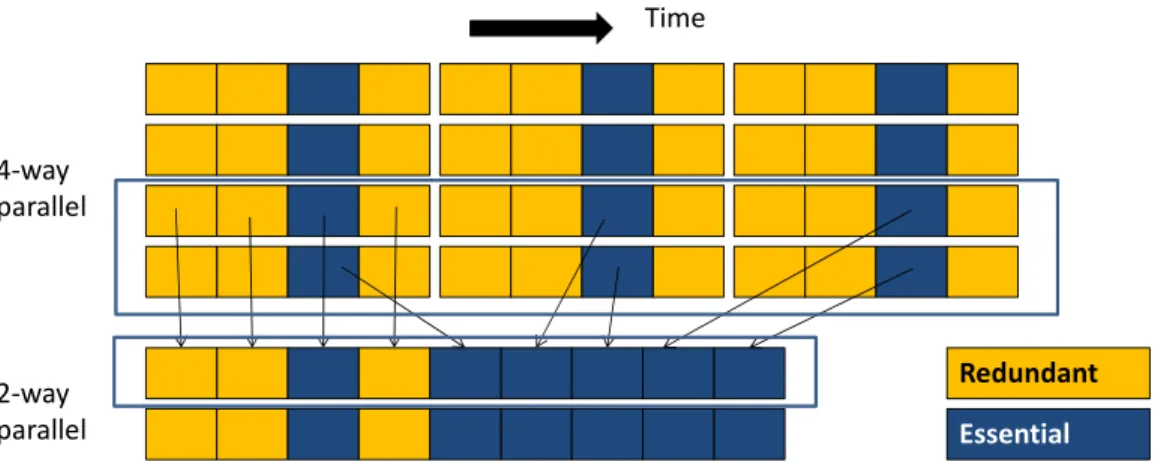
Granularity coarsening is essentially a de-parallelization of a program. In-stead of executing code where each thread processes one element, each thread processes several. Figure 2.6 shows a coarsening transformation by a factor of six. By putting several threads together, redundant operations that were previously executed once by each original thread have their redundant exe-cutions reduced by a factor of the degree of coarsening. Furthermore, what had been shared reads or conflicting writes to a variable in the untransformed code become private uses of data. In the example of Figure 2.6, although task parallelism was reduced by a factor of six, the total number of opera-tions required to compute the full output was reduced by nearly two-thirds. The efficiency gains make incremental coarsening worthwhile so long as the amount of parallelism is still sufficient to occupy the parallel resources of the device. Examples of specific efficiency gains are shown in Table 2.8.
1__kernel void MatMul( __global float *A,
2 __global float *B, __global float *C) {
3 float result;
4 __local float A_tile[TILE_WIDTH];
5 __global float *A_line = A + get_group_id(1)*A_WIDTH;
6
7 result = 0.0f;
8 for (int i = 0; i < A_WIDTH; i+= TILE_WIDTH) {
9 A_tile[get_local_id(0)] = A_line[i + get_local_id(0)];
10
11 barrier(CLK_LOCAL_MEM_FENCE);
12
13 for (int ii = 0; ii < TILE_WIDTH; ii++)
14 result += A_tile[ii] *
15 B[(i+ii)*B_WIDTH + get_global_id(0)];
16
17 barrier(CLK_LOCAL_MEM_FENCE);
18 }
19 C[C_WIDTH * get_group_id(1) + get_global_id(0)] = result;
20}
Figure 2.7: A simple, portable matrix multiplication kernel in OpenCL
2.2
Practical Details of Implementing
High-Performance Accelerator Code
The previous sections primarily highlight high-level optimizations necessary for optimizing parallel code in general. In practice, there are some specific details about precisely how the high-level optimizations are expressed in a particular language such as CUDA or OpenCL. Clearly, if different vendors have seriously divergent expectations of how programmers should use the language, it is impossible for programmers to write portable code. OpenCL programmers have already adopted certain practices to get performance on a variety of GPU and CPU platforms. This section outlines those practices and explains how they match the major architecture principles of GPUs and CPUs today. Figure 2.7 shows a listing of an OpenCL kernel for multiplying two matrices in single precision, which we will use as an ongoing example in this paper. If these practices could be performance-portable in theory, then achieving the goal of a portable language will require that both GPU and CPU implementations of OpenCL deliver high performance for codes written with these programming practices.
2.2.1
Parallelism: Threads and SIMD
The OpenCL programming model includes a two-level decomposition of work. Although the decomposition is just a two-level hierarchy of parallel tasks, the two levels have very distinct performance implications. All of the work-items in a work-group are guaranteed to be scheduled together, allowing them to coordinate more closely. Work-groups cannot make any assumptions about scheduling or co-scheduling of other work groups, which means both that atomic operations must be used to guard critical sections, and that dataflow-based programming patterns that rely on multi-group barriers are disallowed. The groups of co-scheduled tasks are a clear source of thread-level paral-lelism, and are exploited in that way by nearly all implementations. Less obviously, perhaps, the work-items within a group are exploited as a source of vector-level parallelism on all GPU implementations known to the authors. The reasoning is that OpenCL’s single-program multiple-data programming model will often naturally lead programmers to write groups of work-items with nearly-identical paths through the program in many situations. Even if it were not fully natural, the GPU implementations made this programming pattern fastest on their architectures from the beginning, and every GPU programming guide discourages “divergence,” or writing programs such that different work-items within a work-group take different paths through the program, making SIMD less effective.
To be performance-portable, the amount of parallelism in and among work-groups needs to be flexible. Work-work-groups must be at least as wide as the na-tive SIMD width of the machine, but never larger than the machine’s capacity to schedule locally and simultaneously. The number of work-groups should be several times larger than the number of processors on the device to enable load-balancing. Given the variety of architectures, it is unclear whether these constraints can be met for all platforms with a fixed-size work-group. At min-imum, performance-portable programs have to query the device parameters at runtime and choose group sizes appropriately, or allow the platform itself to choose a group size suitable for itself.
Our example kernel program computes a single output element with each work-item, so the number of work-items for a reasonably large matrix would be substantial. In line 19,get group id(1), the second element of the group index tuple, is used as the output row index, indicating that each
work-group should process some contiguous section of a particular output row. Therefore, every work-item in a work-group will need to access the same row of data from the A matrix. Also, there are no divergent branches in the kernel. Every condition is independent of the work-item index, so the entire path taken through the program execution is uniform across all work-items. Therefore, SIMD groups of work-items will be fully exercised, without the need to predicate any SIMD lanes at any time.
One interesting point about the OpenCL programming model is that by using groups of work-items as the basis for SIMD execution, the OpenCL implementations are providing the user a way to exploit SIMD without re-quiring them to program to a specific SIMD width. This is critical for porta-bility, because different CPU and GPU architectures have widely varying SIMD widths. Work-groups that are significantly larger than an architec-ture’s SIMD width enable additional thread- or instruction-level parallelism, as the group can be divided into multiple SIMD-width units. Subsequent proposed languages captured this insight particularly well also, such as the ISPC programming model that advocates SPMD programming as an easy and effective way of writing SIMD code for x86 CPUs [41].
2.2.2
Spatial and temporal memory locality
A large part of writing high-performance code is managing data locality well. In a recent survey article of seven broad GPU programming optimization techniques, only one was not directly related to memory locality manage-ment [50]. The OpenCL programming model makes explicit certain archi-tectural realities that other languages try to keep abstracted away. Large, coherent memories are inherently more expensive to access than small, local data resources. As is typical, we will divide our discussion of locality into two major classes: spatial locality and temporal locality.
Spatial locality originally came from the observation that in sequential, stack-based programs, if a particular address was accessed, other addresses nearby were likely to be accessed soon in the future. Today, spatial locality is almost a performance requirement, because we build our entire memory systems out of large-line data transactions, such as cache lines and DRAM bursts. Furthermore, building hardware data structures with many ports for
independent simultaneous access is very expensive. In particular, this means that even if a wide SIMD unit has gather and scatter capabilities, spatial locality among the addresses accessed will significantly reduce the number of unique memory lines touched by the access, which means a much reduced overall throughput demand on the memory system. In fact, OpenCL pro-grammers are specifically encouraged to assign work-items to data elements such that memory accesses are “coalesced” [36, 35, 1, 19]. Formally, an access is considered coalesced if it can be decomposed into the form:
uniform base address + (get local id(0) % SIMD WIDTH).
A coalesced access causes all of the work-items in a particular SIMD execu-tion bundle to access a set of contiguous elements in memory for the given instruction or expression. To be tolerant to varying SIMD widths across ar-chitectures, many programs assign the entire work-group to a contiguous set of elements, such that any contiguous subdivision of the group will have a coalesced vector access.
Temporal locality is somewhat more complex to manage portably. Given that inter-group scheduling is out of the programmer’s control, her focus is on temporal locality within each group. Furthermore, it is primarily temporal locality in accesses from multiple work-items that needs explicit management; task-private temporal locality is usually handled through simple register pro-motion. There are two possible approaches to achieving temporal locality in OpenCL: explicitly managed local memory buffers or assuming an implicitly managed cache. Older GPUs prevalent during OpenCL’s drafting had very limited caching support, forcing programmers to manage temporal locality through explicitly-managed scratchpads. More recent GPUs from NVIDIA, AMD, and Intel all include memory caches all the way down to the L1 level, which simplifies but does not eliminate the need to specifically consider how temporal locality is managed. Even if a cache is present, it can be exploited one of two ways on a GPU: explicitly controlling the execution order with work-group barriers, or relying on implicit, round-robin scheduling patterns on GPUs to keep all work-items in a work-group roughly in phase with each other. Either of these mechanisms will ensure that memory locations ac-cessed repeatedly by different work-items in the group will likely still be in cache.
across the entire work-group, because the index expressions on lines 9, 15, and 19 are all of the form uniform base + get local id(0). Therefore, this kernel achieves a high percentage of peak global memory bandwidth consumption, even though more advanced tiling algorithms could reduce the total number of global memory accesses significantly. The shown kernel also uses the OpenCL local memory as a software-managed cache. Work-items collectively copy a tile of data from global to local memory on line 9, and then iterate through all of the elements in the tile in lines 13-15. Barriers are necessary to separate each dynamic computation section from the preceding and succeeding local memory update regions.
Note that controlling locality on GPUs always relies on being able to switch between actively executing work-items frequently and with low overhead. Round-robin instruction scheduling is another way of saying that the hard-ware makes frequent implicit moves between actively executing work-items to balance their progress. Frequent barriers are effectively programmer com-mands to suspend currently executing work-items at the barrier so that other work-items can catch up. Therefore, we can say that a fundamental require-ment of an OpenCL implerequire-mentation that supports performance portability for current developer practices is a low-overhead mechanism for switching execution between work-items.
2.2.3
Summary
Table 2.9 shows a compact representation of which optimization patterns were relevant for each benchmark. Note that the table does not convey the relative importance of each optimization pattern to each benchmark. In my experience and that of my colleagues, a given benchmark’s performance improvement due to optimization is typically dominated by one or two opti-mizations, with others making smaller contributions. Also, note that certain optimization patterns are widely applicable, such as granularity coarsening, while others are only applicable to applications with certain characteristics, such as binning. Finally, we would like to point out that some of the op-timization patterns are clustered. Regularization and compaction, for in-stance, are typically combined rather than applied separately, because both are applicable for similar workload characteristics.
T able 2.9: Applicabilit y of optimization patterns to eac h b enc hmark Benc hmark Tiling Priv atization Scatter to Gather Binning Regularization Compaction Data La y out T ransformation Gran ularit y Coarsening cutcp X X X X X mri-q X X X mri-gridding X X X X X X sad X X stencil X X tpacf X X X lbm X sgemm X X X spm v X X X X bfs X X X histo X X X
We are not necessarily convinced that these optimization patterns are a comprehensive list, and would not be surprised to see other application domains introduce optimization patterns not represented in these studied benchmarks. However, given the generality of the patterns that we have seen so far, we do suggest that at least some of these optimization patterns will be applicable to almost any GPU application workload.
This section has described optimizations for resource utilization in binary terms: meeting or not meeting certain criteria for “well-behaved” code. Fol-lowing the optimization guidelines in this section will generally result in high hardware utilization efficiency, i.e. reaching an achieved bandwidth or execu-tion efficiency close to the architecture’s peak. Unfortunately, the guidelines alone cannot predict whether bandwidth or execution throughput will be the ultimate limiting performance factor for a given architecture. Yet “well-behaved” code does not guarantee high performance. To ensure high per-formance, code must apply the optimizations from Section 2.1 for increasing parallelism, decreasing output contention, and increasing locality as much as possible. For instance, the example kernel program of Figure 2.7 is not as well tiled as it could be, and only captures locality among a group of outputs in the same output row. Better tiling techniques would further increase the amount of captured locality and improve performance [54].
Finally, many of the optimization patterns could be applied to any par-allel system, and are still relevant for today’s multicore CPUs after decades of research and experience with high-performance parallel systems. While innovation may still surprise us, it appears likely that manual program op-timization according to the patterns presented in this section will continue to be relevant for parallel architectures in general, and GPUs specifically, for years to come. Current software developers for high-performance appli-cations would do well to brush up on these optimization patterns, and to continue to publish optimization insights either applying these general pat-terns to specific contexts, or possibly describing new optimization patpat-terns. And low-level languages intending to support portable, high-performance code development needs to support the expression of these optimizations in ways that can be portably implemented across architectures.
CHAPTER 3
PERFORMANCE IMPACT OF
ARCHITECTURES
Having explored the workload and optimization characteristics demonstrated by the Parboil benchmarks, we can now discuss in more detail the impact of different GPU architecture features on workload performance. Such a study could be approached in multiple ways, with each method leading to particu-lar insights. To address how these trends may affect performance portability, we would like to focus on three primary methods of inquiry. In the first, we assume that GPU workloads are in a state of perpetual hardware-software co-design and optimization. Our experimental results under this methodol-ogy will show how optimized software targets new features in each successive hardware generation, and how architecture changes amplify the benefit of particular optimization patterns. Secondly, we examine the other end of the optimization spectrum, to see how a simple, unoptimized implementation of each of the Parboil benchmarks improves with successive hardware gen-erations. These results will tell us how well implicit or compiler-targeted hardware features are finding ways to improve performance without explicit software support. Finally, we would like to compare the performance gains of code optimization for each architecture generation, to understand how different architectures change or preserve the optimization process. Unfor-tunately, the Parboil data sets for the MRI-Gridding benchmarks were large enough that the GPU global memory capacity of both the 9800 GX2 and the S1070 were insufficient to collect baseline results. This both highlights the necessity of the compaction optimization for this benchmark, and prevents us from analyzing its performance any further.
Much of this chapter has been adapted from portions of a previously published work, c
2012 IEEE, reprinted with permission [48]. The original paper was written in collabora-tion with the many others who contributed to the development and analysis of the Parboil benchmarks.
1
2
4
8
9800 GX2
S1070
GTX 480
Speedup over 9800 GX2 performance
peak GFLOPS
peak BW
bfs
cutcp
histo
lbm
sgemm
mri-q
sad
spmv
stencil
tpacf
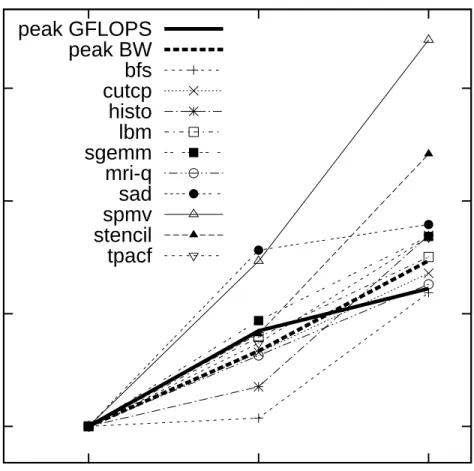
Figure 3.1: Performance of code optimized for each successive GPU genera-tion, plotted against raw throughput and bandwidth scaling for comparison
3.1
Hardware-Software Co-Design Results
We optimized each of the benchmarks for each of the GPU architectures stud-ied, and recorded the speedups achieved by successive architecture genera-tions in Figure 3.1. Because the implementagenera-tions for the earlier generagenera-tions were already optimized around most of the performance cliffs of those archi-tectures, the advances made by successive generations are typically near the increase in raw bandwidth or instruction throughput. Architecture feature improvements with a moderate impact on optimized workload performance include increased register file capacity, which boosted the performance of applications such as SGEMM and SAD in particular because of the exten-sive register tiling of those benchmarks. The performance improvement for register tiled benchmarks came less from the opportunity of additional reg-ister tiling, which reaches asymptotically low incremental benefits and had little impact in practice, but more from the architecture’s ability to increase occupancy for the same degree of register tiling.
The single feature with the most performance impact overall was the global memory cache added in the GTX 480 generation. Even for optimized codes, scratchpad usage can introduce meaningful inefficiencies into the software. That overhead is typically overcome by the performance improvement due to captured locality otherwise unattainable in the absence of a cache, but does put scratchpad at a disadvantage to implicit caches for certain work-loads. Furthermore, the GTX 480’s cache captures what private scratchpads never can: shared locality among different thread blocks and access patterns with irregular locality. The spmv benchmark performance increases for the GTX 480 primarily from the caching of irregular accesses to the dense vec-tor. The stencil benchmark benefits from caching because any memory tiling approach in that benchmark must address the fact that the size of input tile needed to compute an output tile does not match the output tile size. Thread block sizes must be chosen to fit either the input or output tile size, resulting in inefficiencies from idle threads or increased software complexity for explic-itly copying input tiles, respectively. In addition the tile borders overlap with the working sets of other thread blocks, exposing locality that cannot be cap-tured with private scratchpad memory. The version of the stencil benchmark optimized for the GTX 480 actually avoids memory tiling, improving the ef-ficiency of the instruction stream by relying on the cache and thread block
scheduling policy to capture locality. The cache also significantly improves the BFS benchmark’s performance by caching the end of the output queue while threads in a block incrementally add to its tail.
Surprisingly, atomic operations to shared memory had less performance impact than we expected. On further analysis, we found that privatization optimizations had reduced contention on shared memory locations requiring atomic updates to the point that the overhead of our software atomic up-dates, which scales with contention, was not so high as to make hardware assisted atomics indispensable. While our iterative atomic update methods were limited to certain situations, the versions optimized for the 9800 GX2 targeted those situations specifically, resulting in sufficient atomic update performance.
Finally, we note that the BFS benchmark in particular does not scale very well with regards to the number of SMs in the system. The BFS kernel that fills the GPU and performs device-wide barrier synchronizations in certain kernels does not perform as well on the S0170 as on the narrower 9800 GX2 and GTX 480 devices. As it is likely that machine widths will be increasing on average in the future, it seems reasonable to expect that using atomic operations for chip-wide synchronizations will become increasingly inefficient, and should perhaps be avoided if possible.
3.2
Baseline Performance Improvements
Figure 3.2 shows the performance improvement of a single, optimization-agnostic implementation across the different GPU generations, again plot-ted against the raw throughput and bandwidth improvements of the devices themselves. The definition of “unoptimized” is somewhat slippery, because it is always possible to write less efficient code by doing some kind of useless computation. Our philosophy while writing these baseline versions was to write the simplest functional code that seemed reasonable to us. We can-not claim that the baseline versions of all the benchmarks are equivalently unoptimized, but believe we can still learn some useful insights by paying attention to what “inefficiencies” are automatically mitigated or eliminated by particular architectures.