An Adaptive Management Framework To Support
Regional Resource Planning
P. Lawrence a,b J. Bennett a,c and D. Barchiesi a
a CRC Coastal Zone Estuary and Waterway Management, 80 Meieres Road, Indooroopilly, Brisbane, Qld
b Queensland Department of Natural Resources and Mines, Natural Resources Science c Queensland Environmental Protection Agency
Abstract: Adaptive management is the pathway to effective conservation, use and management of Australia’s coastal resources. While the concepts of adaptive management are not new, applications involving both assessment and management responses are indeed limited at the national scale. This paper outlines the components of a systematic, iterative framework for linking existing tools, planning approaches and participatory processes to achieve community partnerships that address the issues of institutional dysfunctionality and uncoordinated management. The Adaptive Management Framework (AMF) developed by the Coastal Zone CRC has six core components: (i) an agreed process and facilitation; (ii) information collation in which stakeholder and research information are continuously pooled to improve an understanding of system functions and find solutions; (iii) systems analysis and vision for context analysis and understanding the ecological and social systems of the catchment, and a process for community aspirations to be expressed as environmental values; (iv) plan making and trade-off analysis for management goals and targets to be established, and social, economic and ecological impacts evaluated to define a preferred strategy; (v) implementation of the necessary actions; and (vi) monitoring and reviewing the effects of the plan against the agreed environmental values, management goals and targets. The framework is hierarchical to allow associated frameworks to be integrated, and represents a construct in which processes, information, decision tools and outcomes are brought together in a structured and transparent way for adaptive catchment and coastal management.
Keywords: Adaptive management; systems approach; natural resource planning 1. INTRODUCTION
Adaptive management can be defined as “a systematic process for continually improving management policies and practices by learning from the outcomes of operational
programs”. The concept is born in the domain
of increasing our understanding of systems as a whole through active participation and learning, evolving experimentation, reviewing and responding. The focus is on action and learning, not in preparing to learn (Lee 1999). Adaptive management is seen as the preferred choice of changed management and policy development when the risk of trial-and-error methods is too high and decisions cannot be postponed while further data are collected given the long timeframes for ecosystem responses. Further objectives and actions (including new scientific research) are then based on improved understanding from the outcomes of monitoring and review. The
adaptive management process therefore assists decision makers to make informed choices on coastal and catchment management actions particularly where integrated knowledge is required. An adaptive management approach is the pathway to effective conservation, use and management of Australia’s coastal waterways. Most natural resource planning and management decisions, however, are surrounded by uncertainty. The difficulties of dealing with uncertainty and complexity arise for a number of reasons, including the time constraints to undertake detailed investigations, that existing data and information are disconnected in time, space and function, or that the knowledge required to fully understand a planning issue can not be assembled from the available pieces of disjointed information. Marshall (1995, p.147) comments on this notion of disconnectedness between the sources and application of
information better than most: “If you don’t synthesise knowledge, scientific journals become spare-parts catalogues for machines that are never built. Until isolated and separated pieces of information are assimilated by the human mind, we will
continue to rattle around aimlessly”.
While accepting that a significant portion of environmental science was conducted using reductionist methods, the challenge is to commence holistic, systems investigations of the way that people interact with their biological and physical environment. The information and learning creates a broader understanding of sustainability and integrating science. An adaptive management approach is ideally suited to linking ecological, social and economic systems, and bringing about a fundamental change in the vision of the catchments in which we live. Folke et al. (2002) promote the concept of resilience, urging us to detach ourselves from a goal of increasing production capacity and reorient towards adaptive capacity as the primary goal in which ecology and society are restored to a balance. Notwithstanding these benefits, adaptive management is time consuming as causal responses are revealed and understood (Walters and Holling 1990), resource intensive and most likely to involve some elements of conflict between participants.
The primary focus of this paper is to advance the concepts of a systematic framework for linking participatory processes, existing tools and planning approaches to achieve community and government partnerships and address the issues of institutional dysfunctionality, uncoordinated management and monitoring, uncertainty in decision making and sub-optimal investments. The Adaptive Management Framework (AMF) presented in this paper is designed to overcome many barriers that have plagued traditional efforts to reach long term collaboration and consensus by taking up the concept of “learning by doing”. To support the concepts, a case study is used to demonstrate the utility of the AMF. The Fitzroy Basin,
covering approximately 150,000 km2 in
Central Queensland (CQ), represents one of the largest catchments under the National Action Plan for Salinity and Water Quality (NAPSWQ) to design, implement and evaluate
a regional natural resource management plan. The current processes and regional arrangements in operation within the CQ Region are examined in relation to the AMF. 2. THE ADAPTIVE MANAGEMENT FRAMEWORK
2.1 Development of the AMF
The Adaptive Management Framework, developed by the CRC for Coastal Zone Estuary and Waterway Management (Coastal Zone CRC), evolved from six frameworks that supported improved decision making in coastal areas. These frameworks are:
(i) National Water Quality Management Strategy (NWQMS) and Queensland activities in implementing the NWQMS (Appendix D3, Bennett et al., 2002);
(ii) Decision Environment (Lawrence et al., 2001);
(iii) Framework for integrating coastal science into planning (Low Choy, 2002);
(iv) Framework for integrating research and management (Ockie Bosch, pers comm.); (v) Management Strategy Evaluation (Smith et al., 1999); and
(vi) Integrated monitoring program using LogFrame (Ron Johnstone, pers comm.). Individually, these frameworks are guides to improve catchment partnerships in developing and implementing their integrated natural resource management plans. By combining their strengths into an adaptive framework for developing and evaluating management actions, there is a greater opportunity for resource management plans to be implemented and supported in the longer term. The AMF recognises that the NWQMS (1994) underpins the National Action Plan and Natural Heritage Trust programs and specifically incorporates the concept of integrated regional natural resource management plans, including targets and performance indicators as measures of effectiveness. Basing the AMF on the NWQMS framework ensures a greater degree of consistency for the development and implementation of resource management plans at the catchment and regional scales. Importantly, the links between the NWQMS and the AMF mean the community is less confused by a ‘forest of frameworks’ and, at
the same time, improves the likelihood of efficient and effective participation by all stakeholders.
2.2 Components
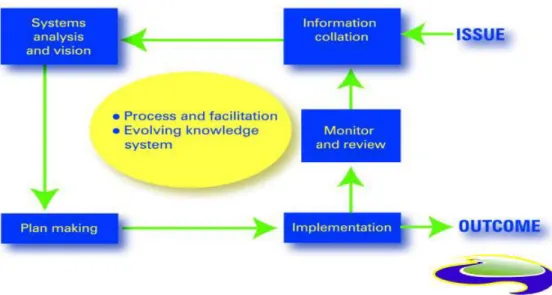
The Adaptive Management Framework comprises six basic components (Figure 1). Each component represents a focused activity with clear outputs, and provides a logical step in the broad framework. The individual components are linked through an on-going, evolving process of actions and responses. A brief description of each component follows.
Core components are a prerequisite for the
iterative planning and management cycle and comprise agreed stakeholder processes for building healthy regional arrangements amongst community, industry and government sectors within the catchment. This core component recognises the principles of trust, negotiation, conflict resolution and an evolving maturity in facilitated decision making processes. In addition, there are actions for developing and implementing an evolving knowledge system and community stewardship.
Information collation, in which information
from stakeholders and on-going research is pooled, commences the AMF cycle. This dynamic integration of information serves several functions, including: defining a broader context of the problem or planning opportunity; refining the understanding of the natural and social systems; identifying knowledge links and gaps; developing better communication between scientists, managers and other resource stakeholders; and scoping options for management solutions. Pooling and communicating information so that it is accessible and understood by all partners is a key step towards building trust.
Systems analysis and vision focuses on
identifying the institutional context and the stakeholders gaining a broad understanding of the catchment systems in order to define their vision and aspirations for the catchment. A
number of participatory processes and engagement tools may be used, including adaptive environmental assessment and management (AEAM) and techniques defined in the CRC Citizen Science Toolbox (See
www.coastal.crc.org.au/toolkit). These
aspirational statements of environmental values should be consistent with the institutional context including current legislation, and the corporate and strategic plans, policies and guidelines of industry, catchment coordinating bodies and government agencies. Stakeholders are encouraged to share their perceptions of the problems, the causes and feasible solutions from their own experiences and based on the best available science. Tools such as influence diagrams and causal-loop systems models are ideally suited for this purpose to construct a ‘mudmap’ of community systems thinking (see Gill, 1998). This phase of the AMF also challenges government agencies to identify and resolve barriers and impediments that prevent institutions from embracing adaptive management. An agreed multi-sector registry of environmental values and aspirational goals is the output from this phase of the AMF.
Plan making is where resource management
goals and targets are established and potential social, economic and ecological impacts are evaluated to negotiate and define a preferred strategy. A range of impact assessment techniques are utilised during this phase of the framework so that data and information are transformed into usable knowledge that lead to strategic positioning and potential solutions. These techniques typically include simulation modelling, multiple objective decision support systems, visualisation of catchment scenarios and social and economic impact assessment techniques. In addition, deliberative qualitative methods, such as a citizens’ jury, can play a strategic role in understanding impacts and choosing a preferred course of action (Robinson et al., 2002). The outcomes from this step of the AMF are agreed goals, targets and management actions that are developed from a base of multi-sourced, transdisciplinary information and knowledge.
Figure 1. Key elements of the Adaptive Management Framework
Implementation of the agreed necessary
actions and assignment of responsibilities follows the plan making. The implementation step includes: agreeing to institutional changes and improved governance for initiating changes to management actions, based on stakeholders’ expectations and responsibilities; the establishment or reinterpretation of relevant legislation, policies, guidelines, codes of practice, licences, and permits; and the allocation of resources, funds, expertise, priorities, timeframes, milestones, performance measures and reporting requirements.
Monitoring and reviewing the effects of the
plan against the agreed environmental values, management goals and targets is essential following the decision to implement. This may involve spatial and temporal evaluation using an integrated monitoring program, and assessment against agreed performance-based targets for management actions and water quality to ensure the community’s expectations for environmental values are being satisfied. The information is continuously pooled to update the shared knowledge base and informed decision making position of the partners.
Outcomes from the monitoring and reviewing are reported, according to processes agreed by the stakeholders, and are subsequently used to determine whether any updating of systems understanding, revision of environmental values, goals or targets and intervention of management actions is warranted. Importantly, these actions must ensure that the health of the catchment is progressing towards the goals and aspirations established at the commencement of the adaptive management process.
3. OPERATION OF THE AMF IN THE FITZROY CATCHMENT
The Fitzroy Basin Association (FBA) is the recognised peak body in the Fitzroy River catchment of Central Queensland and is undertaking the development and implementation of a regional natural resource management plan for the NAPSWQ. The situation represents a multi-sector approach to managing terrestrial, aquatic and coastal natural resources. The assets of the CQ Region include: productive dryland agriculture (predominately grazing), conservation and recreation lands, irrigation, mining, indigenous culture, rural and urban development, port and rail facilities, surface and groundwater
resources, terrestrial and aquatic biodiversity, and water quality for multiple use. Current developments (May 2003) in the catchment which reflect the core components of the Adaptive Management Framework include:
Core Processes: Establishment of FBA
Management Committee involving industry, sub-catchment and indigenous representatives, an NRM Regional Coordination Group supporting dialogue with government agencies, and the establishment of the NRM TaskForce within the Queensland Department of Natural Resources and Mines to assist healthy regional institutional arrangements.
Information Collation and Systems Analysis:
The Central Queensland Strategy for Sustainability (CQSS) has defined the stakeholders’ aspirations and priorities. These aspirations have been advanced through an Information Paper that has assembled and synthesised data and information on resource condition and trends, threatening processes on the critical assets, and recommended targets for future resource conditions and management actions. The Information Paper also supports the processes for setting targets at the catchment and regional level. A pilot interactive regional information system has also been developed
(http://www.coastal.crc.org.au/website/fitzroy/
viewer.htm).
Plan Making and Evaluation: Consultative
community workshops have commenced with each of the 9 catchments to develop resource condition and management action targets. A simplified receiving water and economic model defined through an AEAM process to assess priorities and impacts are available. Quantitative models for land use impacts (Dougall, et al., 2003), and water quantity (IQQM) have also been developed to assist scenario testing. An initial assessment of social and economic dimensions has been undertaken within the National Land and Water Resources Audit and the Information Paper.
Plan Implementation: A Water Resource Plan
is being implemented and the Regional Vegetation Management Plan released for public comment. These two plans and other priority actions plans will link to the regional natural resource management plan.
Monitoring and Evaluation: A framework for
monitoring and evaluation is being developed in conjunction with agency and community representatives.
4. CONCLUDING REMARKS
With the NAPSWQ (and possibly NHT2) redefining the way in which resource management and planning is undertaken within Australia, there is a need for holistic approaches that facilitate the development of partnerships and centralise environmental, social and economic considerations. The Adaptive Management Framework utilises a number of other structured approaches, including the NWQMS, to suggest an improved way for industry, community and government sectors to participate, develop and review coastal resource management plans. At the core of the AMF is the recognition that agreed solutions come from an evolving learning-based model in which the acquisition and sharing of knowledge is used to continuously review and evaluate the implemented management actions. Other steps in the AMF include: the establishment of healthy regional institutional arrangements; processes and tools for systems analysis and understanding; defining an agreed set of goals, objectives and targets for the catchment; using all available sources of information and experiences to identify a preferred management strategy that considers a balanced approach to ecological, social and economic requirements; plan implementation; and monitoring, reporting and an adaptive cycle of review and responsiveness. In practice, the AMF provides an initial guide for multi-sectoral catchment planning groups to establish and maintain constructive dialogue and processes that work towards improving capacity as well as achieving environmental outcomes. To support these groups, an interactive web-based application of the Adaptive Management Framework is now available which describes actions and examples of the individual components being applied for effective and efficient resource planning (http://www.coastal.crc.org.au).
5. ACKNOWLEDGEMENTS
We thank our colleagues: Ockie Bosch, Rob Fearon, John Fien, Ron Johnstone, Don Kerr, Neil Lazarow, Darryl Low Choy, Francis Pantus, Roger Shaw, Tim Smith, Andy Steven, Jan Tilden, Rodger Tomlinson, Lynne Turner and Jess Wallwork for their participation in open discussion workshops and willingness to develop an integrated framework which led to the AMF becoming more than just a concept. 6. REFERENCES
Australia and New Zealand (ARMCANZ) and the Australian and New Zealand Environment and Conservation Council (ANZECC). 1994. National Water Quality Management Strategy, Policies And Principles-A Reference Document. Canberra, Australia: 37pp.
Bennett, J., Sanders, N., Moulton, D., Phillips, N., Lukacs, G., Walker, K. and Redfern, F. 2002, Guidelines for Protecting Australian Waterways, Land & Water Australia, Canberra, 2002: 194pp. Dougall, C., Rohde, K., Carroll, C., Millar, G. and Stevens, S. 2003. An assessment of land management practices that achieve water quality targets set at a Neighbourhood Catchment scale using the SWAT model. MODSIM 2003, Proceedings of the International Congress for Modelling and Simulation, Townsville, Qld, 14-17 July, 2003.
Folke, C. et al. 2002. Resilience and sustainable development: building adaptive capacity in a world of transformations. Background paper for World Summit on Sustainable Development.
www.resalliance.org.
Gill, R. 1998. Malpas Dam Community Catchment Planning, Natural Heritage Trust Malpas Dam Community Catchment Planning Project, Combined Stakeholder Workshop, Thalgarah, 19 June, 1998.
http://members.optusnet.com.au/~rodericg/Malpas Dam/Malpas.html.
Gunderson, L. 1999. Resilience, flexibility and adaptive management – antidotes for spurious certitude? Conservation Ecology 3(1): 7. [online] URL: http://www.consecol.org/vol3/iss1/art7. Lawrence, P.A., Robinson, J. and Eisner, R. 2001. A decision environment: going beyond a decision framework to improve the effectiveness of decision making in natural resource management. Proceedings of the International Congress for Modelling and Simulation, Canberra 10-13 December 2001: 1613-1618.
Lee, K.N. 1999. Appraising adaptive management. Conservation Ecology 3(2): 3.
http://www.consecol.org/vol3/iss2/art3.
Low Choy, D.C., 2003: Cooperative Planning and Management for Regional Landscapes, PhD thesis, The University of Queensland, St Lucia (submitted).
Marshall, A. 1995. in. L. H. Gunderson, C.S. Holling and S.S. Light (eds.) Barriers and Bridges to Renewal of Ecosystems and Institutions. Columbia University Press, New York, New York, USA.
South East Queensland Regional Water Quality Management Strategy 2001.
Smith, A.D.M., Sainsbury, K.J. and Stevens, R.A. 1999. Implementing effective fisheries management systems - management strategy evaluation and the Australian partnership approach. ICES Journal of Marine Science, 56:967-979. Robinson, J., Clouston, B. and Suh, J. 2002. Estimating consumer preferences for water quality improvements using a citizens’ jury and choice modelling: A case study on the Bremer River catchment, South East Queensland. CRC Coastal Zone, Estuaries and Waterway Management Working Paper.
Walters, C.J. 1986. Adaptive Management of Renewable Resources. McMillan, New York, New York, USA.
Walters, C.J. and Holling, C.S. 1990. Large-Scale Management Experiments and Learning by Doing. Ecology, 71: 2060-2068.