University of Nebraska - Lincoln University of Nebraska - Lincoln
DigitalCommons@University of Nebraska - Lincoln
DigitalCommons@University of Nebraska - Lincoln
Library Philosophy and Practice (e-journal) Libraries at University of Nebraska-Lincoln October 2013
Accessing Indigenous Knowledge Resources in Libraries and the
Accessing Indigenous Knowledge Resources in Libraries and the
Problems Encountered by Librarians Managing IK in Oyo State,
Problems Encountered by Librarians Managing IK in Oyo State,
Nigeria
Nigeria
Idowu Adegbilero Adeniyi
Afe Babalola University, Ado-Ekiti, [email protected] Roselyn E. Subair Mrs
Afe Babalola University, Ado-Ekiti, [email protected]
Follow this and additional works at: https://digitalcommons.unl.edu/libphilprac Part of the Library and Information Science Commons
Adeniyi, Idowu Adegbilero and Subair, Roselyn E. Mrs, "Accessing Indigenous Knowledge Resources in Libraries and the Problems Encountered by Librarians Managing IK in Oyo State, Nigeria" (2013). Library Philosophy and Practice (e-journal). 988.
1
Accessing Indigenous Knowledge Resources in Libraries and the Problems
Encountered by Librarians Managing IK in Oyo State, Nigeria
ADENIYI, Adegbilero Idowu Librarian, Medical Library,
Afe Babalola University, Ado-Ekiti. Ekiti State, Nigeria.
SUBAIR, Roselyn E. Librarian,
Afe Babalola University, Ado-Ekiti. Ekiti State, Nigeria.
Abstract
In this era of knowledge economy, a time where it is difficult to ignore any type of knowledge system, it is incumbent on librarians and libraries to reduce the gap between the use of indigenous knowledge owned by local people and the western scientific knowledge. The library for users is a democracy, and there is no reason it should enhance apartheid among knowledge systems and/or resources. LIS professionals all over the world have demonstrated commendable initiatives managing IK though not without attendant challenges. This paper reports the study of how libraries in Oyo State, Nigeria provide access to IK resources and the problems encountered managing them. The descriptive survey was employed. Data was collected using self-designed questionnaire for the project; and analysed using SPSS. It was found that IK resources were not adequately represented in libraries in Oyo State. The study discovered that special, academic and public libraries have differing means by which they provide access to IK resources. While special and academic libraries catalogue and organize their resources, have a separate section created for them within the library public libraries do not. Also, while public libraries network with institutions to share IK resources, special and academic libraries do not. It was moreover found that none of the libraries provide access to IK using public access database nor own a digital library for borderless access to IK resources. Librarians however encounter challenges managing IK. It is however recommended that libraries should up the game in providing access to IK resources.
2
Keywords: Indigenous knowledge, Indigenous knowledge resources, Academic library, public library, Special library, Nigeria
1.0 Introduction
Ranasinghe (2008) defines Indigenous Knowledge (IK) as a corpus of knowledge belonging to a particular geographic area. It is also seen to contrast with knowledge generated within the international system of universities, research institutions and private firms (IK Papers, 2005). It is the unique, traditional and local knowledge existing within and developed around specific conditions of women and men indigenous to particular geographic area (Grenier, 1998). IK comprises of many parts ranging from culture, religion, mythologies, economy, governance, medicine, and agriculture to taboos, poetry, art and crafts and many more. It is often related to oral history, oral archives and oral tradition.
Indigenous Knowledge Systems are thus, the collection of interrelated practices peculiar to people in a specific place. No one indigenous system is superior to the other. Broadly, the knowledge systems include: agriculture, medicine, economy, governance, culture, worship and religion, conservation of natural resources. They are all interrelated and influence the lifestyle of local people
Aina (2004) defines library and information centers as the institutions responsible for the collection, processing and storage of recorded knowledge for the purpose of reading, study and consultation; and the librarian as the professional who is concerned with the collection, storage, processing and dissemination of recorded knowledge in a library. This underlines the management of information and knowledge resources, which Mabawonku (2002) reports to include selection, collection, production, documentation, organization, preservation, dissemination and exchange.
Burtis (2009) reports that, since the 1980s, IK have been a topic of discussion among scholars of anthropology and disciplines related to development studies. Today, there is broadening interest from a variety of fields: ecology, soil science, health, medicine, botany, water resource management and many more. The LIS field has only recently taken note of this important topic of concern. IK is represented in library and archival collections, but often LIS
3
professionals make no attempt to put them into a cultural context. In support of intellectual freedom, librarians skillfully catalogue, digitize and display information so that the public can access it (Burtis, 2009). But indigenous claims for greater protection of indigenous knowledge systems and cultural material lie, albeit perhaps only superficially at right angles to some of the core objectives of libraries and other information services, such as freedom of speech, intellectual freedom, diffusion of knowledge, research and learning, access to information, and preservation of cultural heritage (Wendland, 2008).
But there is so much the LIS professionals can do in the overall management of IK. Mabawonku (2002) remarks that information professional as development agents have definite roles to play in understanding, locating, collecting, interpreting, disseminating and preserving IK. The public library, for instance, has been an appropriate anchor partner in indigenous knowledge system related programmes because of the stability of its position both within the community and within the government structure through which it is established (Greyling& Zulu, 2009). As part of social services, it is well positioned to ensure free and equal access to information and knowledge (Hedelund, 2006). In fact, Adam (2007) reports that, community libraries have shown strong tendency towards preserving local culture in digital and paper formats and promoting exchange of information in many countries, particularly in Latin America.
The International Federation of Library Association (2003) asserts that libraries could help in:
• “collecting, preserving and disseminate indigenous and local traditional knowledge • publicizing the value, contribution, and importance of indigenous knowledge to both
non-indigenous and non-indigenous peoples.”
Burtis (2009) have recommended that Library should diffuse its traditional role of collecting, preserving and providing access not only to materials of scientific origin but to IK resources so as to make all information available. This informs the reason to find out how libraries provide access to IK resources in Nigeria case studying Oyo State.
4
The major focus of this study will be to assess how libraries provide access to IK resources and to determine the problems encountered by librarians managing IK.
1.2 Research Questions
1. Are IK resources well- represented in libraries? 2. How do libraries provide access to IK?
3. Do libraries catalogue, classify and/or organize their IK resources? 4. What are the problems in documenting and managing IK?
2.0Literature Review
2.1 Creation of Access to Indigenous Knowledge.
Scholars have widely reported that the collection of IK would ensure its preservation and thus enhance its eventual use (Mabawonku, 2002; Ranasinghe, 2008). A lot has been done to create access to IK. Today, there are many programme that have been initiated at both national and international levels (Magga, 2005). United Nation Education, Social and Cultural Organization (UNESCO) created the Local and Indigenous Knowledge System (LINKS) in 2002 which works with knowledge holders to promote recognition of their expertise about local environment and reinforce their role in biodiversity governance, Magga reports. It also recognizes the importance of keeping IK alive within local communities by reinforcing its transmission from elders to youth says another scholar.
Access to IK have also been done and IK promoted by documenting it on databases and websites so as to also establish prior existence and deter fraudulent claims of intellectual property (Moahi, 2007). This, Moahi said should be done in consultation with communities where responsibility of putting IK in database is clearly articulated and access issues are taken into consideration and measures put in place to ensure proper use of the IK. In fact, Kiggundu (2007) remarks that, IK documented in digital form is easier to market for the benefit of communities and to prevent unauthorized and surreptitious exploitation. Establishment of networks of IK centers within a country and internationally has been found useful as means of
5
creating global access to IK (Mabawonku, 2002; Msuya, 2007; Ranasinghe, 2008; Warren and Mckiernan, 1995).
Within the library system, Mabawonku reports that state and public libraries could repackage and disseminate IK to literate clients. Non-Literate people in the rural and indigenous communities can also benefit from repacked information through the rural information dissemination activities of public libraries and community information centers. Ranasinghe (2008) reports that some libraries have catalogued palm leaf manuscripts of the IK collection in their libraries noting that it is not sufficient enough as this merely shows the location and not the content of the manuscripts. Mabawonku recommends that at the national level, there should be depository laws guiding the deposit of projects and audiovisual recordings to local or state branches of the National Library of Nigeria.
Warren and McKiernan (1995) reports that every document must be described in accordance with standardized cataloguing procedures; and analoguous cataloguing elements can be identified and assigned to original field descriptions or documents that summarise specific example of IK or its application. Zaid and Abioye (2009) notes that, Libraries usually provide a catalogue to their collection ultimately aimed at making the entire collection accessible and available to reference or loan in accordance with their mission and mandates. Also, all catalogued documents should be fully indexed to provide comprehensive and appropriate access to their content and subject reports Warren and Mckiernan (1995), who equally add that abstracts and connotation can be provided for each document so as to make IK materials become easily accessible to all. And finally, that publication of bibliographies on indigenous knowledge and rural development would equally create access to IK.
2.2Challenges Confronting Libraries Managing Indigenous Knowledge Resources
World Bank (1998) reports that, special efforts are required to understand, document and disseminate IK for preservation, transfer or adaptation elsewhere. IK is mostly tacit or embedded in practices and experiences of the people and it is usually showed through personal communication and demonstration. To this point, recording tacit knowledge, transferring and disseminating it, is therefore a challenge on its own. Moreover, documenting IK requires
6
capacity in terms of skills, expertise and financial resources (Kashweka& Akakandelwa, 2008; Ranasinghe, 2008).
IK faces the critical challenge of scientific validation reports Kashweka and Akakendelwa. IK practitioners are expected to provide documented evidence of the efficacy of their claims in academic journals. However, much of IK is rooted in oral traditions (Mabawonku, 2002; Moahi, 2007; Msuya, 2007, etc.) and is not systematically documented in written form (Magga, 2005). Also, not all aspects of living traditions of IK can be captured as artifacts using technology (Adam, 2007). Such a situation poses some challenges to the libraries that have traditionally been granting access to materials in a site-specific location (Okore, Ekere& Eke, 2009).
Burtis (2009) notes that, there is a discord between LIS professionals and indigenous peoples, remarking that IK and traditional cultural expressions are represented in Library and archival collections, but often LIS professionals make no attempt to put them into a cultural context. “In support of intellectual freedom, we skillfully catalogue, digitize and display information so that the public can access it”, though, a noble goal, Wendland (2008) cited in Burtis (2009) however remarks that indigenous claims for greater protection of indigenous knowledge systems and cultural materials lie, albeit perhaps only superficially, at right-angle to some of the core objectives of libraries and other information services. Moreover, libraries are also facing competition with community structures such as tele-centers which are becoming important platforms for capturing, transferring and giving access to IK (Okore, Ekere& Eke, 2009).
For indigenous communities, IK are not things that exist separately from their culture notes Burtis corroborating the earlier stance of Mabawonku (2002). The discord with LIS systems, however, lies in the orientation of the field toward a scientific topic of information retrieval and information access (Burtis, 2009). Thus, knowledge becomes information, divorced from the context in which it was created (Pyati, 2006 in Burtis, 2009). This process allows indigenous cultural capital to be commodified in the name of intellectual freedom fronted by the LIS profession.
7
And finally, the problem of copyright and intellectual property right can define the limit LIS profession can be involved in the collection, preservation and provision of access to IK (Okore, Ekere& Eke, 2009). Such limitations have been encountered by Libraries in Australia (Anderson, 2005).
3.1Methodology
The descriptive survey research design was adopted for this study. The survey design adopted in this study is a suitable and efficient way of studying large populations because only a sample of the population is used. Therefore, a structured questionnaire was used to gather information regarding use of library for IK resources and provision of access to IK by LIS professionals in libraries in Oyo State, Nigeria.
A non-probability sampling technique (the purposive sampling method) was adopted for the purpose of this study. Two libraries were purposively selected each from the academic, public and special library types. The selected libraries are as given below:
Type of library Library selected Number of library
officers and
professionals Kenneth Dike Library,
UI.
39 Academic
Federal College of Education Library, Oyo
11
NISER Library, Ibadan 8 Special
IITA Library, Ibadan 6
Public Oyo State Library
Board, Dugbe
15
Total 79
8
2. Field Work (2010)
4.0 Results and Discussion
4.1Demographic Information of the Respondents
The demographic information of the respondents was analyzed. It was found that 57.4% of the library and information science (LIS) professionals in the libraries under study are males while 42.6% are females. While 14% hold Diploma/Certificate qualification in Library Science, 47.7% holds a BLIS and 30.8% possess MLIS and higher degrees. Concerning their year of experience in the profession, 24.6% of the respondents have spent less than 5years on the job while 16.4% and 59% have spent between 5-10years and above 10years on the job respectively.
4.2Research Question 1
Are IK resources well- represented in libraries?
From observations and outcome of the interview conducted with some of the library managers within the study area, it was discovered that, IK resources were not adequately represented in libraries in Oyo State. Many LIS professionals were at loss at the meaning of IK.
4.3 Research Question 2
How do libraries provide access to IK? Table 4.1 Provision of access to IK
ACTIVITIES ACADEMIC SPECIAL PUBLIC
Yes No Not Sure Yes No Not Sure Yes No Not Sure
All IK resources in my library can be
consulted and used within the library 63.2 23.9 13.2 54.5 27.3 18.2 33.3 46.7 20 My library catalogues and shelves its IK
resources 61.5 25.6 12.8 61.5 30.8 7.7 26.7 53.3 20
My library prepares abstract and index for
its IK materials 46.2 33.3 20.5 23.1 61.5 15.4 13.3 53.3 33.3 My library has public access database for its
9 My library networks to share its IK
resources with other libraries and other
cultural institutions 26.3 47.4 26.3 18.2 81.8 0 53.3 13.3 33.3 My library has bibliographies on IK
resources 44.7 26.3 28.9 27.3 54.5 18.2 53.3 6.7 40
My library has special section and shelves
for IK resources 60.5 26.3 13.2 54.5 36.4 9.1 13.3 46.7 40 All IK resources in my library can be
consulted and used within the library 64.1 17.9 17.9 72.7 27.3 0 57.1 21.4 21.4 My library loans out IK materials when
necessary and where applicable 34.2 44.7 21.1 63.6 18.2 18.2 42.9 14.3 42.9 There is media equipment to access recorded
IK materials 46.2 30.8 23.1 25 41.7 33.3 46.7 20 33.3
My library keeps a list of all IK materials in
its collection open for public use 51.3 35.6 12.8 33.3 41.7 25 60 6.7 33.3 There is IK digital library maintained by my
library 23.7 52.6 23.7 16.7 50 33.3 13.3 60 26.7
As regards how libraries in Oyo State provide access to their IK collection, Table 4.1 shows that 61.5% of the respondents indicated that academic libraries catalogued and shelved their IK materials. Also, 61.5% of respondents from the special library category indicated that special libraries catalogued and shelved their IK materials. However, 53.3% of the respondents in the public library indicated that public libraries did not catalogue nor shelve their IK resources. This is in agreement with the findings of Ranasinghe (2008).
Whether the library prepares abstract and index for its IK materials, Table 4.1 shows that 46.2% of the respondents from academic library said yes, 33.3% no and 20.5% not sure. With 61.5% and 53.3% of the respondents respectively indicating no, it is drawn that special and public libraries did not prepare abstract and index for their IK materials.
On provision of access using public access database, it is evident that none of the libraries provide access to IK using public access database as shown on Table 4.1 with 43.2%, 58.3% and 60% of the respondents from academic, special and public libraries respectively indicating no.
10
this negate the report of Moahi (2005) that access to IK have also been done and IK promoted by documenting it on databases and websites.
Whether the libraries network to share their IK resources with other libraries and other cultural institutions, Table 4.1 shows that 47.4% indicated no in the academic library category, 81.8% indicated no in the special library category. For public library, 53.3% indicated yes in agreement with the recommendation of Mabawonku (2002) that public libraries can network to share IK. It is quite evident, however, that academic and special libraries did not network to share their IK resources but the public libraries do.
In consonance with previous reports by Warren and McKiernan (1995), academic and public libraries in Oyo State also kept list of IK resources and had bibliographies on IK resources so as to provide easy access to them as shown in Table 4.1 above.
Academic libraries had special sections and shelves for IK materials as 60.5% of the respondent indicated yes according to Table 4.1 so also special libraries with 54.5%. But the table shows that public libraries in the State did not designate special sections or shelves to IK materials. No library in Oyo State maintain digital libraries to provide borderless access to IK as revealed by Table 4.1 although, all the libraries made their IK resources available for consultation and use within the library.
4.4 Research Question 3
Do libraries catalogue, classify and/or organize their IK resources?
It is indicated in Table 4.1 that some of the libraries catalogued and organized their IK collection. While 53.3% indicated that the public libraries did not catalogue their IK resources 61.5% a piece noted that the academic and special libraries did catalogue the resources.
4.5 Research question 4
What are the problems in documenting and managing IK?
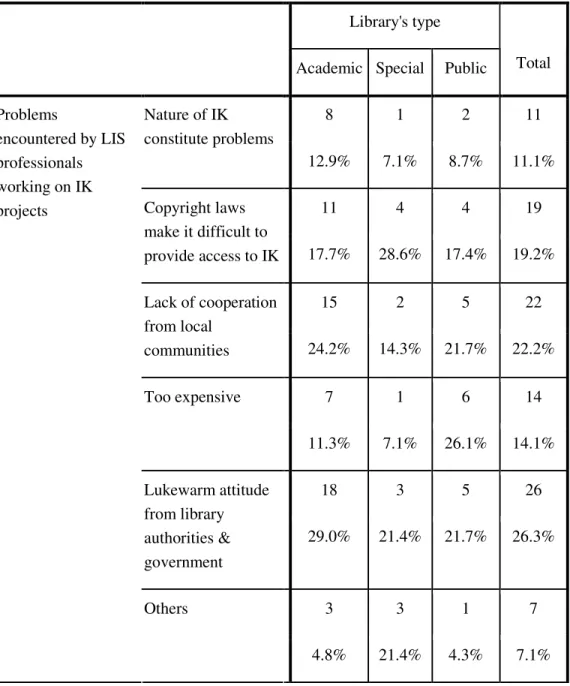
LIS professionals often encounter problems documenting and managing IK; such problems as accounted for by professionals in Oyo State through this study are as revealed in Table 4.2
11
shown below. Lukewarm attitude from library management and government towards IK was largely attributed as the major problem faced by LIS professionals with 26.3% so indicating. Other problems identified are lack of cooperation from local communities (22.2%), difficulty in providing access to IK due to copyright laws (19.2%) and 14.1% accounted that other problems encountered are costliness of the project and the nature of IK itself (11.1%).
Table 4.2 Problems encountered by LIS professionals working on IK projects by Library Type
Library's type
Academic Special Public Total
8 1 2 11 Nature of IK constitute problems 12.9% 7.1% 8.7% 11.1% 11 4 4 19 Copyright laws make it difficult to provide access to IK 17.7% 28.6% 17.4% 19.2% 15 2 5 22 Lack of cooperation from local communities 24.2% 14.3% 21.7% 22.2% 7 1 6 14 Too expensive 11.3% 7.1% 26.1% 14.1% 18 3 5 26 Lukewarm attitude from library authorities & government 29.0% 21.4% 21.7% 26.3% 3 3 1 7 Problems encountered by LIS professionals working on IK projects Others 4.8% 21.4% 4.3% 7.1%
12
62 14 23 99
Total
100.0% 100.0% 100.0% 100.0%
5.0 Conclusion/ Summary
With regards to the provision of access to IK, where academic and special libraries catalogued and shelved their IK collections, public libraries did not. Special and public libraries did not prepare abstract and index for their IK collection. No library in Oyo State has public access database on which their IK content can be accessed. It was also gathered that it is only the public library that network to share its IK resources with other libraries and cultural institutions. While academic and special libraries have separate section and shelves for IK, all the libraries make their IK resources available for consultation and use within the library. However, no libraries in Oyo State maintain digital libraries to provide borderless access to IK.
It was learnt by this study that all the academic and special libraries catalogue and organizes their IK resources while public libraries do not.
Libraries do however encounter problems in documenting and managing IK. Lukewarm attitude from library management and government towards IK was largely attributed as the major problem faced by LIS professionals. Other problems identified through the study are: lack of cooperation from local communities, difficulty in providing access to IK due to copyright laws, costliness of the project and the nature of IK itself.
It is therefore recommended that while the government and all stakeholders should play their roles well to minimize the problems stated above, LIS professionals in Oyo State and Nigeria should consider ICT using connected databases and digital libraries to provide borderless access to IK resources.
References
Adam, L. (2007). Information and Communication Technologies, Knowledge Management and Indigenous Knowledge: Implications to livelihood of Communities in Ethiopia. Retrieved from
13
http://www.eictda.gov.et/.../knowledge_management_and_indigenous_knowledge.doc on April 20, 2010.
Aina, L.O. (2004). Library and Information Science Text for Africa. Ibadan: Third World Information Services
Burtis, A. (2009). Managing Indigenous and Traditional Cultural Expressions: Is Technology the
Solution? Retrieved from
http://www.lis661.pbworks.com/cultural+property:Melissa+Allen+-+traditional+cultural+expressions+and+IP. December 05, 2009
Grenier, L. (1998). Working with indigenous knowledge a guide for researchers. Ottawa; IDRC Indigenous knowledge pages. http://www.ik.ik-pages.net
Greyling, E. and Zulu, S. (2009). Content Development in an Indigenous Digital Library: a case study in community participation. Being a paper presented at World Library and Information Congress: 75th IFLA General Conference and Council 23 – 27 August, 2009, Milan, Italy. Retrieved from http://www.ulwazi.org/index.php/publications/html on February 2, 2010.
International Federation of Library Associations. (2003). IFLA Statement on Indigenous and Traditional Knowledge, IFLA Newsletter, No. 42, June 2003
Kashweka, K. and Akakandelwa, A. (2008). Indigenous Knowledge and the attainment of MDGs in Africa: opportunities and challenges. Proceedings of the 18th Standing Conference of Eastern, Central and Southern African Library Associations. 15th-18th July, 2008, Lusaka, Zambia
Kiggundu, J. (2007). Intellectual Property Law and the Protection of Indigenous knowledge. In: Mazonde, I. and Thomas, P. indigenous knowledge system and intellectual Property in the Twenty-first century perspectives from Southern Africa. CODESRIA, University of Botswana and World Association for Christian Communication.
14
Mabawonku, I.M. (2002). The systematic management of indigenous knowledge: a review of oral information projects in a library school. Proceedings of the SCECSAL 2002, From Africa To The world- the Globalization of Indigenous Knowledge Systems. 15-19 April, 2002. South Africa.
Magga, O.H. (2005). Indigenous Knowledge systems- the true roots of humanism. Being a paper presented at the World Library and Information Congress. 71th IFLA General Conference and Council on 14th-18th August, 2005, Oslo, Norway.MaRhea, Z. 2004. Documentation, ownership and inclusion issues regarding traditional knowledge in western-based education. Being a paper presented at AARE conference, Melbourne 2004. Retrieved from http://www.aare.edu.au/04pap/mar049556.pdf on March 25, 2010
Moahi, K.H. (2007). Globalization, knowledge, Economy and the implication for indigenous knowledge: International Review of Information Ethics (7) 09/2007
Mosimege, M. (2005). Indigenous knowledge systems policy in South Africa: development of digital libraries and implications for benefit sharing and intellectual property. Presentation made at the Commons-Sense Conference, Johannesburg, May 27, 2005. Retrieved from http://www.commonssense.org/presentation/mosimege/Mosimege.pdf on June 02, 2007
Msuya, J. (2007). Challenges and Opportunities in the protection and preservation of indigenous knowledge in Africa.International Review of Information Ethics (7). Retrieved from
http://www.i-r-i-e.net/inhalt/007/38-msuya.pdf in November 2009
Okore, A.M., Ekere, J.N. and Eke, H.N. (2009). Promoting Access to Indigenous Knowledge inthe Digital Age: Libraries as Facilitators. Paper presented at 47th Annual National Conference and AGM, Nigerian Library Association, 26-31 July, 2009. Ibadan, Oyo State
Ranasinghe, P. (2008). Preservation and Provision of Access to Indigenous Knowledge in Sri Lanka. World Library and Information Congress: 74th IFLA General Conference and Council, 10-14 August 2008, Quebec, Canada. Retrieved November 27, 2009, from
15
Warren, D. M., and McKiernan, G. (1995). CIKARD: a global approach to documenting indigenous knowledge for development. In D. M. Warren, L. J. Slikkerveer& D. Brokensha (Eds.), The cultural dimension of development: indigenous knowledge systems (pp. 426-434). London: Intermediate Technology Publications
Wendland, W. (2008). Libraries, Intellectual Property and Traditional Cultural Expressions: Balancing Access and Control. Available at http://wo.ala.org/tce/wp-content/uploads/2008/10/wendland-keynote-american-library-association-final-nov-12-08.pdf
World Bank, (1998). Indigenous Knowledge for development. A framework for Action.Washington D.C. the World Bank. Retrieved from http://www.worldbankory/html/afr/ik
Zaid, Y. and Abioye, A. (2009). Museums, Libraries and archives; collaborating for the preservation of heritage materials in Nigeria. Being a paper presented at the World Library and Information Congress. 75th IFLA General Conference and Council on 23-27 August, 2009, Milan, Italy