Procedia Computer Science 84 ( 2016 ) 14 – 21
1877-0509 © 2016 The Authors. Published by Elsevier B.V. This is an open access article under the CC BY-NC-ND license (http://creativecommons.org/licenses/by-nc-nd/4.0/).
Peer-review under responsibility of the Organizing Committee of IHCI 2015 doi: 10.1016/j.procs.2016.04.060
ScienceDirect
7th International conference on Intelligent Human Computer Interaction, IHCI 2015
Optimal Spatio-Spectral Variable Size Subbands Filter For Motor
Imagery Brain Computer Interface
Jyoti Singh Kirar
a,∗, R. K. Agrawal
aaJawaharlal Nehru University, New Delhi-110067, India
Abstract
Common spatial pattern (CSP) is a commonly used feature extraction technique for motor imagery brain computer interface. CSP provides poor performance when features are extracted from unfiltered or irrelevant frequency band filtered data. In order to overcome this problem, Subband CSP (SBCSP) and Filter Bank CSP (FBCSP) have been proposed in literature to extract features from several fixed size subbands. However, both SBCSP and FBCSP require manually fixing the size of subbands to obtain higher performance. In this paper, we propose a method that obtains features from many variable size subbands within a given frequency band using CSP. Further, Euclidean distance measure is used to obtain the relevant features. The efficacy of the proposed method is evaluated in terms of classification error on BCI Competition III dataset IVa and BCI competition IV dataset Ia. Experimental results demonstrate that the proposed method achieves better performance in comparison to CSP, SBCSP and FBCSP.
c
2015 The Authors. Published by Elsevier B.V.
Peer-review under responsibility of the Scientific Committee of IHCI 2015.
Keywords: motor imagery; common patial patterns; brain computer interface; support vector machine; feature extraction;
1. Introduction
A Brain computer interface (BCI) interprets neuronal activity to derive user commands and thus creates a direct communication pathway between a brain and a device without involving the brains conventional output pathways such as muscles or peripheral nerves1. The electrical signals occurring in the brain due to neuronal activity carry informa-tion for the purpose of communicainforma-tion with a computing device. It has been of profound interest to many researchers due to its extensive applicability in medical and industrial field. The main objective of a BCI is to help a person with intense motor disabilities to control devices such as computers, speech synthesizers, assistive appliances and neural prostheses2which can provide fast information communication. For the analysis of brain signals, machine learning approaches and signal processing techniques have been considered of extreme importance. EEG brain signals are used widely for analysis of brain states due to their low measurement cost, high temporal resolution and non-invasive nature. An increased attention is observed for an EEG based motor-imagery paradigm which involves thinking or imagination of movement of a specific body part. Imagination or execution of limb movement induces variations in rhythmic activity recorded over Sensorimotor Cortex7called Sensorimotor Rhythms (SMRs), which can be detected
∗Corresponding author. Tel.:+91 9582559137
E-mail address:[email protected]
© 2016 The Authors. Published by Elsevier B.V. This is an open access article under the CC BY-NC-ND license (http://creativecommons.org/licenses/by-nc-nd/4.0/).
on the scalp by EEG. The amplitude of SMRs decreases during motor execution or imaginary. This decrease in rhyth-mic activity is called as Event-Related Desynchronization (ERD) and increase in the rhythrhyth-mic activity immediately after the movement is called as Event-Related Synchronization (ERS)1,3,4,5.
Raw EEG signals suffer from weak spatial resolution due to volume conduction1,6. This becomes a problem when the relevant signals are weak while in the same frequency band, other irrelevant sources (artifacts) produce strong signals. For single trial EEG analysis, system is calibrated to the specific characteristics of each user by calculating subject specific spatial filters. These spatial filters are designed in a way that the variances of the out-coming signals carry the most discriminating information.
As a data-driven technique, CSP3technique is one of highly successful spatial technique which helps in estimating spatial filters to analyze multichannel data in motor imagery BCI. The goal of this technique is to find the spatial filters from a linear combination of a multichannel signal which maximizes variance for one class and minimizes variance for the second class simultaneously3,6,7. The spatial filters obtained are applied to relevant frequency bands (αandβbands) data to obtain features. These discriminative frequency bands are subject-specific in nature. If CSP spatial filter is applied to an EEG signal filtered using an irrelevant frequency band, the extracted features will give poor performance. Hence, frequency band selection is an important issue to be handled. Exhaustive search and manual tweaking can help in learning the best bands, but being time consuming, are not suggested. Also, there is no standardized technique for selecting the best frequency bands. The major problem in CSP is tuning of BCI device for every subject as the rhythmic patterns ofαandβrhythms varies from subject to subject. The presence of artifacts and the non-stationary nature of an EEG trial data may further deteriorate the performance of CSP8,9,10. More recently research has been focused on finding spatial patterns from a filter bank of non-overlapping fixed sized subbands. Subband CSP (SBCSP)11has been used to analyze motor imagery data using different fixed sized subbands. Filter bank CSP (FBCSP)12allows analysis of CSP technique by applying it on different frequency bands filtered EEG based on maximal mutual information criterion.
However, both SBCSP and FBCSP require manually fixing the size of subbands to obtain higher performance. Also, these methods do not explore variable size subbands present in a given frequency band, which may further improve the performance of motor imagery based BCI. In order to obtain relevant subbands, we propose a method that obtains features from many variable size subbands with in a given frequency band using CSP. The proposed method involves the following five phases: (i) generation of variable sized frequency subbands and bandpass filtering of raw EEG signals using these subbands, (ii) Features are obtained from each of these subbands filtered data using CSP, (c) CSP features from each subband are then evaluated to obtain bandscore using linear discriminant analysis, (d) Obtained band scores are ranked using Euclidean distance measure, (e) learning a decision model on obtained higher ranked features.
The performance of the proposed method is evaluated on publicly available BCI Competition III dataset 4a and BCI competition IV dataset Ia in terms of classification error and compared with existing methods. Experimental results demonstrate that the proposed method achieves better performance in comparison to CSP, SBCSP and FBCSP. The major contributions of this paper include (a) to provide with an algorithm that can automatically generate all the variable size subbands present within a given frequency band (b) to provide a more robust feature selection method to remove irrelevant frequency bands (c) to analyze the behavior of the proposed method of feature extraction using linear (LDA) as well as non-linear (SVM) classifier (d) to compare the performance of the proposed method on the publically available datasets.
Rest of the paper is organized as follows. Section 2 discusses existing spatial filters based feature extraction techniques. The detailed description of the proposed scheme of feature extraction is given in Section 3. Section 4 includes experimental results. Finally, Section 5 concludes the article and provides some future research directions.
2. Related Works
2.1. Common Spatial Patterns (CSP)
Given the recordings from two class distributions, the goal of CSP is to find the spatial filters from a linear combi-nation of a multichannel signal3which maximizes variance for one class and minimizes variance for the second class simultaneously. To achieve this, spatial patterns are determined using simultaneous diagonalization of the
covari-ance matrices of the EEG signals from data of each class which can be solved by maximizing the following Raleigh criterion9,13: R(w)= W TΣ 1W WT{Σ 1+Σ2}W (1) whereΣ1andΣ2are normalized average covariance matrices of class 1 and class 2 respectively. Equation (1) can be solved by reformulating it into the following constrained optimization problem:
max w W TΣ 1W (2) such that WT{Σ1+Σ2}W−I=0 (3)
For a given EEG trialX, the transformed matrixZis given as:
Z=WX (4)
Feature vector fpare calculated using : fp=log ⎛ ⎜⎜⎜⎜⎜ ⎝2varr (Zp) p=1var(Zp) ⎞ ⎟⎟⎟⎟⎟ ⎠ (5)
whereZpare the first and lastrrows of transformed matrixZ. In literature7, it is shown thatr=1 orr=2 is a good choice and including more spatial patterns does not lead to further improvement in accuracy. In this work, we have usedr=1. Hence, we obtain two features for each trial.
2.2. Subband CSP (SBCSP)
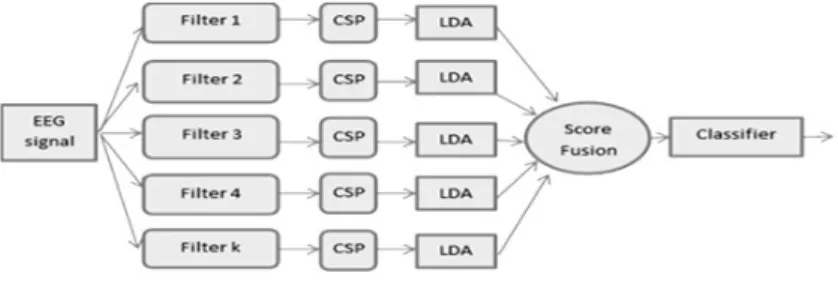
It is very crucial that CSP be applied to optimally filtered signals. More recently, research has been focused on finding spatial patterns from a filter bank of non-overlapping fixed bandwidth of predefined subbands. Sub-band Common Spatial Pattern (SBCSP) method proposed by Novi et al. (2007)11make use of these subbands filtered EEG signals to derive features from all subbands as shown in Figure 1. First, a filter bank is used to decompose the raw EEG signals intoksubband EEG signals. CSP is then applied to each subband. This gives the transformed signal for kthsubband as:
Zk =WkCS PXk (6)
The CSP features defined from first and lastrrows ofZkforkthsubband are given as fk p=log ⎛ ⎜⎜⎜⎜⎜ ⎝ var(Z k p) 2r p=1var(Zkp) ⎞ ⎟⎟⎟⎟⎟ ⎠where p=1, . . . , 2r (7)
CSP features from each subband are then fed to Linear Discriminant Analyser which determines a projection matrix Wldathat maximizes inter class varianceSBand minimizes intra class varianceSWgiven by
SkB=(mk2−m1k)(mk2−mk1)T (8) and SkW = fk p∈1 (fkp−mk1)(fkp−mk1)T+ fk p∈2 (fkp−mk2)(fkp−mk2)T (9) wheremk1andmk2are means of class 1 SBCSP features and class 2 SBCSP features forkthband respectively. The cost function forkthsubband is given by
Jk= W k lda T Sk BWklda Wk lda T Sk WWklda (10)
Thekthsubband score is defined as
sk=WkldaTfkp (11)
The scoresgive a k-dimensional feature vector [s1,s2, . . .sk]Tcorresponding to each trial. It uses Support Vector Machine based Recursive Band Elimination14to rank the subbands. The score from best ranked subbands are fused incrementally. Finally, a decision model is developed using these features.
Fig. 1. Subband CSP
2.3. Filter Bank CSP (FBCSP)
FBCSP12is similar to SBCSP except that maximal mutual information criterion is used for selection of optimal spatio-temporal filters.
SBCSP and FBCSP use a fixed size bandwidth for each frequency band. Thus, they do not explore other relevant subbands that may be present in a given range of frequency band. However, use of inappropriate subbands may provide inferior performance. Also, the spectral and spatial filters are estimated separately in these methods. 3. Proposed Combined Variable Sized Common Spatial Patterns method (CVSCSP)
The proposed method CVSCSP involves five phases as shown in Figure 3. 3.1. Frequency Band Generation and Bandpass Filtering:
In the first phase, variable sized subbands of a given frequency band are generated by defining a frequency range, the minimum size of each band and the frequency granularity i.e. the distance between the central frequencies of two adjacent bands. These set of small frequency bands act as subband filters. The proposed method explicitly does not require knowledge of relevant subbands to distinguish two different brain tasks. For example, different subbands generated for a given frequency range (7-32 Hz), minimum bandwidth of 5 Hz, and a granularity of 5 Hz is shown in Figure 2. These set of bands act as variable sized overlapping subband filters and EEG signal is then band pass filtered using each of these variable sized subband filters.
3.2. CSP and LDA analysis:
In the second phase, features are extracted using CSP from each of these variable sized subband filtered EEG signals. In the third phase, scores to each subband are assigned using linear discriminant analysis of the extracted CSP features which are then concatenated to form a score based feature vector.
3.3. Feature Selection/Ranking
The feature vector so obtained may contain features from irrelevant subbands for a given motor imagery task. Hence, the performance of the proposed method may deteriorate in the presence of these irrelevant features.The
Fig. 2. Different subbands generated for a given frequency range (7-32 Hz), minimum bandwidth (5 Hz.) and granularity (5 Hz.)
reduced relevant set of features will provide less classification error and will require less memory and computation time to build the learning model. Thus in the fourth phase, feature are ranked using Euclidean distance measure. Euclidean distance between two classesc1andc2corresponding to the inclusion ofkthfeature in a (k−1) feature subset is given by:
D12(Xks)12=
(μk
1−μk2)(μk1−μk2)T (12)
whereμk
i is the mean of k-dimensional feature vectors of classesci(i=1,2). For a selected subset of k features,Xsk, the high value ofD12characterizes that the two classes are well separable.
3.4. Classification
In the final phase, the ranked features are classified using two well-known classifiers namely Support Vector Ma-chine and Linear discriminant Analysis separately.
Fig. 3. Flow Diagram of CVSCSP
4. Experimental Setup and Results
Following datasets have been used in our experiments: BCI competition III dataset IVa:
The dataset belongs to Fraunhofer FIRST (Intelligent Data Analysis Group) and Campus Benjamin Franklin of the Charite - University Medicine Berlin (Department of Neurology, Neurophysics Group). It is composed of motor Imagery EEG signals arised from right hand and right foot movement imagination. The signals measured belongs to five healthy subjects named asaa, al, av, awanday. The dataset consisted of signals of 280 trials for each subject
measured using 118 EEG channel positions of the extended international 10/20 electrode montage system. The subject was provided with a visual cue shown for 3.5 seconds for the duration of each trial. The captured EEG signal data was preprocessed using a bandpass filter of 0.05-200 Hz and then fed to digitization at 1000 Hz with 16 bits and downsampled at 100 Hz. Between two adjacent experiments, a resting window from 1.75-2.25 sec was randomly taken.
BCI competition IV dataset Ia:
The dataset belongs to the Berlin BCI group: Berlin Institute of Technology (Machine Learning Laboratory) and Fraunhofer FIRST (Intelligent Data Analysis Group) and Campus Benjamin Franklin of the Charit University Medicine Berlin, Department of Neurology, Neurophysics Group. The signals measured belongs to seven healthy subjects named asds1a, ds1b, ds1c, ds1d, ds1e, ds1f andds1g. The dataset consisted of signals of 200 trials for each subject measured using 59 EEG channel positions of the extended international 10/20 electrode montage system. The subject was provided with a visual cue shown for 4 seconds for the duration of each trial. Two classes of motor imagery were selected from the three classes left hand, right hand, and foot for each subject. The dataset from each subject is bifurcated into two categories: Calibration Data and Evaluation Data. The captured EEG signal data was bandpass filtered between 0.05 and 200 Hz and then digitized at 1000 Hz with 16 bit and downsampled at 100 Hz. Between two adjacent experiments, a resting window from 2-4 sec was randomly taken.
In our experiment, the data captured for each trial belongs to the time window of 0.5-2.5 sec after the onset of stimulus is used. It yields a total of 100×2 time units in a trial or an EEG signal matrix of 118×200 per trial. SVM and LDA are used as classifiers in the proposed model. Features are included incrementally in the order of their rank obtained using the Euclidean distance measure. We have used 10-fold cross-validation and run 10 times to evaluate the model. Matlab 2013a has been used for conducting all the experiments. The performance of the proposed model CVSCSP is measured in terms of average classification error and compared with existing methods such as CSP, SBCSP and FBCSP. For SBCSP, FBCSP and CVSCSP, bandwidth (bw) of 4 Hz is considered for performance evaluation. In CVSCSP, granularity value of 4 is used for bw=4 . Experimental results of CSP, SBCSP, FBCSP and CVSCSP methods for LDA and SVM classifiers for BCI competition III dataset IVa are shown in Table 1 and 2 respectively. Experimental results of CSP, SBCSP, FBCSP and CVSCSP methods for LDA and SVM classifiers for BCI competition IV dataset Ia are shown in Table 3 and 4 respectively.
The following can be observed from Table 1 and 2:
• The performance of the proposed model CVSCSP is better in comparison to FBCSP, SBCSP and CSP for both classifiers SVM and LDA in terms of average classification error.
• In comparison to CSP, the performance of the SBCSP is better with LDA classifier and the performance of FBCSP is better using both classifiers.
• The performance of the SBCSP depends on the choice ofbwand the classifier.
• The performance of all the methods CSP, SBCSP, FBCSP and CVSCSP is subject dependent. Table 1. Comparison of classification error of different methods
using LDA classifier at a bandwidth bw=4 Hz for BCI Competi-tion III dataset 4a.
Subject CSP SBCSP FBCSP CVSCSP aa 0.23 0.16 0.16 0.13 al 0.1 0.02 0.03 0.03 av 0.35 0.26 0.35 0.27 aw 0.14 0.15 0.07 0.14 ay 0.2 0.36 0.33 0.23 Mean error 0.2 0.19 0.19 0.16
Table 2. Comparison of classification error of different methods using SVM classifier at a bandwidth bw=4 Hz for BCI Competi-tion III dataset 4a.
Subject CSP SBCSP FBCSP CVSCSP aa 0.23 0.19 0.19 0.15 al 0.1 0.01 0.01 0.01 av 0.33 0.28 0.26 0.28 aw 0.16 0.22 0.07 0.13 ay 0.15 0.35 0.37 0.15 Mean Error 0.19 0.21 0.18 0.14 Similar observations can be obtained for BCI competition IV dataset Ia from Table 3 and 4
• The performance of the proposed model CVSCSP is better in comparison to FBCSP, SBCSP and CSP for both classifiers SVM and LDA in terms of average classification error.
• Performance of CSP is better in comparison to SBCSP and the performance of FBCSP is better in comparison to CSP and FBCSP.
• The performance of all the methods CSP, SBCSP, FBCSP and CVSCSP is subject dependent Table 3. Comparison of classification error of different methods
using LDA classifier at a bandwidth bw=4 Hz for BCI competition IV dataset Ia. Subject CSP SBCSP FBCSP CVSCSP ds1a 0.25 0.3 0.27 0.33 ds1b 0.33 0.47 0.45 0.41 ds1c 0.3 0.36 0.26 0.2 ds1d 0.21 0.12 0.1 0.09 ds1e 0.14 0.12 0.17 0.08 ds1f 0.17 0.21 0.19 0.18 ds1g 0.22 0.09 0.07 0.08 Mean error 0.23 0.24 0.22 0.2
Table 4. Comparison of classification error of different methods using SVM classifier at a bandwidth bw=4 Hz for BCI competition IV dataset Ia. Subject CSP SBCSP FBCSP CVSCSP ds1a 0.27 0.3 0.28 0.3 ds1b 0.35 0.47 0.45 0.41 ds1c 0.3 0.41 0.25 0.19 ds1d 0.23 0.2 0.12 0.09 ds1e 0.17 0.16 0.19 0.1 ds1f 0.17 0.24 0.2 0.18 ds1g 0.21 0.11 0.09 0.08 Mean error 0.24 0.27 0.23 0.19 5. Conclusion
EEG based BCI are used widely due to their non-invasive nature and low cost. Among the different paradigms of EEG based BCI, motor imagery has ubiquitously been employed to generate brain signals. CSP is a popular and commonly used feature extraction technique from motor imagery brain EEG signals for BCI. In CSP, time related variations and correlation among frequency bands are not captured well. Hence major problem in CSP is selection of most appropriate band to achieve better performance of BCI. Also, tuning of BCI device for every subject is cumbersome as the rhythmic patterns of and rhythm varies from subject to subject. The other variants of CSP include SBCSP and FBCSP which involves dividing the whole frequency band into many subbands of fixed size. Due to the use of fixed size subbands, other more relevant variable sized frequency bands cannot be figured out, thus leading to degraded performance. To capture this relevant information, we have proposed CVSCSP method that explores variable size subbands and Euclidean distance measure to extract relevant features. To check the efficacy of the proposed model CVSCSP, BCI Competition III dataset IVa is used. The performance is evaluated in terms of classification error. Experimental results show that the proposed method CVSCSP attains high classification performance in comparison to CSP and SBCSP.
Since the classification performance achieved by the proposed method depends on the choice of parameters such as bandwidth and granularity. In future, we will attempt to resolve the problem of tuning these parameters. In the present study, we have investigated only univariate feature selection method. The proposed method can be investigated with multivariate feature selection methods, which do not consider redundant features, to improve the performance further.
References
1. Wolpaw JR, Birbaumer N, McFarland DJ, Pfurtscheller G, Vaughan, TM. Braincomputer interfaces for communication and control.Clinical neurophysiology2002;113(6): 767-791.
2. Bashashati A, Fatourechi M, Ward RK, Birch G E. A survey of signal processing algorithms in brain-computer interfaces based on electrical brain signals.J. Neural Eng.2007;4( 2): R32-R57.
3. Muller-Gerking J, Pfurtscheller G, Flyvbjerg H. Designing optimal spatial filters for single-trial EEG classification in a movement task.Clinical Neurophysiology1999;110( 5): 787-798.
4. Pfurtscheller G, Neuper C. Motor imagery and direct brain-computer communication.Proceedings of the IEEE2001 ;89(7): 1123-1134. 5. Beisteiner R, Hllinger P, Lindinger G, Lang W, Berthoz A. Mental representations of movements. Brain potentials associated with imagination
6. Wolpaw JR, Wolpaw EW. Brain-computer interfaces: principles and practice.Oxford University PressOxford; 2012.
7. Dornhege G, Millan JdR, Hinterberger T, McFarland D, Muller KR, Eds. Toward Brain-Computer InterfacingThe MIT Press2007.
8. Blankertz B, Tomioka R, Lemm S, Kawanabe M, Muller KR. Optimizing spatial filters for robust EEG single-trial analysis.Signal Processing Magazine, IEEE2008;25(1):41-56.
9. Grosse-Wentrup M, Schlkopf B, Hill J. Causal influence of gamma oscillations on the sensorimotor rhythm.NeuroImage2011;56(2): 837-842. 10. Samek W, Vidaurre C, Mller KR, Kawanabe M. Stationary common spatial patterns for braincomputer interfacing.Journal of neural
engineer-ing2012;9(2): 026013.
11. Novi Q, Guan C, Dat T H, Xue P. Sub-band common spatial pattern (SBCSP) for brain-computer interface.In Neural Engineering, CNE’07. 3rd International IEEE/EMBS Conference2007: 204-207.
12. Ang KK, Chin ZY, Zhang H, Guan C. Filter bank common spatial pattern (FBCSP) in brain-computer interface.In Proceedings of The 2008 International Joint Conference on Neural Networks (IJCNN)2008: 2390-2397.
13. Ramoser H, Muller-Gerking J, Pfurtscheller G. Optimal spatial filtering of single trial EEG during imagined hand movement.IEEE Transac-tions on Rehabilitation Engineering2000;8(4): 441-446.
14. Guyon I, Weston J, Barnhill S, Vapnik V. Gene selection for cancer classification using support vector machines.Machine learning2002; 46(1-3): 389-422.