Using the Continuous-Time Quantum Walk
Lu Bai1, Edwin R. Hancock1,, Andrea Torsello2, and Luca Rossi2
1 Department of Computer Science, University of York, UK
{lu,erh}@cs.york.ac.uk
2 Ca’ Foscari University of Venice, Italy
{torsello,lurossi}@dsi.unive.it
Abstract. In this paper, we use the quantum Jensen-Shannon diver-gence as a means to establish the similarity between a pair of graphs and to develop a novel graph kernel. In quantum theory, the quantum Jensen-Shannon divergence is defined as a distance measure between quantum states. In order to compute the quantum Jensen-Shannon di-vergence between a pair of graphs, we first need to associate a density operator with each of them. Hence, we decide to simulate the evolution of a continuous-time quantum walk on each graph and we propose a way to associate a suitable quantum state with it. With the density op-erator of this quantum state to hand, the graph kernel is defined as a function of the quantum Jensen-Shannon divergence between the graph density operators. We evaluate the performance of our kernel on several standard graph datasets from bioinformatics. We use the Principle Com-ponent Analysis (PCA) on the kernel matrix to embed the graphs into a feature space for classification. The experimental results demonstrate the effectiveness of the proposed approach.
Keywords: Graph Kernels, Continuous-time Quantum Walk, Quantum Jensen-Shannon Divergence.
1
Introduction
There has been an increasing interest in learning graph structures using graph kernels. A graph kernel is usually defined in terms of a similarity measure be-tween graphs [1]. To extend the large spectrum of kernel methods from the vec-torial domain to the graph domain, Haussler [2] proposed a generic way, named R-convolution, to define a kernel between two graphs by decomposing them and measuring the pairwise similarities between the resulting substructures. For example, Kashima et al. [3] proposed a graph kernel where they compute the number of matchings random walks in a pair of graphs. Borgwardt et al. [4] proposed a shortest path kernel where they enumerate the shortest paths which possess the same length. Shervashidze et al. [5] developed a subtree kernel on limited size subtrees where they iteratively update the vertex labels in a pair
Edwin R. Hancock is supported by a Royal Society Wolfson Research Merit Award.
W.G. Kropatsch et al. (Eds.): GbRPR 2013, LNCS 7877, pp. 121–131, 2013. c
of graphs, and then count the numbers of matching vertex labels between pairs of subtrees in the two graphs. The main feature of these graph kernels is that they usually share the exploit the topological information on the arrangement of vertices and edges in a graph. An attractive alternative kernel measure between a pair of graphs is based on measuring the mutual information using the classical Jensen-Shannon divergence. In probability theory, the classical Jensen-Shannon divergence is a similarity measure between probability distributions, and it is symmetric, always well defined and bounded [6]. In [7], we have used the clas-sical Jensen-Shannon divergence to define a Jensen-Shannon kernel for graphs. Here, the Jensen-Shannon kernel between a pair of graphs is defined using the classical Jensen-Shannon divergence between some suitably defined probability distributions over the vertices of the graphs. Since the entropy associated with a probability distribution of a graph can be directly computed without the need of decomposing the graph, the Jensen-Shannon kernel, unlike the aforementioned graph kernels, avoids the computational burdensome of comparing the similari-ties between all the pairs of substructures of the graphs.
To develop the work in [7] further, we aim to extend the classical Jensen-Shannon divergence measure of graphs into the context of quantum theory by using the quantum Jensen-Shannon divergence [6,8], and then use this as a means of defining a novel graph kernel. Unlike the classical divergence, which is defined as a similarity measure between probability distributions, the quantum Jensen-Shannon divergence is introduced in quantum theory as a distance measure between quantum states, where a quantum state is described by its density op-erator [8]. In order to compute the quantum Jensen-Shannon divergence between a pair of graphs, we first need to associate a quantum state with each graph. To this end, we propose to define a mixed quantum state which is based on the evolution of a continuous-time quantum walk on each graph.
Recently, the continuous-time quantum walk has been introduced as the nat-ural quantum analogue of the classical random walk by Farhi and Gutmann in [9]. Similarly to the classical random walk on a graph, its state space is the set of vertices of the graph. However, unlike the classical random walk, whose state vector is real-valued and whose evolution is governed by a double stochastic ma-trix, the state vector of the continuous-time quantum walk is complex-valued and its evolution is governed by a time-varying unitary matrix. The continuous-time quantum walk possesses a number of interesting properties which are not exhib-ited by the classical random walk. For instance, the continuous-time quantum walk is reversible and non-ergodic, and does not have a limiting distribution. Hence, the continuous-time quantum walk can offer us an elegant way to de-sign quantum algorithms on graphs which have some interesting properties. For further information on quantum walks, we refer the readers to the textbook [10]. In this paper we are interested in developing a quantum kernel for graphs using the quantum Jensen-Shannon divergence and the continuous-time quan-tum walk. Given a graphG, we start by evolving a continuous-time quantum walk onG. The quantum walk evolution can then be described by an ensem-ble of pure states each describing the state of the quantum walker at time t.
As a consequence, we can associate with G the resulting mixed state and its density operator. With the density operators of a pair of graphs to hand, the proposed graph kernel is finally defined as the quantum Jensen-Shannon diver-gence between their density operators. We evaluate the performance of our kernel on several standard graph datasets from bioinformatics. We use the kernel Prin-ciple Component Analysis (kPCA) on the kernel matrix to embed graphs into a feature space where we perform the classification. The experimental results demonstrate the effectiveness of the proposed framework.
2
Quantum Mechanical Background
In this section, we describe the quantum mechanical formalisms that will be used in this work. We commence by reviewing the fundamental concept of continuous-time quantum walk on a graph. We then describe how to associate a density operator with a given graph through a continuous-time quantum walk. With the density operator to hand, we finally show how to compute the von Neumann entropy of the graph.
2.1 The Continuous-Time Quantum Walk
The continuous-time quantum walk is the natural quantum analogue of the classical random walk [11,9]. Similarly to the classical random walk, the state space of the continuous-time quantum walk defined on a graphG(V, E) is the set of the verticesV ofG(V, E). However, the evolution of the quantum walk is governed by an unitary matrix rather than a stochastic matrix.
In [9], the basis state corresponding to the walk being at vertex u ∈ V in G(V, E) is denoted, by Dirac notation, as|u. Here|uare orthonormal vectors in an-dimensional complex-valued Hilbert spaceH. A general state of the walk is then a complex linear combination of the basis states, and the state of the walk at timetis defined as
|ψt=
u∈V
αu(t)|u (1)
where the amplitudeαu(t)∈C and|ψt ∈C|V| are both complex. The proba-bility of the walk being at a particular vertex of the graphG(V, E) is given by the square of the norm of the amplitude of the relative state. More formally, let Xt be a random variable giving the location of the walk at time t. Then the probability of the walk being at vertexu∈V at time tis given by
Pr(Xt=u) =αu(t)α∗u(t) (2) whereα∗u(t) is the complex conjugate ofαu(t). Moreover u∈V αu(t)α∗u(t) = 1 andαu(t)α∗u(t)∈[0,1], for allu∈V,t∈R+.
Let A is the adjacency matrix of G(V, E), then the vertex degree matrix of G(V, E) is a diagonal matrix D whose elements are given by D(u, u) = du =
v∈V A(u, v). From the degree matrix D and the adjacency matrix A we can construct the Laplacian matrixL=D−A. Then the evolution of the walk at timet is given by Schr¨odinger equation, where we take the Hamiltonian of the system to be the graph Laplacian matrixL, as
∂
∂t|ψt=−iL|ψt (3)
Given a initial state|ψ0, Eq.(3) can be solved to calculate the state of the walk at a time,t, as
|ψt=e−iLt|ψ0 (4)
whereUt=e−iLtis the unitary matrix. To implement the simulation of the quan-tum walk evolution, we re-write Eq.(4) in terms of the spectral decomposition L=ΦΛΦof the Laplacian matrixL, whereΛ=diag(λ1, λ2, ..., λ|V|) is a diag-onal matrix with the ordered eigenvalues as elements (0 =λ1< λ2< ... < λ|V|) andΦ= (φ1|φ2|...|φ|V|) is a matrix with the corresponding ordered orthonormal eigenvectors as columns. Hence, Eq.(4) can also be re-written as
|ψt=Φe−iΛtΦ|ψ0 (5)
In this work, we define the initial state|ψ0ofG(V, E) as |ψ0= u∈V du u∈V dud∗u |u (6) where√ du u∈Vdud∗u
is the initial amplitude on vertexu. In other words, the initial probability distribution induced by|ψ0is equal to the steady state of random walk onG(V, E).
2.2 A Density Operator for Graphs
In quantum mechanics, the density operator ρ is a matrix that describes an ensemble of pure states, i.e. a mixed state. A pure state is a quantum state that can be described by a single state vector |ψ and its density operator ρ can be written as|ψ ψ|. On the other hand, we can think of a mixed quantum state as an ensemble of pure states described by a density operator ρ. More formally, consider a quantum system that can be found in a number of pure states {(|ψn, n)|(n = 1,2, . . . , N)} each with a probability pn. The density operator (i.e. density matrix) of the system is then defined as
ρ=
n
pn|ψn ψn| (7)
Now we proceeed to show how to associate a density operator with a graph through a continuous-time quantum walk. Consider a graph G(V, E) and continuous-time quantum walk|ψtonG. We can see|ψtas a pure state describ-ing the state of the walk at timet. If we associate with each of these pure states
a probability pt = 1/T, we obtain a mixed state {(|ψt, t)|(t = 1,2, . . . , T)} describing the quantum walk evolution onG(V, E). Hence, the density operator ρG ofG(V, E) of this mixed state is defined as
ρG= T
t=1
pt|ψt ψt| (8)
2.3 The von Neumann Entropy of A Graph
In quantum mechanics, the von Neumann entropy is an extension of the classical Shannon entropy, and it is defined on a density matrix (i.e. density operator)ρas HN(ρ) =−T r(ρlogρ) [12]. Note that ifρis the density matrix associated with a pure state, then the von Neumann entropy ofρ vanishes. Consider a graph G(V, E) and its density operator ρG defined as in Eq.(8), its von Neumann entropy is
HN(ρG) =−T r(ρGlogρG) (9) Note that computingHN(ρG) is a rather complex operation, since it involves tak-ing the logarithm of the density operator matrixρG. In practice, it is more con-venient to firstly determine the spectral decomposition ofρG =Φρ;GΛρ;GΦρ;G, and then Eq.(9) can be re-written as
HN(ρG) =− |V|
j
λj;ρ;Glogλj;ρ;G (10)
whereλ1;ρ:G, . . . , λj;ρ;G, . . . , λ|V|;ρ;G is the ordered eigenvalues ofρG.
3
A Quantum Jensen-Shannon Graph Kernel
In this section, we use the quantum Jensen-Shannon divergence to develop a novel kernel for graphs. We commence by reviewing the concept of quantum Jensen-Shannon divergence, which can be seen as an extension of the classi-cal Shannon divergence to the quantum realm. The quantum Jensen-Shannon divergence between a pair of density operators is defined as a function of the von Neumann entropy associated with the operators. With the density op-erators to hand, we show that the quantum kernel between the pair of graphs can be computed as a function of the quantum Jensen-Shannon divergence between their density operators.
3.1 Classical and Quantum Jensen-Shannon Divergence
The classical Jensen-Shannon divergence is a non-extensive mutual information measure defined between probability distributions over structured data, and it is related to the Shannon entropy [13]. Assume there are two (discrete) probability
distributionsP = (p1, p2, . . . , pX) andQ= (q1, q2, . . . , qY), the classical Jensen-Shannon divergence betweenP and Qis defined as
DJS(P, Q) =HS P+Q 2 −1 2HS(P)− 1 2HS(Q) (11)
where HS(P) = xpxlogpx is the Shannon entropy. The classical Jensen-Shannon divergence is always well defined, symmetric, negative definite and bounded, i.e., 0≤DJS≤1. By replacing the Shannon entropyHS of a proba-bility distribution with the von Neumann entropy of a density operator as defined in Eq.(10), in [6] the classical Jensen-Shannon divergence has been extended to the quantum realm to define the quantum Jensen-Shannon divergence between quantum states DQJS(ρ, σ) =HN ρ+σ 2 −1 2HN(ρ)− 1 2HN(σ) (12)
where ρ and σ are two density operators describing the corresponding quan-tum states, andHN(.) is the von Neumann entropy of a density operator. The quantum Jensen-Shannon divergence is always well defined, symmetric, positive definite and bounded, i.e., 0≤DQJS ≤1 [6].
3.2 A Quantum Jensen-Shannon Kernel for Graphs
We propose a novel quantum kernel for graphs by using the quantum Jensen-Shannon divergence between the density operators associated with the graphs. To this end, we let a continuous-time quantum walk evolve on a pair of graphs Ga(Va, Ea) andGb(Vb, Eb) with timet(t= 1, . . . , T). Then the density operators ρG;a and σG;b ofGa(Va, Ea) andGb(Vb, Eb) can be computed from their mixed states using Eq.(8). With the density operatorsρG;a andσG;b, and the quantum Jensen-Shannon divergenceDQJS(ρG;a, σG;b) between ρG;a andσG;b computed using Eq.(12) to hand, the quantum Jensen-Shannon divergenceDQJS(Ga, Gb) between the pair of graphsGa(Va, Ea) andGb(Vb, Eb) is
DQJS(Ga, Gb) =HN ρ G;a+σG;b 2 −1 2HN(ρG;a)− 1 2HN(σG;a) (13) Then, we define the quantum Jensen-Shannon kernel kQJS(Ga, Gb) between Ga(Va, Ea) andGb(Vb, Eb) as kQJS(Ga, Gb) =exp(λDQJS(Ga, Gb)) =exp(λHN ρ G;a+σG;b 2 −1 2λHN(ρG;a)− 1 2λHN(σG;a)) (14) where λ is a decay factor which satisfies 0 < λ < 1, and HN(.) is the von Neumann entropy of the density operator associated to the graph. Here λ is used to ensure that the large values do not tend to dominant the kernel value. In particular, in this work we useλ= 0.1.
Lemma.The quantum Jensen-Shannon graph kernel is positive definitepd.
Proof.This follows the definitions in [6,8,14]. In [14], a diffusion kernel ks = exp(λs(Gp, Gq)) associated with any symmetric similarity measures(Gp, Gq) has been proven to bepd. Since the quantum Jensen-Shannon divergence between a pair of density operators is symmetric [6,8], then the proposed quantum Jensen-Shannon graph kernel ispd.
Note that, a positive definite graph kernel is often called avalid kernel. Clearly, the positive definiteness constraint restricts the class of valid graph kernels which can be defined by different similarity measures on graphs. However, the property of positive definiteness is crucial for the definition of kernel machines and turns out to be sufficiently strong to implicate a considerable number of theoretical properties associated with graph kernels [15].
3.3 Algorithmic Complexity
The computational complexity of the proposed quantum Jensen-Shannon kernel of graphs depends on several factors. These factors include 1) the computation of the initial state of the continuous-time quantum walk, 2) the simulation of the continuous-time quantum walk evolution at each time stept = 1,2, . . . , T, 3) the construction of the density operator associated with the graph, and 4) the computation of the von Neumann entropy of the density operator. It is clear that these operations are all dependent on the graph size, and that the com-plexity is highly influenced by the termination time T of the continuous-time quantum walk evolution. For example, we can easily show that the cost of com-puting the von Neumann entropy of the density operator isO(|V|2), where |V| is the number of vertices of the graph. However, it’s easy to see that the over-all complexity is dominated by that of computing the eigendecomposition of the graph Laplacian, which is cubic in the number of vertices of the graph, i.e. O(|V|3). This algorithmic complexity analysis reveals that our quantum Jensen-Shannon kernel between graphs can be computed in polynomial time.
4
Experimental Evaluations
In this section, we demonstrate the performance of our quantum Jensen-Shannon kernel, and then compare it to several state of the art graph based learning meth-ods on three standard graph datasets abstracted from bioinformatics. These datasets include: MUTAG, ENZYMES and PPIs. The MUTAG dataset con-tains graphs representing 188 chemical compounds to predict mutagenicity. The ENZYMES dataset contains graphs representing protein tertiary structures con-sisting of 600 enzymes from the BRENDA enzyme database. The PPIs dataset consists of protein-protein interaction networks (PPIs). Here we select Pro-teobacteria40 PPIs and Acidobacteria46 PPIs as the testing graphs. Details about the datasets are shown in Table.1 and [5,16].
Table 1.Information of the Graph based Datasets
Datasets MUTAG ENZYMES PPIs
Maximum # vertices 28 126 232
Minimum # vertices 10 2 3
Average # vertices 17.93 32.63 109.60
# testing graphs 188 600 86
4.1 Von Neumann Entropy Evaluation
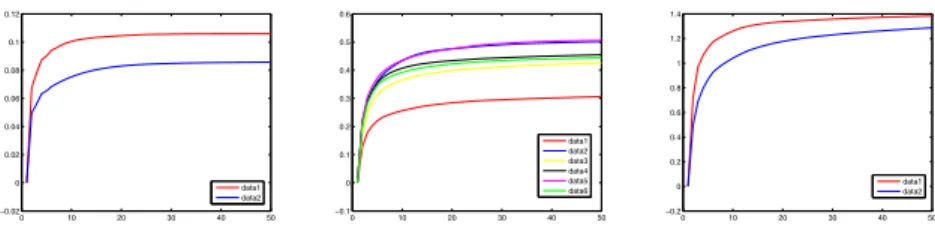
We commence by exploring the relationship between the von Neumann entropy of a graph and its corresponding increasing timet. In our experiments, we utilize the testing graphs in the MUTAG, ENZYMES and PPIs datasets. For each graph, we let the continuous-time quantum walk evolve until a maximum timet, where we varytfrom 1 to 50. For each time twe compute the density operator associated with the graph using Eq.(8). Then the von Neumann entropy of the graph at each timetcan be computed from its corresponding density operator. The experimental results are shown in Fig.1. The left, middle and right subfigures of Fig.1 show the results of the evaluation on the MUTAG, Enzymes and PPIs datasets separately. The x-axis shows the timet which is from 1 to 50, and the y-axis shows the mean value of the von Neumann entropies of graphs belonging to the same class at each timet. Here the different lines represent the entropies of different classes of graphs separately. This evaluation suggests that the von Neumann entropies of different classes of graphs can be divided well, and tend to be stable with increasing timet.
0 10 20 30 40 50 −0.02 0 0.02 0.04 0.06 0.08 0.1 0.12 data1 data2 0 10 20 30 40 50 −0.1 0 0.1 0.2 0.3 0.4 0.5 0.6 data1 data2 data3 data4 data5 data6 0 10 20 30 40 50 −0.2 0 0.2 0.4 0.6 0.8 1 1.2 1.4 data1 data2
Fig. 1.Evaluations on the von Neumann Entropy for increasing timet
4.2 Experiments on Standard Graph Datasets from Bioinformatics Experimental Setup.We evaluate the performance of our quantum Jensen-Shannon kernel on the graph datasets abstracted from bioinformatics databases, and then compare it with several alternative state of the art graph learning methods. These methods include 1) the Weisfeiler-Lehman subtree kernel [5], 2) the shortest path graph kernel [4], 3) the Shannon entropy associated with the information functionals FV and FP [17], and 4) the Ihara zeta function on
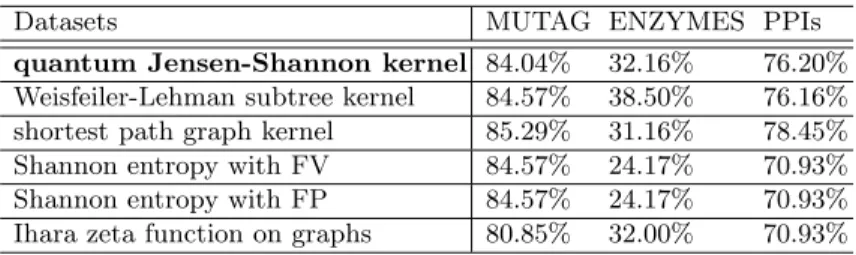
graphs [18]. Based on the evaluation in Section 4.2, here we set timetfrom 1 to 50. For the kernel methods, we compute the kernel matrix of each graph kernel on each dataset, we then apply the PCA [19] on the kernel matrix to embed the graphs into principle component space as feature vectors. For other methods, we compute the characteristics values of graphs on each dataset. We perform 10-fold cross-validation using the Support Vector Machine (SVM) Classification associated with the Sequential Minimal Optimization (SMO) [20] on the graph feature vectors or characteristics values to evaluate the performance of our kernel and that of the alternative methods. We use nine samples for training and one for testing. All the SMO-SVMs and their parameters were performed and optimized on a Weka workbench [21]. We report the average classification accuracies of each method in Table 2.
Results. a) On the MUTAG dataset, the accuracies of all the methods are similar, our kernel overcomes or is competitive to the alternatives. b) On the ENZYMES dataset, the accuracy of our kernel is obviously lower than that of the Weisfeiler-Lehman subtree kernel, but is competitive to that of the shortest path graph kernel and outperforms that of others. c) On the PPIs dataset, the accuracy of our kernel is obviously higher than that of the alternatives. As a whole, our kernel outperforms or is competitive to the alternatives, only the Weisfeiler-Lehman subtree kernel and the shortest path graph kernel are competitive to our kernel on the ENZYMES dataset.
Table 2.Accuracies Comparisons on Graph Datasets abstracted from Bioninformatics
Datasets MUTAG ENZYMES PPIs
quantum Jensen-Shannon kernel 84.04% 32.16% 76.20%
Weisfeiler-Lehman subtree kernel 84.57% 38.50% 76.16%
shortest path graph kernel 85.29% 31.16% 78.45%
Shannon entropy with FV 84.57% 24.17% 70.93%
Shannon entropy with FP 84.57% 24.17% 70.93%
Ihara zeta function on graphs 80.85% 32.00% 70.93%
5
Conclusion
In this paper, we developed a novel graph kernel by using the quantum Jensen-Shannon divergence and the continuous-time quantum walk on graphs. Given a graph, we evolved a continuous-time quantum walk on its structure and we showed how to associate a mixed quantum state to the graph and how to com-pute the von Neumann entropy of the corresponding density operator. With the von Neumann entropies to hand, the quantum Jensen-Shannon kernel between a pair of graphs was defined as a function of the quantum Jensen-Shannon diver-gence between the corresponding density operators. Finally, we used the Prin-ciple Component Analysis (PCA) on the kernel matrix to embed the graphs into a feature space where we performed the classification task. Experiments on several standard datasets demonstrate the effectiveness of the proposed graph
kernel. Our future work is to extend the quantum graph kernel to a quantum hypergraph kernel. In [22], we have developed a hypergraph kernel by using the classical Jensen-Shannon divergence. In [23], we have explored the use of discrete-time quantum walks on a directed line graph which can be generated by transforming a hypergraph. It would thus be interesting to extend these works by using the quantum Jensen-Shannon divergence to compare the quantum walks of hypergraphs based on their directed line graphs.
References
1. Sch¨olkopf, B., Smola, A.: Learning with Kernels. MIT Press (2002)
2. Haussler, D.: Convolution kernels on discrete structures. Technical Report UCS-CRL-99-10, Santa Cruz, CA, USA (1999)
3. Kashima, H., Tsuda, K., Inokuchi, A.: Marginalized kernels between labeled graphs. In: Proceedings of International Conference on Machine Learning, pp. 321–328 (2003)
4. Borgwardt, K.M., Kriegel, H.P.: Shortest-path kernels on graphs. In: Proceedings of the IEEE International Conference on Data Mining, pp. 74–81 (2005)
5. Shervashidze, N., Schweitzer, P., van Leeuwen, E.J., Mehlhorn, K., Borgwardt, K.M.: Weisfeiler-lehman graph kernels. Journal of Machine Learning Research 1, 1–48 (2010)
6. Lamberti, P., Majtey, A., Borras, A., Casas, M., Plastino, A.: Metric character of the quantum jensen-shannon divergence. Physical Review A 77, 052311 (2008) 7. Bai, L., Hancock, E.R.: Graph kernels from the jensen-shannon divergence. Journal
of Mathematical Imaging and Vision (to appear)
8. Majtey, A., Lamberti, P., Prato, D.: Jensen-shannon divergence as a measure of distinguishability between mixed quantum states. Physical Review A 72, 052310 (2005)
9. Farhi, E., Gutmann, S.: Quantum computation and decision trees. Physical Review A 58, 915 (1998)
10. Dirac, P.: The Principles of Quantum Mechanics, 4th edn. Oxford Science Publications (1958)
11. Kempe, J.: Quantum random walks: an introductory overview. Contemporary Physics 44, 307–327 (2003)
12. Nielsen, M., Chuang, I.: Quantum computation and quantum information. Cambridge university press (2010)
13. Martins, A.F., Smith, N.A., Xing, E.P., Aguiar, P.M., Figueiredo, M.A.: Nonex-tensive information theoretic kernels on measures. Journal of Machine Learning Research 10, 935–975 (2009)
14. Konder, R., Lafferty, J.: Diffusion kernels on graphs and other discrete input spaces. In: Proceedings of International Conference on Machine Learning, pp. 315–322 (2002)
15. Neuhaus, M., Bunke, H.: Bridging the gap between graph edit distance and kernel machines. World Scientific (2007)
16. Escolano, F., Hancock, E.R., Lozano, M.A.: Heat diffusion: Thermodynamic depth complexity of networks. Physical Review E 85, 036206 (2012)
17. Dehmer, M.: Information processing in complex networks: Graph entropy and information functionals. Applied Mathematics and Computation 201, 82–94 (2008)
18. Ren, P., Wilson, R.C., Hancock, E.R.: Graph characterization via ihara coefficients. IEEE Transactions on Neural Networks 22, 233–245 (2011)
19. Sch¨olkopf, B., Smola, A.J., M¨uller, K.R.: Kernel principal component analysis. In:
Proceedings of International Conference on Artificial Neural Networks, pp. 583–588 (1997)
20. Platt, J.C.: Fast training of support vector machines using sequential minimal
optimization. In: Sch¨olkopf, B., Burges, C.J.C., Smola, A.J. (eds.) Advances in
Kernel Methods, pp. 185–208 (1999)
21. Witten, I.H., Frank, E., Hall, M.A.: Data Mining: Practical Machine Learning Tools and Techniques. Morgan Kaufmann (2011)
22. Bai, L., Hancock, E.R., Ren, P.: A jensen-shannon kernel for hypergraphs. In: Gimel’farb, G., Hancock, E., Imiya, A., Kuijper, A., Kudo, M., Omachi, S., Windeatt, T., Yamada, K. (eds.) SSPR & SPR 2012. LNCS, vol. 7626, pp. 181–189. Springer, Heidelberg (2012)
23. Ren, P., Aleksic, T., Emms, D., Wilson, R., Hancock, E.: Quantum walks, ihara zeta functions and cospectrality in regular graphs. Quantum Information Processing 10, 405–417 (2011)