TWO-DIMENSIONAL TRANSIENT RADIATIVE HEAT TRANSFER USING DISCRETE ORDINATES METHOD
Zhixiong Guo and Sunil Kumar
Department of Mechanical, Aerospace and Manufacturing Engineering Polytechnic University, 6 Metrotech Center, Brooklyn, NY 11201, USA
ABSTRACT. The S-N discrete ordinates (DO) method is developed for the first time to solve transient radiative heat transfer in a two-dimensional rectangular enclosure with absorbing, emitting, and anisotropically scattering medium subject to diffuse and/or collimated laser irradiation. The transient DO method is used to solve several example problems and compared with the existing results and the Monte Carlo predictions. Good agreement between the transient DO solutions and other predictions is found. Finally, the transient DO method is applied to investigate the characteristics of short-pulsed laser radiation interaction and transport within biological tissues.
INTRODUCTION
With the advent of the short-pulsed laser with the duration of the order of femtoseconds, transient laser radiation transport through turbid media has attracted a great deal of attention in recent years [1], particularly for applications in bio-medical treatment and diagnostics. One mathematical model for describing short-pulsed laser transport is time-dependent radiative transfer equation. The solution of the hyperbolic transient radiative heat transfer equation is then of great interest. Significant progress has been made in the development of solution method of radiative heat transfer in participating media in recent decades. However, the analysis of radiative heat transfer in most engineering problems traditionally neglects the effect of light propagation speed. In the applications of short-pulsed lasers, such a neglecting may induce significant errors [1-5].
Most previous studies on transient laser transport are based on the parabolic diffusion approximation [2,3] or have utilized the stochastic Monte Carlo (MC) method [4,5]. However, the diffusion approximation is hardly applicable to thin tissues or tissues having varying distributions of optical properties and complex geometries. The MC method is time-consuming and the results are subject to statistical error due to practical finite samplings. Few studies have addressed the solution of the entire hyperbolic transient radiative transfer equation. The adding-doubling method [6] was proposed to solve the transient response of a slab medium with constant external source. Kumar et al. [7] considered the solution of the hyperbolic transient radiative equation by using the P1 models
in 1D planar medium. More recently, Mitra and Kumar [8] examined several numerical methods for 1D transient radiative transport in absorbing-scattering medium, in which discrete ordinates method, P-N model, diffuse approximation, and two-flux method have been discussed. Tan and Hsu [9]
developed an integral equation formulation for transient radiative transfer. Guo and Kumar [10] extended the radiation element method to consider the transient radiative transfer. Mitra et al. [11] applied the hyperbolic P1 model to transient radiative transfer in a 2D rectangular medium. Wu and
Wu [12] solved the transient integral equation using quadrature method in 2D cylindrical linearly anisotropically scattering media. However, the P1 model underestimates apparently the light
propagation speed [8], and the integral formulation is difficult to be applied to complex geometries with Mie anisotropically scattering media.
In the solution of multi-dimensional steady state radiative transfer in participating media, the discrete ordinates (DO) method has been one of the most widely applied methods [13-15]. The DO method requires a single formulation to invoke higher order approximations, integrates easily into
control volume transport codes, and is applicable to complete Mie anisotropic scattering phase function and inhomogeneous media. Based on these characteristics, the DO method has been selected in the present study for implementation into multi-dimensional transient radiation transport in absorbing, emitting, and anisotropically scattering media. The transient DO solution is verified by comparison against existing steady state DO solution and transient Monte Carlo prediction in several exemplified problems. The equivalent isotropic scattering results are compared with the anisotropic scattering modeling with truncated Legendre polynomials phase function in the transient domain. Finally, the transient DO method is applied to investigate the short-pulsed laser interaction and transport in living tissues.
MATHEMATICAL MODEL
For 2D Cartesian coordinates as shown in Fig. 1 (a), the hyperbolic transient radiative transfer equation of diffuse intensity Ii in the discrete ordinate direction sˆ is formulated as i
n i S I y I x I t I c i i i i i i i K , 2 ,1 , 1 = = + ∂ ∂ + ∂ ∂ + ∂ ∂ ξ η β β (1)
where the extinction coefficient β is the sum of absorption coefficient κ and scattering coefficient s
σ , c is the speed of light in medium, and Si is the radiative source term:
(
)
I w I S i n S c n j j ij j b i 1 4 , 1,2,K 1 = + + − =∑
= Φ π ω ω (2)where scattering albedo ω =σs /β , Φij represents scattering phase function, and Sc is the source contribution of collimated irradiation. A quadrature of order n with the appropriate angular weight wj is used in the S-N discrete ordinates method. The scattering phase function may be approximated by a finite series of Legendre polynomials as
∑
= = M k k k ij C P 0 ) (cosϕ Φ (3)here, cosϕ =ξiξj+ηiηj +µiµj . The Ck’s are the expansion coefficients of the corresponding Legendre function. ξi, ηi, and µi are the three direction cosines of the discrete direction sˆ . i
The enclosure walls are diffusely reflecting. The diffuse intensity at wall 1 is
∑
< − + = /2 0 1 n j j j w bw w w j I w I I ξ ξ πε ε (4)Similarly, we can set up relations for the rest three walls.
(a) (b)
The collimated laser sheet is normally incident upon the center of wall 1 with spatial width dc and its intensity is ) 1 ( )] / ( ) / ( )[ exp( ) , , ( c = 0 − − − − p − c − c x t I x H t x c H t t x c I ξ β δ ξ , )y∈(−dc/2,dc/2 (5)
where H(t) and δ are the Heaviside and the Dirac delta functions, respectively, tp and I0 are the pulse
width and incident intensity of the on-off square laser pulse. The collimated component Sc in Eq. (2) is then written as ) ( 4 c c i c I S Φ ξ ξ π ω = (6)
In the region where no collimated laser irradiation is passing through, Ic =Sc =0.
Once the intensity field is obtained, the incident radiation G and the net radiative heat fluxes Qx and
Qy can be obtained as c n j j j I I w G=
∑
+ =1 , n j c j j j x w I I Q =∑
+ =1 ξ , n j j j j y w I Q∑
= = 1 η (7) NUMERICAL SOLUTIONTo solve the discrete ordinate equation (1), the finite volume approach is employed. The enclosure is divided into small control volumes by MX×MY meshes. In each control volume as shown in Fig. 1 (b), the spatially and temporally discretized equation can be expressed as
) ( ) ( ) ( ) ( ∆ 0 i P i P i S S i N N i i W W i E E i i P i P I A I A I A I A I V I S I t c V − +ξ − +η − =β − + (8) where, ,AE =AW =∆y AS = AN =∆x, V =∆x⋅∆y , and 0 i P
I is the control volume average
intensity at previous time step. In order to solve Eq. (8), the weighted diamond differencing scheme is introduced [13-16]: i W x i E x i S y i N y i P I I I I I =γ +(1−γ ) =γ +(1−γ ) (9)
Concerning the determination of the values of γx and γy, many types of spatial differencing scheme have been discussed. In the present study, the positive scheme, which guarantees positive radiative intensity in terms of the spatial and angular grids [15], is applied.
The final discretization equation for the cell intensity in a generalized form becomes
y x t c I y I x S I t c I y i x i i y y i i x x i i P i P i P ∆ ∆ 1 ∆ 1 ∆ ∆ ∆ 1 0 β γ η β γ ξ β β γ η β γ ξ β + + + + + + = (10) where i x
I is the x-direction face intensity where the beam enters ( =
i W
I for ξi > 0, and =IEifor ξi < 0), and
i y
I is the corresponding y-direction face intensity.
A time discretized term was added in Eq. (10) for the consideration of transient radiative transfer. If the time step ∆t is infinitely large, Eq. (10) is consistent with the steady state form. It should be
noted that an implicit scheme was used in Eq. (10) for the time-dependent term. An initial field of intensity must be given based on the physical reality. In the present study, the initial values of intensity at all discrete ordinates everywhere in the field are set equal to zero. Actually, the transient solving procedure is very similar to the iterative solution for steady state radiative transfer. Hence, we are not going to describe the solution procedures in detail. However, it should be noticed that the introduction of transient solution does not simply mean an addition of solution method for steady
state radiative transfer. Its significance is embodied by the incorporation of light propagation effect in microscale short time radiation transport. Some short time radiation phenomena, such as the broadening of short pulse through scattering medium, can only be observed in transient solution [1]. Fiveland [13] has introduced limitation on the spatial differential step. For transient radiative transfer, a limitation on time step should also be imposed. Since a light beam always travels with a velocity c, the traveling distance c∆t between two neighboring time steps should not exceed the
control volume spatial step, i.e., c∆t<Min{∆x,∆y}. Thus, if we introduce non-dimensional variables t*=βct, x* = x/L, and y* = y/W, we have
< y x t γ η γ ξ -1 , -1 Min * ∆ i i (11)
The choice of quadrature scheme in the DO method is arbitrary. In the present calculations, the S-12
approximation (n = 84, which computes 84 fluxes over the hemisphere) is generally used. The
values of discrete ordinate quadrature sets and weights can be found in Table 2 of Fiveland [14]. RESULTS AND DISCUSSION
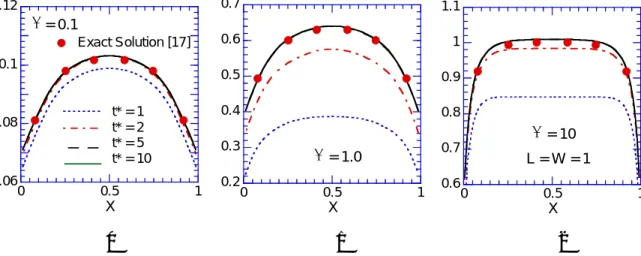
At first, the transient DO method is applied to a square enclosure with cold, black walls, and a purely absorbing medium that is suddenly raised to and maintained at an emissive power of unity. The predicted surface heat fluxes at different time instants for three different absorption coefficients are plotted in Figs. 2 (a), (b) and (c), respectively. It is seen that the heat flux increases as the time proceeds. After t* = 5.0, the change versus time is invisible and the results reach to a steady state
solutions. The results at long time stages are compared with exact solution [17] in steady state. Excellent agreement was found.
Then a boundary incident problem in a square enclosure is studied, where wall 1 is suddenly heated and maintained at hot with unity emissive power, but the rest walls and the medium are kept cold. The medium is anisotropically scattering with Mie phase function F2, which was listed in Table 1 of Kim and Lee [15] in detail. The asymmetric factor g for the strong forward phase function F2 is g =
0.66972. The non-dimensional incident radiation and net heat fluxes along the centerline (y* = 0)
are displayed in Figs. 3 (a) and (b), respectively, for different time instants. The solid circle marks are the steady state values predicted using S-14 DO method [15]. As time advances, it is seen that
the radiation is propagating to the larger x end. The transient results gradually match to the steady
state solutions. The minor difference between the steady state solution and the transient solution at
0.06 0.08 0.1 0.12 0 0.5 1 X t* = 1 t* = 2 t* = 5 t* = 10 = 0.1 κ Exact Solution [17] S u rf ace H eat F lu x 0.2 0.3 0.4 0.5 0.6 0.7 0 0.5 1 X = 1.0 κ 0.6 0.7 0.8 0.9 1 1.1 0 0.5 1 X = 10 κ L = W = 1 (a) (b) (c)
Figure 2. Non-dimensional surface heat flux for a square enclosure with cold black walls and hot absorbing medium: (a) κ = 0.1; (b) κ = 1.0; (c) κ = 10.
t* = 8.0 may be attributed to the different order approximations used in the two solutions.
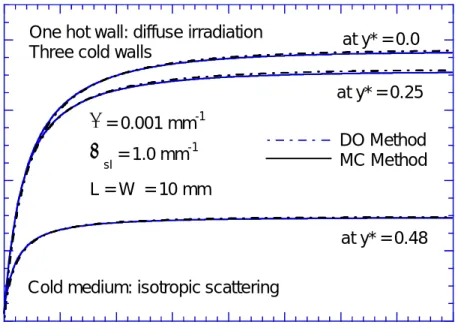
The DO method is examined in transient domain by comparison against the Monte Carlo prediction for isotropically scattering medium with black walls in Fig. 4, where temporal distributions of reflectance are shown. Wall 1 is assumed to be hot and irradiated diffusely, other walls and the
0 0.1 0.2 0.3 0.4 0.5 0.6 0 0.2 0.4 0.6 0.8 1 x* In ci de nt R a d ia tio n G t* = 0.5 t* = 1.0 t* = 2.0 t* = 4.0 t* = 8.0 S-14 Solution at Steady State [15]
L = W = 1 β β ω = 1 0 0.2 0.4 0.6 0.8 1 0 0.2 0.4 0.6 0.8 1 x* Ne t Ra di ati v e He at F lux Q y t* = 0.5 t* = 1.0 t* = 2.0 t* = 4.0 t* = 8.0 L = W = 1 β β ω = 1 (a) (b)
Figure 3. Incident radiation (a) and net radiative heat flux in the y-direction (b) along the
centerline for a square enclosure with one hot wall and cold anisotropic scattering medium.
0 0.2 0.4 0.6 0.8 0 10 20 30 40 50 60 70 80 t* R e fl e c tan c e at y* = 0.25 at y* = 0.0 at y* = 0.48 L = W = 10 mm κ = 0.001 mm-1 σ sI = 1.0 mm -1 DO Method MC Method One hot wall: diffuse irradiation
Three cold walls
Cold medium: isotropic scattering
medium are cold. Other parameters are, L = W = 10 mm, κ = 0.001 mm-1, and σsI = 1.0 mm-1. The
MC results in the current paper are calculated based on the algorithm developed by Guo et al. [12].
It is seen that the transient DO results are in excellent agreement with those predicted by the Monte Carlo method. For isotropically scattering medium, we found that even a lower order DO approximation (S-8) can predict accurate results.
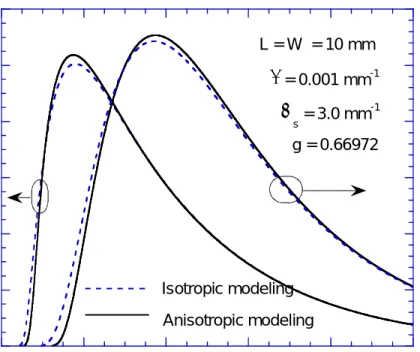
The equivalent isotropic scattering results are then compared with the corresponding direct anisotropically scattering simulations with phase function F2 in Fig. 5 for temporal profiles of transmittance at the center of the output wall and of normalized incident radiation at the center of the enclosure. The square medium is divided by 202×202 meshes and is subject to an impulse laser irradiation at the center of wall 1. It is seen that the equivalent isotropic scattering results approach closely the Mie phase function anisotropically scattering predictions except at the early time stages. This finding is consistent with our previous finding [18] for an optically thick and forward scattering medium with Henyey-Greenstein phase function. Although the input laser pulse is impulse, i.e., with infinitely small pulse width, the transmitted pulse and the temporal distribution of incident radiation are clearly broadened with finite pulse width as shown in Fig. 5. Such a phenomenon is a salient feature of short pulse laser transport in scattering medium and is only observable by performing transient simulation with the incorporation of light propagation effect. Finally, short-pulsed laser transport in living tissues is investigated using the DO method. Parameters are: L = 10 mm, W = 29.9 mm, κ = 0.01 mm-1, and σsI = 1.0 mm-1. The refractive index
of the tissue is 1.40. The spatial width of the incident impulse laser is dc = 0.1 mm (to simulate a laser imposed through a 100 µm optical fiber). The control volume size is 0.1 mm × 0.1 mm in aim to simulate precisely the transient laser transport in microscale area and to simulate detectors using optical fiber. Time resolution is ∆t = 0.2 ps. Internal reflection is not considered because boundary is
0 20 40 60 80 100 N o rm a liz ed G ( x 10 5 ) T ransm it tance ( x 10 3 ) t* = ctβ Ι 3 2 1 0 12 8 4 0 Isotropic modeling Anisotropic modeling σ s = 3.0 mm -1 κ = 0.001 mm-1 L = W = 10 mm g = 0.66972
Figure 5. Comparison between equivalent isotropic scattering results and direct anisotropic simulations for temporal profiles of transmittance and normalized incident radiation
matched when the optical fibers are inserted into living tissue.
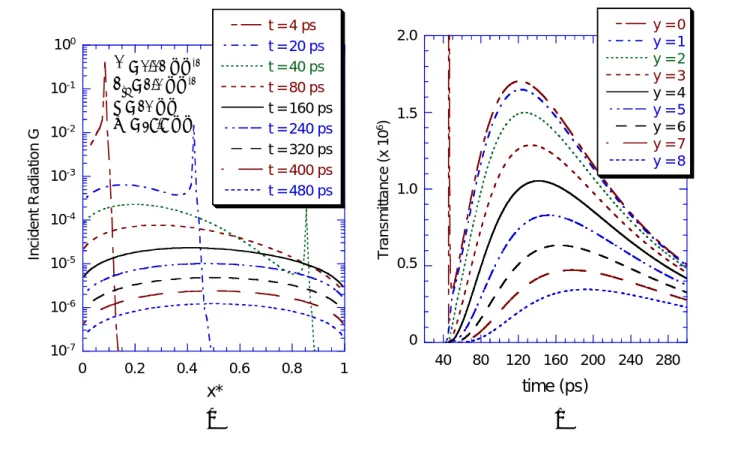
Fig. 6 (a) shows the non-dimensional incident radiation along the centerline (y* = 0) at various time
instants. It is clearly seen that the sudden peak, which represents the ballistic component of the laser, is propagated from small x to large x until it passes through the medium with the speed of light, and
the peak value is substantially reduced in the process of propagation. The diffuse component due to multiple scattering events also forms a second maximum point along the x-direction and the diffuse
apex is also propagated gradually from the small x to the center of the x-axis. At long time stages,
the profile of the incident radiation is symmetric along the center position x* = 0.5. As time
proceeds, the value of the incident radiation becomes smaller and smaller.
The temporal transmittance profiles at different locations are shown in Fig. 6 (b). It is seen that, with the increase of distance between the detector and the laser incident axis, the peak position of the transmitted pulse moves to large time instant and the transmitted pulse width increases. However, the magnitude of the transmitted pulse decreases.
CONCLUSIONS
The discrete ordinates method is formulated to study two-dimensional transient radiative heat transfer in anisotropically scattering, absorbing and emitting medium subject to diffuse and/or collimated short-pulsed laser irradiation. The transient DO solution is verified by comparison with the existing published results and/or with the Monte Carlo simulation for a variety of exemplified problems. It is found that the present method is accurate and can be used to predict all transient radiative quantities. The temporal distributions of transmittance and divergence in equivalent isotropic scattering modeling are found to approach closely the predictions of direct modeling of strong forward anisotropic scattering with truncated Legendre polynomials phase function in most of the transient domain except at early time instants. The transient DO method is applied to study the characteristics of short-pulsed laser interaction and propagation within living tissues. It is found
10-7 10-6 10-5 10-4 10-3 10-2 10-1 100 0 0.2 0.4 0.6 0.8 1 t = 4 ps t = 20 ps t = 40 ps t = 80 ps t = 160 ps t = 240 ps t = 320 ps t = 400 ps t = 480 ps x* In c ide nt R a d ia tio n G κ σsI = 1.0 mm-1 = 0.01 mm-1 L = 10 mm W = 29.9 mm 40 80 120 160 200 240 280 y = 0 y = 1 y = 2 y = 3 y = 4 y = 5 y = 6 y = 7 y = 8 T ra n s m itta nc e (x 1 0 6 ) time (ps) 2.0 1.5 1.0 0.5 0 (a) (b)
Figure 6. Incident radiation along the centerline (a) and temporal distributions of transmittance at various locations (b) in a rectangular tissue subject to an impulse laser irradiation.
that the ballistic component of the laser propagates with the speed of light at the tissue and its value is substantially reduced with the advance of propagation. The diffuse component due to multiple scattering also forms a second maximum incident radiation inside the tissue, but finally the profile is symmetric along the center of the square. The incident radiation is strongly affected by its microscale space position and time instants. The temporal shape of the transmitted pulse is strongly influenced by the position of the detector. With the increase of distance between the detector and the laser incident axis, the peak position of the transmitted pulse moves to large time instant and the transmitted pulse width increases.
ACKNOWLEDGMENTS
The authors acknowledge partial support from the National Science Foundation grant AW 9963 (CTS-973201) administrated by Sandia National Laboratories, Shawn Burns, Project Manager.
REFERENCE
1. Kumar, S., Mitra, K., Microscale Aspects of Thermal Radiation Transport and Laser Applications, Advances in Heat Transfer, Vol. 33, pp. 187-294, 1999.
2. Yoo, K. M., Liu, F., Alfano, R. R., When Does the Diffusion Approximation Fail to Describe Photon Transport in Random Media, Physical Review Letter, Vol. 64, pp. 2647-2650, 1990.
3. Brewster, M. Q., Yamada, Y., Optical Properties of Thick, Turbid Media from Picosecond Time-Resolved Light Scattering Measurements, Int. J. Heat Mass Transfer, Vol. 38, pp.
2569-2581, 1995.
4. Wilson, B. C., Adam, G., A Monte Carlo Model for the Absorption and Flux Distributions of Light Tissue, Medical Physics, Vol. 10, pp. 824-830, 1983.
5. Guo, Z., Kumar, S., San, K.-C., Multi-dimensional Monte Carlo Simulation of Short Pulse Laser Radiation Transport in Scattering Media, J. Thermophy. Heat Transfer, Vol. 14, pp. 504-511,
2000.
6. Rackmil, C. I., Buckius, R. O., Numerical Solution Technique for the Transient Equation of Transfer, Numerical Heat Transfer, Vol. 6, pp.135-153, 1983.
7. Kumar, S., Mitra, K., Yamada, Y., Hyperbolic Damped-Wave Models for Transient Light-Pulse Propagation in Scattering Media, Applied Optics, Vol.35, pp. 3372-3378, 1996.
8. Mitra, K., Kumar, S., Development and Comparison of Models for Light-Pulse Transport Through Scattering-Absorbing Media, Applied Optics, Vol. 38, pp. 188-196, 1999.
9. Tan, Z. M., Hsu, P.-F., An integral Formulation of Transient Radiative Transfer Part 1—Theoretical Investigation, J. Heat Transfer, (submitted).
10. Guo, Z., Kumar, S., Radiation Element Method for Transient Radiative Transfer in Plane-Parallel Inhomogeneous Media, Numerical Heat Transfer, Part A, (in press).
11. Mitra, K., Lai, M.-S., Kumar, S., Transient Radiation Transport in Participating Media within a Rectangular Enclosure, J. Thermophy. Heat Transfer, Vol. 11, pp. 409-414, 1997.
12. Wu, C.-Y., Wu, S.-H., Integral Equation Formulation for Transient Radiative Transfer in an Anisotropically Scattering Medium, Int. J. Heat Mass Transfer, Vol. 43, pp. 2009-2020, 2000.
13. Fiveland, W. A., Three-Dimensional Radiative Heat Transfer Solutions by the Discrete-Ordinates Method, J. Thermophy. Heat Transfer, Vol. 2, pp. 309-316, 1988.
14. Fiveland, W. A., The Selection of Discrete Ordinate Quadrature Sets for Anisotropic Scattering,
ASME HTD-Vol. 72, pp. 89-96, 1991.
15. Kim, T. K., Lee, H., Effect of Anisotropic Scattering on Radiative Heat Transfer in Two-Dimensional Rectangular Enclosures, Int. J. Heat Mass Transfer, Vol. 31, pp. 1711-1721,
1988.
16. Modest, M. F., Radiative Heat Transfer, McGraw-Hill, Inc., New York, 1993.
17. Shah, N., New Method of Computation of Radiation Heat Transfer in Combustion Chambers,
Ph. D. dissertation, Dept. of Mech. Eng., Imperial College of Science and Technology, London,
1979.
18. Guo, Z., Kumar, S., Equivalent Isotropic Scattering Formulation for Transient Short-Pulse Radiative Transfer in Anisotropic Scattering Planar Media, Applied Optics, Vol. 39, pp. 4411-