Analysis Motorcycle Accidents Based on Environmental and
Personal Factors
Glaiza Marie T. Flores, Maria Patricia T. Gotohio, and Noel Gabriel C.Paras,
Rosemary R. Seva,
Department of Industrial Engineering
De La Salle University, Manila, Philippines
Abstract
The number of motorcycle accidents in the Philippines is increasing but studies have not been done to assess its causes. This study considered the separate and interactive effects of environment and driver-dependent factors namely gender, helmet usage, risk taking behavior, day, time and month of the accident, junction type, movement, road character, surface condition, weather, traffic sector, and lighting conditions in predicting motorcycle accidents in the Philippine. Logistic regression was used to analyze the data gathered from 186 motorcycle users. Results showed that the significant variables are weather conditions, age of the driver, and junction type.
Keywords
Motorcycle accidents, logistic regression, accident analysis, road accidents
1
. Background of the study
According to the Metro Manila Development Authority (MMDA) [1], motorcycles are more prone to accidents as they expose the driver and passenger/s to twice as much risk than in four-wheel vehicles. Although there have been laws implemented on Traffic Laws Regulations, specifically on motorcycles, accidents have been declared as one of the leading causes of death in the Philippines [2]. The alarmingly growing number of motorcycle accidents can be attributed to a number of environment and driver dependent factors specifically variables found in the Philippine Police Report form. Among the environment factors in the form are day, time and month of the accident, junction type, movement, road character/type, surface and lighting conditions.
2. Accident variables
Timing as a variable affecting accidents was tackled in previous studies. An assessment of 1,508 motorcycle accidents in Australia was done by Williams and Hoffmann [3] in 1974. Data show that 63.7% of all accidents occurred during hours during day, 29.0% during night, and 7.3% at dawn and dusk. This is because the flow of traffic during day is greater than that of dawn and dusk contrary to the later findings of Yau [4]. Yau [4] considered five factors, namely, the month of occurrence of the accident, day of the week, time of the accident, street lighting conditions and weather conditions. Results revealed that the day of the week and time of the accident are important factors affecting injury severity. It was also found that motorcycle accidents have higher risk during weekends than weekdays because motorcycle drivers driving on weekends may exhibit risky driving behaviors. Furthermore, motorcycle accidents are also more likely to happen between night and midnight. Perhaps during this time, the driver is more susceptible to driving at fast speeds due to the small number of vehicles on the road.
Another environment dependent factor is the type of road which affects the occurrence of an accident. The road characteristics given in the police report in the Philippines include straight or flat, curved, inclined, curved and inclined, on a bridge and other type of roads. A study in the United States estimated probabilistic models of motorcyclists’ injury severities in single and multi-vehicle crashes. Results suggest that road crashes occurring on vertical or horizontal curves, are significantly likely to contribute on incapacitating injuries [5].
No study, however, was found associating the flow of vehicles along the roads to accidents. One-way movement is logically less prone to accidents because head on collisions are probably more prone to happen on two-way movements. Since this is not supported by any study, this shall need further investigation. There were also limited
Saleh [6] has developed predictive models of motorcyclist injury severity by various crash types at T-junctions in the United Kingdom. The authors have considered T-junctions as an important area for the study because more accidents happened at T-junctions than in any other type of junction based on the STATS19 accident injury database from 1991 to 2005. Moreover, an accident is more likely to occur three times at T-junctions than roundabouts or crossroads [7].Predictive models are estimated using human, environmental, vehicle factors and the data for the model estimation. The study has used ordered logit model to find which factors are significant to the independent variable. Among the environmental factors found to be most associated with higher injury severity are day, month, control measure (traffic control type), lighting conditions and weather conditions, which may be directly related with surface conditions (dry or wet roads).
Surface conditions in the Philippines can only be either wet or dry. Surface conditions depend on the weather conditions during the time of accident. Therefore, there are possible interactions between both variables. If there is no rain falling, then accident is less likely [8].This is contradictory to the data from government offices like the MMDA and the Quezon City police district since there seem to be more accidents during dry or fair weather. Out of 102 police reports, 92 motorcycle accidents occurred on a fair weather.
The study of Majdzadeh et al. [9] considered weather condition specifically its association with severe injuries due to motorcycle accidents. The study was conducted in Iran and has used statistical tests and multiple logistic regression analysis to relate and analyze the risk factors of injury. Along with number of collisions, weather condition was found to be significant with the occurrence of road traffic injury in severe cases. Results show that rain increases the risk of occurrence of injury. However, in a study by Shankar and Mannering[8] wet pavement conditions make drivers more cautious in driving. Thus, it is found that wet roads permit less severe crashes. Since this is an unlikely finding it merits a reason for further research.
The same study also takes into consideration some driver dependent factors namely age and gender. Results suggest that female motorcycle drivers are more likely to be injured than males. This is attributed to the difference in body morphology and physical strength [9].
On the issue of age, the study of Abdel-Aty and Radwan [10] reveals that young and older drivers have a larger possibility of accident involvement than middle-aged drivers when experiencing heavy traffic volume do. Young drivers are also subject to involvement in speeding, increasing the risk of getting into an accident. Data used in the study was taken from Central Florida, U.S.A. This result may not be the same for other studies due to the difference in context and proportion of people in certain driver age groups. As of 2000, sixty-five percent of the population is part of the middle-age group in the Philippines [11]. Hence, age is a factor that should be considered in the occurrence of crashes. However, it is evident in the negative binomial model used in Abdel-Aty and Radwan [10] that the factors are correlated. With this, the results may not reflect the actual relationships of each factor in the study done.
Previous studies presented only considered single factors on accident occurrence or injury severity. On the other hand, it can be possible that different factors as well as their interactions are also considered. The study of Yannis et al. [12] and Al-Ghamdi [13] conducted in Greece and Saudi Arabia, respectively, considerthe combined effects of factors including age on different response variables. The former tackles on combined effects of driver and motorcycle dependent factors on two response variables namely accident severity and at-fault risk. It has been found that there is a significant combined effect of age and engine size with respect to accidents. On another context, Al-Ghamdi [13] has used logistic regression in developing a model that determines the relationships between nine variables namely, location, accident type, collision type, accident time, accident cause, driver age, nationality, vehicle type, and license status. The relationships of the variables in terms of correlations of the factors are analyzed through the use of an odds matrix. However with this approach, only two variables are found to be significant and thus included in the model. It has been found that there is a relationship between accident location and accident cause, which can help in the development of specific awareness programs. For example, the odds of being involved in an accident at a non-intesection location due to going the wrong way violation is higher than for any other violation, drivers can be warned about the lethality of the violation. Results for both studies show that interactions between factors significantly affect the response variables.
According to Laflamme and Diderichsen [14], there is a lack of exploratory models on how contextual and individual factors separately and interactively contribute to injury causation. In line with this, it is restudy and consider variables that have contradicting findings on its effect in motorcycle accident occurrence.
Each country has different death rates each year. The differences in death rates between countries can be attributed to a difference in culture. Seat belt use, for example, can be different for countries due to the perception of poor enforcement of seat belt wearing leading to reduced compliance. Death rates can also be attributed to the difference in perception of risk. A study on risk perception among American, Spanish, West German and Brazilian drivers shows that American drivers have the lowest compared with Spanish drivers having the highest risk perception. However, results may have varied for each country since each driver has a different background and the means of the recruitment of samples must have given presumed effects [15]. This proves that there can be a difference in the perception of Filipino drivers compared to other countries studied in the literature reviewed.
The difference in causal relationships among the number of motorcycle accidents, the environment factors and driver dependent factors previously mentioned in the literature reviewed so far can be found due to the differences in culture between the countries used and the Philippines. Although there are limited evidences to this relationship, Filipinos may display different or similar traits as other nationalities do. With this, as well as the lack of studies on motorcycle accidents, there is a need to determine which factors affect the occurrence of motorcycle accidents in Philippine setting.
Considering previous studies reviewed, the separate and interactive effects of environment and driver-dependent factors namely gender, helmet usage, risk taking behavior, day, time and month of the accident, junction type, movement, road character, surface condition, weather, traffic sector, and lighting conditions have not been considered in predicting motorcycle accidents in the Philippine context. This study aims to model accident causation using empirical data gathered from Filipino motorcycle users.
3. Research method
In order to construct a predictive model, motorcycle accident data have been gathered from a city in the Philippines. Police reports from all police districts of the city are submitted to this district. From the data available in the police reports, environment and driver dependent factors were selected according to the availability and reliability of the information as most of the police reports lack certain information and some factors are not necessarily needed to be studied. Since data from the police report on driver behavior is not reliable, a survey was executed later on to explore its effects on the occurrence of an accident. The police determine the cause of an accident based on the story told them by the driver. This may result to subjectivity and therefore can be deemed an unreliable source of data on driver behavior. For the other variables, answers for the survey questions are directly the levels of the variables. However, for driving behavior, 27 questions are divided according to each level (Aggressive=5 questions, Ordinary Violation=8, Errors=7 and Lapses=7). Each question is rated from 1 to 6. Ratings for each category are averaged and the scores are analyzed using logistic regression.
The survey was conducted at the Renewal Licensing Center located at the Land Transportation Office, Quezon City. This is the main office of LTO, which is why most driver and motorcyclists living within the area apply for new license and renew license. Other data, specifically the police reports were collected from the Quezon City Police District.
There were one hundred eighty six (186) participants who answered the survey, 83 of which were motorcyclists who experienced accidents. Motorcyclists renewing their license are the participants for the study. No specific age range was targeted; all motorcyclists encountered were asked to answer the survey since the age was also considered in analyzing the occurrence of motorcycle accident. In addition, all participants have at least one to three-year experience of driving because their licenses are subject for renewal. With this, the driving experience serves as the qualifier and would have minimal variations among motorcyclists.
At the Renewal Licensing Center, all licenses subject for renewal are checked whether it has Restriction Code 1 (RC1). RC1 means that the driver is allowed to drive a motorcycle or tricycle. Drivers who have RC1 on their license are called and asked if they drive a motorcycle for verification, since not all license holder with RC1 drives a
survey. Also, there are two versions of the survey: English and Filipino version. Participants are given the chance to choose which version they prefer more. In this way, they will be able to understand and answer the survey properly. The participants are requested to return the survey after answering. Before they leave, the survey is checked to ensure that the participants were able to answer all the necessary questions properly.
The questionnaire used is designed with respect to and a modified version of the Manchester Driver Behavior Questionnaire (DBQ) [16]. The questions used are modified to help facilitate the understanding of the questions since there have been some questions, which may confuse the respondents. In addition, the questions that are only applicable in the context of motorcycle driving are used as part of the new survey. Questions for the other driver and environment factors have also been formulated. The addition of these factors adds to the capability of the model in determining the result of the dependent variable, which is occurrence of an accident. The survey also requires for a recall of the incidents encountered in order to gather objective data from the survey. It is assumed that the drivers are able to recall these incidents.
The participant is confirmed to be a driver of a motorcycle before taking the survey. After which, they are briefed on what the purpose of the survey is. The definition of a near hit incident is also clarified. A briefing script is used to ensure a uniform understanding of the terms. The volunteers are also going to be reminded that their answers are kept confidential and for academic purposes only. Thus, it is possible for them to answer as honestly as possible. The subject is also going to be designated in an area where he or she is not disturbed or distracted.
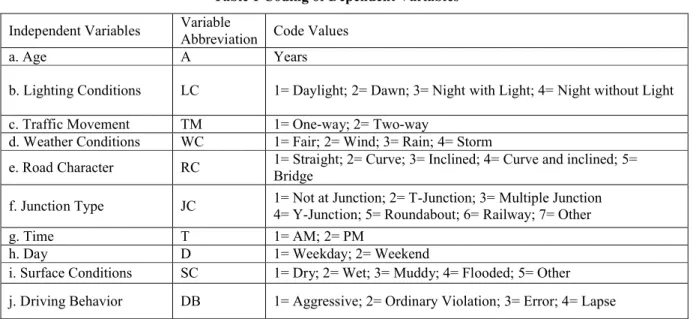
Logistic regression was utilized in predicting the chance of accidents. The dependent variable is the occurrence of accident and independent variables were age, lighting conditions, traffic movement, weather conditions, road character, junction type, time, day, surface conditions and driving behavior. The coding of these factors in the model is shown in Table 1.
Table 1 Coding of Dependent Variables
Independent Variables Variable
Abbreviation Code Values
a. Age A Years
b. Lighting Conditions LC 1= Daylight; 2= Dawn; 3= Night with Light; 4= Night without Light
c. Traffic Movement TM 1= One-way; 2= Two-way
d. Weather Conditions WC 1= Fair; 2= Wind; 3= Rain; 4= Storm
e. Road Character RC 1= Straight; 2= Curve; 3= Inclined; 4= Curve and inclined; 5= Bridge
f. Junction Type JC 1= Not at Junction; 2= T-Junction; 3= Multiple Junction
4= Y-Junction; 5= Roundabout; 6= Railway; 7= Other
g. Time T 1= AM; 2= PM
h. Day D 1= Weekday; 2= Weekend
i. Surface Conditions SC 1= Dry; 2= Wet; 3= Muddy; 4= Flooded; 5= Other
j. Driving Behavior DB 1= Aggressive; 2= Ordinary Violation; 3= Error; 4= Lapse
4. Results of the study
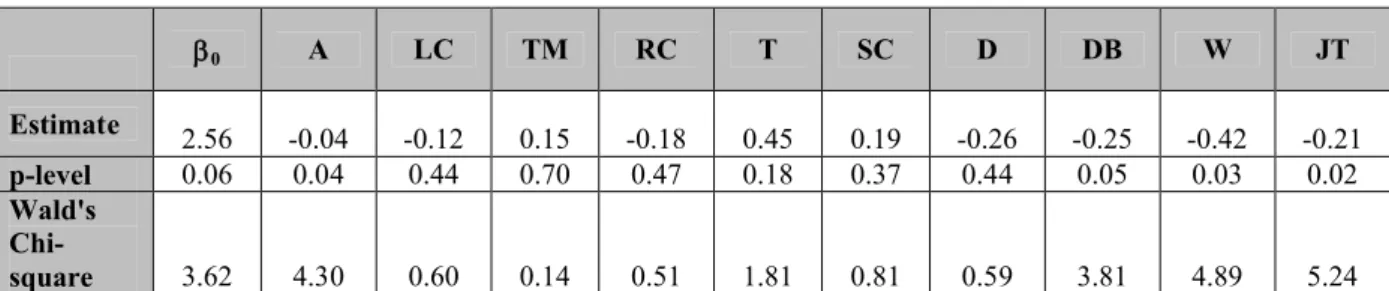
The results of the logistic regression are summarized in Table 2. Computing the t-test parameter and the Wald’s Chi-Square for each variable, significant variables found were Age, Weather and Junction Type. The maximum likelihood test was done to test the goodness of fit.
Table 2 Logistic Regression Results 0 A LC TM RC T SC D DB W JT Estimate 2.56 -0.04 -0.12 0.15 -0.18 0.45 0.19 -0.26 -0.25 -0.42 -0.21 p-level 0.06 0.04 0.44 0.70 0.47 0.18 0.37 0.44 0.05 0.03 0.02 Wald's Chi-square 3.62 4.30 0.60 0.14 0.51 1.81 0.81 0.59 3.81 4.89 5.24
Comparing the full model with all the parameters with the model with the intercept alone, the chi-square value was 24.3770 (p<0.05) making the model significant. The logit model is shown in Equation 1 and the odds ratio in Equation 2.
( )=−0.0358 −0.4177 ℎ −0.2113 (1)
( )
=
. . . (2)The results suggest that the chance of motorcycle accidents decrease with age which is consistent with previous studies that included age as a factor in motorcycle accident such as Lin et al. [17]. Young drivers have a higher tendency for risky behaviors than old ones probably because young people are impatient and full of energy. Young drivers are usually involved in speeding that increases the risk of getting into an accident [10]. Older drivers aside from being less risky are generally more experienced than younger drivers. They might have encountered driving problems in the past that imparted learning on the value of being cautious on the road.
It reasonable to believe that driving in rainy conditions is more challenging than in clear weather due to low visibility and slippery roads. It was observed that when there is heavy rain, drivers tend to slow down as it increases the occurrence of an accident [18]. As such, there is a greater chance of accidents during fair weather because drivers tend to speed up [19].
Based on the model more accidents happen on a crossroad. However, Clarke et al [20] contradicts this as they found that accidents are three times likely to occur on T-junctions because a turning driver usually fails to see an approaching motorcycle or to adequately judge the time available to cross the junction because motorcycles are less conspicuous. On the other hand, it is also argued that drivers are more likely to be involved in accidents in non-junctions because drivers tend to accelerate and exhibit aggressive driving [21]. Furthermore, there are fewer obstructions on non-junction roads and drivers tend to speed up. The cross-junction may have become significant in this study because in Metro Manila there are more vehicles passing through the roads. The number of vehicles in the junction increases the chance of collision with other vehicles especially motorcycles that are difficult to see. It was observed that motorcycle drivers are reckless and try to pass through even small gaps on the road.
5. Conclusion
The study showed that age, weather and junction type had significant relationships with the binary outcome variable, Accident Occurrence (No Accident or Accident). Coefficients of the variables were all negative indicating that a one unit increase for each variable would be detrimental to the probability that the motorcycle driver will be involved in an accident. The decrease, as indicated by the odds ratio, is largest with Age, followed by Junction Type, then Weather. Findings on age are attributed to the maturity and experience of older drivers compared to the younger drivers who are said to be more risky in other studies. For Weather, the negative coefficient is attributed to the cautiousness a drive when driving in more challenging road environments.
1. Metro Manila Development Authority, 2009, "Motorcycle Traffic Accidents 2009", M.S.U. Metro Manila Development Authority, Editor.
2. ABS-CBN News, 2008 "ABS-CBN News". [cited 2009 November 18]; Available from:
www.abs-cbnnews.com/nation/metro-manila/11/06/08/road-accidents-now-4th-leading-cause-death-doh.
3. Williams, M. and Hoffmann, E., 1978, "Motorcycle Conspicuity and Traffic Accidents",Accident Analysis
and Prevention. 11, 209-224.
4. Yau, K., 2003, "Risk factors affecting the severity of single vehicle traffic accidents in Hong Kong",
Accident Analysis and Prevention. 36, 333-340.
5. Savolainen, P. and Mannering, F., 2007, "Probabilistic models of motorcyclists’ injury severities in
single-and multi-vehicle crashes",Accident Analysis and Prevention. 39, 955-963.
6. Pai, C.-W. and Saleh, W., 2007, "Modelling motorcyclist injury severity by various crash types at
T-junctions in the UK",Safety Science. 46, 1234-1247.
7. Clarke, D., et al., 2004, "In-depth study of motorcycle accidents", D.f. Transport, Editor.London.
8. Shankar, V. and Mannering, F., 1996, "An Exploratory Multinomial Logit Analysis of Single-Vehicle
Motorcycle Accident Severity",Joumal of Safety Research. 27(3), 183-194.
9. Majdzadeh, R., et al., 2007, "Determinants of traffic injuries in drivers and motorcyclists involved in an
accident",Accident Analysis and Prevention. 40, 17-23.
10. Abdel-Aty, M.A. and Radwan, A.E., 2000, "Modeling traffic accident occurrence and involvement",
Accident Analysis and Prevention. 32, 633-642.
11. National Statistics Office, 2009 "QUICKSTAT on National Capital Region". [cited 2009 November 27];
Available from: http://www.census.gov.ph/index.html.
12. Yannis, G., Golias, J., and Papadimitri, E., 2005, "Driver age and vehicle engine size effects on fault and
severity in young motorcyclists accidents",Accident Analysis and Prevention. 35, 327-333.
13. Al-Ghamdi, A.S., 2002, "Using logistic regression to estimate the influence of accident factors on accident
severity",Accident Analysis and Prevention. 34, 729-741.
14. Laflamme, L. and Diderichsen, F., 2000, "Social differences in traffic injury risks in childhood and youth- a
literature review and research agenda",Injury Prevention. 6, 293-298.
15. Sivak, M., et al., 1989, "Cross-cultural differences in driver risk-perception", Accident Analysis and
Prevention. 21(4), 355-362.
16. Lajunen, T., Parker, D., and Summala, H., 2004, "The Manchester Driver Behavior Questionnaire: A
cross-cultural study",Accident Analysis, and Prevention. 36, 231-238.
17. Lin, M.-R., et al., 2003, "A longitudinal study of risk factors for motorcycle crashes among junior college
students in Taiwan",Accident Analysis and Prevention. 35, 243-252.
18. Majdzadeh, R., et al., 2008, "Determinants of traffic injuries in drivers and motorcyclists involved in an
accident",Accident Analysis and Prevention. 40, 17-23.
19. Shankar, V. and Mannering, F., 1996, "An Exploratory Multinomial Logit Analysis of Single-Vehicle
Motorcycle Accident Severity",Journal of Safety Research. 27(3), 183-194.
20. Clarke, D., Bartle, P., and Truman, W., 2004, " In-depth study of motorcycle accidents", D.f. Transport,
Editor.London.
21. Libres, G.T.C., Galvez, M.L.I., and Cordero, C.J.N., 2008, "Analysis of Relationship between Driver
Characteristic and Road Accidents along Commonwealth Avenue", in Department of Civil Engineering,