Process-based CRM: A Pilot Study
Manel Mastouri (Corresponing author)
Institut Superieur de Gestion
University of Tunis
E-mail : [email protected]
Salah Boumaiza
School of Management
University of Jendouba
E-mail : [email protected]
Abstract
A lot is written about Customer Resource Management (CRM) but little is found about its portability and compatibility. Only few of its components are transferable and when transferred the outcomes still remain unpredictable. The lack of standardization and portability seem to be the main factors behind its slow acceptance in the business community. By analogy to the International Organization for Standardization (ISO) quality management standards, this article proposes a process-based approach for the CRM concept. CRM performance is studied in terms of its objectives, its inputs, its control mechanism, and its outputs. This pilot study shows that a process-based approach is acceptable in evaluating a CRM system. This CRM architecture, if adequately implemented, will ease CRM portability and compatibility. However, despite this assertion, our preliminary conclusions still show that among all studied variables, only CRM input is found to significantly affect CRM performance; the rest of the variables have been excluded by a stepwise regression model.
Keywords:
CRM, Process-based approach, ISO, pilot study, CRM performance, CRM portability, CRM compatibility, Analytical CRM, Collaborative CRM.Introduction
Despite its abundance, the literature on CRM seems to be ineffective. Plenty of literature but it is all unsound white writing. Most of the white text available tells stories of CRM success that have worked for the claiming companies but have not been tested to expend its utility to similar agencies. Even though the small proportion of sound CRM studies that we succeeded to assemble are very valuable in their experimental environments they still remain silent when projected on different domains of CRM practice. Given our evaluation of the current CRM literature, both in white text and in statistically sound content, this article intends to study the evolution of the CRM concept, using a pilot study in Tunisia, based of similar studies conducted in the rest of the world.
We view the CRM project as a process that consists of a set of objectives, a control mechanism, a set of inputs, a set of outputs, and a transformation process that converts the inputs into outputs. If anything goes wrong in any of the components constituting the CRM process, the CRM project fails. The CRM system, as a process, is discussed later when selected hypotheses are tested. This article also conducts an empirical process-based study of the CRM system to understand its evolution trends given any collected information on its objectives, control mechanism, inputs, outputs, or its transformation process.
Defining CRM
We do not intend inhere to re-organize the literature and propose a CRM taxonomy. Even though such an attempt will be very useful to future studies, the CRM literature is still too young to taxonomize. We will however select the kind of related work we need to assemble to support our research. We will then start by providing a set of selected CRM definitions from the small but sound literature we could find. One may note that any navigator of the Internet who attempts to conduct even a brief Google search could come up with an abundance of items, including white papers and assorted pages, containing CRM literature. But remember that only a small fraction of the those CRM links really contain sound research that can be adopted in any serious research projects like the one we are undertaking. We briefly analyze the selected CRM definitions and study them for the purpose of electing one that we can adopt throughout this article. We next list those definitions in a chronological fashion as follows:
Wayland & Cole (1997): “CRM includes sharing four elements: customer combination management, value positioning, additional-value role and reward, and sharing which determine customer value.”
Kalakota & Robinson (1999): “CRM means to allow all of the departments and employees to work for satisfying all of the customers’ demands. CRM is a set of systems which integrates sales, marketing and after-sale service.”
Tiwana (2001): “From different perspectives, the enterprise understands and segments customers in order to develop a kind of combination model of enterprise procedure and information technology suitable for customized Product / Service which aims to manage the relationship with old customers and allows them to reach the highest level of loyalty, continuity rate and benefit contribution and efficiently selects and attracts new customers.”
Swift (2001): “CRM is an enterprise approach to understanding and influencing customer behavior through meaningful communications in order to improve customer acquisition, customer retention, customer loyalty, and customer profitability.”
Parvatiyar & Sheth (2001): “CRM is a comprehensive strategy and process of acquiring, retaining, and partnering with selective customers to create superior value for the company and the customer”
Bergeron (2002): "Customer relationship management (CRM) is the dynamic process of managing a customer-company relationship such that customers elect to continue mutually beneficial commercial exchanges and are dissuaded from participating in exchanges that are unprofitable to the company."
Kincaid (2003): “CRM is the strategic use of information, processes, technology, and people to manage the customer's relationship with your company (Marketing, Sales, Services, and Support) across the whole customer life cycle”
Kim et al. (2003): “CRM is managerial efforts to manage business interactions with customers by combining business process and technologies that seek to understand a company’s customers.”
Bligh & Turk (2004): “CRM is a customer-centric business strategy with the goal of maximizing profitability,
revenue, and customer satisfaction. Technologies that support this business purpose include the capture, storage and analysis of customer, vendor, partner, and internal process information. Functions that support this business purpose include Sales, Marketing and Customer Service, Training, Professional Development, Performance Management, Human Resource Development and Compensation.”
Sysoptima (2005): “CRM is a business system that consists of enterprise goals, business strategies, business processes and enterprise information systems.”
Salestrack (2005): “CRM is a process of building partnerships with your clients/customers, which involves technology, personal marketing techniques, strategic planning, and internal business processes from customer service, sales and marketing to build a relationship that adds to revenue margins and productivity.”
Christopher, Payne, & Ballantyne (2006): “CRM is a strategic approach to improving shareholder value through the development of appropriate relationships with key customers and customer segments.”
Wang & Kang, (2008): “Relationship Marketing can be defined as providing individualized products and services according to certain individual customers by means of information technologies and database, consequently establishing relationship with customers and therefore building Customer Loyalty and acquiring their Lifelong Value”
Barua & Udo, (2010): “CRM can be defined as (a) a business process that creates and leverages relationships with customers and other external marketplace entities; (b) a business strategy that invests in valuable customers; (c) a business philosophy that is customer-focus; (d) a business capability to understand the customers enough anticipate their future needs; and (e) a technology-based system for integrating sales, marketing, and services to build partnerships between the firm and its customers.”
Abdullateef, Mokhtar, & Yusoff, (2010): “CRM may be defined as “Organization’s ability to efficiently integrate people, process, and technology in maximizing positive relationships with both current and potential customers.”
Faed, Ashouri, & Wu, (2011): “Customer relationship management is the art of having a proper and sophisticated bond with customers and retains the long-lasting continuous relationship with them in a way that both parties can give mutual value to each other.”
All the above definitions are different and will certainly lead to different CRM implementations and CRM products. This will also lead to different CRM development and evaluation methodologies which will even divide more and more the already divided CRM adopters in terms of portability, compatibility, and standardization.
While examining the above definitions of CRM that we encountered in the literature, we however, attempted to identify the main definitional features that we found shared by most definitions above. The following ten definitional features are retained and are found to characterize most of the CRM definitions encountered in the literature:
1. Process: This definitional feature imposes that CRM is a process; that is a transformation mechanism that has clear objectives, inputs, and outputs.
2. Technology: This definitional feature requires that CRM employs technology in order to achieve prescribed objectives.
3. Strategy: This definitional feature vies CRM as a strategy and not a computer program.
4. People: This definitional feature suggests that the working of the CRM concept reposes on people. 5. Information: This definitional feature suggests that the working of the CRM concept reposes on information.
6. Matching product/enterprise and customer: This definitional feature suggests that the working of the CRM concept reposes on matching the enterprise and its products to its customers.
7. Know customers: This definitional feature suggests that the working of the CRM concept reposes on knowing its customers.
8. Business value: This definitional feature suggests that the working of the CRM concept is toned towards enhancing the company‟s business value.
9. Partnership: This definitional feature suggests that the working of the CRM concept reposes some kind of partnership between customers and the enterprise.
10. Relationship: This definitional feature suggests that the working of the CRM concept reposes on defining a relationship between the enterprise and its customers.
We examined the CRM definitions above and studied possible definitional aspects and features that are found in them. For example, we found that Wayland & Cole (1997)‟s definition only mentioned two aspects: the business value intended to be produced by a good CRM and the implied partnership between the enterprise and its customers. We found no mention of technology, or strategy in the statement defining CRM. On the other hand, Kincaid (2003)‟s definition of CRM suggests that CRM involves a process, a strategy, and people that are combined to understand customers and manage their relationship with the enterprise. It is also important to notice that some of the definition confuse or overlap ERP (Enterprise Relationship Management) with various flavors of CRM. ERP is often used to mean a software system with a primary goal to enhance internal business processes and facilitate the collaboration between the organization, its suppliers, and its partners. The confusion is associated with the fact that some of the partners may be company customers and this will generate possible overlapping between CRM and ERP.
A very popular reference identified in the collected bibliography is Bergeron‟s book of 2002 entitled „Essentials of CRM: A Guide To Customer Service Relationship Management; by Wiley: New York.‟ This book presents an overview of CRM, including a history of CRM, and also its limitations. CRM was originally intended to proactively provide the best customer service possible, while creating a database of customer preferences that can be reviewed by sales, marketing, and management. Bergeron discusses the increasing importance of the customer and the significance of the company-customer relationship to the sustainability and profitability of the enterprise, as well as how a CRM implementation can facilitate such a relationship. Bergeron also discusses the dynamics between the company and its customers, and how a positive experience increases profitability. We thought that Bergeron (2002) provided the best definition that we encountered in the CRM literature. Let us bring this definition back here; we intend to adopt this definition of CRM throughout the rest of this article: "Customer relationship management (CRM) is the dynamic process of managing a customer-company relationship such that customers elect to continue mutually beneficial commercial exchanges and are dissuaded from participating in exchanges that are unprofitable to the company"
Main contribution of the article
The CRM concept is a relatively new concept. Many of the features currently adopted in different markets have not been studied. These are major gaps in the CRM literature and can negatively affect the marketing strategies for new adopters of the CRM concept. A more major gap is the adoption of the CRM concept and its unproven features in new markets, like the Tunisian market used in our pilot study. While the CRM offers a new approach to know and retain customers which will enhance the business value for many organizations adopting it, it may be very risky for other companies that implement features that are not applicable to them. This article assembles major CRM features and organizes them using a based approach. The process-based approach is used by most ISO international standards as it provides a sound framework to evaluate the CRM concept, its inputs, its resources, and its outputs.
Those process-based CRM features are used to design a survey where the questionnaire is sent to all the subject companies we have identified as adopters of the CRM concept.
Research methodology
This article investigates various facets of the evolution of CRM using a pilot study conducted in Tunisia. This article uses an empirical study using a quantitative research methodology where the instrument is a survey questionnaire. The instrument, which is translated into French to ease its usability for the Tunisian subjects, contains 121 questions divided into 6 sections organized in terms of the CRM process approach:
1.CRM input section 2. CRM output section 3. CRM objectives section
4. CRM control mechanism section 5. CRM process section
6. CRM resource section Research Design
This section presents the research design adopted in this study. It includes our experimental design, our sampling process, and our hypotheses to be tested. Details of the data analysis based on our research objectives are discussed later in the paper. Sampling is needed here to select a part of the population of organizations that are CRM users, for the purpose of drawing general conclusion about the population. There are often three main interrelated concerns: sampling cost, information accuracy, and sample size. Sampling cost is primarily concerned with the cost of the sample size and the method of data collection. Information accuracy depends on sample representativeness, administrative errors, and subject errors and carelessness. The sample size is related to the availability of historical data about similar surveys, the confidence interval prescribed by survey owners, and the tolerated margin of error adopted.
At this point of the pilot study, we received 19 cases that we included in this study. According tour fixed tolerated error received from selected experts in the field of Marketing and IT, a sample size of 15 cases will be sufficient. Of course, more is better, but we do not have that luxury to have more cases because the population of CRM adopters in Tunisia is still very small. The difference between the pilot study and a formal one may be expressed in the error term, assuming a 95% confidence factor, as follows: (6 = [1.96/e]2 which gives e = .80; or 15 = [1.96/e]2 which gives e = .50). Assume that every subject participating in the survey requires a very high cost to fill out and return the questionnaire, and then the cost for using 15 cases will be about double the cost of using 6 cases. You can see that there should be a tradeoff between accepting an error of .80 when using a smaller sample of 6 cases and achieving a lower error of .50 by incurring double cost of using a larger sample of 15 cases.
As you can see, it is only a matter of how much error our owners accept to tolerate. If a higher error of .80 is tolerated by owners then the pilot study will be sufficient to study the effects of CRM features on CRM output in Tunisia. In this case, the higher cost of collecting more data to allow for a smaller error of .50 may not be necessary. It is important to note that even a sample size of 15 is statistically acceptable, and as explained above, a small number like this one may affect the data analysis later if normality is not present in the data set due its small size. Nonparametric statistics will be used in this case. This study is concerned with the evolution of the CRM in Tunisia. CRM is investigated using an empirical study using a quantitative methodology. Even though our instrument is too long, we are almost done collecting the data. As soon as we get back all survey data, we will enter the data and proceed to data analysis. We intend to test more than a dozen of hypotheses.
Our Data Analysis
Data analysis is the process of gathering, modeling, and transforming data in ways that generate decisional information that reveals conclusions for the support of the marketing decision making system in place. Data analysis employs many approaches adopting diverse techniques that are used by investigators in business, science, psychology, and so on. Data analysis is however preceded by several important phases that we present below. The validation step is concerned with the cleaning of erroneous entries that have to be inspected and corrected before processing the data. There may be missing data or incomplete data that has to be validated. Of course, any subjective decision on how to validate the data should be avoided in order to maintain the quality of the data. While data is being validated one has to make sure that original data is kept in a safe place to be available for possible re-assertion and verification. On the other hand, internal consistency is concerned with the estimation of reliability by grouping questions in a questionnaire that measures the same concept.
On may, for example, include two sets of three questions that measure the same concept and then correlate, often in a Spearman way, the two sets of responses, and then determine whether or not the instrument is reliably measuring that concept. Most often, Cronbach‟s Alpha is adopted in computing correlation values among the questions on the instruments. Cronbach's alpha, however on its own, will split all the questions on the instrument possible ways and computes correlation values for them all. The statistical package in use will generate one number, between 0 and 1, for Cronbach's alpha. As for any correlation interpretation, the closer the Cronbach‟s alpha value to one, the higher the reliability estimate of the instrument. If we compare an internal consistency test, using Cronbach's alpha, to a reliability test, we will find that the Cronbach‟s alpha method is considerably less conservative. From a management point of view and also based on costs, test/retest involves two administrations of the measurement instrument, whereas the internal consistency method involves only one administration of the same instrument.
As in most of the literature, „validity‟ is defined as the strength of a study‟s conclusions, inferences or propositions. Cook and Campbell (1979) defines validity as the best available approximation to the truth or falsity of a given inference, proposition or conclusion. The literature reports four types of validity tests: conclusion validity, internal validity, construct validity, external validity.
1. Conclusion validity is concerned with checking the relationship between the program and the observed outcome. For example, is there any connection between CRM applicability to the adopter and CRM success?
2. Internal Validity is concerned with checking whether any relationship between the program and any desired outcome, nothing but a causal relationship? Have CRM best practices contributed in enhancing CRM performance.
3. Construct validity is concerned with checking whether or not there is a relationship between how any concepts in this study and to the actual causal relationship being tested? For example, can any increase in IT spending be behind the increase in CRM performance?
4. External validity is concerned with the reader or investigator‟s ability to realize the results of the study to other settings. Does any concept we have statically proven for operational CRM also apply in analytical CRM?
In our study, we simply intend to obtain the Cronback‟s alpha value to assure the internal consistency of data. We obtained a value of Cronback alpha of .987. A value close to 1 shows that our data does not suffer from any internal inconsistencies.
Data exploration
While we cannot report all the SPSS Explore task here, we found that there is really not sufficient variability to produce any exploratory power that helps us better understand the data. At this point, we cannot advance the data analysis in a faster way, due to the lack of exploratory power of data, but we have to test for normality to have an idea about the things we can do and the things we cannot. For example, if we find out that our data is not normally distributed then we have to start thinking about non-parametric statistics.
Normality tests and opting for nonparametric analysis
Normality tests are concerned with determining whether or not a data set is well-modeled by a normal distribution. In this case, this represents how likely any random variable in the data set is to be normally distributed. The normality test is mainly needed for model selection, and can be interpreted several ways, depending on how probabilities are interpreted within the context of the data. Most often, as in this article, we encounter two uses of normally distributed data set (i.e., its variables are), in descriptive statistics terms, frequentist statistics hypothesis testing terms, or in Bayesian statistics. In the first use, we measure a goodness of fit of a normal model to the data; i.e., if such fit is not so good then the data is not well modeled by a normal distribution and the normality of the data set is rejected. In the second use, we test the data against the null hypothesis that it is normally distributed. In Bayesian statistics, the test of normality should be understood as we are computing the likelihood that the data is generated from a normal distribution.
We used SPSS to test the normality of the data set by testing for the normality of the variables making the data set. The output of the normality test is not shown in this article but will be provided upon request. We are here reporting only the significance probability values which are all greater than .005, for a 95% significance or .01 for a 90% significance. The arrays containing the significance probability values are not included here but may be provided upon request. At this point, we know that we do not have normality in our data set. This means that we cannot use any of the mean statistics that requires normality among other conditions. The only statistical analysis we can perform is non-parametric statistics. Nonparametric statistics is a branch of statistics dealing with variables without making assumptions about the form or the parameters of their distribution.
Parametric statistics uses the joint distribution of the observations where several unknown constants called parameters are in play. While unknowns in the model are the parameters, the functional form of the joint distribution is assumed to be known. We compute some quantities of interest that are called statistics. The aim of parametric statistics to use observations to draw inference about the unobserved parameters, often models based on means of variables (http://www.iiap.res.in/astrostat/School07/LectureNotes/Bendre.pdf). On the other hand, a nonparametric model does not use any assumptions about the functional form of the joint distribution. The only assumption we have is that observations are independent and identically distributed. There are no parameters in a nonparametric model.
Testing our process-based approach
Our study proposes two sets of contributions: 1) Testing whether or not CRM may be process-based; and 2) Testing selected hypotheses defining useful relationships among the studied CRM variables.
Testing the process-based CRM
A process approach will allow owners to manage the effectiveness of CRM requirements adopted by the organization. As shown in Figure 1, a process has objectives, inputs, outputs, a transformation process, and a control mechanism. This latter is needed to evaluate the gaps between the process performance criteria and its outputs. The transformation mechanism of each process is defined by marketing management. Assuming that there is nothing wrong with the process transformation mechanism then the gaps may be reduced by feasibly adjusting the inputs of the process. Optionally, a process may also display the resources used in transforming inputs into outputs. The control mechanism can only work well if two conditions are satisfied: simple metrics are in place; and precise measurements are available. It needs to assess the process outputs and evaluate the process objective based on its performance criteria and the outputs produced by the process. The control mechanism will make a decision on how to feasibly adjust the inputs in order to produce outputs that satisfy the performance criteria and achieve the desired level set for the process‟ objective.
In order to test the process-based approach for the CRM concept, we have to test at least 7 hypotheses, represented by arrows in Figure 1, and defining effects between Objectives and Control mechanism; Control mechanism and Transformation mechanism; Control mechanism and Inputs; Inputs and Transformation mechanism; Transformation mechanism and Outputs; Outputs and Control mechanism; and Resources and Transformation mechanism.
The questionnaire was designed intentionally to align with the process-based architecture of the CRM process. The same arrows shown on Figure 1 may be found also in the process-based CRM architecture shown in Figure 2. We also have placed hypotheses on the arrows to show the hypothesis testing activity that is to be conducted. The process-based approach hypotheses are:
H1: „CRM objectives tend to affect CRM maintenance.‟ H2: „CRM inputs tend to affect CRM process.‟
H3: „CRM maintenance tends to affect CRM process.‟ H4: „CRM maintenance tends to affect CRM outputs.‟ H5: „CRM inputs tend to affect CRM process.‟ H6: „CRM process tends to affect CRM outputs.‟ H7: „CRM resources tend to affect CRM process.‟
While there are many ways to test our hypotheses, bear in mind that our main objective is only to find significant correlations between the variables used to build the tested hypotheses.
Correlation types
Correlation is a measure of association between two variables. The variables are not designated as dependent or independent. The two most popular correlation coefficients are: Spearman's correlation coefficient rho and Pearson's product-moment correlation coefficient. However, because we have scale data we then have to calculate our correlation coefficients using Spearman's technique. The Pearson's technique should be used when we have interval or ratio-type data.
All those correlations therefore have to be performed with Spearman rank correlations because we are dealing with scale variables without that are not normally distributed as shown earlier. The following is a brief comparison between the Spearman rank correlations we are using and the Pearson correlations:
Spearman rank correlations: • Advantages
-Less sensitive to bias due to outliers‟ effects
-Does not require assumption of normality, although requires assumptions about symmetry of a Gaussian-like distribution
• Disadvantages
-Calculations become tedious in spreadsheet
-Ties are important and must be factored in to computation Pearson correlations:
• Advantages:
– Straightforward – Easy to compute • Disadvantages
– Assumes normality in both profiles of data – Sensitive to outliers
That is, in order to test the H1-H7 hypotheses, we need to estimate the correlations between the following pairs of variables. The correlation table, not shown here due to space reasons, produces the following correlations:
H1: Assert correlation between CRM objectives and CRM maintenance.
Correlation = .593
Significance Probability = .004
H2: Assert correlation between CRM inputs and CRM process:
Correlation = .529
Significance Probability = .010
H3: Assert correlation between CRM maintenance and CRM process:
Correlation = .489
Significance Probability = .017
H4: Assert correlation between CRM maintenance and CRM output:
Correlation = .561
Significance Probability = .006
H5: Assert correlation between CRM input and CRM process:
Correlation = .529
Significance Probability = .010
H6: Assert correlation between CRM process and CRM output:
Correlation = .752
Significance Probability = .000
H7: Assert correlation between CRM resources and CRM process:
Correlation = .506
Significance Probability = .014
After examining the above correlations, you may see that all correlations are significant. We therefore accept all the hypotheses with the corresponding probabilities of statistical significance. We then conclude that CRM may be presented as process-based approach. This conclusion will be crucial for future studies including developing international standards for the CRM concepts, as it is often a requirement that the standard be designed using a process-based approach (for example, ISO 9000/9002, ISO 27001/27002, and so on).
After examining the Spearman correlation table, not provided here, all the process-based hypotheses have been accepted at a statistical significance level of .01, except for H3 and H7, they were accepted at a statistical level of .05.
Testing selected CRM hypotheses
This is only a pilot study where we intend to prepare a more detailed and methodical study of what will be retained as important aspects of CRM that deserve a more thorough study. Given the structure of the experimental design in this study we thought that the following hypotheses deserve a more comprehensive study:
G1: “CRM change management has positive effects on CRM output.” G2: “Probability of success has positive effects on CRM output.” G3: “CRM applicability has positive effects on CRM output.” G4: “CRM best practices have positive effects on CRM output.” G5: “CRM best practices have positive effects on operational CRM.” G6: “CRM best practices have positive effects on analytical CRM.”
G7: “CRM best practices have positive effects on collaborative CRM.” G8: “Operational CRM has positive effects on CRM output.”
G9: “Analytical CRM has positive effects on CRM output.” G10: “Collaborative CRM has positive effects on CRM output.” G11: “CRM service process has positive effects on CRM output.”
Q12: “CRM maintenance has positive effects on CRM output.”
G13: “CRM objectives have positive effects on CRM output.”
As earlier in studying the CRM process approach, we first perform a correlation analysis. Correlations should be produced for all pairs of variables constituting each of the hypotheses above. If the significance probability is less than or equal to.005 then the corresponding hypothesis is accepted. Our SPSS computations produced the following results:
G1: “CRM change management has positive effects on CRM output.”
Correlation = .718
Significance probability = .000
G2: “Probability of success has positive effects on CRM output.”
Correlation = .770
Significance probability = .000
G3: “CRM applicability has positive effects on CRM output.”
Correlation = .509
Significance probability = .013
G4: “CRM best practices have positive effects on CRM output.”
Correlation = .729
Significance probability = .000
G5: “CRM best practices have positive effects on operational CRM.”
Correlation = .643
Significance probability = .001
G6: “CRM best practices have positive effects on analytical CRM.”
Correlation = .599
Significance probability = .003
G7: “CRM best practices have positive effects on collaborative CRM.”
Correlation = .755
Significance probability = .000
G8: “Operational CRM has positive effects on CRM output.”
Correlation = .675
Significance probability = .001
G9: “Analytical CRM has positive effects on CRM output.”
Correlation = .620
Significance probability = .002
G10: “Collaborative CRM has positive effects on CRM output.”
Correlation = .508
Significance probability = .003
The rest of the hypotheses G11, G12, and G13 are the same as hypotheses H7, H1, and H4 respectively. They have been tested earlier with the rest of the process-based approach hypotheses. Given the correlation information above, all the hypotheses have been accepted at a significance level of .01, except for G3, the statistical significance level was .05. The rest of the hypotheses G11, G12, and G13 are the same hypotheses H7, H1, and H4 respectively. They have been tested earlier with the rest of the process-based approach hypotheses.
Our regression analysis
At this point we have accepted all the hypotheses we defined. We now know that there are several important relationships between our CRM output and several independent variables of interest. Insights will be discussed in the managerial implications‟ section later in this article. Linear regression is used to examine the relationship between multiple independent variables and one or more response (dependent) variables. The regression statistics is useful to predict the response variable when relevant independent variables are known.
We intend to process the following linear regression: Y = α1X1 + α2X2 + α3X3 + α4X4 + α5X5 + α6X6 + α7X7 + α8X8 + α9X9 + α10X10 + α0 Where: X1=CRM Maintenance X2=Change Management X3=CRM Applicability X4=CRM Best Practices X5=Analytical CRM X6=Operational CRM X7=Collaborative CRM X8=CRM Reasons X9=CRM Defiance X10=CRM Objectives
αi = Coefficient or slope of Xi, i=1,10
α0 = error term
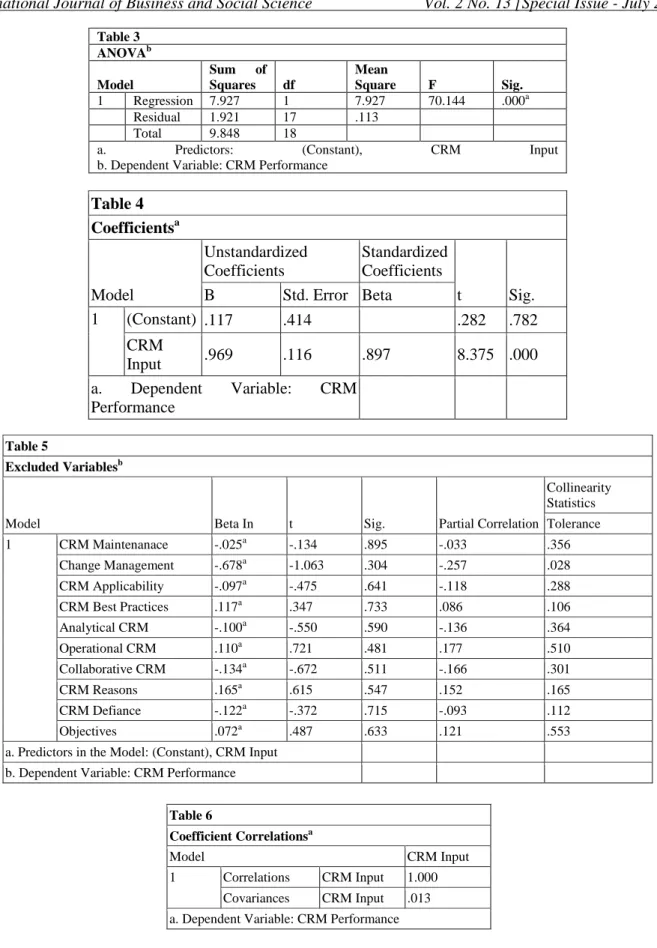
As you may see in the next tables 1 through 6, none of the independent variables is significantly related to CRM output (CRM performance); that is, those variables have no contributions in predicting CRM performance. We however used the method of stepwise regression that is designed to select the best variables to add in a regression line. This stepwise regression model has selected only the independent variable „CRM input‟ that has been selected to have significant relationship with CRM. The stepwise regression method processed 10 candidate variables that can potentially be employed to build a regression model. This method retained only one independent variable, called „CRM input‟ and excluded the rest of the 9 independent methods. The following variables have been excluded from the linear regression model: X1=CRM
Maintenance; X2=Change Management; X3=CRM Applicability; X4=CRM Best Practices; X5=Analytical
CRM; X6=Operational CRM; X7=Collaborative CRM; X8=CRM Reasons; and X9=CRM Defiance.
This section then analyzed our data for the purpose of producing some useful conclusions. Our data analysis proceeded by exploring the data set but the data has not shown sufficient variability. This lack of variability limited our ability to better understand the data which is needed to generate proposals of ideas that are to be tested throughout our data analysis. We then tested the data set for normality and obtained that normality is not present. The lack of normality obliged us to switch from an initial setting to perform parametric statistics to complete our study to non-parametric statistics. The Spearman correlation method was adopted to study all variables involved in defined our hypotheses. We had then two groups of hypotheses: a first set of hypotheses was needed to assert the process-based approach to model the CRM concept; and a second set of hypotheses defined to test some important relationships between certain independent variables and CRM performance. All hypotheses of the first group have been accepted which asserts the process-based approach to model the CRM concept. All hypotheses of the second group were accepted which tell us that we cannot study CRM output without studying all those independent variables.
Finally, after detecting the presence of those relationships between CRM output and many other variables of interest, it is only logical to advance further and build the linear regression model hoping to be able to build a predictive power for the purpose of classifying CRM output based on the knowledge of some selected independent variables. Results showed that all attempts to add the candidate variables to predicting regression line failed except for the „CRM input‟ variable. The regression we optionally produced (normality automatically corrected by the SPSS procedure applied) has not shown any significant results for all the variables included. The only variable that showed significant results is the CRM input variable. Because all the variables entered are excluded by the stepwise regression we applied, except for the input variable, we thought that we might need to develop a simple regression model with one independent variable, the CRM input. In fact, the production of the regression line where non-significant X‟s are excluded may not be necessary.
This means that the regression line equation developed and tested earlier is to be rejected, because all its variables, except for CRM input, have been excluded, and it is to be replaced by a linear equation that only includes one independent variable as follows:
CRM performance = .969 * CRM Input + .117
Where the intercept is not statistically significant.
In fact, this might be a very good result given that we are adopting a process-based approach, and in such approach, the output of one process becomes the input of another process, throughout the entire system.
This is to say that the process is by definition closely linked to other inputs in the system; that is, it makes a lot of sense, beyond intuitively, that CRM input and CRM output produce statistical significance on the coefficient on CRM input. In summary, this section revisited the data analysis phase and summarized it in a behavioral manner after it has simplified its complexities and communicated the findings to mangers and decision makers in the field of IT and Marketing. This section discussed two groups of ideas: Assertion of the process-based approach to model the CRM concept; and Testing of selected hypotheses associated with CRM output. It also presented how the business community can adopt our findings for greater use in their organizations for the purpose of advancing their effort of understanding their customers, build CRM-driven loyalty, and maintain healthy generation capability of greater business value for their firms.
Managerial Implications
This section revisits the data analysis phase and summarizes it in a behavioral manner to simplify its complexities and communicate the findings to mangers and decision makers in the field of IT and Marketing. We will discuss two groups of ideas: Assertion of the process-based approach to model the CRM concept; and Testing of selected hypotheses associated with CRM output. We will present how the business community can adopt our findings for greater use in their organizations for the purpose of advancing their effort of understanding their customers, build CRM-driven loyalty, and maintain healthy generation capability of greater business value for their firms.
The CRM as an international standard
“ISO 27001 uses a process-based approach, copying the model first defined by the Organization for Economic Cooperation and Development (OECD).”
Informationshield
ISO/IEC 27001:2005 specifies the processes to enable a business to establish, implement, review and monitor, manage and maintain an effective information security management system (ISMS). International standards are now imposing that any new standard has to be modeled against the layout of a process-based approach. Most of the literature (http://www.sriregistrar.com/) claims that the ISO 27001 standard is designed to integrate the process-based approach of ISO‟s management system standards – ISO 9001:2008 and ISO 14001:2004. We intended that this section provides sufficient information about the importance of the process-based approach. But not every concept fits the process-based approach. Its components have to behave like process components. In our case, we had to test and assert that the CRM concept can in fact be a process-based system. The process should connect to the output, the output to the control mechanism, the control mechanism to the process, from inputs to the output, and objectives to the control mechanism.
The testing of the hypotheses H1 to H7 showed that the CRM has been asserted as a process-based approach. This gives CRM adopters the capabilities to plan it, audit it, and build its integrated system by toning the objectives, the resources, the inputs, the transformation process, and the control mechanism to produce the outputs planned for it. The CRM may be developed into a standard, similar to total quality management, security management, and business continuity. Just by getting to this point, great advantages are gained in the business community because companies can now comply to the eventual CRM standard, and can get certified. One the standard is imposed on the business community by their government, by the international trade, or in voluntary manners to gain competitive advantage, customers and partners can now make educated decisions where to go to do business with.
Useful findings through correlations
Earlier, we have accepted the hypotheses Gi, i=1,13,with different significance level. By examining those
hypotheses, one can see that that there are many ways to achieve CRM performance. How to achieve the planned CRM performance? We may invest in better CRM change management and we can in this manner enhance CRM performance. Or we may improve some of the individual parameters constituting the probability of success and in this manner we can achieve the level of CRM performance we desire. Or we may enhance CRM applicability by diminishing all the negative effects that stand as barrier to the organization‟s CRM applicability, and in this manner, we can enhance CRM performance. Or we can invest in adopting adequately all known best practices which will lead to improving our CRM performance. Anyway, there are many ways to achieve the desired level of CRM performance. CRM adopters would like to understand what path they should take that lead them to higher CRM performance in more feasible ways; i.e., by minimizing costs, speeding recovery, and so on. The hypotheses G1 to G13 provide some ideas of the tradeoffs that can be made to obtain the desired level of CRM performance. For example, the operational CRM is related to best practices, and CRM adopters can improve their reliance on best practices by investing in improving some of the parameters constituting the operational CRM, the analytical CRM, or the collaborative CRM.
Conclusion
This article looked at the CRM project as a process that consists of a set of objectives, a control mechanism, a set of inputs, a set of outputs, and a transformation process that converts the inputs into outputs. If anything goes wrong in any of the components constituting the CRM process, the CRM project fails. The article conducted an empirical process-based study of the CRM activity to understand its evolution trends given any collected information on its objectives, control mechanism, inputs, outputs, or its transformation process. It investigated various facets of the evolution of CRM, using a pilot study in Tunisia. The CRM concept is a relatively new concept. Manny of the features currently adopted in different markets have not been studied. These are major gaps in the CRM literature and can negatively affect the marketing strategies for new adopters of the concept. Even a more major gap is the adoption of the CRM concept and its unproven features in the Tunisian market. While the CRM offers a new approach to know and retain customers which will enhance the business value for many Tunisian organizations adopting it, it may be very risky for other companies who implement features that are not applicable to them.
The article assembled major CRM features and organized them using a based approach. The process-based approach is used by most ISO international standards as it provides a sound framework to evaluate the CRM concept, its inputs, its resources, and its outputs. Those process-based CRM features are used to design a survey where the questionnaire is sent to all the Tunisian companies we have identified as adopting the CRM concept. The article discussed two groups of ideas: Assertion of the process-based approach to model the CRM concept; and Testing of selected hypotheses associated with CRM output. It also presented how the business community can adopt our findings for greater use in their organizations for the purpose of advancing their effort of understanding their customers, build CRM-driven loyalty, and maintain healthy generation capability of greater business value for their firms.
References
Abdullateef, A.O., Mokhtar, S.S. & R.Z. Yusoff, (2010). The impact of CRM Dimensions on Call Center
Performance, International Journal of Computer Science and Network Security, Vol.10, No.12.
Bergeron, B., (2002). Essentials of CRM: A Guide to Customer Relationship Management John Wiley & Sons,
Inc..
Barua, M.E. & G.J. Udo, (2010). Development And Diffusion Of Customer Relationship Management Across
Disciplines: Fad Or Fashion? Issues In Information Systems, Vol. XI, No. 1.
Bligh, P. & D. Turk (2004). CRM Unplugged – Releasing Customer Relationship Management (CRM)'S Strategic
Value. Hoboken: John Wiley & Sons.
Christopher, M., Payne, A., & D., Ballantyne (2006). Relationship marketing: Bringing quality, customer service
and marketing together. In J. Egan & M. J. Harker (Eds.), Relationship Marketing, Vol. 1 (pp. 65-92).
Cook, T.D. & D.T. Campbell, (1979). Quasi-Experimentation: Design And Analysis Issues For Field Settings.
Boston: Houghton-Mifflin.
Faed, A., Ashouri, A. & C. Wu, (2011). Maximizing Productivity Using CRM Within the Context of
M-Commerce, International Journal of Information Processing and Management. Vol 2, No. 1.
Kalakota, R. & Robinson, M. (1999). e-Business Roadmap for success. Sydney: Addision Wesley.
Kim, J., Suh, E., & Hwang, H. (2003). A model for evaluating the effectiveness of CRM using the balanced
scorecard, Journal of interactive Marketing, Vol. 17, No. 2, p. 5-19.
Kincaid, J. W. (2003). Customer Relationship Management: Getting it Right!, Prentice-Hall PTR, Upper Saddle
River, NJ.
Parvatiyar, A. & J.N. Sheth, (2001). Customer Relationship Management:Emerging Practice, Process, and
Discipline, Journal of Economic and Social Research 3(2) 2001, 1-34.
Swift, R. S. (2001). Accelerating Customer Relationships – Using CRM and Relationship Technologies. Prentice-Hall PTR. P. 480.
Tiwana, A., (2001). The Essential Guide to Knowledge Management: E-Business and CRM Applications, Prentice
Hall, Upper Saddle River, NJ.
Wayland, R. E. and Cole., P. M., (1979). Customer Connections: New Strategies For Growth, Havard Business
School Press, Boston, MA.
Wang, M.L. and K.W. Kang, (2008). Applying Customer Relationship Management on the New Recruiting Force
Project -An Example of Ministry of National Defense The Journal of Human Resource and Adult Learning, Vol. 4,
No. 2.
Wu, S., (2000). Research on Enterprise‟s Introduction of CRM, Master’s thesis of Department of Business
Table 1
Independent Variables Sig. Probabilities
X1=CRM Maintenance .356 X2=Change Management .028 X3=CRM Applicability .288 X4=CRM Best Practices .106 X5=Analytical CRM .364 X6=Operational CRM .510 X7=Collaborative CRM .301 X8=CRM Reasons .165 X9=CRM Defiance .112 Table 2 Variables Entered/Removeda
Model Variables Entered Variables Removed Method
1 CRM Input . Stepwise (Criteria: Probability-of-F-to-enter <= .050, Probability-of-F-to-remove >= .100). a. Dependent Variable: CRM Performance
Figure 2: Testing the Process-based approach for CRM
Objectives Control Mechanism Transformation mechanism Inputs Outputs Resources
Table 3 ANOVAb Model Sum of Squares df Mean Square F Sig. 1 Regression 7.927 1 7.927 70.144 .000a Residual 1.921 17 .113 Total 9.848 18
a. Predictors: (Constant), CRM Input
b. Dependent Variable: CRM Performance
Table 4 Coefficientsa Model Unstandardized Coefficients Standardized Coefficients t Sig. B Std. Error Beta 1 (Constant) .117 .414 .282 .782 CRM Input .969 .116 .897 8.375 .000 a. Dependent Variable: CRM Performance Table 5 Excluded Variablesb
Model Beta In t Sig. Partial Correlation
Collinearity Statistics Tolerance 1 CRM Maintenanace -.025a -.134 .895 -.033 .356 Change Management -.678a -1.063 .304 -.257 .028 CRM Applicability -.097a -.475 .641 -.118 .288 CRM Best Practices .117a .347 .733 .086 .106 Analytical CRM -.100a -.550 .590 -.136 .364 Operational CRM .110a .721 .481 .177 .510 Collaborative CRM -.134a -.672 .511 -.166 .301 CRM Reasons .165a .615 .547 .152 .165 CRM Defiance -.122a -.372 .715 -.093 .112 Objectives .072a .487 .633 .121 .553
a. Predictors in the Model: (Constant), CRM Input b. Dependent Variable: CRM Performance
Table 6
Coefficient Correlationsa
Model CRM Input
1 Correlations CRM Input 1.000
Covariances CRM Input .013