Decidability of Innermost Termination and
Context-Sensitive Termination for
Semi-Constructor Term Rewriting Systems
Keita Uchiyama
1Masahiko Sakai
2Toshiki Sakabe
3Graduate School of Information Science Nagoya University
Furo-cho, Chikusa-ku, Nagoya, 464-8603, Japan
Abstract
Yi and Sakai [13] showed that the termination problem is a decidable property for the class of semi-constructor term rewriting systems, which is a superclass of the class of right-ground term rewriting systems. Decidability was shown by the fact that every non-terminating TRS in the class has a loop. In this paper we modify the proof of [13] to show that both innermost termination andμ-termination are decidable properties for the class of semi-constructor TRSs.
Keywords: Context-Sensitive Termination, Dependency Pair, Innermost Termination
1
Introduction
Termination is one of the central properties of term rewriting systems (TRSs for short), where we say a TRS terminates if it does not admit any infinite reduction sequence. Since termination is undecidable in general, several decidable classes have been studied [6,8,9,12,13]. The class of semi-constructor TRSs is one of them [13], where a TRS is in this class if for every right-hand side of rules all its subterms having a defined symbol at root position are ground.
Innermost reduction, the strategy which rewrites innermost redexes, is used for call-by-value computation. Context-sensitive reduction is a strategy in which rewritable positions are indicated by specifying arguments of function symbols. Some non-terminating TRSs are terminating by context-sensitive reduction without loss of computational ability. The termination property with respect to innermost
1 Email: [email protected] 2 Email: [email protected] 3 Email: [email protected] 1571-0661 © 2008 Elsevier B.V. www.elsevier.com/locate/entcs doi:10.1016/j.entcs.2008.03.051
(resp. context-sensitive) reduction is called innermost (resp. context-sensitive) ter-mination. Since innermost termination and context-sensitive termination are also undecidable in general, methods for proving these terminations have been studied [2,4].
In this paper, we prove that innermost termination and context-sensitive termi-nation for semi-constructor TRSs are decidable properties. We show that context-sensitive termination forμ-semi-constructor TRSs having no infinite variable depen-dency chain is a decidable property. We also extend the classes by using dependepen-dency graphs.
2
Preliminaries
We assume the reader is familiar with the standard definitions of term rewriting systems [5], dependency pairs [4], and context-sensitive rewriting [2]. Here we just review the main notations used in this paper.
AsignatureF is a set of function symbols, where everyf ∈ F is associated with a non-negative integer by an arity function: arity :F →N. The set of alltermsbuilt from a signatureF and a countably infinite setV ofvariablessuch thatF ∩ V =∅, is represented byT(F,V). The set ofground termsisT(F,∅). The set of variables occurring in a termtis denoted by Var(t).
The set of all positions in a term t is denoted by Pos(t) and ε represents the root position. Pos(t) is: Pos(t) ={ε} if t∈ V, and Pos(t) = {ε} ∪ {iu| 1≤ i ≤ n, u ∈ Pos(ti)} if t = f(t1, . . . , tn). Let C be a context with a hole . We write
C[t]p for the term obtained fromC by replacing at positionpwith a termt. We sometimes write C[t] for C[t]p by omitting the position p. We say t is a subterm ofs ifs =C[t] for some contextC. We denote the subterm relationby , that is,
tsif tis a subterm ofs, andtsif ts andt=s. Theroot symbolof a termt
is denoted by root(t).
A substitution θ is a mapping from V to T(F,V) such that the set Dom(θ) =
{x ∈ V | θ(x) = x} is finite. We usually identify a substitution θ with the set
{x →θ(x)|x∈Dom(θ)}of variable bindings. In the following, we writetθinstead ofθ(t).
A rewrite rule l→r is a directed equation which satisfies l ∈ V and Var(r)⊆ Var(l). A term rewriting system TRS is a finite set of rewrite rules. A redex is a termlθfor a rule l→r and a substitution θ. A term containing no redex is called anormal form. A substitutionθ isnormalifxθis in normal forms for everyx. The
reduction relation −→R ⊆ T(F,V)× T(F,V) associated with a TRS R is defined as follows: s−→R t if there exist a rewrite rule l → r ∈ R, a substitution θ, and a context C[ ]p such thats=C[lθ]p andt=C[rθ]p, we say thats is reduced totby contracting redexlθ. We sometimes write −→p
R for −→R by displaying the positionp. A redex is innermost if all its proper subterms are in normal forms. If s is reduced to t by contracting an innermost redex, then s →R t is said to be an
Proposition 2.1 For a TRSR, if there is a reductions−−−→in,R t, thenC[s]−−−→in,R C[t]
for any contextC.
A mapping μ : F → P(N) is a replacement map (or F-map) if μ(f) ⊆
{1, . . . ,arity(f)}. The set ofμ-replacing positions Posμ(t) of a termtis: Posμ(t) =
{ε}, if t∈ V and Posμ(t) ={ε} ∪ {iu|i ∈μ(f), u∈ Posμ(ti)}, ift=f(t1, . . . , tn). A context C[ ]p is μ-replacing denoted by Cμ[ ]p if p ∈ Posμ(C). The set of all
μ-replacing variables of t is Varμ(t) = {x ∈ Var(t) | ∃C, Cμ[x]p = t}. The μ -replacing subterm relation μ is given by sμt if there is p ∈ Posμ(t) such that
t=C[s]p. Acontext-sensitive rewriting system is a TRS with an F-map. Ifs−→p t
andp∈ Posμ(s), thens−→p tis said to be aμ-reduction denoted bys−−→μ,R t.
Let → be a binary relation on terms, the transitive closure of →is denoted by
→+. The transitive and reflexive closure of → is denoted by →∗. If s →∗ t, then
we say that there is a →-sequencestarting from s to tor t is→-reachable from s. We writes→ktif tis→-reachable froms withk steps. A term tterminateswith respect to→ if there exists no infinite→-sequence starting fromt.
Example 2.2 Let R1 ={g(x)→h(x), h(d)→g(c), c→d} andμ1(g) =μ1(h) =
∅. A μ1-reduction sequence starting from g(d) is g(d)−−−−→μ
1,R1 h(d)−−−−→μ1,R1 g(c). We
can not reduceg(c) tog(d) becausec is not aμ1-replacing subterm ofg(c).
Proposition 2.3 For a TRSRand F-mapμ, if there is a reduction s−−→μ,R t, then Cμ[s]−−→
μ,R Cμ[t] for any μ-replacing context Cμ.
For a TRS R (and F-map μ), we say that R terminates (resp. innermost ter-minates, μ-terminates) if every term terminates with respect to →R (resp. −−−→
in,R ,
−−→μ,R ).
For a TRS R, a function symbol f ∈ F isdefined if f = root(l) for some rule
l→r∈R. The set of all defined symbols ofR is denoted byDR ={root(l)|l→ r∈R}. A termt has adefined root symbolif root(t)∈DR.
Let R be a TRS over a signature F. The signature F denotes the union of
F and DR = {f | f ∈ DR} where F ∩DR = ∅ and f has the same arity as f. We call these fresh symbols dependency pair symbols. We define a notation t by
t = f(t1, . . . , tn) if t = f(t1, . . . , tn) and f ∈ DR, t = t if t ∈ V. If l → r ∈R
anduis a subterm ofr with a defined root symbol and u l, then the rewrite rule
l → u is called a dependency pair of R. The set of all dependency pairs of R is denoted by DP(R).
Example 2.4 Let R2 = {a → g(f(a)), f(f(x)) → h(f(a), f(x))}. We have DP(R2) ={a→a, a→f(a), f(g(x))→a, f(g(x))→f(a)}.
A rule l→r is said to be right ground ifr is ground. Right-ground TRSs are TRSs that consist of right-ground rules.
Definition 2.5 [Semi-Constructor TRS] A TRS Ris a semi-constructorsystem if every rule in DP(R) is right ground.
Remark 2.6 The class of semi-constructor TRSs in this paper is a larger class of semi-constructor TRSs by the original definition because a rule l → u is not dependency pair if ul. The original definition of semi-constructor TRS is as follows [11]. A term t ∈ T(F,V) is a semi-constructor term if every term s such that stand root(s)∈DR is ground. A TRSR is a semi-constructor system ifr
is a semi-constructor term for every rule l→r∈R.
Example 2.7 The TRSR2 (in Example2.4) is a semi-constructor TRS but not in the original definition.
3
Decidability of Innermost Termination for
Semi-Constructor TRSs
Decidability of termination for semi-constructor TRSs is proved based on the ob-servation that there exists an infinite reduction sequence having a loop if it is not terminating [13]. In this section, we prove the decidability of innermost termination in a similar way.
Definition 3.1 [loop] Let→be a relation on terms. A reduction sequenceloops if it containst→+C[t] for some contextC, andhead-loopsif containingt→+t.
Proposition 3.2 If there exists an innermost sequence that loops, then there exists an infinite innermost sequence.
Definition 3.3 [Innermost DP-chain] For a TRS R, a sequence of the elements of DP(R) s1 → t1, s2 → t2, . . . is an innermost dependency chain if there exist substitutions τ1, τ2, . . . such that siτi is in normal forms and tiτi−−−→in,R ∗si+1τi+1
holds for everyi.
Theorem 3.4 ([4]) For a TRSR, R does not innermost terminate if and only if there exists an infinite innermost dependency chain.
Let M→≥ denote the set of allminimal non-terminating termsfor a relation on terms→ and an order on terms≥.
Definition 3.5 [C-min] For a TRS R, let C ⊆ DP(R). An infinite reduction se-quence inR∪Cin the formt1−−−−→
in,R∪C t2−−−−→in,R∪C t3−−−−→in,R∪C · · · withti ∈ M
−−−→in,R
for alli≥1 is called aC-min innermost reduction sequence. We use Cminin (t) to denote the set of allC-min innermost reduction sequences starting fromt.
Proposition 3.6 ([4]) Given a TRS R, the following statements hold:
(i) If there exists an infinite innermost dependency chain, then Cminin (t) = ∅ for someC ⊆DP(R) and t∈ M−−−→in,R .
(ii) For any sequence inCinmin(t), reduction by rules ofRtakes place below the root while reduction by rules of C takes place at the root.
(iii) For any sequence in Cminin (t), there is at least one rule in C which is applied infinitely often.
Lemma 3.7 ([4]) For two terms s and s, s−−−−−→
in,R∪C ∗s impliess−−−→in,R ∗C[s] for
some context C.
Proof. We use induction on the numbernof reduction steps ins−−−−→
in,R∪Cns. In
the case thatn= 0, s−−−→
in,R ∗C[s] holds where C = . Letn≥ 1. Then we have
s−−−−→in,R∪C n−1s−−−−→in,R∪C sfor somes. By the induction hypothesis,s−−−→in,R ∗C[s].
•Consider the case thats−−−→
in,R s. Sinces−−−→in,R s, we have C[s]−−−→in,R C[s] by Proposition2.1. Hence s−−−→in,R∗C[s].
•Consider the case thats−−→
in,C s. Sincesis a normal form with respect to→R,
we have s−−−→
in,R C[s] by the definition of dependency pairs. C[s]−−−→in,R C[C[s]], by Proposition2.1. Hences−−−→
in,R∗C[C[s]]. 2
Lemma 3.8 For a semi-constructor TRS R, the following statements are equiva-lent:
(i) R does not innermost terminate.
(ii) There exists l → u ∈ DP(R) such that sq head-loops for some C ⊆ DP(R)
and sq∈ Cminin (u).
Proof. ((ii)⇒(i)) : It is obvious from Lemma3.7, and Proposition3.2. ((i)⇒(ii)) : By Theorem3.4 there exists an infinite innermost dependency chain. By Propo-sition 3.6(i), there exists a sequence sq ∈ Cminin (t). By Proposition 3.6(ii),(iii), there exists some rule l → u ∈ C, which is applied at root position in sq in-finitely often. By Definition 2.5, u is ground. Thus sq contains a subsequence
u−−−−−−−−→
in,R∪DP(R)
∗· →
{l→u}u, which head-loops. 2
Theorem 3.9 Innermost termination of semi-constructor TRSs is decidable. Proof. The decision procedure for the innermost termination of a semi-constructor TRS R is as follows: consider all terms u1, u2, . . . , un corresponding to the right-hand sides of DP(R) = {li → ui | 1 ≤ i ≤ n}, and simultaneously generate all innermost reduction sequences with respect toR starting fromu1, u2, . . . , un. The procedure halts if it enumerates all reachable terms exhaustively or it detects a looping reduction sequenceui−−−→in,R +C[ui] for somei.
Suppose R does not innermost-terminate. By Lemma 3.8 and 3.7, we have a looping reduction sequence ui−−−→in,R+C[ui] for some i and C, which we eventually detect. If R innermost terminates, then the execution of the reduction sequence generation eventually stops since the reduction relation is finitely branching. In the latter case, the procedure does not detect a looping sequence, otherwise it contradicts Proposition3.2. Thus the procedure decides innermost termination of
4
Decidability of Context-Sensitive Termination for
Semi-Constructor TRSs
The proof of decidability for innermost termination is straightforward. However, the proof for context-sensitive termination is not so straightforward because of the existence of a dependency pair whose right-hand side is variable.
Definition 4.1 [μ-Loop] Let → be a relation on terms and μ be an F-map. A
reduction sequence μ-loopsif it containst→+Cμ[t] for some contextCμ.
Example 4.2 Let R3 = {a → g(f(a)), f(g(x)) → h(f(a), x)}, μ2(f) = {1},
μ2(g) = ∅ and μ2(h) = {1,2}. The μ2-reduction sequence with respect to R3
f(a)−−−−→μ
2,R3 f(g(f(a)))−−−−→μ2,R3 h(f(a), f(a)) −−−−→μ2,R3 · · · isμ2-looping.
Proposition 4.3 If there exists aμ-loopingμ-reduction sequence, then there exists an infinite μ-reduction sequence.
Definition 4.4 [Context-Sensitive Dependency Pairs [2]] Let R be a TRS and μ
be an F-map. We define DP(R, μ) = DPF(R, μ)∪DPV(R, μ) to be the set of
context-sensitive dependency pairs where:
DPF(R, μ) ={l→u|l→r∈R, uμr,root(u)∈DR, u μl}
DPV(R, μ) ={l→x|l→r∈R, x∈Varμ(r)\Varμ(l)}
Example 4.5 Consider TRSR3 andF-mapμ2 (in Example 4.2). DPF(R3, μ2) =
{f(g(x))→f(a)}and DPV(R3, μ2) ={f(g(x))→x}.
For a given TRSR and an F-map μ, we defineμ by μ(f) =μ(f) for f ∈ F, andμ(f) =μ(f) forf ∈DR. We writesμt forsμt.
Definition 4.6 [Context-Sensitive Dependency Chain] For a TRSRandF-mapμ, a sequence of the elements of DP(R, μ)s1→t1, s2→t2, . . . is a context-sensitive dependency chain if there exist substitutionsτ1, τ2, . . .satisfying both:
• tiτi−−−→ μ,R∗s i+1τi+1, ifti ∈ V • xτiμui−−−→ μ,R∗s
i+1τi+1for some term ui, ifti =x.
Example 4.7 Consider TRS R3 and F-map μ2 (in Example 4.2).
f(a), f(g(f(a)))∈ Mμ−−−−→μ2,R3 andf(f(a)), h(f(a), f(a))∈ Mμ−−−−→μ2,R3 .
Theorem 4.8 ([2]) For a TRSRand anF-mapμ, there exists an infinite context-sensitive dependency chain if and only if R does not μ-terminate.
Let R be a TRS, μ be an F-map and C ⊆ DP(R, μ). We define −−−→
μ,R,C as
(−−−−→
μ,CF ∪(−−−→μ,CV ·μ)∪ −−−→μ,R ) whereCF =C ∩DPF(R, μ) andCV =C ∩DPV(R, μ).
Definition 4.9 [μ-C-min] Let R be a TRS, μ be anF-map. An infinite sequence of terms in the form t1−−−→
μ,R,C t
ti ∈ Mμ−−→μ,R for alli≥1. We useCminμ (t) to denote the set of allC-minμ-sequences starting fromt.
Note thatCminμ (t) =∅if t∈ Mμ−−→μ,R .
Example 4.10 Let C = DP(R3, μ2), the sequence f(a)−−−−−→
μ2,R3,C f (g(f(a))) −−−−−→ μ2,R3,C f (a)−−−−−→ μ2,R3,C · · · is aC-minμ-sequence.
Proposition 4.11 ([2]) Given a TRSRand anF-mapμ, the following statements hold:
(i) If there exists an infinite context-sensitive dependency chain, thenCminμ (t)=∅
for some C ⊆DP(R, μ) andt∈ Mμ−−→μ,R .
(ii) For any sequence inCμmin(t), a reduction with −−−→
μ,R takes place below the root
while reductions with −−−−→
μ,CF and −−−→μ,CV take place at the root.
(iii) For any sequence in Cminμ (t), there is at least one rule in C which is applied infinitely often.
Lemma 4.12 For two terms s and t, s−−−→
μ,R,C ∗t implies s−−→μ,R ∗Cμ[t] for some
contextCμ.
Proof. We use induction on the lengthnof the sequence. In the case that n= 0, it holds trivially. Letn≥1. Then we haves−−−→
μ,R,C∗u−−−→μ,R,C tfor someu. •In the case thatu−−−−→
μ,CF t, we have u−−→μ,R Cμ[t] by the definition of dependency pairs.
•In the case thatu−−−→
μ,CV vμt, we haveu−−→μ,R Cμ[v] by the definition of depen-dency pairs andv=Cμ[t]. Thusu−−→
μ,R Cμ[Cμ[t]] =Cμ[t].
•In the case thatu−−−→
μ,R t, we have u−−→μ,R Cμ[t] forCμ[ ] =.
Therefore s−−→μ,R ∗Cμ[u]−−→μ,R Cμ[Cμ[t]] by the induction hypothesis and
Proposi-tion2.3. 2
4.1 Context-Sensitive Semi-Constructor TRS
In this subsection, we discuss the decidability ofμ-termination for context-sensitive semi-constructor TRSs.
Definition 4.13 [Context-Sensitive Semi-Constructor TRS] For an F-map μ, a TRSRis acontext-sensitive semi-constructor (μ-semi-constructor) TRSif all rules in DPF(R, μ) are right ground.
For an F-map μ, the class of μ-semi-constructor TRSs is a superclass of the class of semi-constructor TRSs from Definition2.5 and4.13.
For a TRSRandF-mapμ, we sayRis free from the infinite variable dependency chain (FFIVDC) if and only if there exists no infinite context-sensitive dependency
chain consisting of only elements in DPV(R, μ). IfR is FFIVDC, thenCminμ (t) =∅ for anyC ⊆DPV(R, μ) and any term t.
Lemma 4.14 Let μ be an F-map. If a μ-semi-constructor TRS R is FFIVDC, then the following statements are equivalent:
(i) R does notμ-terminate.
(ii) There exists l → u ∈DPF(R, μ) such that sq head-loops for C ⊆ DP(R, μ)
and somesq∈ Cminμ (u).
Proof. ((ii) ⇒ (i)) : It is obvious from Lemma 4.12, and Proposition 4.3. ((i)
⇒ (ii)) : By Theorem 4.8 there exists an infinite context-sensitive dependency chain. By Proposition 4.11(i), there exists a sequence sq ∈ Cminμ (t). By Proposi-tion4.11(ii),(iii) and the fact thatRis FFIVDC, there is some rule inl→u∈ CF
which is applied at the root position insq infinitely often.
By Definition 4.13, u is ground. Thus sq contains a subsequence u−−−→
μ,R,C
+u,
which head-loops and is inCminμ (u). 2
Theorem 4.15 Let μ be an F-map. If aμ-semi-constructor TRS R is FFIVDC, thenμ-termination ofR is decidable.
Proof. The decision procedure forμ-termination of a μ-semi-constructor TRS R
is as follows: consider all termsu1, u2, . . . , un corresponding to the right-hand sides of DPF(R, μ) ={li→ui |1≤i≤n}, and simultaneously generate all μ-reduction sequences with respect to R starting from u1, u2, . . . , un. The procedure halts if it enumerates all reachable terms exhaustively or it detects a μ-looping reduction sequenceui−−→
μ,R+Cμ[ui] for somei.
SupposeRdoes notμ-terminate. By Lemma4.14and4.12, we have aμ-looping reduction sequenceui−−→
μ,R +Cμ[ui] for somei andCμ, which we eventually detect. If R μ-terminates, then the execution of the reduction sequence generation even-tually stops since the reduction relation is finitely branching. In the latter case, the procedure does not detect a μ-looping sequence, otherwise it contradicts to Proposition 4.3. Thus the procedure decides μ-termination of R in finitely many
steps. 2
We have to check the FFIVDC property in order to use Theorem 4.15. How-ever, The FFIVDC property is not necessarily decidable. The following proposition provides a sufficient condition. The set DP1V(R, μ) is a subset of DPV(R, μ) defined as follows:
DP1V(R, μ) ={f(u1, . . . , uk)→x∈DPV(R, μ)| ∃i,1≤i≤k, i∈μ(f), x∈V ar(ui)}
Proposition 4.16 ([2]) Let R be a TRS, μ be an F-map and C ⊆ DP1V(R, μ). Cminμ (t) =∅for any term t.
If DP1V(R, μ) = DPV(R, μ) then R is FFIVDC by Proposition 4.16. Hence the following corollary directly follows from Theorem 4.15 and the fact that DP1V(R, μ) = DPV(R, μ) is decidable.
Corollary 4.17 For anF-mapμand aμ-semi-constructor TRSR,μ-termination ofR is decidable if DPV(R, μ) = DP1V(R, μ).
4.2 Semi-Constructor TRS
In this subsection, we try to remove FFIVDC condition from the results of the previ-ous subsection. As a result, it appears thatμ-termination of semi-constructor TRSs (notμ-semi-constructor) is decidable. The arguments of following Lemma4.18and
4.19are similar to those of Lemma 3.5 and Proposition 3.6 in [3].
Lemma 4.18 Consider a reduction s = Cμ[lθ]p−−−→
μ,R t = Cμ[rθ]p = C[u]q
wheres, u∈ Mμ−−→μ,R andq∈ Pos(t)\Posμ(t). Then one of the following statements holds
(i) su
(ii) vθ=uand r=C[v]q for some θ, v∈ V, C, andq ∈ Pos(r)\ Posμ(r)
Proof. Since q∈ Pos(t)\ Posμ(t),pis not below or equal to q. In the case thatp
andq are in parallel positions,sutrivially holds. In the case thatpis aboveq, it is obvious thatsuholds or, vθ=u andr=C[v]q for someθ, v∈ V, C. Here
the fact thatq ∈ Pos(r)\ Posμ(r) follows fromp∈ Posμ(t) and q∈ Posμ(t). 2
Lemma 4.19 Let R be a semi-constructor TRS, μ be an F-map. For a C-min μ-sequences1−−−→
μ,R∗ t1−−−→μ,CV u1μ s2−−−→μ,R∗ t2−−−→μ,CV u2μ· · · with no reduction
by rules in CF, one of the following statements holds for each i:
(i) sisi+1
(ii) There existsl→si+1∈DP(R)for some l
Proof. Since ti−−−→
μ,CV ui μ si+1, we have ti = C[si+1]q for some q ∈ Pos(ti)\
Posμ(ti). We show (i) or the following (ii’) by induction on the numbernof steps ofsi−−−→
μ,Rnt
i =C[si+1].
(ii’) There exists a reduction byl→r in si−−−→
μ,R∗ti andl→si+1∈DP(R)
•In the case thatn= 0, trivially si=tisi+1.
• In the case that n > 0, let si−−−→
μ,R s−−−→μ,Rn−1ti = C[si+1]q. By the induction hypothesis, s si+1 or the condition (ii’) follows. In the former case, we have
sisi+1, or, we have vθ =si+1 andr = C[v]q for some l→ r∈R, θ, v ∈ V, C
andq ∈ Pos(r)\ Posμ(r) by Lemma 4.18. Hence vθ = v due to root(si+1)∈DR
and Definition2.5. Therefore (ii’) follows. 2
One may think that the Lemma 4.19 would hold even if DP(R) were replaced with DP(R, μ). However, it does not hold as shown by the following counter exam-ple.
Example 4.20 Consider the semi-constructor TRS R4 = {f(g(x)) → x, g(b) →
f(g(b))−−−−→ μ3,R4 f(g(f(g(b)))−−−→ μ3,CV f(g(b)) μ3f(g(b)) whereCV = DPV(R4, μ3). However there exists no dependency pair having f(g(b)) in the right-hand side in DP(R, μ).
Lemma 4.21 For a semi-constructor TRSRand anF-mapμ, the following state-ments are equivalent:
(i) R does notμ-terminate.
(ii) There exists l → u ∈DP(R) such that sq head-loops for C ⊆ DP(R, μ) and somesq∈ Cminμ (u).
Proof. ((ii) ⇒(i)) : It is obvious from Lemma 4.12, and Proposition 4.3. ((i) ⇒ (ii)) : By Theorem4.8there exists a context-sensitive dependency chain. By Propo-sition 4.11(i), there exists a sequence sq ∈ Cminμ (t). By Proposition 4.11(ii),(iii), there exists a rule inC applied at root position insqinfinitely often.
• Consider the case that there exists a rule l → r ∈ CF with infinite use in sq. Since u is ground by Proposition4.11(ii) and CF ⊆ DP(R), sq has a subsequence
u−−−→
μ,R,C +u.
•Otherwise,sqhas an infinite subsequence without the use of the rules inCF. The subsequence is inCminμ (s) for somes. Then the condition (ii) of Lemma4.19holds for infinitely many i’s; otherwise, we have an infinite sequence sk sk+1· · · for somek, which is a contradiction. Hence there exists a l→u ∈DP(R) such that
u occurs more than once in sq. Thus the sequenceu−−−→
μ,R,C +uappears in sq. 2
Theorem 4.22 The propertyμ-termination of semi-constructor TRSs is decidable. Proof. The decision procedure for μ-termination of a semi-constructor TRS R is as follows: consider all terms u1, u2, . . . , un corresponding to the right-hand sides of DP(R) = {li → ui | 1 ≤ i ≤ n}, and simultaneously generate all μ-reduction sequences with respect to R starting from u1, u2, . . . , un. The procedure halts if it enumerates all reachable terms exhaustively or it detects a μ-looping reduction sequenceui−−→
μ,R+Cμ[ui] for somei.
SupposeRdoes notμ-terminate. By Lemma4.21and4.12, we have aμ-looping reduction sequenceui−−→μ,R +Cμ[ui] for somei andCμ, which we eventually detect. If R μ-terminates, then the execution of the reduction sequence generation even-tually stops since the reduction relation is finitely branching. In the latter case, the procedure does not detect a μ-looping sequence, otherwise it contradicts to Proposition 4.3. Thus the procedure decides μ-termination of R in finitely many
steps. 2
5
Extending the Classes by DP-graphs
5.1 Innermost TerminationIn this subsection, we extend the class for which innermost termination is decidable by using the dependency graph.
Lemma 5.1 Let R be a TRS whose innermost termination is equivalent to the non-existence of an innermost dependency chain that contains infinite use of right-ground dependency pairs. Then innermost termination of Ris decidable.
Proof. We apply the procedure used in the proof of Lemma 3.9 starting with termsu1, u2, . . . , un, whereui’s are all ground right-hand sides of dependency pairs. Suppose R is innermost non-terminating, then we have an innermost dependency chain with infinite use of a right-ground dependency pair. Similarly to the semi-constructor case, we have a looping sequenceui−−−→in,R+C[ui], which can be detected
by the procedure. 2
Definition 5.2 [Innermost DP-Graph [4]] The innermost dependency graph (in-nermost DP-graph for short) of a TRSR is a directed graph whose nodes are the dependency pairs and there is an arc froms→t to u→v if there exist normal substitutionsσ andτ such thattσ−−−→in,R ∗uτ anduτ is a normal form with respect toR.
An approximated innermost DP-graph is a graph that contains the innermost DP-graph as a subgraph. Such computable graphs are proposed in [4], for example.
Theorem 5.3 Let R be a TRS and G be an approximated innermost DP-graph of R. If at least one node in the cycle is right-ground for every cycle of G, then innermost termination of R is decidable.
Proof. From Lemma 5.1. 2
Example 5.4 Let R5 = {f(s(x)) → g(x), g(s(x)) → f(s(0))}. Then DP(R5) =
{f(s(x)) →g(x), g(s(x)) →f(s(0))}. The innermost DP-graph of R5 has one cycle, which contains a right-ground node [Fig.1]. The innermost termination ofR5 is decidable by Theorem5.3. Actually we know R5 is innermost terminating from the procedure in the proof of Theorem3.9 since all innermost reduction sequences fromf(s(0)) terminate.
Fig. 1. The innermost DP-graph ofR5
Example 5.5 Let R6 = {a → b, f(a, x) → x, f(x, b) → g(x, x), g(b, x) →
h(f(a, a), x)}. Then DP(R6) ={f(x, b)→g(x, x), g(b, x)→f(a, a), g(b, x)→
a}. The innermost DP-graph of R6 has one cycle, which contains a right-ground node [Fig. 2]. The innermost termination of R6 is decidable by Theorem 5.3. Actually we know R6 is not innermost terminating from the procedure in the proof of Theorem 3.9 by detecting the looping sequence
f(a, a)−−−→
Fig. 2. The innermost DP-Graph ofR6
5.2 Context-Sensitive Termination
We extend the class for which μ-termination is decidable by using the dependency graph. The class extended in this subsection is the class that satisfies the condition of Corollary 4.17.
Lemma 5.6 Let R be a TRS and μbe anF-map. If μ-termination of R is equiv-alent to the non-existence of a context-sensitive dependency chain that contains infinite use of right-ground rules in DPF(R, μ), then μ-termination of R is decid-able.
Proof. We apply the procedure used in the proof of Lemma4.22starting with terms
u1, u2, . . . , un, where ui’s are all ground right-hand sides of rules in DPF(R, μ). Suppose R is non-μ-terminating, then we have a context-sensitive dependency chain with infinite use of right-ground rules in DPF(R, μ). Similar to the μ -semi-constructor case, we have a looping sequenceui−−→
μ,R +Cμ[ui], which can be detected
by the procedure. 2
Definition 5.7 [Context-Sensitive DP-Graph [2]] Thecontext-sensitive dependency graph (context-sensitive DP-graph for short) of a TRS R and an F-map μ is a directed graph whose nodes are elements of DP(R, μ):
(i) There is an arc from s →t ∈DPF(R, μ) to u →v ∈ DP(R, μ) if there exist substitutionsσ andτ such that tσ −−−→
μ,R∗ uτ.
(ii) There is an arc from s → t ∈ DPV(R, μ) to each dependency pair u → v ∈
DP(R, μ).
Similar to the innermost case, a computable approximated context-sensitive DP-graph is proposed [2,3].
Theorem 5.8 LetRbe a TRS,μbe anF-map andG be an approximated context-sensitive DP-graph of R. The property μ-termination of R is decidable if one of following holds for every cycle inG.
(i) The cycle contains at least one node that is right-ground.
(ii) All nodes in the cycle are elements in DP1V(R, μ).
Proof. From Lemma5.6 and Theorem4.16. 2
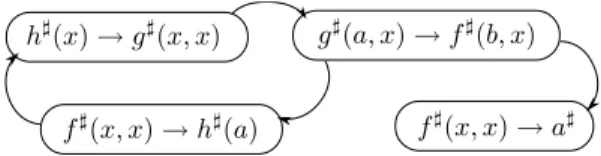
Example 5.9 Let R7 ={h(x)→g(x, x), g(a, x) →f(b, x), f(x, x) →h(a), a→
b} and μ4(f) = μ4(g) = μ4(h) = {1} [10]. Then DP(R7, μ4) = {h(x) →
g(x, x), g(a, x) → f(b, x), f(x, x) → h(a), f(x, x) → a}. The context-sensitive DP-graph ofR7 andμ4 has one cycle, which contains a right-ground node [Fig.3]. Theμ4-termination of R7 is decidable by Theorem5.8. Actually we know
R7 is μ4-terminating from the procedure in the proof of Theorem 4.15 since all
μ4-reduction sequences from h(a) terminate.
Fig. 3. The context-sensitive DP-Graph ofR7andμ4
Example 5.10 Let μ5(g) = {2} and μ5(f) = μ5(h) = {1}. Consider the
μ5-termination of R7. The context-sensitive DP-graph for R7 and μ5 is the same as the one for R7 and μ4 [Fig.3]. The μ5-termination of R7 is decidable by Theorem 5.8. By the decision procedure, we can detect the μ5-looping se-quence h(a)−−−−→
μ5,R7 g(a, a)−−−−→μ5,R7 g(a, b)−−−−→μ5,R7 f(b, b)−−−−→μ5,R7 h(a). Thus R7 is non-μ5-terminating.
The class of TRSs that satisfy the conditions of Theorem 5.8 is a superclass of the class of TRS that satisfy the conditions of Corollary 4.17. The class of semi-constructor TRSs and the class of TRSs that satisfy the conditions of Theorem5.8
are not included in each other.
Example 5.11 The TRS R7 with an F-map μ4 satisfies the condition of Theo-rem5.8, but is not semi-constructor TRS. On the other hand, the TRS R3 with an
F-map μ2 is a semi-constructor TRS, but does not satisfy the second condition of Theorem5.8.
6
Conclusion
We have shown that innermost termination for semi-constructor TRSs is a decid-able property andμ-termination for semi-constructor TRSs andμ-semi-constructor TRSs are decidable properties.
It is not difficult to implement the procedures in proofs of Theorem 3.9, Theo-rem4.15and Theorem 4.22. The class of semi-constructor TRSs are a rather small class: approximately 3 % of the TRSs in the termination problem data base 4.0 [1] are in this class. We can extend the decidable classes if we succeed in developing a method for good approximated DP-graphs.
In the future we will study the decidability of innermost termination and μ -termination by applying known techniques for -termination results [7,13]. Currently, innermost termination for shallow TRSs is known to be decidable [7]. There are several future works, studying whether the condition FFIVDC is removed from Theorem 4.15 or not, and extending the class of semi-constructor TRSs by using notions of context-sensitive DP-graph.
Acknowledgement
We would like to thank the anonymous referees for their helpful comments and remarks. This work is partly supported by MEXT.KAKENHI #18500011 and #16300005.
References
[1] The termination problems data base. http://www.lri.fr/˜marche/tpdb/.
[2] B. Alarc´on, R. Guti´errez, and S. Lucas. Context-sensitive dependency pairs. Inthe 26th Conference on Foundations of Software Technology and Theoretical Computer Science, volume 4337 ofLecture Notes in Computer Science, pages 298–309, 2006.
[3] B. Alarc´on, R. Guti´errez, and S. Lucas. Improving the context-sensitive dependency graph. Electronic Notes in Theoretical Computer Science, 188:91–103, 2007.
[4] T. Arts and J. Giesl. Termination of term rewriting using dependency pairs. Theoretical Computer Science, 236:133–178, 2000.
[5] F. Baader and T. Nipkow.Term rewriting and all that. Cambridge University Press, 1998.
[6] N. Dershowitz. Termination of linear rewriting systems. In the 8th International Colloquium on Automata, Languages and Programming, volume 115 of Lecture Notes in Computer Science, pages 448–458, 1981.
[7] G. Godoy, E. Huntingford, and A. Tiwari. Termination of rewriting with right-flat rules. Inthe 18th International Conference on Rewriting Techniques and Applications, volume 4533 ofLecture Notes in Computer Science, pages 200 – 213, 2007.
[8] G. Godoy and A. Tiwari. Termination of rewrite systems with shallow right-linear, collapsing, and right-ground rules. Inthe 20th International Conference on Automated Deduction, volume 3632 of Lecture Notes in Computer Science, pages 164–176, 2005.
[9] G. Huet and D. Lankford. On the uniform halting problem for term rewriting systems. Technical report, INRIA, 1978.
[10] S. Lucas. Proving termination of context-sensitive rewriting by transformation. Information and Computation, 204:1782–1846, 2006.
[11] I. Mitsuhashi, M. Oyamaguchi, Y. Ohta, and T. Yamada. The joinability and unification problems for confluent semi-constructor trss. Inthe 15th International Conference on Rewriting Techniques and Applications, volume 3091 ofLecture Notes in Computer Science, pages 285 – 300, 2004.
[12] T. Nagaya and Y. Toyama. Decidability for left-linear growing term rewriting systems. Information and Computation, 178:499–514, 2002.
[13] Y. Wang and M. Sakai. Decidability of termination for semi-constructor trss, left-linear shallow trss and related systems. Inthe 17th International Conference on Rewriting Techniques and Applications, volume 4098 ofLecture Notes in Computer Science, pages 343–356, 2006.