CREATIVITY TRAINING EFFECTS UPON CONCEPT MAP
COMPLEXITY OF CHILDREN WITH ADHD: AN
EXPERIMENTAL STUDY
By
Keetam Alkahtani
B.Sc. Special Education M.Sc. Clinical PsychologyA thesis submitted in fulfillment of the requirements for the
Degree of Doctor of Philosophy
University of Glasgow
Faculty of Education
Department of Educational Studies
ABSTRACT
The rationale for this study was to extend the knowledge about creative thinking among children with attention deficit hyperactivity disorder (ADHD) by investigating the effects of creativity training upon concept mapping complexity. To verify whether the CoRT Thinking Lessons can enhance creative ability and improve concept map complexity, a Pretest-Posttest Control Group Design was used in this study. Sixty four students who are fourth and fifth graders (age 9-10 years) and classified as having ADHD participated in the investigation. In order to ensure that concept mapping is a familiar technique to all participants, they all were given a training session in concept mapping. Next to that, they were asked to complete a concept map and Torrance tests of creative thinking (TTCT) as a pre-test measure. After that, they were assigned to either experimental or control group, each group consisted of thirty two students. The experimental group was given creativity training (20 hours of CoRT thinking lessons during ten weeks) and the control group received no creativity training. Finally, all sixty four participants completed a second concept map and the TTCT as a post-test measure.
Data collected from participants were analyzed via the Pearson product-moment correlation coefficient, the t test for two independent samples, and the paired-sample t test. Results of the analysis indicated that participants who received creativity training developed significantly more complex concept maps than those participants who received no such creativity training. Thus, creativity training enhances both concept mapping complexity and creative ability of students with ADHD as measured by the TTCT. Implications for practice include recommendation for teachers to design and establish educational activities and environments in which creative abilities of children with ADHD can be develop.
TABLE OF CONTENTS
LIST OF TABLES………...………..………..…….… LIST OF FIGURES……….………..…...
CHAPTER ONE: INTRODUCTION………..….……….…….
Rationale for the Study………..………. Purpose of the study………...………..… Significance of the study……….………...……….…
Research Questions………...……..………..………….
CHAPTER TWO: CREATIVITY………..………
Introduction……….………... History and Theories of Creativity ……….………..……… Definition of Creativity……….…………..….. Characteristic of Creative Individuals ……….………….……… The Developmental Stages of Creativity……….……….….…..….. Creativity and Education……….……….………..……… Conclusion………..…………
CHAPTER THREE: ADHD………..………..…
Introduction………..………... A brief History of ADHD ……….….…….………...……… Symptoms and Definition of ADHD………..…….…..………. Developmental Stages of ADHD ………..………..…….………. Etiology of ADHD………...…..……….…….…….………. Treatment of ADHD………...……….……….…………. Assessment and Diagnosis of ADHD …………..…..……….….………. ADHD and Education………...……….……… ADHD and Special Education………..………. Conclusion………..………
CHAPTER FOUR: CREATIVITY AND ADHD………..………
CHAPTER FIVE: CONCEPT MAPPING……….………
Introduction………..………... The Origins of Concept Mapping………... Purposes and Applications of Concept Mapping…………...………..…….. Conclusion……….……….………..………..
CHAPTER SIX: REFLECTION ON CREATIVITY, ADHD, AND
CONCEPT MAPPING ………...……….……… v viii 1 1 4 9 15 17 17 17 30 40 41 49 57 60 60 60 67 74 80 86 91 94 109 113 115 126 126 126 131 145 146
CHAPTER SEVEN: METHODOLOGY……..……….………
Introduction…………..……….……… Participants………..……..………. Experimental Design……….………..……….. Procedure for Data Collection……….………..………. Instrumentations of the Study………..……….. Conclusion………..…………..……….……….
CHAPTER EIGHT: ANALYSIS AND RESULT………..………
Introduction………..…………..……… Data Analysis……….…………. Alpha Level……….………..……… Null Hypotheses Findings………...……..………. Conclusion ………
CHAPTER NINE: DISCUSSION OF FINDINGS, RECOMMENDATIONS, FUTURE RESEARCH, AND CONCLUSION ………
Introduction……….……..…..……….. Review of Investigation………..……….. Discussion of Findings………...……….……….. Delimitations and Limitations……….……….. Recommendations………..……….……….. Future Research………..………..……… Conclusion ………..……….……… REFERENCES ……….…..………. APPENDIXES………...………..……….. 154 154 154 157 158 161 173 175 175 175 176 176 202 204 204 204 209 214 217 222 225 226 286
LIST OF TABLES
Table Page
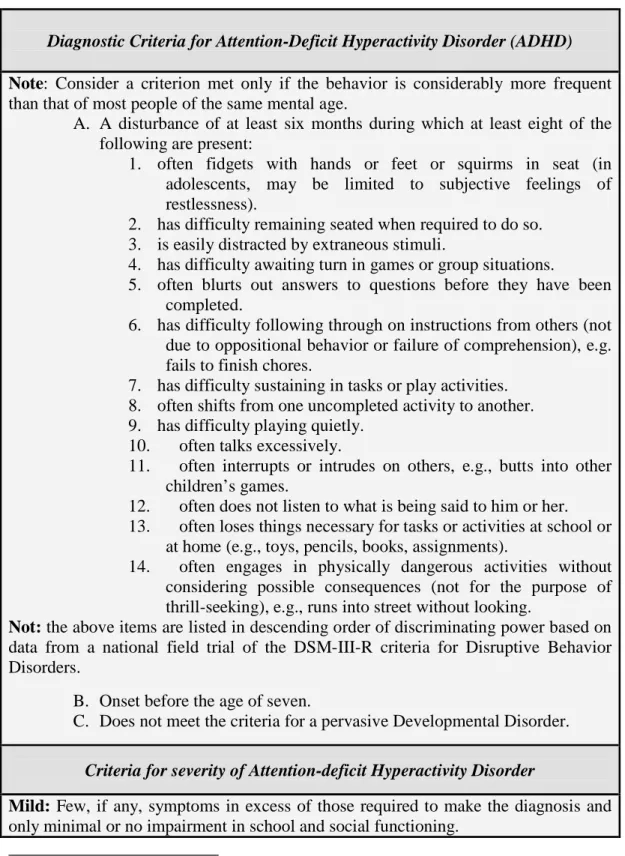
Table 3.1 Diagnostic and statistical manual of mental disorders (3rd Edition) DSM-111 criteria for ADHD.
Table 3.2 Diagnostic and statistical manual of mental disorders (3rd Edition-Revised) DSM-111-R criteria for ADHD.
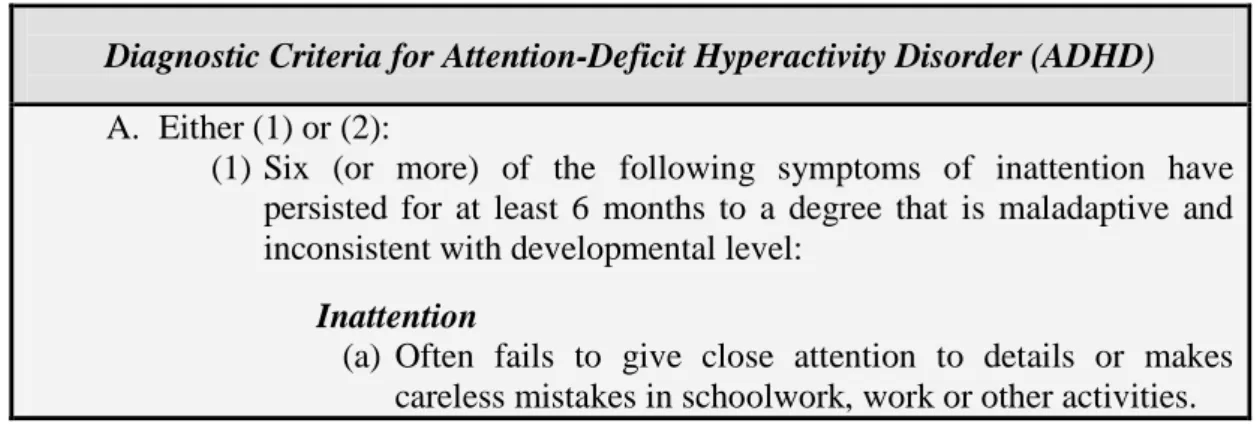
Table 3.3 Diagnostic and statistical manual of mental disorders (4th Edition-Revised) DSM-1V + DSM-1V –TR criteria for ADHD.
Table 3.4 Example of an Inadequate Use of the Designated Quiet Place.
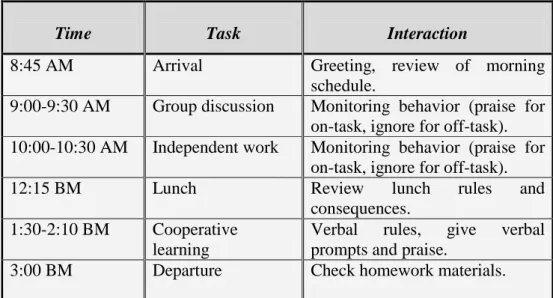
Table 3.5 Sample Timetable for Teaching Assistant's Supervision of Child with ADHD.
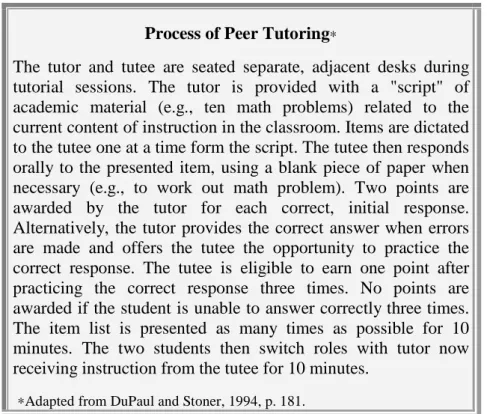
Table 3.6 Description of the Process of Peer Tutoring.
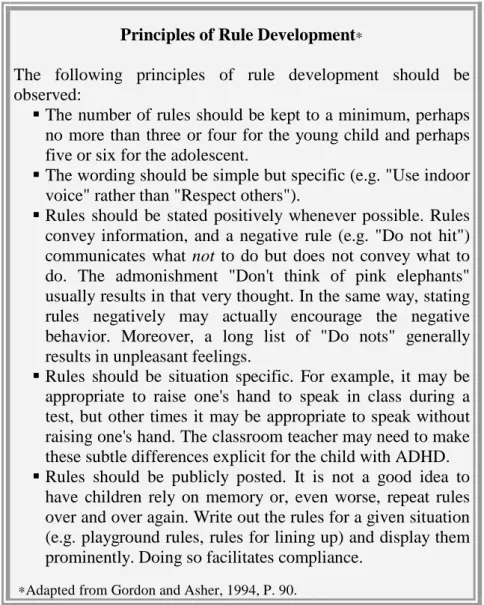
Table 3.7 The Main Principles of Developing the Classroom Rules.
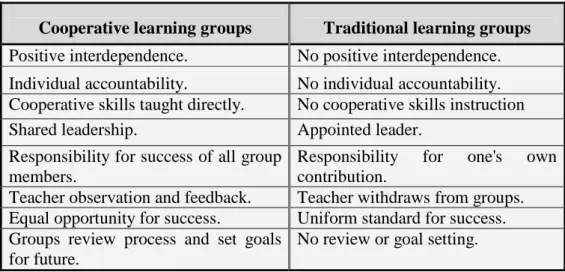
Table 3.8 Differences Between Cooperative Learning Groups and Traditional Groups.
Table 3.9 Inclusion Team Roles: Division of Labor.
Table 4.1 Comparison of Behavioural Characteristics of Creativity and ADHD.
Table 6.1 Literature's Data Sources.
Table 7.1 The Experimental Design.
Table 7.2 Descriptive Statistics for the TTCT.
Table 7.3 Concept Mapping Descriptive Statistics.
Table 8.1 The Number of Participants, Mean, Standard Deviation and r Value of TTCT and Concept Mapping on the Pretest and Posttest.
Table 8.2 Comparison between the Posttest Results of the Experimental and the Control Group on the TTCT.
62 64 65 98 100 102 104 105 113 119 146 157 160 160 177 179
Table 8.3 Comparison between the Results of the Pre-test and the Posttest of the Experimental Group on the TTCT.
Table 8.4 Comparison between the Results of the Pre-test and the Posttest of the Control Group on the TTCT.
Table 8.5 Comparison between the Results of the Experimental and the Control Group on the Concept Mapping.
Table 8.6 Comparison between the Results of the Pre-test and the Posttest of the Experimental Group on the Concept Mapping.
Table 8.7 Comparison between the Results of the Pre-test and the Posttest of the Control Group on the Concept Mapping.
Table 8.8 Comparison between the Results of the Proposition’s Scores Achieved by the Experimental and the Control Group.
Table 8.9 Comparison between the Results of the Proposition’s Scores Achieved by the Experimental Group in the Pre-test and the posttest.
Table 8.10 Comparison between the Results of the Proposition’s Scores Achieved by the Control Group in the Pre-test and the posttest.
Table 8.11 Comparison between the Results of the Hierarchy’s Scores Achieved by the Experimental and the Control Group.
Table 8.12 Comparison between the Results of the Hierarchy’s Scores Achieved by the Experimental Group in the Pre-test and the Posttest.
Table 8.13 Comparison between the Results of the Hierarchy’s Scores Achieved by the Control Group in the Pre-test and the posttest.
Table 8.14 Comparison between the Results of the Cross Link’s Scores Achieved by the Experimental and the Control Group.
Table 8.15 Comparison between the Results of the Cross Link’s Scores Achieved by the Experimental Group in the Pre-test and the Posttest.
Table 8.16 Comparison between the Results of the Cross Link’s Scores Achieved by the Control Group in the Pre-test and the Posttest. 181 182 183 185 186 187 189 190 191 193 194 195 197 198
Table 8.17 Comparison between the Results of the Example’s Scores Achieved by the Experimental and the Control Group.
Table 8.18 Comparison between the Results of the Example’s Scores Achieved by the Experimental Group in the Pre-test and the Posttest.
Table 8.19 Comparison between the Results of the Example’s Scores Achieved by the Control Group in the Pre-test and the Posttest.
199
201
LIST OF FIGURES
Figure Page
Figure 2.1 Maslow's Hierarchy of Needs.
Figure 2.2 The Structure of Intellect.
Figure 2.3 Relationships Between Application, Problem Solving, and Creativity.
Figure 3.1 The Clinical Teaching Cycle.
Figure 5.1 Concept Map about Concept Maps.
Figure 5.2 Concept Map Showing Key Concepts in Concept Mapping.
Figure 7.1 Sample Characteristics.
Figures 8.1 The Correlation between the TTCT and Concept mapping scores on the pretest.
Figures 8.2 The Correlation between the TTCT and Concept mapping Scores on the Posttest.
Figure 8.3 The Posttest Results of the Experimental and the Control Group on the TTCT.
Figure 8.4 The Results of the Pre-test and the Posttest of the Experimental and the Control Group on the TTCT.
Figure 8.5 The Posttest Results of the Experimental and the Control Group on the Concept Mapping.
Figure 8.6 The Results of the Pre-test and the Posttest of the Experimental and the Control Group on the Concept Mapping
Figure 8.7 The Proposition’s Scores Achieved by the Experimental and the Control Group on the Posttest.
Figure 8.8 The Proposition’s Scores Achieved by the Experimental and the Control Group in the Pre-test and the Posttest.
Figure 8.9 The Hierarchy’s Scores Achieved by the Experimental and the Control Group on the Posttest.
21 35 51 112 129 130 160 178 178 180 182 184 186 188 190 191
Figure 8.10 The Hierarchy’s Scores Achieved by the Experimental and the Control Group in the Pre-test and the Posttest.
Figure 8.11 The Cross Link’s Scores Achieved by the Experimental and the Control Group on the Posttest.
Figure 8.12 The Cross Link’s Scores Achieved by the Experimental and the Control Group in the Pre-test and the Posttest.
Figure 8.13 The Example’s Scores Achieved by the Experimental and the Control Group on the Posttest.
Figure 8.14 The Example’s Scores Achieved by the Experimental and the Control Group in the Pre-test and the Posttest.
194
196
198
200
CHAPTER ONE
INTRODUCTION
This chapter is organized in the following manner. It begins with the rationale for this study. The purpose and the significance of the study will also be introduced. The chapter ends with a specification of the study questions.
Rationale for the Study
It is inevitable that schools and, indeed, universities, will emphasize the sharing of knowledge and skills which have come from the past. However, the students of today will live their lives in the world of tomorrow where, with incessant change, things may be very different. Thus, people who can use facts, ideas, and materials of the past as a springboard for future developments are needed in any society. One major task in education, therefore, is to produce more minds that focus on the future than those that concentrate on the past (Taylor, 1964). Nonetheless, traditional education has been more successful at educating students to recite the facts of the past than to develop skills and concepts that will enable them to both discover and use knowledge in the future (Blagg, 1991; Marksberry, 1965). Fisher emphasized this issue, in his words:
there is evidence that traditional teaching methods are efficient in teaching what the Greeks called tekne, the 'technical' side of knowing how to do and make things, the basic skills and techniques which need to be introduced and practiced by beginners in any area of learning. But traditional methods are less successful in developing what Greeks called Phronesis, that is practical wisdom or intelligence, the higher order thinking which enhances skill to the level of expertise (2003, p.18).
It is clear that, these days, we live in a global environment where information and technology are changing as science expounds new insights nearly everyday. For example, Cropley observed that "the knowledge and skills
needed in the future may not even be known at the time a person attends school or university" (2001, p.135). These changes led educators to realize the importance of teaching children skills which they will need as adults, and to become more effective learners. There is no one way to teach these skills, but creativity training has been suggested by many educators and educational leaders as a successful strategy to empower students to understand their abilities, learning style, and to take charge of their own learning.
The movement that promotes creativity training as an essential practice in schools started during the 1950’s. Torrance (1963, p. 12-45) has argued that increasing the level of creative thinking is important and he also offered some reasons to reinforce the desire of both teachers and parents to give children a chance to learn and think creatively. These reasons were summarized by Russell and Meikamp (1994, p. 297) as follows:
Creative thinking,
Helps maintain good mental health and enhances personality development. May lead to the acquisition of new knowledge.
May help in solving daily problems.
Helps people of present and future generations to survive.
Although amending or adding to Torrance's specifications is possible, denying the value of any of those listed is difficult. In fact, everyone who is interested in creativity (such as education leaders, educators and researchers) has tended to agree on one aspect of creativity which is the tremendous value of teaching creativity for everyone and in every domain.
However, unfortunately, not everyone believes that creativity can be taught (e.g. Alvin Wolf who believes that creativity is an important quality and can be encouraged but not taught, in Fraenkel, 1977). According to Runco (2007) the
question of the possibility of teaching creativity and enhancing creative ability may be related to:
A misunderstanding of human behavior. Virtually all human behaviors are flexible. They each have a range of reaction. The range is genetically determined, and the skill or behavior is a reaction to the experiences that influence that potential. It is very much like exercising. Not everyone will be an outstanding weight-lifter, but everyone can build muscle. The amount of muscle built will depend on genetic potentials and the amount of exercise. Creative talents depend on the same two things … programs and techniques … will very likely increase the likelihood that the individual will behave in a creative fashion (p. 372).
Runco's argument suggests that whilst all people have creativity, some people have more than others. Just as some people can enhance their physical strength through exercise, he argues that creativity can also be increased through techniques and exercise presented in creativity programme (such as CoRT which was used in the present study). If this argument is valid creativity training can, as one would suspect, help individuals to perform more creatively.
The above argument by Runco is in line with other researchers' arguments that creativity is very much a feature of humanity. Perhaps it can be found to some degree in everyone and creative abilities are teachable and measurable in terms of fluency, flexibility, originality, and elaboration (e.g. Amabile, 1983, 1989; Blagg, 1991; Dacey, 1989; Getzels and Jackson, 1962; Guilford, 1967; Parnes, 1963; Sternberg, 1995, 1999, 2000; Torrance, 1962a, 1963, 1972; Torrance and Safter, 1989).
Furthermore, results of experimental studies support this argument. Torrance analyzed 103 experimental studies which used nine different programmes to enhance creative ability and the Torrance tests of creative thinking (TTCT) was used to measure the effectiveness of each programme. Torrance concluded
from his review of literature that it is possible to teach children how to think creatively (Torrance, 1972, p. 132-133). In addition, results of more recent Meta-analysis studies confirmed that creative abilities can be enhanced by training (e.g. Ma, 2006; Scott et al., 2004a, 2004b).
Purpose of the Study
Since every child should have the chance to learn and think creatively and assuming that everyone is creative to some measure and creative abilities can be enhanced, this study explores the question about whether creativity training can improve the creativity of children who have ADHD. More specifically, it is the purpose of the current study to verify whether a creativity training programme (the CoRT thinking lessons) can enhance creative ability among children who are classified as having ADHD. Therefore, the researcher hopes that as a consequence of this research children with ADHD will be given access to creativity and talent programmes in their schools if that is in their benefit. In other words, if the findings of the current study are not different from those of previous studies in which a positive effect of creativity training programmes were reported then the creative ability of children who are classified as having ADHD can be enhanced. The enhancement of the creative ability of children with ADHD (presuming that it can be achieved via providing them with creativity and talent programmes which are available in their schools) possibly will result in the development of their learning abilities and skills which might lead them to become independent learners and thinkers who know how to resolve open-ended problems.
The idea of considering creativity among exceptional children (for this study, an exceptional child is the child who is classified in one or more of the following categories: Gifted and talented, behavioural and emotional disorder,
autism, ADHD, learning disabilities/difficulties LD, mental retardation, speech and language impairments, hearing impairments, visual impairments, orthopedic impairments, other health impairments) was first presented as a wild idea by Torrance in 1971. In his words:
I am suggesting that the “creatively handicapped” be adopted as a new category in the field of Special Education of Exceptional Children. I know that it will impress even this sympathetic audience as a wild idea. Actually, the logic for this implication is rather clear. There are many children whose behavior problems stem from the differences their abilities create between them and other children and between them and their teachers. Their learning difficulties from the incompatibility between their abilities and learning preferences on one hand and the teaching methods and system of rewards of the school on the other (Gowan and Torrance, 1971, p.212)
Today and as a result of the twice-exceptional∗ (double-exceptionality) movement new categories such as Gifted/LD (that is, a child who is gifted and has learning disabilities/difficulties) add to the special education categories. Mostly, twice-exceptional children are exceptional because they are gifted and they have a disability such as learning disabilities, ADHD, or Asperger's syndrome (Assoulin, 2003; Baum, 1990; Colangelo, 2003; Seeley, 2003; Silverman, 2003; Zentall et al., 2001).
While there is no scientific evidence that children with ADHD may have high creative ability, considering any child with ADHD as a twice-exceptional child is increasingly being considered among professionals in the field of ADHD (e.g. Hallowell and Ratey, 1994a, 1994b; Hartmann, 1996, 1997, 2003; Kelly and Ramundo, 1995; Kewley, 2005; Sherman et al., 2006; Weiss, 1997). This will be discussed in chapter four in more detail. The purpose of the present study is not to explore the connection between creativity and ADHD or to examine creativity among children with ADHD, but rather to investigate
∗
More information about twice-exceptional children can be found at the Twice-exceptional website: www.2enewsletter.com.
whether a proven creativity programme, specifically the CoRT thinking
lessons, can help children with ADHD to be more creative. The extent to
which it does or does not achieve this goal, it will be argued, will be visible in the complexity of concept maps produced by the students prior to and following creativity training.
Many creativity training programmes are commercially available (e.g. the
Purdue Creativity Program PCP, the Productive Thinking Program PTP, and the Cognitive Research Trust CoRT). These programmes include activities to
teach cognitive skills that lead to creative thinking. Problem recognition, problem definition, generation of possible solutions, testing solutions, and selection of the best solution are some of the skills that creativity training programmes are designed to teach either in isolation or infused in the curriculum (Gehlbach, 1987; Sternberg et al., 2002). Although, the results from analysis of 156 training programmes by Scott et al., (2004b) indicated that each programme has some value, it is not the purpose of the present study to establish a new creativity training programme for children with ADHD or their teachers but rather to explore the effect of the CoRT thinking lessons (which considered by many researchers as a good creativity training programme, see chapter seven) as an enhancement tool on the creative thinking of children with ADHD who are fourth and fifth graders (age 9-10 years). The full description of the CoRT thinking lessons and why the researcher has chosen it are detailed in a later chapter.
It has been argued by many researchers that creativity training programmes which are educational activities designed to increase fluency, flexibility, elaboration, and originality, and are also exercises to bring new, different, and unexpected responses to a situation will improve creative thinking (Amabile, 1983, 1989; Blagg, 1991; Dacey, 1989; Getzels and Jackson, 1962; Guilford,
1967; Parnes, 1963; Sternberg, 1995, 1999, 2000; Torrance, 1962a, 1963, 1972; Torrance and Safter, 1989). Other researchers, such as Mansfield and colleagues, argued that when students scored higher scores on divergent thinking tests (e.g. TCTT) after receiving creativity training might not necessarily reflect real improvement in their creativity. In their words:
a training program may lead to improved performance on divergent thinking tests, it is not at all clear that this improvement will be reflected in real-life creative accomplishments (1978, p. 517).
However, Mansfield and colleagues concerns in 1978 were not supported by results of recent researches. For example, among young adults Cropley and Cropley found that the training of creativity "was associated with changes in behaviour not only on the test, but in a practical activity also" (2000, p. 207). And among students of all abilities (gifted, LD, and regular education students) Russell and Meikamp affirmed that creativity training did develop students' metacognitive skills. Development of metacognitive skills was evidenced by the complexity of the maps produced by the students in the experimental group who received creativity training (Russell and Meikamp, 1994).
Although Mansfield and colleagues concerns fade in results of recent researches, in the present study the researcher will consider Mansfield and colleagues' concerns that the improvement in creative ability as a result of training programmes might be limited to divergent thinking tests such as TCTT. Therefore, the current researcher will follow Russell and Meikamp (1994) and instead of only using the TTCT, which is a divergent thinking test to evaluate the creativity training, concept mapping which is considered to be a metacognitive strategy and widely used to promote and evaluate metacognitive skills (Novak and Cañas, 2006a, 2006b) will also be used along with TTCT to assess the impact, if any, of creativity training.
Based on an analysis of the literature regarding creativity and concept mapping, the current researcher will argue that concept mapping is related to creativity. This argument is presented on the ground that concept mapping is a creative activity which could be used to foster, reflect, and measure creativity.
Creativity, to Ausubel, is the individual's ability to build hierarchical conceptual structures and to make unique associations across concepts at the higher levels in his/her conceptual structures (as cited in Novak, 1977). Thus, creativity is a very high level of meaningful learning which leads to success in finding new solutions to problems (Novak and Cañas, 2006b). Concept mapping also has been considered as a metacognitive strategy that allows learners to learn in a very highly meaningful fashion (Novak, 1991, 1993; Novak and Cañas, 2006a, 2006b; Novak and Gowin, 1984). Additionally, concept mapping might "open the door to more complex, flexible and creative thought processes" (Hill, 1994, p. 30). Moreover, Novak et al., draw attention to the proposition that, "the greatest creativity may be required to construct a concept map without any supplied words or text, but drawing on an individual’s fund of knowledge for some specific topic” (1983, p. 626). Goldstein (2001) suggested that concept mapping "helps to focus the divergent process and provide structure to the inherently organic nature of the creative process" (p. 33). Otis concluded that, “the strength of the concept mapping process is not increasing the size of the student’s data-base but in increasing its malleability and flexibility” (2001, p. 145). Novak and Cañas highlighted that, "there are two features of concept maps that are important in the facilitation of creative thinking: the hierarchical structure that is represented in a good map and the ability to search for and characterize new cross-links" (2006a, p, 2). Russell and Meikamp (1994) found that students who received creativity training developed significantly more complex concept maps compared to students who did not receive training (p.298). Therefore, based on the evidence
in the literature mentioned above, it might be reasonable to say that concept mapping might be related to creativity.
Concept mapping has been considered as a useful teaching and instructional strategy to use with students with various abilities and characteristics. Almost all studies reviewed reported positive results of using concept mapping as a teaching and learning strategy (e.g. Aidman and Egan, 1998; Blair et al., 2002; Bulgren et al., 1988; Cleland, 1981; Roberts and Joiner, 2007; Sturm and Rankin-Erickson, 2002; Zipprich, 1995). Additionally, it has been affirmed, in many studies, that concept mapping is an effective, valid, and reliable assessment tool (e.g. Bolte, 1999; Liu, 2004; Novak, 1998; Osmundson et al., 1999; Reese, 2004; Ruiz-Primo and Shavelson, 1996; Ruiz-Primo et al., 1997; Stoddart et al., 2000).
Apparently then, concept mapping could be used to measure creativity and since creative ability can be enhanced with appropriate training, how would the
CoRT thinking lessons affect the complexity of concept map production among
children (age 9-10 years) with ADHD? Would the concept maps of the children who receive creativity training be more complex compared to that of children who did not receive training? Thus, in this study, concept mapping will be used as a measurement tool rather than teaching strategy.
Significance of the Study
The significance of the current study can be addressed from seven aspects. First, creativity training, it is argued, is a successful practice to address the needs of both exceptional and regular education students in an inclusion classroom. An unprecedented universal movement toward including exceptional children into the regular classroom resulted from launching
the International Year for Disabled Persons (1981)∗ and The UN Decade
of Disabled Persons (1983-1993) by the United Nations in 1976. For the
current study, inclusion refers to the full-time placement of students classified as exceptional children into the regular education classroom. Teaching students possessing varying abilities might be a challenge for both regular and special education teachers. However, the process of including exceptional children into the regular classroom accelerated rapidly in the 1990s. This movement is likely to continue to increase as society and teachers' attitudes change to accept inclusion as mutually beneficial for both normal and exceptional children (Forlin, 1996; Junkala and Mooney, 2001; Kasari et al., 1999; Monsen and Frederickson, 2004; Stainback et al., 1994, 1996; Wetstein-Kroft and Vargo, 1984). Today, as a result of this universal movement toward including exceptional children into the regular classroom, a typical class - of many classrooms around the world - includes two gifted and talented students, five students "who can easily complete all assigned tasks", fifteen average students "who can usually complete assigned tasks with little assistance, six students with learning difficulties who struggle with all tasks and need constant teacher assistance, one student with a learning disability who cannot read but is 'average' in other subject areas, and one slow-learning student who has a mild intellectual disability who generally needs teacher assistance in all subject areas", and one or two students who exhibit behaviour problem (Knight, 1999, p. 3). Moreover, in any classroom "20 per cent of students require special attention, but because they are not categorized as 'disabled', they are not eligible for special education services" (Knight, 1999, p. 3). In short, almost each student in today's classroom brings to the classroom
∗
More information about the International Year for Disabled Persons (1981) can be found at this website: http://www.un.org/esa/socdev/enable/disiydp.htm
his/her unique learning characteristics which are specific to his/her exceptionalities. These unique learning characteristics should be valued by today's school. The idea of enabling "all students to belong within an educational community that validates and values their individuality" by Stainback and colleagues in 1994 (p. 489) is not a new one. According to Fleege (1977) Montessori believed that children need to be treated individually and the impulse to learn comes from inside the child. She also emphasized that children prefer to educate themselves when supplied with the proper conditions. Montessori's aim was to help each child to develop within himself/herself “the foundational habits, attitudes, skills, appreciations, and ideas which are essential for a lifetime of creative learning” (p. 3). Today's school should change to meet the needs of the exceptional children, otherwise, these students will not benefit from the inclusion. Stainback et al., argued that:
Unless fundamental changes occur in regular education, there is little likelihood that students being returned to the mainstream will be any more successful than they were before the advent of special classes (1985, p. 151).
An example of these fundamental changes, which were highlighted by Stainback and colleagues, is adapting and using new teaching strategies. Madden and Slavin (1983) also argued that the base of effective inclusion is the teacher's ability to adapt what they consider as useful teaching strategies to be used with each student in the classroom. In their words inclusion "works when regular classroom teachers are able to adapt instruction for the students in their classrooms, including those with [disability]” (p. 557). Cheminais (2004, p. 40) suggested the following instructions as effective teaching strategies for the inclusive classroom: Mind mapping: powerful tool for giving the 'big picture' connecting thinking
Visualisation: guided visualisations stimulate imagination, support creative writing, mental rehearsal, relaxation, thought control and mood management. Music: reduces stress, boosts memory, improves whole-brain thinking and
increases learning capacity.
Multiple intelligences: promote understanding and mastery of learning. Thinking skills: open-minded, problem solving, investigating and exploring
alternative possibilities, questioning, evaluating, evidence gathering.
Brain gym, brain breaks: help refocus attention, reinforce concepts in learning, promote receptiveness to whole-brain learning, develop hand-eye coordination.
Russell and Meikamp (1994) also recommended "creativity training as an effective strategy for use in the regular classroom with both regular education students and students designated as learning disabled or mentally gifted" (p. 298). Creativity training might be a successful strategy to enhance students' creative thinking abilities. It was also recommended by many researchers as an appropriate strategy to address the needs of both exceptional and regular education students (e.g. Baum, 1990; Baum and Owen, 1988; DeRoche, 1968a, 1968b; Feldhusen et al., 1969; Fleith et al., 2002; Fortner, 1986; Jaben, 1983, 1986a, 1986b; Khatena, 1971, 1973; Laughton, 1988; MacDonald et al., 1976; Renner and Renner, 1971; Russell and Meikamp, 1994; Stasinos, 1984; Swanson and Hoskyn, 1998). The present study may provide additional evidence that creativity training is an effective strategy to use with children with ADHD. Most children with ADHD are already in mainstream schools (Lerner et al., 1995). It is essential to their sense of belonging, that they are valued and can become autonomous learners. Their development and identity as effective learners, therefore, may be enhanced through creativity training.
Second, creativity training, as many educators and researchers suggested, might motivate and help students to become better at resolving open-ended problems (Davis and Rimm, 1998; Torrance, 1963).
Third, creativity enhancement also might increase students’ self-concept (that is, self-ideal, self-image, and self-esteem) and self-efficacy which might help students to become independent learners and thinkers (Davis and Rimm, 1998; Fleith et al., 2002; Ritchhart, 2004; Taylor and Sarks, 1981; Thorne, 2007).
Fourth, academic achievement might be positively influenced by creativity training (Craft, 2002; Craft et al., 1997, Davis and Rimm, 1998; Gowan and Torrance, 1971; Mindham, 2004; Nuss, 1962; Torrance, 1972, 1977; Torrance and Myers, 1970). Creativity training includes activities (e.g. brainstorming, analogies, problem solving, questioning techniques and the like) which help students develop the valuable skills that improve academic performance such as the ability to transfer knowledge from one domain to another (Ritchhart, 2004; Sternberg, 2003; Sternberg and Williams, 1996).
Fifth, behaviour and social skill development also might benefit from creativity training. Creativity training activities such as brainstorming are designed as a group activity which encourages students to work together building social and interpersonal skills. Moreover, most, if not all, creativity training activities are designed to foster cooperation and minimize competition which creates an environment that respects and values individual differences (Nuss, 1962; Ritchhart, 2004; Torrance and Myers, 1970).
Sixth, in general, children between eight and ten are able to use and discover ways of using their creative abilities. Yet, unfortunately, these abilities are thought to decrease between nine and ten (Ligon, 1947; Novak, 1977; Piaget, 1953; Torrance, 1962a) because children between nine and ten are easily discouraged by adult pressure. Unfortunately, most children lose their creativity forever and for only a few creativity returns after the decrease at this stage (Torrance, 1962a). Therefore, the present study will focus on children at
this stage of development. Additionally, this stage of development can also be very distressing for the majority of children with ADHD and their parents because problems are likely to occur both at home and schools. For example, children with ADHD experience academic difficulties because of their lack of academic skills such as sitting quietly, listening, and focusing on their assigned tasks which are essential to success in the academic curriculum (Barkley, 2005, 2006b; Flick, 1998). They also experience social rejection because of their poor social skills and tend to develop feeling of low self-esteem about their school and social abilities. Therefore, creativity training could help those children in developing skills that improve their academic performance and social relationships with others. For example, creativity training activities such as brainstorming are designed as a group activity which might encourage students to work together building social and interpersonal skills.
Seventh, based on the literature on creativity (which was reviewed for the present study) it is reasonably fair to consider creativity training as a useful strategy to be used with children. However, much of the research has used creativity training with regular education students, LD, hearing impaired, mental retardation, and behavioural and emotional disordered, but none - to the researcher's knowledge - have been conducted into the effect of creativity training with children who are classified as having ADHD. Therefore, to add variety to this body of research, the present study will examine the effectiveness of creativity training among children with ADHD. Moreover, if this study is not the first to address creativity growth among children with ADHD using an experimental method it will be one of a few. Therefore, the researcher wishes that the information gained from this study will not only add some knowledge to the field but will also lead to further investigation.
Research Questions
The overall aim of the current study is to explore the question about whether the creative ability of children who are classified as having Attention Deficit/Hyperactivity Disorder (ADHD) can be enhanced by creativity training. The other goal of the study is to inform our understanding of the impact of creativity training on the complexity of concept maps among children who are classified as having ADHD. Specifically, the following questions will be investigated:
1. Is there a correlation between the concept mapping ability of students with ADHD and their performance in the Torrance tests of creative
thinking (TTCT)?
2. Will students classified with ADHD who receive creativity training score higher scores on the TTCT than students with ADHD who not do receive such training?
3. Will students classified with ADHD who receive creativity training score higher scores on the TTCT in the post-test compared with the pre-test? 4. Will students classified with ADHD who receive creativity training
produce more complex concept maps than students with ADHD who not do receive such training?
5. Will students classified with ADHD who receive creativity training produce more complex concept maps in the post-test compared with the pre-test?
6. Will students classified with ADHD who do not receive creativity training produce more complex concept maps in the post-test compared with the pre-test?
7. Will students classified with ADHD who receive creativity training score higher proposition’s scores compared with the students with ADHD who not do receive such training?
8. Will students classified with ADHD who receive creativity training score higher proposition’s scores in the post-test compared with the pre-test? 9. Will students classified with ADHD who do not receive creativity
training score higher proposition’s scores in the post-test compared with the pre-test?
10. Will students classified with ADHD who receive creativity training score higher hierarchy’s scores compared with the students with ADHD who not do receive such training?
11. Will students classified with ADHD who receive creativity training score higher hierarchy’s scores in the post-test compared with the pre-test? 12. Will students classified with ADHD who do not receive creativity
training score higher hierarchy’s scores in the post-test compared with the pre-test?
13. Will students classified with ADHD who receive creativity training score higher cross link’s scores compared with the students with ADHD who not do receive such training?
14. Will students classified with ADHD who receive creativity training score higher cross link’s scores in the post-test compared with the pre-test? 15. Will students classified with ADHD who do not receive creativity
training score higher cross link’s scores in the post-test compared with the pre-test?
16. Will students classified with ADHD who receive creativity training score higher example’s scores compared with the students with ADHD who not do receive such training?
17. Will students classified with ADHD who receive creativity training score higher example’s scores in the post-test compared with the pre-test? 18. Will students classified with ADHD who do not receive creativity
training score higher example’s scores in the post-test compared with the pre-test?
Through the information gained from answering the above questions, the researcher hopes that children with ADHD will benefit from this study through the understanding of their creative thinking. She also wishes to fill a small space in the large gap that exists in our knowledge about creativity among children with ADHD.
CHAPTER TWO
CREATIVITY
Introduction
In this chapter, the literature review on the subject of creativity will be organized in topical sections. This review includes the following related content areas: history and theories of creativity, definition of creativity, characteristics of creative individuals, the developmental stages of creativity, and creativity and education.
History and Theories of Creativity
Many researchers have been occupied with the investigation of the phenomenon of creativity - which has been considered as having mystical or magical characteristics - over the years. The ancient Greek philosophers searched for an understanding of creativity, and recently psychologists, educators and others have continued the quest to understand it (Treffinger et
al., 2002, p.3).
The early studies in the field of creativity focused on philosophical speculation and anecdotal reports of creative mental functioning. As a topic for psychological and educational research, however, creativity was a neglected subject (Daniels, 1985).
Studies of creativity were rare before 1950, but during the 1950’s the field of creativity research changed. In his 1950 parting address as president of The
American Psychological Association (APA), J. P. Guilford pointed out at the
Abstracts dealt with creativity. Although, Galton’s study of heredity genius
attracts empirical researchers to study creativity, Guilford’s presidential address introduced the study of creativity to experimental psychology which resulted in the exploration of Osborn’s brainstorming exercises in 1963.
Torrance and others helped advance the field further, and during the 1950s and 1960s an impressive amount of research was generated on creativity. Following Guilford's call for more research in the field of creativity, the number of entries in Psychological Abstracts on creativity had doubled by 1956, and a number of educational programmes were developed and used which had as their goal the fostering of creative thinking (Barron and Harrington, 1981; Daniels, 1997; Guilford, 1950; Torrance, 1977).
Today, as a result of the interest in creativity as a research topic, creativity is constructed and tackled differently by a large number of theorists. Treffinger (1986) affirmed that there are many ideas that are considered theories of creativity, but there is no single widely accepted theory of creativity.
None of the many theories of creativity provide a clear and widely accepted explanation nor claim they did or could. Therefore, the current researcher will argue that the variety of theories in which creativity is viewed and explained could be considered as an advantage by educators. Today's teachers might find different theories useful at different times (Craft, 2001, 2002; Pope, 2005; Shallcross, 1981; Treffinger, 1986).
Although the current researcher is fully aware that each theory highlights a different aspect of creativity and also offers a different explanation of creativity, as Dacey stated "I doubt whether it makes much sense to argue which of them is right and which is wrong … they remain in such a speculative
state that nothing but an endless argument is likely to result" (1989, p. 53). In this section the current researcher will present the main points of these theories, and the educational practices that might arise from them under the following sub-headings:
The self-actualization approach: Researchers who are proponents of this
approach perceive a creative product as a result of certain personality characteristics in relation to environments. Creative individuals according to this approach use their talents to become what they are capable of becoming. Therefore, those individuals can be considered as being self-actualized people who are fully functioning, mentally healthy, and forward-growing human beings. Additionally, creativity is developed throughout the individual's life (Davis, 1998; Gutman, 1967; Maslow, 1954, 1967, 1968; May, 1975; Mooney, 1967; Moustakas, 1967; Neill, 1968; Rogers, 1954, 1962; Taylor, 1975; Yamamoto, 1967).
They also recognize creativity as a necessary quality for living and growing in a threatening, complex world. Obviously, theorists of the self-actualization approach considered creativity training as an important and good activity for all mankind. ADHD has been considered as a complex developmental disorder which most of children with ADHD will suffer throughout their lives. Living day to day with ADHD will typically be threatening and complex. Children with ADHD, therefore, should have the chance to be educated and prepared to think and behave creatively when solving daily problems. This can be achieved through creativity training programmes such as CoRT which will be used in the present study.
Maslow, in his hierarchy of needs, considered creativity as being a need for any human being. Figure 2.1 presents Maslow's hierarchy of needs. In this
pyramid Maslow divided our needs into two levels. First, the level of "deficiency" in which the needs are possible to be satisfied to the level that they are no longer deficient (e.g. hunger can be fulfilled by eating). In contrast, needs in the second level "being" are not possible to be satisfied. In fact, the more we feed them the stronger and greater they become which enriches our being (e.g. creativity and morality) (Davis, 1998, p.51).
The current researcher, therefore, argues that one value of this approach in an educational setting is that it suggests that teachers should recognize, understand, and fulfill the child's needs. It is important to understand the child's deficiency and being needs in order to support the child to become what he/she is capable of becoming. Thus, teachers should give their attention to the child's
physiological needs which are reported on Maslow's hierarchy of needs (e.g.
making sure that the classroom temperature is ideal for the child). Here, it might be helpful to note that some teachers might assume that they should only meet the physiological needs and that the self-actualization needs is the child's responsibility. It might be true that children have more responsibility toward their own self-actualization needs more than their teachers. Yet, children might not be able to accomplish their self-actualization of being needs unless all their
deficiency needs are satisfied fully by their teachers. For example, teachers
might meet the child's esteem needs (which is deficiency need) through encouraging and valuing the child's contribution in the class.
The psychoanalysis approach: Psychoanalysis is a theory which was created
by Freud whose creativity was essential to him, both in his work and his personal life. Freud concluded that creativity as in art results from unconscious conflict becoming conscious through the creative process, but he also admitted that psychoanalysis cannot explain creativity. Freud saw creative productivity as a result of an unconscious conflict between the libido (sex instinct) and the superego (social conscience). He also said that sexual energy is re-channeled into acceptable forms like creative fantasies and products. Fantasy and creative thinking include a regression to a childlike mode of thought, so creativity to Freud is a combining of childhood free playing and substitution for the free play of childhood (Getzels and Jackson, 1962). Kris (1953, 1976) asserted that creativity is in the service of the ego rather than the id as Freud thought.
Figure 2.1 Maslow's Hierarchy of Needs Adapted from: Dacey (1989, p.51)
As a consequence of the Freudian view of creativity being a negative one, some theorists like Eigen (1983, p.40) questioned whether "Freud's thought contains a unified theory of creativity in any proper sense". Unlike Freud who linked creativity to the human unconscious, Eigen affirmed that "awareness of self and other … is the most essential creative act of humankind" (p. 44). However, according to Solomon (1985) others like Jung were stimulated by Freud’s fertile thinking about the unconscious arousal of creativity. Both Freud and Jung placed the wellspring of creativity in the unconscious (Solomon, 1985). But unlike Freud who considered creativity as being due solely to the personal unconscious (which is repressed thoughts, feelings, and memories) of the artist, Jung in 1966 (as stated in Solomon, 1985) instead of the personal unconscious, used the collective unconscious (which is common to all humanity and not repressed) to explain creativity. To Jung, the collective unconscious is a universal storehouse of memories handed down from the past in the form of primordial images called “archetypes” (e.g. mother, wise old woman). Thus Jung's artist transforms material from the collective unconscious to produce an artistic creation (as stated in Solomon, 1985).
It is clear that psychoanalysis theorists backed Torrance's (1963, p. 12-45) argument that increasing the level of creative thinking through creativity training is important to enhance children's personality development and to help them maintain good mental health. Children with ADHD have been characterized as showing low self-esteem and the rate of comorbidity of ADHD with other psychiatric disorders is high (e.g. conduct disorder, CD, 12-50%, anxiety disorder, 22-34%, mood disorder, 30%, and depression, 47.9%) (August et al, 1996; Barkley, 2006b; Bender, 1998; Biederman et al., 1991; Bird et al., 1993; DuPaul and Stoner, 1994; Hinshaw et al., 1993; Kuhne et al., 1997; Lerner et al., 1995; McKinney et al., 1993; Riccio and Hynd, 1993; Satterfield et al., 1994; Szatmari et al., 1989). Therefore, creativity training, as
psychoanalysis theorists and Torrance presumed, might enhance the development of the personality of children with ADHD and help them to maintain good mental health.
Based on the psychoanalysis approach the current researcher argues that teachers can foster creativity by helping the child to be more open with his/her personal experience. For example, encouraging the child to express and say what he/she feels through drawing or free writing. This practice might help the child to understand his/her feeling and beliefs, which might, in turn lead him/her to move on from using his/her unconscious conflict as the source of his/her creativity (which is a negative way as Eigen suggested) to be aware of his/her feelings and personal experience and, instead, use them to feed his/her creativity.
The behaviourism approach: This approach focuses on the visible behaviour
itself, rather than on the unseen mental events that control the behaviour of a person. This is a different view of creativity because of the different emphasis on the behaviouristic analyses of creative thinking. For example, Skinner (1971) - who argued that there is no such thing as creativity, freedom, or dignity - suggested that all of our behaviour is controlled by those who dispense reinforcements and punishments, therefore we have no freedom.
Traditional behaviourism theory, then, emphasizes the reinforcement “reward” of correct responses and stimulus-stimulus associations. For example, Maltzman (1960) - whose research showed that when new word associations were rewarded the frequency of new word associations increased - argued that we can increase original behaviour simply by rewarding it.
A less traditional behaviourism theory focuses on mental associations which are assumed to be learned on a contiguity basis. For example, the word “carrot” might elicit “rabbit”. According to this behaviouristic view of creativity the person who possesses a large number of verbal and nonverbal mental associations that are available for recombination into creative ideas is a highly creative person and the person who can respond with just a few highly dominant mental associations is a less creative person (Mednick and Andrews, 1967).
In the light of the behaviourism view of creativity, the current researcher believes that teachers can foster creativity by rewarding creative ideas. She also argues that teachers should not use money, tokens, or school grades to reward creativity. The centre of this argument is that it is obvious that these rewards represent examples of extrinsic motivation in which the child's motivation to perform creatively comes from factors which are external or outside. Consequently, when these rewards are removed or lose their meaning to the child (e.g. the child used to have them everyday) the child’s desire to progress stops or decreases.
Instead of that, teachers should employ teaching methods which aid mental associations such as brainstorming (in which the children are encouraged to generate a long list of possible creative solutions to solve a problem) and forcing relationship (in which children are encouraged to produce new thoughts by forming a relationship between two or more things or ideas, where no relationship in reality exists between them). These teaching methods might provide the child with genuine and intrinsic reward by respecting the child's needs, developing his/her creative abilities, and recognizing the importance of these needs and abilities. In a later section entitled "Creativity and Education"
further discussion regarding how schools might foster and reward creativity is presented.
The Gestalt approach: This approach which is unencumbered by a
commitment to conditioning principles focuses on the internal processes in learning, thinking, memory, and problem solving. According to the Gestalt approach creative thinking is the formation and alteration of Gestalts (mental patterns or forms) and not the mere associations or sum of the associations.
For Gestalt theorists (e.g. Wertheimer, 1982) creativity is a complicated process and not only results from associating ideas in new and different ways. The whole of an idea always amounts to more than merely the sum of its parts. For example, “greater paintings are made up of elements that are interrelated to the point that the whole is greater than the sum of the parts” (Dacey, 1989, p.91). Creativity, therefore, occurs as a result of human beings' innate tendency toward clear, whole understanding of what happens in reality and generalized schemas from past experiences which provides a basis for perceiving problems, retrieving needed information, restructuring the Gestalt, and adding to the general schema (Wertheimer, 1982). Thus, theorists of Gestalt suggest that creativity training is an essential activity to be provided to everyone in order to reach clearer and fuller Gestalt about his/her self and his/her situations.
The major task of creativity, as seen by this approach, involves the ability to break up a problem into parts and then to reorganize them in new meaningful ways. According to the Gestalt approach creativity proceeds in a sequence of stages. These stages were explicated by Wallas (1926) in his widely acknowledged four-stage model. The four stages – which will be detailed in a later section – are: preparation, incubation, illumination, and verification.
The current researcher argues that the Gestalt view of creativity can be valuable in many educational settings. The basis of this argument is that learning is self-emergent and teachers can integrate new information with previous knowledge to help children achieve meaningful understanding which might lead to creativity. The child's desire to seek meaning is innate, and when he/she attempts to make meaning while he/she thinks and solves problems he/she is feeding his/her desire to be a self-emergent and creative learner (Wertheimer, 1982; Wheatly, 1992). This becomes more evident in the results of metacognitive research. According to findings of this research (e.g. Caine and Caine, 1995, 1997; Healey, 1990; Hyrle, 1996) our mind is self-regulating and can allow us to keep track of our own thinking to solve the problem at our hand. We use self-regulation, therefore, as mechanism in which meaning becomes self-emergent.
The current researcher further argues that enhancing self-regulation (which might improve self-emergent learning and thus enhance problem solving and creative thinking abilities) could be achieved via the use of metacognitive tools such as concept mapping. Teachers could use concept mapping to assist them to figure out what the child already knows and then teach from there. By knowing the child's prior knowledge, teachers could tie the new concept -which they wish to teach- to the existing ones. Tying concepts is important to assist the child to activate his/her prior knowledge by seeing relationships within and around concepts. Therefore, concept mapping might lead the child to examine concepts and infer relationships when not explicitly stated. In other words, concept mapping might guide the child to achieve meaningful understanding which according to the Gestalt approach might lead to creativity.
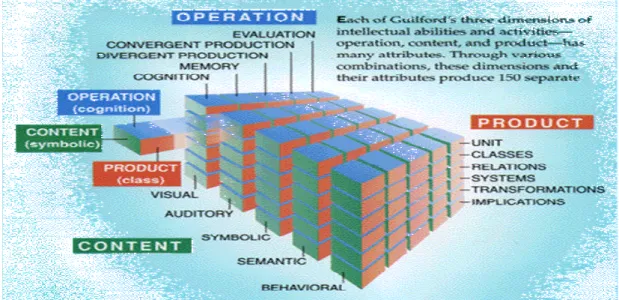
The potential approach: This approach was established by Guilford who with
his colleagues used factor analysis to create the Structure-of-Intellect (SOI) which is a map of the intellectual human mind. Guilford estimated that there are at least 120 unique intellectual abilities (each is a combination of content, an operation, and a product). This will be detailed in a later section.
SOI which is also known as the "factorial theory" is considered one of the most influential contemporary theories of creativity (Dacey, 1989). The potential theory opens the door to measure creativity. For example, based on this theory, Torrance in 1966 created the Torrance tests of creative thinking (TTCT) which is a measure of creative abilities.
Guilford (1984) identified flexibility, fluency, elaboration and originality as creative abilities. Guilford also identified the cognitive processes of these abilities as essential to creativity. He assumed, that the “mental operation of divergent production is a key process in creative thinking” (1984, p.1). Moreover, Guilford suggested that the creative process occurs at the same time as an assistant feature of primary abilities. The primary abilities – fluency, flexibility, originality, and elaboration – will be detailed in a later section.
According to the potential approach when someone is equipped with a set of cognitive traits or potentials (flexibility, fluency, elaboration and originality) he/she should be a creative person. Thus the abilities to be flexible, fluent, elaborate and original are some of the characteristics of the creative person.
The other assumption of this approach is that creative abilities are different factors in different groups of people. Therefore creative abilities are not the same in different fields of creative endeavour. That is, inventors, writers, artists, and composers “may have some same factors in common, but there is
much room for variation in patterns of abilities” (Guilford, 1950, p.451). More importantly, Guilford also anticipated that these abilities vary between and within individuals. This suggests that creativity is an ability that everyone has and it might be enhanced via creativity training. The potential theory of creativity may perhaps give an explanation why some individuals with autism who have a great ability to play a piece of Mozart the way a professional does cannot compose a piece of music. It may also explain why Van Gogh whose IQ was below average reflected great imagination in his painting. Creative ability among children with ADHD is the focal point on the present study. More specifically, this study will investigate the effects of creativity training on fluency, flexibility, originality, and elaboration which were identified by Guilford and Torrance as creative abilities.
Regarding the educational practices arising from the potential approach to creativity, the current researcher argues that teachers could, and should, measure the child's abilities. Measuring the child's abilities via standard tests (which were mainly developed to measure the abilities that Guilford expected in his theory Structure-of-Intellect, SOI, such as TTCT) help teachers to generate an accurate understanding of the child's abilities and style of learning. Thus, the purpose of these tests and the results obtained from them should not be used only to help the child to achieve an academic excellence. Instead, teachers' main objective from measuring the child's abilities should be to develop study materials and teaching styles which suit the child and which enhance his/her abilities and learning skills.
The Right-left brain approach: The central point of this approach is the
special function of brain hemispheres. Hemispheres are the two halves which make up the brain (the left brain and the right brain) and a thick cable of nerves (the corpus collosum) connects the two halves. Each hemisphere takes control
over the opposite side of the body. For example, the left hemisphere deals with the information from the right eye and vice versa. According to this approach certain modes of consciousness and skills are associated with hemispheric specialization. For example, the left hemisphere deals with the following modes and skills (Symbols, phonics, language, verbal, logical, abstract, and linear processes) and the right hemisphere deals with (feelings and emotions, spatial relationships, visualization, intuitive, nonverbal, random, and holistic processes).
The other assumption of this approach is that because of superior creativity-related functions such as spatial relationships and holistic processes a special emphasis is given to the right hemisphere during the creative thinking process. However, this approach asserts that originality and valuableness - two qualities of creativity - occur in opposite sides of the brain. In short, the left hemisphere has a dominant role over valuableness and the right hemisphere has a dominant role over originality. Moreover, to maximize the creative processes, both hemispheres' functions are needed. (Bakan, 1969; Herrmann, 1981; Kats, 1983; Kinsbourne, 1972; Martindale et al., 1984; Reynolds and Torrance, 1978; Torrance, 1982; Torrance and Rokenstein, 1987; Vitale, 1994; Wertheimer, 1982).
Obviously, the right-left brain approach observes creativity as a result of particular functions of brain hemispheres. In other words, creativity is achieved by using both hemispheres. Thus, this approach suggests that teachers might develop and utilize teaching strategies (e.g. concept mapping) which might aid their students in making use of both hemispheres and be more creative. Concept mapping represent modes and skills of both hemispheres. For example, through creating a concept map the child uses symbols, language, and his/her logical thinking to connect concepts. These are modes and skills of
the left hemisphere. The process of creating a concept map also described as visualization, random, and holistic processes which are modes and skills of the right hemisphere.
The current researcher, based on the above theories of creativity, argues that creativity is a multidimensional quality whose origin and definition are more easily understand by the general public. For example, music and art would be considered by most people as having some feature of creativity. Unfortunately, for the purposes of psychological and educational research it is definitely far more difficult to establish a clear answer or to agree on the origin of creativity. For example, Freud admitted that psychoanalysis cannot explain creativity, and Piaget asserted that “the origin of creativity, to me, remains a mystery and it is not explicable” (Piaget, 1981, p.222).
Definition of Creativity
The lack of a broad agreement on a unified theory of creativity, as mentioned earlier, results in different definitions of creativity. Taylor (1964, 1995) and Torrance (1977) hypothesized that any human activity may be looked at from four angles: the person who performs it, the thing which is done, the process of activity itself and the conditions which affect the above three divisions.
Taylor and Torrance's hypothesis seems to stand up well. They argued that the creative product can be observed as a production of the creative process, which is affected by creative abilities and other characteristics of a person. Similarly, the creative product is affected by environmental conditions, which also affect people and creative processes. Based on this argument Moony (1963/1999) defined creativity under the four Ps which he introduced as following:
Creative Person.