O
pen
A
rchive
T
OULOUSE
A
rchive
O
uverte (
OATAO
)
OATAO is an open access repository that collects the work of Toulouse researchers and
makes it freely available over the web where possible.
This is an author-deposited version published in :
http://oatao.univ-toulouse.fr/
Eprints ID : 15483
The contribution was presented at :
http://www.cril.univ-artois.fr/SAT-CSP-IEEE-ICTAI2015/
URL: http://dx.doi.org/10.1109/ICTAI.2015.71
To cite this version :
Fargier, Hélène and Maris, Frédéric and Roger, Vincent
Temporal Constraint Satisfaction Problems and Difference Decision Diagrams:
A Compilation Map. (2015) In: 27th IEEE International Conference on Tools
with Artificial Intelligence (ICTAI 2015), 9 November 2015 - 11 November 2015
(Vietry sul mare, Italy).
Any correspondence concerning this service should be sent to the repository
administrator: [email protected]
Temporal Constraint Satisfaction Problems
and Difference Decision Diagrams:
a Compilation Map
H´el`ene Fargier, Fr´ed´eric Maris, Vincent Roger IRIT (Institut de Recherche en Informatique de Toulouse)
University of Toulouse France
Abstract—The frameworks dedicated to the representation of quantitative temporal constraint satisfaction problems, as rich as they are in terms of expressiveness, define difficult requests - typically NP-complete decision problems. It is therefore adventurous to use them for an online resolution. Hence the idea to compile the original problem into a form that could be easily solved. Difference Decision Diagrams (DDDs) have been proposed by [1] as a possible way to cope with this difficulty, following a compilation-based approach. In this article, we draw a compilation map that evaluates the relative capabilities of these languages (TCSP, STP, DTPandDDD) in terms of algorithmic efficiency, succinctness and expressiveness.
Keywords-Temporal Constraint Satisfaction Problems; Differ-ence Decision Diagrams; Knowledge Compilation; Computa-tional Complexity.
I. INTRODUCTION
In constraint-based reasoning, a model is built by means of a set of constraints restricting the combinations of values of the variables. Soon enough, [2] proposed a formalism to represent temporal problems which derives from the defini-tions developed in the classical CSPframework, namely the TCSP(Temporal Constraint Satisfaction Problem) formalism. In a TCSP, each variable represents an instant at which an event (start or end of an action, expiration of a milestone) occurs, and the domains are continuous (equal toR+). Binary constraints represent the possible time intervals between two events; for instance, this allows to express that a task must take place before or after another (by a constraint of the form
start2−end1∈ ]−∞,−duration1−duration2]∪[0,+∞[), or that the beginning of two tasks must be synchronized (start1−start2∈[0,0]).
ATCSPwhose constraints are not disjunctive (i.e. problems
with only one interval per constraint) is called aSTP(Simple
Temporal Problem). Unlike the resolution of TCSPinstance, which defines a NP-hard problem, that ofSTP instances can be performed in polytime.
The STP framework has been extended by [3] yielding
the framework of generalized disjunctive temporal problems (DTP): while in a TCSP each constraint is a disjunction of elementary constraints on the same pair of variables (it is a disjunction of literal of the formx−y∈Ibearing on the same
xandy), this restriction is dropped in theDTPformalism: the
“literals” in a single constraint may relate different variables. The difficulty is that TCSP and DTP problems can not be
solved online with the guarantee that the response will be given in polynomial time: checking the consistency of this type of network defines a NP-complete problem [2], [3]. Hence, the idea of a preprocessing, a “compilation” of the original problem by its translation into a form that allows an efficient treatment of the queries. It is an emerging idea in different areas of IA, like constraint-based reasoning [4], [5], product configuration [6], planning under uncertainty [7] or automated reasoning [8]. Technically, this compilation is performed offline, before the online query phase: this relaxes the constraints on its temporal complexity1.
This idea has already been proposed for temporal problems with the introduction of Difference Decision Diagrams (DDDs) [1]. The purpose of the present paper is to draw a complexity study ofDDDs,TCSPs,STPs andDTPs that enables the
com-parison of the different languages in terms of expressiveness, succinctness and ability to address in polynomial time some queries and transformations, e.g. the consistency checking query or the conditioning transformation (that corresponds to the assignment of one (interval) of value(s) to some difference
x−y); in other term, to draw a compilation map in the sense of [9].
After introducing in the next Section the definitions and notations that we need, we present in Section 3 the formalisms studied in this work:TCSP,STP,DTPandDDD. Then, Section 4 and 5 present our results, namely a first compilation map for these languages: the former is devoted to the relative succinctness and expressivity of these languages, while the latter studies their ability to address the requests of interest in polytime.
II. PRELIMINARIES
Letχ={x1, ..., xn}be a finite set of variables. LetDxibe
the domain of variablexi, withi= 1..n. For any subsetX⊆
χ,−→x is an assignment of the variables inX.val(xi,−→x)is the
value assigned to xi∈X by−→x.DX is the cartesian product
of the domains of the variables of X. The concatenation of 1But obviously the compiled form may have a spatial complexity
two assignments −→x and−→y of two disjoint sets of variables
X andY is an assignment ofXS
Y; it is denoted−→x .−→y. For any functionf onχand any assignment−→x of a subset ofχ, we denote by f|−→x the restriction of f to−→x, i.e.f|−→x(−→y) =
f(−→x .−→y).
Following [10], [11], a representation languageL on a set of variables χis a tuple
CL, V arL, fL, sLwhere:
• CL is a set of data structures (also called “formulas” or
“L-representations”);
• V arL : CL →2χ is a scope function associating each
L-representation the subset of X it depends on
• fL is an interpretation function associating each L
-representation α a mapping fL
α from the set of all
assignments overV arL(α)toν (typicallyν={⊤,⊥},
i.e.fL
α(−→x)is a boolean value);
• sLis a size function fromCLtoNthat provides the size
of anyL-representation.
In other words, a data structureαrepresents a functionfL α;
data structures in the same language obey the same syntax, and are interpreted using the same interpretation functionfL.
For example, let χbe a set of boolean variables,CL defines
all theCNFonχ; eachCNFαis interpreted according to the
principles of propositional logic and for any assignment−→x of
χ,fL
α(−→x)is the truth value ofαaccording to−→x.
AL-representationαand aL′-representationβare said to be equivalent if for every−→x, fL
α(−→x) = fL ′
β (−→x), i.e. if they
represent the same function. A languageL is “canonical” if the same function can not be represented by two differentL -representations. For example,OBDD> is a canonical language, whileCNF is not. The property of canonicity is important in
a graph-based language like the one of decision diagrams, for practical reasons: by a caching process, it allows to merge equivalent sub-formulas (i.e. isomorphic sub-graphs) and therefore to compact the data structure - to save space.
When the interpretation functions take their values in
{⊥,⊤} - typically, when considering constraint satisfaction problems, clauses bases, etc -−→x is a solution (or model) of
αifffL
α(−→x) =⊤; we denote bysol(α)the set of its solutions.
III. REPRESENTING TEMPORAL PROBLEMS
In the sequel, we focus on representation languages dedi-cated to quantitative temporal problems. The setχof variables correspond to instants, events, milestones, etc, and therefore domains are equal to R+.
A. Constraint-based languages
1) The TCSP language: As a data structure, a temporal
constraint satisfaction problem is a directed acyclic graphα= (Nα,Aα)whose nodes are bijectively labelled by variables of
χ(var(N)denotes the variable labeling nodeN) and arcs by intervals in R.Interv((N, N′))denotes the set of (disjoint) intervals labelling (N, N′): (N, N′) represents the temporal constraint var(N′)−var(N)∈S
I∈Interv((N,N′))I.
CT CSP is the set of graphs that can be built
over χ; varT CSP(α) is the set of labels of
nodes in the graph; sT CSP(α) = Card(Nα) +
Σ(N,N′)∈AαCard(Interv((N, N
′))) measures the size of the data structure by the number of intervals and variables carried by the graph; finally, an assignment
−
→x is a solution of TCSP α iff it satisfies all its constraints. Formally, if for arc (N, N′) in Aα,
val(var(N),−→x)−val(var(N′),−→x) ∈ S
I∈Interv((N,N′))I thenfT CSP
α (−→x) =⊤, andfαT CSP(−→x) =⊥otherwise.
In the original model, the intervals carried by a TCSP
are closed intervals; in this paper open intervals are allowed (which does not make the problems more difficult: determining the consistency of such a TCSP remains an NP-complete
problem).
c)
a) b)
Fig. 1. (a) aTCSP, (b) aDTPand (c) aSTP. TheSTP(c) represents a
sequence of events compatible with (a) and (b).
2) The STP language: Simple temporal constraints
satis-faction problems (STP) areTCSPin which each edge carries
one interval only. The functionsvarST P,sST P and the
inter-pretation functionfST P are the same as those defined for the
TCSPlanguage; theSTPlanguage is therefore a sublanguage of theTCSPone, obtained by a restriction on the “syntax”.
TheSTPlanguage is incomplete with respect to theTCSP
language: the set of solutions ofTCSPwith two nodes labeled
xandyand carrying constraint “x−y∈I∪J”,IandJ being two disjoint intervals, can not be represented by a singleSTP
on these two variables.
3) TheDTPlanguage: The framework of Disjunctive
Tem-poral Problems is a generalization of theSTP one proposed
by [3]. As a data structure, a DTP is a set of clauses α =
{C1, . . . ,Cm}. Each clause is a set of literalsCi={l1, . . . lmj}
and a literal lj is a tuple (x, y,., c) which represents the
constraintx−y.cwhere:
• x∈χ,y∈χ,x6=y (var(lj)denotes the ordered pair
(x, y) of variables associated to literallj);
• cis a constant (which will be denotedconst(lj));
• .(which will be denotedop(lj)) belongs to{<,≤};
CDT P is the set of sets of clauses that can be built in this
way over χ; varDT P(α) is the set of variables associated
with the literals ofα;sDT P(α) = ΣCi∈αCard(Ci)measures
the size of the data structure; finally, an assignment of−→x is a solution of aDTPiff it satisfies all its clauses, which results
in the following interpretation function:fDT P
α (−→x) =⊤if−→x
satisfies at least one literal (on difference constraint) in each clause ofαand⊥otherwise. The set sol(α)of assignments
−
→x such thatfDT P
α (−→x) =⊤is the set of solutions ofDTPin
the usual sense of the term.
B. Difference Decision Diagrams
Difference Decision Diagrams [1] constitute an attempt of extending of Ordered Decision Diagram to temporal problems.
The idea is basically to label the nodes by difference con-straints, rather than by propositional variables.
1) TheDDDlanguage: ADDDoverχis a directed acyclic graph α = (Nα,Aα) with a single root, denoted root(α) and two terminal nodes, labeled by ⊥ and ⊤ respectively-see Figure 2 for an example.
Fig. 2. DDDordered according to the orderz ≻y≻x; it represents the solutions of the system of inequalities(x−y>5)∨(x−y≤3∧z−x <1)
Each non-leaf nodeNhas exactly two children,low(N)and
high(N), and is labeled by a constraint of the formxi−xj.
c, where:
• xi∈χ(denotedpos(N), the positive variable) andxj ∈
χ (denotedneg(N), the negative variable) are such that
i6=j
• cis a constant (denotedconst(N))
• .(which will be denotedop(N)) belongs to{<,≤}
... ...
Fig. 3. Illustration of basic notations for a non-leaf nodev
[1] propose the following notations:
• high(v) (respectively low(v)) is the first child (respec-tively the second child) of N; this function selects the constraints to be satisfied by an assignment−→x when the label ofN evaluates to true (respectively false). • var(v) = (pos(v), neg(v))
• bound(v) = (const(v), op(v)) • cstr(v) = (var(v), bound(v)) • attr(v) = (cstr(v), high(v), low(v))
The size of a DDD is its number of arcs and nodes:
sDDD(α) = Card(Nα) +Card(Aα);varDDD(α) is
obvi-ously the set of variables involved in at least one node ofα. The interpretation function ofαis defined as follows:
• For any nodeNand any assignment−→x (covering at least the two variables that label the node),fnode
N (−→x)returns
the value⊤if−→x satisfies the constraint labellingNand
⊥otherwise. Formally, iff:
(val(pos(N),−→x)−val(neg(N),−→x))op(N)const(N). • ifαis a leaf, thenfDDD
α (−→x)is equal to the value carried
by this node. So we either have fDDD
α (−→x) = ⊤ or
fDDD
α (−→x) =⊥.
• otherwise the rootN ofαis a non-leaf node and
fDDD
α (−→x) = fhighDDD(N)(→−x) if fNDDD(−→x = ⊤ and
fDDD
α (−→x) =flowDDD(N)(−→x)otherwise.
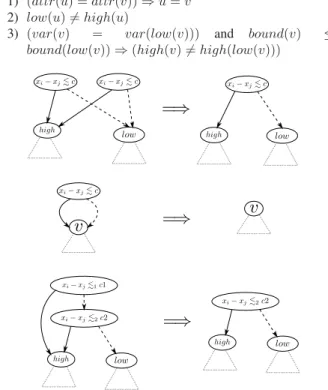
A DDD is in locally reduced form if it does not have isomorphic nodes, nonselective nodes nor stammering nodes - see Figure 4. Formally, if any pair of non-leaf nodesuand
vsatisfies the following properties: 1) (attr(u) =attr(v))⇒u=v
2) low(u)6=high(u)
3) (var(v) = var(low(v))) and bound(v) ≤
bound(low(v))⇒(high(v)6=high(low(v)))
Fig. 4. An example of applications of the three rules for obtaining a locally reducedDDD. Top to down: isomorphic nodes are merged; then stammering nodes are merged; finally a non-selective node is removed.
It is always possible to transform aDDDrepresentation into an equivalent locally reduced representation in polynomial time (the fusion of isomorphic nodes can in particular be performed implicitly using a “unique table”). This property remaining satisfied for any kind ofDDD, it is assumed in the following that theDDDconsidered are locally reduced.
2) Ordered Difference Decision Diagrams: In the DDD
framework like in the BDD framework, it can be required
that the diagrams respect an order that determines how the variables are met along the paths of the graph; Let ≻ be a total order onχ;≻extends to pairs of variables (and thus to nodes) by means of a lexicographic extension:(x, y)≻(x′, y′) if y≻y′ or ify=y′ andx≻x′; to rank-order two nodes bearing the same variables, it is required that the one who carrying the more restrictive constraint is met first on the paths (see Figure 2). Formally,αobeys ≻if and only if for every nodeN we have:
1) pos(N)≻neg(N) 2) var(high(N))≻var(N) 3) var(low(N)))≻(var(N)∨
(var(N) = var(low(N)) ∧ bound(low(N)) ≻
Let us denote DDD≻ the language defined by the DDD
representations onχthat are ordered by≻.
3) Path-reduced and Tight Difference Decision Diagrams: [1] then proposes several restrictions onDDDthus several sub
languages eg,P-DDD, the language of path-feasibleDDDs and PT-DDD, that of path-feasible and minimalDDDs.
A pathp in a DDDrepresents a set [p]of constraints: for any pair of consecutive nodesN andN′ ofp,[p]contains a constraintcons(N, N′)of the form x−y≤corx−y < c ifN′=high(N), or a constraint of the formx−y > cor
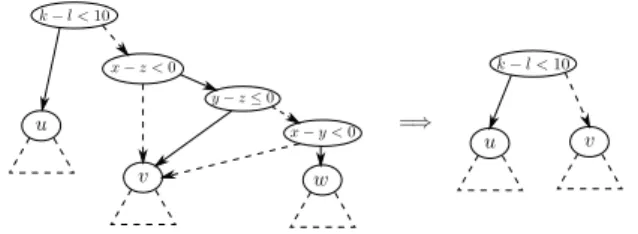
x−y ≥c if N′ = low(N). A path is feasible (consistent) if and only if there is an assignment −→x over χ which satisfies all the constraints of [p]. A DDD α is said to be path-feasible if each of its paths is feasible. [1] shows that anyDDDrepresentation can be transformed into an equivalent and path-feasible one, but the procedure proposed in this seminal paper is exponential in the worst case (assuming that
P 6= N P), as shown in the following Section. We denote
P-DDDthe language of path feasibleDDDs, andP-DDD≻ its
ordered variant.
Fig. 5. A non path-feasibleDDD(left) and a path-feasible version (right) of
this latter
TheP-DDDlanguage allows only one possible representa-tion for tautologies (the node⊤) and only one representation for unsatisfiability (the node⊥) - [1] calls this property “semi canonicity”. However, the usual property of canonicity does not hold, neither for path-feasibleDDD, nor for path-feasible
ordered DDDs (P-DDD≻): consider the order z > y > x, the set of solutions of the system of equalities {x−y = 0, y−z= 0, x−z= 0}can be represented by four different (but equivalent) path-feasible DDD which carry respectively
the constraints sets {x−y = 0, y−z = 0, x−z = 0},
{x−y = 0, y−z = 0}, {x−y = 0, x−z = 0},
{y−z= 0, x−z= 0}.
[1] then propose to make the constraints of the diagram as restrictive as possible, in a sense close to the notion of minimality proposed in theTCSP framework. To this extend they introduce the concept ofdominantconstraint:xi−xj.c
is a dominant constraint in a pathp(and more broadly in a set of constraints, such as[p]) if and only if any other constraints (xi−xj.′c′) bearing on the same variables is less restrictive
(i.e. (c,.) < (c′,.′)). The idea is to require that such dominant constraints are as restrictive as possible, without changing the set of solutions: a constraintβ=xi−xj .c
is tight in a path p =p1∧β∧p2 if there is no constraint
β′ = xi−xj .′ c′ such that (c′,.′) < (c,.) and that
[p1]∪{β′}∪[p2]≡[p]. Hence, a path is tight iff all its dominant constraints are tight and aP-DDDis tight if and only if all the
paths that compose it are tight. We callPT-DDDthe language of tight and path-feasibleDDDs, and PT-DDD≻ its ordered
variant.
Fig. 6. A non tightDDD(left) and a tight version (right) of this latter
IV. A COMPILATIONMAP
We have described in the previous Section a number of languages devoted to the representation temporal problems with numeric variables. The objective of the preliminary compilation map presented in this paper is to define their respective merits in terms of efficiency with respect to a number of tasks, be they queries (e.g. ”does the problem have a solution ?”) or transformations (e.g. ”make the conjunction of two representations representing the constraints of the planner for the former, the objectives of the customer for the latter”). The question is also to evaluate the respective representational capacity of the languages in terms of expressiveness and of succinctness.
A. Expressiveness, polynomial translation and succinctness The languages TCSP, STP, DTP and DDD (and sub lan-guages) defined on a givenχdo not have the same power of representation; e.g. aTCSP representing the solutions of the
constraint (x−y≤0)∨(x−y≥1)can not be transformed into an equivalentSTP. In a compilation map, this capability is captured by the notion of expressiveness.
Formally, considering two languages LandL′ defined on the same variables (on χ) targeting the same output set (in our context,{⊥,⊤}), we say thatLcan be compiled intoL′
(thatL′ is at least as expressive asL), and denoteL′ e L, iff for any L representationαthere is aL′-representation β such that α≡β; we writeL′≺eL when the compilation is possible fromLtoL′only andL∼eL′when possible in both directions.L′is said to be as least as succinct asLiff for anyL
representationαthere is an equivalentL′-representationβthe size of which is polynomial with respect to the one ofα; this is denoted L′sL. If this compilation can be performed in polytime, i.e. if there exists a polynomial algorithm which, for any L-representation αcomputes aL′-representation β such that α≡β, we writeL′pL. L≺≻eL′ (resp.L≺≻sL′) means thatLandL′are incomparable in terms of expressivity (resp. succinctness).
Any STP representation can trivially be transformed into
an equivalent DTP representation the clauses of which are singletons; this STP is also a TCSP with unary constraints only; moreover, it is clear that anySTPrepresentation can be
transformed in linear time into an equivalentDDD
representa-tion (or orderedDDD, or P-DDDorPT-DDDrepresentation); however, we have seen thatSTP is less expressive than the other three languages - i.e.TCSP≺eSTP,PT-DDD≻≺eSTP
andDTP≺eSTPetc; andTCSP≺pSTP,PT-DDD≻≺pSTP
andDTP≺pSTP. Similarly, theTCSPlanguage is incomplete
with respect to the DTP language: the set of solutions of
the DTP with three variables x, y andz and one constraint (x−y≤0)∨(z−x≤0)can not be represented by aTCSP
on these three variables. It is possible to encode aDTPas a TCSP, but this requires the addition of a (linear) number of
variables [12].
Our results in terms of succinctness are based on the following Propositions:
Proposition 1: Let≻be a total order overχ. AnyTCSP
representation onχcan be translated, in polynomial time and space, into an equivalentDTPrepresentation onχ.
Indeed, consider an arc of a TCSP between a variable y
and a variablexcarrying the set of intervals:{I1, ..., Im}=
{[a1, b1], ...,[am, bm]}; it represents the binary constraint
Txy= (a1≤x−y≤b1)∨...∨(am≤x−y≤bm). We can
assume without loss of generality that intervals are pairwise disjoints:∀i∈ {1..m−1}, bi< ai+1. In order to encodeTxyin
theDTPformalism, we first add two constraintsy−x≤ −a1 andx−y≤bmin order to prevent the assignment ofx−yto be
lower thanI1or greaterIm. Then for eachi∈ {1..m−1}, we
add the disjunctive constraint(x−y≤bi)∨(y−x≤ −ai+1); this prevents the assignments ofx−yto be between the end of Ii and the beginning ofIi+1. Hence, in the DTP, x−y is required to belong exactly to the set of intervals defining constraintTxyin theTCSP(see Figure 7 for an example).
Fig. 7. Compilation ofTCSPas aDTPrepresentation
Proposition 2: Let≻be a total order overχ. It holds that: (i) Any TCSP representation on χ can be translated, in
polynomial space and time, into an equivalent DDD≻
representation.
(ii) AnyDTPrepresentation onχcan be translated, in poly-nomial space and time, into an equivalentDDD
represen-tation onχ.
(iii) Any DDD representation on χ can be translated, in polynomial space and time, into an equivalent DTP
representation onχ.
The principle of the proofs are the following:
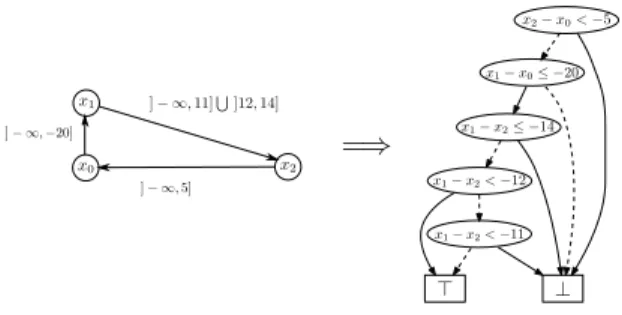
(i) Consider aTCSPand any of its constraintsTxy= (a1≤
x−y≤b1)∨...∨(am≤x−y≤bm)(for instance the one
of Figure 8). Each elementary pair of inequations ai≤
x−y≤bi can be directly compiled into a smallDDD≻. Letγ be the one corresponding to the first disjunct; we iteratively add the next one, say, β as follows: all the arcs ofγ pointing to the leaf ⊥point now to root(β); the⊤sinks ofγandβare merged.We thus get aDDD≻
for each constraint. The conjunction of these diagrams is
performed as follows: letγbe the one corresponding to the first of them; we iteratively add the next one, say,β
by redirecting all the arcs ofγpointing to the leaf⊤to
root(β); the ⊥ sinks ofγ andβ are merged. We thus get in polynomial time aDDD≻ equivalent to the original
TCSP. If the constraints are considered in accordance to
the order≻on the variables / constraints, the resulting structure is an instance ofDDD≻. Then, the diagram will be transformed into a path-feasible one, or a tight one, but these operations are not necessarily polynomial neither in time nor in space.
(ii) Similarly, a DTP is a conjunction of disjunctions of
literals of the form x−y ≃ a; each literal can be directly transcribed into a smallDDD. Binary operations
∧ and ∨ between these DDD are applied as for the TCSP compilation in the previous proof. This DDD is
not necessarily ordered.
(iii) To prove this point, simply enumerate the paths of the
DDDfrom the⊤node to the root; we obtain a disjunction
of conjunctions, which may be (by distributivity) trans-formed into a conjunction of disjunctions.
Fig. 8. Compilation of an inconsistentTCSPas aDDD≻representation
Proposition 3: Let ≻ be a total order over χ. There are PT-DDD≻ representations which have no equivalent
DTP representation of polynomial size and there are DTP
representations that have no equivalentP-DDDrepresentation
of polynomial size, nor any equivalent DDD≻ representation
of polynomial size.
The incomparability in terms of succinctness of DTP and
DDD≻ come from the fact that one can always convert aCNF
into a DTP and an OBDD≻ into a PT-DDD≻: just consider for any propositional variablep, the pair of variablesxp, yp;
the positive literalpleads to the constraint xp−yp≥1and
the negative literal ¬p to the constraint xp−yp ≤ 0. The
incomparability ofDTPandPT-DDD≻ then derives from the one of CNF and OBDD≻. The proof of the incomparability
of DTP and P-DDD is similar: we can always transform a CNFinto aDTPand aFBDDinto aPT-DDD(using the same encoding of literal by difference constraints) whileCNF and
FBDDare incomparable in terms of succinctness.
Proposition 4: Let≻be a total order overχ.
(i) Any P-DDDrepresentation on χ can be translated into an equivalentDDD≻, but there areP-DDDrepresentations
that have no equivalentDDD≻ representation of polyno-mial size.
(ii) Any DDDrepresentation on χ can be translated into an
equivalent P-DDD representation on χ, but under the assumptionP 6=N P, this compilation can not be done in polynomial time.
The proof first item relies on the fact that any FBDD can
be transformed into a P-DDD: to each variable p of the
FBDD correspond two variables xp and yp; nodes labeled
by p in FBDD are labeled by xp−yp ≥ 0: we obtain a
P-DDD; if it were possible to transform this P-DDD into
a DDD≻ of polysize, we could recover an OBDD; but there are FBDD representations which have no equivalent OBDD
representations of polynomial size.
For proving the second item, recall that [1] propose algo-rithms to transform aDDD(resp. P-DDD) into an equivalent P-DDD (resp a PT-DDD). The non polynomiality of these algorithms (assuming thatP6=N P) is trivial since anyTCSP
can be transformed into an equivalent DDD in polynomial
time, while (i) the test of consistency is NP-complete for the
TCSPlanguage and (ii) it is an easy problem forP-DDDand sublanguages.
These propositions yield the following results about the relative expressiveness and succinctness of the temporal languages (summarized in Tables I, II and III):
Theorem 1 (Expressiveness):
• DDD∼eDTP≺eTCSP≺eSTP
• DDD ∼e DDD≻ ∼e P-DDD≻ ∼e PT-DDD≻ ∼e DDD≻
∼e P-DDD∼ePT-DDD
We can now compare the succinctness of equally expressive languages: Theorem 2 (Succinctness): • For all L ∈ {DDD≻,P-DDD≻,PT-DDD≻,P-DDD, PT-DDD},L≺≻sDTP • DDD≺sP-DDD≺sP-DDD≻, • DDD≺sPT-DDD≺sPT-DDD≻
B. Compilation map: queries and transformations
A direct consequence of the previous results is that consis-tency cannot be checked in polytime forDDDnor forDDD≻,
assumingP 6=N P. Indeed, if it were the case, it could be possible to test the consistency of aTCSPrepresentationαby compiling it as aDDDα′(which is polytime) then to test the consistency ofα′ in polynomial time.
ր STP TCSP DTP STP X X X TCSP ! X X DTP ! ! X DDD ! ! • DDD≻ ! ! • P-DDD ! ! • P-DDD≻ ! ! • PT-DDD ! ! • PT-DDD≻ ! ! • TABLE I
EXPRESSIVITY AND SUCCINCTNESS OFSTP,TCSPANDDTP.XMEANS
“COMPILATION IN POLYNOMIAL TIME”,•MEANS“NO POLYNOMIAL COMPILATION ALGORITHM” (NOT ALL REPRESENTATIONS IN THE SOURCE
LANGUAGE ARE REPRESENTABLE IN POLYSIZE IN THE TARGET LANGUAGE);!MEANS“THE COMPILATION IS NOT ALWAYS FEASIBLE”
(INCOMPLETE TARGET LANGUAGE)
. ր DDD P-DDD PT-DDD STP X X X TCSP X ◦ ◦ DTP X ◦ ◦ DDD X ◦ ◦ DDD≻ X ◦ ◦ P-DDD X X ? P-DDD≻ X X ? PT-DDD X X X PT-DDD≻ X X X TABLE II
EXPRESSIVITY AND SUCCINCTNESS OF NON ORDERED DIFFERENCE DECISION DIAGRAMS.XMEANS“COMPILATION IN POLYNOMIAL TIME”,◦
MEANS“NO POLYNOMIAL COMPILATION ALGORITHM UNLESSP = NP”; ?
MEANS“DON’T KNOW”
. ր DDD≻ P-DDD≻ PT-DDD≻ STP X X X TCSP X ◦ ◦ DTP • • • DDD • • • DDD≻ X ◦ ◦ P-DDD • • • P-DDD≻ X X ? PT-DDD • • • PT-DDD≻ X X X TABLE III
EXPRESSIVITY AND SUCCINCTNESS OF ORDERED DIFFERENCE DECISION DIAGRAMS.XMEANS“COMPILATION IN POLYNOMIAL TIME”,◦MEANS
“NO POLYNOMIAL COMPILATION ALGORITHM UNLESSP = NP”,•MEANS
“NO POLYNOMIAL COMPILATION ALGORITHM”;?MEANS“DON’T KNOW”
.
The DDD and DDD≻ languages are actually comparable
to BDD (which do not guarantee consistency checking in polynomial time) and not toFBDDnor toOBDD. The class that could be close to theFBDDone is the class path-feasibleDDD
(where all paths are feasible) and the one that could correspond to ordered boolean decision diagram isP-DDD≻.
Beyond the query of consistency, we describe in this Section a number of requests, and we analyze the ability of the studied languages to address them efficiently.
1) Definitions: Let us first recall some basic queries of transformation that are worthwhile studying for temporal ap-plication (typically, for planning problems):
• CO:, L satisfies consistency if and only if there exists a polytime algorithm that maps any L-representation α
to1 if it has a solution (if∃−→x , fL
α(−→x) =⊤) and to0
otherwise.
• EQ: L satisfies equivalence if and only if there ex-ists a polytime algorithm that maps every pair of L -representationshα, βito1iffL
α =fβLand to0otherwise.
• MX: L satisfies model extraction if and only if there exists a polytime algorithm that mapsL-representationα
to an assignment −→x such thatfL
α(−→x) = ⊤if any and
stops without returning anything otherwise.
• CE:Lsatisfies clausal entailment if there exists a poly-time algorithm that maps anyL-representationαand any temporal clause β to 1 if sol(α) ⊆ sol(β), and to 0 otherwise.
And for transformations:
• CD: L satisfies conditioning if and only if there is a polytime algorithm that maps any L-representation α, any pair of variables (x, y) ⊆ χ and any w ∈ Rto a
L-representation ofW
u,vs.tu−v=wfαL|x←u.y←v.
• ∧BC:Lsatisfies bounded conjunction if and only if there exists a polytime algorithm that maps any pair of L -representationsαandβto aL-representation offL
α∧fβL
• ∧C: L satisfies conjunction if and only if there exists a polytime algorithm that maps any set {α1, ..., αn} of
L-representations to a L-representation of∧n i=1fαLi
• ∨BC:Lsatisfies bounded disjunction if and only if there exists a polytime algorithm that maps any pair of L -representationsαandβto aL-representation offL
α∨fβL
• ∨C:L satisfies disjunction if and only if there exists a polytime algorithm that maps any set{α1, ..., αn}ofL -representations to aL-representation of∨n
i=1fαLi
Many planners useDTPorTCSPsolvers to schedule events in time. The task of the planner is then to build the plan by selecting actions, and the handling of time is left to the temporal solver. Consistency checking (CO) is used to know if selected actions can lead to an admissible plan, and model extraction (MX) to order actions and/or fix their start date. A set of admissible plans (all composed by the same actions, but possibly different in their scheduling) is memorized; At execution, when a temporal contingent event occurs that breaks the plan chosen (for example, because the user learns that an action has begun), a replanning phase is entered, that conditions the set of plans according to the new information, i.e. performs a CD transformation and then extracts a new (temporally consistent) plan - again, a MX request.
It is worthwhile noticing that the definition of conditioning we propose does not correspond to the usual one, which assigns a given value to one single variable, because the classical definition of “conditioning” would be of no use in the current context: it would lead to formula that are beyond the language. E.g. the conditioning of theSTPx1−x2∈[3,8]by
x1←4can not be represented by aSTPoverχ={x1, x2}(or by any of the languages described in this article). In general, in
temporal reasoning, there is a distinguished variable, sayx0, which represents the beginning of time - in our example, we would haveχ={x0, x1, x2}; assigning a value to an instant
xiyields assigning a value to the difference xi−x0 (in our example, we would choosex1−x0←4).
Other requests (typically,∧- and∨- based transformations, and the EQ query on which the caching mechanism rely) are crucial when building a compiled form in a bottom up approach.
2) Results: As to queries, we have obtained the following results:
Theorem 3: The results of Table IV hold.
CO EQ MX CE STP X X X X TCSP ◦ ◦ ◦ ◦ DTP ◦ ◦ ◦ ◦ DDD ◦ ◦ ◦ ◦ DDD≻ ◦ ◦ ◦ ◦ P-DDD X ◦ X ? P-DDD≻ X ◦ X ? PT-DDD X ◦ X ? PT-DDD≻ X ( ?◦) ? ? TABLE IV
MAP OF QUERIES.XMEANS“SATISFIES IN POLYNOMIAL TIME”,◦: “DO NOT SATISFY IN POLYNOMIAL TIME,UNLESSP = NP”,•: “DO NOT
SATISFY”, ?: “DON’T KNOW”; ( ? )DENOTES A CONJECTURE
Let us briefly sketch the proofs of these results:
• CO: easy onSTP and hard onTCSP[2]; hard onDTP
[3]; hard onDDD≻ and thus onDDDbecause anyTCSP
can be transformed in polytime into an equivalentDDD≻;
easy onP-DDDand subclasses by definition.
• EQ: easy on STP (compute the distance matrices and compare them: they must be equal); hard onTCSP and
DTP,DDDandDDD≻: if EQ were satisfied, it would
pro-vide a way to satisfy CO (by testing the equivalence be-tween the formula and the unsatisfiable one, represented by the sink labeled by⊥) - and we have seen that the languages do not satisfy CO; hard onP-DDDsince every FBDD can be encoded as a P-DDDand EQ is hard on FBDD. We conjecture hardness onPT-DDD≻because it is not a canonical language (x−y= 3, y−z= 4, x−z= 7 may be represented by severalPT-DDD≻).
• MX: easy onSTP (by computing the distance matrix);
hard on theTCSP andDTP, DDD andDDD≻ languages since they do not satisfy CO; easy on P-DDDand sub-languages (P-DDD,P-DDD≻,PT-DDD,PT-DDD≻): it is enough to choose the path from the⊤sink to the root -because the paths are feasible, we get aconsistentSTP
the solutions of which are solutions on theDDD. • CE: easy onSTP, by computing the corresponding
dis-tance matrix and applying a Floyd-Warshall pass on it before testing the literals of the clause iteratively until getting a one that is a consequence of theSTP; hard on
TCSP and DTP, DDD and DDD≻ languages since they do not satisfy CO. We conjecture that it is also hard on
PT-DDD≻ and on its superclasses. As to transformations, we obtained: Theorem 4: The results of Table V hold.
CD ∧BC ∧C ∨BC ∨C STP X X X ! ! TCSP X X X ! ! DTP X X X X • DDD X X X ? ? DDD≻ X ? • ? • P-DDD • • • ◦ • P-DDD≻ • • • ? • PT-DDD • • • ◦ • PT-DDD≻ • • • ? • TABLE V
MAP OF TRANSFORMATIONS.X: “SATISFIES IN POLYNOMIAL TIME”,◦: “DOES NOT SATISFY IN POLYNOMIAL TIME,UNLESSP = NP”,•: “DOES NOT SATISFY”, !: “THE TRANSFORMATION IS NOT ALWAYS FEASIBLE”; ?:
“DON’T KNOW”
The surprising result is that conditioning is hard on the
DDD languages; to show that, consider a P-DDD on χ =
{x, z1, . . . , zn, y} representing the constraint set {x−z1 ∈ [1,1]∪ [0,0], z1 −z2 ∈ [1,1]∪ [0,0], . . . , zn −zn−1 ∈ [1,1]∪[0,0], y−zn[1,1]∪[0,0]}and whose nodes are labeled
x−z1,z1−z2,zn−1−zn,y−zn. This diagram is path-feasible
and tight. It implies thatx−y∈[0, n]. If it is now conditioned by x−y = [n
2,n2], the size of the representation of the corresponding function by aP-DDDexplodes (it is not enough
to addx−y∈[n
2,
n
2]at the end). The operation of conditioning is exponential forP-DDDand all its sub languages.
The other proofs are easy:
• The satisfaction of CD,∧BC and∧C is immediate on
STP,TCSP,DTP.
• DTP satisfies ∨BC because disjunction is distributive on conjunction. Finally, we get a • regarding ∨C on
DTP because any CNF of propositional logic can be
encoded by a DTP whose “literals” are of the form
xp−yp∈ ]− ∞,−1]∪[1,+∞[(eachpcorresponding
to a propositional variable of the originalCNF) and∨C
is not satisfied onCNFlanguage.
• the hardness of ∧BC (and therefore of ∧C) onP-DDD
and sublanguages results from hardness of conditioning on these languages.
• the hardness of ∨BC (and therefore of ∨C) onP-DDD
and PT-DDDresults from the correspondence between
these languages andFBDD, and on the hardness of∨BC onFBDD.
• the hardness of∧C onP-DDDand sub-languages results
from the correspondence between these languages and
OBDD/FBDDfor which unbounded conjunction is expo-nential in space in the worst case.
The situation is thus not so good for theDDDlanguages: as
soon as CO is required, almost all transformations are hard; even worst: conditioning, which is the basic transformation for planification as for many other applications, may lead to an exponential explosion.
V. CONCLUSION
In this article we presented preliminary results for the building of a compilation map of temporal problems. We looked at the efficiency of several representation languages, namelyTCSP,DTPand different types of decision diagrams
-ordered DDDs, path-feasibleDDDs and path-feasible and tight DDDs.
It appears that, from a theoretical point of view at least, basic ordered difference decision diagram are disappointing: they do not satisfy any of the considered requests. And this despite the fact than an order on the variables is required: in the DDD framework, this assumption does not provide any good property, contrarily to what happens in the classical decision diagram one. The language of path-feasibleDDD(and
its sub languages) is more interesting from the perspective of queries. Unsurprisingly, compiling a temporal constraints satisfaction problem (a TCSP or a DTP instance) as a path-feasible decision diagram is hard, and the compiled form can be exponentially more space-consuming than the original one. The bad news is that even the most basic transformation, namely conditioning, is not satisfied by any kind of path-feasibleDDD.
These conclusions are rather pessimistic regarding the for-malism proposed in [1] when compared to the classical, non compiled, ones. This does not mean that efficient target languages do not exist for temporal problems; sets of “convex” Horn-type constraints seem for instance worthwhile studying. The compilation of temporal problems simply remains an open question.
REFERENCES
[1] J. B. Møller, J. Lichtenberg, H. R. Andersen, and H. Hulgaard, “Differ-ence decision diagrams,” inProceedings of the 8th Annual Conference of the EACSL, 1999, pp. 111–125.
[2] R. Dechter, I. Meiri, and J. Pearl, “Temporal constraint networks,”
Artificial Intelligence, vol. 49, no. 1-3, pp. 61–95, 1991.
[3] K. Stergiou and M. Koubarakis, “Backtracking algorithms for disjunc-tions of temporal constraints,”Artificial Intelligence, vol. 120, no. 1, pp. 81–117, 2000.
[4] N. R. Vempaty, “Solving constraint satisfaction problems using finite state automata,” inAAAI’1992, 1992, pp. 453–458.
[5] R. Weigel and B. Faltings, “Compiling constraint satisfaction problems,”
Artificial Intelligence, vol. 115, no. 2, pp. 257–287, 1999.
[6] J. Amilhastre, H. Fargier, and P. Marquis, “Consistency restoration and explanations in dynamic csps application to configuration,” Artificial Intelligence, vol. 135, no. 1-2, pp. 199–234, 2002.
[7] J. Hoey, R. St-Aubin, A. J. Hu, and C. Boutilier, “SPUDD: stochastic planning using decision diagrams,” inUAI ’99, 1999, pp. 279–288. [8] M. Cadoli and F. M. Donini, “A survey on knowledge compilation,”AI
Communications, vol. 10, no. 3-4, pp. 137–150, 1997.
[9] A. Darwiche and P. Marquis, “A knowledge compilation map,”JAIR, vol. 17, pp. 229–264, 2002.
[10] G. Gogic, H. Kautz, and C. P. F, “The comparative linguistics of knowledge representation,” inIJCAI’95, 1995, pp. 862–869. [11] H. Fargier, P. Marquis, A. Niveau, and N. Schmidt, “A knowledge
compilation map for ordered real-valued decision diagrams,” inAAAI’14, 2014, pp. 1049–1055.
[12] L. R. Planken, “Temporal reasoning problems and algorithms for solving them (literature survey),” Master’s thesis, Delft University of Technol-ogy, October 2007.