An Integrated Framework for Firewall
Testing and Validation
Mehdi Akiki
A Thesis in
The Department of
Electrical and Computer Engineering
Presented in Partial Fulfillment of the Requirements for the Degree of Master of Applied Science at
Concordia University Montreal, Quebec, Canada
June 2009
?F?
CanadaLibrary and Archives Published Heritage Branch 395 Wellington Street OttawaONK1A0N4 Canada Bibliothèque et Archives Canada Direction du Patrimoine de l'édition 395, rue Wellington Ottawa ON K1A 0N4 CanadaYour file Votre référence ISBN: 978-0-494-67146-7 Our file Notre référence ISBN: 978-0-494-67146-7
NOTICE:
The author has granted a
non-exclusive license allowing Library and
Archives Canada to reproduce,
publish, archive, preserve, conserve, communicate to the public by
telecommunication or on the Internet, loan, distribute and sell theses worldwide, for commercial or
non-commercial purposes, in microform, paper, electronic and/or any other formats.
The author retains copyright ownership and moral rights in this thesis. Neither the thesis nor substantial extracts from it may be printed or otherwise reproduced without the author's permission.
AVIS:
L'auteur a accordé une licence non exclusive permettant à la Bibliothèque et Archives Canada de reproduire, publier, archiver, sauvegarder, conserver, transmettre au public par télécommunication ou par l'Internet, prêter, distribuer et vendre des thèses partout dans le
monde, à des fins commerciales ou autres, sur
support microforme, papier, électronique et/ou autres formats.
L'auteur conserve la propriété du droit d'auteur et des droits moraux qui protège cette thèse. Ni la thèse ni des extraits substantiels de celle-ci ne doivent être imprimés ou autrement
reproduits sans son autorisation.
In compliance with the Canadian Privacy Act some supporting forms may have been removed from this thesis.
Conformément à la loi canadienne sur la protection de la vie privée, quelques formulaires secondaires ont été enlevés de cette thèse.
While these forms may be included in the document page count, their removal does not represent any loss of content from the thesis.
Bien que ces formulaires aient inclus dans la pagination, il n'y aura aucun contenu
manquant.
1+1
ABSTRACT
An Integrated Framework for Automated Firewall Testing and Validation
Mehdi Akiki
In today's global world, most corporations are bound to have an Internet presence. This phenomenon has led to a significant increase in all kinds of network attacks. Firewalls are used to protect organizational networks against these attacks. Firewall design is based on a set of filtering rules. Because of the nature of these rules, and due to the rising complexity of security policies, an increasing number of mistakes are found in configurations. A reliable and automated technique for testing firewall configuration is becoming necessary to ensure the full functionality of the firewall.
In this thesis, a new approach to fully test a firewall has been developed using a white box approach that takes into account its inner implementation. Also—thanks to the information provided by the network information file—the environment where the firewall will be deployed is considered, ensuring a better accuracy and performance than previous work. Moreover, the method uses a combination of algorithms that remove common misconfigurations widely present in current firewall configurations [1] and guarantees a coverage that is greater than previous methods for generating test sets with a novel test set generation approach.
The developed framework is fully automated and contains the full steps to get testing done, from the parsing of the firewall file to the generation of the test set based on the actual configuration of the firewall to the correction of the error in the firewall file,
avoiding all types of errors of omission and misconfiguration that occur during a manual configuration.
Keywords; Firewall, Policy Language, Conflict Free Rules, Rule Set, White Box Testing, Misconfiguration Errors, Configuration, Rule Update
ACKNOWLEDGEMENTS
First, I would like to express my gratefulness to my mentor and supervisor, Dr. Abdeslam En-nouaary, whose guidance, encouragement, support and kindness have made
this thesis possible. I wholeheartedly appreciate his suggestions and the inspiring
discussions we enjoyed.
I also want to thank all the professors who have taught me invaluable lessons while I was a student at Concordia University.
I dedicate this work to my father, my mother, my wife Houda, my brother, and my friends.
Table of Contents
List of Figures vi
List of Tables viii
Chapter 1: Introduction 1
1.1 Objectives of This Thesis 2
1 .2 Organization of this Thesis 3
Chapter 2: Network Security 4
2.1 Introduction to Networking 4
2.2 TCP/IP: The Language of the Internet 6
2.3 Risk Management: The Game of Security 13
2.4 Types and Sources of Network Threats 14
2.5 Firewalls 20
2.5.1 Firewalls Definitions 20
2.5.2 Types of Firewalls 23
2.6 Summary 27
Chapter 3: Firewall Testing 29
3.1 Passive Testing 29
3.1.1 Vulnerability Testing 30
3.1 .2 Real Time Testing 31
3.1.3 Formal Network Building 33
3.1.4 Algorithmic Approach 35
3.1 .5 Query Engines 39
3.2 Active Testing 40
3.2.2 Formal Policy Writing 42
3.3 Summary 44
Chapter 4: A New Approach for Automated Firewall Testing and Validation 45
4.1 General Presentation of the Framework 46
4.2 The Different Modules of the Framework 48
4.2.1 Firewall Parser 48
4.2.2 Misconfiguration Removal 49
4.2.3 Test Set Generation 53
4.2.4 Test Execution 58
4.2.5 Log File Parser 60
4.2.6 Results Analyzer 61
4.2.7 Rule Updater 62
4.3 Summary 64
Chapter 5: Implementation and Case Study 65
5.1 Implementation 65
5.1.1 Software and Tools Used 65
5.1.2 UML Class Diagram of the Framework 67
5.2 Case Study 69
5.3 Summary 78
Chapter 6: Conclusions and Summary 80
6.1 Achievements 80
6.2 Future Work 81
List of Figures
Figure 2.1: The OSI Model 5
Figure 2.2: The IP header 7
Figure 2.3: IP Spoofing Attack 8
Figure 2.4: IP Hijacking 9
Figure 2.5: 3-Way TCP Handshake 1 1
Figure 2.6: Denial of Service Attack 15
Figure 2.7: Bastion Host 21
Figure 2.8: DMZ with one firewall 22
Figure 2.9: Proxy server architecture 23
Figure 2.10: Example of an application level firewall 24
Figure 2.11: Packet Filtering Firewall 25
Figure 3.1 : Blowtorch Packet Flow 31
Figure 3.3: Vigna's Firewall Testing Approach
34
Figure 3.4: Different Rule Configurations 36
Figure 3.5: Policy Segmentation Technique
37
Figure 3.7: Fang Query Engine Data Flow 39
Figure 3.8: Graphical User Interface 41
Figure 3.10: Or-BAC Model in XML 43
Figure 4.2: Testing Framework Schema 45
Figure 4.2: Misconfiguration Algorithm
51
Figure 4.4: Test Bench Schema 58
Figure 4.5: Correction Algorithm's Pseudo code 61
Figure 5.1: UML Diagram of the test framework 67
List of Tables
Table 3.1: Rule Anomaly Types 36
Table 4.1 : Format of the Parsed Rule Set 48
Table 4.2: Correction to the Current Algorithm Technique
52
Table 4.3: Network Information File 54
Table 4.4: Iptables Log Entry 59
Table 4.5: Useful log file information 60
Table 4.6: Error Detection and Correction Example
62
Table 5.1: Specifications of the Tested Firewall 68
Table 5.2: Input configuration file 69
Table 5.3: Parsing Results of the Firewall File 70
Table 5.4: Results of the Misconfiguration Removal Algorithm
71
Table 5.5: Generated Packets per Rule 72
Table 5.6: Faulty packets with their decision 74
Table 5.7: Updated Rules 75
Table 5.8: Output configuration file 76
Chapter 1: Introduction
The Internet has dramatically transformed the manner in which organizations and individuals conduct business. The increased communication potential and efficiency of network technology have made e-commerce, web-based business-to-business operations, and global connectivity integral components of successful business strategies. For an ever-increasing number of enterprises, the online presence is crucial. At the same time,
however, this global network has created a variety of problems such as intrusions, both
automated and manual, which cause damage that can cost organizations enormously in terms of money, efficiency, and resources. Thus, organizations must discover methods to
achieve their mission goals in relation to the Internet, while simultaneously keeping their
websites secure from attacks. Given the unsafe nature of Internet protocol , as well as the
increasing sophistication of attacks to which organizations are exposed, secure and
reliable access to the Internet must be a priority. In effect, a system that protects
organizations while letting them operate in a normal capacity is critical.
Firewalls play that role in the sense that they act as network devices that filter the
ingoing as well as outgoing traffic that passes through them, preventing various Internet attacks and intrusions [2]. In other words, they constitute a bridge between trusted and
untrusted networks. In this respect, firewalls are the cornerstone of a corporation's
general security policy. Thus, these devices have to work properly by correctly
translating the security policy of a given corporation or organization. In this sense, the
testing phase of a firewall is the most essential step towards ensuring that the right
functionality of the device is deployed, thus avoiding network leakage and security holes.
Firewalls are placed between a private network and the Internet. They often
represent the single point of failure in an organization's network security, since all
connections are established through the firewall policing the network traffic for a given
organization. Moreover, firewalls are only as efficient as their configuration.
Configuration is thus a vital task, if not the most significant factor, in the security
firewalls provide. According to [1], most corporate firewalls are poorly configured. The
main reasons for this deficiency are:
The rising number of rules needed to enforce more and more protectionist policies
The low level, archaic configuration language used to enforce a given policy
The problematic of testing to validate a system is being able to test a system
covering all cases while keeping it feasible. In an ideal world, exhaustive testing would
be conducted. Unfortunately, due to the duration of testing, this objective would take a
considerable amount of time. Random testing can be an alternative, but is just too
inaccurate to inspire confidence. Given the aforementioned situation, there is a clear need
to test and correct each security policy in order to produce a rule set that accurately maps
it. An intelligent method is needed to select the packets used for testing in order to save
time on exhaustive testing and allow for more accurate results than with a random testing
1.1 Objectives of this Thesis
Having grasped the ongoing need for testing, this thesis presents an automated framework to fully test and update a given firewall configuration, using an intelligent test set selection and correction process. This thesis will describe an approach that takes as an input a given firewall configuration file, tests it, and then corrects it, ultimately producing an error free configuration file.
The automated testing approach is based on a white box testing approach thanks to a set of algorithms that take into account the inner configuration of the firewall, allowing it to obtain an accurate and complete test set. The test set obtained can then be applied against the firewall. Once the test is complete, a comparison module detects errors as it tests results against expected values. The last step is to correct and update the firewall file.
Moreover, the approach starts by translating the rules into a formal language from the configuration file. Then, a misconfiguration algorithm is applied in conjunction with a test set generator module that takes into account both addresses and services in the network to produce test packets, taking into account the environment where the firewall is tested. This step will then result in a test set that maps the inner functioning of the firewall in its environment. Next, the test is applied against the configured firewall. Finally, the obtained results are analyzed for correctness; a firewall updater module
detects the inconsistencies and corrects them.
This method is based on a combination of algorithms and real-time testing to produce a reduced yet accurate test set. Due to the increasing number of
misconfígurations in actual firewalls, this approach uses the advantages of the
algorithmic approach by removing all misconfiguration errors and optimizing the test set
generation. At the same time, it takes into account the configuration of the firewall as
well as its environment to provide a realistic set of tests, while keeping the test length
reasonable. Also, the test is applied in real time, ensuring the normal functioning of the
device, as opposed to simulation-only approaches where the functionality of the device is
not taken into consideration. In short, this approach is optimized, complete, and real-time.
1.2 Organization of this Thesis
The structure of this thesis starts with an introduction to computer and network
security. Beginning with an introduction to networking, Chapter 2 discusses these
concepts in detail and introduces more advanced topics like TCP/IP and sources of
network threats. A brief introduction to the role of firewalls in a network is also
discussed. After that, Chapter 3 presents a literature review of testing methods used to
solve the complex issues related to firewall testing. Chapter 4 introduces a new approach
for testing a firewall configuration. The chapter highlights the different modules
composing the framework and its functioning as a whole. Chapter 5 describes the
implementation of the testing framework using Java programming language as well as a
case study to showcase the use of the tool. The case study showcases the use of a firewall
configuration from the Linux firewall iptables. The chapter ends with a comparison of the
framework against existing tools. To conclude, Chapter 6 presents a summary of the
research and presents propositions that can be useful to improve the solutions for this
Chapter 2: Network Security
In today's increasingly digital world, there exists a greater need to grasps the fundamental concepts of network security and risks involved. The notion of network security raises a number of complex problems. While these concerns have traditionally resided in the domain of trained specialists, this chapter provides an overview of the relevant issues, along with some background on networking and Internet protocols. Factors like risk management, network threats, and protection tools like firewalls are considered. A thorough understanding of network security is essential to comprehend the growing need to have reliable firewalls in organizations of all sizes.
2.1 Introduction to Networking
A network consists of two or more computers that are linked in order to share resources such as printers and CD-ROMs, exchange files, or allow electronic communications. The computers on a network may be linked through cables, telephone lines, radio waves, satellites, or infrared light beams. An example of a network is a Local Area Network (LAN), a computer network that spans a relatively small area.
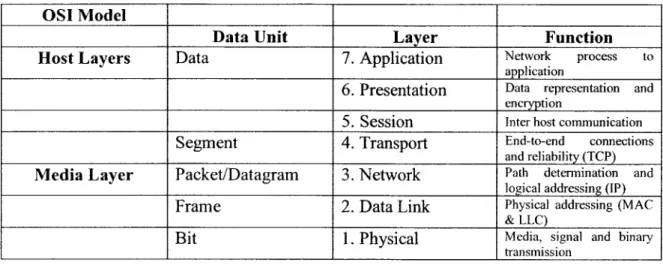
The International Standards Organization (ISO) Open Systems Interconnect (OSI) Reference Model is an abstract description of communications and network protocol designed according to layers. The model consists of seven layers, from highest to lowest: Application, Presentation, Session, Transport, Network, Data Link, and Physical layers. Each of the layers, as illustrated in Figure 2.1 , is dependent upon the ones below, with the physical network hardware—like network adapters and connecting wires—at the bottom.
OSI Model
Data Unit Layer Function
Host Layers Data 7. Application Network process
application
to
6. Presentation Data representation and
encryption
5. Session Inter host communication
Segment 4. Transport End-to-end connections
and reliability (TCP)
Media Layer Packet/Datagram 3. Network Path determination and
logical addressing (IP)
Frame 2. Data Link Physical addressing (MAC
&LLC) ^_^
Bit 1 . Physical Media, signal and binary
transmission
Figure 2.1: The OSI Model
This model can be readily understood through the familiar metaphor of telephone communication. The telephone is a device that allows us to speak over a great distance— the application layer. However, a telephone by itself is useless without being able to convert the sound of speech into an electronic signal that can be carried over a telephone
line—the functionality made possible by the layers beneath the application layer.
Ultimately, we reach the physical layer—the hardware and infrastructure that connects the phones to a switch within the system's larger network of switches. Making a telephone call involves lifting the receiver and dialing a number, which directs the request to a central dispatch. From there, the central office specifies the appropriate phone to start ringing. The session begins when that phone is answered and the two parties commence speaking. This dynamic is, in essence, exactly how a computer network works. For its functionality, each layer of the ISO/OSI Reference Model depends on the operation of the layer directly beneath.
With this basic conceptual understanding of networking in place, it is useful to
consider a specific example of the world's most widely used network. The Internet
functions as a meta-network—the biggest network of all the networks in the world. To access an online resource, like a website, does not actually involve connecting directly to the Internet. An entity connects to a sub-network that ultimately links up with the Internet
backbone, consisting of vast numbers of interconnected, high-speed, and high-capacity
network components like core routers that can only function with a language protocol. TCP/IP is the most used and common language protocol and is often described as the language of the Internet. A throughout description of this protocol is provided as follows.
2.2 TCP/IP: The Language of the Internet
The Internet functions using Transport Control Protocol/Internet Protocol (TCP/IP). Thus, fluency in TCP/IP is required to access the Internet. In terms of the ISO/OSI Reference Model, IP corresponds to the Network layer, and TCP to the Transport layer. Any host with TCP/IP functionality, such as an operating system, is able to support applications, such as web browsers, that make use of the network. Collectively, the suite of Internet protocols is known as TCP/IP, since the two were designed together and are inevitably found together, working in tandem.
Among the most significant elements of TCP/IP is not its technological character, but what might be termed its uniquely social one. Because this protocol is open, it can be implemented freely by anyone who wishes. Around the globe, members of the scientific community regularly contribute to the protocol design that drives the Internet, through their role in the Internet Engineering Task Force (IETF) work groups.
IP, as a protocol corresponding to the Network layer, enables the hosts to communicate with each other. IP ensures that devices with Internet connectivity are able
to identify and reach each other by carrying datagrams; mapping Internet addresses, such
as 10.2.3.4, to physical network addresses, such as 08:00:69:0a:ca:8f; and routing. The IP
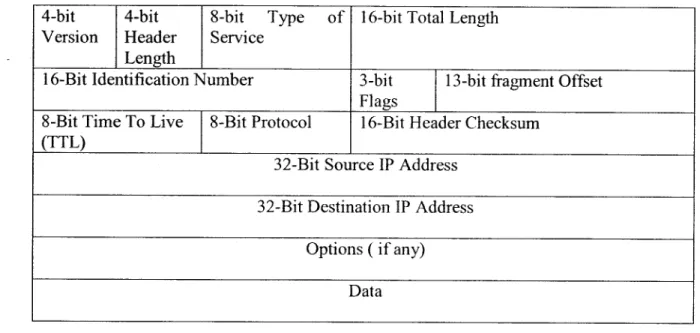
header content is described in Figure 2.2.
4-bit Version 4-bit Header Length 8-bit Type of Service
16-bit Total Length
16-Bit Identification Number 3-bit
Flags
13-bit fragment Offset 8 -Bit Time To Live
(TTL)
8-Bit Protocol 16-Bit Header Checksum 32-Bit Source IP Address
32-Bit Destination IP Address Options ( if any)
Data
Figure 2.2: The IP header
There are several significant elements that contribute to the incredible flexibility
and robustness of IP as a protocol, like routing and data encapsulation. However, IP was
not designed to provide a reliable service. This means that the network makes no
guarantee about packets arrival, which can cause security problems and this is the major
weakness of the protocol.
IP is vulnerable to various kinds of attacks. Generally, attackers take advantage of
the lack of a strong feature within IP for authentication to ensure that packets actually
originate from their stated source. As a consequence, there is no pre-established way to
determine the provenance of a given packet. While this anonymity does not constitute a
flaw as such, it is worthwhile to note that the service of host authentication must take
place at a higher layer in the ISO/OS1 Reference Model. This authentication is performed
at the application layer, for instance, in contemporary applications, like cryptographic
applications, that call for strong host authentication.
Spoofing is » CWp mmlikstytosw ite feiern Q XmmmçgsB mat it's A Q B responds mtli packet to A1 MckngwisUgmg A's session Rymüsrmtí specifies its mn, 0 X takes anottm pacMthzt ackmwtetiges session wmixr.
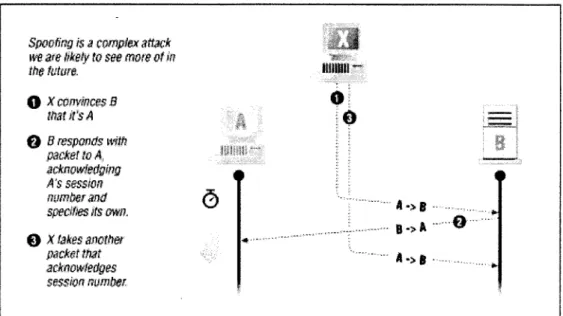
Figure 2.3: IP Spoofing Attack
IP spoofing occurs when a host claims to have a different host's IP address. A number of systems, like router access control lists, use the sender's IP address to determine the admissibility or inadmissibility of packets; IP spoofing is thus a valuable weapon in an attacker's arsenal. Packets can be sent to the host that will result in its taking a particular action. For some applications, login is allowed on the basis of the requesting party's IP address. These examples illustrate the way that undependable layers can result in weakened security. Figure 2.3 illustrates the different steps engaged in a typical IP spoofing attack. First, Host X disables Host A. Then, Host X impersonates
tea««* mm of in 1 1" "
Ö
;-~s-3f ItIIBII" O A->8 ... A->tHost A by sending a connection request to host B. After that, Host B responds to host A
along with a sequence number. Eventually, Host A then sends back an answer to Host B
by guessing the sequence number and Host X is then able to fully communicate with
Host B.A comparatively more sophisticated attack is IP session hijacking, as first
identified by Steve Bellovin [3]. Such an attack, nonetheless, poses an extremely large
risk, particularly since the underground community now offers toolkits to assist otherwise
untrained would-be perpetrators with this illicit execution. In this type of attack, a user's
session is taken over and placed in the attacker's control. If the attacker interrupts a user
in the process of sending emails, the attacker can now access all of the user's information
and perpetrate functions in the user's place. Meanwhile, the user under attack will find
that the session has been dropped and might proceed to simply login once more,
potentially unaware that the attacker may still be logged in and executing commands.
? TÊËBT Initial Sesiie« Server A Server B * # # SereecC Figure 2.4: IP Hijacking
For a better understanding of the IP session hijacking attack, an example, in Figure 2.4 is described in the following. Host A is currently in the middle of a session with Host B. This occasion could be a telnet session, wherein a user is checking email or using a home-based account running UNIX. Meanwhile, lurking in the network between A and B, is Host C, run by a malefactor who observes the traffic between them. Host C can then implement a tool that imitates A to B, while simultaneously silencing A or even convincing it that B has left the network, as could occur in a crash or network outage. In the event of a successful attack, within only a few seconds, the user's session has been hijacked. Whatever actions the user could have performed are now possible for the attacker, while B remains completely oblivious to the infraction.
One possible solution to this scenario is to use encrypted versions of applications in place of their standard telnet-type counterparts. While the session could still be hijacked, because of the encryption, only garbled nonsense will be visible to the attacker, who lacks the necessary key or keys for decrypting the data stream from host G. As a result, the attacker will be rendered incapable of any actions during the session.
TCP, as the transport layer of the ISO/OSI Reference Model, must rest upon a network-layer protocol. TCP was intended to work in conjunction with IP, while IP was designed to carry TCP packets. Some significant features of TCP will be briefly
Client
Server
¦
Ser*-s/
Figure 2.5: 3-Way TCP Handshake
Perhaps most notable among these features is guaranteed packet delivery. Host A,
when transferring packets to host B, will anticipate acknowledgment of the receipt of
each packet within a predefined time period. If the expected acknowledgement from B
does not arrive, the packet will be resent by A.
The applications run by host B will expect a complete and properly ordered data
stream from a TCP session. Whenever a packet is missing, as above, A will resend it.
Any packets that arrive out of sequence are re-ordered by B before being passed to the
application requesting the data. In that sense, TCP uses a handshaking technique to open
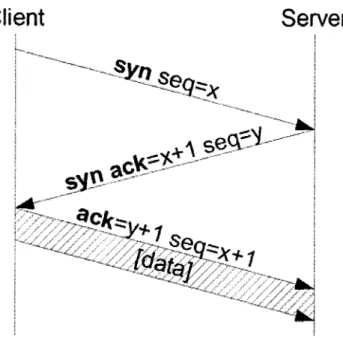
connections. It is referred to as 3-way handshaking or as "SYN-SYN-ACK". The
handshaking works as follows. Client sends a TCP SYN packet to server to initiate the
session. Server, then, sends a SYN-ACK to the client along with a sequence number.
Client, then, answers by sending the ACK flag with the incremented sequence number.
Finally, server receives ACK with the valid sequence number and the TCP connection is then, established. This mechanism, described in Figure 2.5, is designed so that two systems attempting to initiate a connection for communication can negotiate one connection at a time independently of each other.
For many applications, such as a telnet session, this system works very well. For a
user, the key is to ensure that the remote host receives each keystroke and that every
packet is received and sent back. The minor, intermittent slowdowns caused by resending
or rearranging lost or out-of-order packets are a negligible problem in these cases.
On the other hand, when it comes to media-rich applications like streaming audio
and video, this system is far from ideal. In such situations, the occasional dropped packet
in a stream of hundreds is of minor matter. Of greater consequence are speed and the
packets' timely arrival; slowdowns caused by resending lost packets will result in a break or pause of the data stream. Only after the lost packet is resent and received can it be
slotted into the appropriate position in the data stream and accessed by the application.
A simple transport-layer protocol, User Datagram Protocol (UDP), provides fewer features than TCP. UDP is therefore not considered robust or reliable. Still, while UDP is not suitable for all applications, there are those for which it is better suited than the more sophisticated TCP.
A major advantage of UDP is the parsimony of this protocol. The fact that it need
not track the packets' sequences or ensure their receipt results in a lower overhead compared to TCP. The protocol's simplicity contributes to its suitability for
streaming-data applications, since it involves expending less effort for rearranging out-of-sequence
packets or resending lost ones. After understanding how the Internet operates, especially
the TCP/IP protocol, and the threats that associated with it, an analysis of the risk management is developed, in other words, the level of security that we need to ensure against the access that we need to have and the compromises that should be done.
2.3 Risk Management: The Game of Security
When considering risk management, there are no one-size-fits-all solutions, nor is any one firewall necessarily the best for a given organization. In all cases, the extremes of total security and total access must be moderated. In practice, absolute security can only be attained in the case of a machine disconnected from any network and made physically inaccessible. Of course, this machine would then be of no practical value whatsoever. At the other extreme, absolute access—without any passwords, authorizations, or other security measures required—would have the virtue of absolute convenience. From a security standpoint, however, this increased access would be equally undesirable, given the risks associated with the Internet. Eventually, the damage caused by attacks or break-ins could render such a machine just as useless.
The same principle is constantly applied in everyday life: choices must be made about what level of risk is acceptable in a given situation. Every time someone starts a car
or boards an airplane, the possibility of danger is introduced. We accept these risks in
exchange for the convenience involved, while in other situations convenience is sacrificed in favor of greater security. Generally, we all operate within certain pre-defined boundaries that dictate which risks are acceptable and which are not. In situations where
the danger associated with an action clearly outweighs its convenience, most of us will
choose the safer alternative.
In terms of organizational security policy, then, the same general rule applies. It
must be decided what point on the spectrum between absolute security and absolute
access is appropriate for that organization's needs. An effective security policy should
clarify the acceptable level of risk and dictate the mechanisms used to enforce those boundaries in a consistent way.
2.4 Types and Sources of Network Threats
Having reviewed the relevant networking context, we can now consider the
implications for network security. To begin with, the various kinds of security threats
faced by networked computers will be described. Next, some of the precautionary
Atta* kef machine running citent proQfam
O *j¡> O *>
Hardier Handies Horwiäer H,mcif"
¦
H
M
H
«
M
Compromised Compromised Comptomísed Cùmpcan-tepiì Cam ?? orni s ed Compromised
Internet
Figure 2.6: Denial of Service Attack
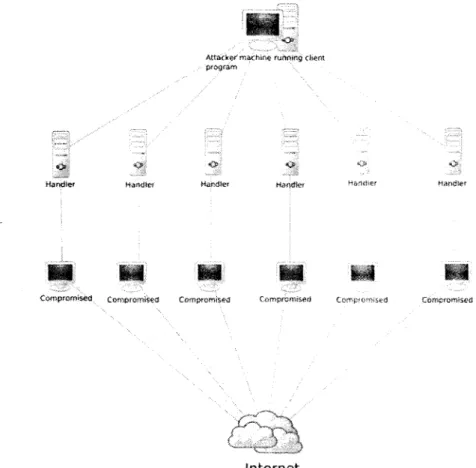
Perhaps the most pernicious attacks are Denial-of-Service (DoS) attacks. The ease of perpetrating such attacks, the difficulty or impossibility of tracking them, and the fact that an attacker's requests cannot easily be refused—without compromising service to legitimate users-—make DoS attacks notoriously tricky to handle. DoS attacks, shown in Figure 2.6, operate according to a simple premise: more requests are sent to the machine than it can effectively process. In the underground community, toolkits circulate that simplify the process further. A program is run that can be instructed to target a specific host. Then, the program connects to a service port, sometimes using forged packet header information to misidentify its origin and then immediately drops the
connection. By sending a large number of requests per second to which the host is able to
respond, the program renders the host unable to answer all of the requests. In the
meantime, legitimate requests—like those from users trying to access a website on the
server—will also be prevented from being serviced.
The risks of getting hit by such an attack can be mitigated in a few ways. One is
not running visible-to-the-world servers too close to capacity. Packet filtering can be used
to keep the network space clear of packets that are obviously forged—like those claiming
to originate from one's own hosts, from addresses reserved for private networks as
defined in RFC 1918 [4] and the loopback network (127.0.0.0). Finally, it is helpful to
stay updated on security patches for hosts' operating systems.
The term unauthorized access refers, at a high level of abstraction, to various sorts
of possible attacks. Overall, such attacks aim to access any resource that the computer
should not grant the attacker. In the case of a web server, for example, the host should
deliver the requested web pages to any user; it should not, however, provide command
shell access to any user, except local administrators or anyone else confirmed to have the proper authorization.
Clearly, preventing unknown and untrustworthy parties from executing
commands on server machines is essential to the integrity of the system. Generally, the severity of the problem is classified according to normal user and administrator access.
Normal users can perform certain actions, like reading and mailing files, which would be
undesirable for an attacker. In some cases, retrieving confidential documents may be all
that an attacker hopes to accomplish. In other cases, an attacker might seek administrator
access in order to make configuration changes to the host, resulting in even more
dramatic harm. Examples include changing the host's IP address or putting in place a
start-up script to prevent the machine from starting up effectively.
According to the threat model, the key question to ask is: what is it that one is trying to protect oneself against? A company's sensitive documents or other data that can be accessed by a normal user may cause a great deal of harm if accessed by competitors, enemies, or the public. Thus, break-ins occurring on normal users' accounts can have significant implications for security, in the form of public relations disasters or the leaking of closely guarded information.
Many of these sorts of break-ins are simply the work of relatively harmless, if misguided, thrill-seekers. An attacker may have no interest in breaking into a company's network beyond the excitement of the deed itself. As discussed below, however, other attackers may have more malevolent intentions. Keep in mind that the former, thrill-seeking breed of trouble maker can be enlisted in the service of the latter, more pernicious enemy or competitor.
The most destructive kinds of attacks and break-ins can be divided into two classifications: data diddling and data destruction. Data diddling is, in some ways, the most harmful, since it can be more difficult to initially detect. A data diddler may modify spreadsheet data, alter key project dates and deadlines, change employee payroll deposit information, or otherwise interfere with relevant company data. Such tampering may not become apparent until weeks or months later, when a discrepancy finally turns up. By this point, tracking down the source of the problem will present enormous difficulties. Even then, the difficulty of establishing order in the face of unsafe data remains. Data
by deleting files. The resulting damage to an organization's computing infrastructure can
be comparable to an arsonist setting a fire that destroys all of the physical equipment.
One obvious question is: how is it possible for attackers to gain access? The
answer is that any link to the exterior world—be it through an Internet connection, a
modem, or even staff members' physical use of equipment—represents a point of
vulnerability. It only takes one unscrupulous employee to uncover sensitive information like passwords, contacts, and other data. Thus, all such vulnerabilities need to be
carefully considered before security issues can be effectively tackled. All points of access
to an organization's computing system need to be secured, in keeping with that organization's security policies.
Several steps can be implemented to reduce the risks of attack and mitigate their consequences, based on the types of common attacks identified above. These measures
include both high-level practices to prevent security breaches and damage control
initiatives that can be taken to minimize the harm caused by a successful attack.
The benefits of regularly and thoroughly backing up data are not limited to
security implications. A backup policy, as dictated by the organization's operational
needs, ought to be accompanied by a comprehensive recovery plan. In the case of
disaster, such as fire or flooding, the backup policy and data recovery plan should
function together to allow normal operations to be restored, even from a remote location
if necessary. The same is true for electronic failures or malicious damage caused by
Despite the fact that this may seem like common sense, such details often escape
the attention of many. Simply put, any data that need not be available to outsiders should
not be made accessible. Neglecting to protect this information can needlessly compound
the damage caused by break-ins.
An organizational security system is only as strong as its weakest link. If the
entire system can be compromised by access through a single component, the
organization's overall security will be weak as a result. Redundancy in the system can help eliminate some of the risk associated with break-ins.
Staying abreast of security-related advisories from the relevant dealers can prevent one of the most popular, and effective, means of attack: taking advantage of old
bugs in order to break into the system. Somebody familiar with the system should stay
closely updated on operating system patches. Besides information and advisories issued by commercial vendors, security organizations like CERT[5] and CIAC[6] can be a valuable source of information.
Within the organization, a good practice is to have at least one employee
responsible for taking note of the latest developments in the field of security. This person
can simply stay informed about advisories and other news related to security and become familiar with basic security protocols like the "do"s and "don'f's found in resources like
the "Site Security Handbook". The person need not be a technical specialist or otherwise
possess special computer expertise. Armed with knowledge of the latest issues, such as current software problems, this person can be a valuable resource to confer with on matters of organizational security.
2.5 Firewalls
The Internet and other computer networks represent a two-way communication pathway through which information both enters and leaves a connected organization. In some contexts, this bilateral flow of information can be detrimental. For instance, proprietary data may be easily accessible from inside an organization's Intranet. A firewall, a set of components designed to act as a fence between one network and another, are commonly used to form a partial barrier between internal and external networks.
2.5.1 Firewalls Definitions
Before we proceed, some terms associated with firewalls will be defined. This introduction is important to understand how the designs involved in securing a network work. The terms that we are going to define in the following are bastion host, router, access control list, demilitarized zone, and proxy.
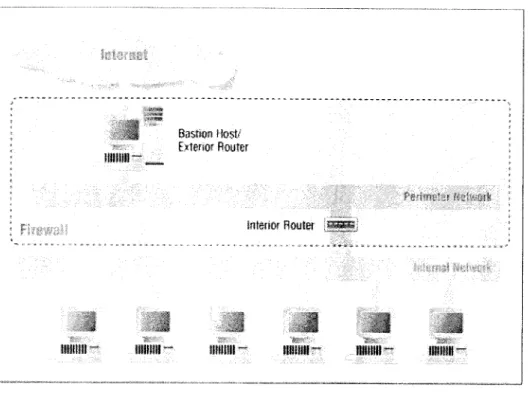
A bastion host, depicted in Figure 2.7, is a computer on the network that regulates contact between an Internal network and any untrusted network, like the Internet. Designed to resist attacks, bastions are general-purpose computers dedicated to this purpose, generally running a customized version of a UNIX operating system. All other service functionality is removed, or limited as much as possible, in order to reduce the external threat to the system.
;|1
Basson Host·'
E «tew Bouter
IlttIIIH — _____
interior Router ,»
'i
.-â
¿â
M
M
?
HHIIIIl- IMIHII — tlHIHII" IMlMH — IMINN ™ !»»?« —
Figure 2.7: Bastion Host
A router is used to connect networks to each other. These special purpose
computers are also responsible for functions like routing or traffic management on
connected networks. By using an access control list (ACL), some routers and servers are
able to identify permitted origination addresses, destination addresses, and destination
service ports by analyzing various data about incoming and outgoing packets.
Effectively, the ACL can allow the router to perform selective filtering.
The demilitarized zone (DMZ) is a network that intervenes between the trusted
and untrusted network. It is not itself part of either one, but connects the two to each
other. This function makes it a key element of the firewall, since the DMZ includes layers
of protection between the network and anyone attempting to break in via the Internet.
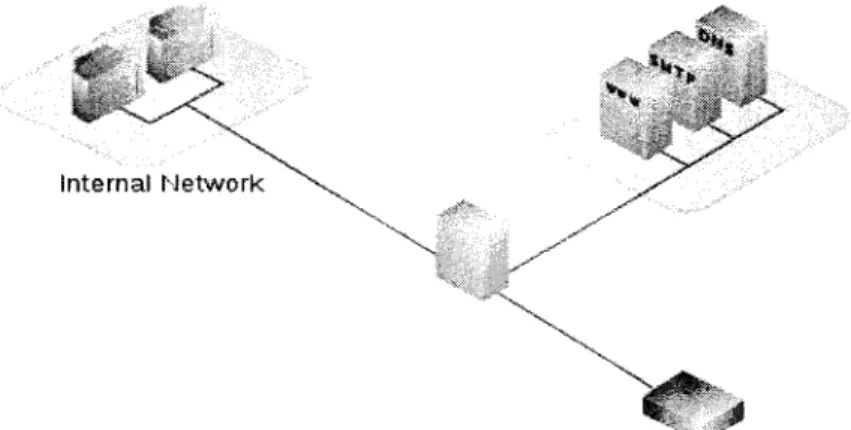
Figure 2.8 presents architecture of single firewall DMZ. In this case, the firewall must
have three network interfaces, one for the external network, the second for the internal
network and the third for the DMZ. The firewall in this case, must be configured to handle the traffic on these three interfaces.
>
Internal Network
é
Router to External
Networl-Figure 2.8: DMZ with one firewall
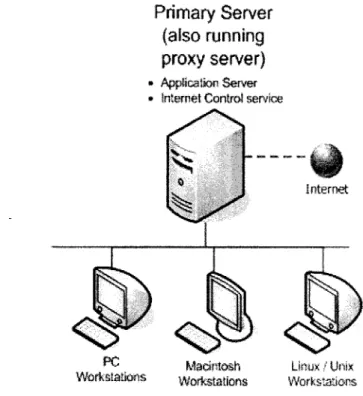
A proxy is one host acting in place of another host. As in Figure XX, They can allow hosts on an internal network to access Internet resources while being unable to directly connect to the Internet. The proxy server acts on the application layer of the OSI Model and controls traffic on that level as shown in Figure 2.9. For example, a host capable of requesting online documents from the Internet can be configured as a proxy server. Intranet-based hosts can be configured as proxy clients. Every time a host on the Intranet fetches a given webpage, the web browser connects to the proxy server to request the URL. In the following section, different kinds of firewalls are described.
Primary Server
(also running
proxy server)
Application Server
Internet Control service
Internet
PC
Workstations WorkstationsMacfRíosh WorkstationsLinux / Unix
Figure 2.9: Proxy server architecture
2.5.2 Types of Firewalls
The next considerations are the three main types of firewalls— application gateways, packet filtering, and hybrid systems—and their features.
5 Applicator)
<sf
. TransDO'l Control ¦* PfOtOCOl(TCP)
'
, Internet Protocol3 (IP)
2 Data Link 1 Physical m DiSsaSuvveei^> m
lowedTraffic is filtered based on
specified appücation rules, such
as specified applications (such as a browser) or a protocol, such as
FTP, or combinations
Unknown traffic is allowed up to
the top of the Network Stack.
Incoming Traffic Allowed Outooing Traffic
Figure 2.10: Example of an application level firewall
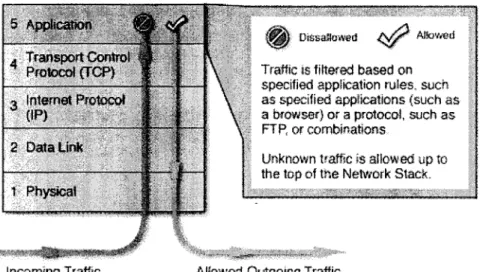
Early firewalls functioned as application gateways, or proxy gateways. The application gateways consist of bastion hosts running software designed to let them function as a proxy server. In terms of the ISO/OSI Reference Model, the software operates at the Application layer. All clients behind the firewall need to be configured to use the proxy before they can access resources and services on the Internet. In terms of security, because this kind of firewall prevents any default access to traffic, they are considered the strongest. The security offered by these systems, however, comes at the cost of speed. Generally, the number of processes required to return a request make them the slowest. Figure 2.10 shows how the filtering occurs in incoming and outgoing traffic in an application firewall.
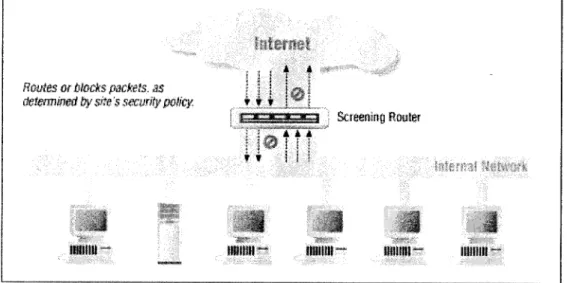
With packet filtering, a router uses access lists (ACL) to regulate incoming traffic. The default setting allows all traffic to pass through, with no restrictions. ACLs allow
security policies to be implemented in terms of access between the internal and external
networks.
•Mtersci
* *
m Routes ûr ùtocks pâcfœis. â$ '·._., tiet&mffled by site's security policy * tA.J'Y;
ggasagg Screening Router »ti!
IWIItIl-* Milli" IIHIIUt — IHIIIIII- ISIiIIIII'
Figure 2.11: Packet Filtering Firewall
Packet filtering, Figure 2.11, compared to application gateways, involves
comparatively low overhead. This property is due to the fact that access control takes
place at a lower level, on the ISO/OSI Reference Model, generally the transport or
session layer. For this reason, and because the routers employed by packet filtering are
special purpose machines designed to function optimally in a network environment,
packet filtering is also usually a faster system than application gateways.
Moreover, since this filtering takes place below the application level, new
applications can be supported with relative ease. The support of new applications either
happens automatically or involves specifying particular types of packets that are allowed
to pass.
However, this technique is not without its flaws. As noted above, TCP/IP does not include any mechanism for authenticating the origin of a given packet. Restricting traffic thus involves employing layers of packet filters, and all that can be ascertained for certain is the network from which the packet originated. By using two layers of packet filters, it is possible to distinguish packets originating from the Internet and those from within the internal network. The host itself cannot be authenticated.
Some systems have been developed that seek to combine the strengths of each of these approaches; thus, retaining the stronger security of an application layer gateway, while offering the greater flexibility and speed associated with packet filtering. This integration involves a two-stage process, in which authentication and approval is first granted to new connections at the application layer with the rest of the connection relegated to the session layer. The connection is then monitored by packet filters, ensuring that packets which have already been authenticated and approved at the application layer are allowed to pass.
Another option is to combine packet filtering with proxies at the application layer. This technique offers the security advantages of protecting machines, like web servers, which provide Internet resources, while at the same time functioning as an application layer gateway for an internal network. This approach also has the advantage of setting up more obstacles through which an attacker must penetrate to access the internal network. In order to break in, an attacker must get past the access router, bastion host, and choke
In order to choose the most suitable solution from among the many options available, organizations are well advised to consult with a security expert who is familiar
with their security policies. Based on those policies, firewall architecture can be designed
and built to optimize security in keeping with stated objectives, while also taking into
consideration other factors like the required services, ease of use, and scalability.
Often, the term firewall is used to describe a single component, like a bastion
host, that can ostensibly be used all by itself to keep networks from harm's way. In fact, a
firewall is a series of components working in conjunction to protect the system from attack. In the case of a single component, of course, there is only one barrier that an attacker needs to contend with in order to break into the internal network.
2.6 Summary
This chapter has presented some basic issues involved in network security, along with some of the considerations that networked organizations need to keep in mind in
order to minimize the risk of attacks and break-ins. The nature of TCP/IP protocol, which
lacks any inherent means for host authentication, entails a certain level of vulnerability
for any machine connected to the Internet. Network security testing is thus a crucial step
for mitigating the inevitable risks. The most common types of attacks have already been
outlined. As we have seen, the harm caused by DoS attacks or unauthorized access at the user or administrator levels can be devastating to an organization. Firewalls, as collective assemblages of security components, can provide solutions tailored to an organization's
needs—effectively translating security policy into practice. However, certifications and
other quantifications can be unreliable indicators of a firewall's practical efficacy. More
comprehensive methods for firewall testing are key to ensuring the functionality of these systems. In that sense, firewalls are as good as the policy they are configured to implement. When testing firewalls, we are essentially seeking to determine whether packet filtering has taken place effectively. To accomplish this goal, an efficient and complete testing method should be implemented.
In the next chapter, the different methods that have been developed and tested to
date in the field of firewall testing are reviewed and compared. As discussed next, the area of firewall testing can be divided into active and passive testing methods. Active methods help system administrators in the writing of the policy while passive methods take existing firewall configurations and correct them.
Chapter 3: Firewall Testing
Firewall development and implementation is constantly being improved to
accommodate higher security and performance standards. In contrast, the testing of
firewalls has for a long time not been taken as seriously as it should [I]. In the last couple
of years, however, more research in the field of firewall and network security testing has
been taking place. Methods have evolved from vulnerability testing of firewalls using
tools, like SATAN [7], to more advanced techniques that take into account the firewall
rules to produce a corresponding test.
To fully grasp the issues involved in firewall testing, the basics of network
security testing and the most popular methods used to test a network for security breaches
and functionality must first be discussed. Then, the latest state-of-the-art for firewall
testing will be explored in greater depth. Previous work in firewall testing can be divided
into two categories. On the one hand, passive methods use a given firewall configuration
and develop various methods to test it. Some methods use a predefined test set while
others, more advanced, use the actual firewall configuration and extract tests from it.
Active methods, on the other hand, look for ways to avoid errors during the writing
process of the configuration rules by developing algorithms and formal languages on top
of low level firewall rules or by using graphical interfaces that are more user-friendly.
3.1 Passive Testing
One of the two major methods for firewall testing, namely passive testing, takes
an already-configured firewall device and performs operations on this same
configuration, whether to remove mistakes by analyzing the configuration or by
performing a test and analyzing the output, be it log file analysis or program output.
3.1.1 Vulnerability Testing
The first real-time testing technique ever used was based solely on vulnerability
testing using tools like SATAN [8]. SATAN is used to identify network security
vulnerabilities and misconfigurations. Administrators frequently use this publicly
available tool to identify weaknesses in a network's security—however, it can be used by
attackers for the same purpose. In article [7], SATAN is used to test two popular
firewalls, namely, TIS [9] and SOCKS [10]. Test cases include known vulnerabilities and hence do not take into account the firewall rule set. Moreover, the test does not ensure that our network is protected against new types of vulnerabilities. Finally, for this test, a network needs to be already set up; testing comes afterwards, leaving the private network
vulnerable for a certain time window. This type of testing is time-consuming and can
demand costly resources. In article [11], a CASE tool is used to derive test sets after formally modeling the network surrounding the firewall. A mechanical approach is used to derive test-cases that check for common network vulnerabilities and threats. This method takes into account the network topology as it goes further than SATAN.
Unfortunately and just like SATAN, the approach uses simple check lists for
3.1.2 Real Time Testing
Traasmit packets Receive packets 1O ? ·· 1O-I J- objects Packe tScheduler Packetlter[
Packe tTransmit1O0 IO, ... IO„ , 1 p*cjcet? ? ? / ?1>.,?:&
I Firewall tmder test |
-. 1 Pacxet
G » .»-'J objects
1On IO, ... IO,,
Packe tReceive
T -r t ? Packetlter
1O 1I - Vi Jobjecti
Figure 3.1 : Blowtorch Packet Flow
Blowtorch in article [12] is another example of real-time testing. Blowtorch is a C++ framework designed for testing firewall rule sets in the process-control environment, where the cost of failure is high and extensive testing is justified. Blowtorch tests the firewall in isolation, connected only to test equipment. It has more capabilities as it includes a packet generation module, supports handshaking as well as allows for traffic capture and replay. The C++ implementation of the framework is based on the packet flow described in Figure 3.1. In that sense, the flow is being inspired from the real
functioning of the firewall and simulates the packets entering and exiting the latter. As
the tool is specifically designed for process control environment, its main focus is in the
real time part of testing. Unfortunately, it lacks an important feature: it does not generate
tests based on the internal specification of the firewall. The test generated remains then incomplete.
Further improvement has come with PBit [13]. PBit is a pattern-based testing
framework for iptables. It contains a collection of test templates. For example, to test the
protocol options for iptables, we use the following template: ProtocolTest(rule-proto, test-proto, direction)
The input domains for this test template are: rule-proto: {tcp, udp}
test-proto: {tcp, udp, icmp} direction: {inbound, outbound}
Figure 3.2 is an example of a multiport template in PBit as well as the options
available for generating a test set. From the interface, you can select protocols, input
source and destination ports as well as common ports. Then, it uses regression testing
with the help of parameterized test cases that can be configured in the user interface to
reduce the test overhead. Just like the previous tool, PBit does not include tests based on the firewall specification and thus cannot produce accurate test cases based on the its functioning.
id Test Muftipert Sr JSJ
select protocols to test
: input «out ce ports:
I SKS t<»M* !*¦» ?«"·<?«1«>
t
pe»t 20
t*i 21
Input destination pons: 'S ChiU« Ih·· ,— ..,....?«. P<ww: 180 J
PCK14Ì'·« X80
input common pons:
¦ äf* !«able I*·· !W*m*!*f
?ß,?»; 500 ."»i"
?<? 'JOO
Run Cióse neip
Figure 3.2: PBit multiport template
3.1.3 Formal Network Building
In formal network building approaches, we model the network as well as its elements to test a firewall configuration. Computer networks are composed of hosts connected by communication links. Hosts are connected to the communication links by interfaces, through which messages are sent. The previously described network model can be used to model vulnerabilities as well—for example IP spoofing. This attack usually happens when a host tries to masquerade as another host. In article [14], a formal
method similar to what was just described is presented. In order to test the firewall, the following steps are presented in Figure 3.3.
Network Mööeling Requirement Modeling Condition Verification Test Case Generation Execution
Figure 3.3: Vigna's Firewall Testing Approach
The proceeding measures must be taken to test firewalls. First, a program models
the network using network topology typified by hypergraphs and trust relations using
trust vectors. Requirement modeling then specifies the types of vulnerabilities against which the network has to be protected. Condition verification is used to ensure that
sufficient conditions satisfy the requirements of the given firewall. In test case
generation, the set of messages that should be obtained is derived for each requirement.
Then, using monitors, whether the configuration matches the policy can be determined.
During the test execution phase, the messages that correspond to the generated test cases
are injected and verified for correctness.
The main drawback of this method is that it is only a model and fails to take into
account the real functioning of the firewall. Also, this formal representation is not
intuitive and requires the administrator time to become accustomed to the formal
tests for common vulnerabilities. The test generation also generates one test per case, making it inaccurate and not necessarily covering all cases.
3.1.4 Algorithmic Approach
Work in algorithmic research for firewall testing and error detection has been conducted in several projects to date. On the one hand, we have tools [15,16] that are used to detect anomalies as depicted in Table 3.1 and Figure 3.4 and remove them using one or more algorithms. The most advanced work in this field can be found in article [15]. The approach is can be considered the most general and the most simple. They consider any misconfiguration a redundancy or a shadowing. Two algorithms are used in this approach: an algorithm that detects and removes shadowing and a second one that detects and removes redundancy. In this way, when applying both algorithms sequentially, we get misconfiguration error free rules. However, these tools do not guarantee an error-free rule set, since they do not take into account typographical or policy errors.
<', m.¦at
? ?
\
a) Correlated
b) Inclusive
c) Disjoint
Figure 3.4: Different Rule Configurations
Shadowing anomaly: R2 subset of Rl. Rl decision F R2decision
Correlation anomaly: Some of R2 subset of R, vice versa, Rl decision F R2 decision Generalization anomaly: Rl subset of R2, Rl decision F R2decision
Redundancy anomaly: Rl subset of R2, Rl decision = R2decision Table 3.1 : Rule Anomaly Types
On the other hand, we have algorithms that analyze rules and policies to generate
an efficient test. In Table 3.1, we describe the four types of anomalies, namely
shadowing, correlation, generalization and redundancy. Shadowing consists of covering
the whole address space of a rule by another rule, the consequence is that the shadowed
rule is never used. Correlation, on the other hand consists of having some address space
of one rule that are covered by some address space of the other rule, the covered address
space is never used in this case. Generalization anomaly consists of having a rule that is a
subset of another rule. The consequence is that the address space of the subset rule
contained in the other rule never gets triggered. Redundancy is only different from
Generalization in the sense that both rules have the same decision. As in article [16], a
segmentation approach, in Figure 3.5, is used to intelligently select packets to be used for
the test. In that sense, a system is used that is capable of smart selection of test packets using information about the network and the policy. After that, packets are selected to cover the whole space of possible packets, in the best possible manner. To that end, weights are used to select packets based on the segmentation and the precedence of rules in the rule set. The different steps to get to the intended result are the following. First, the address space is partitioned into segments based on the policy, as depicted in Figure 3.5. In fact, rule address space is partitioned into segments with each segment covering a unique address space. After that, the importance of each segment is calculated. Then, the rules from each segment from the firewall are extracted. Finally, by injecting these test packets, the output can be logged and analysed.
/ ^, R*
/ f \ /_ •\K ^
R "(a) Policy address-space {b) Segmented address-space
Figure 3.5: Policy Segmentation Technique
This packet selection method guarantees a much better and more accurate test than the previous methods. One major problem with this method is its latency, using a large set of rules when dynamic firewalls are used. In fact, the complexity of the
testing time can increase with an exponential factor. In fact and due to the recursive
loops, see the algorithm in Figure 3.6, the complexity of the algorithm is 0(2n).
? 2 3 4: 5 6 7 8: 9: 10: II: 12: 13: 14: 15: 16: 17: 18: 19: 20: 2Î: SEGLIST <- A
AddSegment (InitDomain.A ,? , defAct)
for all rules: i = 1 to ? do
for segments: j = SEGLI ST. Count downto 1 do
.
S = SEGLIST[J]
IncSeg *— S,AS ? AS(Ri) {Included part}
ExcSeg <— S. AS ? -iAS(Ri) {Excluded part}
if IncSeg f Seg.AS then -{Segment not contained in the Rule's AS}
if IncSeg f F then
AddSegment (IncSeg, S.R4n U {Ri}.
S.R.OUt-S.Reff U {?f
AddSegment (ExcSeg, S.Rin, S. Rom U {fit},
S. Reff U {Ri})
else {no intersection of rule and segment}
AddSegment (ExcSeg, S.Rin. S. Rout U {Ri\,
S.RcffU{R4})
end if
else {Segment is inside the Rule's AS }
AddSegment (IncSeg, S.Rin U {R>}, S.Rout.
S. Reff)
end if
SEGLIST.Delete (Segment j) {delete original segment}
end for end for
return SEGLIST
3.1.5 Query Engines
Query engines like those in [17] answer questions about the firewall's
configuration and its network. Figure 3.7 shows the data flow of a typical query engine. They take as input different firewall configuration files. Topology definition is then used to parse the configuration files into a language that the analyzer can process. The user thus interacts with the query engine in a query-and-answer session, taking place at a high level of abstraction. For example, the tool is able to answer such questions as which machines can reach the DMZ and with what services. This tool therefore serves a complementary role with respect to existing vulnerability analysis tools. It can be implemented prior to the deployment of the security policy; it functions at a more intuitive level of abstraction; and it deals with several firewalls simultaneously.
Configuration File (e.g. Cisco Router IOS)
Configuration Rie
(e.g. Luceíit firewall)
Configuration FsIe (e.g, Cisco Router IOS)
Topology Definition (MDL Program)
\iialvzer Prosram
Answer
The main disadvantage of query engines, however, is that they can only manually detect errors. The system administrator's job is to formulate these queries. The method is not automated and lacks precision. It depends too much on human factors, the most significant being experience.
3.2 Active Testing
Active testing methods take the reverse approach. Given that most errors are the
consequence of a faulty translation of the high-level policy into low-level rules, tools and
methods to avoid these errors have been developed. In the field of active testing, two
main approaches have been developed: visual graphical interfaces that are intuitive and
easy to use and formal languages that are closer than the high level policy that reduce
errors in the process.
3.2.1 Graphical Analysis
In articles [18, 19], for example, intuitive graphical interfaces are used. A graph,
Figure 3.8, is used in article [18], to detect overlapping mistakes as well as masking
mistakes when writing the rules. Colors are also used to help correct and spot those errors. There is also an editor that is used so the system administrator can manually correct mistakes.
LAN control ? internat internet malicious .
(Q] campusNet |
Rñ¡5tetf DMZ webserver miscSetverFigure 3.8: Graphical User Interface
On the other hand, an entity-relationship model in [20], illustrated in Figure 3.9 is used to derive firewall rules from that diagram. The entity-relationship model contains, in a unified form, global knowledge of the security policy and the network topology. A model compiler is used to derive this model into low level rules. The model is not complete as it neither covers all cases nor takes into account the all redundancies and shadowings leaving the final rule set error-prone.
Gateway-interface Adjacent Zone Hosting Gateway imertace Host Hosï Group Consists or HP Range)
m
Rote Group Assigned!© Rotes Service Group Pee CapabSittee -+. one-to-one » » one-to-many 1 K> Address Assumed Rotes Services Direction Service Protocol Base Oest Port No Range Siv Port No Range3.2.2 Formal Policy Writing
Firewall configuration languages currently lack any well founded semantics.
Article [21] tackles the lack of founded semantics in current firewall configuration
languages and suggests a high level configuration language for network access policy.
One of the results of this is the difficulty in managing network access control policies.
Most firewalls, in fact, are incorrectly configured. In Figure 3.10, an access control
language based on XML syntax is presented with the access control model Or-BAC
(Organization Based Access Control) used to interpret its semantics. This language can
be used to dictate high-level network access control policies and automatically derive
practical access control rules with which specific firewalls, by way of a translation
process, can be configured. This approach offers clear semantics for specifying network
security policy; greatly increases the ease of policy management for administrators; and guarantees portability between different firewalls.
policy
&-T?
-j, ôir:-ûrgâfïiïâffeni ?| {*»·?3
\M ortfcubfect f
r -> olfaction t|¿
- ~ljf or:oí>ject
subOrgamzetlort Hierarchy hx^risitvi
1
¦?, orrefevantEntity
1 '"""" "'"'"" "o"5"
¡ relevants ole ?-
<EPk.
], çr;empowerP. <
; J ? /~* i, w
? Mi-snwvb} Extension
t
-h reievantA cfcvity JE5 «™-jQ- -^ or consider j
! _ __ ___ _ „ _ -„-.v-^ ? . -, >_ » ? """" jD sukActivity · Hkfäuhv I \teriswrt (•"OD ¦{ SUOVlïVï '¡ Míerarctu i-Aícnstun !, or.secuntyRuíe !¡ permission
Figure 3.10: Or-BAC Model in XML
In the case of an already configured firewall, the formal policy writing approach does not actively test the firewall and requires the system administrator to become accustomed to the language and rewrite the entire rule set.
3.3 Summary
Real time testing tools assess the integrity of firewalls in a realistic environment. Creating an accurate environment to perform the tests; however, is sometimes unfeasible and can be costly. On the other hand, query engine tools exist that avoid having to set up a testing environment by modeling the network topology. They can then answer any query typed by an administrator. However, these tools are lacking in their ability to detect and correct mistakes. Their functioning is also dependent on human intervention. Furthermore, the algorithmic approach is convenient because we can automatically detect and remove all firewall anomalies. Finally, the active method testing tools currently used do not take into account the existing firewalls and require the network administrator to rewrite the rules in order for the policy to be applied.
The approach presented in this thesis uses the advantages of the algorithmic approach to remove misconfigurations, responsible for security leaks. As described in [1], most corporate firewalls are not correctly configured due to mainly complex policies that have to be deployed. It combines along with the algorithmic approach, a real time testing approach that takes into account the network environment where the firewall is deployed as well as the rules that are enforcing the policy. This way, it ensures that all misconfigurations errors as well as functioning and policy enforcement errors are detected and removed. The removal process is done using an update module that automatically detects and corrects the firewall configuration and produces a new configuration file.