http://dx.doi.org/10.4236/am.2014.51006
Note on the Linearity of Bayesian Estimates
in the Dependent Case
Souad Assoudou1, Belkheir Essebbar2
1Department of Economics, Faculty of Law, Economics and Social Sciences, Hassan I University, Settat, Morocco
2Department of Mathematics and Computer Sciences, Faculty of Science, Mohammed V University, Rabat, Morocco
Email:
Received September 21, 2013; revised October 21, 2013; accepted October 28,2013
Copyright © 2014 Souad Assoudou, Belkheir Essebbar. This is an open access article distributed under the Creative Commons At-
tribution License, which permits unrestricted use, distribution, and reproduction in any medium, provided the original work is prop- erly cited. In accordance of the Creative Commons Attribution License all Copyrights © 2014 are reserved for SCIRP and the owner of the intellectual property Souad Assoudou, Belkheir Essebbar. All Copyright © 2014 are guarded by law and by SCIRP as a guar- dian.
ABSTRACT
This work deals with the relationship between the Bayesian and the maximum likelihood estimators in case of dependent observations. In case of Markov chains, we show that the Bayesian estimator of the transition proba- bilities is a linear function of the maximum likelihood estimator (MLE).
KEYWORDS
Bayes Estimator; Maximum Likelihood Estimator; Markov Chain; Transition Probabilities; Jeffreys’ Prior; Multivariate Beta Prior; MCMC
1. Introduction
Let X be the random variable with Bernoulli distribution with parameter . It’s known that the Bayesian
solution, under quadratic loss and a beta distribution Be
,
as prior for , is given by
,E X aX b (1.1)
with a1
1
and b
1
. If X1, , Xn is a sample from X, the Bayesian estimate becomes
1, , n
n n,E X X a Xb (1.2)
with ann
n
and bn
n
.Moreover, X is the MLE which coincides with the empirical estimate.
Formulas (1.1) and (1.2) are still true with distribution of X in the exponential family [1].
Let’s now move to the dependent case and show that (1.2) is still true for the Markov chains.
Let X
X0, , Xn
be the n1 first observations of an homogeneous Markov chain with a finite state space E
1, , s
and let P
pij be the matrix of transition probabilities. The likelihood is
0
1
0 0
1
, , n n t t ,
t
L x x L x x P X x
(1.3)
where L j i
p i jij, , E.Let
1 ,
11 t t ,
n ij
n t X i X j
N I
which gives the number of one step transition from i to j until time n,
0
0 0
,, , ij.
n
N
n ij
i j
L x x P X x
p (1.4)The parameter
2
1,
, , 0,1s s
i j E ij
p i j
is to be estimated, and we assume that the distribution of
0
X is known, that is
1, ,s
with i P X
0 i
is known. Then, the MLE of is given by
2ˆ , , ,
ij n ij ij n j E N
p i j E
N
(1.5)which coincides with the empirical estimate.
The Bayesian estimator under the quadratic error loss, is given by
1
20 π d , , ,
ij ij ij ij ij
p E p X
p p X p i j E (1.6)where π
p Xij
is the posterior distribution. Two conjugate prior distributions are viewed. The multivariatebeta distribution [2] and the Jeffreys’ distribution [3].
This work is organized as follows: In the second Section, we develop the Bayesian estimation for different priors. In Section 3, the cases of 2 and 3 states Markov chain are discussed. A numerical study is given in Section 4.
2. The Bayesian Framework
In this section, we introduce two conjugate prior distributions for of a multistate Markov chain. The first kind of these priors is the product of the multivariate beta which doesn’t take account of a possible correlation between the rows of transition probability matrix. The second kind is the Jeffreys’ prior [3] which incorporates a certain type of dependence between the components of the parameter.
2.1. Multivariate Beta Priors
Given the characteristics of the transition probabilities pij, the natural choice of prior distributions is the multivariate beta distribution [2]. Thus, let the prior distribution for the elements of the th
i row of the matrix P be the multivariate beta, that is,
1 11 1 1 , , , ( ) ij s ij s j a
i is s ij
j ij j
a
f p p p
a
(1.7)
where denotes the gamma function.
There are s rows in the transition matrix P and thus there are s such prior’s in (1.7). If the rows of P
are assumed independent then the joint prior probability density function for all pij is
1 1
1
1 1 1
1
π , , ij .
s
ij
s s s
j a
i is s ij
i i j
ij j
a
f p p p
a
(1.8)
Making use of the likelihood given by (1.4) and the prior in (1.8), the joint posterior is
1 1
1 1
1
π nij ij .
s ij
n ij
s s
j N a
ij s ij i j n ij j N a x p N a
. ij n ij ij ij n ij j E N a p N a
(1.9)Let us remark that the Bayesian estimator pij can be written as
ij ˆ
ij ,ij n ij n
p A N p B N
with
ij ij
ij
n j E n j E n ij
A N
N
N a and
nij ij
nij ij
j E
B N a
N a . The above relation seems tobe compared to (1.2), but here, the coefficients
ij nA N and B N
nij depend also on the sufficient statistics ijn
N .
2.2. The Jeffreys’ Prior
Assoudou and Essebbar [3] have studied the Bayesian estimation for the multistate Markov chains, under the Jeffreys’ prior distribution. As shown, this prior has many advantages: it permits a certain type of dependence between the various transition probabilities. Moreover it’s a conjugate prior for L x
0, , xn
given by (1.4). The absence of extra parameter in this prior is of great interest, because we don’t need to do more extra estimation.The Jeffreys’ prior and the correspondent posterior distributions [3] are respectively given by
2
1
1 2
2
1 ,
π 1 ,
s s
i i ij
i i j E
n p p
2
1
1 2
2
1 ,
π 1 nij ,
s
s N
i i ij
i i j E
x n p p
where p
p1, , ps
is the stationary probability and i is the probability that the initial state X0 is i.One can deduce the Jeffreys’ prior and posterior distributions for the two-states Markov chain,
2
1 1 2 2 2 1 1 ,
π i 1 i ij ,
i i j E
n p p
(1.10)
2
1 1 2 2 2 1 1 ,
π 1 Nijn ,
i i ij
i i j E
x n p p
(1.11)where
p12,p21
and p
p p1, 2
is the stationary probability given by21 12
1 2
12 21 12 21
and .
p p
p p
p p p p
For the three-states Markov chain with parameter
p12,p13,p21,p23,p31,p32
0,16, the prior and theposterior Jeffreys’ distributions are respectively
2
1 3
2 2
1 ,
π i 1 i ij ,
i i j E
n p p
(1.12)
2
1 3
2 2
1 ,
π 1 ,
ij n
N
i i ij
i i j E
x n p p
(1.13)where the stationary probability p
p p1, 2,p3
is given by
21 32
31 21 23
1
12 13 32 23 31 12 21 23 21 13 32
,
p p p p p
p
p p p p p p p p p p p
12
31
32 12 13
2
12 13 32 23 31 12 21 23 21 13 32
,
p p p p p
p
p p p p p p p p p p p
13
21
23 12 13
3
12 13 32 23 31 12 21 23 21 13 32
.
p p p p p
p
p p p p p p p p p p p
3. The Bayesian Solution
For either posterior distributions (1.11) or (1.13), the integral given by (1.6) is difficult to calculate, so we propose an approximation of it by mean of an algorithm, namely the Independent Metropolis-Hasting algorithm (IMH) [4].
The fundamental idea behind these algorithms is to construct an homogeneous and ergodic Markov chain
l with stationary measure
π x .
For m “large enough”, m is roughly distributed from π
x and the sample m,m1, , can beused to derive the posterior means. For instance, the Ergodic Theorem [4] justifies the approximation of the integral (1.6) by the empirical average
1 1 m l l m
in the way that is converging to the integral (1.6) for almost every realization of the chain
l underminimal conditions.
For next, we will give the description of this algorithm in the cases of two-states and three-states. 1) Case of the two-states Markov chain
Given
1 , 2
l l l
Step1. Generate
1 , 2 0,1 0,1.
l l l
y y y U U
Step2. Take
1 1 1with probability ,
with probability 1 ,
l l l
l
l l l
y y y where
1 1 1 π, min ,1 ,
π l l l l y x y x
π1
.x is the posterior density given by (1.11).2) Case of the three-states Markov chain Given
1 , 2 , , 6
l l l l
Step1. Generate l
1 l, 2l, , 6l
y y y y such as:
1) Generate
1 , 2
0,1 0,1l l
y y U U until 1 2 < 1,
l l
y y
2) Generate
3 l, 4l
0,1 0,1y y U U until y 3l y4 l < 1,
3) Generate
5 , 6
0,1 0,1l l
y y U U until 5 6 < 1,
l l
y y
Step2. Take
2 1 2with probability , ,
with probability 1 , ,
l l l
l
l l l
where
2 2
2
π
, min ,1 ,
π l
l l
l
y x
y
x
π2
.x is the posterior density given by (1.13).4. Numerical Study
In order to characterize the relationship between the Bayesian estimator and the MLE, it’s indispensable to perform simulation studies. The first part of the analysis is devoted to Bayesian model founded on the multivariate beta prior given by (1.8) while the second deals with the Bayesian model using the Jeffreys’ prior given by theorem 1. We discuss through this analysis the cases of Markov chain with two and three states.
In both experiments, a pascal program is written to run the transition probabilities. The Bayesian estimator corresponding to Jeffreys’ prior is obtained from a single chain including 105 iterations of IMH algorithm
(Section 3).
4.1. Experiment (a)
In Section 2.1, we have shown that, under the multivariate beta prior, the analytical Bayesian solution doesn’t express clearly a certain linearity of the MLE. In this experiment, we demonstrate by simulation that the Bayesian estimator given by (1.9) is a linear function of the MLE given by (1.5).
4.1.1. Case of the Two-States Markov Chain
The data set is composed of 100 independent two-states Markov chains with 20 observations. To generate this data set, transition probabilities for each chain are drawn from the beta prior given by (1.8) with s2 and
parameters aij 1 2. The first state X0 , in each chain, is assumed to be equal to 1
1 1
. The remainingobservations given each chain, are then simulated in succession according to the appropriate transition probabilities. The Bayesian estimator pij for each chain, is computed from (1.9).
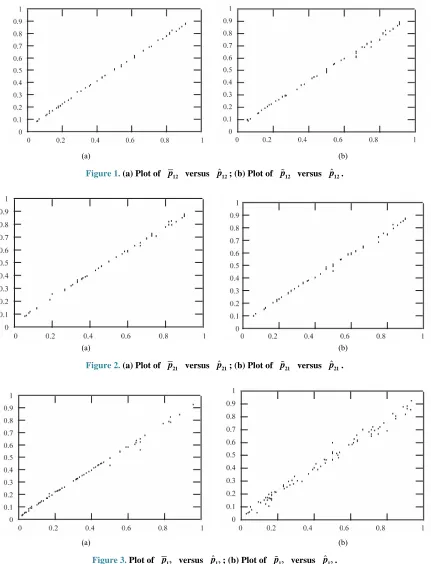
Figure 1(a) (resp. Figure 2(a)) shows the plot of p12 (resp. p21) versus pˆ12 (resp. pˆ21). These figures
prove that the Bayesian estimator pij is quite a linear function of the MLE ˆpij.
4.1.2. Case of the Three-States Markov Chain
In this experiment we generate 100 independent Markov chains each with three states and 60 observations. By using the IMH algorithm, the transition probabilities are simulated from the multivariate beta given by (1.8) with
3
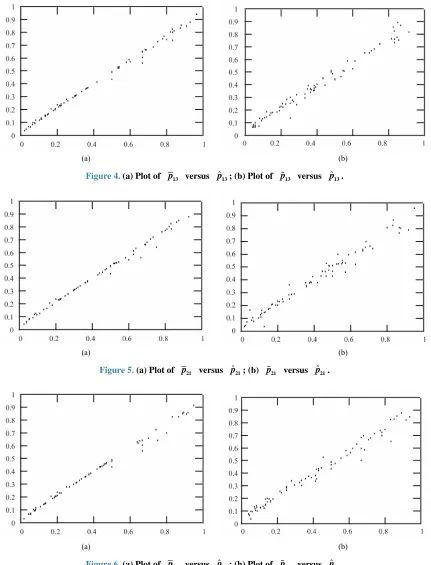
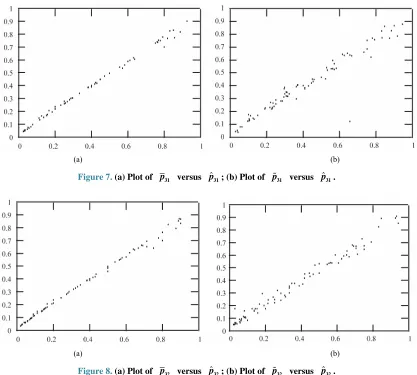
s and parameters aij 1 2. As previously, the Bayesian estimator pij is calculated from (1.9). The plots of pij versus ˆpij are given by the next figures (Figure 3(a) until Figure 8(a)). It’s true that the linearity of the Bayesian estimates is still verified, but we remark that the plot is not quite a line as soon as the number of states grows.
4.2. Experiment (b)
Now let us consider the Bayesian model based on the Jeffreys’ prior such that described in Section 2.2.
4.2.1. Case of the Two-States Markov Chain
In this experiment, we simulate 100 independent two-states Markov chains with n20, obviously the chains
may be of differing lengths. The IMH algorithm is first used to generate the transition probabilities from the Jeffreys’ prior given by (1.10). We assume, without loss of generality, that the first state X0 , in each chain, is
equal to 1 (1=1). The remaining observations, in each chain, are then simulated in succession with the appropriate transition probabilities. To obtain the Bayesian estimator pij of the transition probabilities given
each chain, we apply the IMH algorithm to the posterior distribution given by (1.11). The MLE ˆpij is
calculated from (1.5).
Figure 1(b)(resp. Figure 2(b)) displays the plot of p12 (resp. p21) versus pˆ12 (resp. pˆ21). From these
4.2.2. Case of the Three-States Markov Chain
The same experiment is repeated once more, but now the transition probabilities are drawn from the Jeffreys’
prior given by (1.12) in order to gererate 100 independent three-states Markov chains with n60. The
Bayesian estimator is approximited by mean of IMH algorithm applied to the posterior distribution given by (1.13). The next figures (Figure 3(b) until Figure 8(b)) show the plots of pij versus ˆpij. The same results as in Section 4.1.2 are obtained about the relationship between the Bayesian estimator and the MLE.
(a) (b)
Figure 1. (a) Plot of p12 versus pˆ12; (b) Plot of p12 versus pˆ12.
(a) (b)
Figure 2. (a) Plot of p21 versus pˆ21; (b) Plot of p21 versus pˆ21.
[image:6.595.98.529.166.730.2]
(a) (b)
(a) (b)
Figure 4. (a) Plot of p13 versus pˆ13; (b) Plot of p13 versus pˆ13.
(a) (b)
Figure 5. (a) Plot of p21 versus pˆ21; (b) p21 versus pˆ21.
[image:7.595.98.529.84.649.2]
(a) (b)
Figure 6. (a) Plot of p23 versus pˆ23; (b) Plot of p23 versus pˆ23.
5. Conclusion
(a) (b)
Figure 7. (a) Plot of p31 versus pˆ31; (b) Plot of p31 versus pˆ31.
(a) (b)
Figure 8. (a) Plot of p32 versus pˆ32; (b) Plot of p32 versus pˆ32.
simulation will be developed for different Bayesian models. The next step will be to proof analytically this property.
REFERENCES
[1] P. Diaconis and D. Ylvisaker, “Conjugate Priors for Exponential Families,” The Annals of Statistics, Vol. 7, No. 2, 1979, pp.
269-281.
[2] T. C. Lee, G. G. Judge and A. Zellner, “Maximum Likelihood and Bayesian Estimation of Transition Probabilities,” JASA, Vol.
63, No. 324, 1968, pp. 1162-1179.
[3] S. Assoudou and B. Essebbar, “A Bayesian Model for Markov Chains via Jeffreys’ Prior,” Department of Mathematics and
Computer Sciences, Faculté des Sciences of Rabat, Morocco, 2001.