Designing mixed
H
2
H
∞
structure specified
controllers using Particle Swarm Optimization
(PSO) algorithm
Ayman N. Salman Younis1, Ali A. Khamees1, Farooq T. Taha2
1
Electrical and Electronics Department, Engineering College, Thi-Qar, Iraq; [email protected]
2
Iraq University College, Basra, Iraq
Received 15 June 2013; revised 15 July 2013; accepted 25 July 2013
Copyright © 2014 Ayman N. Salman Younis et al. This is an open access article distributed under the Creative Commons Attribution License, which permits unrestricted use, distribution, and reproduction in any medium, provided the original work is properly cited. In accordance of the Creative Commons Attribution License all Copyrights © 2014 are reserved for SCIRP and the owner of the intellectual property Ayman N. Salman Younis et al. All Copyright © 2014 are guarded by law and by SCIRP as a guardian.
ABSTRACT
This paper proposes an efficient method for de-signing accurate structure-specified mixed H H2 ∞
optimal controllers for systems with uncertain-ties and disturbance using particle swarm (PSO) algorithm. It is designed to find a suitable con-troller that minimizes the performance index of error signal subject to an unequal constraint on the norm of the closed-loop system. Although the mixed H H2 ∞ for the output feedback
ap-proach control is considered as a robust and op-timal control technique, the design process nor-mally comes up with a complex and non-convex optimization problem, which is difficult to solve by the conventional optimization methods. The PSO can efficiently solve design problems of multi-input-multi-output (MIMO) optimal control systems, which is very suitable for practical en-gineering designs. It is used to search for pa-rameters of a structure-specified controller, which satisfies mixed H H2 ∞ performance index. The simulation and experimental results show high feasibility, robustness and practical value com-pared with the conventional proportional-inte- gral-derivative (PID) and proportional-Integral (PI) controller, and the proposed algorithm is also more efficient compared with the genetic algo-rithm (GA).
KEYWORDS
Mixed H H2 ∞ Optimal Control; Particle Swarm Optimization Algorithm; Structure-Specified Controller
1. INTRODUCTION
Recently, mixed H2 H∞ optimal control problems
have received a great deal of attention from the view-point of theoretical design because it is an advanced technique for designing robust and optimal controllers for systems associated with sources of uncertainties. It was firstly proposed by Bernstein [1], and has been fur-ther developed by many researchers [2,3]. Although GA is a useful tool for solving optimization problems and has been applied successfully in many control systems, it still has limitations due to its stochastic searching characte-ristic and complex computation that make it slow con-vergence to global optimum. PSO is a powerful method for solving complex and ill-defined optimization prob-lems because of its oriented searching and simple com-putation search [4]. Many researchers have become in-creasingly interested in the use of PSO as a means to design various classes of control systems. Kao [5] used PSO to design a self-tuning PID controller for a slider- crank mechanism. Chang [6] used PSO to design a PID controller for chaotic synchronization. In this paper, we propose a method to design the structure-specified mixed
2
H H∞ controllers by using PSO algorithm. The aims
of this design are to obtain both robust stability and good performance, for instances, small tracking error, less control energy, etc. In the method, model uncertainty of the system is represented by multiplicative uncertainty, and the system is assumed to be affected by external unit step disturbances and then the structure-specified con-troller is defined. Finally, PSO is used to search for pa-rameters of an admissible structure-specified controller
that minimizes the integral of squared error (H2 norm)
subjected to robust stability constraints (H∞ norm)
paper is organized as follows. Section 2, 3 and 4 explain a systematic procedure of the proposed controllers design algorithm. Simulation and results are presented in Sec-tion 5. Finally, SecSec-tion 6 concludes the paper.
2. STRUCTURE-SPECIFIED MIXED
2
H
H
∞CONTROL
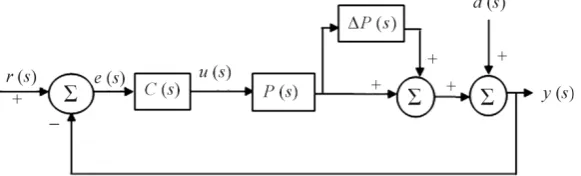
Consider a system with ni inputs and no outputs
controlled system as shown in Figure 1, where P s
( )
isnominal plant model, ∆P s
( )
is plant perturbation,( )
C s is controller, r t
( )
is reference input, e t( )
istrackingerror, d t
( )
is external disturbance, and y t( )
is output of the system [7]. The plant perturbation
( )
P s
∆ is assumed upper bounded by a known stable
weighting function matrix W s1
( )
( )
(
P j)
(
W s1( )
)
,[
0,)
σ ∆ ω ≤σ ∀ ∈ω ∞ (1)
where σ
( )
A denotes the maximum singular value of amatrix A.
It is proved that if a controller C s
( )
is designed sothat:
1) The nominal closed-loop system (∆P s
( )
=0 and( )
0d t = ) is asymptotically stable.
2) The robust stability performance against plant per-turbation satisfies the following inequality
( ) ( )
1 1
a
J = W s T s ∞ < (2)
3) The disturbance attenuation performance satisfies the following inequality
( ) ( )
2 1
b
J = W s S s ∞ < (3)
Then, the closed-loop system is also asymptotically
stable with ∆P s
( )
and d t( )
, where W2( )
s is asta-ble weighting function matrix specified by the designers.
( )
S s and T s
( )
= −I S s( )
are the sensitivityfunc-tions, and the complementary sensitivity of the system, respectively [8]
( )
(
( ) ( )
)
1S s = I+P s C s − (4)
( )
( ) ( )
(
( ) ( )
)
1T s =P s C s I+P s C s − (5)
In many control systems, not only the robust stability against plant perturbation and external disturbances,
but also small tracking error is also important. The prob-lem of minimizing the tracking error of a system can be defined as minimizing the cost function, called the in- tegral of the squared error (ISE)
( )
( )
22
2 2
0 d
J e t t E s
∞
=
∫
= (6)where e t
( )
is the system error between input andout-put which can be obtain from inverse Laplace
transfor-mation of E s
( )
with ∆P s( )
=0 and d t( )
=0( )
(
( ) ( )
)
1( )
E s = I+P s C s − R s (7)
The handling of constraints in Equation (2), and Equa-tion (3) is to recast the constraints as objectives tobemi-nimized and, consequently, a weighted sum approach is
conveniently used with suitable weightings u1 and u2,
which can be calculated by the designer. Therefore, the objective function of the investigated problem of
de-signing mixed H2 H∞ optimal controllers will be as
follows
1 2 2
min
C J=u J +u J∞ (8)
In this paper, the value of u1 and u2 is chosen equal
to 1, and a suitable structure specified PID controller will be chosen depending on the number of the inputs and the number of the outputs.
3. PSO ALGORITHM
Particle swarm optimization is a heuristic global opti-mization method and also an optiopti-mization algorithm, which is based on swarm intelligence. It comes from the research on the bird and fish flock movement behavior. In an initial moment, all the particles are positioned ran-domly in the searching space, in which the solution must be. The movement of each particle is the result of a vec-tor sum of three distinct terms; the first contribution is related to the inertia of the particle (a particle’s personal component), the second is related to the best position occupied by the particle (a personal component-memory) and the third is relative to the best position found by the group (group contribution-cooperation). Let the search
space be N-dimensional, and the particle i is represented
[image:2.595.157.448.631.719.2]by an N-dimensional position vector
(
1, 2, ,)
i i i iN
x = x x x . The velocity is represented by an
N-dimensional velocity vector vi =
(
v vi1, i2,,viN)
. Thefitness of particles is evaluated by the objective function of the optimization problem. The best previously func-tion of the optimizafunc-tion problem. The best previously
visited position of particle i is noted as its individual
best position, Pi =
(
P Pi1, i2,,PiN)
. The position of thebest individual of the whole swarm is noted as the global
best position, G=
(
g g1, 2,,gN)
. At each step ofsearching process, the velocity of particle and its new position are updated according to the following two equ-ations [9]
(
)
( )
(
( )
( )
)
( )
( )
(
)
1 1 2 2 1i i i i
i
v k w v k c r P k x k
c r G k x k
+ = ⋅ + ⋅ ⋅ −
+ ⋅ ⋅ − (9)
(
1)
( )
( )
i i i
x k+ =x k +v k (10)
where w, called inertia weight, controls the impact of
previous velocity of the particle. r1, r2 are random
variables in the range of [0, 1]. c1, c2 are positive
constant parameters called acceleration coefficients. The
value of each component in v is limited to the range
[
−vmax,vmax]
to control excessive roaming of particlesoutside the search space.
4. PSO-BASED STRUCTURE-SPECIFIED
MIXED
H
2H
∞CONTROL
A procedure for designing PSO-based structure-speci-
fied mixed H2 H∞ controllers for the problem defined
in Section 3.1 is presented below.
Step 1: Define a structure-specified controller of the form
( )
( )
( )
1 1 01
1 0
m m
c m m
n n
c n
N s B s B s B
C s
D s s a s a
− − − − + + + = = + + +
(11)
and specify the upper bound of plant uncertainty, W s1
( )
,weighting function for disturbance rejection, W2
( )
s .Step 2: Set particle i to
(
1, 2, ,) (
0, 1, , 0, 1,)
i i i iN
x = x x x = B B a a , the number
of parameters of the controller in Equation (11) is the
dimension of particle, N = + +m n 1.
Step 3: Initialize a random swarm of H particles as
[
x x1, 2,,xH]
when the swarm size is set to H.Step 4: For each generation, evaluate objective func-tion of each particle using the objective funcfunc-tion ex-pressed in (6), and also evaluate the constraints (2) and (3). The cost function can then be calculated as following: • If E s
( )
has right half-plane poles, then set J2= ∞.• If Max J
(
∞,a,J∞,b)
≥1 then set J2 = ∞ else J2 =( )
.E s Determine the individual best, and the global
best.
Step 5: Update the velocity of particle and its new po-sition using (9) and (10).
Step 6: When the maximum number of iterations is ar-rived, stop the algorithm. Otherwise, go to Step 4.
5. SIMULATION RESULTS
In this section, an PID and PI examples are given to illustrate the proposed design procedures and a compari-son study with GA algorithm is carried out to illustrate the effectiveness. Consider a highly coupled distillation column model [8]
( )
(
)(
) (
)(
)
(
)(
) (
)(
)
33.98 32.63
98.02 1 0.42 1 99.6 1 0.35 1
18.85 34.84
75.43 1 0.3 1 110.5 1 0.03 1
s s s s
P s
s s s s
− + + + + = − + + + + (12)
The bound W s1
( )
of the plant uncertainties ∆P s( )
is
( )
1 100 1 0 1000 100 1 0 1000 s s W s s s + + = + + (13)To attenuate disturbance, the stable weighting function
( )
2
W s is chosen as
( )
2 1000 0 1000 1 1000 0 1000 1 s s W s s s + + = + + (14)5.1. PI Problem
Since there are 2-inputs and 2-outputs, the structured- specified PI controller will be
( )
1 3 2 4
5 7 6 8
B B B B
s
B B B B
C s s + =
A typical controller C s
( )
obtained from the POS-based method with 10 runs
( )
18.5612 16.4037 25.5642 15.4331
2.4486 21.6076 25.5703 15.8784
C s s s s = − − + −
With the following value of performance indices J2=
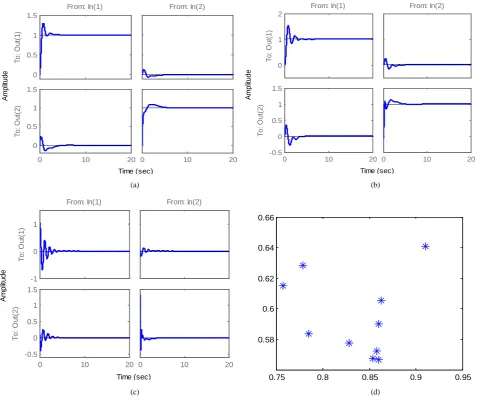
0.5835,Ja=0.636, and Jb =0.0.4599. The step
re-sponse, the disturbance rere-sponse, and Step response with the following value uncertainty for the resultant system
using PSO is shown in Figures 2(a)-(d).
5.2. PID Problem
specified PI controller will be
( )
1 4 2 2 5 3 6
7 10 8 11 9 12
s
B B B B B B
s
B B B B B B
C s
s
+ +
=
A typical controller C s
( )
obtained from the PSO-based method with 10 runs (equation at the end of the page).
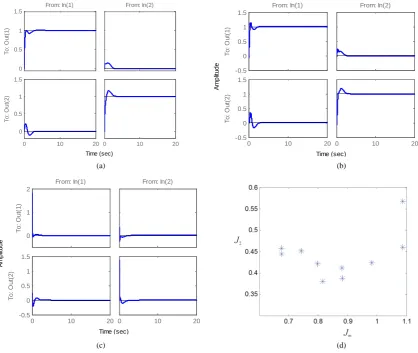
The step response, the disturbance response, and step response with the following value uncertainty of the
[image:4.595.58.269.86.143.2]re-sultant system using PSO is shown in Figures 3(a)-(d).
Table 1 shows the statistical results from the 10 runs of
problems 1 and 2. Figure 4 shows the convergence of the
best trial from both PSO-based and GA-based algorithms. It can be seen that PSO-based algorithm is convergent at about 30 generations whereas GA-based algorithm takes about 45 generations.
6. CONCLUSION
This paper proposed a PSO-based algorithm for de-
signing structure-specified mixed H2 H∞ MIMO
con-trollers with robust stability and disturbance attenuation. The high performance and validity of the proposed me- thod are demonstrated by a MIMO system with PI and
(a) (b)
(c) (d)
Figure 2. Output response for example 1. (a) PI step response; (b) PI disturbance response; (c) PI Step response with uncertainty; (d) Distribution of the ten PI controllers.
( )
2
5.7086 1.5980 40.8379 10.8117 1.1010 1.8873
0.3567 0.1178 s 17.3910 12.0784 s 1.1966 25.6294
C s
s
− − − −
+ +
− − − −
= 0
0.5 1 1.5
From: In(1)
T
o:
O
ut
(1)
0 10 20
0 0.5 1 1.5
T
o:
O
ut
(2)
From: In(2)
0 10 20
p p
Time (sec)
A
m
pl
itude
0 1 2
From: In(1)
T
o:
O
ut
(1)
0 10 20
-0.5 0 0.5 1 1.5
T
o:
O
ut
(2)
From: In(2)
0 10 20
Time (sec)
A
m
pl
itude
-1 0 1
From: In(1)
T
o:
O
ut
(1)
0 10 20
-0.5 0 0.5 1 1.5
T
o:
O
ut
(2)
From: In(2)
0 10 20
p
Time (sec)
A
m
pl
itude
0.75 0.8 0.85 0.9 0.95
[image:4.595.58.537.248.645.2]
(a) (b)
[image:5.595.92.511.85.438.2]
(c) (d)
[image:5.595.59.283.492.713.2]Figure 3.Output response for example 2. (a) PID step response; (b) PID disturbance response; (c) PID Step response with uncertainty; (d) Distribution of the ten PID controllers.
Table 1. Performance of the pso-based controller from 10 runs.
Controller 2
J J∞ J
Best Avg. Std. Best Avg. Std.
Problem 1 (PI) 0.5665 0.5947 0.0264 0.7574 0.8355 0.0475 1.3239 1.4302 0.0739 Problem 2 (PID) 0.3801 0.4405 0.0526 0.6749 0.8625 0.1517 1.055 1.303 0.2043
Figure 4. Convergence of the cost for PSO-based and GA-based optimization algorithms.
PID controllers. It shown empirically that the perfor-mance of the proposed method is more superior than that of existing GA due to the presence of very good speed and fitness with a few numbers of iteration and less complexity to reach the optima simulation and experi-mental results show the robustness and efficiency of the proposed controller. The PSO-based method can be most widely used for designing high-performance optimal controllers.
REFERENCES
[1] Bernstein, D.S. and Haddad, W.M. (1989) LQG control with a H∞ performance bound: A Riccati equation ap-proach. IEEE Transactions on Automatic Control, 34, 293-
0 0.5 1 1.5
From: In(1)
T
o:
O
ut
(1)
0 10 20 0
0.5 1 1.5
T
o:
O
ut
(2)
From: In(2)
0 10 20
p p
Time (sec)
A
m
pl
itude -0.5
0 0.5 1 1.5
From: In(1)
T
o:
O
ut
(1)
0 10 20 -0.5
0 0.5 1 1.5
T
o:
O
ut
(2)
From: In(2)
0 10 20
Time (sec)
A
m
pl
itude
0 1 2
From: In(1)
T
o:
O
ut
(1)
0 10 20 -0.5
0 0.5 1 1.5
T
o:
O
ut
(2)
From: In(2)
0 10 20
p
Time (sec)
A
m
pl
itude
0 20 40 60 80 100
0 5 10 15 20 25 30 35
generation
c
o
s
t
Comparison
Genetic
305.http://dx.doi.org/10.1109/9.16419
[2] Chen, B.S., Cheng, Y.M., et al. (1995) A genetic ap-proachto mixed H2/H∞ optimal PID control. IEEE Control Systems, 15, 51-60.http://dx.doi.org/10.1109/37.466262
[3] Ho, S.J., Ho, S.Y., et al. (2004) OSA: Orthogonal simu-lated annealing algorithm and its application to designing mixed H2 H∞ optimal controllers. IEEE Transactions
on Systems, Man and Cybernetics, 34, 588-600.
[4] Kennedy, J. and Eberhart, R. (1995) Particle swarm opti-mization. Proceedings of the IEEE International Confe-rence on Neural Networks, 4, 1942-1948.
[5] Kao, C.C., Chuang, C.W., et al. (2006) The self-turning PID control in a slider-crank mechanism system by ap-plying particle swarm optimization approach. Mecha-tronics, 16, 513-522.
http://dx.doi.org/10.1016/j.mechatronics.2006.03.007
[6] Chang, W.D. (2007) PID control for chaotic
synchroniza-tion using particle swarm optimizasynchroniza-tion. Chaos Solitons & Fractals, 39, 910-917.
http://dx.doi.org/10.1016/j.chaos.2007.01.064
[7] Chen, B.-S. and Cheng, Y.-M. (1998) A structure-speci- fied H∞ optimal control design for practical
applica-tions: A genetic approach. IEEE Transactions on Control Systems Technology, 6, 707-718.
http://dx.doi.org/10.1109/87.726532
[8] Tan, W., Chen, T. and Marquez, H.J. (2002) Robust con-troller design and PID tuning for multivariable processes. Asian Journal of Control, 4, 439-451.
http://dx.doi.org/10.1111/j.1934-6093.2002.tb00085.x