http://dx.doi.org/10.4236/jbcpr.2016.41006
How to cite this paper: Hoogeveen, R. and Veenswijk, M.B. (2016) Coping and Constructing: A Narrative Perspective on Project Dynamics. Journal of Building Construction and Planning Research, 4, 89-102.
http://dx.doi.org/10.4236/jbcpr.2016.41006
Coping and Constructing: A Narrative
Perspective on Project Dynamics
Rik Hoogeveen1, Marcel B. Veenswijk2 1Engineering Division, Amsterdam, The Netherlands
2Faculty of Social Sciences, Vrije Universiteit, Amsterdam, The Netherlands
Received 12 January 2016; accepted 25 March 2016; published 28 March 2016
Copyright © 2016 by authors and Scientific Research Publishing Inc.
This work is licensed under the Creative Commons Attribution International License (CC BY).
http://creativecommons.org/licenses/by/4.0/
Abstract
Recent studies on collaborative practices in large infrastructural projects address the importance
of discursive strategies and power relations in dynamic project arenas [1]-[3]. This paper focuses
on the coping narratives developed by contract team members during the building phase of a large-scale infrastructural project. Coping narratives relate to the management based grand narr-ative of the project and are produced and shaped in the process of sense making. By analyzing this interaction and the developments in a specific sub-team of a project, which is faced with multiple identity claims, this paper aims to contribute to the knowledge on how policies, views and deci-sions on an organizational level work out in project teams. The empirical material relates to a re-cent Dutch Mega-Project regarding the construction of a new sea defense and boulevard in Sche-veningen. This paper shows that developments, discourses and decisions on an organizational level are of importance for the commencing coping narratives in project teams.
Keywords
Project Management, Project Teams, Project Narratives, Intervention
1. Introduction
loca-90
tions along the Dutch coast was technically insufficient; these were called weak links1. By law these weak links had to be upgraded before the end of 2015. One of them was located in Scheveningen. This upgrading was the responsibility of the Ministry of Infrastructure and Environment2, who mandated this to the province of South Holland who, as is common in The Netherlands, sub-mandated this to the local Water Authority of Delfland3. In order to improve the coastal defense, the existing boulevard had to be demolished and rebuild after strengthen-ing the sea defense. The city of The Hague seized this opportunity to realize their vision to build an entire new, attractive boulevard. The four commissioners mentioned reached an agreement to reinforce one kilometer of sea defense, to widen the beach by supplying two million cubic meters of sand, to build a new boulevard of two ki-lometers in length, and to combine all these activities in one project in which the city of The Hague acted as leading partner.
Since the 1980’s, most civil engineering projects in The Netherlands are structured and managed according to a rational approach focusing on technical design steps and concurrent decision milestones, as described by e.g. Wijnen, Renes and Storm [4]. This approach hardly takes into account modern influencing processes by stake-holders and the public.
A vast number of large infrastructural and building projects in western society have their own history of tech-nical, financial and political mishaps, which makes the legitimacy of these projects not self-evident, e.g. [5] [6]. To cater this, more process-oriented approaches were developed, with attention to complexity and diversity [7]. Grand narratives are often used in an attempt to regulate and manage complexity and diversity. Narratives how-ever do not only affect the external public but also internal project team members. In order to understand this mechanism, we studied the discursive practice in the municipal contract team of the New Boulevard Schevenin-gen, focusing on the coping mechanisms team members developed in response to the grand narrative. The first author of this article was involved professionally as contract manager in this project. This led to an empiric de-scription and analysis, based on research and inside knowledge of and experience in the contract team.
In this paper, we answer the question: How does the grand narrative influence the meaning giving discursives in the contract team Scheveningen and does this influence the development of commencing coping narratives? With this study, we aim to contribute to the knowledge on the effects of developments in parental organizations on the sense making and daily practices inside project teams.
In the next section, we introduce the academic debate on narratives as vehicles for sense making, within the context of organizing and decision-making. We then summarize various forms of narratives and the relation to coping and describe our methodological approach. In the following section, we describe the context of the case and our research method. After this, we elaborate on our findings regarding the developments of grand narra-tives and coping narranarra-tives in the researched project. Finally, we conclude this paper with our analysis, a discus-sion and our concludiscus-sions in which we argument that narrative development and decidiscus-sions on organizational level are of importance for the daily practice and decisions in project teams.
2. A Narrative Approach
The concept of narrative dynamics in interpretive project management and organizational studies is a broad concept and has been discussed by many scholars, e.g. [8]-[13]. Narratives can be viewed as important vehicles through which meaning is negotiated, shared and contested. Most research relates to the question how discursive structures and patterns influence and shape actors, interpretations and actions, and consequently social practices
[14] [15]. In these studies, narratives are seen as both sense making and sense giving devices [16]. In this paper, we define narratives as temporal stories in which meaning is created, modified and distributed, during a process of social interaction [17].
Several authors have developed conceptual descriptions on potential developments in narrating processes and its consequences for organizational actors participating in a discourse. Boje [9] distinguishes narratives and “an-tenarratives”. Antenarrative is the “story” preceding a narrative, i.e. before plot and coherence are added. Ante-narrrative “gives attention to the speculative, the ambiguity of sense making and guessing as to what is happen-ing in the flow of experience”. A particular narrative, introduced by Boje, is the “grand narrative”, which he de-scribes as “a metanarrative that subjugates and marginalizes other discourses”. Because of this “dominant” na-ture, grand narratives might invoke their own counterforces, which have the “ambition… to shatter grand
narra-1In this article, Dutch quotes and expressions, which are translated to English, are presented in Italic script. 2
Ministerie van Infrastructuur en Milieu.
3
91
tive into many small stories and to problematize any linear mono-voiced grand narrative of the past by replacing it with an open polysemous (many meanings) and multivocal (many-voiced) web of little stories”. Beech [18]
characterizes narratives and narrators by their “style”, i.e. the way a narrative develops for the actors and narra-tors involved. He distinguishes the epic/heroic, the romantic, the tragic and the ironic style. The epic/heroic style is characterized by a “hero” who takes action and leads “his followers” to a “better future”, while the romantic style is characterized by the views and actions of a romantic suspect with an integrating behavioral style. The tragic style belongs to situations where actions are taken which regretfully do not result in the desired future. Finally, in the ironic narrative the “better future” is not reached because the ironic suspect misreads the situation. To describe the narrated situation and its development in this study, we distinguished the narratives and the interaction with the actors. The narrative dynamics concern the way narratives evolve in the process of organiz-ing. We discern three subtypes. The first sub-element relates to the time aspect, the temporal development. The second one relates to the content characteristics of the narrative and the third is the way this context is expressed in several sub-contexts. The second theme of analysis shifts from the narrative to the narrator. Here we identify also three aspects. First we identify the key editors, which are involved as main narrators in the process of narra-tive dynamics. Second the way actors express and jump on several sub-characteristics. And third the dominant styles of the way they form and modify their stories in time.
3. Context
The New Boulevard Scheveningen project was carried out by the accessory departments of the city The Hague, under the administrative liability of the alderman responsible for Scheveningen. The Hague has two departments, which are involved in the physical aspects of the city: the Department of Urban Development4 (DSO) and the Department of City Management5 (DSB). DSO is responsible for town planning and for existing buildings and housing and DSB for managing, operating and maintaining municipal urban space [19]. The planning stage of this project was commissioned to DSO in 2006, which appointed a city-commissioner and a project manager from their organization. The project manager organized a planning team, which selected Sola de Morales for the design of the boulevard. His design of the New Scheveningen Boulevard should give the village international grandeur but also appeared very “un-Dutch” in shape and materialization.
In 2008, when the planning stage was finalized, the plan went into realization and the project was transferred to DSB. DSB appointed a new city-commissioner and a project manager, who assembled a new team. Civil en-gineers replaced the spatial planners and designers and the orientation shifted from process to execution. The realization stage comprised two distinct activities: the engineering and tendering, and the supervision of the ac-tual construction. Two separate teams carried out these tasks, respectively an engineering team and a contract team.
The project manager, the members of the engineering team and the members of the contract team were re-cruited from the Engineering Division of The Hague6, which is a division of DSB. As with most municipal en-gineering divisions, the Enen-gineering Division is specialized in civil enen-gineering in the applied local context and organized in mono-disciplinary sections, comprising e.g. pavements, roads, sewers, constructions, environmen-tal engineering, insenvironmen-tallations and public lighting. Cooperation between disciplines is rarely necessary and their experience with integrated projects and integrated engineering therefore limited. The Engineering Division was very keen on executing this project to the best of their abilities and they selected their most experienced senior staff in the required technical fields. For the engineering fields that they lacked, they commissioned subtasks to
92
well-known, national companies and institutes. Initially the only “outsiders” in the contract team were the dike building supervisor and his assistant, acquired from the responsible water authority.
The project was financed by the ministry, the province and the city and by some national and European grants. Because of these grants, the commissioners wanted construction to start in 2010. Dutch Law states that work on sea defenses is only allowed between March 1 and October 1, as in winter the sea defenses of The Netherlands have to be fully operational. This meant tendering before the end of 2009, so the contractor could start construc-tion in March 2010 and complete the first secconstruc-tion before October. This gave the engineering team less than a year to complete the technical design and tender documents. As this was not possible, they chose to base the tender documents on a not fully developed technical design to meet the time frame. The remaining technical de-tails would be designed after contracting. The project was tendered in a traditional manner, which implied that the commissioner is fully responsible for all design and scope modifications after contracting. The tender started in the second half of 2009 and the contract was awarded at the end of 2009. The construction preparations started in January 2010.
The described contract for the construction of the sea defense and new boulevard was not standing on its own. The engineering team decided to tender six concurrent contracts for sand supply and various special objects, and three supply contracts, all supporting the same overall project. Members of the contract team also supervised these contracts. The coordination of all these concurrent contractors added complexity to the task of the contract team. The technical manager, who prepared the technical design and the contracts, also became responsible as contract manager for the contract team. Because of the incomplete design, the engineering team continued com-pleting and refining the technical design. This team stayed at the main office in the city center, whereas the con-tract team became stationed near the construction site. The technical/concon-tract manager had to combine two tasks on two different locations. Approximately six months after the start of the construction phase, it became appar-ent that the combined function of technical and contract manager was not tenable. The Hague asked their col-leagues from Amsterdam to supply a contract manager for the contract team, so the original technical/contract manager could solely focus on finalizing the design. With a time lag of eight months, the first author of this ar-ticle started as contract manager in the project.
4. Research Method
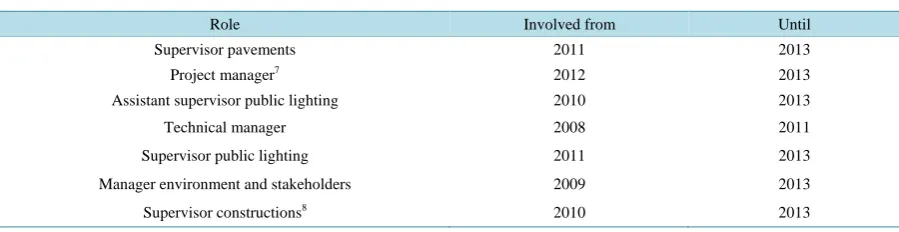
[image:4.595.88.538.561.677.2]This article intends to contribute to the knowledge on the relation between grand narratives and coping narra-tives, from an empirical point of view, and is based on an explorative study with a constructive angle. The inside position of the first author made it possible to gain ample knowledge on the situation and the developments in and around the contract team. In that sense, the research represents an ultimate form of ethnographic fieldwork. Data and information have been gathered through interviews, document searches and by participation. In total, 14 people successively have been part of the contract team. During the period of the interviews, the team con-sisted of seven team members from which all long term participating incumbent members were interviewed, who all played significant roles in the project. In addition the project manager and the technical manager were also interviewed. All interviews were carried out in the first quarter of 2013 (Table 1). The threat of bias was mitigated by triangulation.
Table 1.Interviewees.
Role Involved from Until
Supervisor pavements 2011 2013
Project manager7 2012 2013
Assistant supervisor public lighting 2010 2013
Technical manager 2008 2011
Supervisor public lighting 2011 2013
Manager environment and stakeholders 2009 2013
Supervisor constructions8 2010 2013
7The project manager was earlier involved as project manager in the planning stage, from 2006 to 2008. Being employed by the DSO, he
was replaced by a colleague from DSB for the realization stage. When this colleague retired, he became project manager of the Boulevard again, now employed by DSB.
93
In 2002 a parliamentary enquiry showed the Dutch construction sector was indulged in collusive practices [20] [21]. In order to strengthen the professionalism of government project managers, the Dutch Directorate-General for Public Works and Water Management9 founded the Public Project Academy10 (RPA) in 2009 [22]. As part of his study at the RPA in the period 2011-2013, the first author, guided by the second author, studied the effects of decision-making by the administration on the Scheveningen contract team from an interpretive point of view. The results were reported in a paper in May 2013 [23]. The authors realized the collected data for this study contained valuable additional information. So they analyzed the data again, now with an emphasis on coping narratives, which the project team members developed under influence of the grand narratives.
The methodological approach chosen in this paper has, besides strength, also limitations. The first limitation has to do with the scope of the research, which was based on a limited number of interviews. The second limita-tion concerns the involved posilimita-tion of the first author in the researched project as team leader and contract man-ager, which gives him an interest, as he is also part of the analysis.
5. Narratives
5.1. Development of Grand Narratives
The key commissioners in this project were the city and the Ministry of Infrastructure and Environment, both with their interests, agenda’s and national and international ambitions, which led to a high profile and highly visible project, raising expectations by politicians and the public. As governmental commissioners are well aware of political and public attention to high profile projects with major impacts on society and landscape, they use grand narratives for communication purposes.
Sea defense grand narrative
The Netherlands has a history in coastal protection, land reclamation and water management. Dike building started in The Netherlands around 1000 AC but became successful by the order of Cistercians in the 12th century
[24]. Nowadays The Netherlands is one of the most densely populated countries in Europe with about 65% of its area below average sea level [25]. This history of land reclamation and sea defenses is used in a national narra-tive, which is often referred to as “the eternal battle of the Dutch against the sea” e.g. [26]. The ministry com-monly uses variations on this narrative to stress the importance of sea defense projects e.g. [27]. At Schevenin-gen the importance of the sea defense was strengthened by the fact that this particular weak link was part of the largest “dike ring” in The Netherlands; i.e. dike ring 14. This dike ring protects an area of 2000 km2 with an av-erage land level of one meter below sea level. There are 3.5 million people living in this area, which comprises 1.7 million houses. Also the three largest cities of The Netherlands are located within this dike ring; Amsterdam, Rotterdam and The Hague. The area supplies 65% of the gross national product [28]. Therefore, at the start of the project in 2006, the sea defense narrative became the “natural” grand narrative. However, in 2008 the atten-tion slowly drew more to the new boulevard of Scheveningen and the grand narrative started to shift [29].
Boulevard grand narrative
The village of Scheveningen is historically a small fishing village, originating from the 13th century. In the 19th century tourism made its entry. Nowadays Scheveningen is the most well known seaside resort in The Netherlands and tourism is the major source of income for the population of 52.000 [30]. The village is visited annually by 18 million tourists [31].
The first plans for the new boulevard in Scheveningen originate from 2001. In 2003, the weak links project provided the municipality with the financial means to realize the boulevard project. On April 25, 2007 the re-sponsible alderman for Scheveningen send a preliminary design of the new boulevard to the council commission with the following advocacy: “Improvement of the Scheveningen Boulevard is one of the key projects to improve the public space and is therefore of vital importance for tourism and liveability” [29]. The alderman was very committed to the project and linked it to his personal political conduct.
The text, with which the alderman presented the preliminary design to the council commission on April 25, 2007, contained the only reference we found in the city council’s process dossier on the boulevard [29] contain-ing an explicit argumentation why a unique new boulevard was desired. We did not find any notices in the dos-sier questioning the legitimacy of the boulevard narrative; i.e. “a high quality boulevard with international
al-9Rijkswaterstaat.
94
lure”. The boulevard narrative appears to be implicitly accepted as a natural perspective, as something that can-not be opposed. In an implicit way this shows the strength of this narrative.
During the realization stage, the city put a lot of effort in stakeholder communication. They set up an informa-tion center and prepared flyers, animainforma-tions and other channels of communicainforma-tion, which had this narrative as one of their focus points. In 2008, the local saga surpassed the national one. The local grand narrative focused on the unique new boulevard and its international appeal. Only by the end of the project, when the Minister of Infrastructure and Environment officially opened the Boulevard, the importance of the sea defense temporarily gained attention again. She mentioned: “Scheveningen was a so called weak link in our coastal defense and had to be dealt with. The west of The Netherlands is like a bathtub. When the water inundates our dikes, embank-ments or dunes, we got a real problem. Continuous action is needed. (…) From the eight important weak links, now five have been solved. We are on schedule. The approach of this ex-weak link is—like the others—evidence of our extended knowledge and strong reputation in the field of water management. Rightly so we regard our knowledge on water issues a top sector with great export opportunities. Nowadays “Time to bring in the Dutch” is a motto abroad, when flood disasters are at hand.” But the Minister also responded to the local narrative and added: “With this new boulevard, Scheveningen has gained a recreational top attraction with even more gran-deur. (…) The Hague is not only a beautiful city behind the dunes, but now also a beautiful and safe city in front of the dunes.” [32].
An example, which illustrates the dominance of the boulevard narrative over the sea defense narrative, is the following: Along the old boulevard a road was present, which was used for sauntering. Part of the design of the new boulevard was a new road dedicated to this sole purpose; i.e. sauntering with motorized vehicles. When this road was finalized, in advance of the completion of the entire new boulevard, the alderman opened this road and gained quite some media exposure. But when the sea defense was officially finished and the boulevard was still under construction, no attention whatsoever was given to this fact. From a sea defense point of view, this could have been an opportunity for media and governmental exposure: “Dike ring 14 is safe again, protecting 3.5 mil-lion people”. Remarkably, this opportunity was not seized; it was not mentioned by the local or national press.
5.2. Coping Narratives
Within the project team, the members developed various coping narratives. We distinguished three; the profes-sional superiority coping narrative, the locality coping narrative and the co-creation coping narrative.
Professional superiority coping narrative
The first coping narrative is based on the ambition of the Engineering Division. They selected their most ex-perienced, senior staff for the contract team. In combination with the boulevard narrative, framing the new bou-levard as a high profile project with international allure, this resulted in a discourse in which the selected team members pictured themselves as “the best of the best”. The senior team members all acted before as independent project leaders of their own teams, in mono-disciplinary projects. In this project however they had to work to-gether in an integrated contract team. This caused tension, which got room to flourish as the technical/contract manager was focusing on finalizing the technical design and depended on the senior contract team members to start up their tasks with minimal guidance. Without apparent guidance, competition commenced and team members felt back on their own disciplinary fields, which they “protected” against interference from colleagues from other fields. The project management blamed this lack of team cooperation on a conflict of characters: “We expected the supervisors of the three disciplines to collectively approach their task. That proved a “bridge to far”; their characters didn’t match”. Nevertheless, the team members regarded themselves as experienced pro-fessionals and expressed themselves complacent: “My role in this project is to discuss matters with the other team members and to positively guide them. (…) I always led major projects in The Hague as well as political sensitive projects. (…) I was project manager of the rail infra project between Rotterdam and The Hague. (…) Actually I was supposed to be the contract manager but I was more interested in another role.” It led to high self-expectations, which were not always supported: “I could have meant a lot more in this project but I did not get the opportunity and I wasn’t supported by the management”.
95
A member of the project management expressed his doubts on the supposed professionalism of the team and the Engineering Division: “I never expected the Engineering Division to be so compartmentalizing. I had the feeling team members were walking around with an inferiority complex and because of that they were afraid to make mistakes and therefore abdicated responsibility. At least, they didn’t assume responsibility. (…) I am used to project interests being prevailing to individual interests”. A top manager confirmed the Engineering Division had little experience on integrated projects, indirectly acknowledging the problem of interdisciplinary coopera-tion: “We rarely work on integrated projects. Therefore it is not very useful to develop these skills and we are not going to. When necessary, we hire personnel from other engineering divisions within the G411”.
Locality coping narrative
The second narrative focused on the locality. The followers of this narrative considered themselves represent-atives of the neighborhood, i.e. Scheveningen or The Hague. They considered themselves loyal to and having special knowledge of the locality. This narrative was strongest with team members originating from the village of Scheveningen. Their affiliation with this project stretched beyond their usual professional commitment. They used their position to defend the interests of the village and its inhabitants as they saw necessary. They consi-dered themselves “advocates” of Scheveningen: “I saw my assignment as I carried it out; I originate from this village, so I am more aware of the interests of the inhabitants. (…) This is my project, my village. I am doing this for Scheveningen. (…) The Hague? I don’t care; I don’t like them. (…) My clients are the inhabitants, the entrepreneurs, the beach pavilions, the lifeboat association, the harbor, all of them; but not the commissioner”. These team members showed strong convictions in their views on matters. They sometimes went against the chain of command to achieve what they felt was necessary.
The Scheveningen members had to deal with frustrations regularly when their ideas were not met, and some-times they were called to order. They all considered leaving the team at some point, but their loyalty to the loca-tion and to the project prevented this: “I had moments I wanted to quit. But I didn’t do it because it’s a beautiful projected and I am no quitter.” And another mentioned: “I could not leave this job and I could not leave this team. It is my project! I am from Scheveningen. I do what I can for this village.” They considered the project management and the management of the Engineering Division incompetent and the origin of their lack of influ-ence: “Those political management games, I hate those. (…) There is no team spirit. The project management did not properly initiate this team. (…) I was selected by the division but they do not understand anything of this project.”
There were other team members, not from Scheveningen, who were also committed to the locality, now being The Hague and its region. They showed a broader focus: “The client is the visitor of the boulevard. They are the objectives of this project. The target of my discipline is to give the boulevard allure and to realize what the arc-hitect has designed. (…) Temporary hired employees are just carrying out a job. When they finish this project, the job is done and they move on. We, the civil servants of the Engineering Division, are more committed. We focus more on the quality and the details of the final result. We have more affection with the project and are ap-proaching it from another angle”.
Co-creation coping narrative
The third coping narrative can be characterized as a management narrative. It focused on “getting the job done” in the interest of all commissioners, by working together in the team and in cooperation with the sur-rounding stakeholders, the contractors and the engineering team.
A member of the project management explained his vision on the way he wanted the team to cooperate with stakeholders and especially the surrounding: “We are working on a municipal project in a complex environment. We have to assure we finalize this in a proper way. (…) It did happen emotions evolved, like: “The surrounding against us”; “We have to carry out our job and the surrounding (authors: stakeholders) hinders us”; “They do not appreciate our efforts”; “They do not approve our approach while we have very good and practical reasons to do it as we do”. Those emotions I did sense, but I regarded it my job to emphasize: “Guys, it is part of our job”. Some slight acts of resistance were experienced but these were approached understandingly: “Sometimes it happened that matters were not executed as ordered, but often this was a matter of communication. (…) There have been attempts to manipulate me but these were quite obvious”.
A leading team member explained how he experienced the internal cooperation: “When I took part in a meet-ing with the contractor for the first time, matters flared up. It started already in the internal preparation meetmeet-ing.
11The “G4” are the four great municipalities of The Netherlands: Amsterdam, Rotterdam, The Hague and Utrecht. The engineering divisions
96
I thought: ‘This team is not really a team’. And than matters went wrong in the meeting with the contractor; there was a lot of friction. I thought: ‘Wow! I really have to put in a lot of effort to change this’. I saw that as my greatest challenge when I started. We had to try developing a common approach instead of ‘every man for him-self’. Matters developed in time: “Matters changed when the work commenced, when we saw, literally, the con-tours of the construction evolving. We saw the results of our meetings and efforts. We all saw our tasks on the construction site more clearly. When the construction commenced, we came closer to each other and under-standing grew.” The cooperation with the contractors was also subject to this narrative: “The fairy park12 was a major issue. We could have said ‘Send everything back’, but I decided we are going to solve this. (…) Regard-ing those cables last week; I took responsibility and suggested to make it a combined effort (authors: of the var-ious contractors and the contract team)”.
Meaning giving dynamics sometimes limited the co-creation; for example the cooperation with the contrac-tors: “I like to make a significant contribution to the project. Usually I am fully in charge of my projects and can do that. Here I also had a real contribution and influenced matters. It is fun to counter the contractor. These are usually small matters such as corrections on the design or the construction method, which lead to better results. Those are the ones that make a difference. (…) It is about the course on finding a solution, on how you convince everybody. But also when I see the final results, I still remember the course followed. Yes, that is what satisfies me most, and when afterwards I can prove I was right, not to brag, but to prove to myself I was right”.
The key-editors of the co-creation coping narrative showed generally more satisfaction on their roles and the results they acquired than the key-editors of the other two coping narratives. The project manager and one of the team members both formulated this in almost the same concise way: “With so many different people and cha-racters, it went quite well. A lot of people do not realize that”.
6. Analysis
6.1. Narrative Dynamics
During the project, the local grand narrative took over the leading role from the national grand narrative. Initial-ly the sea defense grand narrative was stronger; it stressed the importance of national flood protection. When the project progressed and the influence of the city of The Hague commenced, they came in the position to streng-then the boulevard grand narrative, which eventually took over the role from the national grand narrative as ex-ternal public grand narrative and as inex-ternal municipal grand narrative. The ministry guarded their main goal, i.e. the sea defense, and their financial contribution, but let the daily process to the municipality and the water au-thority. The water authority guarded their interest in sea defense and flood safety but, as with most water author-ities in The Netherlands, they did not put a lot of effort in public communication. This gave The Hague not only a leading position in the project but also in the public communication. As a result, after public communication had made a serious start, the municipal narrative was brought more explicitly into play and both narratives were temporarily integrated. The grand narratives followed a logical chronological path; during the first years of the construction phase the sea defense was built and during the latter years the boulevard, which was reflected by their respective presence in means of communication. A significant driving force behind the boulevard grand narrative was the responsible alderman who continuously drew media attention to the project and tirelessly ex-pressed to public and media his message on the importance of this “high quality boulevard of international allure” for Scheveningen. He showed continuous personal interest in the project and its progression, which gained him positive recognition from members of the contract team. e.g. a story told in the contract team was that in week-ends the alderman apparently visited the project site regularly by bicycle, and on Monday morning he would gave his comments and instructions to the director of the DSB.
The professional superiority coping narrative was initially dominant, due to two reasons. First, the selection of the initial contract team members focused on a maximum experience level, which was the base for the com-mencement of this coping narrative. Second, the start of the contract team was not organized explicitly; man-agement propagated the team members to organize their jobs without explicit guidance, being experienced pro-fessionals who could do without. This endorsed the first reason to the contract team members themselves.
The project management changed during the project. The first project manager and the technical/contract manager encountered the first tensions within the team, and between team and contractor. Although the project
97
manager initially selected the team members himself, based on seniority, he subsequently made some important changes in the team. This intervention initiated the shift towards the co-creation coping narrative. The new team members were selected on a balance between flexibility and experience. They took the opportunity to suggest a different cooperation with the contractor and focused more on cooperation in the contract team; i.e. they were relatively less focused on “protecting their own discipline”. The decisive push for this change came with the new project manager who operated diplomatically but with a clear goal. He supported the co-creation coping narrative more explicitly, which gave the followers of this narrative space to practice their ideas and position over the supporters of the other coping narratives.
The locality coping narrative stayed strong from beginning to end. The local team members were very com-mitted and stayed their cause. They often combined the locality narrative with the superiority narrative but the locality was leading. Initially they were very successful as their commitment gave them credits. However, after problems with the contractor arose and the tension in the team increased, the project manager gave them less space and decreased their influence. The temporal development of this coping narrative differed from the supe-riority narrative as the followers of the locality narrative were consistent and did not give in.
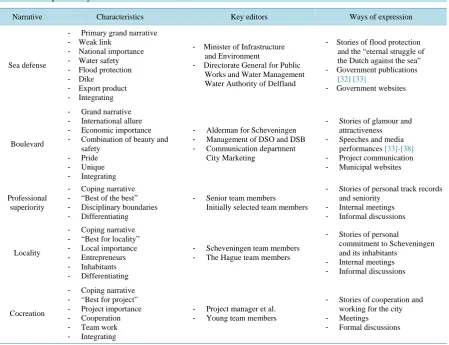
InFigure 1, the temporal development of influences of the various narratives is indicated on a relative scale. In Table 2, the narratives and their characteristics are summarized and augmented with ways of expression. Also the key editors are described, who will be analyzed further in the next section.
6.2. Narrator Dynamics
Each narrative had its followers, with their personal development styles [18]. Table 3 presents an overview, as observed by the first author.
[image:9.595.91.541.375.720.2]Table 3shows most participants followed more than one narrative. Apparently it is not necessary to commit
Table 2.Conceptual analysis.
Narrative Characteristics Key editors Ways of expression
Sea defense
- Primary grand narrative - Weak link
- National importance - Water safety - Flood protection - Dike
- Export product - Integrating
- Minister of Infrastructure and Environment
- Directorate General for Public Works and Water Management
Water Authority of Delfland
- Stories of flood protection and the “eternal struggle of the Dutch against the sea” - Government publications [32] [33]
- Government websites
Boulevard
- Grand narrative - International allure - Economic importance - Combination of beauty and
safety - Pride - Unique - Integrating
- Alderman for Scheveningen - Management of DSO and DSB - Communication department
City Marketing
- Stories of glamour and attractiveness
- Speeches and media performances [33]-[38] - Project communication - Municipal websites
Professional superiority
- Coping narrative - “Best of the best” - Disciplinary boundaries - Differentiating
- Senior team members Initially selected team members
- Stories of personal track records and seniority
- Internal meetings - Informal discussions
Locality
- Coping narrative - “Best for locality” - Local importance - Entrepreneurs - Inhabitants - Differentiating
- Scheveningen team members - The Hague team members
- Stories of personal commitment to Scheveningen and its inhabitants
- Internal meetings - Informal discussions
Cocreation
- Coping narrative - “Best for project” - Project importance - Cooperation - Team work - Integrating
- Project manager et al. - Young team members
- Stories of cooperation and working for the city - Meetings
98
Figure 1.Indication of temporal influence of narratives.
Table 3.Overview of followers of the various narratives and their development styles.
Narrative Grand narratives: Coping narratives:
Team/Team member Sea dense Boulevard Professional superiority Locality Co-creation
Contract team
1 r R
2 H r
3 h TS
4 I
5 H
6 H
7 R
8 H
9 rTH R
10 R
11 h t RTH
12 h IS
13 h R
14 R r
Project management
1 r R r
2 R r
3 h T
4 r H r
Legend: H/h: Narrator or follower of the narrative, showing a heroic development style. R/r: Narrator or follower of the narrative, showing a roman-tic development style; T/t: Narrator or follower of the narrative, showing a tragic development style; I/i: Narrator or follower of the narrative, showing an ironic development style; H, R, T, I: Preferential narratives; h, r, t, i: Minor narratives; S: Follower of the Scheveningen locality narrative; TH:
[image:10.595.91.524.372.684.2]99
to one narrative only. With some this was a matter of combining two, non-conflicting narratives, with others it was development in time and sometimes it was “jumping the narrative”. All team and project management members showed preferential narratives, which generally became leading in case of conflicting interests. The two grand narratives did not led to significant conflicting interests as they followed each other logically in time. The coping narratives however partially contradicted each other. It was difficult to combine the co-creation coping narrative with one of the other coping narratives. As for the combination of the coping narratives with the grand narratives, only the locality coping narrative sometimes led to conflicts in situations where the per-ceived interests of Scheveningen differed from the project interests. The supporters of the various coping narra-tives hardly undermined the grand narranarra-tives but neither did they use the grand narranarra-tives to strengthen their coping narratives. The latter is considered surprising as it could be reasoned that using the grand narrative for strengthening one own coping narrative, enhances the chance “to win”.
The style categories presented in Table 3are nothing more than contemporary styles observed by the first author, from an emic point of view, because as Beech [18] states: “actors are clearly not fixed in a single style category”. Nevertheless, it is apparent that the dominant project management style was romantic, whereas in the contract team more a mix of styles was present. We observed correlation between styles and coping narratives. The heroic style was dominant with the professional superiority coping narrative and the romantic style pre-vailed with the co-creation narrative. The differentiating versus the integrating character of the heroic respec-tively the romantic style are logical driving forces behind the chosen styles; i.e. superiority is inextricably linked to differentiation, whereas co-creation is not possible without integration. The locality coping narrative did not show a dominant style. The behavior of the “localist” could generally be described as differentiating but the narrative did not develop in a heroic way; hence the diversity of styles.
The described mechanisms can be explained by Hirschman’s theory on “Exit, Voice and Loyalty” [39]. Hir-schman describes “exit and voice” as options for organization members to react on dissatisfying developments. He regards “loyalty” as the key parameter for the actor’s choice of behavior, in which loyalty is defined as an actor’s commitment to an organization. High loyalty makes a choice for “voice” plausible in which case the ac-tor tries to prevent an undesired outcome by criticizing the situation. In absence of loyalty, there is little that withholds an actor from “exit”; i.e. leaving the organization and therewith the dispute.
Hirschman also states “voice is likely to play an important role in organizations only on condition that exit is virtually ruled out”. In this study almost all interviewees mentioned to consider exit not an option. In such a sit-uation, Hirschman describes “expulsion (…) as an instrument—one of many—which “management” uses in or-ganizations to restrict voice by members”. This fits the management interventions in the middle of 2010 when the project manager rearranged tasks, introduced a new contract manager and, in due time, replaced some team members. The contrast between the supporters of the locality narrative and the co-creation narrative can be seen as an ideological one, in which the supporters of the locality narrative followed a more “activist approach” and the supporters of the co-creation narrative were representing the “voice of reason”. In terms of Hirschman, in such a situation there is a threat of “overshooting the optimum”; i.e. due to their “extreme position”, the “local-ists” “have nowhere else to go” and are expected “to fight harder” than the “co-creation“local-ists”, thus having more chance to tip the balance in their favor. The supporters of the co-creation coping narrative are seen as having more space to act and thus less in dire straits. This situation was prevented through intervention by the succes-sive project managers who promoted the co-creation coping narrative and restricted the (formal) discussions on this matter.
100
integrating romantic style was also demonstrated in the way the second project manager steered the team to-wards co-creation. In the observations it became apparent that team members were given only seemingly space to maneuver outside the “targeted narrative” but actual deviation from this path was restricted. Both project managers appeared to act out of sincere believe in a romantic approach as voiced in their micro-narratives. This is only coherent when we accept that their conviction and actions were layered.
Finally, the alderman clearly demonstrated his conviction and skills to achieve his goals. Whether he applied power did not became visible as this was not a subject of our research, but it is hard to imagine he did not. His style was heroic as he convincingly took the lead and presented himself as the frontman of the New Schevenin-gen Boulevard.
7. Discussion and Conclusions
The last two decades, there have been major developments in the Dutch infrastructure sector. New laws and regulations were introduced, abolishing old patterns of collaborating practices. As market players apparently were long lasting insufficiently aware of the consequences of new legislation, old practices continued for several years, resulting in a public inquiry in 2002, which uncovered widespread irregularities [6] [20] [20]. Similar de-velopments were observed internationally [39]. Since 2002 the Dutch infrastructure struggles for finding new ways and structures of collaboration. This struggle is still taking place on the level of national forums, inside client organizations as well as contracting organizations, and inside operational (project) teams. On national and organizational level new practices are developed and decided upon in a vast tempo. New strategies of collabora-tion are unrolled in projects, requiring stakeholders and staff to adopt “on the spot” new working practices. Var-ious studies have focused on the consequences of these developments on organizational level e.g. [6] [40] [41]. The function of narratives in daily practice of project teams is less studied. What is happening inside the project arena, what social constructs are developed, what is the influence of parent organizations, what narratives are constructed and how do these develop? Are there reverse effects of these developments on the parental organi-zations, i.e. do project teams influence their parent organiorgani-zations, and if so, what mechanisms evolve? This pa-per intends to contribute to the insight on interaction between parental organizations and project teams by pre-senting our findings on the interaction between grand narratives and coping narratives in the contract team of the New Boulevard Scheveningen, a large municipal construction project in The Netherlands.
As we saw the smooth transition of the national grand narrative towards the municipal grand narrative, we conclude that it is possible for an infrastructural project to follow more than one grand narrative but this will in-volve some dynamics. In this case, the temporal prevailing narrative on any given moment was determined by two factors: one was the topicality and the other the level of control by stakeholders. In the first phase of the project, control over finances was of influence and in the second phase the control over the public communica-tion appeared decisive. These influences coincided with the topicality, which made the outcome convincing as well as obvious.
The studied grand narratives aimed for public communications by the respective governmental organizations but were also ingrained inside these organizations and in the teams entrusted with the realization of the project. Therefore our second conclusion is that grand narratives are used in the process of sense making and meaning giving by commencing coping narratives in project teams.
In the process of coping and sense making, members of the contract team created various coping narratives, which developed and varied in time and influence. None of the studied coping narratives fulfilled Boje’s defini-tion of microstoria in the sense that they aimed to “shatter grand narrative” and break it down [9]. All coping narratives supported more or less the grand narratives and mainly fulfilled sense making and sense giving pur-poses for the team members. Our third conclusion therefore is that coping narratives are developed by team members to give meaning and direction to their daily actions but do not necessarily oppose grand narratives.
Diverging coping narratives led to competition inside the team. The styles used by the various team members were correlated to the values within the narratives. The differentiating professional superiority narrative was commonly supported by the, also differentiating, heroic style, whereas the integrating co-creation coping narra-tive was usually propagated with an integrating romantic style. Our fourth conclusion is therefore that narrating style and narrative content are interdependent in order to create coherency.
101
Acknowledgements
The authors thank the employees of the Engineering division of The Hague for their cooperation in this research; we especially thank Hans Alewijnse and Jack Amesz for their support.
References
[1] Geiger, D. (2009) Revisiting the Concept of Practice: Towards an Argumentative Understanding of Practicing. Man-agement Learning, 40, 129-144. http://dx.doi/10.1177/1350507608101228
[2] van Marrewijk, A., Veenswijk, M.B. and Clegg, S. (2014) Changing Collaborative Practices through Cultural Interven-tions. Building Research & Information, 42, 330-342. http://dx.doi/10.1080/09613218.2014.867619
[3] Merkus, S., de Heer, J. and Veenswijk, M. (2014) Framing the Zone: Executives Engaging in a Narrative-Framing Contest during Strategic Decision-Making. Planning Practice and Research, 29, 569-584.
http://dx.doi/10.1080/02697459.2014.976999
[4] Wijnen, G., Renes, W. and Storm, P. (1984) Projectmatig Werken. Het Spectrum B.V., Utrecht.
[5] Flyvbjerg, B., Skamris Holm, M. and Buhl, S. (2002) Underestimating Costs in Public Works Projects: Error or Lie? APA Journal, 68, 279-295.
[6] Berendse, M. (2013) Authoring Cultural Change. PhD Thesis, Vrije Universiteit, Amsterdam. http://dare.ubvu.vu.nl/handle/1871/48139
[7] Teisman, G.R. (2007) Publiek management op de grens van orde en chaos. Academic Service-SdU Uitgevers b.v., Den Haag.
[8] Veenswijk, M. (2006) Interventies van betekenis. Management van cultuurverandering in complexe organisatienetwerken (2006), Inaugural Speech, Amsterdam
[9] Boje, D.M. (2001) Narrative Methods for Organizational and Communication Research. TSAGE Publications, housand Oaks.
[10] Vaara, E. (2002) On the Discursive Construction of Success/Failure in Narratives of Post-Merger Integration. Organi-zation Studies, 23, 211-248. http://dx.doi.org/10.1177/0170840602232003
[11] Gabriel, Y. (2000) Storytelling in Organizations: Facts, Fictions, and Fantasies. Oxford University Press, Oxford. http://dx.doi.org/10.1093/acprof:oso/9780198290957.001.0001
[12] Barry, D. and Elmes, M. (1997) Strategy Retold: Toward a Narrative View of Strategic Discourse. The Academy of Management Review, 22, 429-452. http://www.jstor.org/stable/259329
[13] Weick, K.E. (1995) Sensemaking in Organizations. SAGE Publications, Thousand Oaks.
[14] Noordegraaf, M., Veenswijk, M. and Vermeulen, J. (2004) Culturen identificeren: Een nieuwe agenda voor cultuura-nalyses in de publieke sector. Bestuurskunde, 13, 102-109.
[15] Heracleous, L. (2006) A Tale of three Discourses: The Dominant, the Strategic and the Marginalized. Journal of Man-agement Studies, 43, 1059-1087. http://dx.doi.org/10.1111/j.1467-6486.2006.00629.x
[16] Søderberg, A.M. and Vaara, E. (2003) Merging across Borders: People, Cultures and Politics. Copenhagen Business School Press, Copenhagen.
[17] Poldner, K. and Veenswijk, M.B. (2011) Moda Fusion on the Global Catwalk: A Narrative Approach to Studying the Ethical Fashion Industry. International Journal of Entrepreneurship and Small Business, 14, 230-244.
http://dx.doi/10.1504/IJESB.2011.042721
[18] Beech, N. (2000) Narrative Styles of Managers and Workers: A Tale of Star-Crossed Lovers. The Journal of Applied Behavioral Science, 36, 210-228. http://dx.doi.org/10.1177/0021886300362006
[19] The Hague (2014) Municipal Organization.
http://www.denhaag.nl/en/residents/municipality-of-the-hague/to/Municipal-organisation.htm
[20] Priemus, H. (2004) Dutch Contracting Fraud and Governance Issues. Building Research and Information, 32, 306-312. http://dx.doi/10.1080/0961321042000221089
[21] Dorée, A.G. (2010) Collusion in the Dutch Construction Industry: An Industrial Organization Perspective. Building Research & Information, 32, 146-156. http://dx.doi.org/10.1080/0961321032000172382
[22] van der Vlist, M., Hoogkamer, H. and Jeekel, H. (2010) Rijkswaterstaat: Greep op kennis? Rijkswaterstaat. http://publicaties.minienm.nl/download-bijlage/20931/rws-greep-op-kennis.pdf
[23] Hoogeveen, R. (2013) Gedoe in Projectteams.
102
[24] Rooijendijk, C. (2009) Waterwolven. Uitgeverij Atlas, Amsterdam/Antwerpen.
[25] van de Ven, G.P. (Ed.) (1993) Man-Made Lowlands: History of Water Management and Land Reclamation in the Netherlands. Uitgeverij Matrijs, Utrecht.
[26] Rijksoverheid (2010) Toespraak van minister De Jager bij de eerste slag van de herdenkingsmunt rond het thema: De strijd tegen het water, door Prins Willem-Alexander.
https://www.rijksoverheid.nl/documenten/toespraken/2010/10/28/muntslag-de-strijd-tegen-het-water
[27] van Twist, M.J.W., Schulz, M., van der Steen, M. and Ferket, J. (2013) De deltacommisaris. Een kroniek van de instelling van een regeringscommissaris voor de Nederlandse delta. Nederlandse School voor Openbaar Bestuur, Den Haag. ISBN 978-90-75297-33-1.
[28] van Schrojenstein Lantman, J.P. (2007) Overstromingsschade in dijkring 14. MNP Rapport 500072002/2007. Milieu en Natuur Planbureau, Bilthoven. http://www.pbl.nl/sites/default/files/cms/publicaties/500072002.pdf
[29] Den Haag (2015) Procesdossier Scheveningen boulevard en kustverdediging. RIS 163952.
http://www.denhaag.nl/home/bewoners/gemeente/document/Procesdossier-Scheveningen-Boulevard-en-kustverdedigin g.htm
[30] Starmans, J. and Vermeulen, R. (2012) Bevolkingsprognose Den Haag 2012-2020. Gemeente Den Haag—Dienst Stedelijke Ontwikkeling/Programmamanagement, Strategie en Onderzoek.
http://www.denhaag.nl/home/bewoners/to/Bevolkingsprognose-Den-Haag-20122020-1.htm
[31] Boekesteijn, A. and Soeterbroek, R. (2008) Bezoekersonderzoek Den Haag, overall rapportage. BRO, Boxtel. Report Number 203X00291.039307_6.
[32] Rijksoverheid (2013) Toespraak bij opening nieuwe boulevard Scheveningen door minister Schultz van Haegen. http://www.rijksoverheid.nl/documenten-en-publicaties/toespraken/2013/04/06/toespraak-bij-opening-nieuwe-boulevar d-scheveningen-door-minister-schultz-van-haegen.html
[33] Rijksoverheid (2013) Magische opening nieuwe boulevard Scheveningen door minister Schultz.
http://www.rijksoverheid.nl/nieuws/2013/04/06/magische-opening-nieuwe-boulevard-scheveningen-door-minister-sch ultz.html
[34] De Weekkrant (2007) “Toeristen blijven weg”: Wethouder Marnix Norder wil aan de slag met Scheveningen. Downloaded on 11-9-2015. Copy available with the author.
[35] Randstad Urgent (2008) Project van de maand: Den Haag internationale stad. Nieuwsflits juli 2008, Nummer 8. http://www.rijksoverheid.nl/bestanden/documenten-en-publicaties/brochures/2008/07/14/randstad-urgent-nieuwsflits-8 /randstadurgentnieuwsflits8-juli2008.pdf
[36] De Ondernemer.nl. (2009) Een veiliger en mooier Scheveningen.
http://www.deondernemer.nl/wetenschap/296869/Een-veiliger-en-mooier-Scheveningen.html
[37] Toekomst Scheveningen Bad (2009) Masterplan van B&W voor Scheveningen bad. Summary of television interview with alderman Norder on July 11, 2009: “Scheveningen gaat op de schop”. http://www.toekomstscheveningenbad.nl [38] Architectenweb (2010) Verbouwing boulevard Scheveningen gestart.
http://www.architectenweb.nl/aweb/redactie/redactie_detail.asp?iNID=22721
[39] Hirschman, A.O. (1970) Exit, Voice and Loyalty. Harvard University Press, Cambridge and London.
[40] Smits, K.C.M. (2013) Cross Cultural Work: Practices of Collaboration in the Panama Canal Expansion Program. PhD Thesis, Vrije Universiteit, Amsterdam. http://dare.ubvu.vu.nl/handle/1871/41486