www.impactjournals.com/oncotarget/
Oncotarget, Vol. 6, No. 37
Influence of companion diagnostics on efficacy and safety
of targeted anti-cancer drugs: systematic review and
meta-analyses
Alberto Ocana
1, Josee-Lyne Ethier
2, Laura Díez-González
1, Verónica
Corrales-Sánchez
1, Amirrtha Srikanthan
2, María J. Gascón-Escribano
1, Arnoud J. Templeton
3,
Francisco Vera-Badillo
2, Bostjan Seruga
4, Saroj Niraula
5, Atanasio Pandiella
6and
Eitan Amir
2¹ Medical Oncology Department, Albacete University Hospital and Translational Research Unit, Albacete, Spain
² Division of Medical Oncology and Hematology, Princess Margaret Cancer Centre and the Department of Medicine, University of Toronto, Toronto, Canada
3 Department of Medical Oncology and Hematology, Kantonsspital St. Gallen, Switzerland 4 Department of Medical Oncology, Institute of Oncology, Ljubljana, Slovenia
5 Department of Medical Oncology and Hematology, CancerCare Manitoba and University of Manitoba, Winnipeg, Canada 6 Centro de Investigación del Cáncer CIC-CSIC, Universidad de Salamanca, Salamanca, Spain
Correspondence to: Alberto Ocana, email: [email protected]
Keywords: cancer drugs, companion diagnostics, efficacy, trial design
Received: August 01, 2015 Accepted: September 06, 2015 Published: October 04, 2015
This is an open-access article distributed under the terms of the Creative Commons Attribution License, which permits unrestricted use, distribution, and reproduction in any medium, provided the original author and source are credited.
ABSTRACT
Background: Companion diagnostics aim to identify patients that will respond to targeted therapies, therefore increasing the clinical efficacy of such drugs. Less is known about their influence on safety and tolerability of targeted anti-cancer agents.
Methods and findings: Randomized trials evaluating targeted agents for solid tumors approved by the US Food and Drug Administration since year 2000 were assessed. Odds ratios (OR) and and 95% confidence intervals (CI) were computed for treatment-related death, treatment-discontinuation related to toxicity and occurrence of any grade 3/4 adverse events (AEs). The 12 most commonly reported individual AEs were also explored. ORs were pooled in a meta-analysis. Analysis comprised 41 trials evaluating 28 targeted agents. Seventeen trials (41%) utilized companion diagnostics. Compared to control groups, targeted drugs in experimental arms were associated with increased odds of treatment discontinuation, grade 3/4 AEs, and toxic death irrespective of whether they utilized companion diagnostics or not. Compared to drugs without available companion diagnostics, agents with companion diagnostics had a lower magnitude of increased odds of treatment discontinuation (OR = 1.12 versus 1.65, p < 0.001) and grade 3/4 AEs (OR = 1.09 versus 2.10, p < 0.001), but no difference in risk of toxic death (OR = 1.40 versus 1.27, p = 0.69). Differences between agents with and without companion diagnostics were greatest for diarrhea (OR = 1.29 vs. 2.43, p < 0.001), vomiting (OR = 0.86 vs. 1.44, p = 0.005), cutaneous toxicity (OR = 1.82 vs. 3.88, p < 0.001) and neuropathy (OR = 0.64 vs. 1.60, p <
0.001).
INTRODUCTION
The aim of personalizing cancer treatments by
targeting genomic alterations in the tumor has seen
rapid advances in recent years [1]. Knowledge of the
molecular mechanisms associated with cancer initiation
and progression has recently improved with the increasing
use of molecular techniques such as gene sequencing [1,
2]. This knowledge has permitted the identification of
alterations in cancer cells and the subsequent development
of therapeutic agents targeting these alterations [3, 4].
Central to the drive for personalized medicine is the
need to develop and validate specific diagnostic tests
that facilitate the identification of patients that are most
likely to respond to a given treatment [5]. Such tests
have been named companion diagnostics and are defined
by the US Food and Drug Administration (FDA) as
in
vitro
diagnostic devices that provide information that is
essential for the safe and effective use of a corresponding
therapeutic product [6].
A companion diagnostic is a
pre-treatment predictor of benefit that is expected to allow
selection of patients with a biomarker predicting greater
efficacy from a given therapy compared to patients
without the biomarker treated with the same drug. In
parallel with the development of companion diagnostics,
the identification of tumors where specific molecular
alterations are ubiquitous has also permitted the design and
evaluation of agents targeting these molecular alterations
[4]. This has been the case for agents targeting
c-kit
in
gastrointestinal stromal tumors (GIST) [7-8] or
RET
in
medullary thyroid cancer [9, 10].
Some companion diagnostics have been developed
using retrospective analyses of clinical studies [11-12]
while others have been developed synchronously with the
related experimental drug and have been incorporated in
multiples steps of the drug development process, including
randomized controlled trials (RCTs)
[5].
Presently, there
are few targeted drugs in clinical development that do
not have an associated biomarker discovery program to
identify a specific companion diagnostic
[5].
Despite
these advances, little is known about the influence of
the availability of companion diagnostics on safety and
tolerability of targeted agents.
Here, we aimed to evaluate the impact of
incorporating companion diagnostics in randomized
controlled trials (RCTs) of targeted agents that were
used for the approval of new drugs since 2000. We
hypothesized that t
he identification of responding patients
by using companion diagnostics would be associated with
not only increased magnitude of clinical benefit but also
reduced toxicity compared to targeted agents without
accompanying diagnostic tests.
RESULTS
We identified 28 different targeted anti-cancer agents
approved by the US FDA for 15 different indications
between January 2000 and April 2014. These agents were
evaluated in 41 separate trials. Seventeen trials (41%)
were categorized as having a companion diagnostic
(including 4 studies in
tumors with ubiquitous molecular
alterations, see
Figure 1). Characteristics of included
studies are shown in Table 1 and a list of drugs, their
licensed indications and subgroup category is shown in
Supplementary Table 1. Studies of drugs with companion
diagnostics generally had lower sample sizes
(Mann-Whitney U
p
= 0.03) and were more likely to use PFS
rather than OS as the primary endpoint (Mann-Whitney
U
p
= 0.01). A non-significantly higher proportion of
studies of targeted drugs with companion diagnostics
led to accelerated approval by the FDA compared with
regular approval (Mann-Whitney U
p
= 0.18). A list of
FDA approved diagnostic tests identified in our search is
shown in Supplementary Table 2.
Among the 13 RCTs with companion diagnostics
(excluding studies in tumors with ubiquitous molecular
alterations)
, 11 studies (85%) utilized prospective
development of the diagnostic test in the RCT, while in 2
studies
[11, 12]
the companion diagnostic was developed
retrospectively. In 11 RCTs (85%), the companion
diagnostic comprised measurement of a mutation of which
the protein product was an oncogenic target associated
with favourable response to the experimental drug.
Conversely, in 2 studies (15%)
[11, 12]
the diagnostic
test identified patients with unfavourable responses
to the investigational agent. Companion diagnostics
associated with favourable drug responses comprised
genomic alterations in non-small cell lung cancer (
EGFR
mutations and
ALK
rearrangements), breast and gastric
cancers (
HER2/neu
amplification or overexpression), and
in melanoma (
B-RAF
mutation). Companion diagnostics
associated with resistance to the experimental drug were
for mutations of the
K-RAS
gene in colon cancer.
Impact of companion diagnostics on efficacy
Data on OS and PFS were available from 39 and
41 studies respectively. Compared to agents used in
control groups, targeted drugs used in experimental arms
of included trials showed improved PFS and OS. The
magnitude of improvement in OS between targeted drugs
in experimental groups and agents used in control groups
was similar for targeted drugs with companion diagnostics
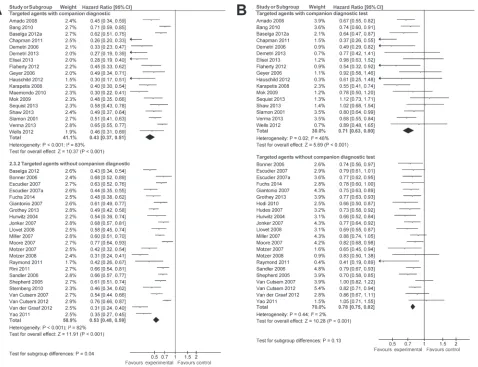
and those without companion diagnostic tests (HR 0.71,
95% CI 0.63-0.80
vs
. HR 0.78, 95% CI 0.75-0.82, p for
difference = 0.13, Figure 2B). When studies for conditions
with
ubiquitous molecular alterations or mutations [7-10]
were excluded, there remained no difference between
studies with companion diagnostics and those without
(HR
0.70, 95% CI 0.61-0.80
vs
. HR 0.78, 95% CI 0.75-0.82, p
for difference = 0.11).
Table 1: Characteristics of included studies.
Characteristic
Companion
Diagnostics
(n=17)
Non-companion
Diagnostics
(n=24)
Sample size
Median
Range
347
199-1217
637
171-1226
Disease Site
Breast Cancer
Colorectal Cancer
Non-small cell lung cancer
Melanoma
Renal cell carcinoma
Medullary thyroid cancer
Gastrointestinal Stomal Tumor
Other
4 (24%)
2 (12%)
3 (18%)
3 (18%)
0 (0%)
2 (12%)
2 (12%)
1 (6%)
2 (8%)
7 (29%)
2 (8%)
0 (0%)
6 (25%)
0 (0%)
0 (0%)
7 (29%)
Primary Endpoint
Overall survival
Progression-free survival or time to progression
3 (18%)
14 (82%)
14 (58%)
10 (42%)
Cross-over
6 (35%)
6 (25%)
Quality of life reported
4 (24%)
13 (54%)
Type of FDA approval
Regular
Accelerated
11 (65%)
6 (35%)
20 (83%)
4 (17%)
Table 2: Differences in odds of individual grade 3/4 AEs between studies with available companion diagnostics and
those without companion diagnostics.
AEs, adverse events, CI, confidence interval; OR, odds ratio
Adverse event
Companion Diagnostics
No Companion Diagnostics
P for
difference
Number of
included
studies
OR
95% CI
Number of
included
studies
OR
95% CI
Anemia
8
0.79
0.62-1.00
12
1.14
0.89-1.46
0.04
Neutropenia
10
0.39
0.33-0.44
10
1.40
1.20-1.63
<0.001
Thrombocytopenia
5
5.18
3.09-8.66
12
1.66
1.23-2.22
<0.001
Diarrhea
14
1.29
1.07-1.55
22
2.43
2.08-2.83
<0.001
Vomiting
9
0.86
0.65-1.14
20
1.44
1.14-1.83
0.005
Stomatitis
7
1.53
0.78-3.02
14
2.59
2.01-3.33
0.16
Cutaneous toxicity
11
1.82
1.45-2.28
18
3.88
3.06-4.94
<0.001
Asthenia/Fatigue
14
0.99
0.79-1.23
24
1.23
1.11-1.37
0.07
Pulmonary/Dyspnea
6
1.15
0.84-1.57
11
0.90
0.74-1.09
0.19
Hypertension
5
5.95
3.03-11.67
14
5.87
4.74-7.26
0.97
Cardiac
4
1.57
1.11-2.23
3
6.88
1.25-37.82
0.10
[image:4.612.73.551.332.699.2]Neuropathy
3
0.64
0.40-1.01
3
1.60
1.20-2.12
<0.001
Table 3: Sensitivity analyses for the effect of availability of companion diagnostics on adverse events.
AEs, adverse
events; CI, confidence interval; N, number; OR, odds ratio.
NE, not estimatable.
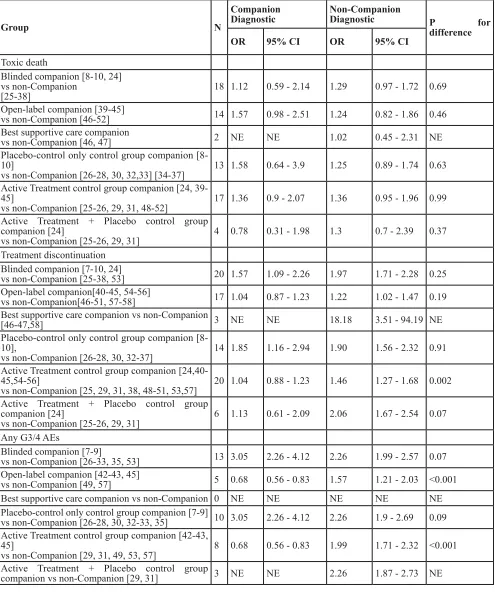
Group
N
Companion
Diagnostic
Non-Companion
Diagnostic
P for
difference
OR
95% CI
OR
95% CI
Toxic death
Blinded companion [8-10, 24]
vs non-Companion
[25-38]
18 1.12
0.59 - 2.14
1.29
0.97 - 1.72 0.69
Open-label companion [39-45]
vs non-Companion [46-52]
14 1.57
0.98 - 2.51
1.24
0.82 - 1.86 0.46
Best supportive care companion
vs non-Companion [46, 47]
2 NE
NE
1.02
0.45 - 2.31 NE
Placebo-control only control group companion
[8-10]
vs non-Companion [26-28, 30, 32,33] [34-37]
13 1.58
0.64 - 3.9
1.25
0.89 - 1.74 0.63
Active Treatment control group companion [24,
39-45]
vs non-Companion [25-26, 29, 31, 48-52]
17 1.36
0.9 - 2.07
1.36
0.95 - 1.96 0.99
Active Treatment + Placebo control group
companion [24]
vs non-Companion [25-26, 29, 31]
4 0.78
0.31 - 1.98
1.3
0.7 - 2.39
0.37
Treatment discontinuation
Blinded companion [7-10, 24]
vs non-Companion [25-38, 53]
20 1.57
1.09 - 2.26
1.97
1.71 - 2.28 0.25
Open-label companion[40-45, 54-56]
vs non-Companion[46-51, 57-58]
17 1.04
0.87 - 1.23
1.22
1.02 - 1.47 0.19
Best supportive care companion vs non-Companion
[46-47,58]
3 NE
NE
18.18
3.51 - 94.19 NE
Placebo-control only control group companion
[8-10],
vs non-Companion [26-28, 30, 32-37]
14 1.85
1.16 - 2.94
1.90
1.56 - 2.32 0.91
Active Treatment control group companion
[24,40-45,54-56]
vs non-Companion [25, 29, 31, 38, 48-51, 53,57]
20 1.04
0.88 - 1.23
1.46
1.27 - 1.68 0.002
Active Treatment + Placebo control group
companion [24]
vs non-Companion [25-26, 29, 31]
6 1.13
0.61 - 2.09
2.06
1.67 - 2.54 0.07
Any G3/4 AEs
Blinded companion [7-9]
vs non-Companion [26-33, 35, 53]
13 3.05
2.26 - 4.12
2.26
1.99 - 2.57 0.07
Open-label companion [42-43, 45]
vs non-Companion [49, 57]
5 0.68
0.56 - 0.83
1.57
1.21 - 2.03 <0.001
Best supportive care companion vs non-Companion 0 NE
NE
NE
NE
NE
Placebo-control only control group companion [7-9]
vs non-Companion [26-28, 30, 32-33, 35]
10 3.05
2.26 - 4.12
2.26
1.9 - 2.69
0.09
Active Treatment control group companion [42-43,
45]
vs non-Companion [29, 31, 49, 53, 57]
8 0.68
0.56 - 0.83
1.99
1.71 - 2.32 <0.001
Active Treatment + Placebo control group
diagnostic were associated with a higher magnitude of
benefit for PFS compared to agents without companion
diagnostic tests (HR 0.43, 95% CI 0.37-0.51
vs
. 0.53,
95% CI 0.45-0.54, p for difference = 0.04, Figure 2A).
However, this effect was lost after excluding agents used
for conditions with ubiquitous activation of specific
molecular pathways
[7-10]
(HR 0.47, 95% CI 0.40-0.55
vs
. 0.53, 95% CI 0.45-0.54, p for difference = 0.20).
Impact of companion diagnostics on safety and
tolerability
Data on toxic death, treatment discontinuation
and any grade 3/4 AEs were available from 32, 37 and
18 studies, respectively.
Compared to agents used in
control groups, targeted drugs used in experimental arms
of included trials showed an increase in toxic death,
treatment discontinuation and grade 3/4 AEs. Availability
of companion diagnostics did not affect the magnitude
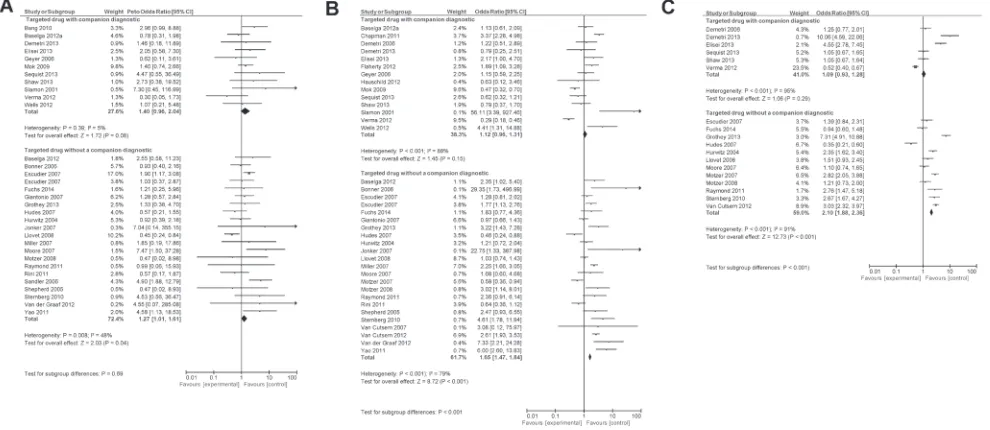
of toxic death (OR 1.40, 95% CI 0.96-2.04
vs
. 1.27,
95% CI 1.01-1.61, p for difference = 0.69, Figure 3A).
However, availability of companion diagnostics was
associated with lower odds of treatment discontinuation
(OR 1.12, 95% CI 0.96-1.31
vs
. 1.65, 95% CI 1.47-1.84,
p for difference < 0.001, Figure 3B) and any grade 3/4
AEs (OR 1.09, 95% CI 0.93-1.28
vs
. 2.10, 95% CI
1.88-2.36, p for difference < 0.001, Figure 3C). Differences
between drugs with companion diagnostics and those
without for individual grade 3/4 AEs are shown in Table
2. Companion diagnostics were associated with lower
odds of
anemia, neutropenia, diarrhea, vomiting, fatigue/
asthenia, dyspnea, neuropathy and skin AEs; similar odds
of stomatitis, hypertension, pulmonary and cardiovascular
AEs and higher odds of thrombocytopenia. Sensitivity
analyses restricting studies based on blinding and type of
control group are shown in Table 3. Sensitivity analyses
did not show substantial differences in the results. There
remained no difference in the odds of toxic death between
agents with companion diagnostics and those without in
all subgroups. Furthermore, the magnitude and direction
of effect for treatment discontinuation was similar among
subgroups as it was in the analysis of all included studies.
However, lower odds of grade 3/4 AEs were not observed
among blinded studies or in placebo controlled only
control groups. Of interest, among the minority of studies
reporting quality of life, studies utilizing companion
diagnostics were more likely to report improved quality
of life compared to those with companion diagnostics
(Mann-Whitney U
p
= 0.03).
DISCUSSION
[image:6.612.62.557.488.703.2]The presence of heterogeneity within histologically
defined tumors means that the ability to identify
subpopulations of patients who are more likely to benefit
from a certain treatment is crucial [13]. Advances in
the understanding of cancer biology have permitted the
identification of molecular alterations that can be used
for patient selection; both by ascertaining molecular
alterations that are amenable to pharmacological
intervention or by characterizing markers of resistance
to specific therapy. In recent years, numerous targeted
drugs have been approved for use in solid tumors. Some
of these were approved with an accompanying companion
diagnostic test allowing for identification of responsive or
unresponsive patients while others were registered in less
selected populations. Despite the increasing use of targeted
agents and diagnostic tests to aid in personalization of
therapy, there remain little data to inform of the impact of
the availability of companion diagnostics on the efficacy,
safety and tolerability of approved targeted anti-cancer
drugs. Specifically, it is unclear if targeted agents with
available companion diagnostics allow for both improved
efficacy and toxicity compared to targeted agents used in
unselected cancer patients.
As expected, we have shown that availability
of companion diagnostics is associated with modest
improvements in efficacy of targeted anti-cancer drugs.
Compared to treatment administered in control groups
of RCTs, use of experimental targeted treatment with
a companion diagnostic led to greater improvements
in PFS than for experimental targeted agents without
accompanying tests. However, the availability of
companion diagnostics did not appear to influence the
magnitude of benefit in OS; targeted agents with and
without these tests showed similar improvements in
pooled HR for OS.
Of interest, our data showed generally better safety
and tolerability for experimental targeted treatment with
a companion diagnostic compared to targeted agents
without accompanying tests. Consistent with data reported
previously [14, 15], we observed that newly approved
targeted drugs were generally associated with higher odds
of toxic death, treatment discontinuation due to toxicity
and both overall grade 3/4 AEs as well as individual
grade 3/4 AEs. However, availability of companion
diagnostics was associated with a lower magnitude of
increase in the majority of these safety and tolerability
parameters. Additionally, studies with companion
diagnostics were more likely to report favorable changes
in quality of life. These results suggest that targeted
drugs developed with companion diagnostics may have
a more favorable therapeutic index than targeted drugs
without such accompanying tests. There are a number
of possible reasons for this finding. First, the availability
of a companion diagnostic may allow for lower doses of
targeted drugs to be used in more responsive patients.
Second, receipt of more efficacious drugs may lead to
reduced tumor burden or improved performance status
thereby leading to a lower frequency of AEs. Of note,
differences in grade 3/4 AEs between targeted drugs with
companion diagnostics and targeted drugs without these
tests were not consistently observed in both blinded and
open-label studies suggesting that some of the effect may
relate to either subject or observer bias. However, no such
findings were observed for treatment discontinuation
suggesting that some of the differences in safety and
tolerability parameters are likely true.
The availability of a companion diagnostic was
also associated with differences in clinical trial design.
RCTs utilizing companion diagnostics had smaller
sample sizes. The reason for this finding is unclear, but
may be explained by the greater magnitude of anticipated
benefit resulting from enriching the study population with
patients more likely to benefit from the experimental drug.
Another explanation is the increased use of intermediate
endpoints such as PFS, which was seen with studies
utilizing companion diagnostics. No differences were
observed for other parameters such as whether RCTs were
used to support accelerated rather than regular approval,
allowance of cross over or reporting of quality of life.
The value of companion diagnostics as predictive
markers appears clear. However, only a minority of
approved targeted drugs have been developed with
such diagnostic tests. The development of companion
diagnostics in solid tumors is complex and has many
challenges. Access to tissue for molecular characterization
is guaranteed generally only at diagnosis and attempts to
collect tissue at multiple time points after exposure to
experimental therapy are limited by concerns about slower
patient enrolment and insufficient research infrastructure
to obtain and process tumor samples for molecular
analysis. There has also been reluctance of the scientific
community to design studies with mandatory repeated
tissue collection [16]. This may explain why many
biomarker programs embedded in RCTs do not lead to the
identification of robust predictive markers.
This study has limitations. First we focused on
RCTs, which were used to support registration with the
US FDA. While this is a pragmatic and clinically relevant
inclusion criterion, there may have been negative studies
with companion diagnostics and their exclusion may have
affected the observed difference in effect size for efficacy,
safety and tolerability. It is likely that this may have led
to enrichment for agents with a more favorable balance
between efficacy and toxicity. Second, assessment of
efficacy was based only on relative differences in OS or
PFS between groups. Substantial differences in relative
measures of efficacy do not necessarily translate into large
differences in absolute benefits. Third, only 18 studies
provided information on number of patients experiencing
at least one grade 3/4 AE, although assessment of
individual toxicities yielded similar results especially for
non-hematological AEs. Finally, all included studies were
designed to test primarily the efficacy of new systemic
treatments and the outcome measures included in our
analysis of toxicity were not primary endpoints in any of
the included studies. Collection and reporting of toxicity
data in published RCTs can be suboptimal and variable
[17-19] so that results of our analysis may not represent
the true rates of toxicity even within the included studies.
In conclusion, in addition to improvements in PFS,
targeted drugs with companion diagnostics are associated
with improved safety, and tolerability.
MATERIALS AND METHODS
is shown in Supplementary Figure 1.
Identification of studies
All targeted, anticancer agents approved by the
US Food and Drug administration (FDA) between
January 2000 and April 2014 for treatment of advanced
or metastatic solid malignancies in adults were identified
through the FDA website [20]. We excluded agents used
in supportive cancer care, such as antiemetic drugs or
bisphosphonates. We also excluded studies of cytotoxic
chemotherapy, systemic radiation therapy, endocrine
therapy and cancer vaccines. Drug labels of included
agents were consulted for all referenced RCTs. We
reviewed each article and identified those that used a
companion diagnostic to select patients. We also reviewed
the FDA website to evaluate those companion diagnostic
tests approved for the specific indication.
Data extraction
Extracted data included the experimental agent, the
diagnostic kit used in the study, the molecular alteration
evaluated, tumor type, primary endpoint, use of
cross-over, type of FDA approval (regular or accelerated),
reporting of quality of life, and year of publication. For
efficacy outcomes, we extracted hazard ratios (HR) and
their corresponding 95% confidence intervals (CI) for
time-to-event endpoints including overall survival (OS)
and/or progression-free survival (PFS). When data for
PFS were not available, we extracted data for time to
progression (TTP). For toxicity outcomes, the events of
interest were the occurrence of death reported as being
related to systemic treatment, treatment-discontinuation
related to AEs and occurrence of grade 3/4 AEs. If a
drug label did not report toxic death, it was assumed to
be zero as such events are mandated to be reported to
the FDA. For AEs, the number or proportion of patients
with at least one grade 3/4 AE was collected. The 12 most
commonly reported AEs were also assessed individually
and included anemia, neutropenia, thrombocytopenia,
diarrhea, vomiting, stomatitis, hypertension, fatigue/
asthenia, neuropathy as well as cardiovascular, pulmonary
and skin AEs. Data were extracted by three authors (JE,
VS and LD). Discrepancies were resolved by consensus.
Data synthesis
Drugs were assigned to one of two subgroups:
targeted agents without companion diagnostic and
targeted agents with available companion diagnostic. For
the primary analysis, tumors with ubiquitous molecular
alterations or mutations (e.g.
c-kit
in GIST or
RET
in
medullary thyroid cancer) were included in the group of
studies with companion diagnostics. To identify whether
different levels of efficacy were derived from availability
of companion diagnostics, we pooled HRs for OS and
PFS for all available studies. A sensitivity analysis was
conducted excluding studies conducted in
conditions with
ubiquitous activation of specific molecular pathways.
For toxicity, we compared the rates of treatment-related
death, treatment discontinuation due to toxicity and grade
3/4 AEs between the companion diagnostic and
non-companion diagnostic groups. Sensitivity analyses were
conducted to examine the effect of blinding (i.e. blinded
or open-label studies) and type of control group
(placebo-only, active treatment or active treatment plus placebo) on
toxicity outcomes.
Statistical analysis
Data were reported descriptively as means or
medians together with respective standard deviations and
ranges, respectively. When possible, data were combined
into a meta-analysis using RevMan 5.3 analysis software
(Cochrane Collaboration, Copenhagen, Denmark).
Pooled estimates of HRs for OS and PFS were weighed
by generic inverse variance and computed by random
effects modeling [21, 22].
Pooled estimates of odds ratios
(OR) of safety and tolerability endpoints were computed
using different methods for toxic death,
treatment-discontinuation and grade 3/4 AEs. For toxic death where
absolute event rates were less than 1%, the Peto
one-step odds ratio method was utilized [23]. For
treatment-discontinuation where there were low absolute event
rates and substantial variability in relative effect-sizes,
the Mantel-Haenszel odds ratio method was used [21].
Finally, for grade 3/4 AEs, the DerSimonian and Laird
random-effects method was utilized and studies were
weighted using the generic inverse variance approach [21,
22].
Differences in the pooled estimates for companion
and on-companion studies were evaluated using
subgroup
analysis as described by Deeks et al [21]. All statistical
tests were two-sided, and statistical significance was
defined as
p
< 0.05. No corrections were made for multiple
testing.
ACKNOWLEDGMENTS
Ministry of Economy and Competitiveness of
Spain (BFU2012-39151 and RD12/0036/0003 to AP),
and the AECC (to AP). Fondo de Investigación Sanitaria
(PI13/01444) and CRIS Cancer Foundation and ACEPAIN
(to AO).
CONFLICTS OF INTEREST
received for this work.
REFERENCES
1. Wood LD, Parsons DW, Jones S, Lin J, Sjoblom T, Leary RJ, Shen D, Boca SM, Barber T, Ptak J, Silliman N, Szabo S, Dezso Z, Ustyanksky V, Nikolskaya T, Nikolsky Y, et al. The genomic landscapes of human breast and colorectal cancers. Science. 2007; 318: 1108-1113.
2. Vogelstein B, Papadopoulos N, Velculescu VE, Zhou S, Diaz LA, Jr. and Kinzler KW. Cancer genome landscapes. Science. 2013; 339:1546-1558.
3. Kris MG, Johnson BE, Berry LD, Kwiatkowski DJ, Iafrate AJ, Wistuba, II, Varella-Garcia M, Franklin WA, Aronson SL, Su PF, Shyr Y, Camidge DR, Sequist LV, Glisson BS, Khuri FR, Garon EB, et al. Using multiplexed assays of oncogenic drivers in lung cancers to select targeted drugs. Jama. 2014; 311:1998-2006.
4. Ocana A and Pandiella A. Personalized therapies in the cancer “omics” era. Molecular cancer. 2010; 9:202. 5. Rubin EH, Allen JD, Nowak JA and Bates SE. Developing
precision medicine in a global world. Clinical cancer research : an official journal of the American Association for Cancer Research. 2014; 20:1419-1427.
6. Mansfield EA. FDA perspective on companion diagnostics: an evolving paradigm. Clinical cancer research : an official journal of the American Association for Cancer Research. 2014; 20:1453-1457.
7. Demetri GD, van Oosterom AT, Garrett CR, Blackstein ME, Shah MH, Verweij J, McArthur G, Judson IR, Heinrich MC, Morgan JA, Desai J, Fletcher CD, George S, Bello CL, Huang X, Baum CM, et al. Efficacy and safety of sunitinib in patients with advanced gastrointestinal stromal tumour after failure of imatinib: a randomised controlled trial. Lancet. 2006; 368:1329-1338.
8. Demetri GD, Reichardt P, Kang YK, Blay JY, Rutkowski P, Gelderblom H, Hohenberger P, Leahy M, von Mehren M, Joensuu H, Badalamenti G, Blackstein M, Le Cesne A, Schoffski P, Maki RG, Bauer S, et al. Efficacy and safety of regorafenib for advanced gastrointestinal stromal tumours after failure of imatinib and sunitinib (GRID): an international, multicentre, randomised, placebo-controlled, phase 3 trial. Lancet. 2013; 381:295-302.
9. Elisei R, Schlumberger MJ, Muller SP, Schoffski P, Brose MS, Shah MH, Licitra L, Jarzab B, Medvedev V, Kreissl MC, Niederle B, Cohen EE, Wirth LJ, Ali H, Hessel C, Yaron Y, et al. Cabozantinib in progressive medullary thyroid cancer. Journal of clinical oncology : official journal of the American Society of Clinical Oncology. 2013; 31:3639-3646.
10. Wells SA, Jr., Robinson BG, Gagel RF, Dralle H, Fagin JA, Santoro M, Baudin E, Elisei R, Jarzab B, Vasselli JR, Read J, Langmuir P, Ryan AJ and Schlumberger MJ. Vandetanib in patients with locally advanced or metastatic
medullary thyroid cancer: a randomized, double-blind phase III trial. Journal of clinical oncology : official journal of the American Society of Clinical Oncology. 2012; 30:134-141. 11. Karapetis CS, Khambata-Ford S, Jonker DJ, O’Callaghan CJ, Tu D, Tebbutt NC, Simes RJ, Chalchal H, Shapiro JD, Robitaille S, Price TJ, Shepherd L, Au HJ, Langer C, Moore MJ and Zalcberg JR. K-ras mutations and benefit from cetuximab in advanced colorectal cancer. The New England journal of medicine. 2008; 359:1757-1765. 12. Amado RG, Wolf M, Peeters M, Van Cutsem E, Siena S,
Freeman DJ, Juan T, Sikorski R, Suggs S, Radinsky R, Patterson SD and Chang DD. Wild-type KRAS is required for panitumumab efficacy in patients with metastatic colorectal cancer. Journal of clinical oncology : official journal of the American Society of Clinical Oncology. 2008; 26: 1626-1634.
13. Gerlinger M, Rowan AJ, Horswell S, Larkin J, Endesfelder D, Gronroos E, Martinez P, Matthews N, Stewart A, Tarpey P, Varela I, Phillimore B, Begum S, McDonald NQ, Butler A, Jones D, et al. Intratumor heterogeneity and branched evolution revealed by multiregion sequencing. The New England journal of medicine. 2012; 366:883-892.
14. Niraula S, Amir E, Vera-Badillo F, Seruga B, Ocana A and Tannock IF. Risk of incremental toxicities and associated costs of new anticancer drugs: a meta-analysis. Journal of clinical oncology : official journal of the American Society of Clinical Oncology. 2014; 32: 3634-3642.
15. Niraula S, Seruga B, Ocana A, Shao T, Goldstein R, Tannock IF and Amir E. The price we pay for progress: a meta-analysis of harms of newly approved anticancer drugs. Journal of clinical oncology : official journal of the American Society of Clinical Oncology. 2012; 30:3012-3019.
16. Sawyers CL. The cancer biomarker problem. Nature. 2008; 452:548-552.
17. Seruga B, Sterling L, Wang L and Tannock IF. Reporting of serious adverse drug reactions of targeted anticancer agents in pivotal phase III clinical trials. Journal of clinical oncology : official journal of the American Society of Clinical Oncology. 2011; 29:174-185.
18. Pitrou I, Boutron I, Ahmad N and Ravaud P. Reporting of safety results in published reports of randomized controlled trials. Archives of internal medicine. 2009; 169:1756-1761. 19. Ioannidis JP. Adverse events in randomized trials:
neglected, restricted, distorted, and silenced. Archives of internal medicine. 2009; 169:1737-1739.
20. (<http://www.accessdata.fda.gov/Scripts/cder/drugsatfda/ index.cfm > ).
21. Deeks J.J., Higgins J.P.T., Altman D.G., editors. Analysing and presenting results. Cochrane Handbook for Systematic Reviews of Interventions 4 2 5 In: The Cochrane Library, Chichester, UK, John Wiley & Sons, Ltd 2006.
23. Sweeting MJ, Sutton AJ and Lambert PC. What to add to nothing? Use and avoidance of continuity corrections in meta-analysis of sparse data. Statistics in medicine. 2004; 23: 1351-1375.
24. Baselga J, Cortes J, Kim SB, Im SA, Hegg R, Im YH, Roman L, Pedrini JL, Pienkowski T, Knott A, Clark E, Benyunes MC, Ross G, Swain SM and Group CS. Pertuzumab plus trastuzumab plus docetaxel for metastatic breast cancer. The New England journal of medicine. 2012; 366:109-119.
25. Baselga J, Campone M, Piccart M, Burris HA, 3rd, Rugo HS, Sahmoud T, Noguchi S, Gnant M, Pritchard KI, Lebrun F, Beck JT, Ito Y, Yardley D, Deleu I, Perez A, Bachelot T, et al. Everolimus in postmenopausal hormone-receptor-positive advanced breast cancer. The New England journal of medicine. 2012; 366:520-529.
26. Escudier B, Eisen T, Stadler WM, Szczylik C, Oudard S, Siebels M, Negrier S, Chevreau C, Solska E, Desai AA, Rolland F, Demkow T, Hutson TE, Gore M, Freeman S, Schwartz B, et al. Sorafenib in advanced clear-cell renal-cell carcinoma. The New England journal of medicine. 2007; 356:125-134.
27. Fuchs CS, Tomasek J, Yong CJ, Dumitru F, Passalacqua R, Goswami C, Safran H, dos Santos LV, Aprile G, Ferry DR, Melichar B, Tehfe M, Topuzov E, Zalcberg JR, Chau I, Campbell W, et al. Ramucirumab monotherapy for previously treated advanced gastric or gastro-oesophageal junction adenocarcinoma (REGARD): an international, randomised, multicentre, placebo-controlled, phase 3 trial. Lancet. 2014; 383:31-39.
28. Grothey A, Van Cutsem E, Sobrero A, Siena S, Falcone A, Ychou M, Humblet Y, Bouche O, Mineur L, Barone C, Adenis A, Tabernero J, Yoshino T, Lenz HJ, Goldberg RM, Sargent DJ, et al. Regorafenib monotherapy for previously treated metastatic colorectal cancer (CORRECT): an international, multicentre, randomised, placebo-controlled, phase 3 trial. Lancet. 2013; 381:303-312.
29. Hurwitz H, Fehrenbacher L, Novotny W, Cartwright T, Hainsworth J, Heim W, Berlin J, Baron A, Griffing S, Holmgren E, Ferrara N, Fyfe G, Rogers B, Ross R and Kabbinavar F. Bevacizumab plus irinotecan, fluorouracil, and leucovorin for metastatic colorectal cancer. The New England journal of medicine. 2004; 350:2335-2342. 30. Llovet JM, Ricci S, Mazzaferro V, Hilgard P, Gane E,
Blanc JF, de Oliveira AC, Santoro A, Raoul JL, Forner A, Schwartz M, Porta C, Zeuzem S, Bolondi L, Greten TF, Galle PR, et al. Sorafenib in advanced hepatocellular carcinoma. The New England journal of medicine. 2008; 359:378-390.
31. Moore MJ, Goldstein D, Hamm J, Figer A, Hecht JR, Gallinger S, Au HJ, Murawa P, Walde D, Wolff RA, Campos D, Lim R, Ding K, Clark G, Voskoglou-Nomikos T, Ptasynski M, et al. Erlotinib plus gemcitabine compared with gemcitabine alone in patients with advanced pancreatic cancer: a phase III trial of the National Cancer Institute of
Canada Clinical Trials Group. Journal of clinical oncology : official journal of the American Society of Clinical Oncology. 2007; 25:1960-1966.
32. Motzer RJ, Escudier B, Oudard S, Hutson TE, Porta C, Bracarda S, Grunwald V, Thompson JA, Figlin RA, Hollaender N, Urbanowitz G, Berg WJ, Kay A, Lebwohl D, Ravaud A and Group R-S. Efficacy of everolimus in advanced renal cell carcinoma: a double-blind, randomised, placebo-controlled phase III trial. Lancet. 2008; 372:449-456.
33. Raymond E, Dahan L, Raoul JL, Bang YJ, Borbath I, Lombard-Bohas C, Valle J, Metrakos P, Smith D, Vinik A, Chen JS, Horsch D, Hammel P, Wiedenmann B, Van Cutsem E, Patyna S, et al. Sunitinib malate for the treatment of pancreatic neuroendocrine tumors. The New England journal of medicine. 2011; 364:501-513.
34. Shepherd FA, Rodrigues Pereira J, Ciuleanu T, Tan EH, Hirsh V, Thongprasert S, Campos D, Maoleekoonpiroj S, Smylie M, Martins R, van Kooten M, Dediu M, Findlay B, Tu D, Johnston D, Bezjak A, et al. Erlotinib in previously treated non-small-cell lung cancer. The New England journal of medicine. 2005; 353:123-132.
35. Sternberg CN, Davis ID, Mardiak J, Szczylik C, Lee E, Wagstaff J, Barrios CH, Salman P, Gladkov OA, Kavina A, Zarba JJ, Chen M, McCann L, Pandite L, Roychowdhury DF and Hawkins RE. Pazopanib in locally advanced or metastatic renal cell carcinoma: results of a randomized phase III trial. Journal of clinical oncology : official journal of the American Society of Clinical Oncology. 2010; 28:1061-1068.
36. van der Graaf WT, Blay JY, Chawla SP, Kim DW, Bui-Nguyen B, Casali PG, Schoffski P, Aglietta M, Staddon AP, Beppu Y, Le Cesne A, Gelderblom H, Judson IR, Araki N, Ouali M, Marreaud S, et al. Pazopanib for metastatic soft-tissue sarcoma (PALETTE): a randomised, double-blind, placebo-controlled phase 3 trial. Lancet. 2012; 379:1879-1886.
37. Yao JC, Shah MH, Ito T, Bohas CL, Wolin EM, Van Cutsem E, Hobday TJ, Okusaka T, Capdevila J, de Vries EG, Tomassetti P, Pavel ME, Hoosen S, Haas T, Lincy J, Lebwohl D, et al. Everolimus for advanced pancreatic neuroendocrine tumors. The New England journal of medicine. 2011; 364:514-523.
38. Escudier B, Pluzanska A, Koralewski P, Ravaud A, Bracarda S, Szczylik C, Chevreau C, Filipek M, Melichar B, Bajetta E, Gorbunova V, Bay JO, Bodrogi I, Jagiello-Gruszfeld A, Moore N and investigators AT. Bevacizumab plus interferon alfa-2a for treatment of metastatic renal cell carcinoma: a randomised, double-blind phase III trial. Lancet. 2007; 370:2103-2111.
advanced gastric or gastro-oesophageal junction cancer (ToGA): a phase 3, open-label, randomised controlled trial. Lancet. 2010; 376:687-697.
40. Geyer CE, Forster J, Lindquist D, Chan S, Romieu CG, Pienkowski T, Jagiello-Gruszfeld A, Crown J, Chan A, Kaufman B, Skarlos D, Campone M, Davidson N, Berger M, Oliva C, Rubin SD, et al. Lapatinib plus capecitabine for HER2-positive advanced breast cancer. The New England journal of medicine. 2006; 355:2733-2743.
41. Mok TS, Wu YL, Thongprasert S, Yang CH, Chu DT, Saijo N, Sunpaweravong P, Han B, Margono B, Ichinose Y, Nishiwaki Y, Ohe Y, Yang JJ, Chewaskulyong B, Jiang H, Duffield EL, et al. Gefitinib or carboplatin-paclitaxel in pulmonary adenocarcinoma. The New England journal of medicine. 2009; 361:947-957.
42. Sequist LV, Yang JC, Yamamoto N, O’Byrne K, Hirsh V, Mok T, Geater SL, Orlov S, Tsai CM, Boyer M, Su WC, Bennouna J, Kato T, Gorbunova V, Lee KH, Shah R, et al. Phase III study of afatinib or cisplatin plus pemetrexed in patients with metastatic lung adenocarcinoma with EGFR mutations. Journal of clinical oncology : official journal of the American Society of Clinical Oncology. 2013; 31:3327-3334.
43. Shaw AT, Kim DW, Nakagawa K, Seto T, Crino L, Ahn MJ, De Pas T, Besse B, Solomon BJ, Blackhall F, Wu YL, Thomas M, O’Byrne KJ, Moro-Sibilot D, Camidge DR, Mok T, et al. Crizotinib versus chemotherapy in advanced ALK-positive lung cancer. The New England journal of medicine. 2013; 368:2385-2394.
44. Slamon DJ, Leyland-Jones B, Shak S, Fuchs H, Paton V, Bajamonde A, Fleming T, Eiermann W, Wolter J, Pegram M, Baselga J and Norton L. Use of chemotherapy plus a monoclonal antibody against HER2 for metastatic breast cancer that overexpresses HER2. The New England journal of medicine. 2001; 344:783-792.
45. Verma S, Miles D, Gianni L, Krop IE, Welslau M, Baselga J, Pegram M, Oh DY, Dieras V, Guardino E, Fang L, Lu MW, Olsen S, Blackwell K and Group ES. Trastuzumab emtansine for HER2-positive advanced breast cancer. The New England journal of medicine. 2012; 367:1783-1791. 46. Bonner JA, Harari PM, Giralt J, Azarnia N, Shin DM,
Cohen RB, Jones CU, Sur R, Raben D, Jassem J, Ove R, Kies MS, Baselga J, Youssoufian H, Amellal N, Rowinsky EK, et al. Radiotherapy plus cetuximab for squamous-cell carcinoma of the head and neck. The New England journal of medicine. 2006; 354:567-578.
47. Jonker DJ, O’Callaghan CJ, Karapetis CS, Zalcberg JR, Tu D, Au HJ, Berry SR, Krahn M, Price T, Simes RJ, Tebbutt NC, van Hazel G, Wierzbicki R, Langer C and Moore MJ. Cetuximab for the treatment of colorectal cancer. The New England journal of medicine. 2007; 357:2040-2048. 48. Giantonio BJ, Catalano PJ, Meropol NJ, O’Dwyer PJ,
Mitchell EP, Alberts SR, Schwartz MA, Benson AB, 3rd and Eastern Cooperative Oncology Group Study E. Bevacizumab in combination with oxaliplatin, fluorouracil,
and leucovorin (FOLFOX4) for previously treated metastatic colorectal cancer: results from the Eastern Cooperative Oncology Group Study E3200. Journal of clinical oncology : official journal of the American Society of Clinical Oncology. 2007; 25:1539-1544.
49. Hudes G, Carducci M, Tomczak P, Dutcher J, Figlin R, Kapoor A, Staroslawska E, Sosman J, McDermott D, Bodrogi I, Kovacevic Z, Lesovoy V, Schmidt-Wolf IG, Barbarash O, Gokmen E, O’Toole T, et al. Temsirolimus, interferon alfa, or both for advanced renal-cell carcinoma. The New England journal of medicine. 2007; 356:2271-2281.
50. Miller AA, Wang XF, Bogart JA, Hodgson LD, Rocha Lima CM, Radford JE, Vokes EE, Green MR, Cancer and Leukemia Group B. Phase II trial of paclitaxel-topotecan-etoposide followed by consolidation chemoradiotherapy for limited-stage small cell lung cancer: CALGB 30002. Journal of thoracic oncology : official publication of the International Association for the Study of Lung Cancer. 2007; 2:645-651.
51. Rini BI, Escudier B, Tomczak P, Kaprin A, Szczylik C, Hutson TE, Michaelson MD, Gorbunova VA, Gore ME, Rusakov IG, Negrier S, Ou YC, Castellano D, Lim HY, Uemura H, Tarazi J, et al. Comparative effectiveness of axitinib versus sorafenib in advanced renal cell carcinoma (AXIS): a randomised phase 3 trial. Lancet. 2011; 378:1931-1939.
52. Sandler A, Gray R, Perry MC, Brahmer J, Schiller JH, Dowlati A, Lilenbaum R and Johnson DH. Paclitaxel-carboplatin alone or with bevacizumab for non-small-cell lung cancer. The New England journal of medicine. 2006; 355:2542-2550.
53. Van Cutsem E, Tabernero J, Lakomy R, Prenen H, Prausova J, Macarulla T, Ruff P, van Hazel GA, Moiseyenko V, Ferry D, McKendrick J, Polikoff J, Tellier A, Castan R and Allegra C. Addition of aflibercept to fluorouracil, leucovorin, and irinotecan improves survival in a phase III randomized trial in patients with metastatic colorectal cancer previously treated with an oxaliplatin-based regimen. Journal of clinical oncology : official journal of the American Society of Clinical Oncology. 2012; 30:3499-3506.
54. Chapman PB, Hauschild A, Robert C, Haanen JB, Ascierto P, Larkin J, Dummer R, Garbe C, Testori A, Maio M, Hogg D, Lorigan P, Lebbe C, Jouary T, Schadendorf D, Ribas A, et al. Improved survival with vemurafenib in melanoma with BRAF V600E mutation. The New England journal of medicine. 2011; 364:2507-2516.
55. Flaherty KT, Puzanov I, Kim KB, Ribas A, McArthur GA, Sosman JA, O’Dwyer PJ, Lee RJ, Grippo JF, Nolop K and Chapman PB. Inhibition of mutated, activated BRAF in metastatic melanoma. The New England journal of medicine. 2010; 363:809-819.
Kaempgen E, Martin-Algarra S, Karaszewska B, Mauch C, Chiarion-Sileni V, Martin AM, Swann S, et al. Dabrafenib in BRAF-mutated metastatic melanoma: a multicentre, open-label, phase 3 randomised controlled trial. Lancet. 2012; 380: 358-365.
57. Motzer RJ, Hutson TE, Tomczak P, Michaelson MD, Bukowski RM, Rixe O, Oudard S, Negrier S, Szczylik C, Kim ST, Chen I, Bycott PW, Baum CM and Figlin RA. Sunitinib versus interferon alfa in metastatic renal-cell carcinoma. The New England journal of medicine. 2007; 356:115-124.