To Study the Properties of Concrete by Adding
Fevicol
Anand B. Kudoli1,Sudarshan S. Bobade2
1,2
Civil Department, PCET’S PCCOER College of Engineering SSPU University,
Abstract: The objective of the study is to increase as well as study the pattern of increase of compressive strength and effect on workability of concrete. In this experiment, the study on strength characteristics of concrete using fevicolas an addition to concrete is conducted.. Moulds of standard size 150x150x150mm were casted. The admixture (fevicol) is added into concrete at the dosage levels of 3,6 and 9% then checked the properties improvements in concrete. Properties of concrete improved are Compressive strength of concrete and setting time of concrete. All the strength parameters were observed.
Keywords: Include at least 5 keywords or phrases
I. INTRODUCTION
Concrete is considered most durable material. Reinforced concrete is one of the materials used for construction around the world. Reinforced concrete is exposed to deterioration in some regions especially in coastal regions. Therefore many researchers around the world are trying to develop new material to overcome these problems. Admixtures vary widely in chemical composition, and many perform more than one function. Two basic types of admixtures are available: chemical and mineral. Admixtures are ingredients other than water, aggregates, hydraulic cement, and fibres that are added to the concrete batch immediately before or during mixing, in nominal quantities. A proper use of admixtures offers certain beneficial effects to concrete.
II. OBJECTIVES AND SCOPE OF INVESTIGATION.
The main aim of this project is how to increase the properties of concrete check the behaviour of concrete with well known and easily available materials. For increasing the strength of concrete there is necessary to decrease the water content in the concrete. It results in increasing the strength of concrete. So for this reason there is need to add an admixture which increases the strength of concrete without decreasing the workability. When water is added to cement, it sets and hardens gradually under normal climatic conditions. Fevicolis the admixture used to change the properties of concrete.
Admixture mixed concrete comprises of various ingredients like Cement, sand, aggregate,water &Thus it is important to perform Slump cone test and Compressive strength test for to knowing properties of it. All these tests were carried out in standard manner in lab, usingmaterials as required.
III.TESTING METHODOLOGY
Following tests of concrete were conducted.
A. Compaction factor tes
B. Compressive strength test
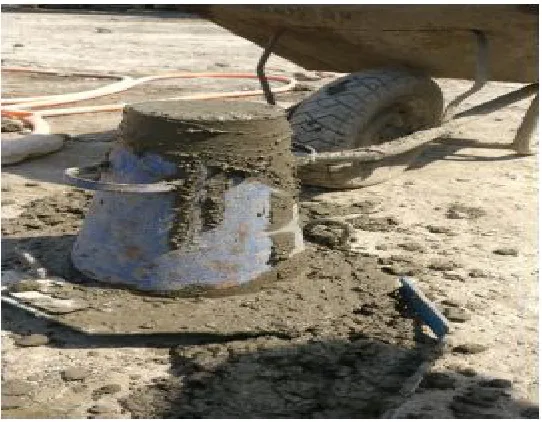
Slump cone tes
C. Procedure
1) First clean the cylinder from outside and inside.
2) keep it on smooth horizontal, rigid and uniform surface on top of the tray.
3) Remove the mould by one smooth continuous vertical motion.
4) The concrete subsides and this subsidence is called slump. Measure the slump in mm byusing a metric scale.
D. Compressive strength Test
1) Select a suitable mix design concrete to be tested.
2) The moulds are cleaned and shuttering oil is applied to the internal sides.
3) Then concrete is filled in moulds and each layer is compacted by tamping rods.
After this these moulds are kept in Curing tanks. After 28, 7, 3days strength of cubes were checked.
Fig. 1 The compression testing machine
3) Compaction Factor Test - The compaction factor test is designed basically for use in the laboratory but it can also be used on site.. It is highly precise and sensitive to the slump. This test works on the principle of determining the degree of compaction achieved by a standard amount of work done by allowing the concrete to fall through a standard height. The degree of compactor factor is measure by density ratio i.e. ratio of density actually achieved in the test to identify of same concrete fully compacted this test measure the inherent characteristics of the concrete which relates very close to the workability requirements of concrete and such it is one of the good tests to depict the workability of concrete.
a) The sample of concrete to be tested is filled in the upper hopper up to the brim. The trap door is opened so that the concrete falls in to the lower hoper then trap of the lower hopper is opened and concrete is allowed to fall into the cylinder.
b) In the case of a dry mix, it is likely that the concrete may not fall an opening the trap door.
c) In such a case, slight poking by a rod may be required to set concrete in motion.
d) The excess concrete remaining above the top level of the cylinder is then cutoff with the trowel.
e) The outside of the trowel is wiped clean. The concrete is filled up exactly up to the top level of the cylinder.
It’s weight is taken on electronic weighing machine , the weight is known as weight of partially compacted concrete, the emptied the cylinder and then refilled with the concrete from the same sample in layer. The layers are tamped by tamping rod uniformly giving 25 blows. The top surface of fully compacted concrete is then carefully and weighed, the weight is known as fully compacted concrete.
C.F = Weight of partially compacted concrete Weight of fully compacted concrete.
[image:3.612.180.451.505.716.2]IV.RESULTS & CALCULATIONS:
The admixture like fevicol when added, it tends to increase the setting time of cement by creating a thin layer between the cement particles and slowdowns the setting action of cement.
[image:4.612.165.439.142.521.2]A. Workability of Concrete.
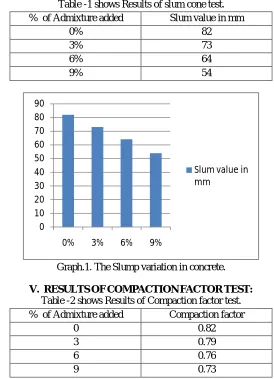
Table -1 shows Results of slum cone test.
% of Admixture added Slum value in mm
0% 82
3% 73
6% 64
9% 54
Graph.1. The Slump variation in concrete.
V. RESULTS OF COMPACTION FACTOR TEST:
Table -2 shows Results of Compaction factor test.
% of Admixture added Compaction factor
0 0.82
3 0.79
6 0.76
9 0.73
Discussions on Workability Results: All test results were compared with conventional concrete and results were tabulated in tabulated as shown in Graph.3. Based on the experimental results, as the percentage of admixtures increased, consequently both slump and compaction factor also increased.
To check the compressive strength of the concrete with and without fevicol, a standard150x150x150mmsize cubes mould were tested.. It was tested under compression testing machine (CTM) in lab.
Table -3 Shows Results of Compressive strength test.
% of Admixture added Compressive strength N/mm2
0 16.3
3 17.4
6 19.2
9 18.9
0 10 20 30 40 50 60 70 80 90
0% 3% 6% 9%
[image:4.612.171.442.620.718.2]Graph.2. the Compressive strength variation in concrete
Discussion The compressive strength of concrete is increased by 6.32 % for 3% addition of fevicol as shown in Graph.5. The compressive strength of concrete has been decreased by addition of fevicol beyond 9%. The test covers determination of compressive strength of cubic concrete specimens.
VI.CONCLUSION
A. Workability increases when the percentage of admixture was decreased.
B. Compressive strength of concrete increases when dosage of admixture is increased. Up to 9% Concrete with fevicol as admixture & there after decreases.
REFERENCES
[1] Hewlett, P. C., and Young, J. F. "Physico Chemical Interactions between Chemical Admixtures and Portland Cement,"Journal of Materials Education. [2] A. E.Abalaka, “Comparative Effects of Cassava Starch and Simple Sugar in Cement Mortar and Concrete”, ATBU Journal of Environmental Technology, 4,
(1), 2011, pp 13-22
[3] A.R.Santha Kumar,” Concrete Technology ”Oxford Higher educati
[4] HasanYildirim and BarisAltun , “ Usage of Molasses in concrete as a water reducing and retarding admixture”, Indian Journal of Engineering and Materials Sciences, 19, 2012, pp 421-426.
[5] Bazid Khan and BulentBaradan, “The Effect of Sugar on Setting –Time of Various type of Cements”, Science Vision, 8(1), 2002, pp 71-78.
[6] PiyanutMuangtong, SuvimolSujjavanich, SansaneeBoonsalee, SumatePoomiapiradee, and DuangrudeeChaysuwan , “ Effects of fine Bagasse Ash on the workability and compressive strength of mortars” Chiang Mai J. Sci. 2013, 40(1), 126-134.
[7] G.L Oyekan and O.A Oyelade, “Crushed Waste Glass as a Partial replacement of Cement in Normal Concrete Production With Sugar added as an Admixture” , Journal of Engineering and Applied Sciences , 6(6), 2011, pp 369-372.
[8] Rr. M.I. RetnoSusilorini, Prasaja Putra KresnoAdhi S, ArdyHaryono, “ Sugar Based Admixture for Promising „Green Concrete Technology‟ - Improving Concrete Beam Performance with Sugar Based Admixture 0.03% of Cement Weight”, BungaRampai
0 3 6 9
16.3 17.4 19 18.9
1 2 3 4
% of Admixture added