Image Segmentation using Modular Method
Based on Super Pixel
Chandanpreet Kaur1, Er. Jaspreet Singh Kaleka 2, Dr. Charanjit Singh 3
1,2,3
Department of Electronics and Communication, Punjabi university Patiala
Abstract: Image segmentation greatly influences and manipulates the processing and analysis of an image. Thus, to elucidate the issue of partitioning an image into homogeneous regions, this paper introduces an effective hierarchical agglomerative clustering algorithm based on modularity intensification with initial pre-processing. Motivated by the large-scale network applications of community detection algorithm, we aim to outlook an image from the aspect of a network and examine the image segmentation as a community detection problem. Considering in account an over segmented image which comprises of tiny regions, the proposed algorithm automatically merges the neighbouring tiny regions to form larger modules with larger modularity index. The final segmented image is produced when increase in modularity ceases and thus the algorithm stops combining the neighbouring regions. The histogram of states of image gradient feature is used altogether with colour feature to produce an adaptive similarity matrix which retains the reiterative patterns in homogeneous region. The proposed algorithm is tested on the publicly available Berkeley Segmentation Data Set and compared with other popular segmentation algorithms. As Compared to previous existing segmentation algorithm, proposed algorithm commence with initial denoising and segmentation techniques and gives the computation of modularity index which leads to better segmentation and improved accuracy.
Keywords: Image segmentation, modularity, community detection, superpixel, clustering.
I. INTRODUCTION
With the advent of digital technology, digital images are nowadays present everywhere due to extensive use of digital cameras and Smart phones, leading to immediate demand for the analysis of images, such as object detection, image searching, and categorization [1]. As a very essential process for these image analysis tasks, image segmentation is a pre-processing step to cluster image pixels into homogeneous regions so as to reduce the complications in further analysis.
Image segmentation can be defined as a mid-level processing technique used to classify or cluster an image into various segments. Segmentation is done by gathering the pixels to frame an area of homogeneity according to pixel attributes like gray level, texture, colour, intensity and other characteristics. Image segmentation is an important signal processing tool that is widely employed in many applications including object detection, industrial inspection, object tracking, content based image retrieval, and medical imaging. For example in medical imaging, image segmentation methods can be used for diagnosis purposes, detecting tumours, biomedical image analysis and for other treatments. In addition, image segmentation methods can be applied to traffic control systems, machine vision, and localization of objects in satellite images. The primary motive behind the segmentation process is to acquire more information in the region of interest in an image which helps in defining of the object scene. The main goal of image segmentation is to provide clear distinction between the object and the background.
Different algorithms have been introduced for image segmentation like those based on image threshold, edge based segmentation, region growing and graph partitioning techniques. Most of these techniques have some drawbacks and do not provide precise segmentation results. Among these methods, Graph based method is acquiring popularity essentially due to its capability in emulating global image properties. With the evolution of complex network theory, image segmentation methods based on graph partitioning have emerged substantially. The applications of modularity in community detection algorithm can be implemented to these graph based methods and can minimize the computational cost to some degree of extent thereby yielding fast computation. Modularity [1] is one method of computing the anatomy of complex networks or graphs. It was devised to calculate the effectiveness of partitioning a network into modules. Modularity determines the consistency or inconsistency between two clusters and results in optimum segmentation when the modularity index of the image is maximized. Modularity when maximized is frequently used for discovering community structure in networks.
results for the selected images. The proposed algorithm is qualitatively compared with some popular existing segmentation methods and thus shows improved segmentation results and preserves the regularities and reduces time complexity.
II. RELATEDWORK
The Mean Shift algorithm [2] views image segmentation as an issue of clustering by identifying the modes of the probability density function in the feature space. The mean shift algorithm is incorporated in the feature space to produce a convergence point for each pixel. All the pixels whose convergence points are closer than the spatial bandwidth h and the range bandwidth h are considered in the same segment. The method is fast but very sensitive to the bandwidth parameters h and h , and often causes over segmentation. Since it is based on the density estimation of the colour feature for all the pixels, some smooth changes in brightness and texture or the regularities of different colours converges to different modes, though they belong to the same segment visually.
Felzenszwalb and Huttenlocher [3] proposed a predicate for measuring the evidence for a boundary between two regions using a graph based representation of the image. Based on this predicate an algorithm is defined which gives segmentation results that satisfied global properties. They image is considered as an undirected weighted graph, while each pixel is regarded as a node in the graph and edge weights calculate the similarity or dissimilarity between nodes. The algorithm is fast in practice and it preserves the details in low variability image regions while ignoring the details in high variability regions.
A compression based texture merging [4] method models the image texture features using gaussian mixture model. In mid level segmentation the mixture components are assumed to degenerate or nearly degenerate. The degeneracy is introduced by employing a common feature representation for different texture features in an image. It uses the principle of minimum description length to get the optimal segmentation. The experiment shows the performance of algorithm in terms of visual evaluation and various quantitative indices for image segmentation. A texture and boundary encoding based algorithm improves the compression texture merging by using a ladder of multiple window sizes and gives more precise coding length computation. The algorithm requires more computational time.
Watershed segmentation method (MCW) depends upon the gradient of the contour of an image. The pixels where a water drop commence from would discharge to the alike local intensity minimum are in one partition, which is defined as catchment basins. The catchment basins are distinguished by the trajectories called the watersheds, namely, the boundaries. Several advanced methods are present, e.g., [5]–[8], but these methods are usually sensitive to noise and results in over-segmentation.
Modular theory and detection [9] in the domain of network science has been highly recommended in the past decade and due to their extensive utilization in large-scale networks, many researchers attempt to employ this concept in the image segmentation which includes a million of pixels. In this section, firstly an overview of these two concepts is given and then two new procedures based on modularity intensification are discussed in detail.
Modularity was initially described by M.E.J Newman [9] which is weighted network analysis. Assuming a weighted network G having the weighted adjacency matrix A, the modularity index Q is given by:
Q= ∑,[ , − ] ( ) (1)
where A signifies the weight between node i and node j; m= ∑ A shows the total weight of the network; k = ∑ A is the
weighted measure of node i;c is the community label in which node i resides; δ c , c is 1 if node i and node j belongs to same community label, else it is 0. Assuming that the two nodes are randomly connected modularity index calculates the difference between the true probability of the connected two nodes belonging to same community label and the estimated probability.
Community Detection algorithms intend to discover the division of the network in a way that every division illustrates a specific property of a community. Concept of modularity index is widespread employed in analysing the behaviour of community detection algorithms. Louvain method [10] is an example of community detection based upon the modular increase to find the communities. The modular increase by integrating community j into community i can be calculated by Equation (2):
∆ = [∑ , − ∑ ]-[∑ −(∑ ) −( ) ]|
= ( , −
∑
) (2)
where ∑ is the sum total of weights of edges residing in community I and ∑ is the total weights of the edges incident to nodes in community i; k, is the summation of the weights from community j to community i; other notations are the same as explained
The Louvain method uses the concept of iteratively repeating the procedure of modularity index in phase 1 and community agglomeration in phase 2 as explained below:
A. Phase 1: Modularity Optimization
Initially, the network consists of various communities (at the beginning each community is considered as one node, after a number of iterations, each community is regarded as cluster of nodes). For each community i and the node connected N = j|A > 0, evaluate the possible increase in modularity index ∆Q , if we integrate community i into community j into community i, in accordance to equation (2).Calculate the maximum increase in modularity index that occurred due to integration of community i into community j and combine these two communities. The process is repeated iteratively until there is no further increase in modularity index for all communities in the network.
B. Phase 2: Community Aggregation
To re-establish the network, integrate the communities with the same label and then label them again; the communities with the similar label are considered as one node in the network and the weighted adjacency matrix is recalculated by summation of all the weights that joins two communities.
The above processes including phase 1 and phase 2 are repeated iteratively until there is no increase in modularity due to merging of any two communities. Inspired by the limitations of previous methods the proposed method considers following points into account: 1) time complexity 2) preserving the regularities and 3) preventing over-segmentation. Motivated by the uses of community detection algorithms in large networks, we tend to outlook an image from the aspect of a network. For a network, modularity [9] is an important element, which is used to evaluate the behaviour of numerous community detection algorithms. Moreover, larger the modularity of a network, the more precise the discovered communities are. Taking into account the effective computation of modularity in the community detection algorithm, likewise, we treat image segmentation problem as a community detection problem, and the optimum segmentation is accomplished when the modularity index of the image is maximized.
Though the concept of modularity index has been used in some image segmentation applications by some researchers recently, e.g., [11], [12], it still confronts problems like previously mentioned segmentation algorithms, due to the ignorance of the inherent properties of image. Different from the prevailing algorithms using modularity concept, we differentiate between community detection and image segmentation. Starting from ‘superpixels’, we introduce a new consistency feature to preserve regularities for the visually coherent object and encode it into the similarity matrix; further, the homogeneity between regions of pixels is established in an adaptive fashion so as to avoid problem of over-segmentation. Compared with other prevailing segmentation algorithms, our proposed algorithm can automatically recognize the count of regions/segments present in an image, produces sizable regions with preserved regularities, and accomplish better segmentation results to some extent.
III.THEPROPOSEDALGORITHM
preserves boundary features. This further reduces the complexity of algorithm by denoising the image initially as it preserves the important features and suppress the noise from image.
Fig.1. Illustration of Louvain Method: single iteration includes the process of modularity optimization followed by the community aggregation.
The hierarchical agglomerative algorithm can then start the integration process by considering each pixel as a community; however, it will be a complex procedure as it is time consuming, especially for the first Louvain iteration as shown in Figure1. As a single pixel contains no texture feature so we initiate the process with ‘superpixels’. Superpixel is an array of tiny homogeneous regions of pixels. Beginning with superpixels can considerably reduce the time complexity without altering the segmentation process. Therefore, pre-processing step is used in order to over-segment the image into a group of superpixels. This pre-processing step can be carried out by simple K-Means clustering algorithm (K is usually set to a larger value, e.g., 200 or more) or other superpixels producing algorithms. In our algorithm, we employ a publicly accessible code [13] to initialize with superpixel.
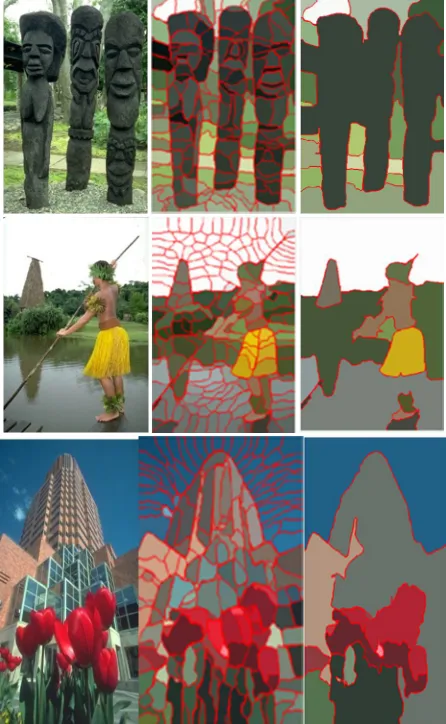
As is shown in Figure 2, the middle image shows the superpixel image with more than 200 over-segmented regions. This superpixel process can considerably scale down the complexity to take into account about 200 nodes in the first iteration of the proposed algorithm. The right image in Figure 2 shows the segmented output given by our algorithm, where approximately 10 homogeneous regions with similar regular structure inside are left. This factor illustrates that the segmentation results are certainly the outcome of our proposed algorithm instead of superpixel generation algorithm.
In the conventional Louvain method [1] for community detection, a homogeneous similarity matrix is employed to upgrade the new similarity matrix by the summation over the weights of nodes in two different clusters during iteration. In our algorithm, we establish an adaptive similarity matrix in the following manner: By taking into account two features color and texture which are essential to uniform distribution we simply utilize the Gaussian radius basis function in equation (3):
W (color) = exp ( , ) , (3)
where dist (R , R) evaluates the distance between the pixel distributions for the regions R and R. In our algorithm we make use of mean distance and value of σ is set to 0.08.
For the Histogram of States (HoS) texture feature, regions R and R are demonstrated by a 256 dimensional vector, which means HoS texture vector h , hϵ R . We employ the cosine similarity measure to calculate the consistency between the regions, as shown in equation (4):
W (texture) = cos h , h =‖ ‖
•‖ ‖ (4) For computingW , several segmentation methods are present but here traditional hybrid model is used which incorporate both color
and HoS feature in form of equation (5):
W = a⨯ W (texture)⨯W (color) + (1−a)⨯W (color), (5)
[image:6.612.195.418.228.590.2]where a is the balancing constant. If value of a is zero it means the image has more precise and specified boundaries. However, if the value of a is large, the boundaries are not defined as the background and object regions get merged.
Fig. 4. Image segmentation results with the various similarity matrices.
Color is the most important attribute for segmentation, so we employ the pixel value in the L*a*b color space as one of the important features for calculating the similarity. However, the color feature alone cannot contribute to good segmentation results, as it does not take into account the repetitive sequence of various colors in homogeneous object. To elucidate the problem, we not only use the color feature, but also a novel texture attribute is proposed in order to preserve the regularities in an image. Inspired by the Histogram of oriented gradients [14 ]for community detection a new texture feature Histogram Of states is introduced for each region.
that with homogeneous consistency matrix, the images are segmented into homogeneous regions, but it results in over-segmentation. Therefore, our proposed adaptive similarity matrix based segmentation achieves better segmentation output results, visually.
IV.THEEXPERIMENTALEVALUATION
The efficiency of the segmentation results is determined from two quality measures as explained below:
The first measure is Probabilistic Rand Index (PRI) [36] which determines the probability of pair of samples which have similar labels in the two segmentations. The range of PRI is within [0,1], where larger the value, better is segmentation indicating better consistency.
The second quality metric is Variation Of Information (VOI) which shows the information about one segmentation from another given segmentation. Smaller the value of VOI better is the consistency between two segmentations. It is defined as:
VOI(C, C ) = H(C) + H(C )−2I(C, C ) (6) where H(C) and H(C ) describe the entropy of segmentation C and C and I(C, C ) is the combined information of both segmentations C and C . The range of VOI is [0;+∞).
The performance is further evaluated in means of boundary level by two parameters: Precision and Recall. Let testing segmentation be represented by C and ground-truth segmentation be represented by C , Precision finds the detected boundary level pixels that equals with the ground-truth values and is given as:
Precision =| |∩ (7)
where |C| shows the number of pixels present in the segmentation area C. Similarly Recall is defined as measure of detected ground-truth boundary pixel values. To outline these two metrics, F evaluates the performance of segmentation. It is the harmonic mean of
the two metrics Precision and Recall. For evaluation α is set to 0.5.
F = .
( ). . (8)
The result illustrates better segmentation in terms of accuracy. Table I lists the values of PRI and VOI values with the proposed algorithm and Table II lists precision and recall values. We also calculated global consistency error (GCE) which finds the range to which segmentation can be estimated as refinement of the other one. When same image is segmented at various scales, the segmentations are regarded as consistent. The range of GCE is [0,1]. The lower the value of consistency error, the better is the segmentation.
The proposed algorithm gives larger PRI value of 0.8119 and smaller VOI value of 0.7765. We further calculated GCE error which is 0.1440.These parameters shows better results than with the previous method. It is observed that our proposed algorithm gives higher precision with a value of 0.785, which shows that most of our generated boundaries match the ground-truth segmentation. The result also shows the highest recall value as compared with previous algorithm which further leads to a high F . measure
compared to previous method.
TABLEI
REGIONLEVELCOMPARISONONBSDS
Algorithm PRI (larger better) VOI (smaller better) GCE (smaller better)
Proposed 0.8119 0.7765 0.1440
MBS[1] 0.7881 0.8953 0.1643
TABLEII
BOUNDARYLEVELCOMPARISONONBSDS
Algorithm Precision Recall .
Proposed 0.785 1 0.879
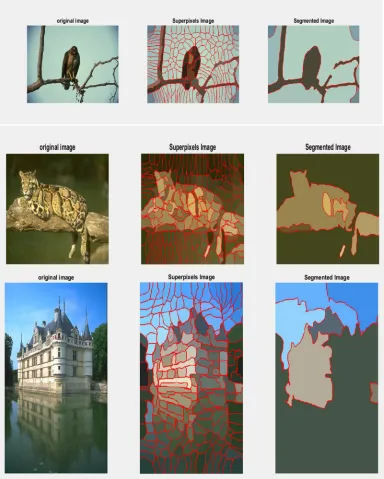
Fig. 5 Image segmentation results of our proposed algorithm
V. CONCLUSION
precision, removes the noise sensitivity issues in the initial phase and also reduces time complexity as the proposed algorithm is fast in terms of execution time which is approximately half as that of previous algorithm thus indicating enhanced accuracy.
VI.ACKNOWLEDGMENT
I wish to extend my sincere gratitude to my research guide, Er. Jaspreet Singh Kaleka for his valuable guidance and encouragement. I am grateful to my friends for their appreciation and support. I would like to thank my parents for their kind support in uplifting my career.
REFERENCES
[1] Li, Shijie, and Dapeng Oliver Wu. "Modularity-based image segmentation." IEEE Transactions on Circuits and Systems for Video Technology 25, no. 4
(2015): 570-581.
[2] Comaniciu, Dorin, and Peter Meer. "Mean shift: A robust approach toward feature space analysis." IEEE Transactions on pattern analysis and machine
intelligence 24, no. 5 (2002): 603-619.
[3] Felzenszwalb, Pedro F., and Daniel P. Huttenlocher. "Efficient graph-based image segmentation." International journal of computer vision 59, no. 2 (2004):
167-181.
[4] Yang, Allen Y., John Wright, Yi Ma, and S. Shankar Sastry. "Unsupervised segmentation of natural images via lossy data compression." Computer Vision and
Image Understanding 110, no. 2 (2008): 212-225.
[5] Vincent, Luc, and Pierre Soille. "Watersheds in digital spaces: an efficient algorithm based on immersion simulations." IEEE Transactions on Pattern Analysis
& Machine Intelligence 6 (1991): 583-598.
[6] Grau, Vicente, A. U. J. Mewes, M. Alcaniz, Ron Kikinis, and Simon K. Warfield. "Improved watershed transform for medical image segmentation using prior
information." IEEE transactions on medical imaging 23, no. 4 (2004): 447-458.
[7] Tai, Xue-Cheng, Erlend Hodneland, Joachim Weickert, Nickolay V. Bukoreshtliev, Arvid Lundervold, and Hans-Hermann Gerdes. "Level set methods for
watershed image segmentation." In International Conference on Scale Space and Variational Methods in Computer Vision, pp. 178-190. Springer, Berlin, Heidelberg, 2007.
[8] Osma-Ruiz, Víctor, Juan I. Godino-Llorente, Nicolás Sáenz-Lechón, and Pedro Gómez-Vilda. "An improved watershed algorithm based on efficient
computation of shortest paths." Pattern Recognition 40, no. 3 (2007): 1078-1090.
[9] Newman, Mark EJ. "Analysis of weighted networks." Physical review E 70, no. 5 (2004): 056131.
[10] Blondel, Vincent D., Jean-Loup Guillaume, Renaud Lambiotte, and Etienne Lefebvre. "Fast unfolding of communities in large networks." Journal of statistical
mechanics: theory and experiment 2008, no. 10 (2008): P10008.
[11] Li, Wenye. "Modularity segmentation." In International Conference on Neural Information Processing, pp. 100-107. Springer, Berlin, Heidelberg, 2013.
[12] Browet, Arnaud, Pierre-Antoine Absil, and Paul Van Dooren. "Community Detection for Hierarchical Image Segmentation." In IWCIA, vol. 11, pp. 358-371.
2011.
[13] Mori, Greg. "Guiding model search using segmentation." In Computer Vision, 2005. ICCV 2005. Tenth IEEE International Conference on, vol. 2, pp.
1417-1423. IEEE, 2005.
[14] Dalal, Navneet, and Bill Triggs. "Histograms of oriented gradients for human detection." In Computer Vision and Pattern Recognition, 2005. CVPR 2005.