Technology (IJRASET)
An intelligent system for effective fire detection in video:
An image processing approach
Saurabh Shrivastava1, Prof. Shivam Khare2, Prof. Richa Shrivastava3
1
M Tech Scholar, EC Department, VITS, Jabalpur
Abstract: In this paper, we propose a real-time fire-detector that combines foreground object information with color pixel statistics of fire. Simple adaptive background model of the scene is generated by using three Gaussian distributions, where each distribution corresponds to the pixel statistics in the respective color channel. The foreground information is extracted by using adaptive background subtraction algorithm, and then verified by the statistical fire color model to determine whether the detected foreground object is a fire candidate or not. A generic fire color model is constructed by statistical analysis of the sample images containing fire pixels. The first contribution of the paper is the application of real-time adaptive background subtraction method that aids the segmentation of the fire candidate pixels from the background. The second contribution is the use of a generic statistical model for refined fire-pixel classification. The two processes are combined to form the fire detection system and applied for the detection of fire in the consecutive frames of video sequences.
Keywords: Fire detection, image processing, video processing, color modeling, motion detection, image segmentation.
I. INTRODUCTION
Fire detection systems are among the most important components in surveillance systems used to monitor buildings and the environment. Currently, almost all fire detection systems use built-in sensors that depend primarily on the reliability and the positional distribution of the sensors. It is essential that these sensors are distributed densely for a high precision fire detection system. In a sensor-based fire detection system for an outdoor environment, coverage of large areas is impractical due to the necessity of a regular distribution of sensors in close proximity. Due to rapid developments in digital camera technology and video processing techniques, there is a major trend to replace conventional fire detection methods with computer vision based systems. Developments in content based video processing, more and more vision based fire detection systems are introduced. Vision based systems generally make use of three characteristic features of fire: colour, motion and geometry. The colour information is used as a pre-processing step in the detection of possible fire.
II. A BRIEF REVIEV OF THE WORK ALREADY DONE IN THE FIELD
Technology (IJRASET)
interest for the fire pixels. Therefore, triangular regions in respective r-g, r-b, and g-b planes are used to classify a pixel.
A pixel is declared to be a fire pixel if it falls into three of the triangular regions in r-g, Rb, and g-b planes. The low-cost CCD cameras to detect fires in the cargo bay of long range passenger aircraft. This method uses statistical features based on grayscale video frames, which include mean pixel intensity, standard deviation, and second-order moments as well as non-image features, such as humidity and temperature to detect fire in the cargo compartment. The system is commercially used in parallel with standard smoke detectors to reduce the number of false alarms caused by the smoke detectors, and it also provides visual inspection capability which helps the aircraft crew confirm the presence or absence of fire. However, the statistical image features are not considered to be used as part of a standalone fire detection system.
Recently, proposed a generic model for fire colour [1-2]. The authors combined their model with simple moving object detection. The objects are identified by the background subtraction technique. Later on they have proposed a fuzzy logic enhanced approach which uses predominantly luminance information to replace the existing heuristic rules which are used in detection of fire-pixels. YCbCr colour space is used rather than other colour spaces because of its ability to distinguish luminance from chrominance information. The implicit fuzziness or uncertainties in the rules obtained from repeated experiments and the impreciseness of the output decision is encoded in a fuzzy representation that is expressed in linguistic terms. The single output decision quantity is used to give a better likelihood. The fuzzy model achieves better discrimination between fire and fire like-coloured objects. Since the colour based pre-processing is essential part for all image processing based fire detection systems, an efficient colour model is needed. The fuzzy logic technique is now applied to detect fire pixels.
III. APPROCHES FOR FIRE DETECTION THROUGH IMAGE PROCESSING
In most of the image-processing applications, a classical technique used to find the similarity between a pair of images to evaluate fire pixel between the images. In order to detect possible changes, which may be caused from fire, we need to use an effective background modeling algorithm. The algorithm should be simple and robust to achieve a real-time detection of the fire. The background modeling used in our system is similar to the work done in [25] where the scene observed is almost stationary and the camera’s position is fixed. The background is modeled with covariance matrix extracted from incoming image where incoming image is composed of Luminance Chroma-Blue and ChromaRed (YUV) components. In our system, incoming image is composed of Red, Green, and Blue (RGB) components.
IV. PROPOSED METHODOLOGY
A. Fire Detection Algorithm
This section covers the details of the fire detection algorithm. Figure 1 shows the flow chart of the proposed algorithm for fire detection.
Technology (IJRASET)
It is assumed that the image acquisition device produces its output in RGB format. The algorithm consists of three main stages: Fire pixel detection using colour information Detecting moving pixels Analyzing dynamics of moving fire pixels in consecutive frames.
1) RGB to CIE L*a*b*(YUB) Colour Space Conversion: The first stage in our algorithm is the conversion from RGB to Luminance Chroma-Blue and ChromaRed (YUV) colour space. Most of the existing CCTV video cameras provide output in
RGB colour space, but there are alsoother colour spaces used for data output representation. The conversion from any colour
space representation to YUB colour space is straightforward. Given RGB data, the conversion to YUB colour space is formulated as follows:
Where Xn, Yn, and Zn are the tri-stimulus values of the reference colour white. The data range of RGB colour channels is between 0 and 255 for 8-bit data representation. Meanwhile, the data ranges of L*, a*, and b* components are [0, 100], [–110, 110], and [–110, 110], respectively.
B. Colour Modeling for Fire Detection
[image:4.612.168.443.480.567.2]A fire in an image can be described by using its visual properties. These visual properties can be expressed using simple mathematical formulations. In Fig. 2, we show sample images which contain fire and their YUB colour channels (L*, a*, b*).
FIG 2. Sample RGB images containing fire and their CIE L*a*b (YUB) colour channels
RGB image L* colour channel A* colour channel B*colour channel
For visualization purposes, responses in different colour channels are normalized into interval [0, 1]. Figure 2 gives some clues about the way CIE L*a*b* colour channel values characterize fire pixels. Using such visual properties, we develop rules to detect fire using CIE L*a*b* colour space.
Technology (IJRASET)
where *Lm , *ma , and * mb are a collection of average values of the L*, a*, and b* colour channels, respectively; N is the total number of pixels in the image; and (x, y) is spatial pixel location in an imaging grid. The numeric colour responses L*, a*, and b* are normalized to [0, 1]. It is assumed that the fire in an image has the brightest image region and is near to the colour red. Thus, the
following rules can be used to define a fire pixel:
Where R1, R2, R3, and R4 are binary images which represent the existence of fire in a spatial pixel location (x, y) by 1 and the non-existence of fire by 0. R1(x, y), R2(x, y), and R3(x, y) are calculated from global properties of the input image. R4(x, y) represents the colour information of fire; for example, fire has a reddish colour. Figure 3 shows sample images from Fig. 2(a), and binary images created using (3)-(6). Figure 3(f) shows a combination of these binary images with the binary AND operator. Figure 3(g) displays the segmented fire image.
FIG-3 APPLYING (3)-(6) TO INPUT IMAGES Original RGB image
Binary image using eq(3) Binary image using eq(4) Binary image using eq(5) Binary image using eq(6)
Combining results of (b)-(e) by binary operator Segmented fire region
In order to find the correlation between L*, a*, and b* values of fire pixels, the following strategy was applied. A set of 500 RGB images was collected from the Internet. Then, each image was manually segmented to identify all fire regions. Segmented fire regions are converted to L*, a*, and b* colour space. A histogram of fire pixels is created for each of the 3 different colour planes, that is, (L*-a*), (L*-b*), and (a*-b*).
Technology (IJRASET)
FIG-4 Distribution of labeled fire pixels in fire images (L*,a*) colour channels
(L*,b*) colour channels (a*,b*) colour channels
The number of quantization levels can be changed, but through experimentation, 24 levels were found to give satisfactory results. A look-up table is created for each pair of 24 quantized levels to keep track of the likelihood that any pair of L*, a*, and b* belongs to a fire. It is clear from Figs. 4(a), 4(b), and 4(c) that a fire can be defined by the combination of three histograms. Given the L*, a*, and b* colour values at spatial location (x, y), the likelihood that L*, a*, and b* belong to a fire P(L*, a*, b*) is defined as
P(L*,a*,b* )= P(L*,a* )P(L*,b* )P(a*,b* ), (7) where P(L*, a*), P(L*, b*), and P(a*, b*) are the likelihoods that (L*, a*), (L*,
b*), and (a*, b*) belong to a fire, respectively.
The likelihood of being fire as defined by (7) can be used to detect a fire pixel by using simple thresholding:
where α is a threshold value. Figure 5 shows input RGB images, corresponding likelihood images P(L*, a*, b*) resulted from (7), and corresponding R5 images resulted from (8) for α = 0.005.
FIG-5 Calculating P(L*,a*,b*) and thresholding it with α=0.005
(a) RGB input image which contains fire
(b)Corresponding likelihood image P(L*,a*,b*) computed according to eq (7) (c) Threshold according to P(L*,a*,b*) computed according to eq(8)
Technology (IJRASET)
the number of correct detections and false detections are calculated for the whole image set. The correct detection is defined as any pixel detected as a fire pixel using (8) which is also manually labeled as a fire pixel in the original image. Similarly, false detection is defined as any pixel detected as a fire pixel using (8) but is not in the manually labeled fire regions. For each value of α, the average rate of correct detection and false detection is evaluated on a training image set and used in the ROC curve. Figure 6 shows the ROC curve.
FIG-6 ROC curve for variable α ranging in [0, 0.01]
Using the ROC curve, a threshold value for α can be easily selected for the fire detection algorithm with a predefined correct detection versus false detection rates. Different values of α result in different system performances. In our implementation, we chose
α as the value which gives more than a 90% correct detection rate. The very first value of α which satisfies this condition is α = 0.00016. However, it also produces a 36.5% false detection rate as shown in Fig. 6. The smaller value of α makes the algorithm produce a higher correct detection rate but also produces a higher false detection rate, and vice versa. The value of α can be changed at any time to adjust for higher correct detection or lower false detection rates. Using (3)-(6) and (8), a final fire pixel detection equation can be defined as
where F(x, y) is the final decision on whether a pixel located at spatial location (x, y) results from fire or not. Equation (9) means that if inequalities defined in (3)-(6) and (8) give one as their output for spatial location (x, y), then there is a fire in that spatial location. Figure 7 shows the performance of fire segmentation using (9) on sample RGB images.
Figure 7(a) is the original image, Fig. 7(b) is the result of applying (9), and Fig. 7(c) is the segmented image using binary map in Fig. 7(b). It is clear that the proposed fire colour model can adequately detect fire pixels under different conditions. For instance, the illumination shows high diversity in between input images (see Fig. 7(a)), and the proposed fire colour model can still detect fire regions.
C. Combining Colour And Background Subtraction Technique
It is observed that the motion of flames in consecutive frames should show a deviation in shape, which is mainly caused from the burning material or the wind in the
Technology (IJRASET)
size and motion of fire in the consecutive frames. Because of the fire-like colour of the sun, sometimes it is likely to detect the reddish colour in horizon as fire or other kind of effects may produce such affect. The case mentioned is compensated using background subtraction procedure, which mainly subtracts background from foreground changes and adapts the background model with time, so that fire-like colours will be removed.
The background subtraction process is the final step in our algorithm. The changes detected by the background subtraction stage are supplied to colour verification process. Pixels that are detected by the algorithm as foreground object, and have a fire-like colour classified by the rules defined are grouped into blobs with respect to their spatial connectivity. A time analysis of each fire-like blob is considered, and if it grows in size or changes its center location, then each fire blob is considered as a fire candidate.
The algorithm of the proposed fire detection is summarized in fig 8.
FIG-8 Proposed fire detection algorithm flowchart
Technology (IJRASET)
where wb and hb are width and height of corresponding blob respectively, and wg and hg are width and height of guard area.
V. RESULTS AND DISCUSSIONS
A. Input And Output Images
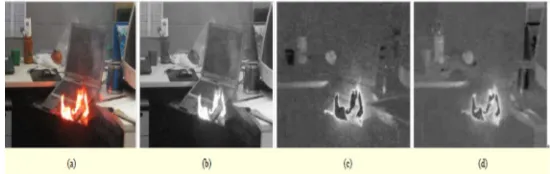
Fig 10 shows the step-by-step visualization of the algorithm. In the first row, background is shown with its binary maps of change detection map (column (b)), fire colour detection map (column (c)), and detected fire map respectively (column (d)). The second row shows that there is a foreground object but no fire. The third row and rest of the rows show that there is a foreground object, which is fire.
FIG-10 Experimental results Input image
Change map
Fire filtered binary map of input image Detected fire image
B. Overall Detection
Technology (IJRASET)
rate and false alarm rate. This is due to the ability of YCbCr colour space to separate luminance from chrominance. This provides a way to express the output decision in linguistic terms. As a result, the most needed discrimination between fire and fire-like regions is enhanced. This fire detection is done on the basis of the of original RGB images. By using image processing fire, smoke and its intensity, magnitude and location can be detected.
VI. CONCLUSION AND FUTURE SCOPE
A. Conclusion
The objective of my thesis is to detect fire by replacing fire sensors, for this we have developed a real-time fire-detector, which combines colour information with registered background scene. Since the colour based pre-processing is essential part for all image processing based fire and smoke detection systems, an efficient colour model is used to give a better likelihood that a pixel is a fire pixel. The background modeling used in our system is similar to the work done in others where the scene observed is almost stationary and the camera’s position is fixed. The background is modeled with covariance matrix extracted from incoming image where incoming image is composed of Luminance Chroma-Blue and ChromaRed (YUV) components. In our system, incoming image is composed of Red, Green, and Blue (RGB) components.
Colour information of fire is determined by the statistical measurement of the sample images containing fire. Simple adaptive background information of the scene is used to model the pixel values of the coloured information in each colour channel. The foreground objects detected are combined with colour statistics and output is analyzed in consecutive frames for fire detection. After simulation the objective of our thesis is achieved. The correct detection rate for our algorithm is 99.89%. The system detects the fire as soon as it is started, except in the explosive conditions, in which generally smoke is seen before the fire is started.
B. Future Scope
The proposed algorithm can be extended to incorporate the smoke in the video sequences, which may be used as faster fire alarm detection in such special conditions.The performance of the proposed fire detection system can be further improved by considering smoke at early stages of fire. However, detecting smoke is a challenging task and prone to high false detections caused from fog, different lighting conditions caused by nature, and other external optical effects. Such high false detections can be resolved by analyzing every smoke-like region. However, this yields a high computational load. In order to alleviate such cases, the proposed system will be further improved to include different scenarios. Furthermore, texture and shape information of fire regions will also be investigated to improve the system’s fire detection performance
REFERENCES
[1] Celik, T., Demirel, H., Ozkaramanli, H., Uyguroglu, M., “Fire Detection in Video Sequences Using Statistical Colour Model”, Proc. Internat. Conf. on Acoustics, Speech, and Signal Processing, vol. 2, no. pp. II-213 - II-216, May 2006.
[2] Chen, T., Wu, P., Chiou, Y., “An early fire-detection method based on image processing”, Proc. IEEE Conf. on Image Processing, ICIP04, pp. 1707-1710, 2004.
[3] C. Liu and N Ahuja. “Vision Based Fire Detection”. Proc. of Int. Conference, pp. 1707-1711. on Pattern Recognition, 2004.
[4] Cristiana Jacques Moissan, Adolfo Bauchspiess, “Fuzzy Inference System Applied to Edge Detection in Digital Images”, in the proceedings of the V Brazilian Conference on Neural Networks pp. 481–486, April , 2001
[5] Dong-Su Kim, Wang-Heon Lee , In-So Kweon, “Automatic edge detection using 3x3 ideal binary pixel patterns and fuzzy-based edge thresholding,” in Pattern Recognition pp.365-385 , June, 2004.
[6] E. Pearson and K. Fu., “Shape Discrimination Using Fourier Descriptors”. IEEE [7] Transactions on Systems, Man and Cybernetics,7(3):170-179, March 1977.
[8] G. Healey, D. Slater, T. Lin, B. Dram, A.D. Goedeke, “A system for real-time fire detection. in: Computer Vision and Pattern Recognition”, 1993, Proceedings CVPR ’93, 1993 IEEE Computer Society Conference, 15–17 , pp. 605–606 June 1993.
[9] Haritaoglu, D. Harwood, L.S. Davis, W4: real-time surveillance of people and their activities, Pattern analysis and machine intelligence, IEEE Transactions on Pattern Analysis and Machine Intelligence 22 809–830 June 2000.
[10] Kosmas Dimitropoulos a, Kvanc Köseb, Nikos Grammalidisa, and Enis Cetinb.“Fire Detection and 3D Fire Propagation Estimation for the Protection of Cultural Heritage Areas” International Archives of the Photogrammetric, Remote Sensing and Spatial Information Science, Volume XXXVIII, Part 8, Kyoto Japan 2010.
Technology (IJRASET)
[14] M.-H. Yang and N. Ahuja. “Gaussian Mixture Model for Human Skin Colour and its Application in Image and Video Databases”. In Conference on Storage and Retrieval for Image and Video Databases (SPIE 99), volume 3656, pages 458-466, 1999.
[15] O.A. Plumb, R.F. Richard, “Development of an Economical Video Based Fire Detection and Location System”. US Department of Commerce, Technology Administration, National Institute of Standards and Technology, 1996.
[16] Phillips III, W., Shah, M., Lobo, N.V, “Flame recognition in video”, Pattern Recognition Letter. 23 (1–3), 319–327, 2002.
[17] R. T. Collins, A. J. Lipton, and T. Kanade, “A system for video surveillance and monitoring,” in 8th Int. Topical Meeting on Robotics and Remote Systems. , American Nuclear Society,1999
[18] Shashank Mathur, Anil Ahlawat, “Application Of Fuzzy Logic In Image Detection”, International Conference Intelligent Information and Engineering Systems INFOS 2008, Varna, Bulgaria, June-July 2008.
[19] S.Y. Foo, “A rule-based machine vision system for fire detection in aircraft dry bays and engine compartments”, Knowledge-Based Systems 531–541, Sep 1995.
[20] T. Celik et al., “Fire Detection Using Statistical Color Model in Video Sequences,” J. Visual C.Image Representation, vol.18, no.2, pp. 176-185, April 2007. [21] T. Celik, H. Demirel, and H. Ozkaramanli, “Automatic Fire Detection in Video Sequences,” Proc. European Signal Process.Conf. Florence, Italy, Sept. 2006. [22] Toreyin, B.U., Dedeoglu, Y., Cetin, A.E., “Contour based smoke detection in video
[23] using wavelets”, European Signal Processing Conference, EUSIPCO-06, Sept. 2006.
[24] Turgay Celik, Hüseyin Ozkaramanli, Hassan Demirel, “Fire Pixel Classification Using Fuzzy Logic and Statistical Colour Model”, ICASSP 2007.
[25] T. Celik, H. Demirel, and H. Ozkaramanli, “Automatic Fire Detection in Video Sequences,” Proc. European Signal Process.Conf. Florence, Italy, Sept. 2006. [26] W. Krill et al., “Design and Test Methods for a Video-Based Cargo Fire Verification
[27] System for Commercial Aircraft,” Fire Safety J., vol. 41, no. 4, pp. 290-300 2006.
[28] Water Philips III, Mubarak Shah, Niels da Vitoria Lobo, “Flame recognition in video, Pattern Recognition” Letters 23 319–327,2002.
[29] Yinghua Li, Bangui Liu, and Bin Zhou, “The Application Of Image Edge Detection by using Fuzzy Technique”, in Conference Electronic Imaging and Multimedia Technology, November 2004